First heard about this on QI. I stopped watching it after Stephen Fry stopped presenting it, and then watching old episodes didn't feel right anymore after Sean Lock's passing...
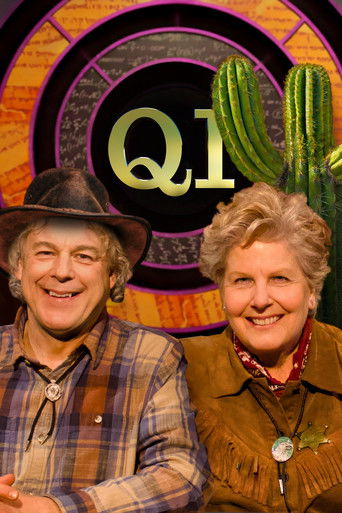
This is probably my biggest pet peeve in all of pop-science. It often feels like the _vast_ majority of pop-science explanations fall into this category of non-explanation. Watching popular TV shows (say, QI in the UK) about scientific or knowledge based topics can be a real drag if you're actually a highly curious person.
"comparatively, very few episodes. Especially places like the UK"
OK - Fawlty Towers: 12 episodes. Now, look up the Two Ronnies, Morecambe and Wise, Victoria Wood, Absolutely Fabulous, French and Saunders, Lenny Henry, Monty Python's Flying Circus, Ben Elton, The Fast Show, ... oh and I'm watching Dawn French doing current stand up right now. Jo Brand, ... oh this is getting boring and I've missed out loads. That's just a few comedians.
We have a few soaps that have stood the test of time too and a few current affairs programmes that have been around for a while: Coronation Street, East Enders, Have I got News for you, QI, The Archers, Panorama.
The BBC alone has been running for quite a while and I'll finish with an honourable mention for Blue Peter.
I haven't really refuted your argument but then that was pretty arse to start with. Gave me an excuse to reminisce for a while 8)
Uk is going through a comedy golden age last decades. I attribute it to bbc doing an excellent job giving chances to younger comedians on gameshows like mock the week, qi, 9 out of 10 cats, im sorry i havent a clue etc... as well as the prominence of edinburgh fringe
I think this sort of talent development really is just about giving chances to new folks, its the risk averse large networks only re-hiring the same older folks that stifles an artistic sector, be it movies, shows, music, games, comedy etc
Edit: I watched a documentary on the making of QI - a British TV quiz where the questions or answers are supposed to be "Quite Interesting". And the commentator pointed out that they have changed the sort of facts they bring into the show - in the early years it was all "you might think X but really it's Y". But there are a limited number of "common misapprehensions", and the show has / will exhaust them. So now they focus on Quite Interesting things that you did not know before.
I tend to think of HN as the process the QI team goes through - lots of discussion, a few interesting things I did not know before and very rarely something that will chnage my view on a subject. It's just that can only happen so often.
So yeah, most internet comments are bad. And even on HN which has a high signal to noise ratio, the overall noise is still pretty loud. But so far it's helping me.
As the film says, it'll do till it dies or I find something better.
"An article in the British Medical Journal about European tortures describes a method of tickle torture in which a goat was compelled to lick the victim's feet because they had been dipped in salt water. Once the goat had licked the salt off, the victim's feet would be dipped in the salt water again and the process would repeat itself.[...] However, it remains unclear if this method was ever used in practice as it is only described in the 1502 Tractatus de indiciis et tortura by the Italian jurist and monk Franciscus Brunus de San Severino – a treatise that actually cautioned against torture in general – and while it seems clear that Franciscus Brunus had not made up this practice, the issue is left open whether the inclusion in the treatise is based on hearsay, (reliable) eye-witness accounts, or personal experience.[...] This uncertainty does not preclude this anecdote from being repeated in popular culture, for instance during a 2013 episode of the British satirical quiz show QI.[...]"
Probably the least understood: Pants. There is a line from a Doctor Who episode, "My house full of soldiers and I'm in my pants." That joke doesn't make sense in America.
I was watching QI a couple years ago. One of the guests was a Canadian actor who had been working in the UK for years and still she still had not realized the different uses of the word.
Probably the recordings were made more than 3 years ago, but I was laughing my ass off at episodes of the British show QI hosted by Stephen Fry. I saw it on BritBox but it's available from several sources.
I remembered hearing that on QI, which was enough to turn up this[0]:
> "The panel are shown a photo of a man and are asked how his bare bottom helped Britain win World War One. The man is William Lawrence Bragg, a physicist and the youngest ever Nobel laureate. In 1915, he was in Flanders trying to figure out a way of using sound to locate enemy artillery. One day, he was sitting on the latrine in the house where he was billeted, and noticed that when there was nearby gunfire his backside momentarily lifted off the seat, even if he didn't hear the explosion. Another physicist he was working with, William Tucker, was billeted in a tar paper hut, and noticed by his cot that there some little holes, and even on windless days little puffs of air were blowing through. The two compared notes, and concluded it was due to inaudible, low-frequency sounds of artillery. They thus began to build detectors, and by 1917 the Allies had really devastating advantage when locating and targeting enemy guns."
Unfortunately, I think it's probably made up; I couldn't find a solid source for the story, which seems unlikely if it were true (given that it's a great story, Bragg was decently well known at the time, and 1915 is fairly recent [by "sources disappearing in the sands of time" standards, at least])
Edit: although I suppose the story would've been highly classified for years, so maybe it's plausible that there would be no solid sources.
You have to be careful with taking something from QI and believing it too much. They often stretch the truth, simplify connections, and obfuscate etymology.
I've been using visuospatial techniques like the method of loci (i.e. memory palaces, but I don't call them that) to enhance my memory for about 10 years - here are a few reasons why I think this particular solution won't really improve your memory, at least compared with normal diagramming/outlining techniques.
1. How you navigate through the environment matters. A lot. Let me use an example to try to illustrate how navigation plays a role in the method of loci. You're tasked with remembering how to solve a maze you must walk through. Consider how your brain ultimately end up encoding the solution. The brain only retains information that's (likely) relevant to solving some problem it is motivated to solve, and, also noteworthy, it tries to encode this information as sparsely as possible. Thus, what you end up remembering is not the precise spatial layout of the maze. Instead, you remember a stack of instructions/decisions associated with certain visual cues that contain a very small handful (say 1 to 3) of precise identifying details framed within a very undetailed visual "gist".[0] How does this relate to the method of loci? Well, as the encoding of your memory palace matures in your brain it is precisely these pictorial memories that end up solidifying in long term memory and becoming the "loci" in which you place the items you want to remember.
This entails some important things: first, to actually use a "method of loci" it is important that the environment change little. The solution here does not appear to afford that; you generate the environment, you can change the environment, etc. Well, learning is ultimately a generative activity, so this is okay. Chunking is a generative activity, and that is a highly effective memory technique. But I am going to guess that this, as a generative activity, is not significantly more effective than the generative activities of spider diagramming or outlining in a word document. Worse, if it's implemented poorly or lacks certain features it's probably worse. Second, to actually use a "method of loci" it is important that you have a clearly defined path to navigate. Again, the solution here does not afford this, as you seem to be constantly moving around wherever you like in the environment. Exploration is fine as a learning activity but if you never boil it down to a specific path (like you do in the maze example), you're not creating a true "mind palace" and getting the benefits thereof. Third, each loci must have specific and fairly apparent details that distinguish it from the others, or else your images will tend to get confused. Doesn't look like this solution offers much in the way of that with the little models you can place on the islands. I assume that will change over time.
As a side note, I also once tried to use the method of loci with such a top down perspective as you see in the demo (specifically I was using the Sims 2, ah how I love that game...). I found it didn't work that well.
Some years ago my experience was further validated by reading Mary Carruthers' work on the medieval idea of _ductus_, a core concept in medieval memorytechnique. Ductus doesn't have to do with a defined navigation of your body through an environment, though, but a defined navigation of your eyes through an image.
To sum up point #1, this solution does not help you produce strong loci like you get with a true method of loci. The "loci" it helps you produce are, if I had to guess, not significantly more effective than the "loci" you produce in your mind when you create, view, and encode the spatial relationships in, say, a draw.io diagram.
2. The loci are not being populated with imageable contents, and the method of loci works best for imageable content. I remember reading some cog psyche studies showing this somewhere but CBA to go find them. Also, the more specific the images the more memorable. E.g. apple is worse than Macintosh is worse than "that one Macintosh apple I saw on the floor at the store last week".
3. Related to #2, converting non-imageable concepts to images is expensive and, when you don't have at least a partly preconceived "memory language" of images, this almost always offsets the advantages of using the method of loci. I think the problem with non-imageable content is probably the biggest obstacle to using the method of loci for real work (There are some exceptions to this, e.g. if you're learning Art History or Medicine) and this does nothing to solve that big problem. Again, I think this puts it in the same league as other diagramming/outlining techniques.
<long tangent>
The solution to this problem I found was creating a bunch of rules for creating such a "memory language". Most of these images (I call them "esographs") are compiled and a few can be made JIT when you need them. Another advantage of using these rules is that creating and using the esographs can be a mnemonic/memory exercise in of itself that can be used for real work. An example. I might use a black chicken to represent the concept of a decimal point. The connection comes from a story that I heard from watching the TV show QI[1]. The story goes that John Napier, the inventor of the decimal point, had a thieving servant. Now, to figure out which was the thief he persuaded his servants that he owned a magic black chicken that could identify thieving hands when touched. He placed this chicken in an empty room and had each servant go in and touch it. In reality, the story goes, the chicken was actually covered in soot and he identified the thief by seeing which servant had clean hands.
Now you can see that this image packs a whole parable-like story (which is itself a memory techniqe), and every time I use this image it reinforces my knowledge.
The trick to creating a "memory language" like this is to get into the habit of creating these images whenever possible and eventually you will build up enough images to have some sort of fluency in the language. Admittedly, this is a difficult habit to pick up. But after a while it has been paying off in my case, and can be enhanced with the method of loci. YMMV.
Digging through some old notes I found a list of good "rules" for converting non-imageable concepts into imageable ones. I'm not sure if I should share them since this post is already really long.
In any case, such a framework is actually more important than the method of loci since, without it, it's very difficult to use the method of loci for real work.
Funnily enough, such images representing abstract concepts is also core to medieval memorytechnique and also seems to be a major underlying motivation for religious iconography. And of course you can use the iconography as readymade images for certain concepts.
</long tangent>
I guess the last thing I will mention is that the method of loci seems to work quite well for some people, especially when they are highly motivated and interested in content that is more imageable, but it does not seem to be all that effective for others. So YMMV.
[0] Anecdotally, I have a long commute that doesn't require a lot in the way of cognitive effort to navigate. I noticed that it took a very long time for me to remember the landmarks on long stretches of road where I don't have to turn.
Steven Fry in an episode of his funny informative show QI incorrectly called Cruithne Earth's second moon. It's not; it orbits the sun, not the Earth. I don't think it's ever directly sunward or starward from us, but always either in front of us, behind us, or on the other side of the sun.
This is one of those things that I heard on QI[1] that seems really plausible -- thus I did not fact check it -- but I'm not sure if it's just because of my Western cultural bias and prejudices.
Is it well attested/documented?
[1] Which, I think, should mostly be considered "entertainment" rather than particularly correct, though I do believe that they actually do strive for correctness. It's more that it has turned into a sort of "twist the words" game -- which is a shame.[2]
[2] It seems to have gained a little bit of a second wind with Toksvig in the current season -- as a sort of a more chat-about-random-things-prompted-by-question-X type thing. Which is nice. (Disclaimer: Only 2 episodes in.)
> "a very un-intuitive interpretation of the question" is often part of the game on QI.
Hence my clarification that this was despite it being the nature of the show.
The question about “who was the first president of the United States” really annoys me, because the definition of ‘president' was so poorly explained on the show yet the (incorrect) answer has probably now become a dinner party anecdote for lots of people.
> you should take QI and their other show more as a bunch of geeks talking about fun stuff and frequently getting caught up in juggling technicalities and stuff they don't necessarily know all that much about.
Which I do, but I’m also aware that it presents itself as being a factual quiz and so I do think there should be some level of fact-checking (or clarification). Random QI Elves writing complex questions on topics they know very little about without consulting experts doesn’t make good TV.
> It's entertainment, after all, not documentaries.
I’m aware it’s for entertainment, but lots of people take everything that’s said on QI at face value and don’t try to find things out for themselves, which is sad.
"a very un-intuitive interpretation of the question" is often part of the game on QI.
As for the researchers, yes, QI has little to do with the knowledge of the host. The researchers actually got to present their own (extremely low budget) show for a while - it was quite quirky and fun, but you should take QI and their other show more as a bunch of geeks talking about fun stuff and frequently getting caught up in juggling technicalities and stuff they don't necessarily know all that much about.
For the uninitiated, he's a member of the QI panel, a British comedy quiz show. There are quite a few episodes where they talk about Pliny the Elder on that show, its quite funny.
> If your knowledge of evolution is limited to having read 'The Selfish Gene', you should be aware that you likely carry several misconceptions
I know this is veering wildly offtopic, but when I see misconceptions about evolution on HN, they're usually not being displayed by people with too rudimentary a science background, it's mostly people with an altogether unscientific background such as creationism or other religious and philosophical ideas that are in conflict with factual information.
> Incidentally, I've also spotted this on the TV show QI, many of whose clever 'facts' are misleading at best or just plain incorrect.
I'm not familiar with that show, but that's a common problem in science journalism now, and it's not even confined to "popular" science anymore either. Maybe it's always been that way, and I just notice it more nowadays.
I've noticed this on HN for genetics- and especially evolution-related topics. Many commenters here confidently state as fact things which turn out to be dead wrong. If your knowledge of evolution is limited to having read 'The Selfish Gene', you should be aware that you likely carry several misconceptions and also have many large gaps in your knowledge.
It turns out that, although possibly a virtue when programming, hubris can easily lead you astray if you're outside your field of expertise. Humility is more useful in these situations.
I am sure that this holds true for many other topics; it should give us all pause before we accept statements as true just because they sound agreeable to us, or before we regurgitate opinions whose veracity we're not in a position to verify.
Incidentally, I've also spotted this on the TV show QI, many of whose clever 'facts' are misleading at best or just plain incorrect.
> In Europe it's not really the stuff of comedians anymore,
The BBC has plenty of comedy where racial stereotypes are commonplace. Even the great lefty Stephen Fry has them on his QI show, as he makes jokes about 'dagos' and Alan does his shitty Mexican "speedy gonzales" joke accents. Occasionally you'll see a Welsh celebrity arc up over the incessant sheep-shagging jokes as well. I can't speak for European standup per se (or continental fare), but I can speak to the BBC tv episodes that get shipped over here.
One thing that stood out for me was that I remember seeing John Oliver call out Dara O'Briain on Mock the Week for making racist French jokes (on the smelly/don't wash stereotype) and now Oliver has his own show in the US, he's constantly using racist stereotypes in his skits. Racial stereotypes seem to be pretty hard to get out of comedy, even amongst the more highbrow comedians...
> But just imagine calling Picasso "the mercurial Spaniard" when talking to a friend.
Consider the UK talking heads landscape is filled with individuals with a formidable command of the English language and pg's example comes across as very parochial and culturally ignorant.
Perhaps the essay should be 'Write like I talk', because I can't imagine how he would deal with an episode of QI with Stephen Fry holding forth.
This has always been my position, and seems common in the ex pat community. I would pay the equivalent license fee just to get access online via iPlayer in a heartbeat.
Some of the issues were touched on by QI creator John Lloyd, when they were trying to get QI licensed for the US(only source I found was dead link referenced by wiki). There are so many differences in licensing around the movie clips and songs used in episodes between countries that what the Beeb can play under fair use in the UK would be prohibitively expensive elsewhere.
In the UK there's a TV show called QI ("Quite Interesting"), hosted by Stephen Fry, which likes to dig up "quite interesting" odd "facts" (in quotes, as sometimes they are twisting things quite far) and ask questions about them. Especially things that will get the celebrity panelists to give "obvious" but wrong answers (which they are penalized for).
One of their questions years back was "why does the House of Lords smell like wee?"
Supposedly it at least used to because stale human urine used to be used in the manufacture of Harris Tweed, which used to be the favoured cloth for suits worn by the peers. Which was not usually a problem, except, supposedly, when it rains, at which point the suit would smell faintly of urine. Gather a few hundred of them together in a room...
Here's a thread from the QI forum regarding the topic - the whole thread is quite amusing, but the end contains a fuller description, with their sources:
> Carl Meredith is one local viewer upset about Ovation’s removal from his Time Warner lineup. Meredith and his wife, who live near Clayton, are big fans of Ovation’s reruns of the original British version of “Antiques Roadshow.” Meredith said he had his DVR set to record the episodes during the day, and the couple would watch them together at night. Now, he gets a blue screen telling him Time Warner Cable no longer carries Ovation.
That's a rather left-field choice of show to enjoy, and in most of these discussions reruns (especially esoteric ones) don't get a lot of focus. Pundits tend to focus on the newest episode of, say, Homeland as the item worth buying. The Merediths show us that there is more to that puzzle.
The à la carte selection of and payment for individual shows, as opposed to individual channels, may have some merit after all; if you read between the lines, they don't want Ovation. They want reruns of British Antiques Roadshow, and Ovation just happened to have them. This couple is already down the road toward a different model, too, since they utilize their DVR to time-shift the episodes anyway.
The downside to shifting to paying for shows is (the often useful) local network affiliates, live sports programming, real-time news, and so forth, which are problems yet to be solved. Basically, anything live. I think the generation that's in their 20s and 30s now, though, is more palatable to this kind of model, and we're very likely on the way.
----
Other point I'd like to make here is that British Antiques Roadshow is produced by the BBC, who haven't quite figured out the United States yet. Different legal systems force them to make real bummers, like rescoring Top Gear since they have a very liberal licence to use popular music in the UK and America is a very different picture. In many Top Gear films, the music is half of the equation[1] and its replacement with stock light rock jams is a real shame. Heard some of that in the Best of Top Gear edits that BBC America just aired. That's also probably why they have to be really aggressive on YouTube, and a lot of the unofficial clips of Top Gear on YouTube have been disappearing, replaced by official edits following the same rules.
A lot of Americans, myself included, are chomping at the bit for Top Gear but the BBC finds itself having to edit it to remove British-specific jokes (which I disagree with) or rescoring as mentioned above (which is just unfortunate). They're pretty lax on QI on YouTube, though, which is just great; I've seen all of QI XL Series J so far, not far behind Britain.
[1]: Example from last series, brilliantly written, shot, edited, and scored: http://vimeo.com/40226173
$18/month? If I got all content that was produced for the entire history of the BBC, and all future content, then yes. I'm tired of having to wait for new episodes of QI to show up on youtube.
But keep in mind that content production is a fixed cost, so if you increase the number of subscribers you can lower the cost per subscriber.
Oh get over trying to shame me for "deciding I know what your ethics are" (I did no such thing and wouldn't know where to start). I've never even seen Gilligan's Island, I didn't know it was ropey quality, only that the parent had dismissed it and the entire industry because he thought it lowbrow.
Funded by advertising is a bit different it can still be run like a traditional business, but where is the amateur TV as good as BBC Frozen Planet, or Sherlock, Wallander or QI? And they're just people talking in scenic locations - or in a big room, nothing requiring months of filming and hundreds of people.
Where are the part time charity funded films like Lord of the Rings or The Shawshank Redemption? The Shining? 2001? Kill Bill?
Amateur work can be good, but mostly it's worse than professional work that's the informal definition of the difference between amateur and professional. The formal one being "profession: paid work".
The only bit of "piracy" I have done in the last 5 years was an episode of QI ( http://en.wikipedia.org/wiki/QI )
They decided not to air it for political reasons - Jeremy Clarkson was on the panel and they wanted to keep him off the air during a row about something offensive he had said on another show.
So I got a copy from an illegal source. I still do not see this as stealing as I had already paid for it (via the UK TV License.)
There is an episode of QI : http://www.youtube.com/watch?v=XCAg5_vHFmI where in they discuss about this , and also a brief interview with the mathematician involved.
This is the kind of stuff that appears on a TV Show here in the UK that I love called QI, presented by Stephen Fry, who by the way, is a big geek like us.
Youtube is your friend if you're not familiar with it.
 Hacker Cinema
44 comments on Hacker News
First heard about this on QI. I stopped watching it after Stephen Fry stopped presenting it, and then watching old episodes didn't feel right anymore after Sean Lock's passing...
This is probably my biggest pet peeve in all of pop-science. It often feels like the _vast_ majority of pop-science explanations fall into this category of non-explanation. Watching popular TV shows (say, QI in the UK) about scientific or knowledge based topics can be a real drag if you're actually a highly curious person.
Go easy on calling yourselves "QI", the hugely entertaining BBC TV show might have some qualms about this.
https://www.qi.com/
"comparatively, very few episodes. Especially places like the UK"
OK - Fawlty Towers: 12 episodes. Now, look up the Two Ronnies, Morecambe and Wise, Victoria Wood, Absolutely Fabulous, French and Saunders, Lenny Henry, Monty Python's Flying Circus, Ben Elton, The Fast Show, ... oh and I'm watching Dawn French doing current stand up right now. Jo Brand, ... oh this is getting boring and I've missed out loads. That's just a few comedians.
We have a few soaps that have stood the test of time too and a few current affairs programmes that have been around for a while: Coronation Street, East Enders, Have I got News for you, QI, The Archers, Panorama.
The BBC alone has been running for quite a while and I'll finish with an honourable mention for Blue Peter.
I haven't really refuted your argument but then that was pretty arse to start with. Gave me an excuse to reminisce for a while 8)
Uk is going through a comedy golden age last decades. I attribute it to bbc doing an excellent job giving chances to younger comedians on gameshows like mock the week, qi, 9 out of 10 cats, im sorry i havent a clue etc... as well as the prominence of edinburgh fringe
I think this sort of talent development really is just about giving chances to new folks, its the risk averse large networks only re-hiring the same older folks that stifles an artistic sector, be it movies, shows, music, games, comedy etc
Also a fact on one of the earliest QI episodes, and a popular podcast:
https://www.nosuchthingasafish.com
Yes but the comments that I make ...
:-)
Edit: I watched a documentary on the making of QI - a British TV quiz where the questions or answers are supposed to be "Quite Interesting". And the commentator pointed out that they have changed the sort of facts they bring into the show - in the early years it was all "you might think X but really it's Y". But there are a limited number of "common misapprehensions", and the show has / will exhaust them. So now they focus on Quite Interesting things that you did not know before.
I tend to think of HN as the process the QI team goes through - lots of discussion, a few interesting things I did not know before and very rarely something that will chnage my view on a subject. It's just that can only happen so often.
So yeah, most internet comments are bad. And even on HN which has a high signal to noise ratio, the overall noise is still pretty loud. But so far it's helping me.
As the film says, it'll do till it dies or I find something better.
Wikipedia is sceptical about that:
"An article in the British Medical Journal about European tortures describes a method of tickle torture in which a goat was compelled to lick the victim's feet because they had been dipped in salt water. Once the goat had licked the salt off, the victim's feet would be dipped in the salt water again and the process would repeat itself.[...] However, it remains unclear if this method was ever used in practice as it is only described in the 1502 Tractatus de indiciis et tortura by the Italian jurist and monk Franciscus Brunus de San Severino – a treatise that actually cautioned against torture in general – and while it seems clear that Franciscus Brunus had not made up this practice, the issue is left open whether the inclusion in the treatise is based on hearsay, (reliable) eye-witness accounts, or personal experience.[...] This uncertainty does not preclude this anecdote from being repeated in popular culture, for instance during a 2013 episode of the British satirical quiz show QI.[...]"
Source: https://en.wikipedia.org/wiki/Tickle_torture#Historical_Anecdotes
Fascinating site - and the linked article especially as it cites the tv show QI as a reference. QI is a true gem…
Probably the least understood: Pants. There is a line from a Doctor Who episode, "My house full of soldiers and I'm in my pants." That joke doesn't make sense in America.
I was watching QI a couple years ago. One of the guests was a Canadian actor who had been working in the UK for years and still she still had not realized the different uses of the word.
Probably the recordings were made more than 3 years ago, but I was laughing my ass off at episodes of the British show QI hosted by Stephen Fry. I saw it on BritBox but it's available from several sources.
https://en.wikipedia.org/wiki/QI
The title is a perfect starter question for the tv show QI...
Here they call the number in the British television show QI: https://youtu.be/zUrYRdIxYp8
QI is a gem of a television show. American has no such caliber of broadcast media.
Of course I also watch QI ;D At least the episodes I can find on YouTube.
I remembered hearing that on QI, which was enough to turn up this[0]:
> "The panel are shown a photo of a man and are asked how his bare bottom helped Britain win World War One. The man is William Lawrence Bragg, a physicist and the youngest ever Nobel laureate. In 1915, he was in Flanders trying to figure out a way of using sound to locate enemy artillery. One day, he was sitting on the latrine in the house where he was billeted, and noticed that when there was nearby gunfire his backside momentarily lifted off the seat, even if he didn't hear the explosion. Another physicist he was working with, William Tucker, was billeted in a tar paper hut, and noticed by his cot that there some little holes, and even on windless days little puffs of air were blowing through. The two compared notes, and concluded it was due to inaudible, low-frequency sounds of artillery. They thus began to build detectors, and by 1917 the Allies had really devastating advantage when locating and targeting enemy guns."
Unfortunately, I think it's probably made up; I couldn't find a solid source for the story, which seems unlikely if it were true (given that it's a great story, Bragg was decently well known at the time, and 1915 is fairly recent [by "sources disappearing in the sands of time" standards, at least])
Edit: although I suppose the story would've been highly classified for years, so maybe it's plausible that there would be no solid sources.
[0] https://www.comedy.co.uk/tv/qi/episodes/15/14
You have to be careful with taking something from QI and believing it too much. They often stretch the truth, simplify connections, and obfuscate etymology.
I mean, it is a TV show, after all. /s
I like this clip from a QI episode where they discuss if there is such a thing called as fish (as per Stephen Jay Gould)
Particularly like David Mitchell and Sean Lock (or as a comment spells his last name Locke)
https://www.youtube.com/watch?v=uhwcEvMJz1Y
That would be William Brodie. See https://en.wikipedia.org/wiki/William_Brodie
Edit: I only know this because I recently heard about this guy on the British TV show "QI".
And certainly an episode or several of the BBC's (television though, not radio) QI too.
I've been using visuospatial techniques like the method of loci (i.e. memory palaces, but I don't call them that) to enhance my memory for about 10 years - here are a few reasons why I think this particular solution won't really improve your memory, at least compared with normal diagramming/outlining techniques.
1. How you navigate through the environment matters. A lot. Let me use an example to try to illustrate how navigation plays a role in the method of loci. You're tasked with remembering how to solve a maze you must walk through. Consider how your brain ultimately end up encoding the solution. The brain only retains information that's (likely) relevant to solving some problem it is motivated to solve, and, also noteworthy, it tries to encode this information as sparsely as possible. Thus, what you end up remembering is not the precise spatial layout of the maze. Instead, you remember a stack of instructions/decisions associated with certain visual cues that contain a very small handful (say 1 to 3) of precise identifying details framed within a very undetailed visual "gist".[0] How does this relate to the method of loci? Well, as the encoding of your memory palace matures in your brain it is precisely these pictorial memories that end up solidifying in long term memory and becoming the "loci" in which you place the items you want to remember.
This entails some important things: first, to actually use a "method of loci" it is important that the environment change little. The solution here does not appear to afford that; you generate the environment, you can change the environment, etc. Well, learning is ultimately a generative activity, so this is okay. Chunking is a generative activity, and that is a highly effective memory technique. But I am going to guess that this, as a generative activity, is not significantly more effective than the generative activities of spider diagramming or outlining in a word document. Worse, if it's implemented poorly or lacks certain features it's probably worse. Second, to actually use a "method of loci" it is important that you have a clearly defined path to navigate. Again, the solution here does not afford this, as you seem to be constantly moving around wherever you like in the environment. Exploration is fine as a learning activity but if you never boil it down to a specific path (like you do in the maze example), you're not creating a true "mind palace" and getting the benefits thereof. Third, each loci must have specific and fairly apparent details that distinguish it from the others, or else your images will tend to get confused. Doesn't look like this solution offers much in the way of that with the little models you can place on the islands. I assume that will change over time.
As a side note, I also once tried to use the method of loci with such a top down perspective as you see in the demo (specifically I was using the Sims 2, ah how I love that game...). I found it didn't work that well.
Some years ago my experience was further validated by reading Mary Carruthers' work on the medieval idea of _ductus_, a core concept in medieval memorytechnique. Ductus doesn't have to do with a defined navigation of your body through an environment, though, but a defined navigation of your eyes through an image.
To sum up point #1, this solution does not help you produce strong loci like you get with a true method of loci. The "loci" it helps you produce are, if I had to guess, not significantly more effective than the "loci" you produce in your mind when you create, view, and encode the spatial relationships in, say, a draw.io diagram.
2. The loci are not being populated with imageable contents, and the method of loci works best for imageable content. I remember reading some cog psyche studies showing this somewhere but CBA to go find them. Also, the more specific the images the more memorable. E.g. apple is worse than Macintosh is worse than "that one Macintosh apple I saw on the floor at the store last week".
3. Related to #2, converting non-imageable concepts to images is expensive and, when you don't have at least a partly preconceived "memory language" of images, this almost always offsets the advantages of using the method of loci. I think the problem with non-imageable content is probably the biggest obstacle to using the method of loci for real work (There are some exceptions to this, e.g. if you're learning Art History or Medicine) and this does nothing to solve that big problem. Again, I think this puts it in the same league as other diagramming/outlining techniques.
<long tangent> The solution to this problem I found was creating a bunch of rules for creating such a "memory language". Most of these images (I call them "esographs") are compiled and a few can be made JIT when you need them. Another advantage of using these rules is that creating and using the esographs can be a mnemonic/memory exercise in of itself that can be used for real work. An example. I might use a black chicken to represent the concept of a decimal point. The connection comes from a story that I heard from watching the TV show QI[1]. The story goes that John Napier, the inventor of the decimal point, had a thieving servant. Now, to figure out which was the thief he persuaded his servants that he owned a magic black chicken that could identify thieving hands when touched. He placed this chicken in an empty room and had each servant go in and touch it. In reality, the story goes, the chicken was actually covered in soot and he identified the thief by seeing which servant had clean hands.
Now you can see that this image packs a whole parable-like story (which is itself a memory techniqe), and every time I use this image it reinforces my knowledge.
The trick to creating a "memory language" like this is to get into the habit of creating these images whenever possible and eventually you will build up enough images to have some sort of fluency in the language. Admittedly, this is a difficult habit to pick up. But after a while it has been paying off in my case, and can be enhanced with the method of loci. YMMV.
Digging through some old notes I found a list of good "rules" for converting non-imageable concepts into imageable ones. I'm not sure if I should share them since this post is already really long.
In any case, such a framework is actually more important than the method of loci since, without it, it's very difficult to use the method of loci for real work.
Funnily enough, such images representing abstract concepts is also core to medieval memorytechnique and also seems to be a major underlying motivation for religious iconography. And of course you can use the iconography as readymade images for certain concepts. </long tangent>
I guess the last thing I will mention is that the method of loci seems to work quite well for some people, especially when they are highly motivated and interested in content that is more imageable, but it does not seem to be all that effective for others. So YMMV.
[0] Anecdotally, I have a long commute that doesn't require a lot in the way of cognitive effort to navigate. I noticed that it took a very long time for me to remember the landmarks on long stretches of road where I don't have to turn.
[1] Season 3, Episode 3
Steven Fry in an episode of his funny informative show QI incorrectly called Cruithne Earth's second moon. It's not; it orbits the sun, not the Earth. I don't think it's ever directly sunward or starward from us, but always either in front of us, behind us, or on the other side of the sun.
Reminds me if this joke from QI, the UK TV show:
"Australians have a big problem with cane toads. They have a foul odour and spread like wildfire. And they have a big problem with cane toads."
This is one of those things that I heard on QI[1] that seems really plausible -- thus I did not fact check it -- but I'm not sure if it's just because of my Western cultural bias and prejudices.
Is it well attested/documented?
[1] Which, I think, should mostly be considered "entertainment" rather than particularly correct, though I do believe that they actually do strive for correctness. It's more that it has turned into a sort of "twist the words" game -- which is a shame.[2]
[2] It seems to have gained a little bit of a second wind with Toksvig in the current season -- as a sort of a more chat-about-random-things-prompted-by-question-X type thing. Which is nice. (Disclaimer: Only 2 episodes in.)
> "a very un-intuitive interpretation of the question" is often part of the game on QI.
Hence my clarification that this was despite it being the nature of the show.
The question about “who was the first president of the United States” really annoys me, because the definition of ‘president' was so poorly explained on the show yet the (incorrect) answer has probably now become a dinner party anecdote for lots of people.
> you should take QI and their other show more as a bunch of geeks talking about fun stuff and frequently getting caught up in juggling technicalities and stuff they don't necessarily know all that much about.
Which I do, but I’m also aware that it presents itself as being a factual quiz and so I do think there should be some level of fact-checking (or clarification). Random QI Elves writing complex questions on topics they know very little about without consulting experts doesn’t make good TV.
> It's entertainment, after all, not documentaries.
I’m aware it’s for entertainment, but lots of people take everything that’s said on QI at face value and don’t try to find things out for themselves, which is sad.
"a very un-intuitive interpretation of the question" is often part of the game on QI.
As for the researchers, yes, QI has little to do with the knowledge of the host. The researchers actually got to present their own (extremely low budget) show for a while - it was quite quirky and fun, but you should take QI and their other show more as a bunch of geeks talking about fun stuff and frequently getting caught up in juggling technicalities and stuff they don't necessarily know all that much about.
It's entertainment, after all, not documentaries.
For the uninitiated, he's a member of the QI panel, a British comedy quiz show. There are quite a few episodes where they talk about Pliny the Elder on that show, its quite funny.
> If your knowledge of evolution is limited to having read 'The Selfish Gene', you should be aware that you likely carry several misconceptions
I know this is veering wildly offtopic, but when I see misconceptions about evolution on HN, they're usually not being displayed by people with too rudimentary a science background, it's mostly people with an altogether unscientific background such as creationism or other religious and philosophical ideas that are in conflict with factual information.
> Incidentally, I've also spotted this on the TV show QI, many of whose clever 'facts' are misleading at best or just plain incorrect.
I'm not familiar with that show, but that's a common problem in science journalism now, and it's not even confined to "popular" science anymore either. Maybe it's always been that way, and I just notice it more nowadays.
I've noticed this on HN for genetics- and especially evolution-related topics. Many commenters here confidently state as fact things which turn out to be dead wrong. If your knowledge of evolution is limited to having read 'The Selfish Gene', you should be aware that you likely carry several misconceptions and also have many large gaps in your knowledge.
It turns out that, although possibly a virtue when programming, hubris can easily lead you astray if you're outside your field of expertise. Humility is more useful in these situations.
I am sure that this holds true for many other topics; it should give us all pause before we accept statements as true just because they sound agreeable to us, or before we regurgitate opinions whose veracity we're not in a position to verify.
Incidentally, I've also spotted this on the TV show QI, many of whose clever 'facts' are misleading at best or just plain incorrect.
I'd like to see him on the QI tv show.
I saw an episode of QI, in which Fry said up until 20th century pink was for boys and blue was for girls
This put me in mind of this QI episode and David Mitchell. https://www.youtube.com/watch?v=E9PSg0sQyfs
> In Europe it's not really the stuff of comedians anymore,
The BBC has plenty of comedy where racial stereotypes are commonplace. Even the great lefty Stephen Fry has them on his QI show, as he makes jokes about 'dagos' and Alan does his shitty Mexican "speedy gonzales" joke accents. Occasionally you'll see a Welsh celebrity arc up over the incessant sheep-shagging jokes as well. I can't speak for European standup per se (or continental fare), but I can speak to the BBC tv episodes that get shipped over here.
One thing that stood out for me was that I remember seeing John Oliver call out Dara O'Briain on Mock the Week for making racist French jokes (on the smelly/don't wash stereotype) and now Oliver has his own show in the US, he's constantly using racist stereotypes in his skits. Racial stereotypes seem to be pretty hard to get out of comedy, even amongst the more highbrow comedians...
> But just imagine calling Picasso "the mercurial Spaniard" when talking to a friend.
Consider the UK talking heads landscape is filled with individuals with a formidable command of the English language and pg's example comes across as very parochial and culturally ignorant.
Perhaps the essay should be 'Write like I talk', because I can't imagine how he would deal with an episode of QI with Stephen Fry holding forth.
This has always been my position, and seems common in the ex pat community. I would pay the equivalent license fee just to get access online via iPlayer in a heartbeat.
Some of the issues were touched on by QI creator John Lloyd, when they were trying to get QI licensed for the US(only source I found was dead link referenced by wiki). There are so many differences in licensing around the movie clips and songs used in episodes between countries that what the Beeb can play under fair use in the UK would be prohibitively expensive elsewhere.
In the UK there's a TV show called QI ("Quite Interesting"), hosted by Stephen Fry, which likes to dig up "quite interesting" odd "facts" (in quotes, as sometimes they are twisting things quite far) and ask questions about them. Especially things that will get the celebrity panelists to give "obvious" but wrong answers (which they are penalized for).
One of their questions years back was "why does the House of Lords smell like wee?"
Supposedly it at least used to because stale human urine used to be used in the manufacture of Harris Tweed, which used to be the favoured cloth for suits worn by the peers. Which was not usually a problem, except, supposedly, when it rains, at which point the suit would smell faintly of urine. Gather a few hundred of them together in a room...
Here's a thread from the QI forum regarding the topic - the whole thread is quite amusing, but the end contains a fuller description, with their sources:
http://old.qi.com/talk/viewtopic.php?t=1694&start=0&sid=5efc1aa4ede05c49f8570f6a3fdd6210
> Carl Meredith is one local viewer upset about Ovation’s removal from his Time Warner lineup. Meredith and his wife, who live near Clayton, are big fans of Ovation’s reruns of the original British version of “Antiques Roadshow.” Meredith said he had his DVR set to record the episodes during the day, and the couple would watch them together at night. Now, he gets a blue screen telling him Time Warner Cable no longer carries Ovation.
That's a rather left-field choice of show to enjoy, and in most of these discussions reruns (especially esoteric ones) don't get a lot of focus. Pundits tend to focus on the newest episode of, say, Homeland as the item worth buying. The Merediths show us that there is more to that puzzle.
The à la carte selection of and payment for individual shows, as opposed to individual channels, may have some merit after all; if you read between the lines, they don't want Ovation. They want reruns of British Antiques Roadshow, and Ovation just happened to have them. This couple is already down the road toward a different model, too, since they utilize their DVR to time-shift the episodes anyway.
The downside to shifting to paying for shows is (the often useful) local network affiliates, live sports programming, real-time news, and so forth, which are problems yet to be solved. Basically, anything live. I think the generation that's in their 20s and 30s now, though, is more palatable to this kind of model, and we're very likely on the way.
----
Other point I'd like to make here is that British Antiques Roadshow is produced by the BBC, who haven't quite figured out the United States yet. Different legal systems force them to make real bummers, like rescoring Top Gear since they have a very liberal licence to use popular music in the UK and America is a very different picture. In many Top Gear films, the music is half of the equation[1] and its replacement with stock light rock jams is a real shame. Heard some of that in the Best of Top Gear edits that BBC America just aired. That's also probably why they have to be really aggressive on YouTube, and a lot of the unofficial clips of Top Gear on YouTube have been disappearing, replaced by official edits following the same rules.
A lot of Americans, myself included, are chomping at the bit for Top Gear but the BBC finds itself having to edit it to remove British-specific jokes (which I disagree with) or rescoring as mentioned above (which is just unfortunate). They're pretty lax on QI on YouTube, though, which is just great; I've seen all of QI XL Series J so far, not far behind Britain.
[1]: Example from last series, brilliantly written, shot, edited, and scored: http://vimeo.com/40226173
These days, QI is my favourite TV show for exactly these reasons.
http://www.youtube.com/results?search_query=qi&page=&utm_source=opensearch
$18/month? If I got all content that was produced for the entire history of the BBC, and all future content, then yes. I'm tired of having to wait for new episodes of QI to show up on youtube.
But keep in mind that content production is a fixed cost, so if you increase the number of subscribers you can lower the cost per subscriber.
Oh get over trying to shame me for "deciding I know what your ethics are" (I did no such thing and wouldn't know where to start). I've never even seen Gilligan's Island, I didn't know it was ropey quality, only that the parent had dismissed it and the entire industry because he thought it lowbrow.
Funded by advertising is a bit different it can still be run like a traditional business, but where is the amateur TV as good as BBC Frozen Planet, or Sherlock, Wallander or QI? And they're just people talking in scenic locations - or in a big room, nothing requiring months of filming and hundreds of people.
Where are the part time charity funded films like Lord of the Rings or The Shawshank Redemption? The Shining? 2001? Kill Bill?
Amateur work can be good, but mostly it's worse than professional work that's the informal definition of the difference between amateur and professional. The formal one being "profession: paid work".
The only bit of "piracy" I have done in the last 5 years was an episode of QI ( http://en.wikipedia.org/wiki/QI )
They decided not to air it for political reasons - Jeremy Clarkson was on the panel and they wanted to keep him off the air during a row about something offensive he had said on another show.
So I got a copy from an illegal source. I still do not see this as stealing as I had already paid for it (via the UK TV License.)
There is an episode of QI : http://www.youtube.com/watch?v=XCAg5_vHFmI where in they discuss about this , and also a brief interview with the mathematician involved.
This is the kind of stuff that appears on a TV Show here in the UK that I love called QI, presented by Stephen Fry, who by the way, is a big geek like us.
Youtube is your friend if you're not familiar with it.
Fair enough. Maybe I was harsh. I just hate the implication that TV is for dumb idiots.
I would say if we took the content on the web, and compared it with the content on TV, the web would not come out of the comparison well at all.
And yes, if you're interested in politics,news,world issues,etc Question Time is good.
There's 100s of other TV shows that are of fantastic quality and well worth watching. QI springs to mind for example (Stephen Fry).