 Hacker Cinema
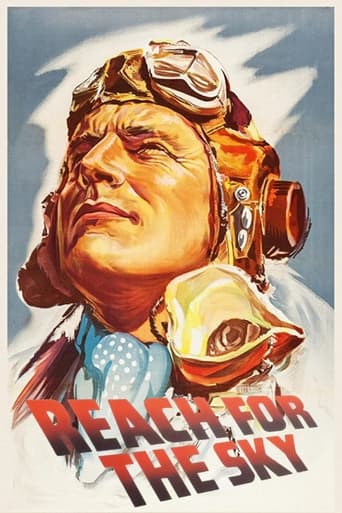
Reach for the Sky
1956 · Film · 135 min
Directed by Lewis Gilbert
The true story of airman Douglas Bader who overcame the loss of both legs in a 1931 flying accident to become a successful fighter pilot and wing leader during World War II.
1 positive4 neutralfrom 5 commenters
Where to watch
No streaming data for this title.





5 comments on Hacker News
I have not read the book (Reach for the Sky - 1954) nor watched the movie (Reach for the Sky - 1956) in a very very long time however I recall them fondly from my youth.
War historian Antony Beevor discussed that stereotype thusly:
''Patriotism also permeated those British war movies of the 1950s and 60s – The Dam Busters, Reach for the Sky, The Cruel Sea, The Heroes of Telemark, The Battle of the River Plate, Cockleshell Heroes. It camouflaged itself in self-deprecation, but the rousing march music in the finale always braced our belief in the rightness of our cause. We have long made fun of all the period cliches, unable to believe that anyone talked like that. But when researching my new book Arnhem: The Battle for the Bridges, I found that German officers really did say to the British paratroopers taken prisoner: “For you the war is over.” One of my favourite remarks, recorded at the time by a junior doctor, is the reaction of Colonel Marrable, the head of an improvised hospital in the Netherlands, when Waffen-SS panzergrenadiers seized the building. Still puffing gently on his pipe, he says to his medical staff: “Good show, chaps. Don’t take any notice of the Jerries. Carry on as if nothing has happened.” I have always been doubtful about the notion of “a national character”, but a national self-image certainly existed during the war and for some time afterwards.''
https://www.theguardian.com/film/2018/may/29/antony-beevor-the-greatest-war-movie-ever-and-the-ones-i-cant-bear
There is a movie about Bader: Reach for the Sky:
https://en.wikipedia.org/wiki/Reach_for_the_Sky
I can't remember if it includes the bit about parachuting in a replacement artificial leg... I can't imagine there was much desire to portray Hermann Göring in a positive way in the mid 1950s!
They did make it into a movie, but not sure if it covers the parachuted legs incident: https://en.wikipedia.org/wiki/Reach_for_the_Sky
It's very easy to see patterns which aren't present. We as humans are quite good at doing this. How might I confirm that this pattern is present?
To start, let's look at movies that deal with "Scientists, Engineers, Doctors, Researchers, Inventors, Explorers and People who do Amazing Things", from http://www.imdb.com/list/ls050940841/ . These include Apollo 13, Fat Man and Little Boy, Einstein and Eddington, Shackleton, Creation, Captain Cook: Obsession and Discovery, Gorillas in the Mist, Temple Grandin, Jobs, and Reach for the Sky.
Of the 31 films (though two are not biographies or based on real-life), 2 are about women (Gorillas in the Mist, Temple Grandin), and the rest are about men. Einstein is certainly high on the list of mythologized people, so mythologization is not limited to women. (Feynman would be another. Infinity (1996) is a biopic about Feynman, but it's not on the list.)
Women appears underrepresented in that list compared to their modern presence in STEM fields. To be fair, the movies include Pasteur from the 1800s, and Harrison from the 1700s. Women were often strongly restricted from doing research in STEM fields during that time.
I saw one non-white person on that list, Vivien Thomas, from the 2004 film "Something the Lord Made".
"Reach for the Sky" from 1956 is "The true story of airman Douglas Bader who overcame the loss of both legs in a 1931 flying accident", and Temple Grandin is autistic. However, since 1956 is rather a long time ago, it does point out the need for a baseline - if the percentage of movies about disabled people has been stable, then it's not a growing pattern. As another example of someone who 'received the mythology treatment', consider "Helen Keller in Her Story" from 1954.
(Howard Hughes, in 'The Aviator' (2004), may also fall into the mentally challenged category, due to his obsessive-compulsive disorder which was present already by the 1930s. I haven't seen the film to see if it touches on his mental illness.)
Films about gay people would have been restricted under the Motion Picture Production Code, so not really seen in films from the 1930s to 1968. That would make it hard to establish a long term pattern. Still, as about 2% of the US adult population (1.2 to 5.6 according to https://en.wikipedia.org/wiki/LGBT_demographics_of_the_United_States ) identifies as LGBT, then about 2% of the films about famous people in STEM should concern someone LGBT.
It should not be hard to come up with an evaluation technique, like "all biopics about people in STEM done as movies/made-for-TV movies in the US from 1970 to the present", and redo this same evaluation to see if there is a pattern.
The tricky part is to normalize it. If 2% of the population is homosexual, then what percentage should we expect to see portrayed as they are in movies? If 51% of the US population are women, and 27.9 percent of the PhDs in the physical sciences are women, what patterns should we expect to see in films?
Otherwise you might just be seeing the secular trend that more women are getting involved in STEM, that policies like the ADA make it easier for people with disabilities to get advanced educations, etc.
How have you done the analysis to determine if the patterns you see are due to the expected shift in population distribution of people in STEM, vs. any special sort of mythologization?