 Hacker Cinema
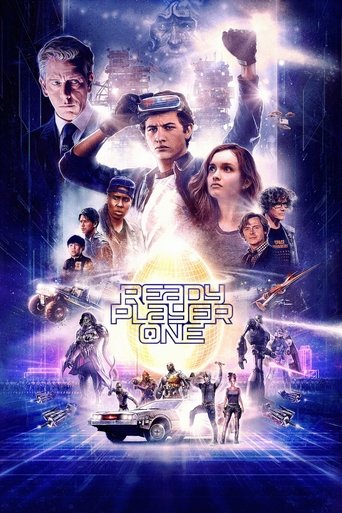
Ready Player One
2018 · Film · 140 min
Directed by Steven Spielberg
AdventureActionScience Fiction
When the creator of a popular video game system dies, a virtual contest is created to compete for his fortune.
14 positive32 negative6 mixed59 neutralfrom 111 commenters
Where to watch
No streaming data for this title.
130 comments on Hacker News
> Like Zuckerberg‘s shift to VR that looks like he came out of the theater of Ready Player one.
They took most of us employees to see Ready Player One in the cinema when it came out (sometime after the Oculus acquisition, but before "the metaverse")
With Musks ideas I often think I saw that movie/read that book. For his Mars plans I see the Mars colony from Total Recall, the Schwarzenegger film
Like Zuckerberg‘s shift to VR that looks like he came out of the theater of Ready Player one.
Wasn't this the end goal in the a totalitarian state in the novels by Orwell and sort of described in the movie Ready Player One?
The gist of it as I understand it is in a society where things are fake and incredibly extractive (where a select few, bourgeoisie or rich prioritize their interests over others like we see accelerating today) they limit the forums available for people to question them and peddle their interests on the select few that remain. If you sufficiently isolate the people, it's hard for them to tell whats real and eventually they come to accept the fake narratives as truth.
In an odd way, this sort of fits in with the theories about winners writing history, and all those weird, sort of conspiracy-laden accounts of human history having these odd unexplainable gaps or stories around it. I don't know about you, I think we are simply seeing those forces of the past working at preserving their interests and using the latest technology to do it.
What do you expect? Did you see the movie ready player one? This kind of experience is ideal for furries and cosplay types and they featured in the movie too.
If you can be anything, it makes sense it attracts people who want to not be what they already are.
> the first graphical RPG I ever played, Dungeons of Daggorath
In case you didn't know Dungeons of Daggorath (1982) for the Radio Shack Color Computer featured significantly in the best-selling sci-fi book "Ready Player One" (although it was not an element in movie). https://readyplayerone.fandom.com/wiki/Dungeons_of_Daggorath
I got my Color Computer in 1982 and banged my head on Daggorath for many hours. Randomly reading Ready Player One in 2012 was surreal. There were so many impossibly obscure references to esoteric 80s computer and arcade trivia that was personally very significant to me - but to almost no one else - it felt like I was being punked by someone that knew me. And the more I read, the more bizarre coincidences kept piling up - from Daggorath on the Coco to knowing how to beat a Joust arcade cabinet with the arcane pterodactyl bug which was only present in Red/Yellow Joust cabinets. The Coco was obscure, maybe 1/100th as popular as the Commodores and Ataris, and Daggorath wasn't even close to a top selling game on it.
In the early 80s, every time I'd go to an arcade I was always on the lookout for a red/yellow Joust so I could drop a high score. I also read Rainbow Magazine every month and even flew across the country to attend the first RainbowFest in Chicago. Good times, indeed.
"it's like what some writer thought things were and not how they actually were"
Doesn't that refer to a lot of pop culture? I can remember the 1980s and my memories of that period rarely bear much resemblance to the TV/films I see nowadays set in that period. I don't think it's just my personal experience. It goes deeper than that because many of the writers can't remember it well, or at all. That said I think the author of "Ready Player One" could remember the 1980s, just not my 1980s.
I would actually put a lot of the blame for today's VR winter (or at least expectations cooldown) on Ready Player One, and particularly its movie adaptation. Not that it was bad per-se, but for me and others I spoke too it was so outlandish that it essentially made VR "jump the shark".
But is there much of a demand for it? VR has been a feature of video games for over a decade now, last time I used it I thought it was good enough (that was 6-7 years ago), technology wise. But it's nowhere near as popular as e.g. regular displays.
Any movie depictions of VR are fully immersive - Ready Player One (at least the film) takes some liberties in depicting the game world as if it's immersive, even though the guy plays with VR glasses and force feedback gloves/suits, all current-day technology. Most others have a direct brain interface. Some (Star Trek) model a realistic immersive environment around the player, but both of those are very much science fiction still.
There's some brain / tech interfaces, but if I recall correctly the brain has to learn to handle the signals first, there's no way to create a perfect, instant link.
I was really hoping for a Snow Crash movie. That project has been in development hell for years. Instead, we got Ready Player One, which is like Snow Crash for dummies. There's a trailer for a low-budget version of Snow Crash.[1] It's awful.
I don't hold out much hope for that project. Snow Crash is about a conspiracy between a media baron and a televangelist to take over the world. That would upset a lot more people now than in 1992.
[1] https://www.youtube.com/watch?v=t8WYiYcaRY4
> these decisions go through large rounds of discussions at any FAANG company.
"We figure we can fill up to 80% of the user's field of view with ads before inducing seizures" was a very apt description of such discussions (Ready Player One the movie)
Soon, the only thing that will make "Ready Player One" a fiction is that, in the end of the movie, they agree to shut the thing down once in a while.
That will never happen under Silicon Valley's watch.
This is the idea they had at the end of Ready Player One (the film, not the inferior book). It's only taken 7 years for people to start making it a thing!
It feels like this quote from "Ready Player One" (2018 film)
"Once we can roll back some of Halliday's ad restrictions, we estimate we can sell up to 80% of an individual's visual field before inducing seizures"
I loved ready player one. It's not a classic, but it's a fun movie. I think a lot of the hatred comes from the people who have read the book (I haven't).
I don't think Spielberg ever lost it. He's made a lot of exceptional films since E.T. or Raiders of the Lost Ark or whenever you could say he had power and money. Saving Pricate Ryan, Schindler's List, Jurrassic Park, etc. Even clunkers like Ready Player One show how great a director he really is.
> I swear, man. Until every surface is used to display ads I don’t think advertisers will rest.
"[...] We estimate we can sell up to 80% of an individual's visual field before inducing seizures."
(from a scene in the Ready Player One movie)
> Coming back to see whether your crush had messaged you.
Reminds me of personal experience of course but also the "Less Than Three" video [0], which in turn reminds me of the GUNSHIP Art3mis & Parzival music video [1]. I'll probably never watch the Ready Player One movie again, but I'll likely watch the GUNSHIP video another 100x.
[0] https://www.youtube.com/watch?v=uQu71l1WQ3g
[1] https://www.youtube.com/watch?v=WQaH3lh-CA4
It's so strange because my experience is the opposite. I see a lot of content about reading and books (how there are no great books anymore, what was the best book, etc), fun facts and other trivia about authors, a few books getting made into movies (hello Dune, but I was thinking of the Martian and Ready Player One) ...
but I don't see any of this cultural expectation, this peer pressure. (One of my friends keep recommending me books and movies, but that's an exception. Okay, I saw Pikkety's Capital on a different friend's bookshelf. And that's it.)
...
and it's also interesting because I remember when half of the world was waiting for GRRM to stop trampolining!
I purposefully put down the last book somewhere around halfway because I thought the next one will be upon us soon, so it'll be great to pick it up and read the remaining story in one go. Hah.
And somehow after Banks died I stopped reading books. (Sure, no connection, but well, it would have been nice to get more of his funky space stories!)
The casino scene in the Percy Jackson movie [1] (and book) have always seemed hauntingly accurate to me as far as describing much of modern life.
The thing we all have a finite amount of is time, and we’re increasingly distracted to where we waste more and more of it on unimportant, artificial digital worlds/life while the real world passes by. As I’m getting older, I’m seeing how precious youth, energy, and health are, but those who have the most of that (younger people) seem to be sucked in even more. We’re racing towards the dystopia shown in the movie Ready Player One.
[1] https://m.youtube.com/watch?v=p9-Fbl2QVJc
The dystopia in the film version of Ready Player One clearly borrows from this.
The movie “Ready Player One”, despite trying to end on a forced positive note, was/is prophetic. It was a very sad and disconnected world there, and we’re slowly moving that way here.
It would be very hard. You would fall. Which would be wrong because you’re not falling in game. You said harness but it would need to by a smart dynamic harness that adapts the tension which would be weird if you moved your leg oddly.
Some relevant edge cases:
1) you’re at a ledge and trying to dip your foot down (or conversely as shown in ready player one the film, you’re at a precipice and feel off balance because your VR foot is not fully supported by VR ground)
2) you’re running and a limb or foot hits a small object in a way that should realistically cause you to fall or be obstructed. Extremely tough problem to solve with the harness idea.
You can handle different edge cases with reasonable band aids but not comprehensively in a way that will work for general movement.
It won’t work. Ready Player One (as implied by the book or visually shown in the film) is actually immersive in way that is impossible to input with physical controls.
Take a step irl. In game your foot goes through a wall. In Ready Player One your foot is stopped by the wall. This contradiction can’t exist.
It’s more ok for hands where you can just demand the hand move back before the wall irl. But with feet that’s your whole sense of balance.
On a RPG tangent, and related to the dialogue "Elon Musk tells Rishi Sunak AI will put an end to work" (https://www.bbc.com/news/uk-67302048) I catch myself wondering..
I used to play VikingMUD (like A LOT). I have read the book Halftime (by Bob Buford). Then I consider a UBI. Also adding to the mix the "humans" in the movie Wall-E (all obese, sitting on floating chairs drinking soda all day wearing their VR devices). Now add a little of "Ready Player One" in that mix.
Now, adding all these to the mix (for for the future generation), will we become something like that? Will we be 'producing' 1h per day, sleeping 8h per day, and consuming the remaining 15h? (let's assume single or married person, but without any kids or pets)
Will I be able in my 80s to play VikingMUD again for 12h straight? (boot-run for those unique +3str iron gaunts, etc) Will I be able to play again Midnight Sun? (oh I have forgotten 99% of it).
Will someone revive Spellfire (oh how I miss this game.. I still have my cards in dossiers organized) and we will be able to scan & play with our cards from all over the world?
Or will we simply be playing Fortnite (or whatever 3d game will be the 'cool one') in 20-30 years when the above criteria are fulfilled?
And the 'drone spitter' USPS vans in the Ready Player One film.
Your experiences are absolutely out of date.
For example, the recent (6th season) of JoJo, are all sorts of references that the fansubbers can make from the original material, but the corporate subbers aren't legally able to.
In fact, the corpo-subs are considered degraded and garbage, compared to a fansub. There aren't 'sensibilities' to maintain, nor is there corporate rights etc to hold up. And frankly, we make better!
If you want a comparison between corporate and fansubs, look no further than the book and movie of Ready Player One. That's a fair comparison.
Yes, that's the classic. I've linked that video before, but didn't know the creator had a web site. That's what I expected Facebook/Meta/Oculus/Zuckerberg to ship as augmented reality. It's quite do-able with Apple's new headgear, although that thing is too bulky and doesn't have the battery life for full-time wear.
There's a line in the Ready Player One movie where the big bad is discussing how much of the human visual field they can fill with ads before inducing seizures. I was expecting this years ago, as Google Glass 2.x, but nobody has yet been able to get the size and cost down for untethered headgear.
> OP gives sober perspective of regular Joe, who didn't have VR as a wet dream since early childhood
Yes, the average Joe doesn't care about this stuff. That's why Ready Player One grossed 600 million dollars at the box office[0]. And why we've had movies like Tron since the 80's. And hypothetical tech in movies like Iron Man display AR/VR capabilities we dream about. Clearly the average Joe doesn't concern themselves with AR/VR or care about it becoming a reality. /s
[0]: https://en.m.wikipedia.org/wiki/Ready_Player_One_(film)#:~:text=Reception-,Box%20office,in%20order%20to%20break%20even.
Augmented Reality (AR, or I guess "spatial computing" now) has always been what I thought would push the whole thing over the edge, and not VR. The "killer app" for VR is immersive experiences - while there's a niche for them, and I think we'll see more and better iterations, I don't think it has the growth potential that AR does.
The killer app for AR is the pair of glasses that pops up information as an overlay on the rest of the world. Directions? You get an arrow and line telling you where to go. Meet someone for lunch? Facial recognition tells you information about them - either recent social media posts if you're already connected or something like a public profile if you don't. Testing out a new recipe? It shows you step by step directions and floating video of the task you need to do right them. Watching a movie? Built in subtitles and tells you who the actors (or voice actors) are. Looking to buy a car? The AR headset gives you pricing information and stats for any car that you look at.
I could keep going. Think combination of Ready Player One, any gadget spy movie, and a video game isekai. Menus that allow you to make notes for when you go to the store, calendar reminders popping up visually
The potential for abuse of privacy is high, but the convenience factor and instant gratification probably mean that people will still adopt it in droves. Add in some kind of AI assistant that does a halfway decent job at anticipating the user's needs and it's a done deal.
The main things holding back that kind of thing are battery tech and miniaturization. 2 hours isn't gonna cut it, and it needs to shrink to a more innocuous level before we get there, but that's the direction I see it going. That's probably also why these companies are working so hard at iterating, to get that first-mover advantage.
If we do get there I pity anyone with photosensitivity issues or epilepsy. They're gonna have a rough time.
"Apple’s ambition is that customers will eventually wear the device continuously all day, replacing daily tasks done on an iPhone or a Mac such as playing games, browsing the web, emailing, doing FaceTime video calls while collaborating in apps, working out and even meditating. It will feature hand and eye control and run many of the kinds of apps found on Apple’s other devices."
This concept has been well-explored in science fiction, and it doesn't look good. See "Hyperreality"[1] for one of the best visualizations. That's all too realistic.
There's a line in Ready Player One:
"We call this Pure O2. This is the first of our planned upgrades. Once we can roll back some of Halliday's ad restrictions, we estimate we can sell up to 80% of an individual's visual field before inducing seizures."
I was expecting that from Zuckerberg/Meta/Oculus.
Remember Google Glass? People wearing those were called "Glassholes". What to call people who wear this? "iDweebs"?
[1] https://www.youtube.com/watch?v=YJg02ivYzSs
[2] https://www.springfieldspringfield.co.uk/movie_script.php?movie=ready-player-one
Asa Butterfield plays in a few sci-fi films that might be fun for that age:
- Ender’s game
- Space between us
Also:
- Ready player one (book is way better, but nonetheless)
Like the movie ready player one. No one went backwards in that race? This was written by people who do not game but know the flash of it. Watch any of the thousands of vids on youtube of people doing crazy things in speed runs and you will see different.
Have you read "Ready Player One"?
The author predicted that players will play a game where they will be dropped into their favorite movies, and will be given points for exactly mimicking the dialogue, inflection, and movements of the characters.
Spoiler: the first one is War Games.
Indeed, the big tech companies do not seem to understand what users want out of a VR experience.
They want "Ready Player One", warts and all. Big Tech wants all the rough edges filed off, and for there to be little user control.
This is why VRChat is so amazing and AltspaceVR is dull and uninteresting.
Curated experiences with moderation and controls to prevent copyright infringement don't have broad appeal. A few of these events sound mildly cool:
https://account.altvr.com/events/all
But something like VRChat always has something weird and interesting going on. Like, maybe I find a virtual theater where a bad sci-fi movie is playing and I sit down next to a group of Kermit the Frog / Booby Anime girl avatars who are trash talking the movie ala MST3K. Every day of the week you get this!
> I sometimes wonder if Zuck has ever read a novel or watched a movie because one way he is tone deaf is not understanding the possibilities of fiction.
He loves Ready Player One and has referenced it in interviews regarding the metaverse, but he's basically basing his business model after the main bad guy/group in the story.
Not really an answer to your second bit, but "Moss" is a lovely little game in VR that you play from third person (fixed camera). I wish more VR games did 3rd person, aside from Moss it seems exclusive to strategy games.
> Then they've still invented a lot of super interesting tech along the way.
Google has also developed a lot of interesting tech along the way. Most of it is junk you can buy for $5 at the Salvation Army now.
The problem with "Meta" is that it's pushing something without any buy-in from an audience that cares about it.
The actual audience for VR is almost completely at the early adopter, 1974 Altair stage. We're at the stage where the enthusiasts are figuring out what works and what doesn't. That's mostly what social interactions will work at first, and what hardware mods are most important to expand those.
As much crap as people give Ready Player One, there's an analogy in there. Facebook is the mega corp trying to take over. They're the "Innovative Online Industries (IOI)" from the novel, a "multinational corporation bent on a well-funded effort to find the Easter egg in order to take control of the OASIS and monetize it." (Direct quote from Wikipedia.)
As a counter example, let me tell you about an early experience I had in Second Life circa 2005 or so.
I got involved with SL for a few years back then. There was one singular critical moment I experienced that convinced me there was something very special happening back then which I really haven't experienced again yet.
In SL your avatar can fly around. Here I am on my low level 2005 pc and low res 2005 monitor with 2005 headphones. I'm cruising around a bit I fly over this hill into one of the weirdest things I had ever seen at that point in my life of 25 years.
I fly over the crest of this hill and run into an amphitheater with a stage. Same thing we've all seen dozens of times in real life. There are dozens of other avatars all in the crowd sitting in different areas of the amphitheater. Most of the audience was oddly wearing furry costumes.
On the stage is a band of other characters, all doing different animations of playing fake instruments.
So the way I'm describing this seems pretty normal these days and nothing impressive. But this was 2005.
What hit me really hard is that these are all real people experiencing the same event AT THE SAME TIME. That was the aha moment.
The band wasn't just npc characters. There was an actual band of 5 or so people together in the real world streaming their show into SL for a bunch of other people from all over the world to watch in real time. Sure, it's like 50 people dressed as sexy foxes and stuff, but they were all witnessing this musical performance in real time through this weird 3rd party virtual interface that very accurately replicated a real world experience in terms of spatial placement and audio (to some extent).
For me, it was this super weird magical moment that gave me a glimpse of what the future actually could be. Everything was built by the people from their avatars to the band people to the person that designed and built the stage and amphitheater. And it was in a shared virtual/physical space where I was able to randomly encounter it just by flying around and crossing a certain hill.
To this day I've probably had a similar AHA moment a handful of times.
Today you can watch bathtub fun time on Twitch, or people begging for subs on YouTube, or people spamming TikTok to promote their SoundCloud accounts.
But none of that comes close to the experience of discovery in 2005 of finding an impromptu rock show in Second Life with furry foxes watching in real-time.
In modern times, I haven't bought a VR headset yet. I've played with it when available, and I've seen a taste of VRChat and some other awesomely weird modern experiences.
I'm firmly convinced that whatever actually ends up becoming "the metaverse" isn't coming from an out of touch older millennial billionaire who took the wrong message from a particular book/movie or it's actual spiritual predecessor Snowcrash.
There's a last sentence here that I tried to write a few times and failed. Weirdos is wrong, so is "alternate thinkers". Young people? That's wrong too because since 2005 Second Life's population of users has been mostly flat but consistent, and they tend to be older tech savvy folks that have used these platforms for decades before they got "popular".
I don't have a label, and that's probably the point. There eventually may be lots of people who dive into "the metaverse", but those people are so diverse that IOI/Meta isn't going to be able to dictate whatever it becomes.
Are you going to be willing to install a brain implant from Facebook? Dear God. It's like something out of a dystopian movie. No amount of money will convince me to do something like this, especially coming from Facebook, but any corporation really.
Very light AR glasses can be an interesting proposition but they will not provide the VR immersive experience.
I'm not sure what people expect from VR but it's not Ready Player One and will not be for a very long time. However, playing Half Life Alyx is quite phenomenal even today on current hardware.
The article isn't really clear on what's meant by this. I assumed it was people being paid to roleplay characters in games, which isn't a horrid idea per se, except it would only make sense for important characters that benefit from skilled improv acting talent. It would be laughable for random NPCs to try and make a place feel alive.
But the article also seems to refer more to doing labor in pay to earn pyramid scheme games.
Both are pretty stupid. But the former reminds me of the most preposterous part of the Ready Player One movie where it is revealed at the end of the movie that one of the founding developers was secretly the museum curator in the game world the whole time. Which was just... bonkers to try and comprehend that this intelligent, highly skilled person, was roleplaying as a curator in a museum dedicated to his dead friend, catering to teens, and doing non trivial amounts of labor every single day, pretending to not be sentient.
It troubles me rather deeply how many people I have talked to about that movie who completely tuned out the whole pervasive advertising subplot. Didn't see it.
I was talking about the ads on every vertical surface in the mall, not long after the movie came out, and someone said, "I guess I didn't notice." This is how democracy dies. Not with a bang, but a whimper.
Ready Player One is much more on the nose about it, but it goes by so fast people likely missed it too:
> we estimate we can sell up to 80% of an individual's visual field before inducing seizures
Birmingham is surprisingly versatile as a filming location. The dystopian scenes in “Ready Player One” were shot there, but it can also double for up-market London housing as seen in the “Kingsman” movies.
I feel like I have a pretty good idea of what does and doesn't impact him; he reacts quite clearly if something is problematic (he's read/watched LOTR/Hobbit and one moment he reacted to in The Hobbit movies was Bolg vs Kili). Mal in Inception was probably the heaviest thing as the gunplay there isn't overly visceral. We've watched The Matrix together, Ready Player One (undead ballroom was fine, but skipped the old zombie in the bathroom) and Ender's Game (has a graphic bullying revenge scene). I love Moon, but the language is a bit old for him for now - one day though, as I think that's one of the tightest sci-fi stories, and will get him thinking. Blade Runner too.
He'd probably cope with recent Dune, which I thought was very polished. We should watch The Martian, as he read Project Hail Mary and liked it. From memory, Arrival would be good assuming some of the undertones went over his head. Contact is another good one in a similar vein (common element with Project Hail Mary and Arrival of decoding messages).
There's better tech-related Disney movies like Ralph Breaks The Internet and Ready Player One (full with memes).
A minor spoiler I guess, but that's what they decided to do at the end of Ready Player One (the film, not sure about the book).
What is inevitable VR? Is it ready player one? Because that's what companies keep explaining it as. But that's never going to happen. Is it treadmills? Is it just what we have now but with better glasses? The discussion is swamped with people who saw a dumb movie once and don't understand how anything works.
It is and it isn't. Getting to the point where you were the one bot fast enough to get into the right position to snag that liquidation involves writing the bot itself, writing the smart contract, understanding the lending protocol and how their liquidations work, understanding how oracle transactions work, working out the math such that every input and output is precisely correct to 18 decimal places, having your server in the right rack in the right datacenter to beat the others, and on and on, are not easy tasks.
But yes, once you do all of that...it actually is a money printing machine that will never end as long as markets have volatility. It's a bit like living in the movie Ready Player One...once you are clever enough to run the gauntlet, riches are yours.
Meta = Facebook. Facebook bought an innovative team that sold the first mainstream VR headset, they are certainly doing the work to sell a quality hardware product at a competitive price. If only Mark Zuckerberg watched Ready Player One and Sword Art Online he might be able to communicate what it means, but he hasn't and he won't.
Netflix doesn't seem like a great innovator if you compare it to Disney. (e.g. animated films, that Lincoln, Space Mountain, building a machine that turns Star Wars and Marvel into $$$ better than anyone else...)
Apple has the talent and resources to create something new but there are a limited number of products that most people buy that cost as much or more than a smartphone: there's room for an Apple Car and an Apple House, but will an Apple AR headset move the needle financially?
> VR is in my opinion a success if it becomes normal but no one really uses it day to day.
I think pretty much all the members of my family regularly play games in VR (on their own headsets).
> But as something central like I imagined the metaverse or what ready player one proposed?
We don’t actually want that. That movie was supposed to display something dystopian. Meta is something dystopian.
Ready Player One didn't have ready player one tech. The movie was wildly inconsistent with how it worked, because there are numerous fundamental design problems with getting really good vr. Like hard technical interface problems that just didn't make sense.
Ready Player One movie had a private prison owned by the facebook equivalent. Seems legit.
I love this article because it puts the metaverse in historical context, which is so important post the 'ahistoric turn' where people can't believe they are living in a unique moment separated from the rest of our experience.
That said, I think it underestimates the importance of improving technology.
Virtual Reality has been a north star of our culture since at least the 1980s being a persistent theme in fiction and science fiction (you knew Star Trek The Next Generation had jumped the shark when in half the episode they never left the Holodeck) and in culture such as video games, as much as the reality was a pale shadow of what we imagined.
I remember the bad old days of VRML in the 1990s when I argued with people who thought it was all junk because it didn't measure up to games like Doom and Descent and others didn't realize what a big problem it was that it was inevitable that you'd wind up turning your back to a 3-d model and not being able to find it again. Today I dream about turning an abandoned big box store into a VR park -- the other day I found out that Disney tried this and failed in the 1990s.
What I do know is that culture lags technology. Futurists in 1970 expected people would be getting personalized news from a service like the web in the early 1980s, and they did in the form of services like VideoTex, MiniTel and Compuserve.
One thing that killed it was that the technology was expensive; in principle a single corporation could have designed an end to end system (the phone company in France did) but without a clear plan to make money on it (or save money by not printing phone books) they wouldn't do it. By the time the web came along people were able to build it without worrying about what it costs and think about paying for it later.
Facebook became a household word and insinuated itself into commerce not because it was adopted by firms like Apple, General Motors, and Disney, but because the Thai Restaurant with great food and terrible atmosphere put "Like Us On Facebook" in all of their marketing materials and made Facebook a key touchpoint for their customers.
I agree with Ralph that 2-d presentation will always coexist with 3-d presentation, but 3-d presentation may well get better and much more accessible to a wider range of organizations. The frustration we've had since the 1990s might very rapidly fall away to something that looks like Ready Player One.
Agreed, and they also could have named this concept after something cooler than the metaverse from Ready Player One. It was a pretty bad book and movie IMO. They should have chosen the "Holodeck" and renamed themselves "Holo".
Eh, not really. Video game design is hard. You won't succeed trying to make social media into a video game. People like to point to things like Ready Player One, but honestly both the book and the movie's depiction of the game were stupid. They would not work. That's not how games work.
Spielberg made Ready Player One at the right time. It covers the terrain of the "metaverse" in a way which is accessible to all generations -- he did it late enough that people would accept it but early enough to remind us that Zuckerberg is a follower not a leader.
A big thing this article misses is that work is going to be a big driver for VR and in AR. I saw a documentary the other day that showed how the operators of an offshore drilling operating in Europe use a VR "Cave" to model everything from the gas reservoir they are tapping to the operation of machines that do tasks like connecting wells to pipelines. AR is hugely practical when it comes to accessing service manuals when you are inside an aircraft engine or can overlay the plans for a construction project over the physical space. In these applications avoiding mistakes can justify the cost of the hardware and software development.
In terms of entertainment the strength of VR is highly intense experiences. People can't stand to be in VR for as long as they can spend reading, watching TV, playing video games, surfing the web, swiping on tinder, etc. I would love to turn an abandoned store in the mall into a VR park where people can play LaserTag++ but on top of dealing with people who fall blind wearing $3000 worth of gear (I think I could manage to do that on a padded surface and not get hurt but I know many people couldn't) I just can't see how you could make the financials work out.
Virtual and augmented reality will find uses and markets.
Will Facebook be at the center?
I know the only real VR headsets Best Buy sells are from Oculus (Facebook.). With stimulus cash burning a hole in my pockets I thought about buying a VR system and found that competitors for Oculus are more expensive relative than what you get considerably. No way am I logging into Facebook, but most folks won’t care.
That might not turn into a meaningful advantage.
See the movie Ready Player One that makes Zuckerberg look like a clueless follower instead of a bold leader. Sword Art Online particularly in the arcs after the death game is better science fiction, but Spielberg tamed the nostalgia of the book to make something which I think speaks to all generations in the ‘West’ and is a great jumping off point for conversations.
If you haven't already, check out Ready Player One. The book, not the movie.
debatable to what degree meme culture has become more repetitive but I think there's probably something to it. Mark Fisher borrowed the term Hauntology from Derrida to describe this kind of media consumption/production. He thought that one key aspect of the way we communicate was that we're essentially trapped in a sort of self-referential loop that cannot escape old aesthetics, ideas or forms and that we had in a sense cancelled the future or anything genuinely new.
It seems like that's the sort of thing the OP feels about memes, and people have often observed it about retro-pop fiction like Ready Player One, the intensity with which fashion is recycled, the never-ending superhero movies that now comprise most of mainstream cinema, and so forth. Subjectively kind of like you're stuck in some 2000s videogame where nobody bothered to turn the servers off.
I think that's a sort of feeling many people have about large parts of the media today in some form or another.
It's popped up again because they made a movie out of Ready Player One, so now lots of people are talking about the VR immersive world concept after watching that movie.
Oh it's going to succeed, alright, it's going to look just like that version of the Oasis that IoI demoed in the recent Ready Player One movie.
And then come the Metaverse Loyalty Centers.
I picture Facebook owning the metaverse close to the alternative outcome to Ready Player One, if IOI ended up owning the Oasis.
If you’ve not read it, it’s an enjoyable read. Definitely skip the movie, however.
Go watch the movie "Ready player one". The book has been given to all facebook employees. They want something like that.
> Zuckerberg wants to be the villain from that Ready Player One book but without any of the hassle of taking it over
He probably sees himself as the misunderstood, genius creator of The Oasis rather than the conniving corporate bureaucrat in that movie (I never read the book version)
Not related to Tech Noir, but since people are posting their favorites in this thread: Gunship released "Art3mis and Parzival" [0] a couple weeks before the movie Ready Player One was released.
I had liked the book and was looking forward to the movie. I listened to the music video probably hundreds of times on loop, and then, when I finally saw the movie, I wished it had been more like the music video.
[0] https://readyplayerone.fandom.com/wiki/Art3mis_%26_Parzival_(GUNSHIP_Song)
> I was one of these young software engineers that saw Hackers back in 1995 and was totally blown away by the potential shown of network technology.
> … Hackers (1995), which after more than 20 years, holds still up amazingly well.
I’m not sure you’re demonstrating any appreciable sense of objectivity here.
Hackers was an absolute joke of a movie; an exaggerated snapshot of ridiculous, misinformed 1990s pop culture thinking on technology.
Ready Player One is pop culture fan service, played out amidst a dystopian corporate future. It’s not even really trying to discuss technology at all.
The book is even worse than the movie, IMHO. Shamelessly plugging my own article [1] But the movie had the potential to be a cultural game-changer in the same way as Hackers and surely The Matrix had to the adoption and "coolness" of the Internet at the turn of the century.
[1]https://medium.com/@jsemrau/hackers-vs-ready-player-one-b6ad0f117814
Ready Player One movie was terrible. The book was fun. Felt more genuine and didn’t have silly stuff like the movie
AR/VR does run the high risk of creating a super dystopian and fragmented real world. It’s definitely something to watch out for
Interesting that the male lead of "The Music Man," (film and stage versions) Robert Preston, also starred in a film where he brings out the talent latent on Earth. In "The Last Starfighter" a huckster named Centauri places an arcade game in various places as a sort of "Excalibur" test to find twitch-game experts who could defend the Star League's Frontier against Xur and the Kodan Armada.
For your further pop culture enjoyment: fans of stories like these may enjoy a more modern version -- Ernest Cline's "Armada" shares many similarities. You might remember Cline from such films as "Fanboys" and "Ready Player One." I imagine "Armada" will get its own film adaptation someday.
No it's not. It's just another hardware commercial grab that relies on using the real current version of Library of Alexandria - Thepiratebay.org
There's no vendor that could afford license fees to copy every game, from say, the NES, SNES, Atari, Commodore, etc. The rights are either untracable, unpurchasable, or exorbitantly priced.
It's also why Ready Player One book was so awesome, and why the movie was a pale joke... Even with Spielberg as the big name directing, there was absolutely no way to afford every right mentioned in the book. - Do you think that even the 1st quest, a D&D campaign, would be licensed reasonably by WoTC/Hasbro? And, well, it wasn't.
Any particular reason you think a metaverse is incompatible with an evil organization?
The evil co. in Ready Player One, the movie, literally imprisoned people and used them for forced labor.
(then, somehow, the CEO gets arrested by regular cops, lol).
Hi HN!
I built this small app in my spare time to aggregate books recommended on Hacker News. I personally find books recommended on HN to be super helpful, so I think this is the way that I can contribute back.
This book aggregation idea is not new. A bunch of sites have done similar things [1, 2, 3].
Yet one common limitation of those sites is that they have limited recall (i.e. not able to get a comprehensive set of book mentions), and thus don't paint an accurate picture of what the top books are. They're all based on insufficient rules, e.g., looking for Amazon Links. As you can see from my app, people often do not include Amazon links when recommending a book.
I wondered, why can't we just match book names? Well, not so easy. Some books have pretty short names, e.g. Meditations [4], or Steve Jobs [5]. Some book name might as well be the name of a movie, e.g. Ready Player One [6]. Simply matching the names of the books would produce a whole lot of irrelevant results.
This is where Deep Learning comes into play. Recent advances in large NLP models (transformers and BERT in particular) have made machine language understanding unprecedentedly accurate. It enables me to fine-tune a BERT model on a couple thousand labeled HN comments and predict accurately whether each word in a comment is part of a book or not - a task commonly termed as Named Entity Recognition (NER).
As a result, my app is able to present a whole lot more results while maintaining desirable accuracy. For example, NER works pretty well on the tough examples I mentioned ([4, 5, 6]). Compared to prior sites, my app captures 9-50X more mentions and thus presents a much more complete picture of what books are recommended on HN.
Furthermore, I've made sure that the comments are presented well in the UI because the recommendations are just as useful as the books. I highlighted the mentioned book name, and used a custom NLP-based ranking function to sort the comments. These are non-trivial improvements over prior sites, which I hope you can find useful.
Nevertheless, this app is not without limitations: 1) matching book names would fail when two books have the same or similar names; 2) although not often, this approach would wrongly classify some short stop-word names [7] and 3) sometimes NER fails to see that the commenter actually hates the book. These problems can be alleviated with more Deep Learning. For 1), one can use BERT to learn the authors mentioned which can be used as a filtering criteria. 2) and 3) should be fixable with more training data (currently there are only ~4,000 hand-labeled HN comments).
Lastly, I'd like to especially thank my gf who helped me label ~1,000 comments, which boosted the model accuracy by 5 percent! I also want to thank the people who create and maintain the HackerNews big query dataset [8]. And of course, thank everyone on HN who recommends books to others.
Hope you enjoy this app! Feedback and suggestions are welcome :)
[1] https://news.ycombinator.com/item?id=15169611
[2] https://news.ycombinator.com/item?id=10924741
[3] https://news.ycombinator.com/item?id=12365693
[4] https://hacker-recommended-books.vercel.app/category/0/all-time/page/2/2
[5] https://hacker-recommended-books.vercel.app/category/1/all-time/page/1/3
[6] https://hacker-recommended-books.vercel.app/category/0/all-time/page/3/2
[7] https://hacker-recommended-books.vercel.app/category/12/past-6-months/page/0/0
[8] https://news.ycombinator.com/item?id=19304326
P.s. The amazon links are NOT sponsored. This app is free of monetization.
Children getting whisked away by a handsome protagonist and his magical sidekick to fight against "cool things" like pirates and mermaids in a world unlike our own?
Its an Isekai.
---------
Isekai is this modern trend in anime (and US movies sometimes!! Like Ready Player One), where characters are sent to another world. Sometimes due to death explicitly ("Reincarnated in a New World" plotline: like "I'm a Spider So What"), sometimes just "temporarily" transported (Sword Art Online / Ready Player One, they are "just" playing a video game).
From an "Isekai" perspective: people want two things.
1. A world very different from our own. Completely different "physics" or rules. So magic systems, history, culture, etc. etc. that's nothing like our world. Neverland easily qualifies.
2. A character who explores the new world from our perspective. The main character is always someone "like the audience", who can be ignorant about the new world. (The various characters the protagonist meets are therefore given an opportunity to explain the world to the newcomer, allowing the audience to learn about the world in a natural manner). In Peter Pan, Wendy is the Isekai protagonist.
------
Alice in Wonderland, Connecticut Yankee in King Arthur's Court, Wizard of Oz, A Lion, A Witch, and the Wardrobe. The concept happens again and again as a pattern, because its a good framing device. I'm not sure if Peter Pan can be seen as an allegory of death necessarily, any more than "I'm a Spider, so What?" (2021 Anime) could be.
The children are... children... because the main character often should match the profile of the target audience. Not always, but its a good rule of thumb to keep. Children stories will therefore have child-protagonists more often than not (Polar Express, Lion Witch Wardrobe, Harry Potter). There are exceptions (Peanuts has child protagonists but is largely written for an adult audience), but its just the rule of thumb authors seem to use.
Zero-shot means it can generalize to things it's never seen before.
You don't need to train CLIP on any examples of "The stacks from Ready Player One drawn by MC Escher" to have it do a pretty good job of being able to judge which outputs of a GAN more closely resemble that concept[1].
Saying this isn't "zero-shot" because CLIP has been trained on a corpus (the Internet) that had some info about the setting of the movie Ready Player One and the artist MC Escher isn't a particularly useful interpretation. By the same reasoning, humans aren't capable of "zero-shot" classification either because they have prior knowledge of real-world concepts.
The model does object tracking well whether you feed it fish, or playing cards, or sperm because the generalized feature vector it extracts represent all the possible properties. It "knows" (and uses) properties like "facing right", "profile view", "blue sheen", "foggy", etc. to make its determination of which instances are which.
[1] https://twitter.com/braddwyer/status/1430576141572657162
I really want to gripe about "Ernest Cline's" Ready Player One. There was an element of dystopia to it, yes, but it was only the movie adaptation that came away with the takeaway that the virtual world was bad. In the movie they decide to add in the protagonist making the executive decision to shut down the virtual world on a couple weekdays or something. That pissed me off. That world was people's livelihoods. This kid lived in a poor junky slum and had a great social life and presumably some level of income in the virtual world when the movie starts. At the end of the movie he is super rich and has a hot girlfriend (who's character arc was largely that she perceived herself as ugly?). There's really not that much in the film or the book that says that forcing people to go unplugged made any sense.
The actual book was about a virtual world gone extremely right. The dystopian part was the corporations that sought private control of the platform.
Bonus complaint: The evil corporation in the film literally enslaves people and brazenly murders others in public, yet it's CEO is brought down by some unremarkable local cops? What?
Ready Player One would probably be the goto example of what we envision as metaverse. But I wasn't particularly wowed by its presentation in the film. I personally found this a more cohesive vision of what the metaverse could be: https://www.youtube.com/watch?v=kPTfdO5hQUw.
Of course, this could just be a difference in cinematic/storytelling approach. The director's upcoming feature also deals with these themes. Interestingly, in neither case is a VR/AR headset seemingly the preferred means of access... The advantage is that you don't look like a complete doofus like in RP1 when you maneuver in real life using VR headsets/haptic accessories.
Really just watch the Spielberg film for Ready Player One and to get the gist of it.
What would the "killer app" even be, you make it sound like it should be very obvious what it would be, but even knowing exactly what it should be, a killer app is still just luck and the right timing.
The only app that I could imagine bringing mainstream appeal would be a Ready Player One Oasis kind of thing (I've only seen movie, not read the book), but seeing and testing all the social vr apps we have now, the Oasis is the most fantasy thing about that universe.
The primary reason why CGI is used is to save money. The secondary is to ease production of movies, which at the end saves money and time (which is money).
Styling as done in some of them is an optional bonus if creators strive for some additional artistic message, but otherwise its all about money, money, money.
You even contradict yourself - they tried to look Avengers as realistically as possible within the realm of comic book fairy tale, that's why they changed character of Thanos significantly well after introducing him (arguably a good choice). From cartoonish styling to realism. Nobody would take the epic battles so seriously if they all looked like Ready Player One.
Where I want to also see this extending is for the platform that Epic Games has created with the Unreal Engine. Should we be able to load in any skins that we could sell on our own store [- the users could decide to not allow/block them], etc? This would help counter Epic's ability to simply make skins that copy higher detail versions or make them look enough like other mainstream-popular characters, e.g. the skin that by users is called the "John Wick" skin - but it's not called that by Epic, so instead that movie franchise could have created and sold the John Wick skin on all game platforms for users to integrate if they allow [e.g. moving towards the Ready Player One movie].
Movies like the Matrix and Ready Player One seem more like warnings than aspirations to me.
Ready Player One was competently directed by freaking Steven Spielberg with a "$155–175 million" budget and still sorta disappointed lots of us who had read the book.
Perhaps some awesome scifi books are just better left to the imagination?
Edit: I felt the same after watching "Ender's Game" (2013).
Edit 2: I felt that the TV adaptation of Neil Gaiman's "Good Omens" featuring David Tennant and Michael Sheen was absolutely brilliant. I hadn't gotten around to reading the book yet though...
My favorite part of the article was this:
> “Everybody is looking at the Metaverse as something to experiment with and be in, but they never talk about the creation,” said Descamps, the former general manager for Zynga, the company best known for its viral Facebook hit game, FarmVille. “Even in [the film] ‘Ready, Player, One,’ who actually made the Metaverse there? ...”
Unless I'm misunderstanding the quote, did Descamps miss the entire premise for the movie?? That would be so deliciously poetic in context of the film and the article that it deserves an emphatic chef's kiss.
I digress... more on topic to the point at hand, one of my children spends quite a bit of time playing Fortnite and I realized several months back that much of that was in the game's "Creative" mode (largely with school friends) participating in things that might best described as "schoolyard-like"? Say, akin to four square or (loosely-organized) soccer. There's a fair amount of good-natured ribbing (which has escalated to unhealthy levels on a couple occasions with actual friends, not unlike what may occur during those aforementioned IRL examples), camaraderie-building teamwork/competition, and most of the other social dynamics that are exercised among young adolescents. Of course this is all minus such aspects as actual exercise or body language.
And that was long before the whole coronavirus situation disconnected them physically. Now it's effectively the de facto substitute casual social gathering for his circle of friends, for better or worse (plenty of both, best I can assess at this stage.)
However, all that said, there's absolutely nothing that suggests to me that Fortnite is—or ever could become—the (a?) metaverse. My view for now is that it is, frankly, very much a fad.
That isn't to say it won't leave lasting cultural effects. Just look at AOL: their reign of dominance was deep, wide, and surprisingly (if ultimately anticlimactically) long-tailed. They were The Internet to a vast number of Americans. But now? And I only pose that with the slightest dash of cynicism on top of a heaping serving of bland "time will tell"...
edit(s): minor grammar/clarity
Right. I read that months ago.
I'd like to see the "metaverse" happen. So would many others. There's work going on in multiple directions. We're getting there technically. As a business, not so much.
There's Second Life, still plugging away. Content looks great, runs slow because the system is not parallel enough internally. Those guys need about a dozen really good C++ programmers and some people who know how to make distributed stuff that isn't web go fast. The original devs are long gone and the current ones are overwhelmed by the legacy code. Usage is up 5% or so since everybody had to shelter in place. About 55,000 concurrent users on a good day, comparable to GTA V Online. All in one persistent world built mostly by the users. Second Life is profitable but Linden Lab blew a lot of money on the CEO's pet project, Sansar, which flopped. A quick overview of SL by a user: [0]
There's a crowd of "blockchain" worlds - Decentraland, Sominum Space, Sandbox. They're about 80% land speculation and 20% virtual world. Mostly, I suspect, so that their internal currency is considered a "utility token" by the SEC, rather than an unregistered public offering.
Tim Sweeney, Epic's CEO, has been making "metaverse" noises since 2017. But, over the last three years, his vision has shrunk. Early plans read like Ready Player One. By this spring, it's only being able to teleport you and your friends from Minecraft to Fortnite as a group. He used to talk about an open metaverse where anyone could build. If someone did that, the margins would be like those of a hosting service.
The whole Improbable/Spatial OS thing seems to have gone bust. They built a back end for big virtual worlds with about $500M of VC money. (Softbank, who else? [1]) They were supposedly valued around $2BN at peak. It sort of works, but the terms are awful - you have to run on Google's cloud, under Google's thumb, at high pay per use rates. No major game company has taken that deal, and the three minor companies that did games for it went bust. 2019 revenue, $1.5M.
There were the "game level loaders" - you log in, you pick a game map, you play in a prebuilt virtual world. High Fidelity (went bust), Sansar (sold to somebody in Marin who buys distressed companies), and SineSpace (limping along, user count in 2 digits). All could be very pretty, but were not that compelling. You can't do much in there.
Headset VR, as John Carmack says, isn't going anywhere until the headgear gets down to swim goggle size. Even then, a sizable fraction of the population can't stand an immersive VR world where your sense of motion and the motion you're seeing are very different. There's a reason that the most successful VR game is Beat Saber, where the real and virtual worlds stay locked together while you slash at approaching objects. This is a big problem with getting to a Metaverse.
Facebook did Facebook Spaces, which flopped. Its replacement, Facebook Horizons, was supposed to have launched by now, but hasn't been mentioned in months.
Ball, the VC, claims Disney should be the power player in this, with games as extensions of the movie franchises. You can read his article series as to why. Movie franchise games have been successful, but they're usually tied closely to a canned story line, which is not the Metaverse.
So right now we don't quite have the technology and don't have a killer app, but what's out there is interesting and useful.
[0] https://youtu.be/H3Z49MOG_xU
[1] https://www.bloomberg.com/news/articles/2020-03-09/softbank-backed-effort-to-revolutionize-gaming-industry-is-struggling
I tried this when reading Ready Player One (I counted to eight in my head to stop vocalizing). I did read it much faster (in fact, faster than my partner who is a native English speaker/reader). I cannot vouch for how much I remember of the book though. I think it's less, because I remember watching the movie thinking "oh, right, that's what happened" about a major plot part. That's never happened with other books that I first read, then watched the movie/series adaptation of.
The Troy rising trilogy by John Ringo. An excellent military science fiction book with a Libertarian lean. My favourite is the first in the trilogy called live free or die. Basically tells the story of how to bootstrap a whole world. Pays homage to a lot of other science fiction. If you complete this trilogy and are left wanting more then I suggest the legacy of the Aldenata and the black tide rising series.
American nations by Colin Woodward. Great book to understand the historical underpinnings of different regions in America.
Carrion Comfort by Dan Simmons (who wrote Hyperion). Great horror scifi book with a nice concept. Fairly long though.
Thwarting enemies at home and abroad by William R Johnson. If you like spy novels or it’s text book albeit somewhat dated now likely on counter espionage.
On technical books I read the Linux programming interface by Michael Kerrisk. Really interesting incredibly detailed Linux book and always a great reference. Find myself keeping going back to it.
Ready player one the book by Ernest Cline. Way different than the movie. I actually preferred it as the movie justifiability leaves a lot out and condenses the story.
While I really enjoyed Ready Player One as a movie, I couldn't help leave it feeling it would've been better as a mini-series.
My fear with any Snowcrash adaptation is that it will feel like John Carter of Mars (or Warhammer Online [1]). John Carter was a groundbreaking novel, but its ideas became so adapted and universally understood that revisiting them in a movie felt ironically like derivative work.
If I have to endure years of my non-cyberpunk friends talking about how Snowcrash feels like a rip-off of Ready Player One, then I will flip tables.
[1] https://www.penny-arcade.com/comic/2006/04/10/i-hope-you-like-text
Sounds like an interesting formula. Ready Player One is popular too, but I guess since there is a movie that's already been done... but I guess you can have a series and also movies... The Purge has a TV series now even though originally it was a movie.
Ready Player One movie comes to mind; https://en.wikipedia.org/wiki/Ready_Player_One_(film)
I had similar reaction when initially thinking through such a centralized architecture - and made me understand that a decentralized computational infrastructure ("personal computers") is a necessary failsafe to prevent against pitfalls of such centralization; similar reason as to why I think mesh network technology should potentially be everywhere, however not used as a default network.
These are the systems and failsafes, along with canaries we build into systems, that we need to educate everyone about - so the public can clearly understand and have a document available for them be able to refer to.
>The second Blade Runner is a love letter to the first that also expands on some themes and further adds to the original myth
fully agreed, but I wish it would have been as visionary and as much of a leap as the original movie. We seem to live in the age of love letters with star wars, comic book adaptions, ready player one, and soon a fourth matrix movie.
I would be really glad if we had more filmmakers work on truly new aesthetics instead of just paying homage to works of the 70s, 80s and 90s.
Why everyone is recommending even more work for on your summer leave is beyond me. I'd personally recommend Ready Player One, perhaps use an audiobook (I love them). I personally listened to the one voiced by Wil Wheaton and it was fantastically done. Definitely recommended! It is a lot better than the movie in case you're wondering.
Yes, for now.
Jio's rival Airtel owns satellite/cable tv platforms and even supplies wired internet in parts of major cities. No one with any ambition has really tried wired internet in India -- for a long time the only way to get it was via the government-run telecoms provider (who are -- surprise! -- not very good).
Jio's parent company produces a lot of movies in India and in Hollywood, including Arrival, Ready Player One, Ghost in the Shell, Lincoln, etc. They know the value of a converged platform that serves data + video. And they don't have a satellite/cable tv network because the Jio vision was all-digital, all IP. And they have been building the backhaul to do this at scale across India (lots of planning applications are online) and are now slowly trialling Jio GigaFibre (a Gigabit Home Fibre service) in parts of India.
What I don't know is if they can turn these trials into a compellingly priced proposition Indians will pay for (and get rid of their cable tv subscriptions for -- and cable is very popular in India, even wired cable tv -- even in low-income neighbourhoods. So clearly India can solve the last-mile wiring problem if they want to). But they have been able to do it with 4G and I suspect they wouldn't trial a Gigabit fibre product if they didn't have a proposition in mind.
Incidentally if you're wondering: "won't 5G make wired internet redundant" -- India has lots of cell towers but also lots of people connecting to each of those towers. This means that often speeds during the daytime are pathetic. I personally used Jio and Airtel while visiting India recently in May, and even web pages had trouble loading (on both networks) in the afternoon^. I suspect the effective bandwidth available per subscriber in even small Indian cities (1M would be small in India) would be quite variable, and certainly small during busy periods.
Sorry if this is too much detail. I just find the ambition involved in bringing internet at scale to an entire country (especially one the size of India!) endlessly fascinating.
^ May is 'peak summer' in India, and the afternoon sees very few people on the roads and the bazaars are deserted as people rest or take a siesta. I suspect internet usage goes through the roof then.
It's a real shame Dungeons of Daggorath was replaced in the movie version of Ready Player One. Adventure, with its Easter egg, wasn't a bad replacement but the CoCo got so little mainstream love in its day that it would have been nice to see it on the big screen.
Maybe this is captured in “Infinite Detail” but it seems to me that this list is missing the one thing that is explicitly stated to be the key to making the MetaVerse popular in the book: highly detailed and accurate facial expressions.
The facial scanner in the movie adaptation of Ready Player One was a good touch for this. I think we could accomplish the same with temporary (or permanent!) non visible tattoos for facial tracking via cameras.
I am convinced art is one of VR killer apps.
First we have VR-native art. Like Quill, Tiltbrush, Medium, etc. that let you lay down paint strokes in mid air in space for volumetric illustrations (an entirely new medium that didn't exist before), or sculpt virtual objects.
Then we have VR as a mean to create 3D assets for games. Medium, Gravity sketch, etc. Sculpt in VR, export, retopo. Same as what you'd do with a ZBrush workflow except you sculpt the thing organically. Currently most useful for organic shapes, possibly hard surfaces depending on the tool used.
Coming soon, VR for rigging and animating assets.
Then we have VR-based museums for traditional art. Then VR-based museums for VR-based art.
Then we have VR for movie pre-production, where it is used to visit a movie set before it is fully built, like Spielberg used in Ready Player One. This can also be used to figure out key shots angles.
I agree, a well-read book can really make it. A bad reader not only makes a good book boring, it also works conversely. For example, Ready Player One was a mediocre movie, an alright book, and the audio book was really great (i.e. I also enjoyed the story itself much more because of the telling).
If you just want to read books without the effort of reading, and have "audio books" be cheap, text to speech is totally there. You'll miss some intonation, but modern speech engines are beyond understandable. If it would be just about understandability, try espeak (apt install espeak). An absolutely awful voice, but copy any decently sized text (maybe a pg essay) and listen to it. I find that after 30 seconds to a minute, I've adjusted enough to perfectly understand it, and after 4+ minutes I forget that I'm listening to the most horrendous voice known to mankind. And if you want to nerd out some more about our brain's capacity to understand speech and adapt to things that don't even resemble speech anymore, try whistling languages. I'm always amazed how understandable they can be.
>"This may be a particular peeve of mine and no one else’s, but I note it, because it’s my book: Name-dropping, for no better reason than to show off, under-appreciated novels, obscure foreign films, or cherished indie bands by having one’s characters irrelevantly reading or watching or listening to them is massively sore-thumbish. A novel is not a blog post about Your Favorite Things.[5] If you must do this sort of thing—and, seriously, must you?—contextualize heavily."
Laughs in Ready Player One: https://i.imgur.com/oJXgNRQ.jpg
I'd say it is unsavory in the same way today's movies are "manufactured" to extract the most value from american and chinese markets. Where decisions of film locations, dialogue, plot, etc are driven by marketing and political aspects of these two major markets. And the "art" comes after the market research.
"ars gratia artis" doesn't apply to Forrest Gump. It was manufactured out of marketing data. It was the 90s version of most recent nostalgia film "Ready Player One". I know it won a bunch of awards ( which I put no credence or value on ) but it is film saccharine. Forrest Gump is one of the forefathers of the current movie industry.
The ulter ego he says he encountered in his occult rituals he calls "Dajjal". Interestingly, it is the same name for the Anti Christ that exists in early Islamic literature. What is even more striking is that this same literature describes the Dajaal as one-eyed. We all know that the one eye is the symbol of the illuminaty cult. Another thing that really reminded me about this guy is the movie "Ready Player One", it had the same insinuations, regarding the moon landing mixed with the illuminaty one eye and the movie The Shinning.
Lots of dystopian and alternate world sci-fi (most recently read first):
1) The Handmaid’s Tale
2) Off to be the Wizard
3) The Three-Body Problem
4) Good Omens
5) We Are Legion (We Are Bob)
6) American Gods
7) Ready Player One
I really enjoyed all of these, though the Neil Gaiman books are rather long-winded. Ready Player One in particular is something I’d recommend to any geek or 80s movies and music fan. I found myself watching lots of old movies and listening to old music so I’d understand those references I didn’t know.
I’m now quite eager to not read any more about virtual worlds though.
Graphic Novels / comics:
8) Monstress
9) Rat Queens
10) Saga
Monstress and Saga develop really amazing worlds with engaging stories. Read them both. Rat Queens is just good fun.
Coding:
11) Code
Still working my way through, but it’s pretty cool. It goes from Morse code and electrical circuits to more complex code as conceptual fundamentals.
I’m sure I’ve missed a few, but these are the ones that stand out.
When I said "Bush-era", I was talking more of the national zeitgeist during Bush's presidency and not so much about how Bush himself was perceived.
The Bush era—or rather the core of the era, from about 2002 to 2007 (i.e. after the dust from 9/11 settled and before the housing crisis), was a boom time, and much of the future situation feels like it comes from "what if this boom lasts forever?" (i.e. society becomes wealthy enough to automate everything, so people just sit around and watch Ow My Balls and drink Brawndo every day instead of having to work). Something made nowadays would probably start with a premise that comes from "Millenials can't afford anything".
Mainstream culture during the Bush era was also before the sudden explosion in nerd culture. Superheroes hadn't eaten the entertainment industry yet, nostalgia wasn't yet a driving force in pop culture, and it was still uncool to admit that you enjoy RPGs or reading comic books or doing whatever else nerds do. A parody of modern cultural memes would resemble Ready Player One more than Idiocracy, and Ready Player One wasn't even intended as parody. Instead, Idiocracy spends a lot of time lampooning shock reality TV (e.g. Ow My Balls), which was a huge thing in the mid-00s with shows like Jackass and Fear Factor but isn't big anymore. And the general culture is different. Like, you had people saying things like "you talk faggy", which sadly was common in real life during the mid-00s, and as such it was a ripe target for parody, but would be completely taboo now. Even in bro-culture you wouldn't see that in 2018 (I mean, there's still a lot of homophobia around, but you don't see those slurs dropped casually anymore), and so a parody of modern bro-culture probably wouldn't even mention it. TBH, a parody of modern bro-culture would probably involve MRAs and redpillers and pseudo-intellectuals who worship Jordan Peterson.
Like, the _idea_ of a movie about the future being full of stupid people would still be relevant in 2018 (and you can thank Trump for that), but it wouldn't be Idiocracy because Idiocracy was more about parodying mid-00s pop culture than anything else. I'd imagine a late-10s Idiocracy would involve some combination of nerd culture turned mainstream eating the world, '90s nostalgia (with "only '90s kids remember" somehow being reiterated over and over 500 years in the future), avocado toast, and nobody being able to afford a house.
These are some games I played 10 years ago: Snake, Pacman, Space Invaders, Oregon Trail. These games weren't addictive because they were so repetitive and the difficulty level increased to the point where it was frustrating and impossible.
Oregon Trail and games like that had an end.
So non-addictive games are designed to end whether through increasing difficulty levels or story?
Three of my favorite games are Telltale Games The Walking Dead (PC release, mobile port), Last of Us, and The World Ends with You (Nintendo DS release, mobile port). I loved the story. They weren't addictive and they had an end. TWD had such a simple game mechanic (point and click choose your adventure) too, it was pure storytelling. If you watch Ready Player One the movie, it's a little bit of video game history. You can also research video game history and play those old games too.
The most recent game I played that's kind of like old game mechanics is Overcooked. I unlocked the NG+ for Overcooked 2 and I had to quit because it was too hard which is a good thing.
Iain M. Banks had a much more nuanced take on this in A Few Notes on the Culture [http://www.vavatch.co.uk/books/banks/cultnote.htm] (free to read online), where his general point was that things like the Culture's drug glands should be taken as contraindicators by the government that they're messing up in reality and need to do better.
Ready Player One's problem as a movie/book is really that its not interested in exploring too much detail about how this world came to be, so you get fairly trite morals like that.
Like you could imagine a much longer epilogue where the protagonist uses his wealth to improve society, reduce poverty, advocate for governmental change, provide refuge for domestic abuse victims, and uses individual participation rates in the Oasis as a barometer for his success. Which wold be a real interesting moral for a mainstream movie to include.
I found it notable the "Ready Player One" movie, featured the group decision to close "The Oasis" on Tuesdays and Thursdays.
-->Because reality is real.
> What, Web 3.0 will come with booze?
Off topic but, you know what, maybe it eventually will. Just like in the movie Ready Player One, nothing says it couldn't be done.
Maybe the reduce of physical interaction between people are not caused by social medias, maybe just because people don't want to spend time and energy (or, lazy) on those physical interactions.
If meet with friends face to face cost 2 bars of power, and interact with them on social media cost 1 bar, I think many people will rather to save 1 bar, so they can do more tings (like, take a nap).
Ready Player One.
Read it before seeing the movie.
If you were born in late 70s or 80s, you will enjoy the references.
When I was walking out of Ready Player One recently the trailer for Infinity War was showing - and it looked like exactly the same movie, with an indistinguishable CGI aesthetic, and similar action.
One thing you can say for 2001 is that it wasn't a copy of anything else. In fact it invented a lot of the visual tropes that are still used in science fiction movies.
That's not a thing that happens much now. There were some genius-level directors around in Kubrick's time, but now virtually all movies look like they live in the same CGI world, with standard stock characters, and similar directing tropes.
It would be huge fun it CGI stopped working for a few years, and directors had to go back to telling stories without it.
Songs aren't ads (except the songs that are ads, of course), they are the final product, and I just got it for free. If I record the radio, I've gotten what I wanted (if the DJ doesn't talk over it at some point). That's why there's so much effort put into trying to stop "pirating" (DJs talking over songs is one of those measures).
Movie trailers are certainly ads but, lately, I avoid trailers for movies I know I want to see even harder than regular ads (fingers in ears "LA LA LA" type stuff) because I know they're going to spoil everything. I can't believe how many times all the twists and final scenes are shown in trailers. The Ready Player One trailer even spoiled the book for me because SPOILER I hadn't learned about Aech's real identity yet, just seeing the cast was enough to accidentally deduce it (and not just 1, but 2, "surprising" aspects of the character).
Superbowl ads did tend to be good before they became a "cultural product". Now they're all just Idiocracy level shit.
Bit of a tangent on the "song is an ad" thing: Now that our personal information is the final product, like a song is, and enough people are finally starting to realize that can lead to trouble (yet still don't want to pay for anything with money) they want exactly what media companies have been seeking for decades, DMCA and DRM for their personal information. As we all know, DMCA and DRM suck for everyone involved. They don't stop copying and inconvenience both creators and "legitimate" users far more than "pirates". The reality is simple, if you don't want your information "product" to be consumed, just refuse to give it to anyone.
Edit: "Consumed" is the wrong word, information isn't a consumable product in that it's not gone afterwards. What's the right word? Whatever it is, that's what we should be using to talk about the act of receiving information.
Edit again: "Received" is better. duh.
I am one of those people who can enjoy a video game inspired movie, but only if I've played the game. I believe that is because the movie reminds me of game play that I enjoyed so it gets that extra bonus feeling. If I haven't played the game the movie is definitely less engaging. This can be true for movies adapted from books like the Lord of the Rings, I enjoyed reading the books and the movie reminded me of that enjoyment.
But given that, it seems it can go the other way as well. I saw Ready Player One (and have read the book) and the differences between the book and the movie, while understandable, interfered with me enjoying the movie.
There are also fairly formulaic movies that unroll just like a video game. With early levels, a mini boss, more levels, another boss, a few more levels and then the big boss. Watching Kong skull island was like that.
In the movie "Ready Player One" I had a pleasant memory triggered by the appearance of Matt Frewer, who played Max Headroom in the TV series later.
He's one of many tech / 80s cameos in the movie. I wonder if someone has counted them all.
It's hard to make something you don't like.
For example, Ready Player One focused on movies in large part because Spielberg really loves movies. You can tell they move him, whereas the video game parts are largely gags.
Not just video game movies, but also movies based on books about video games.
Having read Ready Player One and then seeing the movie, it's like they didn't even try to capture what made the book successful. The book had clues that were hard for the characters to figure out, but in the movie, it was basically trivial for them.
They should have done 3 movies, each one focusing on obtaining a single key and opening its respective gate. It would have left plenty of room for character development and the underlying love story that are in the book. They could have been Netflix movies too.
Ready Player One is a super fun read and they are making it into a movie too!
http://readyplayeronemovie.com/
Yeah, both these books are very fun, with enough hard science to be believable, but still very accessible. My only disappointment with the Bob books was that they ended.
"Ready Player One" was full of naked eighties nostalgia fan service, but that suits me just fine. I listened to the audiobook, narrated by Wil Wheaton (speaking of eighties nostalgia...), and he's a great reader who brought real enthusiasm to his reading. Given that Spielberg is at the helm, the movie should be awesome.
What I loved about Ready Player One was that it was an unapologetic celebration of obsession and nostalgia. It was a plot contrived to create a setting where those qualities were what was needed to save the world. It's not particularly deep outside of that, and I don't really mind.
Geekdom is becoming more popular in popular culture, but RP1 does it in a special way that I can appreciate. The Big Bang Theory does standard sitcom stuff and plays a laugh-track when recognizable "geeky" thing happens like a character having a Nintendo 64 on-screen for a moment. RP1 has an infodump about an easter egg and a glitch in a specific arcade game (... not entirely different than some of the type of nonfiction I like) and then works it into a contrived but fun plot point. It paints a world where many characters are driven by obsession, and that this isn't a spectacularly weird thing they do. (Yes, the book does take it to some amusing extremes.) Maybe it's the likely asperger's syndrome in me talking, but I feel like obsession is a big thing in my life, and it's fun to find a story that actually embraces that.
Yes, I know that the way the character often interacts by trivia-dropping is grating outside of scenarios where trivia saves the world, and possibly still a bit grating within those scenarios. I never thought those parts were being portrayed otherwise. Yes, there's common problems with fandoms about gatekeeping and lack of inclusion, and no, I don't think it's unforgivable that RP1 doesn't address these. RP1's popularity is not a dismissal by society of these issues.
No, I never thought it would be a good idea for human culture to stop creating new media and cling to 80's stuff, or felt like the book pushed for that at all. Maybe others read it differently, but I figured that the setting was like that just so the book could focus on 80s nostalgia specifically with no other media to get in the way while also having futuristic VR.
I'm currently reading Cryptonomicon because of somebody's recommendation on here. I'm not very deep in just yet, but I'd already recommend it.[0]
Also, the movie for Ready Player One is coming out and the book is alright, too. Though it's a little heavy on the hipster/nostalgic wankery, it's still a good story. Kept me reading. It's also an interesting take on overpopulation, class divides, and the future role of VR. Steven Spielberg is directing the movie, so I'm kind of looking forward to seeing it.[1][2] ---
[0] https://en.wikipedia.org/wiki/Cryptonomicon
[1] https://en.wikipedia.org/wiki/Ready_Player_One
[2] https://en.wikipedia.org/wiki/Ready_Player_One_(film)
'Ready Player One' is 80's nostalgia porn. It was obvious from very early on in the book, and if you read more than a few chapters in the book and expected more, well, you would indeed be disappointed.
Knowing that the book is 80's nostalgia porn, and that this is what made it so popular, I would be disappointed to get anything else out of the movie. I don't want to get an in-depth story about lessons learned from using media to escape from pain... I want to watch a DeLorian race Akira's motorcycle while Voltron and Godzilla duke it out in the background.
"But, rather than take a stand against the apotheosis of self-satisfied male nerdism, the mainstream media made itself complicit in an atrocity."
For how I have read it, the book starts with a guy that find in `self-satisfying male nerdism` his only way out of a depressed hopeless world and and up opening up, growing and making real friends over the digital world (while saving it).
Also since when nerdism is bad and why would the media not accomplice in `the atrocity`?
Regarding the quotes problem you talk about, `that's 70s show` and `Stranger Things` aren't staged in a distant future and their own zeitgeist is important to understand some things and to stage the show, but in `ready player one` the character is a `millennial from the future` that has to solve puzzles and riddles related to a far away in time culture (tbh good luck asking today to kids what `war games`, a nerd movie that came out 34 years ago, was.) and while recalling those movies (in a few lines) and having a thought process revolving around them (sure just to pull memories from his brain) he puts himself in hallyday's shoes as if it was an async tutorial setup by hallyday, a path towards world salvation that goes through the revival of a culture 'lost in time'.
The world doesn't spin around specific games and movies the author likes, I think the book delivers a simple story (classic hero journey https://en.wikipedia.org/wiki/Hero%27s_journey#Campbell.27s_seventeen_stages) with an interesting catch of being revolved around a specific time, culture and media.
"It simply constructs a world around the reader, where his comfort zone, his passively acquired knowledge of retro video games and Star Wars, is enough to effortlessly make him a Great Man of History."
that is exactly what it takes to make someone `a great man of history` on the internet.
I didn't like the trailer, but i think the book is a nice and very easy to read.
ps i don't play videogames.
There are some books I keep coming back to when I am "feeling lost and/or hopeless", when my "back is up against the wall and/or feel cornered", when I feel like I have "hit rock bottom" or I just need to "escape reality"... This list contains books I have read/listened to more than a couple times:
!For inspiration:! 1. Loosing my virginity (Richard Branson) - Richard Branson's Autobiography. From student magazine to Virgin to crazy ballooning adventures and space! I keep coming back to this when I feel like I need a morale boost. There isn't an audible version for this book, but there is a summary-type version on Audible "Screw it, Let's do it"- does a good job curating the exciting parts.
2. The Everything Store (Brad Stone) -AMAZON and the man leading the massive team behind it. Jeff Bezos is quite easily one of the most important and influential people in the world. His relentless pursuit to build Amazon (& it's various products) amid constant setbacks, losses and naysayers... I personally use Amazon and their products every day. It's a really interesting view of how things are run backstage.
3. Steve Jobs (Walter Isaacson) - One of the most popular books in the Valley. Almost all startup founders I have met has read this. They usually have a very polarized view of Jobs after reading this. Take the good stuff and leave out the bad/crazy. Jobs was a very polarizing person and so is his biography...This is a very long book. "The second Coming of Steve Jobs" by Alan Deutschman is another really good book and a much shorter read and not super-polarizing (leaves out some of the crazy stuff from early life). Other notable Steve Jobs books I have read & highly recommend: Becoming Steve Jobs & The Steve Jobs Way.
4. Elon Musk (Ashlee Vance) -Another polarizing book. I am a Spacex & Tesla Fan-boy. I picked this up in 2015 the day it was launched! I have read this at least half a dozen times by now. Hard-work, perseverance and creativity to the max. A must read for every entrepreneur.
5. iWoz (Steve Wozniak) -If you are a technical-founder, this is a must read! Gives a very interesting view of- behind the scenes at Apple during its inception and early years. I was really moved by how humble Woz was/is and I am inspired by his problem solving approach.
6. How Google Works (Eric Schmidt, Alan Eagle & Jonathan Rosenberg) - A very good book to read after/before this: "In the Plex" by Steven Levy. Hands down the two most important / influential books while you are starting something new. I read these while I was contemplating conceiving my startup and giving up the "safety" (illusion of safety) of a "normal-job". A must read for anyone planing to start a company and want to take it to the stratosphere (or higher)!
7. Dreams from My Father (Barack Obama) - Another polarizing personality. A short but powerful memoir by Obama. This gives a unique insight into Obama's thought processes. Most people can relate to this and every "Leader" must read this. It really helps clear some of the fog on- what makes an effective leader.
!Business & Management:!
1. The Upstarts (Brad Stone) -An amazing story about AirBnB and Uber. Culture is key and culture is defined by the Founders and the first few hires. The two companies are extremely similar in many ways (timing, shared economy, disruptive) but radically different in the way they are run. This came out earlier this year and is probably one of the best "startup-books" of 2017!
2. Zero to One (Peter Thiel) -A very short book, a must read for every entrepreneur. Dives into "first principal" thinking & execution. A very good read after/before "Elon Musk" the biography by Ashlee Vance.
3. The power of Habit (Charles Duhigg) -I have always wondered how successful people get so much done. They have the same amount of time as everyone else, but they are able to get so much more done...how? This book answered that question. Ever since, I have been using "Habits" as my ultimate personal tool. Day & night difference when you figure out how habits are formed how they are broken and how you can influence the process. A good companion book (from the same author) "Smarter Faster Better".
4. How to win friends & Influence people (Dale Carnegi) - I bought this book freshman year in college. I tried reading it then and gave up / got bored after the first few pages. I really wish I had actually made an effort to read the whole thing. It sat on my shelf collecting dust. Luckily I picked up the book again and gave it another shot. I read this during a particularly "rough-patch" at our startup- really helped me cope with the "situation". What was once a boring book is now scribbled with notes, bookmarks and highlights. A very useful life-guide.
5. How to win at the Sport of Business (Mark Cuban) - A very entertaining yet eye-opening book. It is very short, finished it in a couple hours. A must read for every entrepreneur. I keep coming back to this when I feel like things are going dreadfully slow and I need a boost. If you follow Mark Cuban's blog, skip this. It is mostly a summary of his blog posts.
6. Finding the next Steve Jobs (Nolan Bushnell) - Finding good talent and retaining it is probably the single most important thing you will do as startup founders (especially if you are the CEO). Many things in this book seem obvious (if you are familiar with the Silicon-valley culture). A good read before you set out to hire your dream team of "rockstars". A good companion book: "Outliers" By Malcom Gladwell.
7. The hard thing about hard things (Ben Horowitz) -Are you in a startup? If the answer is YES, then read this NOW. Ties well with "Finding the next Steve Jobs". I wish I had read this before I started my company. I have lost track of how many times I have listened to this audio-book.
8. Start with the Why (Simon Sinek) - Mid-late 2013 I came across Simon Sinek's ted talks on the golden-circle and my mind was blown. I bought the book the very next day and I keep coming back to my notes whenever we are starting a new project. Get the "Why?" right and the product will define itself. This is true for building companies as it is for building great products. A must read for every entrepreneur.
9. Art of the Start (Guy Kawasaki) -Getting ready to pitch? read this! Also watch Guy's many presentations/talks on YouTube. A good companion book- "Pitch Anything" By Oren Klaff
!Escaping Reality! 1. Hatching Twitter (Nick Bilton) -Sooooo much drama! Definitely learnt what not to do! Very interesting read.
2. The accidental Billionaires (Ben Mezrcih) -I have heard that not everything in this book is "completely-true" (more distorted than others...) but still a great read!
3. The Martian (Andy Weir) - Hands down the best science fiction book I have read. I have lost count how many times I have listened to the audio-book (probably >15). I want to go to MARS!
4. Harry Potter Series. -My go-to "background noise". I read the books as a kid. I use the audio-books to tune out the world when working on stuff that does not require my full attention (Listening Goblet of Fire as I type this)...
5. Jurassic Park || The Lost world (Michael Crichton) - Read the books as a kid. I usually listen to it while I am traveling. Still gets me as excited as it did when I first read the book. (The movies are nothing compared to the book...)
6. Ender's Game (Orson Scott Card) - I am looking forward to reading the entire series. Read it once, listened to it many times (lost count). I love Space!
7. Ready Player One (Ernest Cline) -I picked this book up while I was working on a VR project back in 2014. An excellent book for re-reads and a nice place to get some inspiration.
!Other honorable mentions:! Actionable Gamification (Yu-Kai Chou) I invented the Modern Age (Richard Snow) Inside the tornado (Geoffrey Moore) Jony Ive (Leander Kahney) Sprint (Jake Knapp) The lean startup (Eric Ries) The selfish Gene (Richard Dawkins) Titan (Ron Chernow) The inevitable (Kevin Kelly) The Innovators (Walter Isaacson) Scrum (Jeff Sutherland)
!Most if not all have an audio-book version!
If you are in a startup or plan to start one soon, reading/listening to books should become a routine. I try to get through at least one book a week, sometimes two.
Good luck!
Having just finished "Ready Player One" (Ernest Cline, recommended), I think the 'if you build it' approach may work here.
If the virtual world essentially becomes where you go for TV / film / music (which isn't impossible, when you look at how we're starting to consume) and where you chat whilst getting to be the version of yourself you really want to be, or using it for an escapist 'coworking space', or whatever else - I could see it having some future.
It would probably encourage interest if the inequality gap broadened and people struggled with terrible living conditions, or a more dystopian world, and looked for escapism.
All big ifs, of course...
Somebody at YC likes "Ready Player One", which is a stupid book. (Essential skill for taking over a big company: ability to play a perfect game of PacMan.) "Snow Crash" was ahead of its time. Yet the plot of Snow Crash would play out the same if everybody simply had modern phones.
Where's the killer app for VR? VR headsets have been around for years. The current generation of technology works adequately. Yet other than first person shooters, there's not much to do in there. You can plug into Second Life or High Fidelity with a VR headset, but few people do. Using a VR headset to simulate a screen so you can watch a movie is more trouble than it's worth.
Last year I gave myself a Zuckerberg-style goal to read a book every two weeks. It started well, but some months were harder than others (usually when the book wasn't very good, so I would switch to podcasts for a few weeks, before getting back on track).
Here's an unordered list of the best:
[BUSINESS / SELF-IMPROVEMENT]
- "Work Rules!" - about Google's culture and values
- "Search Inside Yourself" - about mindfulness, meditation, and the impact on your life.
- "What got you here won't get you there" - Liked a lot more than I expected.
- "Re-read Innovator's Dilemma" - a great classic; never gets old.
- "How will you measure your life" - from the same author. Also excellent.
- "The Best Service is No Service" - good overview on why Amazon's customer service is so good
- "Crucial Conversations" - half is common sense; half is good tips to practice everyday.
[PROGRAMMING]
- "Fluent Python" - was afraid it'd be too basic, but not really. Enjoyed it a lot.
- "Think Complexity" - about algorithm complexity, data structures, etc. Great read.
- "Python Data Science Handbook" - meh.
- "Fundamentals of Deep Learning" - good intro. Helped me solidify some concepts from Andrew Ng's ML course
- "Deep Learning" - by Goodfellow and Bengio. Just started, but really liking it.
[STARTUPS] (all excellent; in order)
- "The Hard Things about Hard Things"
- "Zero to One"
- "The Founder's Dilemmas"
- "The Launch Pad"
[FICTION]
- Trilogy: "Off to be a wizard / An Unwelcome Quest / Spell or High Water"
- "Infinite Jest" - tried but failed to finish. May try again later.
- "Ready Player One" - nice, but repetitive after a while. Good read before the movie comes out.
[NON-FICTION]
- "What If?" - xkcd FTW
- "How to Read a Book" - good concepts, but should be a 10 pages blog post, not a book
- "Spark" - Science of the Exercise and the Brain - Long, but good
- "Sugar Shock" - still reading; hopefully will help me cut my sweet cravings
[BIOGRAPHIES]
- "The New New Thing" - about Jim Clark's life, one of the very first entrepreneurs
- "Machines of Loving Grace" - about the research and the rise of AI
- "Hackers: Heroes of the Computer Revolution"
- "The Second Coming of Steve Jobs" - About Pixar's story. Liked more than Isaacson's biography
- "The Innovators" - great summary of computer industry, from the 1800's till today
- "Ghost in the Wires" - Kevin Mitnick's story. Had started years ago, but finally finished it
- "Idea Man" - about Paul Allen's story. Quite an impressive man.
I thought it was funny recently that people were pleased Spielberg chose Birmingham as the perfect post-apocalyptic wasteland for shooting Ready Player One.
http://www.birminghammail.co.uk/whats-on/film-news/look-steven-spielberg-turns-jewellery-11844767
Not sure I would have been happy about that...
Ah, Ready Player One... basically Willy Wonka as told by a Gen-Xer who sneers at modern video games (because the old ones were, of course, the best).
I can't believe they haven't made a movie of it yet.
When I read for light entertainment, [that's how I read Ready Player One] it's roughly a replacement for watching movies/TV. It gets chunked into multi-hour sessions over two or three or so nights. If the book doesn't motivate me to read at least 100 or so pages the first and second evening, odds are I won't finish it. I used to worry about not finishing books, now I don't.
On the other hand, recently I have started rereading a few books by some favorite authors and those I have read slowly. Not everything is worth savoring or caring about much beyond the general idea.
Reading is habits and my habits around reading for several hours formed when I was a child. On the other hand, my beloved only really started reading for fun after we were living together and its taken a couple of decades to get to reading several books at once or sometimes finishing books in a few days.
I'm really surprised to see Ready Player One on there. It relied way too heavily on the 80's nostalgia, to prop up the shallow story telling. But even that got old, it was like hanging around with someone that talks entirely in movie quotes, while fun at the right times, gets stale fast. You didn't care about the character, because there was nothing for him to really lose.
I think it depends. I take months to finish a book casually, but when a true page-turned like "Ready Player One" pops up, I blazed through it in days. I think there's a need for active reader engagement, where there is incentive ("It's going to be a movie directed by Steven Spielberg and music composed by John Williams!") to enjoy the fruits of being cool before it becomes cool.
That is actually a really great point.
Its like hiring a writer based on their grammar. A writer could have perfect grammar but their books are boring as hell.
Or even hiring a writer for adhering to the techniques of connoisseurs. The book "Ready Player One" was heavily criticized as amateur work (it was, after all, the author's very first book), but it nonetheless was hugely successful (and even has a movie in the making).
Who's read "Ready Player One"? Cause that's all I'm seeing here. Also, can't wait for the movie!
Okay I completely understand the concept of the post and get the sadness and humor all at the same time. In an era where attentiveness and long-form reading seems to be in distinct decline, distinctions within the marketplace losing meaning hurts. I'm sure customers will eventually adapt though...but this quote:
>I wrote this post because I’m tired of vanity titles and success without quality.
...just makes me laugh, because we're talking about an industry that most recently is probably the most guilty of "success without quality" by way of the Fifty Shades of Grey franchise and all the buckets and buckets of money it made. Self-help being a juggernaut of sales year after year. Obvious derivative slop like Pride and Prejudice & Zombies and the wish-fulfillment nostalgia collage of Ready Player One aren't bringing a new enlightenment to society, practically speaking.
>I hope my story illustrates that the best marketing tactic you can use for a book is to write a great book that actually sells over the long term.
Actually, it kind of illustrates the opposite, in that "a book uploaded every five minutes" isn't a signal-to-noise ratio that really makes much of any sense. The only reason to write a quality book is vanity at this point.
The day that an entity - a startup, a publisher, a legacy firm - can figure out how to intelligently and profitably cull 'good quality' new artists from the loads and loads of self-publishing writers, musicians, or cinema/visual creators out there on their own and bring viewers is the day artists and audiences probably start meeting the monetization in the middle.
You are assuming these films wont be 100% digital in the future. It's not hard to believe digital will equal reality in time. There are already plenty of digital boobs etc. Actors will be 3d mapped and fitted with Golum suits. Hello Holodecks/Ready Player One tech!
As someone with a rift, I've experienced something really cool: Youtube videos in rift format.
It's a way different experience than watching a 3D TV is, where you just get that fun little bit of pop. Just like when playing a rift game, you feel as though you're physically present in the world, and it's incredible. The thing they're missing is the ability to move your head around in the video -- it's a little bit disorienting to have to look where the recorder looked.
I'm aware of a few ways to marry traditional video entertainment and videogames with rift support (there may be more):
1 - 360 degree video with free head movement 2 - Extremely linear, story-driven games without cut-scenes 3 - Re-living movies or TV shows by being placed within them (a la in Ready Player One)
We're very close to having 2, and 3 is very similar to that but it's in the distance still. 1 is something we're not really doing yet, but I think it'll be a pretty big deal when it hits. Videogame replays and streaming are already a big deal, and they're growing fast. Being placed within them and given the ability to look around will be fantastic.