 Hacker Cinema
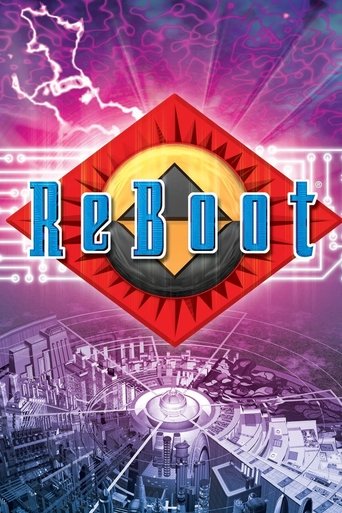
ReBoot
1994 · TV series · 30 min episodes · 4 seasons
Created by John Grace, Philip Mitchell, Gavin Blair, Ian Pearson
Science FictionFantasyAnimationActionAdventureKids
Bob, a guardian from the Super Computer, helped by his friends Dot, Enzo, and dog Frisket, defend the digital city of Mainframe from evil computer viruses that seek to dominate the city and infect the entire net.
6 positive6 neutralfrom 12 commenters
Where to watch
No streaming data for this title.
13 comments on Hacker News
Reboot has been posted to youtube[1] and twitch according to the notes on that YT page.
In a reddit post on the above[2], I came across information that there is an 8-part documentary[3] on Reboot coming out from September 24th, along with a remaster of the series soon.[4]
1. https://www.youtube.com/watch?v=cyKRWU_Bdvk [country restricted]
2. https://www.reddit.com/r/videos/comments/1fcew8l/reboot_the_90s_animated_show_is_streaming_on/
3. https://www.youtube.com/@ReBootRewindDoc/videos
4. https://www.reddit.com/r/ReBoot/comments/1f2ltql/the_d1_decks_and_the_reboot_master_tapes_a_faq/
It was the first CGI music video done by the folks that would do the first CGI TV show. I still have a soft spot for Reboot from my childhood
> Happy 30th anniversary, ReBoot! The series first aired on September 10, 1994. It was a groundbreaking triumph in the field of animation, and its legacy continues to this day. Check out the very first episode newly re-mastered in HD!
Kind of OT, but FWIW... a very fun series was ReBoot. An animated series set inside a computer.
In one exemplary episode, the user initiated a reboot of the machine and this set off an entire string of song & dance numbers by the system's inhabitants.
Those pictures remind me of the TV show on cartoon network toonami ReBoot.
Talk about a blast from the past.
Reboot was one of the first completely 3D CGI television shows, starting in 1994 .[0]
"The recordings are on a rare digital tape format called D1, a technology that Weldon said was cutting edge and rare when Mainframe was using it. ... Weldon and Lin have since put out a call on social media for a working Bosch BTS D1 deck that would allow them to play the tapes, and incorporate them into their documentary." [1]
[0] https://en.wikipedia.org/wiki/ReBoot
[1] https://globalnews.ca/news/10194517/reboot-documentary-digital-master/
> Not really. Just look at windows. I press the windows key, type reboot and it gives me a link for the movie ReBoot. The Windows design is a joke. There must be something else going on, OP.
FYI in Windows lingo you want to "restart" rather than reboot.
“You know, strip clubs weren’t really like how they show them in the movies” remarks the geriatric millennial as they turn away from ReBoot reruns for a brief moment, “not the most romantic of places back then.”
"the worst case scenario"
"The network could be severely throttled for weeks"
That's exactly what would stabilize it instead of it having the wild multi-hundred dollar swing it's experienced essentially since inception. It's the wild hashing power China currently holds right now that's giving it the dominant influence over the currency. Reduce the dominance, spread the risk, stabilize the currency.
This is like a basic lesson that was taught in the TV series "Reboot" with Dot Matrix vs Captain Capacitor - Diversification.
Production cost is a problem, and technology has made it worse. Look at that long, long list of animators and technicians at the end of any effects-heavy film today. A cast of thousands.
In the late 1990s, when I was working on physics engines for animation, I was talking to a major Hollywood director. He'd done some of the first films that had both live and photorealistic CGI characters. He wanted to get the cost down, so he could make $20 million movies. At $20 million, he could direct; at $100 million, he was running a huge operation that had to have everything pre-planned in great detail.
His model was the early CGI cartoon, "Reboot". Reboot was a weekly half hour cartoon made by a staff of about 30. He wanted to get to that level of productivity at theater quality - make a 2 hour film in a month with 30 people.
That didn't happen. Not even close.
It's been tried. "Sky Captain and the World of Tomorrow" started as a low-budget picture rendered on Macs. In that film, if nobody touches it, it's CG. Ended up costing $70 million. Worldwide box office $50 million. Fail. "Iron Sky" was made for €7.5 million. Worldwide box office $11.5 million. Fail.
There were successful low budget directors in the past, Roger Corman being the prime example. (His autobiography is titled "How I made a hundred movies in Hollywood and never lost a dime".) It's harder to do that today. Viewers today expect incredible production value. Most TV shows have more production value today than 70s movies did. Hollywood has so many people on set because they bring a team together on short notice to do a job, then disband the team. They need many competent people with different skills to make that work. If you cut corners, it looks like Youtube crap.
On big movies, we've mostly replaced set painters and carpenters with people who sit at workstations and do the same job with CG models. "Big" is now cheap, but "detailed" remains expensive. Procedural visual content generation can generate good landscapes and vegetation now (check out SpeedTree), but as yet, nobody has been able to procedurally generate one convincing block of a city street seen at ground level. Making GTA V cost $265 million. Not seeing an incoming reduction in production cost.
Netflix has no huge advantage. HBO is in the same position - they make content to sell to their own customers, and know exactly what sold. Data collection is retrospective. Trying to figure out what movies will be box office failures in advance remains hard. That's why Hollywood generates so many sequels - predictability.
In the 1990s, when I was working on animation software, I was told something like that by a major Hollywood director. He'd directed some of the early films that had both animation and live acting. The costs were high. What he really wanted was to get the overhead down, so he could make first-rate films for about $20M.
At the time, "Reboot", the first all 3D cartoon, was being cranked out at one episode per week by 30 people. He was hoping the technology would let him produce feature films with a similar sized staff. The idea was to pull in set models from a "digital back lot", green-screen in the actors, and go.
The technology didn't deliver that. Instead of a cast of thousands of actors, we now need thousands of animators. Look at the credits for any action movie today. There's just too much custom modeling, artwork, move matching, and manual editing of the edges of clipping paths. (The last two are outsourced grunt work and likely to be automated soon.) Viewers wanted photorealism, and that requires as much detail work as set-building.
People have tried to do CG action features on the cheap. "Sky Captain and the World of Tomorrow" was supposed to be one. But that cost $70 million, and only made $54 million. (The semi-noir look didn't help. Done better, it might have been a franchise like Captain America.) Iron Sky (budget $10M, box office $8.1M) almost a decade later had much better effects; the CG isn't as obvious.
Other than low-budget horror features, most notably "Paranormal Activity", there haven't been many successful low-budget action movies in recent years.
Reminds me of a http://reboot.wikia.com/wiki/Null, somewhat. (1987 graphics tech is about right for a 1994 TV show.)
I babysit a lot of my friend's kids (lacking kids of my own, I'm available for this) so I get to watch A LOT of children's TV. Perhaps its just an "in my day..." sort of bias but I do feel like the 90s were of higher quality than content of today.
Most hit shows of the '00s till today are invariantly tied up in trying to peddle toys of some kind. Certainly older shows were used for merchandizing but it seems like today the toy comes first and the show is developed around it. Plot development is optional and stories need not build off one another or refer back to past episodes. Out of those the early seasons of Pokemon and Digimon weren't bad and there are certainly a few neat shows on Disney & Nickelodeon (The Fairly Odd Parents and Sponge Bob come to mind).
Aside from that it seems like a lot of shows lack the complex story telling of shows like Batman: TAS, Superman: TAS, Spiderman, Beastwars, Reboot, XMen, and the others mentioned in the article. While not really a kids show (seriously - watch this as an adult and its 10 times funnier), Freakazoid outdoes most content peddled to adult audiences.
Another thing I've observed that seems to be detrimental to animated shows is the rise of cheap soap opera style live animation in place of cartoons. Probably the biggest example is Miley Cyrus' early career (Hannah Montana, etc). These shows let companies monetize in more ways since you can create concert movies and albums and the fanbase will follow the actor/actress to multiple shows. Benda Song[1] has spent nearly a decade jumping between various TV shows on the Disney channel (and playing a pretty good 'crazy girlfriend' in the Social Network IMO). I'm sure there are many other examples (all the faces seem to look the same between Disney's shows) but she stands out to me since she's seemingly the only cast member my age in shows filled with 12-16 year olds.
[1]http://en.wikipedia.org/wiki/Brenda_Song