 Hacker Cinema
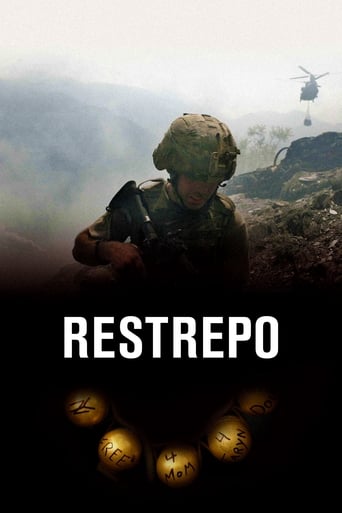
Restrepo
2010 · Film · documentary · 93 min
Directed by Tim Hetherington, Sebastian Junger
Directors Hetherington and Junger spend a year with the 2nd Battalion of the United States Army located in one of Afghanistan's most dangerous valleys. The documentary provides insight and empathy on how to win the battle through hard work, deadly gunfights and mutual friendships while the unit must push back the Taliban.
16 positive1 mixed8 neutralfrom 25 commenters
Where to watch
No streaming data for this title.
26 comments on Hacker News
The article is written by Sebastian Junger, an author and documentary-maker who co-directed Restrepo with Tim Hetherington. He also used to own a bar in Manhattan called The Half King.
When Hetherington was killed in 2011, The Half King was soon filled with Hetherington's incredible war photography, which was an odd thing to look at if you were there for a quick pint after work, but a good way to remember an incredible photojournalist.
>The whole growth experience is leaving quite a few people in difficult situations after.
This is true. It’s not a cakewalk for everybody. But the dichotomy of some of those difficult situations is they can both foster growth and simultaneously stress is an individual. I think some would say that stress/sacrifice is a necessary precursor for that growth. Unfortunately, sometimes the stress exceeds the individuals coping mechanisms.
The book Tribe gives an interesting perspective on military service. The author wrote it after his personal growth (and stress) from creating the documentary Restrepo about the outpost of the same name in Afghanistan.
In no particular order:
- Inside Job - https://www.imdb.com/title/tt1645089/
- Planet Earth - https://www.imdb.com/title/tt0795176/
- Restrepo - https://www.imdb.com/title/tt1559549/
- The Tillman Story - https://www.imdb.com/title/tt1568334/
- Chernobyl (??) - https://www.imdb.com/title/tt7366338/
- Hoaxed - https://www.imdb.com/title/tt8991264/
Sebastian Junger’s work is relevant to this, and after a decade of thinking about happiness and looking back on my own experiences and others, he lays out explicitly what I couldn’t put into words. His book Tribe is worth the read, and he has two documentaries on Netflix, Restrepo and Korengal that touches on the issue lightly.
It answers the question of why cancer patients can miss being sick, why soldiers miss being on the frontlines and why I was happiest living in a third world hole in a beat up apartment vs the luxury I’m living in now.
Also check out Korengal, another documentary that picks up where Restrepo left off:
https://en.wikipedia.org/wiki/Korengal
Restrepo is a 2010 American documentary film about the Afghanistan war.
The 2nd Platoon is depicted defending the outpost (OP) named after a platoon medic who was killed earlier in the campaign.
The huge success of this film and what separates it from the hundreds of other war pictures is that Junger puts us right in the middle of the action without any political agenda. He simply decides to film these groups of soldiers who have been deployed to one of the most dangerous locations in Afghanistan and lets us experience their day to day lives without making any pro or anti war comments. We are allowed to see a small glimpse of what the American soldiers have to go through and how they live amongst the villagers. In a way Junger allows the soldiers being filmed to tell their own story. We experience what they are going through in this dangerous war zone and how they interact with the local people. The cinematography is actually quite astonishing and I really felt like I was there with the soldiers.
The movie isn`t pro or anti war; it simply places the camera in the middle of the action and lets us experience what is going on. No one`s opinion about War is going to change: those who favor Americans involvement in Afghanistan will still do so after watching this documentary and those who don`t will still feel the same because the directors don't try to manipulate us into thinking the way they do. There aren`t any personal opinions about politics or war; it's all about experiencing what these soldiers have to go through every day whether or not they actually understand what they are fighting for.
It is only 90 minutes long so it is really worth your time.
https://en.wikipedia.org/wiki/Restrepo_(film)
Spraying would be effective at destroying poppies in Afghanistan. There's nothing technical stopping poppies from being eradicated in Afghanistan, it's political more than anything. Opium cultivation in Afghanistan has been tolerated by the US and Afghan governments for a variety of reasons.
The USA discovered in the Vietnam War that destroying people's livelihood isn't a great way to win hearts and minds. Unfortunately half of Afghanistan's GDP comes from opium and heroin.
The Afghan government doesn't want to eradicate opium production because half of the government is involved in the opium trade.
The Russians actually wanted to spray the fields back in 2010, but the USA declined [1].
ISAF actually specifically avoided destroying poppy fields, if you watch documentaries from the Afghan War, like Restrepo or The Battle for Marjah, you'll see American troops just walking right through poppy fields and doing nothing.
[1] https://www.reuters.com/article/uk-nato-russia-afghanistan/nato-rejects-russian-call-for-afghan-poppy-spraying-idUKTRE62N56U20100324
This is a compelling long read. If the subject is of interest, the movie Restrepo and this talk from Sebastian Junger [1] may be of interest, too.
[1] https://www.youtube.com/watch?v=wn0zEBhvwXY
Yeah, maybe...
I think the problems are far easier to explain. Watching the documentary Restrepo, I was surprised to see how terrifyingly stupid American GIs are at anything but actual warfare.
The most telling scene was a meeting they had with the local "elders". This was in one of the most isolated valleys, even by Afghani standards. They were talking about a road to be build, and promising jobs for the locals.
Yet it was absolutely clear that these villagers did not even share the concept of a "job". They were goat herders mostly, and possibly some farmers. I'd bet that not one of them is a wage-earning employee or worker. They simply tend to their family's animals.
"Trade" is probably understood in these places, "jobs" is not. They tried to win over the local population with promises entirely based on an American POV.
In larger cities, such promises might have had a better chance to succeed. But I think it's instructive to look at the only people whose "hearts & minds^ the US actually managed to win: translators and other local employees tend to be the US' most ardent supporters. That's maybe due to the money they got, yes. And there's some selection bias at play, as well. But if I had to guess, I'd say simple, honest day-to-day social contact had the most influence.
I think the Us military should form a brigade entirely made up of hippies that can play instruments, like to talk to strangers, can play soccer and basketball, grow weed, and are good petting dogs and getting children to smile.
Generation Kill is unwatchable, in the sense that you'd rather see the characters die at the hands of Freddy Kruger or Jason Voorhees, than bother to care about, oh, i dunno, a plot line or whether it's based on real journalism?
Same goes for The Hurt Locker, among others. So many, are simple emotional pandering, set against a dubious backdrop, without dealing with the premise of the backdrop. American Sniper simply feels like an effort to influence, even with Clint Eastwood's involvement (or perhaps even more so, with it).
Live from Baghdad is a shade too early, and the wrong Iraq war, but captures the joke-like atmosphere of the post-hoc rationale for even going to war in the region.
Similar era war movie, but different conflict, is Restrepo, which is a documentary. And, unfortunately, maybe it's accurate enough to be completely unflattering. No one appearing on screen is particularly charismatic or inspiring, and so too the story it tells is uneventful, no surprises.
But these jingoistic movies suck because very nearly all movies in general mostly suck. Everything seems like long-form, substance-lacking music videos, or student exercises in cinematography and digital effects editing. Oh well. Keep waiting for any good movie, but don't hold your breath. They are few and far between, since the advent of digital production techniques.
It's just how things are now. Now that all footage makes it make it past the film-developer-chemical bath, it's easy to undo, and selectively retry. It's too easy to make a movie, so it's very easy to make meaningless movies.
Wasn't Iraq rather overshadowed by the subsequent events in Afghanistan which does have some superb movies (Kajaki, Restrepo, Korengal, Bitter Lake....).
in a forward operating base there are firefights every day.
see: restrepo, korengal films.
Perhaps that is mostly because Junger's documentaries are all around American troops. I also highly recommend Restrepo, and the follow up, Korengal.
The author makes some very good points.
The British were able to control vast swaths of the world with minimal military power. They fought smart.
I remember watching Restrepo and other similar documentaries. I come from a tribal culture too; and there were several instances where I could clearly see how the Americans were making a mistake in their dealing with the locals. Those people have been living and dying by their tribal codes for millennia, and "democracy" and "freedom" means nothing to them.
Minor nitpick: it was GHW Bush who committed US troops to Somalia, just as he was leaving office, in December 1992; a nice welcoming present for Clinton.
Edited: It was pappy Bush, not Dubya. Thanks @theorique :)
Mountains. Observation posts linked by foot trails. The film "Restrepo" shows this very well.
Full Metal Jacket.
• Three Kings.
• In The Valley of Elah.
Good Morning Vietnam.
A Few Good Men.
Platoon.
• Jarhead.
Casualties Of War.
• The Men Who Stare At Goats.
The Deer Hunter.
The Thin Red Line.
• Syriana.
• The Green Zone.
• Stop Loss.
Also, • HBO's "Generation Kill".
(•'d relatively recent movies)
I don't think "The Hurt Locker" was particularly critical of the military and didn't count it. Also not counting documentaries like "Restrepo".
I hereby dispute the idea that the DOD has made it impossible for big-budget Hollywood movies to criticize the US military, and suggest instead that the bias Hollywood in favor of the military is responding to customer preferences and not leading it. Given what I presume to be America's default position of "supporting our troops", I'm struck by how many films Hollywood produce that challenge that default.
Remember also that Hollywood confronts at least two vectors of consumer preference in marketing films: first, Americans (in the large) have a (typical) diffuse nationalistic home-team support for our overseas adventures, and, more importantly, there's a less-political less-issue-oriented reverence expected for the sacrifices made by the young people we send into combat which is especially intense during times when large numbers of people are serving in combat zones. In other words, it's especially tricky to criticize the military during active conflicts.
Also, Three Kings is a fantastic movie.
Restrepo was already at the top of my lists with the book, photo book and movie, but after Hetherington died it has ascended to a special place all its own.
I liked First In, but I also read Jawbreaker and I have trouble separating the two in my mind. I don't remember the order that I read them in but even as I was reading the second book I was often unsure if I was rereading the first book or reading the second. The experience was not that unlike reading any of the Robert's Ridge books. There is a report from the Army War College that I have been meaning to read but I have lost the citation.
If you like reading about A-Teams the non fiction "Lions of Kandahar" was an exciting read. But my favorite book on the subject is a work of fiction: The Degüello. If you have not read it I highly recommend it.
As far as winning the war goes we could not win the AfPak war by only winning in Afghanistan. No amount of effort is going to keep my lawn weed free as long as my neighbor's lawn is a forest of dandelions.
One of the major problems that occupying forces have had in Afghanistan is that modern military strategy fundamentally isn't designed for taking and holding ground. Outside of the bases in Afghanistan, there is not one square meter of ground that is "owned" by the coalition.
That is almost 100% false. For example, read the on-the-ground account in Junger's book War (and the related documentary Resprepo).
The whole aim of the Restrepo outpost was to control entry to the Korengal Valley, and take and hold control of the ground.
It kind of worked for a short period of time, but ultimately failed.
Nevertheless, the strategy was to gain control of the ground, then hand control over to local Afghan forces. There were some fairly significant failures in implementing that strategy though - not least that the government put in place to replace the Taliban was notably worse in many respects for the local population.
Restrepo nor Armadillo really stuck with me. I'll admit I've seen way too many of these kinds of documentaries, even to the point of not being able to tell them apart. The PBS ones are quite good. Two that stands out of the top of my head is Blood and Dust and Bulletproof Salesman, the later being mostly about Iraq.
http://www.aljazeera.com/programmes/peopleandpower/2011/09/2011915105947578551.html http://www.imdb.com/title/tt1186201/
If you liked this video you might also like:
* Armadillo[1] a documentary about a group of Danish soldiers deployed to Helmland. Armadillo is right up there with Restrepo in my opinion.
* The Dancing Boys of Afghanistan[2] if you are curious about the bacha bazi boys.
[1] https://en.wikipedia.org/wiki/Armadillo_%28film%29
[2] http://www.pbs.org/wgbh/pages/frontline/dancingboys/
An article about the reasons infantry fire or not:
http://www.historynet.com/men-against-fire-how-many-soldiers-actually-fired-their-weapons-at-the-enemy-during-the-vietnam-war.htm
I read somewhere (citation needed!) that the percentage of soldiers who deliberately fire their weapon at the enemy has increased from WWI to the Iraq conflict, which some put down to violence in movies and video games. After watching excellent Iraqi conflict documentaries like Restrepo and Armadillo (Danish movie) and seeing how soldiers react to conflict, there could be merit to that argument.
---China:
Last Train Home http://www.imdb.com/title/tt1512201/
Up The Yangtze http://www.imdb.com/title/tt1114277/
Discovery Channel - The People's Republic of Capitalism - 4 parts series
China Rises, 4 parts CBC series
---Megacities:
Megacities http://www.imdb.com/title/tt0169024/
BBC Megacities, BBC 3 parts series
---War:
Fog of War: http://www.imdb.com/title/tt0317910/
Restrepo: http://www.imdb.com/title/tt1559549/
The best documentary I've seen in a while is Restrepo (2010) [1,2].
Probably the best insight you can get on a platoon's experience in what is (or rather, was) probably the most contested area in Afghanistan.
[1] - http://www.imdb.com/title/tt1559549/
[2] - http://en.wikipedia.org/wiki/Restrepo_%28film%29
Tim Hetherington directed & produced the popular documentary 'Restrepo', which follows the deployment of a US Army platoon mostly in the Korengal Valley.
It was a pretty neutral, sobering glimpse into the war, whether you're for or against.
http://en.wikipedia.org/wiki/Restrepo_%28film%29
Ugh.
Restrepo is an incredible film. My younger brother is a freshly-minted second lieutenant in the Marine Corps, so I'm very thankful that there are people like Tim in the world who can help people like me see what soldiers go through.
If you've missed these, here are a few on Netflix Streaming that I really enjoyed: Restrepo, Brother's Keeper, all the "Up" (7 Up, 35 Up, etc.) documentaries, Harlan County USA.