 Hacker Cinema
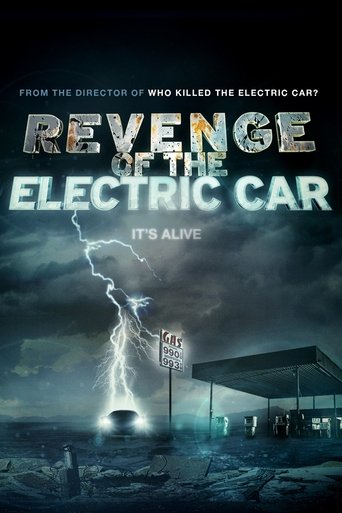
Revenge of the Electric Car
2011 · Film · documentary · 90 min
Part of Electric Car Collection
Directed by Chris Paine
A sequel to 2006's Who Killed the Electric Car?, director Chris Paine once again looks at electric vehicles. Where in the last film electric cars were dismissed as uneconomical and unreliable, and were under multiple attacks from government, the auto industry, and from energy companies who didn't want them to succeed, this film chronicles, in the light of new changes in technology, the world economy, and the auto industry itself, the race - from both major car companies like Ford and Nissan, and from new rising upstarts like Tesla - to bring a practical consumer EV to market.
5 positive2 neutralfrom 7 commenters
Where to watch
No streaming data for this title.
12 comments on Hacker News
The sequel Revenge of the Electric Car is a very interesting follow up, especially now with hindsight. It followed the stories of the Tesla Roadster, Nissan Leaf, and Chevy Volt all in about the exact same time period and stages of development.
Of those, the Leaf is the only model that has continuously existed since then, and from the documentary there is a sense of that. GM admits the Volt was a stepping stone and not the final product. Tesla's part of the documentary involves a lot of trials and tribulations and even Tesla seeming unsure about their manufacturing problems. (Though the documentary itself spins a hopeful tune.)
Of the figures in the documentary the most prescient seems to be Carlos Ghosn, then in charge of Renault-Nissan. He very much insisted that EVs weren't just the future, they were the scramble for the present. Renault took that message to heart and seemed to be the side that won it in the messy divorce that also eventually wound up with Ghosn getting charged for treason and embezzlement in Japan. Which is an incredible and weird story on multiple levels and maybe the documentary makers will get a chance to include that in a third movie for the series.
See perhaps the 2006 movie:
> Who Killed the Electric Car? is a 2006 American documentary film directed by Chris Paine that explores the creation, limited commercialization and subsequent destruction of the battery electric vehicle in the United States, specifically the General Motors EV1 of the mid-1990s. The film explores the roles of automobile manufacturers, the oil industry, the federal government of the United States, the California government, batteries, hydrogen vehicles and consumers in limiting the development and adoption of this technology.
* https://en.wikipedia.org/wiki/Who_Killed_the_Electric_Car%3F
And from the same director in 2011:
* https://en.wikipedia.org/wiki/Revenge_of_the_Electric_Car
See perhaps 2006 movie:
> Who Killed the Electric Car? is a 2006 American documentary film directed by Chris Paine that explores the creation, limited commercialization and subsequent destruction of the battery electric vehicle in the United States, specifically the General Motors EV1 of the mid-1990s. The film explores the roles of automobile manufacturers, the oil industry, the federal government of the United States, the California government, batteries, hydrogen vehicles and consumers in limiting the development and adoption of this technology.
* https://en.wikipedia.org/wiki/Who_Killed_the_Electric_Car%3F
And from the same director in 2011:
* https://en.wikipedia.org/wiki/Revenge_of_the_Electric_Car
>Either way it's just surprising they didn't help design the standard and work to make it better.
Oh so you have a good deal to learn. You should start with
- Who Killed the Electric Car? (2006 film)
- Revenge of the Electric Car (2011 follow up)
Let me tell you that when Tesla entered the market as a serious player, the rest of the industry did not intend to let Tesla have their say nor to collaborate with them. Tesla had to make their own (better) design and find their way through. They could not wait for standardization when the rest of the industry was fighting tooth and nails against the transition to EV.
GM has most of its EV facilities in Michigan (Detroit), so they have some skin in the game of supporting the Midwest winter lifestyle. Winter testing was very important to them when building the Volt, according to the documentary Revenge of the Electric Car.
I recommend the follow up film as well, Revenge of the Electric Car. (It follows the launches of the Chevy Volt and Nissan Leaf, as well as the first production run of the Tesla Roadster.)
The Volt was in development quite prior to the bailout. The Volt was developed for selfish reasons by an executive to leave an electric legacy behind, not to curry favor with the American polity. Revenge of the Electric Car is a good documentary with first person glimpses into the Volt development/launch (as well as the launch of the Tesla Roadster and the development of the Nissan Leaf).
GM branding seems to want to continue to imply that their electric vehicles are better than their "mainstream models"; showboating is marketing. GM has also said (per the link above) that they expect to have the first "mainstream" electric in the ways the car industry would define it (high volume, reasonable profits). GM isn't just now responding to "market demands" because they anticipated them years ago, and in some ways have been working to create those market demands that Mercedes and VW are just now feeling.
VW, on the other hand, also is responding to the American polity. The US has graciously allowed VW to use the fines the EPA should have charged for "dieselgate" to instead go (and only go) to electric vehicle development.
A great follow up documentary is Revenge of the Electric Car from the same documentarian. He was invited to witness the launches of the Chevy Volt, Nissan Leaf, and Tesla Model S.
The King of California (the fact you can believe in something and not let obstacles get in the way.)
Indie Game: The Movie
The Revenge Of The Electric Car
just to name a few...
You ought to watch "Revenge of the Electric Car" (it was available on Netflix streaming last I checked). Even for a documentary that's as ra-ra about EVs as it is, it shows how much blood, sweat and tears Musk has gone through just to get this far. It's been no cakewalk.
> Is it really a replicable test?
Yes.
> They'd need the same weather patterns, traffic conditions
Okay.
> and the same car
Find an honest 3rd party who already owns the same model.
> not a different, "equivalently equipped" model.
Now you're just being obtuse. Consumer Reports gets to test a car that's the same model. They're not required to come to your house and test your car!
> In the documentary Revenge of the Electric car, there's a scene where Musk walks into a warehouse full of cars, all having different issues preventing shipment.
That's a completely different car! They were taking Lotus bodies and fitting them out with batteries and motors, somewhat by hand. This one is built on a bona-fide assembly line and designed to be electric from the ground-up. Sorry, but this is a huge stretch.
> For all we know, there was a problem isolated to the particular car Broder drove AND, at the same time, Broder was embellishing his story. In other words, the truth is somewhere in the middle.
I'm sorry, but this tactic of thinking of all the confounding things you can, then throwing up your hands and saying "middle!" is the sort of thinking you expect on Fox News or on the playground. If replicability can't settle such debates, then science is in deep doodoo. However, we know from the history of science that it can settle debates 10X more acrimonious than this.
To be fair, you are right that the truth is probably somewhere in the middle. Exactly where is important and something we can get a good locality of through replicating.
>> If a bunch of other journalists replicate the trip
Is it really a replicable test? They'd need the same weather patterns, traffic conditions and the same car (untweaked or modified since Broder's drive), not a different, "equivalently equipped" model.
In the documentary Revenge of the Electric car, there's a scene where Musk walks into a warehouse full of cars, all having different issues preventing shipment. For all we know, there was a problem isolated to the particular car Broder drove AND, at the same time, Broder was embellishing his story. In other words, the truth is somewhere in the middle.
Of course, we'll never know because we'll never get access to the raw logs.