 Hacker Cinema
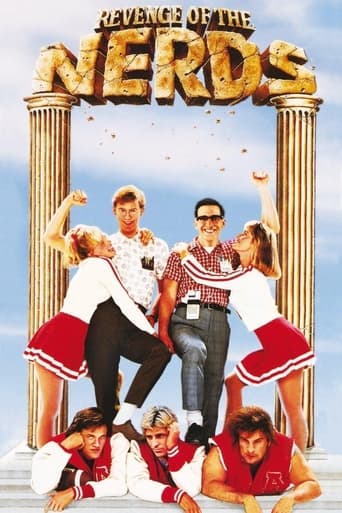
Revenge of the Nerds
1984 · Film · 90 min
Part of Revenge of the Nerds Collection
Directed by Jeff Kanew
At Adams College, the jocks rule from their house on high, the Alpha Beta fraternity. So when a group of socially-challenged misfits try to go Greek, they're instantly rejected by every house on campus. Deciding to start their own frat to protect their outcast brothers, the nerds soon find themselves in a battle royale as the Alpha Betas try to crush their new rivals.
6 positive8 negative28 neutralfrom 42 commenters
Where to watch
No streaming data for this title.
43 comments on Hacker News
In the movie Revenge of the Nerds, they basically rape someone. So I dunno, being a "nerd" doesn't necessarily imply you're also a good person. Mark Zuckerberg is definitely a nerd, and he's also a piece of shit.
I also think its another variation of that trope that the people that seek power are the very ones you don't want to have it. And those that don't care about it are the ones we need to seek it. Take Woz for example.
The "Revenge of the Nerds" movie series follows this arc too - when them being oppressed to becoming the oppressors.
> When you get bullied in American public schools for being a "nerd" and liking science and math, your country doesn't exactly produce a lot of state-of-the-art STEM professionals. You get a small handful of exceptional people who overcame the adversity but that's it.
Is bullying nerds still happening? It was commonplace when I was young in the 1980s. (In fact, it was so common that it was the basis of the 1984 movie Revenge of the Nerds.) But I had thought the social status of nerds and geeks had leveled up a few times since then. Did the level-ups not happen?
Ya I'm shocked by it too, said as a Gen Xer born in the late 1970s, occasionally a Xennial.
I partied for 4 years of college which is something like 30 years in sober adult terms. Our ragers were reminiscent of Animal House and Revenge of the Nerds, all of those old party movies that didn't age well. Scenes from Hackers, Fight Club, The Matrix, Trainspotting, Go, Swingers, Made, 200 Cigarettes, SLC Punk, Dazed and Confused, PCU, even Undergrads (a cartoon) were so spot-on for campus life, living for the weekend. Can't Hardly Wait, American Pie, Varsity Blues, Waiting, Superbad, etc came later, and I almost consider those watered down versions of the feral partying that happened earlier just as the internet went mainstream, but still canon.
A Friday night at my city's bar scene today looks like what our Sunday or Monday was. People half tipsy on 2 drinks, even though they're Ubering home later. The faint scent of ganja now instead of basements filled with smoke and first timers trying laughing gas. Nobody puking or disappearing around a corner to relieve themselves. No sound of bottles shattering. I feel like a curator of a museum now, a derelict from a forgotten time.
In fairness, I went to college in the midwest, where there was nothing else to do. Now the West Coast has effectively legalized drugs, awakening much of the country to the full human experience, and people have done the trips and plant medicine and maybe realize at a young age that alcohol and tobacco are rough drugs that tear you up. Which is admirable, but they also prepare you for getting torn up as an adult. To miss out on learning how to make your way home on drunk logic before you black out seems like a crucial rite of passage has been lost.
And it shows. In our country's embrace of puritanical politics like we saw in the jingoist 2000s, regentrified for the antivax era. In the worship of unspoiled beauty, idolizing of influencers, pursuit of financial security over visceral experience. In the fanboyism, bootlicking and drinking the kool-aid for every new evolutionary tech that cements the status quo instead of freeing the human spirit in a revolutionary manner. I gotta be honest, most of what's happening today is laughable to my generation. Blah I sound like a Boomer. Ok cryable then. We're in mourning. We worry about the kids today. All work and no play and all that. It's killing our souls, and theirs.
I guess my final thought after writing this is that partying is one of the most powerful reality-shifting tools in our arsenal. All of this can't be it. This can't be how America ends. You know what to do.
My first celebrity crush as a kid. She's also in _Revenge of the Nerds_. Those two movies made young-me think that being a geek could be cool.
Revenge of the Ninja
All the Chuck Norris movies
All the Schwarzenegger movies
Goonies
Flight of the Navigator
Revenge of the Nerds
It really started around 1994 with Netscape and then the dotcom cultural mindset that valued ability over credentials.
Also at that time, as you say, there wasn’t a broad cultural awareness of the money to be made in quantitative fields. In fact this was the era of Revenge Of the Nerds movies and glorification of the idiot jock getting a business degree and the passionate nerd being the butt of the joke. You really only went my route if you were a total fuck up loser. Now the social view of things has completely pivoted.
I would say interestingly the middle school kids optimizing their resume only make it so far in industry. They’re never really passionate about what they’re doing they’re just laddering. At some point they shift to management or product or something. At the top firms though the people who really make the money and whose opinion has ultimate power are the fuck up losers who live and breathe their passion and would do it for free if that’s all there was.
I was surprised to see Cars listed as one of the ones that people generally hate. I’m a little biased because my son absolutely adored that movie, and I have fond memories of him taking his Lightning McQueen toy around with him everywhere. But over many repeated watchings both my wife and I agreed it was a quality production.
It has a good cast with Owen Wilson, Bonnie Hunt, Paul Newman, and even Larry the Cable Guy puts in a pretty decent performance. The minor characters are charming, too (including George Carlin and Cheech Marin).
The story is fairly timeless and reminiscent of Doc Hollywood. I don’t know how they manage to make it work so well with anthropomorphic cars, but somehow they do. The main character has a good arc, and there’s a good amount of nostalgia. I don’t think I ever cried, but I definitely felt something - which is more than I can say for the Cars sequels.
Would I go and watch it now without kids? No. But Pixar put out a movie that entertained kids and adults alike. Earned $462 million at the box office. Made an absolute killing in merchandise sales (and I thought the toys were pretty high quality, especially the die cast Tomica cars here in Japan). I have a lot of respect for what they were able to do with Cars. Not so much for the sequels, though.
They also call Monsters University a mediocre sequel, but I tend to prefer it over Monsters Inc. Pretty much for the same reasons as Cars - good cast, timeless story reminiscent of Revenge of the Nerds, and my kids loved it.
No so broad a notion of 'culture', mainly cultural 'content'. This can be, and it is tweaked (worldwide), as needed. Cinema/TV in US has always been a leading indicator of societal change, rarely a lagging indicator. So it has always been, in a sense, understood and used as a pedagogical platform.
They actually tried this in US starting in late 80s and 90s, when we got a slate of 'geeks who get babes, and social acceptance' movies - War Games, Real Genius, Revenge of the Nerds, Weird Science, Hackers, etc.
[p.s. didn't finish that thought! /g]
But imho this was the wrong set of adjustments. The inducements - sex, money, and social acceptance -- are certainly attractive, but any kid with half a brain can note that there are far easier and certainly more exciting ways than learning -- culturally celebrated ways, yo -- to get that very same set of inducements. It did however get us to the geek hero celebrity stage, with Jobs and now Musk.
[edits]
> It is certainly inappropriate to say today. It may have been closer to being acceptable in 1985,
It was not.
> Remember, this was only one year after the movie Revenge of the Nerds was a lasting hit
Holy non-sequitur Batman!
It is certainly inappropriate to say today. It may have been closer to being acceptable in 1985, when it (allegedly) took place. Customs and morals change with the times, sometimes more than we want to imagine or recall.
Remember, this was only one year after the movie Revenge of the Nerds was a lasting hit (it spawned one theatrical sequel and two more TV sequels). Viewed with today’s eyes, the movie is unequivocally terrible, with rape perpetrated by the movie’s protagonist being played for laughs, among many other things. But it was not viewed as terrible by audiences at the time. However, the people who liked the movie at the time, and even the people who made the movie at the time have presumably changed in the intervening years, and may not deserve to be judged by something they did forty years ago.
Check out "Steve Jobs: The Lost Interview" which is long form footage from the clips used in "Triumph of the Nerds" and "Revenge of the Nerds". Two fantastic documentaries that chronicle the history of personal computing.
I can tell you as someone that graduated college in 92 that being nerdy as a kid in the 70s/80s it was very different from that, at least in my area of the world (Midwest USA).
If you want a not very distorted glimpse of what it was like watch the movie, "Revenge of the Nerds".
This article reminds me of the Simpsons episode where Homer goes to college and expects it to be exactly like Animal House and Revenge of the Nerds.
It's my understanding that the causality went the other direction; that "nerds" were a clear youth subculture in the 60s and 70s, and this subculture inspired all of the 70s-90s movies about them even as the term "nerd" broadened far beyond any concrete set of characteristics. If you had to pick one movie that contributed the most to fossilizing the image, Revenge of the Nerds has to be it.
The word marginalized gets thrown around too much, it's the wrong word to use.
Unpopular would be the better word. We were nerds. Revenge of the Nerds was about people like us: https://www.imdb.com/title/tt0088000/
I know that when I came across an article where Wil Wheaton was complaining about CUPS and how bad printer drivers were in linux I was tickled pink.
Over time, as society became more aware of the value this industry brings, it's brought it more mainstream and also brought a lot more people into it (different types of people). But at the time I think the other posters assessment was spot on.
Like you, I never cared either, but I also think what they said is true.
> The culture wars the republicans have been running on since the 80s turns off thoughtful people - anti-intellectualism
There was plenty of anti-intellectualism in the US in the 70s. The movie "Revenge of the Nerds" wasn't made in a cultural vacuum. Neither was "Animal House". Sports heros have always been worshiped, not so with intellectuals (other than Einstein).
Much of this changed with Bill Gates. He was derided for being a nerd for years, until he made so much money people stopped laughing at him.
What came first? Was the cast of Revenge of the Nerds all males because nerds were males and art was depicting reality, or did only men start becoming nerds become this movie had an all-male cast? I get being envious of people who had a head start with computers and feeling behind. I had zero coding experience before my first CS class in college. It sucked, but I grinded through it. It's relatively easy to catch up with determination. Probably going to be an unpopular opinion.
Perhaps we can start with reflecting our societal beliefs w'r't' this stuff via our media to reinforce peoples logical deductions of how to act in these areas. E.g. I think a friend showed me one of the 'revenge of the nerds' movies when I was fairly young, which, if you think of from a perspective this post is advocating, is basically just a movie about people being completely terrible, I guess. I mean, our brains are maybe basically similar to high capacity neural nets, especially before they gain the ability for logical reasoning (or if lost this ability for whatever reason via old age or idk, but seems possible), and thus gain an idea of 'what is acceptable' through the sum total of all relevant situations put in. This would be sort of an application of HN style tech to improving such situations on a more statistical level (I guess), rather than rigidly coding human behavior into a blockchain.
I mean, it would be nice, for the sake of all the people growing up today, if you took something like 'Total Recall' at 5:00 minutes and had them explicitly and robotically ask each other for consent. I think that would do a whole lot more good than having your tinder fling download a 20 gb blockchain onto their cellphone before the date. (Sorry to slightly make fun of this - I think the idea is good actually, and haven't played with it enough, but just wanted to make a point in this direction).
To address this app specifically though- wouldn't such an app not really matter in the direction of: you can always say 'no' during the course, and then the required behavior is to stop. I'm not sure if that would be reflected very well in the app, since the person could point to the consent and say it was given, when in fact, it may have initially been given, but the more important point was that it was (maybe the word is ) rescinded .
The "socially awkward" archetype of a computer programmer I think is mostly a western (probably American) cultural artifact
It was around that time in the 80s that "the nerd" or "the geek" became a staple movie character. Computers up 'til then had just been a piece of industrial machinery like a lathe or a microscope. Now they were associated with "losers". Richard Pryor in Superman III. Revenge Of The Nerds. Etc etc.
And by and large society was perfectly happy to relegate computing to these losers and shun them. Noone cared about the demographics of these losers, either, it was not "problematic". It's only recently when the geeks have built something that took over the world, that people are saying, hey, I didn't do the work or make the sacrifices but I deserve the rewards. That's where we get "brogrammers" et al.
If we're throwing around theories without evidence, what do you think about the fact that nerd culture, exemplified by movies from the 80s like Revenge of the Nerds, welcomes and glorifies young men who don't know how to talk to women? If women are less interested in computers than men, could it not be because we have created a culture that is unappealing to them?
To Joseph Campbell people identify with an in group and an out group. Have you ever empathized and cheered for a villain? Where in the psychology does that come from? A good story requires identifying with the protagonist or villain protagonist as a friend or someone we become emotionally wrapped in. Some stories we identify with the out group that we aren't in. First two movies that come to mind are the early Stars Wars and really to make this point is Revenge of the Nerds.
The story of Revenge of the Nerds was really needed at the time. Keep in mind at the time that movie was released gays were still hated, much more than today and yes there seems to be people in today's government who vocally hate gays. The movie causes us to identify with the nerds, to see how we might fit in as an individual, and to see how Lamar with his effeminate javelin throw is a member of our in group, our team.
Any larger community that doesn't accept gays are a bunch of idiots and there is a time and still large communities in the United States that don't. In that case the world is filled with idiots.
> The "we're in this together" spirit of films from the 1930s, 1940s and 1950s later gave way to a reflex shared by left and right, that villainy is associated with organization.
That's not true. First movie that comes into my mind is the Wizard of Oz from 1939. The witch with her obedient monkeys and the wizard are the antagonists. The Munchkins were not idiots or enemies in the film. They were hard working people who wanted to get through the day and take care of the their families (maybe not that exactly). They needed someone who was brave, smart, and compassionate, to help them face a problem. That is what the hero does.
"Society never works". This completely misrepresents what Joseph Campbell was explaining about these stories. He would say most people need to conform because they need at the top of Maslow's pyramid to belong but society only works if someone with a new and different idea to solve a problem for that era and time stands alone against the grain of all the people who submit to the status quo because their need to belong.
It's not that society are idiots. It's that most people need to conform. Also, society won't work if people didn't conform. Society doesn't need everybody to be a hero but only a few.
The movie, 'The Revenge of the Nerds' came out in 1984, after I had left my neighborhood, and for all of its silly comedy, was a sign that things were changing.
My parents and other parents in my poor, working class neighborhood saw education as the way to a better future, not just financially. Intelligence was berated by others in my age group in class. I don't equate education with intelligence, since I have met so many bright people who never finished high school (my father), and so many phDs whose intelligence I question to this day. That piece of paper, a university degree, can be earned with average intelligence, but costs a fortune for most non-public universities. As an acquaintance said to me about his son going to an Ivy league school, 'he's set up for life'. Regardless of his son's IQ, or final GPA, the societal strata he will interact with and form networked connections with, along with the school's reputation, will guarantee him a higher-than-average floor of entry compared to my children. For the record, I am not for that type of education.
If they want ideas for shows, how about life at uni, in the us, for the year 2016. Over here in Europe, we either get the view that it is like back in revenge of the nerds movies, or worse, stuff like this:
Http://www.zerohedge.com/news/2016-03-24/emory-students-scared-pain-after-safe-space-violated-word-trump-written-chalk
Hopefully it is not like revenge of the nerds in 2016, and hopefully it is also not full of students crying in "safe" spaces.
Might even be interesting!
In your previous comment, you demonstrated a much better understanding, and your arguments were likewise much better. This one sounds almost as an attack!
> Biologists for the large part disagree with you. It has no biological fact any more than saying that some dogs are short-haired and others are long-haired.
Either those biologists also deny that dogs have breeds and are painfully stupid, or they use "biological fact" differently than I do (I use it in the sense of "genetics").
> The reason why issues of identity don't concern you is that you seem to be part of a well known, large, and easily recognized subculture. You don't have to explain yourself to anyone because your identity is obvious to others.
I've no idea what you're trying to say here. I've been an abused "minority" most of my youth (before being a "geek" became cool), and I never had the need to explain myself. Most of those who scream about "identity" are not very tiny subcultures either.
> But look at the terms 'pretentious and fake' that you used. They are terms of identity, eg, people who act above their station are pretentious.
I use "pretentious" to mean "trying to impress by pretending", which is pretty much the dictionary definition that has nothing to do with identity.
> I get the idea that you are a social conservative, who believes that the terms you grew up with are somehow the correct terms and should not change.
If you say so... although I'm not convinced - I'm exactly the opposite of Wikipedia's description ("opposition to abortion, LGBT rights, gender equality"). I just oppose the politicization of speech; I oppose Pluto not being a planet any more and the widespread use of the word "terrorist" in media for the same reason.
> How did the term "geek" change, if not by force?
Was the mainstream media screaming that the term should be used in a certain way, and shaming those who disobeyed?
> Because I lived through the era when "geek", "nerd", and "dork" where synonymous, and movies like "Revenge of the Nerds" and "Real Genius" helped redefine what those terms meant in popular culture.
Aren't "geek" and "nerd" still synonyms? The only usage of "dork" I'm familiar with is as an insult, but then I'm not from the US so I haven't been exposed to the term a lot. The change of the meaning over generations isn't forceful, people simply die off.
> How do you reconcile your view that pride must be due to 'satisfaction about one's own actions and accomplishments' with your acceptance that someone may be 'proud of actions of other people'?
When you say "I'm proud of him", I understand that as (a) you think he can be proud of his accomplishments, or (b) you're proud of the influence you had on him that resulted in his accomplishments (e.g. parents being proud of their children). Being "proud of MLK" is fine, what he did was amazing, but being "proud to be black" is, as you suggested, illogical and unreasonable.
> As a reminder, the definition of "identity" I gave was in regards to 'what you consider to be a positive distinctiveness'.
This was regarding pride, not identity. Obviously, if we accept the premise that people should be proud of something they didn't do, they should also be ashamed of things they didn't do. Both of which are ridiculous.
>The difficulty with your purely descriptive interpretation is that it has no predictive power. [...] My identity is so tied in to being a programmer that I don't think I would accept even 3x my salary to stop being a programmer. [...] Your descriptive framework has no way to evaluate an emotional reaction like mine. [...] You expressed preferences. Preferences are at best the mildest form of identity.
I think this is it. What you call identity I call preferences (what you prefer). Further, I take goals (what you want) and actions (how you get it) into account. For example, your goals are programming (gives you intellectual pleasure) and money (assuming you want to retire). But your preferences are programming > money, which explains you actions. The difference is that I don't identify with my preferences, I observe or discover them. Then I adjust my actions to suit them. I've no attachment to them.
> You envy a woman's broader range - is it only your fear of social snubbing keeping you back?
That, and familiarity with male clothing.
> For that matter, there's a wide range of men's clothing styles. What keeps you from exploring them?
I avoid clothing that would be too much of a statement, which is how most people interpret fashion nowadays.
>And why wouldn't some feminists be sexually attracted to movie stars or athletes? I don't see how the desire to have equal rights for women in the workplace and in society has any bearing.
In addition to equal rights, feminists also try to abolish social roles. The irony being that it isn't working, as they still conform to them!
> in my view there is a clearly obvious biological fact that there are distinct races
Biologists for the large part disagree with you. The examples you gave derive from a cultural interpretation based on certain phenotypes. It has no biological fact any more than saying that some dogs are short-haired and others are long-haired.
If it's not clearly obvious to biologists, then it's much more likely that you do not understand the issue.
> I don't see "geek" as my identity
As far as I can tell, you don't recognize the existence of identity as a principle, which leads you to reject the idea that you have multiple identities. The reason why issues of identity don't concern you is that you seem to be part of a well known, large, and easily recognized subculture. You don't have to explain yourself to anyone because your identity is obvious to others.
But look at the terms 'pretentious and fake' that you used. They are terms of identity, eg, people who act above their station are pretentious. An equivalent term not based in identity would be "incorrect", as in "I find that incorrect and hence I dislike it."
Or look at how you reject the idea of sports geeks, like http://thesportsgeeks.com/ . If you ever saw the series "Sports Night", the character Jeremy Goodwin is a portrayal of a sports geek.
> I would object a forceful redefinition of the word ["geek"], such as what some people are attempting to do with "man"/"woman"
I get the idea that you are a social conservative, who believes that the terms you grew up with are somehow the correct terms and should not change. The problem is that terms, culture, and people change. The change is most obvious as a baby grows into adulthood and decides which identities to take on.
The term "geek", of course, has changed several times. I don't know what "forceful" means. Is a geek pride day 'forceful'? Quoting from a 1998 article at https://news.google.com/newspapers?nid=1933&dat=19980416&id=L5sgAAAAIBAJ&sjid=4WgFAAAAIBAJ&pg=6787,5237177&hl=en - "Dorks of the world, unite! ... Pocket-protectors are recommended ... it's time for geeks to come out of the cubicle ... 'There's a real pent-up desire to come forward'". Are the Stonewall Riots, which were part of the events that helped redefine "gay", not forceful?
How did the term "geek" change, if not by force? Because I lived through the era when "geek", "nerd", and "dork" where synonymous, and movies like "Revenge of the Nerds" and "Real Genius" helped redefine what those terms meant in popular culture.
> You can totally be proud of actions of other people ... I don't think that you're justified about feeling better about yourself just because your ancestors are great
It appears that you have changed your mind. Earlier you said 'I understand "pride" as a satisfaction about one's own actions and accomplishments, and as such I think that being "proud" to be black, or American, or Irish is stupid; be proud of the decisions you took and of the things you've accomplished, not of the way you were born.'
How do you reconcile your view that pride must be due to 'satisfaction about one's own actions and accomplishments' with your acceptance that someone may be 'proud of actions of other people'? Because to me it sounds like you don't have a good understanding for yourself of what pride means, and end up by using an argument that I've otherwise seen used mostly to dismiss "gay pride", "Indian pride", "black pride", "geek pride", etc. movements as being illogical and therefore unreasonable.
> I don't see a reason you should feel bad because your ancestors were shitty
As a reminder, the definition of "identity" I gave was in regards to 'what you consider to be a positive distinctiveness'. Feeling shitty is not positive, so your comments here are tangential to the topic of what identity means.
> s/he's just using the implied general knowledge about cultural/social standards about how managers (and the like) are expected to dress in most companies
Yes, "expected to dress" can be part of identity.
The difficulty with your purely descriptive interpretation is that it has no predictive power.
What would happen if tomorrow the job policies changed so that, starting next month, everyone had to wear evening gowns while at work? (Assume it's a company issued evening gown, made to order for each person, this is a non-customer facing job, and there is a changing room so people can change at the office.) Some people, including some men, wouldn't care. Others would. Some might quit, rather than see themselves as being a cross-dresser.
How do you interpret the protests that are likely to occur, using your descriptive framework?
Identity is a matter of degree. Suppose you told a programmer "if you quit your job I'll pay you the equivalent in income but you aren't allowed to program ever again." Some programmers would jump at the chance. I think about it in horror. My identity is so tied in to being a programmer that I don't think I would accept even 3x my salary to stop being a programmer.
Your descriptive framework has no way to evaluate an emotional reaction like mine.
You could apply the same economics framework to other identities. Those with a strong vegetarian identity (assuming no digestion issues) wouldn't eat a piece of bacon even if you offered to give them $1,000. Some might even prefer to die rather than eat meat. While those with a weak identity as a vegetarian might find it worthwhile. Or you can look at other enticements. The Jews were expelled from Spain in 1492. Some decided it was more worthwhile to stay, and became conversos. Some conversos was actually crypto-Jews, and continued to keep their Jewish identity despite the likely brutal consequences.
Your descriptive framework doesn't explain why the Jews in Spain didn't simply convert en masse to Catholics. The identify framework does.
> People do strongly identify with being a Jew, so it is an identity of sorts, but in the end, it's largely a voluntary choice.
Umm, yes. Identity is all about voluntary choice.
> stereotypically feminine
You expressed preferences. Preferences are at best the mildest form of identity. You might prefer long-haired women, but would likely not break up with someone who gets a haircut, nor would abstain from sex for years should short hair become popular again, such that effectively no available women have long hair.
> I dress like a man (1) because
Yes, dressing as a man is part of your identity. How is my statement incorrect? What would it take for you to start dressing like a woman all the time? You envy a woman's broader range - is it only your fear of social snubbing keeping you back?
For that matter, there's a wide range of men's clothing styles. What keeps you from exploring them?
> Women still crave masculine men
What the ... ? Seriously? You linked to a People magazine article about two people? How is that proof of anything?
If it's proof, why don't you accept my example of how some UK men think that the men in Stockholm "dress like girls" as a counter-example? One of the comments in that thread posits the exact opposite as you, saying "to get a girl..look like a girl lol".
And why wouldn't some feminists be sexually attracted to movie stars or athletes? I don't see how the desire to have equal rights for women in the workplace and in society has any bearing.
Unfortunately for the author, the numbers simply don't support the narrative she wishes to paint:
> The percentage of women studying computer science actually has fallen since the 1980s. Dr. Cheryan theorizes that this decline might be partly attributable to the rise of pop-culture portrayals of scientists as white or Asian male geeks in movies and TV shows like “Revenge of the Nerds” and “The Big Bang Theory.”
CS degrees took a huge jump from 5,000 per year in 1975 with 18% being women to 39,000 per year in 1985 with 37% being women. Perhaps she should ask what caused that.
I'll tell you what--Punchcards, COBOL and the PDP/Vax. Suddenly everybody put their accounting systems on computers, and you needed people who could program them or feed them data. And that required keyboard skills--which were taught to women because every high school had secretarial classes (typing/shorthand/dictation). And, right around when the decline started happening (1984/1985), those secretarial programs all got wiped out.
Perhaps if we start training women to be secretaries again, we'll fix the CS enrollment problem (CAUTION: I'm being sarcastic here about drawing stupid conclusions that fit your desired narrative).
In addition, if you look at Master's degrees awarded, you find that the percentage of women earning Master's in CS is about 28% and has bounced around that number since 1985 and been around 30% since 2001. The percentage of PhD's going to women in CS has been gradually increasing every year since 1977 or so and stands at 21% in 2010.
These aren't the statistics for a field women are having difficulty entering (take a look at electrical engineering for that ...). The fact that female CS undergraduate percentages crashed in 2005 is a bit concerning (similar downblip in EE--wonder what the issue is), but that should be a local cause that should be discoverable rather than systemic.
References: http://www.nsf.gov/statistics/nsf13327/content.cfm?pub_id=4266&id=2 http://www.nsf.gov/statistics/nsf13327/pdf/tab33.pdf
There's also the aspect, that I seldom see mentioned, that being a "nerd" was considered unattractive/uncool in the 80s (in part because of movies like "Revenge of the Nerds").
To be fair, that's been the stereotype for quite a while. Remember Revenge of the Nerds movies?
Here the articles points to childhood experiences with hardware, commodore 64s, etc. However, i think this is absolutely nonsense. Now, many people go into college with little idea of what they want to do. Perhaps this is a result of the expansion of college from building a unique skilled career path, to simply being expected.
When talking about demographics and college degrees, i think popular culture is certainly relevant. We are talking about high school and college freshmen discovering themselves. Thus, i'd like to point out that 1984 is the same year the film Revenge of the Nerds came out.
Thus, i'll throw out the hypothesis that, since 80's popular culture was a very regressive era in terms of anti-intellectualism, desire to enter STEM probably took a serious hit at the time in general, much more so with women. That is not to say that previous generations were much better, but gone were the days where the space race inspired tons of kids to pursue STEM education regardless of gender.
Note that Autism and Asperger's Syndrome are "male dominated". Something like 4:1.
If you have a field toward which nerds gravitate, it will become male-dominated.
What happened around 1984? Yes, home computers were becoming much more common as the article aptly notes.
But what else? It was becoming obvious that the people who flocked to these things most, who outright related to these computers, were nerds.
Popular culture latched on to this instantly!
What was on the big screen and on TV?
- War Games (1983)
- Superman III (1983) - Major character is a computer nerd played by Richard Pryor (August "Gus" Gorman).
- Riptide TV Series (1983) [1] - Major character Murray "Boz" Bozinsky is an utter nerd
- Whiz Kids TV Series (1983) [2]
When 1984 rolled around the trend went all out:
- Revenge of the Nerds (1984)
Nerd stereotypes were in the spotlight, as well as the connection between nerds and technology, especially computers. And that of course is going to have some effect on enrollment in fields of study having to do with computers. Young people respond to stereotypes in mass culture.
[1]: http://en.wikipedia.org/wiki/Riptide_%28TV_series%29
[2]: http://en.wikipedia.org/wiki/Whiz_Kids_%28TV_series%29
> Movies like Weird Science, Revenge of the Nerds, and War Games all came out in the '80s. And the plot summaries are almost interchangeable: awkward geek boy genius uses tech savvy to triumph over adversity and win the girl.
Movies like Revenge of the Nerds are not about nerds triumphing over adversity and getting the girls because they are nerds... it's about triumphing over adversity and getting the girls in spite of being nerds. Or, if the key to their success was really their brains, they used it to overcome an adversity that was caused by being nerds. If they weren't being nerdy and brainy, there would be no adversial story to begin with.
To implicitly suggest that movies like that are supposed to inspire people to become and continue to be nerds is asinine. It's a role reversal concept; not something that people believe happens in real life. The whole point is them being unlikely heroes and winners.
> Ordóñez got through the class but earned the first C in her life.
I guess this is supposed to evoke some "hitting a low" sentiment? The sheer horror of getting a grade that is technically right in the middle? Long live grade inflation, I give it an A+++.
Wait, wait. So a nerd wants to buy his way into the coolest nerd party of all? Sounds like the plot to the next revenge of the nerds movie.
Here's a fact: You can't buy cool.
I wonder if there's an age breakdown for people who hate/like the show. I'm well past the age where early high school is something I flash back to, so I'm perfectly OK with the show.
But if I were younger I could see myself hating it. I can say that the "Revenge Of The Nerds" movies did me no favors at that stage of my life.
Wow our culture today! My stars.
It's my interpretation that the protagonist in question provides oral sex to the lady and stimulated her clitoris in ways her jock boyfriend never thought or knew how to. It's my understanding she definitely enjoyed that. It is also my understanding that she was not too pleased to find out who was behind the mask at first.
It's further my understanding that Revenge of the Nerds II: Nerds in Paradise (1987) [1] intimates that they then became something of an "item" (in today's terms that means they dated!).
Finally, it's my understanding that it's a fun movie and not a manual for life.
[1] http://www.imdb.com/title/tt0093857
>In the great tradition of Revenge of the Nerds (1984)
In which the protagonist commits rape by fraud, dressing up in a costume of Betty's boyfriend, then having sex with her under false pretenses? Probably not the best movie to shine as a star of anything good sexually. (The peeping tom crap too)
Start thinking of it as a little penis. Treat it like one! It is much more than the "head" or glans.
In the great tradition of Revenge of the Nerds (1984) [1], we have been hacking the clitoris for a long time.
I especially am a fan of this: https://github.com/scanlime/arduino-lelo-remote
Hack the Clitoris!
[1] http://www.imdb.com/title/tt0088000/
Steve Jobs alone is more of a counter culture figure, with the ashram in India, and the drug use, and the whole garage story.
Zuckerberg was a kid from freakin' Harvard and Phillips Exeter. I think the Harvard thing alone disqualifies him from being a counter cultural figure, especially since he has always seemed squeaky clean and fairly intelligent.
As far as the nerds "winning" -- I thought that was the way of the world. Napoleon wasn't some giant, neither was Bill Gates. The idea that the jock's best years are in high school is a pretty well-known trope at this point, often used to comedic effect in movies like Revenge of the Nerds -- or TV shows like Married with Children.
Well-off kids doing well for themselves is hardly unusual or counter cultural -- it's more like that's what we would expect with the advantages afforded to them.
Think "Revenge of the Nerds" if it were a horror movie instead of a comedy.
This is exactly what I was thinking, while reading through the comments, the phrase "Neeerds!" kept playing in my head from the Revenge of the Nerds movie. The American culture has not been favorable to intellectuals socially, at least in my life time, 36 years. I believe most people tend to gravitate to what is socially acceptable. Also there is a sense I get from the political media, that intellectuals are to be demonized. Intellectuals generally seem to speak of complex problems, with complex solutions. Which are a hard sell in a form that seems to live off the 30 second sound clip, not to mention any ideological conflicts. And then there is the part where being an intellectual is hard work, it takes dedication, sometimes a complete lifestyle to gain, and maintain. Something that you'd have to put down the remote control, get off the sofa and go get. Its an up hill battle, TV, which is the most powerful form of dispersing to the people, what their culture is and thus, what they should be doing, to maintain their social status, is easy to do, more so than learning about a topic. Also the people making it, want to do what ever it takes, to make sure you keep watching instead. Then the people through ratings, tell the producers what they want to watch. So it is rather easy for this process to spiral out of control. The race to the bottom if you will. The internet has changed things a bit, it brought fame and glory to some smart people, the innovators and the builders, but I would still wager the vast majority is still tied up in social networking. Recently getting a twitter account I've noticed whats on TV tonight, seems to trend quite often.
I love stuff like this. I get so inspired when I see "Pirates of Silicon Valley" or "Revenge of the nerds" or any other movie/documentary about computer history. Please tell me if there's any other good computer history movies/documentaries!
Revenge of the nerds had programmers. God, I loved that movie. My younger brother liked it even more. Remarkably, my parents let him watch it over and over on VHS. Violent movies were more likely to get scrutiny: for an explanation, see "Hair" ;)
the chart is relevant, to us
it's the first movie intelligence solution application to be seen in the wild
movie intelligence in the next big thing, the new rave, en vogue and in demand
i hope to see the same done on another very interesting movie called "revenge of the nerds" if they ever make a sequel for that, which they should. the intelligence chart will include, the numbers of computers, servers, hand-helds, girls in bikinis and refference to Perl specially the line "it's scary the number of things you can do with Perl"
yes i once saw a perl script and it was indeed scary, all horror movies from now on should be written in Perl
Programming languages and movie intelligence will changes the cinema industry as we know it
next thing you know, you will go to the cinema and in the middle of the movie, you will be presented with a BSOD and the movie will restart