 Hacker Cinema
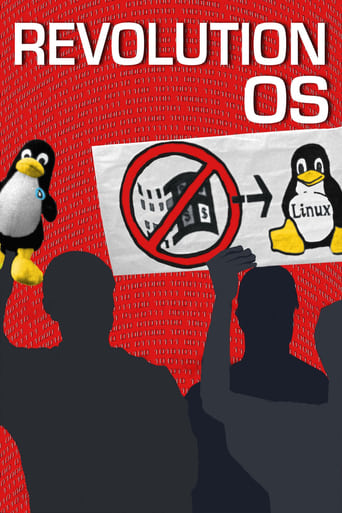
Revolution OS
2001 · Film · documentary · 85 min
Directed by J.T.S. Moore
REVOLUTION OS tells the inside story of the hackers who rebelled against the proprietary software model and Microsoft to create GNU/Linux and the Open Source movement.
25 positive2 negative2 mixed11 neutralfrom 40 commenters
Where to watch
No streaming data for this title.
42 comments on Hacker News
The gist is that every software comes with a license agreement, and the publisher can choose the conditions under which their software is available by specifying terms of use, modification, and distribution for their software.
Although, as the publisher, there are countless ways to which you can specify how restrictive or open these terms are, most industries usually have "standard" set of terms that most commercial license agreements follow, while a few Open Source Software Licenses are widely adopted. It's really inconvenient to ask end users to understand a non-generally accepted license agreement in most cases.
The history of software licensing mostly goes back to the 70s / 80s, before that time, IBM and mainframes typically gave away most of the software for free as did most computer enthusiasts. Bill Gates was somewhat controversial at the time for arguing software should not be free, in a letter he wrote to the hobbyist computer club (link to wikipedia below).
The topic of software licensing has since become philosophical, where some people think software should be free as in "freedom" and should benefit everyone. From a commercial perspective, some people see OSS as a way to grow adoption of their products. Others think it's important to charge for software in order to continue maintaining it.
Some resources: - https://opensource.org/licenses -> lets you search by criteria (greeter or fewer "freedoms" granted for different OSS license types.)
- https://en.wikipedia.org/wiki/An_Open_Letter_to_Hobbyists, arguably the letter that started the whole debate around software licensing.
- Documentaries: for the history, I would suggest Revolution OS, and Triumph of the nerds. https://en.wikipedia.org/wiki/Revolution_OS https://en.wikipedia.org/wiki/Triumph_of_the_Nerds
- first court case against a Chinese telco using cracked software was regarding EDA software, in case you're interested in learning how phone home technology came about: https://www.itca.com/news/using-friendly-jurisdictions-to-enforce-copyrights-in-difficult-jurisdictions/
We wrote a few other blog posts about this topic (about software IP protection) on licensespring.com/blog.
There's this amazing documentary on linux, from 2003. It's called Revolution OS. Highly recommended! https://www.youtube.com/watch?v=k0RYQVkQmWU
Revolution OS is a 2001 documentary about GNU, Linux, Open Source and the Free Software Movement.
It's a must watch for anyone and everyone interested in open source software.
Wikipedia: https://en.wikipedia.org/wiki/Revolution_OS, IMDb: https://www.imdb.com/title/tt0308808/, JustWatch: https://www.justwatch.com/us/movie/revolution-os
> Stallman is right once again that electric content/IP such as ebooks, movies, etc. are a bad idea
He also melodromatically states on his personal page that Netflix is a threat to freedom (https://stallman.org/stallman-computing.html).
Ironically, the documentary, Revolution OS, that he stars in, is not free https://www.justwatch.com/us/movie/revolution-os
It was 1994. There weren't that many jobs for UNIX-oriented C/C++ developers, working on large scale problems for the internet.
In 1994, MS-DOS and Windows 3.1 were the most popular desktop operating systems. Most internet access was dial-up. Windows 95 was yet to be released. Steve Jobs was working on NeXT and wouldn't return to Apple for another 3 years. The GNOME project didn't even start until 1997, which is 3 years later. Python 2.0 wouldn't be released for 6 years, in 2000. Heck, Netscape Navigator's first version wasn't even out yet (not for a few months) -- there were no distinctly popular browsers other than, perhaps, Mosaic, released only a year earlier.
No one was building web apps yet; pg started Viaweb in 1995, one year later. Internet commerce was not at all an obvious idea. Very few people were working on "internet companies", and very few people yet were working primarily on UNIX (outside of open source hobbyists). This job posting was appealing to UNIX enthusiasts and academic computer scientists who were hoping to turn their hobbies into a lucrative day job, in a world where 90%+ of "computer jobs" were rudimentary IT schlep.
The entire culture you describe in your comment -- of companies needing to distinguish themselves via strong benefits and mission alignment -- wouldn't grow up for a few years. This wasn't a job posting among a sea of web startup job postings; this was, instead, one of the earliest web startup job postings in a sea of enterprise IT management and DOS/Windows desktop software development postings.
The "competition" for these developers was startup versions of companies like Redhat and Netscape (maybe), of which there were only a handful of comparables. A good documentary you can watch to put yourself more into the mindset of this period of developer history is "Revolution OS" (2001): https://watch.amazon.com/detail?gti=amzn1.dv.gti.cf101954-e017-40e5-b1ad-b5a583f0228f (Amazon Prime Video) -or- https://imdb.com/title/tt0308808/ (IMDB)
The quote I always think about in such cases is from Bruce Perens in a movie Revolution OS who described the Open Source Definition rule about non-discrimination as: "There is no discrimination against people or groups. The example I usually use is, you can’t stop an abortion clinic or an anti-abortion activist from using the software." This is not an apolitical statement, it just says that ones judgement shouldn't influence who can use free software.
I'd recommend The Internet's Own Boy, Buckaroo Banzai, Real Genius, Office Space, or Bret Victor's Inventing on Principle ahead of Hackers and Sneakers.
Startup.com is pretty good as a movie about startups (I lived just about every minute of that movie, just at a different company) but it doesn't have any actual hackers in it.
I hear Risk and Citizenfour, both about Wikileaks, and Revolution OS, about Linux and the GNU and open-source movements, are pretty good, but I haven't seen them.
The Internet's Own Boy in particular has 8/10 on IMDB, 93% "Fresh" on Rotten Tomatoes, handily beating both Hackers and Sneakers, and is under a Creative Commons license: https://archive.org/details/TheInternetsOwnBoyTheStoryOfAaronSwartz which
I found it very hard to watch because Aaron was a friend of mine.
The Matrix is nominally about hackers (and even, like Hackers, computer security) but, as with Startup.com, hacking doesn't really enter into the movie much; instead it's all running firefights and magic disguised as computers. Like Hackers and Sneakers, it bears the same relationship to hacking as https://axecop.com/ (a comic scripted by a five-year-old) bears to law enforcement. However, it's enormously more popular than all the movies above, even if its Rotten Tomatoes ranking is lower than The Internet's Own Boy.
I hear Masters of Doom is pretty good but I haven't watched it.
Was just showing the subject to a youngster recently. Other folks mentioned the Code book, I liked that one. The MMM by Brooks of course. We also looked at the following videos on youtube/Kanopy and other places:
- The Story of Math(s) by Marcus du Sautoy to set the stage... school and taxes in ancient Sumeria, Fibonacci bringing Indian numbers to Europe, and other fascinating subjects.
- We watched short biographies of Babbage and Lovelace, full-length ones of Turing and Von Neumann. The "code breakers" of WWII.
- Top Secret Rosies: The Female "Computers" of WWII, another good one.
- There's more history in PBS' Crash Course Computer science, than you might expect. It is great although so peppy we had to watch at .9x with newpipe. Shows relays, vacuum tubes, to ICs, to the Raspberry Pi. As well as the logic gates they model.
- "The Professor" at Computerphile is a great story teller about the early days.
- There are great videos about CTSS being developed at MIT I think, where they are designing an operating system via paper terminal and trying to decide on how to partition the memory/storage: https://www.youtube.com/watch?v=Q07PhW5sCEk
- The Introducing Unix videos by ATT are straight from the source: https://www.youtube.com/watch?v=tc4ROCJYbm0
- The movie/book "Hidden Figures" touches on this time as well. Facing obsolescence by IBM, one of the characters teaches herself Fortran.
- The Pirates of Silicon Valley is a fun dramatization of the late 70s to 80s PC industry. It specifically calls out the meeting between MS and IBM as the deal of the century. We also watched a "Berkeley in '68" doc on Kanopy to set the stage before this one. Interesting, but a tangent.
- The "8-bit Guy" is also great, he dissects and rebuilds old home computer hardware from the same era, and teaches their history as he does it. Even his tangential videos on why there are no more electronics stores (besides Apple) in malls is great.
- There are good docs on the "dead ends" of the industry as well, such as "General Magic" and "Silicon Cowboys."
- "Revolution OS" a doc about the beginnings of FLOSS and Linux.
Two good ones that haven't been mentioned so far:
In the Realm of the Hackers (2003) https://www.imdb.com/title/tt1199631/
Revolution OS (2001) https://www.imdb.com/title/tt0308808/
Glad to see Revolution OS in the list! Helped me get through times in grad school when I'd get stuck on something working on my thesis. Grab a bowl of ramen and put this movie on!
I’m going to get downvoted into oblivion for this, but as a teenager who remembers when this happened, this always struck me as the absolute dumbest idea and the most useless of performative actions.
First, it was sponsored by a VC-backed company (that had hired a documentary crew to capture their success, the ill-fated VA Linux Systems (which eventually became known as Geeknet) and the pretty poor propaganda documentary “Revolution OS” that managed to just sort of forget the whole dot com collapse thing)), so although I know the LUGs were part of it, this was a marketing event by a company looking to boost their IPO. I didn’t know any of that at the time, but looking back, it’s so clear this was just yet another VA Linux publicity event.
Second, to anyone who wasn’t part of the group “protesting” — that is, outsiders — all you see is a bunch of weirdos dressed up with picket signs outside a sales office (they didn’t even go to Redmond) to demand action, only to be greeted what seem to be very polite corporate people with a sign and lemonade.
Third, it fundamentally changed nothing. It took the DoJ agreements to lessen the hold Microsoft had one some OEMs, but it really took the proliferation of Chromebooks (which was predicated by the short-lived netbook era) for manufacturers to get cheaper deals on Windows licenses and to offer more customizations of OS choice at purchase. That still had zero impact on Linux on the desktop adoption rates.
And sure, most bigger OEMs if you buy direct will let you customize a machine with no OS and sometimes with Ubuntu, but the Ubuntu XPS 13 isn’t much cheaper than the Windows variant (max $50), you just get more of an assurance that there is some sort of driver support for your system (although usually not for stuff like fingerprint readers).
So like, all I remember is that 21 years ago, some angry nerds showed up to an office park parking lot, got some free lemonade, were told politely to leave, and then went home with their cardboard signs screaming victory. When they didn’t get a refund. Didn’t change OEM terms, and had zero impact on OS adoption. OS adoption changed over the years but it wasn’t because of anything any of the people in that movement did, it was because of Apple and Google.
rms mentions ITS in the movie Revolution OS, I think
For anyone new to it I recommend watching revolution OS, it's about 20 years old at this point, and just ignore the part at the end about the stocks, but it has some good interviews with stallman, linus, and others. Including the great line of stallman accepting the linus torvalds award on behalf of the fsf. "It's like giving the han solo award to the rebel fleet"
I'm 33 now. When I was in 7th grade, the same friend who taught me how to build PCs (also my age) one day brought over a burned CD of Mandrake Linux. Back then Mandrake was a major distro like SUSE, Red Hat, etc. IIRC, it was the heyday of Windows XP. I can't remember whether I did dual-booting or just wiped my whole drive with Mandrake but after I installed it there was little going back to Windows... at least not until I got into PC gaming for a brief stint in my early high school years. Damn EverQuest and Morrowind.
I had already taught myself basic programming with VB6 at the time, so learning more and more about PC power-user stuff was very exciting to me. I remember KDE back then was a treasure trove of great software that just came for free, making Windows XP actually feel inferior. At some point around that time I watched Revolution OS, the Linux documentary. I think I heard about it on ThinkGeek. I must have watched that documentary at least five times then. I was hooked on open-source software and I finally felt like I had some direction in my life: I wanted to help out with the open-source thing any way I could. Suffice it to say, when I started my high school "webmastering" and Computer Science classes, I was closer to the teachers in knowledge than my peers.
I've been a full time Mac user since '06 for desktop use, however recently I've gone back to giving Arch Linux a decent try for my main desktop environment. Gotta say, Linux on the Desktop, particularly with KDE Plasma, is finally what I had hoped it would become. There was a stretch of time in the last 20+ years I've used Linux that every time I tried using Linux seriously there were some major software disadvantages that kept me returning to Mac such as ridiculous issues with Broadcom or Nvidia drivers, no modern-feeling text editor, generally clunky UX, etc. These days pretty much all the software I use is cross-platform, making it very easy make the transition stick.
I think the Linux for the desktop has a very bright future. Remember folks, authoring cross-platform apps that support Linux is very important!
The majority of that torrent was junk -- something like 20 GB of Microsoft's (freely available) patents downloaded from the USPTO, a couple of DVD rips of documentaries tangentially related to Microsoft (like Revolution OS), and a bunch of wacky conspiracy videos downloaded from YouTube (Bill Gates 5G nanoprobe vaccines, etc).
All of the actual content was available elsewhere as much smaller downloads. In particular, the Windows 2000 and XP leaks are distributed as a single 3 GB archive ("nt5src.7z").
It’s from a documentary (Revolution OS) and is an intentional edit to juxtapose the difference in the two men. The camera pans — Linus was presumably getting an award too. He’s standing off-stage, he’s not walking in while RMS is talking.
From the movie "Revolution OS" [1], Richard Stallman explaining Copyleft:
"If we put the software in the public domain, somebody else would be able to make a little bit of changes and turn that into a proprietary software package, which means that the users would be running our software, but they wouldn't have freedom to cooperate and share."
"And what we do is, we say, this software is copyrighted and we, the authors give you permission to redistribute copies, we give you permission to change, we give you permission to add to it. But when you redistribute it, it has to be under these terms, no more and no less. So that whoever gets it from you also gets the freedom to cooperate with other people, if he wants to. And then, in this way everywhere the software goes, the freedom goes, too. And it becomes an inalienable right to cooperate with other people and form a community."
Bruce Perens, on the choice of the GPL for Debian:
"Uh, it's one of the few software licenses that was written from the standpoint of the community rather than from the standpoint of um, protecting a company or um, as is the case with MIT and BSD license, performing the goals of a government grant program. Uh, and the GPL is really unique in that. It's not just a license. It's a whole philosophy that, I think, motivated the open source definition."
MongoDB tried to protect its company's profits, and as a result, Amazon [and its users] now have a proprietary product rather than an open source one. Could have gotten free fixes from the biggest lab in the world, but instead they're getting jack squat. And since Amazon's product is proprietary, now users and the community have less freedom.
Linus is asked at the end if he's bothered that he's not cashing out on billions of dollars of use, and he basically doesn't care. He just wanted people to work on the software. If Linux had the same licensing scheme, it may have remained a hobby operating system.
[1] https://www.youtube.com/watch?v=Eluzi70O-P4#t=17m
All documentaries by: Scott Noble (available free at his site http://metanoia-films.org/), Patricio Guzman, Werner Herzog, Adam Curtis, The Yes Men.
Other great documentaries: Man with a Movie Camera, Sherman's March, Burden of Dreams, Bus 174, My Winnipeg, How to Start a Revolution, Merchants of Doubt, Silenced (2014), the Corporation (2003), Man on Wire, The Parking Lot Movie, Land of Look Behind, Intangible Asset No. 82, Brasileirinho, Jodorowsky's Dune, Revolution OS, Facebookistan, The King of Kong, Kumaré, McLibel, Harlan County USA
Why? Because they're amazing, important, will change your life etc. Sorry I don't have hours to go into detail. Enjoy!
ps I found a lot of these by googling best documentaries lists, IMDb lists etc. I judge whether to watch movies/docos by reading 2 or 3 pages of user reviews on IMDb, occasionally Ebert or Urban Cinefile etc also.
Recommended documentary: Revolution OS - https://en.wikipedia.org/wiki/Revolution_OS
So good to see RMS being recognized for his work. A lot of my interest in computers is due to being inspired by RMS. stallman.org is a good resource for anyone wanting to learn more. Stallman's commentary on politics is also second to none.
_Revolution OS_ is a really good documentary that goes over the genesis of FSF and how Stallman played an in important role: https://www.youtube.com/watch?v=jw8K460vx1c
TL;DR Microsoft tried to leverage its desktop monopoly to become a browser monopoly to a server monopoly and thus own and tax and sanitize the early web, we wuz saved by Firefox.
The web freedoms we are losing today were hard won.
Back when browser choice was NCSA Mosaic or Netscape , Microsoft was ignoring the web as a fad - Gates thought little of it then - sounds crazy now but in the early 90's, before access was readily available outside Universities, BBS was dominant for the public.
The web was small then: registering a domain was altering a text file (no cost); SPAM didn't exist, every email was answered; all very university nice nice; ecommerce wasn't a thing.
Microsoft 'awoke' to the webs potential and gave away Internet Explorer for free ( Netscape's browser cost money to buy unless you used the latest beta ) - this is what the antitrust case of win95 was about - Microsoft leveraging it's monopoly ( no Linux back then ) to aquire browser share.
Why was this seen as a problem ?
Because of Microsoft's strategy of embrace , extend , extinguish.
It was feared Microsoft browsers would only talk 'properly' to Microsoft servers ( the server market was the 'big' money ) - thus Microsoft would dictate the web rather than Berners-Lee's democratic W3C.
Everone else would be shut out of spec by dint of Microsoft end user browser monopoly leveraged from it's Desktop monopoly.
This would certainly have slowed adoption as every site and every server would have to pay Microsoft's large costs - 1 server per site then so the Microsoft tax was then ~$2000, recurring, per site.
Then only way to compete with the behometh of Microsoft's developers & emerging browser monopoly was the Free (GPL) development model - Netscape gave away their whole browser business to the public domain, inspired by Eric Raymond's analysis of the power of the public domain to attract developers - "The Cathedral and the Bazaar".
Raymond argued that ensuring developer contributions couldn't be locked away by proprietry companies would attract developers. This had happened before with UNIX, necessitating GNU & LINUX.
The GPL, the Free software license of Richard Stallman's GNU toolchain, adopted by Torvalds for LINUX, was the model for a public domain that avoided the 'tragedy of the commons'.
The GPL ensured the 4 freedoms remained intact on downstream contributions.
Free GNU software meant basically: if you improve public code, you must give the source code of improvements back to the public domain.
Free Firefox ( in freedom & price ) coupled with the LINUX kernel (or BSD) and the GNU toolchain provided a Free server OS. With A Patchy Server ( renamed Apache ) this provided a way for the web to grow unencumbered.
They had to dilute Free by calling it Open Source as some business types feared Free (as in beer) & Freedom - but it was Stallman's GPL in all but name.
Imagine a building filled with floors of rackservers , if every server, every OS was forced to pay Microsoft rates - and perhaps also be content Microsoft didn't disapprove of.
Microsoft licenses in a Monopoly market - the web would have been strangled at birth.
Only for the wealthy and approvable - basically Encarterised.
Lillywhite rather than everything and everyone.
So the GNU toolchain and license, and LINUX kernel and (GPLed) Apache server meant that building of servers could be had for the price of traing staff - zero cost of entry, everyone gets to play.
A server farm could be set up by a devotee in a cupboard for zero cost rather than ~$2000 per site, ~yearly to Microsoft.
This is why Stallman is the granfather of all our freedoms.
He saw UNIX stolen and LISP crushed by and invented GNU Free toolchain early enough (80's) to have it useable to write the LINUX kernel and be a complete Operating System by the 90's.
The truth of the crappiness of the Microsoft web vision became the nightmare of late 90's early 00's web devs having to write for IE6 bizzaro HTML.
Yes the W3C became stagnant later and Mozilla support of legacy httprequest allowed modern web to AJAX, etc, HTML5 blah, etc, continual revolution.
Early public web culture was very BBS anarcho, democractic rules not central power - the public had after all built a functional web and email system without oversight or control - distrubuted over phone lines in the 1980's (q.v. FIDONet & BBS) before the gov & universities 'shared' TCP/IP. All early non-uni ISP's were BBS's.
Arguably the tie-down of broadband and 'mistrust thy neighbours surfing' crushed sharing access & many early freedoms & the anonimity of temporary copper dialup net & webbery ( crypto was an illegal munition then ).
If the web had failed, then we would be living in an info desert like the 1980s, where most people relied on newspapers & official propaganda was absolute.
Without the web Rupert Murdoch would now be absolute kingmaker and dissent to the big lies of authority would be absent without the blogosphere.
The freedoms we are losing today were hard won.
[ * ] sources, my greybeard.
[ ] references :
Jason's Scott's BBS documentary ep4 FIDONet https://www.youtube.com/watch?v=_Cm6EFYktRQ
"Revolution OS" - rise of Open Source https://www.youtube.com/watch?v=jw8K460vx1c
Yes Bill Gates is super nice now but he was ruthless to get there.
Does the 2001 documentary film "Revolution OS" represent the source of this claimed Richard Stallman quote? https://en.wikipedia.org/wiki/Revolution_OS#Quotes
If so, it seems the film has Torvalds making the quote and claim, not Stallman (?) From Wikipedia:
"Think of Richard Stallman as the great philosopher and think of me as the engineer."--Linus Torvalds
Highly recommended (though the Gary Kildall bit is very short):
- A movie: Pirates of Silicon Valley (https://youtu.be/BI-nzUIYIX4)
- A documentary: Triumph of the Nerds (https://www.youtube.com/playlist?list=PLudrw8Z7-gFa7Is4YZitOF7-AfLl2u8IA)
- Not involving Gary Kildall, but about open source, gnu, and linux: Revolution OS: (https://youtu.be/fxjElWL8igo)
Wargames
Hackers
Revolution OS
Freedom Downtime
Any/all Jason Scott movies
Short Circuit 2
I also made a short ~8min piece about GNU with Stephen Fry that I'm still fond of. http://gnu.org/fry/
That's somewhat oblique, easily attributed to misunderstanding (I'm not sure what actual question was asked - it's been a decade since I saw Revolution OS), and poorly thought out: a "Red Hat Linux" system at the time was running more GNU code than Linux code (and overwhelmingly more than Red Hat code).
Every damned other thing in there seems to argue precisely the opposite.
I defy you to find anything Stallman said (as opposed to characterizations by others, which could easily be deliberate or accidental mischaracterizations) that implies a position that a system without GNU code (or with insignificant amounts) running Linux should be called GNU/Linux. If such exists, then I will agree with you that Stallman once held the absurd position you attribute to him.
Edited to add:
"It came up in the documentary because there had been a huge firestorm over RMS saying everyone should call it GNU/Linux."
I agree that there was a huge firestorm over RMS saying everyone should call it GNU/Linux. I disagree with what that "it" refers to.
When Linus Torvalds was asked in the documentary Revolution OS whether the name "GNU/Linux" was justified, he replied:
Well, I think it's justified, but it's justified if you actually make a GNU distribution of Linux ... the same way that I think that "Red Hat Linux" is fine, or "SuSE Linux" or "Debian Linux", because if you actually make your own distribution of Linux, you get to name the thing, but calling Linux in general "GNU Linux" I think is just ridiculous.[34]
It came up in the documentary because there had been a huge firestorm over RMS saying everyone should call it GNU/Linux. Various allegations of 'usurpery' etc and generally bad feelings. Linus' counter, which he made in the documentary and I had heard in person at a Usenix conference was that if the GNU project made a distro (and this is still a valid point) where everything in it was free and wanted to call it "GNU/Linux" that would be great, but trying to change the kernel name from Linux to GNU/Linux is just silly (or ridiculous as Linus points out).
[34] ^ Moore, J.T.S. (Produced, Written, and Directed) (2001). Revolution OS (DVD).
I watched the mentioned 'Revolution OS' film on Netflix recently and it was extremely painful for exactly this reason. The icing on the cake was an excessively dramatic voice reading a fairly innocent letter from Bill Gates to a background of excessively dramatic music, it was enough to make me want to stop watching.
It should have Iron Man. Maybe also A Beautiful Mind.
Closer to home, if we're doing documentaries, Revolution OS maybe ought to be there.
If you're into this topic, there's a ready-made doc on the evolution of OSS available on Netflix called "Revolution OS": http://movies.netflix.com/WiMovie/Revolution_OS/60025132?locale=en-US
It's a bit old but at least includes the dotcom bubble punchline.
These are some movies/tv series that I deeply enjoyed and (some I) wish I had known about earlier.
9.9 Hitchhiker's guide to the universe, BBC TV series
9.9 Contact (1997) based on a novel by Carl Sagan. Very few people seem to know about this movie.
9.3 War Games
9.0 most Akiro Kurosawa movies:
Seven Samurai
High & Low
The Bad Sleep Well
Ikiru
Red Beard
9.0 Terminator 1 (watch again)
8.8 Terminator 2 (watch again)
8.7 Pirates of Silicon Valley
8.7 Matrix 1 (watch again)
8.7 The Italian Job (featuring Napster's original inventor)
8.7 Live Free or Die Hard
8.5 Track Down or Takedown (about social hacker Kevin Mitnick)
8.5 Revolution OS (2001)
8.5 Dr. Strangelove
8.5 2010 A space odyssey
8.3 Antitrust (2001)
8.3 Sneakers
8.3 COSMOS
8.2 Minority Report
8.2 2001 A space odyssey
8.2 Paycheck (2003)
8.0 The Thirteenth Floor (1999)
8.0 The Net
They kind of proved this from the day one. Interesting documentary on this topic is Revolution OS[1]. It is kind of biased and now very outdated but it is still worth watching. If you haven't seen it and you are interested in early history of OSS I recommend it.
1. http://www.imdb.com/title/tt0308808/
I was an engineer at Netscape through the period this documentary covers and it's one of my favorite (though bittersweet) documentaries. I wasn't involved in the development side, so my involvement with most of those featured was quite limited, but . . . what a great piece. I'd also couple it with (what I'm sure has been mentioned elsewhere, but I've not read that far, yet) Revolution OS ( http://www.youtube.com/watch?v=CjaC8Pq9-V0 ).
Here are some nerdy ones:
"BBS: The Documentary" and "Get Lamp" by Jason Scott are a couple great hacker docs, about BBSs and Interactive Fiction Games (though I would have to say they have a more Apple/wintel PC bent over other computers, but still historically interesting). Both have many great interviews with BBS and interactive fiction luminaries.
Tilt - The Battle to Save Pinball, this one covers the trials and tribualtions of Pinball 2000 the development of a digital/analog pinball hybrid. There's also The History of Pinball, its not as fancy but it's interesting.
The King of Kong is slightly entertaining about the world of Donkey Kong high scores and a peek into competitive arcade game competitions.
Revolution OS - About Linux/GNU kinda dry but interesting interviews.
Deathbed Vigil...and other tales of digital angst. Documents the last days of Commodore when it went bankrupt in 1994. I think mainly interesting to Commodore fans or folks who enjoyed seeing commodore fail...
My review of the computer documentary Revolution OS!
On the documentary side of things (all of which are available free/legally online):
1. "Code Rush", documentary about Netscape open sourcing Mozilla.
http://www.viddler.com/explore/coderush/videos/1/
2. "Revolution OS" was a pretty interesting documentary on Linux and the free software movement.
http://video.google.com/videoplay?docid=7707585592627775409&ei=xYF-ScDeJZPCqAOfkJizBA
3. "Freedom Downtime", a documentary about Kevin Mitnick. There's also "Track Down", but that's more of a fictional portrayal loosely based on him.
http://video.google.com/videoplay?docid=-6746139755329108302&ei=fIF-SceYCKS2qAO52Py1BA
From the movie "Revolution OS": http://video.google.com/videoplay?docid=7707585592627775409
"Revolution OS" (http://en.wikipedia.org/wiki/Revolution_OS) --- is a great movie about Linux and FSF, and it also features a story about "Cygnus Solutions" startup.
I recently watched the documentary called "Revolution OS" and became disenchanted with the guy as a personality.
(The movie is available on the NetFlix WatchNow service...ironically only if you run windows+IE+MediaPlayer.)
Startup.com was lame, it moved slow and had no point. I never did care at the end that their website blew up considering they never really explain why it blew up.
E-Dreams conversely was a better documentary in the same vein but harder to find. It talked about the rise and collapse of Kozmos.
Aadvark is lame. It's just a bunch of kids being hyper that they're working in New York with fancy schmancy big screen LCDs.
PBS also did a lot of features back in the 90's. Code Rush as someone mentioned and Revolution OS are both good to take a look.
In Search of the Valley http://www.stage4.co.uk/film/dvd_offer.php is also worth a look. The filmmakers examined why Silicon Valley is Silicon Valley and talked with quite a few well known people.
Dont forget:
- Forbin project ~ http://en.wikipedia.org/wiki/Colossus:_The_Forbin_Project
- E-Money with Cringely ~ http://www.pbs.org/opb/electricmoney
- Nerds 2.0.1: with Cringely ~ http://www.pbs.org/opb/
- NerdTV: Cringely interviews ... ~ http://www.pbs.org/nerdtv/
- Doug Englebart Mother of all Demos ~ http://ross.typepad.com/blog/2005/06/doug_englebart_.html
- More Doug Englebart ~ http://video.google.com/videoplay?docid=-8734787622017763097
SEEN
- Startup.com: 9/10: How things get all messed up b/w friends in startups, 'lets get to work'.
- Revolution OS: 8/10: Nerdy interviews with the GNU, Linux & Free software movement. Worth it to see Bruce Perens hair & Eric Raymonds 'we are your worst nightmare' speech to an MS exec in a lift.
- Pirates of Silicon Valley ~ 8/10: Very funny take on Gates, Woz & Jobs http://www.imdb.com/title/tt0168122
- The Triumph of the Nerds ~ 7.5/10: Cringley doing his stuff with web1.0 startups. Great to see Joe Kraus with Excite ~ http://www.pbs.org/nerds
- Apollo 13; 7/10: Brings back memories of my childhood & Apollo missions. Not long after I got this on DVD I got to see Jack Schmitt talk (last man on the moon). Best bit was on how they handled the complexity.
- The Fog of War ~ 7/10: Robert McNamara, how smart people can get fooled http://en.wikipedia.org/wiki/The_Fog_of_War
- Walking with Dinosaurs: 7/10: Ok
- E-Dreams: 6.5/10: Dark, gritty and how did they get all that money?
- Project Aardvark ~ 6/10: Uneventful, nerdy guys building co-pilot ~ http://www.copilot.com/
Documentaries for geeks or about geeks? The ones about geeks will probably be really boring. They'll leave out both the technical stuff and the potentially actionable war stories. "Revolution OS", for instance, was a well-crafted film, but pretty dull if you read Slashdot.
Branch out a bit. Off the top of my head:
"The Pleasure of Finding Things Out": Richard Feynman talks. (Danny Hillis pops up for a bit.)
"The Fog of War": a smart, reflective person discusses how he presided over a huge disaster.
"Lost in La Mancha": Terry Gilliam takes a bunch of risks to get a movie started and doesn't make it.
"Around Cape Horn": Captain Irving Johnson describes sailing around the Horn on one of the last windjammers.
"Walking with Dinosaurs": Woo! Dinosaurs!
"Apollo 13" is not an actual documentary, of course, but it's fun and reasonably faithful for a big-budget movie.
The Triumph of the Nerds http://www.imdb.com/title/tt0115398/
Revolution OS http://www.imdb.com/title/tt0308808/
Startup.com http://www.imdb.com/title/tt0256408/