 Hacker Cinema
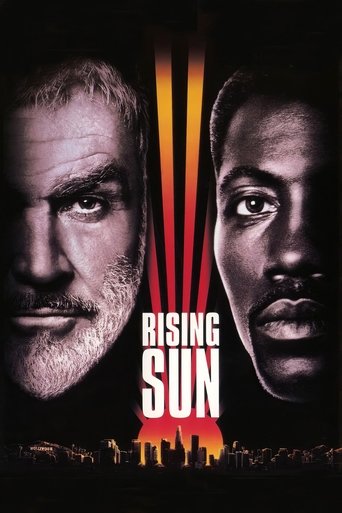
Rising Sun
1993 · Film · 129 min
Directed by Philip Kaufman
When a prostitute is found dead in a Los Angeles skyscraper occupied by a large Japanese corporation, detectives John Connor and Web Smith are called in to investigate. Although Connor has previous experience working in Japan, cultural differences make their progress difficult until a security disc showing the murder turns up. Close scrutiny proves the disc has been doctored, and the detectives realize they're dealing with a cover-up as well.
5 positive3 negative12 neutralfrom 20 commenters
Where to watch
No streaming data for this title.
20 comments on Hacker News
the USA was worried that Japan would take over/buy up the USA in the late 80s, esp. after Sony bought Columbia Pictures and Mitsubishi bought Rockefeller Center in NYC.
see https://www.businessinsider.com/japans-eighties-america-buying-spree-2013-1
and movies like Gung Ho, and Rising Sun, https://en.wikipedia.org/wiki/Gung_Ho_(film) and https://en.wikipedia.org/wiki/Rising_Sun_(1993_film)
I mainly associate that movie with Sean Connery's lecture on the senpai-kohai relationship in which, being Sean Connery, he pronounced "senpai" like "shenpai".
Rising Sun in both novel and film forms were written in a time of strong anti-Japanese sentiment, in which there was considerable fear that Japanese companies would gobble up American assets (real estate, businesses, etc.) till there was no domestic industry left. Japan really was the China of the 1980s. Of course, things didn't really stay that way; the Japanese economy stagnated but the popularity of Japanese media like anime, manga, and video games helped foster more positive relations between Japan and the West (especially the USA).
Take Rising Sun as a "product of its time" and it's really quite enjoyable.
The keiretsu are actually groups of related companies that cooperate, often around a central bank which is the core of the keiretsu. They are usually descendants of zaibatsu, which were the huge dynastic companies that were broken up after WWII, although some "new keiretsu", like Seven & i Holdings which administers, among other things, 7-Eleven's Japanese locations, have emerged.
I first heard the word Kereitsu in the movie Rising Sun with Sean Connery and Wesley Snipes. The movie involves large Japanese corporations and this word is used a lot. It's a great movie, well worth watching -- though I have no idea how accurate it is. It depicts large Japanese corporations vying for an American technology company.
https://www.imdb.com/title/tt0107969/?ref_=nv_sr_srsg_0_tt_8_nm_0_in_0_q_rising%2520sun
I don't think the tech war is the full explanation for the decline of Japanese tech; the failure to focus on software is a big one and seems to be due to internal factors such as conservatism and business models tied to sale of hardware.
However when the US combines it industrial interests with its state apparatus it is a formidable force; media described the Japanese society as authoritarian, bitter and racist - eager to get back the Americans after world war 2 - with the everyday Japanese being mindless warrior drones in a strict hierarchy. (For examples of this sentiment see the movies Black Rain or Rising Sun - or lookup the tragic death of Vincent Chin - a Chinese mistaken for being Japanese).
The US justice system ran a series of entrapment campaign targeting Japanese firms. And there was buy-american campaigns and extra tariffs were put on Japanese imports.
Ultimately the Japanese yielded. The plaza accord fixed the Yen at a very high price point hampering Japanese exports. And quotas were set for US exports to Japan and Japanese car factories were setup in the US.
And then in 90es you had the rise of now competitative tech firms from South Korea and Taiwan.
They have flying cars. See the documentary Red Sun (1993) (https://en.wikipedia.org/wiki/Rising_Sun_(film)). :-)
Reminds of the movie "Rising Sun"
> Isn't the premise of every one of his books "scientists fuck it up, leading to exciting circumstances"?
No, that's an inaccurate and uncharitable summarization of his literary career. Scientists fucking up covers some of his more popular works accurately, Jurassic Park more than the rest, but other stories have the scientists/doctors working hard to save lives, or otherwise behaving admirably. Sphere has the scientists accidentally acquire godlike powers, only to willingly relinquish those powers for the greater good.
In fact, in several of his novels, including Jurassic Park, I think there is stronger anti-corporate sentiment than there is anti-science sentiment. The book makes clear that the problems at Jurassic Park are caused by a corporation cutting corners to turn a profit on a complex system before pausing to understand what they were dealing with. In the novel, the park owner John Hammond is consumed by dinosaurs. For whatever reason the movie let him live, and otherwise tuned down the anti-corporate angle. In the book his idiocy and greed made him a villain, but the movie makes him seem like a cuddly victim. In the book the two heroes are paleontologists (scientists) who were not to blame for the disaster but nevertheless behaved heroically in their attempts to mitigate harm.
A similar theme is found in Airframe though, which covers the interactions between a crash site investigator trying to find a truth that's inconvienent to the airline (that the pilot was to blame.) It could have been about aircraft engineers or aerospace scientists fucking up... but it wasn't. Disclosure and Rising Sun are controversial for their own reasons, but both have prominent anti-corporate themes.
Then there are the novels that seem unrelated to the discussion at all, like Eaters of the Dead which was a retelling of Beowulf from the perspective of an Arab traveler from Baghdad.
I remember relatives in the eighties expressing worries about the Japanese buying up farmland, and the movie Rising Sun or whatever - the theory being that what Japan couldn’t do militarily they were going to accomplish economically. There was concern about Japan as an enemy but never solidly like we have with China today. As you say, Japan never stopped being an ally, and China is barely this side of detente.
The fear of Japan was also fossilized in the classic Crichton novel Rising Sun (1992, made a movie the year later). But it quickly became aged, as that was right at the tail of the mania.
The original Rising Sun book by Michael Crichton is a good read if you didn't know about it. Haven't seen the movie.
The late 80s were all hysteria about Japanese firms taking over America. You can see it in a lot of books and films from the era.
There's a really quite odd film called Rising Sun with Sean Connery and Wesley Snipes that has corporate espionage as part of the plot. 1993 release, which was actually just after Japan's economy slowed down.
"Rising Sun" was made into a movie.[1] It has some of the early MIT Leg Lab robots in it.
[1] https://en.wikipedia.org/wiki/Rising_Sun_(film)
I've tried to stick to "no excuses" ever since I watched Rising Sun in the mid '90es. When Wesley Snipes' character is late he starts making excuses to Sean Connery's character who promptly tells him to stop making excuses and "don't be late". It's not a very prominent quote from the movie or anything, but for some reason it just resonated with me. Perhaps because I tended to make a lot of excuses.
Nope
Do you remember a film titled Rising Sun?
Basically, they crashed and burned. This book and movie captures the paranoia that many Americans felt about Japan at that time.
http://www.amazon.com/Rising-Sun-Michael-Crichton/dp/0099233010/ref=sr_1_1?ie=UTF8&qid=1459297051&sr=8-1&keywords=Rising+sun
Not sure if I agree with the article, but I'm always fascinated with how the classics can relate to modern times.
I'm also old enough to remember 30 or so years ago when Japan was the rising power that terrified everyone (watch the film Rising Sun). We all know how that played out. I'm a Brit, but in matters like this I would never bet against America.
I don't mean to eye-roll, but Sam on economics tends to be, well, meh. The thing I always remind people when they say that China will take over the world is that everyone said the same thing about Japan in the 1980s (remember the movie/novel Rising Sun?). What happened?
Well, the mercantilist economic toolkit has an endgame. Neither Sam nor I knows when it's going to let them down, but building an entire economy on cheap labor and radical amounts of investment is hard to sustain. Eventually you need things like domestic demand and that requires wages, which short-circuits the export machine. Japan got caught in that trap, and China will eventually too.
Wow, I had no idea its that bad. I have never worked in India, but my Indian friends describe a similar environment in the Indian public sector - jobs for life, generally no job-hopping, no worries about money, company homes, company schools, company hospital, servants provided for, essentially just punch the clock, pretend to do some work & go home.
I wonder how the salaryman culture gels with the Japanese being so innovative. In Rising Sun (both the bad movie & worse book by same name), Michael Crichton make the claim that the Japanese are light years ahead of the US viz-a-viz computing/tech/optics/physics. There's a scene where Sean Connery walks into a physics lecture hall in ucla & points out that all the students are Asian while Americans are missing because they avoid hard subjects. If they are all boring homogenous salarymen, what's the impetus for being so innovative ? Any innovation by definition rocks the boat, so why do that ?
There is a fun Michael Crichton book (and a subsequent movie) that captures the "fretting" quite well IMHO. It's called Rising Sun.
I like his milder films, like Looker and Rising Sun