 Hacker Cinema
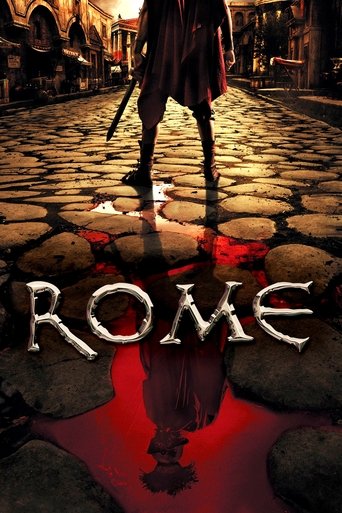
Rome
2005 · TV series · 2 seasons
Created by John Milius, Bruno Heller, William J. MacDonald
A down-to-earth account of the lives of both illustrious and ordinary Romans set in the last days of the Roman Republic.
12 positive1 mixed15 neutralfrom 28 commenters
Where to watch
No streaming data for this title.
29 comments on Hacker News
But I think the HBO series Rome captured exactly this, or at least as much as it could in brief span. The life and struggles of freemen and slaves, not just the emperor. One of the greatest TV series ever, and cut off in its prime after only 2 seasons. Full set of Rome built on Cinecittà studios!
Yes, very clever. I am familiar with SPQR as a common tattoo on Roman legionnaires from the (excellent) BBC miniseries "Rome". https://en.wikipedia.org/wiki/Rome_(TV_series)
You don't understand, it's terrible to censor movies but absolutely vital to make sure people can't make movies I disagree with.
edit: It's funny, I wouldn't be happy about a version of the old HBO series Rome reedited with anything gay taken out, but I'd be absolutely excited to watch a version of Queer As Folk with all the gay stuff edited out.
From the historical fiction TV series Rome (2005), Octavian/Augustus becomes Consul of Rome, https://www.youtube.com/watch?v=PbMKc17EtGI
George RR Martin once commented that he wished he could create a character like Rome's Titus Pullo (or something to that effect). Maybe Game of Thrones would have had a much better ending if the writer's of Rome had been in charge of it. Even though Rome ended abruptly in Season 2, it still ended in a much, much more satisfactory way than the crappy last seasons of Game of Thrones which really butchered the whole storyline with poor writing.
20 years ago HBO made the tv show Rome. They filmed it on analog film. I’ve recently been watching it for the first time and it’s absolutely amazing how well it looks compared to shows shot on digital from the same time. It looks good even compared to modern cinema and because it’s film they could do 4k captures.
For a recent movie, Strange Darling was filmed in analog. Great movie and looks unparalleled.
Dune was filmed on digital, transferred to analog, and the scanned back to digital for distribution.
I guess my point is, that there is some magic in analog. Whether the inherent limitations of the form, or by introduced randomness of the chemical process, or by placebo assumption of “realness”.
We live in an age of Netflix enforcing all shows to look exactly the same and even adding de-aging filters to actors. The gulf between the perceived reality of analog film and digital has never been larger. So yeah, analog excites me.
Wow, I totally didn't expect them to be actually this stunningly beautiful, despite the title!
I saw souvenir glassware explicitly featured in the HBO TV series Rome, which I highly recommend btw, and that's been something stuck with me. I don't know why, but I always thought of glass as a rather modern material.
I wish this was an episode in the ‘Rome’ (HBO - 2005) series. It’s a great watch nonetheless.
That would be an interesting production skill for an org to build out. I don't think anyone is really good at it and wind-down seasons are all over the place. Freed from the need to fit into the season templates you could also wind shows down with partial seasons or even an audiobook.
2 fun examples of coping with winding down are HBO's Rome, that "telescoped the third and fourth season into the second one" (https://www.reuters.com/article/televisionNews/idUSTRE4B00VV20081201/) and Blacklist's final episode before the pandemic shutdown that filled the gaps with animated storyboards: https://www.youtube.com/watch?v=O0nF4njky94
I remember wanting to watch the HBO "Rome" TV series when I didn't have HBO, so therefore downloading it from usenet in some weird text format - had to combine multiple large downloaded chunks using some tool chain I forget (I think rar was involved). Now, that was painful. Nowadays I'll happily throw a few bucks to whatever streaming service to watch what I want on my Roku TV.
As a movie fan, I despise Netflix's creative line. Their model is to create dumb TV Shows repeating the same concepts over +8 seasons with no real inherent concept. People just get engaged because it's what's closest and easiest to watch.
Now, said that, The Power of the Dog and Rome were two very good movies that somehow came out of Netflix. I don't think that CODA is such a turning point. All these services are pouring so much money into productions that sometimes they hit the bullseye.
TV shows are really pushing things too. Twenty years ago, a big budget show was a premium cable production like Deadwood ($4.5M/episode) or Rome ($8.5M/episode), but now you have mainline shows like The Crown, Stranger Things, and The Mandalorian, all costing $12M+/episode.
What's interesting that you see this come up in places in cinematic period pieces like Takeshi Kitano's Zatoichi remake, Oliver Stone's Alexander, the shows _Rome_ and _Spartacus_ on HBO. We _should_ have seen this in Zack Snyder's _300_ as well (Spartans allowed for same-sex relations in older/younger male mentorships in their warrior-aristocracy training, much of the lifestyles of Spartan citizens would be prohibited from being depicted) but that movie chose to be a historically inaccurate Triump of the Will of the straightest of straight male masculinity.
> What's your source for the claim that a typical Roman citizen is white? That's a pretty bold statement. Much bolder than the relatively non-controversial statement that Rome had a diverse population.
We're circling back to the definition of "white". How's that a bold statement? Today's Great Britain has very diverse population, too, including lots of people from Africa, and yet I wouldn't think that a statement that a typical Brit is white is controversial. Typical Brit is not black, although there are many black British people, of course. And even if we constrain discussion to the most narrow definition of "white" (say, 18th century Englishmen) let's not forget that English people are the result of centuries of mixing of Britons, Germans, Celts... So, white Britons are themselves of diverse ancestry, but all these diverse ancestral people are "white". Let me repeat that race is an artificial construct, but if I'm pressed to say if someone is "white" or "not quite white" I can only go by outside appearance. Someone in Europe can have some genes from one Zimbabwean ancestor, but if he "looks white" to me, I can only say he's "white".
> The problem is simply with depicting all of Rome as (essentially) British.
Yes. That is a TV series. The point of TV series (in my opinion) is not to be 100% accurate, it's to entertain and (somewhat) educate. And the people in TV series are not real ancient Romans, but current actors. The series is for British audience, so it's normal that it's filled with British actors. If the series was produced in Bulgaria, the senators would be played by Bulgarian actors. Both are not exactly of the same color spectrum as ancient Romans, but are close enough to pass as Romans to their viewers. If the series was produced in China, and Romans were played by Chinese actors, that would probably pass as normal to Chinese audience. Maybe Zimbabwean actors could pass as Romans, at least in sub-Saharan Africa; why not? I'm not sure why people insist so much that British actors are bad representation of Romans. They seem quite OK to me (I'm not British).
It's great seeing Livius getting some attention, and on hackernews of all places.
Ab Urbe Condita is really much more of an epic tale than a proper history book by modern standards, even though, as Deveraux notes, the later bits are probably more or less accurate in the big picture (e.g. the 2nd punic war).
Livius mostly wanted to create a sort of national romantic work with Ab Urbe Condita. He was a republican who wanted to look back to the glory days of the republic, even as Rome became an empire. With his stories, he wanted to create an ideal of Rome to set an example to other Romans. Livius preaches to Romans about Roman justice, cleverness, and honesty. Livius has his own agenda, he does not represent every Roman.
Luckily we have archaelogy and the historical method to help us. I feel like ancient history is trending (at least on the internet). There's hope for more TV shows with more diverse casting.
Great piece, wonderfully researched, I'm excited for the next article in the series.
It's ironic in this context that one of the most prominent non-Roman characters in HBO’s Rome, the enslaved Eirene, who speaks English with a thick accent, was played by an actress from… Rome:
https://www.imdb.com/name/nm1493547/
https://hbo-rome.fandom.com/wiki/Eirene
Have you watched Rome the TV show? I think you might enjoy it.
Some years ago, I watched some historical TV show (could be Rome?) where one of the characters has been diagnosed with some disease, so I wondered if they knew how to properly diagnose it at the time the show was set at. So I used Google to search for the disease to get to its Wikipedia page. Then I almost forgot about it.
For months after that, Google bombarded me with the links to the disease and cures and remedies and whatnot.
I remember even seeing that at my kid's gaming PC, and I don't remember ever logging in to my Google account there. We only shared the same IP in the household.
That's pretty anecdotal, I know, but that's what there is.
The TV series Rome (set around Julius Caesar's era) shows a guy orating/reading the daily news which was generally propaganda for whomever was in power, in the making of the accompanying the series, a consultant claims this was historically accurate. Several details in the series seem fantastical to modern viewers but have some historical basis.
SyFy's not at fault here. They don't produce The Expanse, they only have limited first-run distribution rights in the US and Canada. The producer, Alcon, retains all other rights to the show.
The Expanse is the most expensive TV show that isn't Game of Thrones--estimates are that each episode is approximately 70% of the average cost of GOT, which is currently the most expensive TV show in production. However, ratings-wise, it's not even the most popular show on SyFy, so the advertising revenue isn't that great for the channel. The low revenue, combined with the lack of alternative revenue streams (i.e., digital streaming rights, foreign distribution rights, etc.) means that the show has been a major money loser for SyFy and is one of the reasons that Comcast's cable unit has been underperforming the past 3 years. Alcon also decided to make the distribution rights even more restrictive when they came up for renewal this spring, meaning even less potential revenue for SyFy.
Rather than brand your pitchforks at SyFy for cancelling the show, you should give them credit for keeping it going for 3 seasons in the face of significant revenue losses. And you should blame Alcon for trying to blame hardball when it didn't have the leverage.
[Edit: Rome was actually the most expensive TV show; the average cost per episode was $9m over the course of its run. GOT's season 6 averaged $10m/episode and season 8 will average $15m/episode, but it's earlier seasons were relatively cheap. ]
Well the potential audience is small, that's true for most TV shows out of the bat which is why competition is so hard.
Any show that can't be turned on at a random moment for some entertainment will be at a disadvantage which is why various talk shows/entertainment shows are usually the most popular ones. And as far as serials go then vanilla shows tend to work best, this is why NCIS is one of the most popular shows even tho it's pretty darn dumb (I still like it somewhat, tho it used to be better, I can't deal with skinny Tim).
Scifi and Fantasy shows have not to only perform well but to outperform their competition by a mile because they are so expensive to make (a sitcom or a run of the mil cop drama costs nothing), same goes for historical/periodic shows which is why Rome got canceled (it actually was more expensive than GoT with the exclusion of maybe the last season of Got) and since the licensing was shared between BBC and HBO neither saw enough revenue to continue pouring so much money into it.
But yeah Fox butchered Firefly this is was one of the ads for it https://www.youtube.com/watch?v=e1iWbgQUpRo they sold it as a kick ass action show and the people who tuned in were dissapointed, it had action but it was more of a goofy space comedy than a serious thriller.
there's no magic to the Wolf
Funny. That's my favorite scene in that movie, too. For exactly the same reason. I only find it comment-worthy here because you're the first person I've heard outside myself make this observation.
Another scene I really like, for similar didactic reasons, is the opening scene to the HBO series Rome, where Caesar's army is battling the Gauls in a forest and Titus Pullo breaks out of formation to start kicking barbarian ass. Vorenus, his commanding officer, has to follow him out at great personal risk to knock him back into line.
I see it as an allegory for the perils of bringing a ninja/rockstar/cowboy to a mature team that has a greater need for professionalism and discipline.
Shows are expensive to make period it just depends what is your "catch", drama's can be also very expensive to make especially historical ones Broadwalk empire has nearly the same budget as GOT, Rome (the HBO & BBC one) was the most expensive show ever made besides friends which had a budget of over 10M$ per episode because much of the cast was being paid over 1M per episode.
It's not always the budget it's also the production Firefly managed to make very good use of VFX with relatively "small" budget, BSG didn't had an explosive budget either, Star Gate had also a relatively small budget with the VFX heavy episodes having less than 400,000$ effects budget they just used it rather well.
On the other hand you can have very high budget shows looking like B-movie quality, Terra Nova, Falling Skies and Fox's attempts at scifi Almost Human (which was a freaking amazing show and Fox exec's need to pay in blood) and their current Minority Report shows are very expensive but have very low quality looking effects.
And if you want the best example of how budget can easily be misused well then Agents of Shield had a 14M budget for the pilot and even the per episode budget was considerably lower it was still pretty damn high and they still managed to completely cock it up both in the visuals and the story/plot departments.
IF they'll build a solid production team hopefully there are some folks at Paramount Television that worked on previous shows and are still either alive and or working in TV production and give them budget and creative freedom to work then we might get a good product, if this is going to be brand managed like AOS then it's going to be completely bonkers.
AOS is tethered to the cinematic Marvel's universe and it's it's biggest flaw, it's plot is completely dictated by the movies and it spoiled Cap 2 for me and just became a running joke.
Agent Carter was considerably better because it was set back enough in the past that they can do anything without having to tie it in with the movies.
And this is my biggest must have for this show, either put it in the original canon, reboot it again, or throw it so far away from the movies that it couldn't touch them with a 10 foot pole or don't make it at all.
I believe that the US is a net exporter of food and could probably be self sufficient in oil too if need be. Also, with that huge military the US could pretty much take whatever we want from whomever we want. It reminds me of a scene from the Rome TV series when Caesar is in Alexandria trying to collect the money owed to Rome (Pompey the Great). He is explaining his calculations to the Egyptians when the minister of Egypt protests that is based on Roman law, and Caesar replies "Is there any other?"
Interested in Ancient Rome? I went through a phase where I was some what obsessed about it.
I thoroughly enjoyed The History of Rome podcast: http://thehistoryofrome.typepad.com/
Also of note (less historical, but still brilliant imho), the HBO (fictional) series Rome: http://www.imdb.com/title/tt0384766
Absolutely agree with you. G0T's theme song is unusually long. Yet, I haven't forwarded past it even once.Same with Fringe (I love the little changes they make based on the episode's universe or timeframe). The retro theme song was absolutely nerdgasmic. I also used to be quite fond of Rome and Prison Break's (chiefly because of the music, which is also composed by the music director of GoT) opening sequences.
Yeah, I've long thought it's a great idea that circumvents a lot of the weaknesses of tightly-constrained TV storytelling.
The problem is the economics. It seems people tend to respond negatively to production values below a certain standard. Cable productions run about $2M/episode, which translates to roughly $3M/hour or $50K/minute. Even if you can cut that by 20%, you still need to make a serious amount of money, and that's a lot of $2.10 iTunes purchases or $0.xy (I don't know what that number is, but it's got to be smaller than a dollar) Netflix streams that you've got to get in order to break even. And that's for the production values of "White Collar" or "Leverage", not "LOST" or "Rome"
On top of that, you have the business costs. You've got to pay the overhead costs, and you've got to pay development costs. Half the new shows that get a slot on TV fail, and getting one slot filled requires shooting 2-3 pilot episodes at a couple million a pop. In addition to expansion, you've got to replace your shows every few years, since (a) even the best shows get stale after a while and (b) costs go up every year.
While I am no history scholar (most of my info comes from reading the Wiki and watching the history channel) I think the 1000 year thing is a bit of an overstatement. The western roman empire (The part that actually had rome in it) only lasted ~450 years (fell in 476), and really it reached it's peak long before that.
As I understand it the Rome that tends to captivate people's imaginations is the era between Julius Ceasar (Rome the TV show) and Marcus Aurelius (Gladiator). Lasted about 150 years.
Rome didn't really fall, it more so decayed slowly over a long period of time, which I think is probably more suited to the point of this article with regards to LJ, and a future vision of Facebook.
Just wait until this article hits 4chan or fark, and you'll get your Lady Gaga / Venus de Milo mashup.
I think the Rome TV show had lots of color all over the place, which appeared a first to me, compared to the classic peplum movies.