 Hacker Cinema
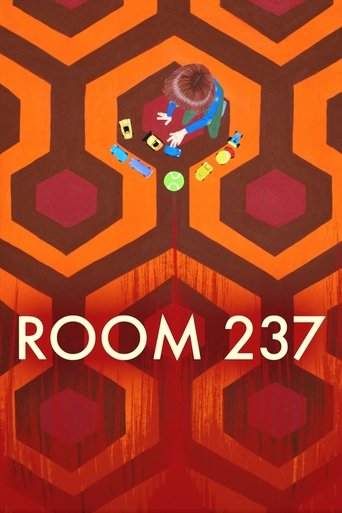
Room 237
2012 · Film · documentary · 103 min
Directed by Rodney Ascher
A subjective documentary that explores various theories about hidden meanings in Stanley Kubrick's classic film The Shining. Five very different points of view are illuminated through voice over, film clips, animation and dramatic reenactments.
3 positive4 negative1 mixed2 neutralfrom 10 commenters
Where to watch
No streaming data for this title.




10 comments on Hacker News
A significant amount of context is missing if you're not aware of Room 237: https://en.wikipedia.org/wiki/Room_237
A documentary about the various conspiracy theories developed around The Shining. The music in the YT video is from the documentary.
Highly recommend watching "room 237" a documentary about the shining, some of it veers into speculation but one interesting take was that Kubrick in the film specifically lets Stephen King know that this is his vehicle(the movie) and is quite subtle about the message.
I appreciate this article is about how bad the NYT is, but let's never forget their most epic correction of all time: https://www.nytimes.com/2012/01/29/movies/room-237-documentary-with-theories-about-the-shining.html
Agreed, then watch Room 237, probably my favourite conspiracy theory doc:
https://www.imdb.com/title/tt2085910/
https://en.wikipedia.org/wiki/Room_237
https://www.nytimes.com/2013/03/31/movies/aide-to-kubrick-on-shining-scoffs-at-room-237-theories.html
> “I stood staring at all that stuff for weeks while we were shooting in that room. It’s a downhill skier. It’s a downhill skier. It’s not a Minotaur.”
Etc, etc. Room 237 is not only the ravings of madmen, it has a bit right st the start where a guy is talking over The Shining shots, a baby starts crying on the background (of the guy talking) and they stop and discuss that. I turned it off in disgust after that.
It's an excerpt from a feature length documentary called Room 237. Taken as a whole, it's a pretty fun, non-judgmental tour through some colourful interpretations and theories surrounding Kubrick and The Shining. I don't think it's actually intended to convert anybody to moon landing skepticism.
"The Shining" is, among other things, a giant metaphor of human (and in particular, western) civilization. The constant references to the moon landing (and 2001: A Space Odyssey) can imho be understood as an one of the many illustrations of the great and unprecedented things that came out of a civilization that is masterfully portrayed in the movie as a fading grand hotel built on a burial ground that is trapped in a seemingly eternal winter. Seeing it as Kubrick's confession that he staged the moon landing is not only silly, it doesn't even begin to describe the film's poetic depth. However, I watched the documentary where this clip is taken from (Room 237 [0]) and can recommend it with reservations. But I remember that it "jumps the shark" somewhere around the middle of the documentary.
Just to elaborate: I often hear people discredit "The Shining" because it didn't scare them enough, or because they think King's book is better, or because they find Duvall's and Nicholson's performances over-the-top. In my opinion, "Shining" is Kubrick's masterpiece. It is arguably deeper than 2001, has a very high artistic quality (some scenes are staged like a ballet) and at the same time, the movie is constantly entertaining and thrilling (which is a quality 2001 clearly lacks, as I have experienced again and again when I tried to watch it with friends who were unfamiliar with Kubrick's work).
If you want to go down the rabbit hole of "The Shining" interpretations, you should start with the Wikipedia article [1] and end with the shot-by-shot-analysis [2]
[0] https://en.wikipedia.org/wiki/Room_237
[1] https://en.wikipedia.org/wiki/The_Shining_(film)#Social_interpretations
[2] http://idyllopuspress.com/idyllopus/film/shining_toc.htm
Tbh, Stanley Kubrick is vastly overrated. Yes every one of his movies has great cinemotography, and is technically excellent, but many of his movies are not excellent as movies. Eyes Wide Shut, full metal jacket, and the shining are not 10/10 movies, and David Fincher, Harmony Korine, Charlie Kaifman have all created movies better than all those movies listed. The problem with Stanley Lubrick is because he has a style that is very attractive to viewers, and his movies are very accesible also, he gets massively overrated by a lot of casual film watchers, which is fine so are a lot of directors, but his hype has leaked even to actual film critics with years of experience. It also doesn't help that movies like Room 237 come out that jack of Stanley Kubrick and draw meaning out of things that had no meaning. Sad that people glorify Kubrick but don't even know who Charlir Kaufman or Harmony Korine are, even though both directors have created movies that are just as good as a lot of Kubricks films.
I do believe that China's unmanned lander is real. I don't believe that the US manned landings were real.
Here is more elaboration than I had planned:
I came to the conclusion that the landings were faked by my own reasoning. I grew up believing they were real, and only changed my mind in my 20s, after learning more about cosmic rays.
Cosmic Rays weren't even on the radar for the Apollo missions; US states had only just begun banning shoe-fitting fluoroscopes in the 60s.
That was the first inkling I had that something was suspect. Later I learned about Stanley Kubrick's alleged involvement in the documentary film, "Room 237".
Every other recorded major scientific advance has been followed by more observed results in the same area. Yet the official story is that astronauts drove around in moon buggies and played golf on the moon in the 1970s. We just haven't been back because ... there's no reason to go back? Is it not funny that there was a huge reason to get to the moon in the 60s and 70s, but once we got there that reason just vanished?
No, the official story is to me simply not plausible, whereas the alternative makes a ton of sense. The US had every intention of going, but the task itself was simply too difficult. Thankfully, existing trick camera technology, as evidenced in science fiction movies of the time, made the hoax appear entirely believable (to a gullible public).
The last straw for me was around 2010, when I read one of Buzz Aldrin's accounts of the moon landing in "The Week"[0], and I thought, "wait a minute, I've heard that story before", and sure enough, went and found approximately the exact same story of the "last-minute, running out of fuel, manual take-over moon landing" in a novel by Heinlein called "Rocket Ship Galileo"[1]. I would encourage anyone interested to compare the landing story told by Aldrin with the landing story told by Heinlein and judge for themselves whether or not the official story is what actually happened in reality[2], and not just a really great (and wonderfully written, I might add) piece of sci-fi.
[0] https://theweek.com/articles/503621/last-word-eagle-landedbarely [1] https://en.wikipedia.org/wiki/Rocket_Ship_Galileo [2] I also believe in an objective reality, where things either did or did not happen.
I don't mind people who analyse everything. It's great that there are people who know why processes are how they are.
I dislike the amount of "post rationalisation" that goes with arts critique. See the movie "Room 237"[1] as a great example of this. Some of them sound reasonable, and make sense. And some of them just sound ridiculous, and tenuous, and make very little sense. And because Kubrick is dead and didn't tell us what he meant there's little way for us to know if these people's imaginings about his film are in any way correct or not.
I tend to go a bit too far the other way. I know someone who, when at school and asked "Why did that character do that thing?" would answer "because that's what the author wrote" which is correct, but not what an English comprehension teacher wants to hear.
[1] <http://www.imdb.com/title/tt2085910/>