 Hacker Cinema
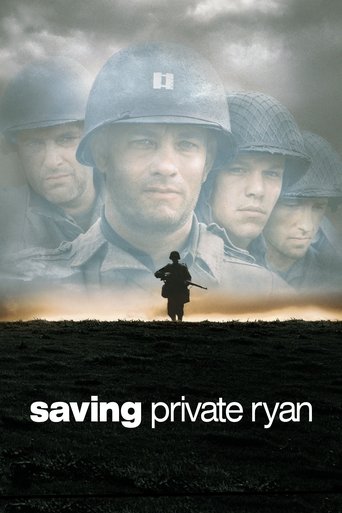
Saving Private Ryan
1998 · Film · 169 min
Directed by Steven Spielberg
As U.S. troops storm the beaches of Normandy, three brothers lie dead on the battlefield, with a fourth trapped behind enemy lines. Ranger captain John Miller and seven men are tasked with penetrating German-held territory and bringing the boy home.
21 positive9 negative1 mixed47 neutralfrom 78 commenters
Where to watch
No streaming data for this title.
84 comments on Hacker News
With the final movie in the series being Saving Private Ryan.
>That night my family watched a war movie on the VCR, maybe saving private ryan or something similar, and the helicopter struck me.
If there was a helicopter in the movie, then we can confidently exclude Saving Private Ryan.
You're ignoring the core analogy. The author's point is that someone (or something) can be verbose and articulate about a topic without having any real knowledge or experience of it. I can talk at length about war because I've seen Saving Private Ryan and read a hundred books on the topic, but do I really understand what it's like to be shot at, or to watch my friend die? No, I don't. My cousin's husband does, though, because he experienced both of those things.
The author is saying that that difference matters, that it isn't just a philosophical point but is actually a fundamental aspect of this new technology. I can spit out a bunch of words about war, and so can an LLM, but our understanding of war is limited to textual representations of it. Thomas Hobbes made this exact point centuries ago when he said, "Words are the wise man's counters but the money of fools."
As a complete aside, I don't agree that "Good Will Hunting" is a power fantasy. The whole point of the movie is that that power was illusory, and that it has nothing to do with what really matters in life.
“My point is that it's not very obvious what it is unless you are super studied in Nazi symbology”
Or if you ever played a WWII themed video game (Wolfenstein, Call of Duty), or if you’ve ever watched a WWII show like Band of Brothers or watched a major WWII movie like Schindlers List or Saving Private Ryan. I could go on, it’s prominent in nearly any WWII media.
Honestly, I don’t know if people toting the line saying it’s “obscure” are intentionally lying because he aligns with their political agenda or are completely oblivious to any level of detail in any media.
It’s really astonishing.
Interesting - I got something completely different out of The Thin Red Line. To me it was fascinating to see how different people processed the war and their different struggles, whether philosophical (Private Witt), with relationships back home (Cpt Staros), or PTSD. It was a little scattered as it bounced between so many soldiers but the central theme seemed to centre around Pvt Witt and Sgt Welsh - the actual battle was almost secondary. IMO there’s no snobbery - though Malick is maybe a little self indulgent - and I enjoyed movies like Saving Private Ryan or even Fury just as much.
He is definitely a director's director. The people who study cinema like him, people who become young directors and cinematographers like him, college professors teaching cinematography like him, but is he definitely not for the general audience.
I completely understand why your average moviegoer (is there such a group of people any more?) would walk out of his movies.
When Thin Red Line came out (1998) I saw it a few times in the theaters, then Saving Private Ryan came out about the same year, and I remember having interesting debates with my friends about which one was a "better" war movie. It was this perfect A/B study. They found Thin Red Line completely boring and terrible: no main hero, one who is sort of the main character dies senselessly in the end (well he sacrificed himself, but it wasn't with any sense of bravado or anything). And my point was, that's kind how war is: there are no heroes and people die senselessly and often stupidly, and there is a lot of boredom and sitting around waiting, too.
> This kind of earnestness stood out in an age of relentless irony and snark.
That's why I like him. And to be fair, I am the first one to enjoy relentless irony and snark, but on a deeper level I realize it's also unhealthy and often is an escape from something terrible or a way of distancing from what's happening, so when something more honest and authentic some about, I pay attention.
"FUBAR" comes up in the movie Saving Private Ryan. It's not a plot point, but it's used to illustrate the disconnect between one of the soldiers dragged from a rear position to the front line, and the combat veterans in his squad. If you haven't seen the movie, you should. The opening 20 minutes contains one of the most terrifying and intense combat sequences ever put to film.
If you are not awake, you are asleep. American Cinema has been all for defeating nazis since before the war ended. Band of Brothers, Saving Private Ryan, https://en.wikipedia.org/wiki/Inglourious_Basterds
All we have seen so far is white kids shooting people in red states.
Is DHH trying to legitimize a stance that fascists are some how good?
Not disagreeing with the economics behind it, but this movie-goer walked away decades ago when the "super hero" genre became Hollywood's focus.
Even before that though otherwise decent movies were starting to play heavy handed and treating their audiences for children that need lecturing — need "The Moral of the Story" spelled out for them. I disliked the "book-ending" that was popular when Titanic, Saving Private Ryan (and even Schindler's List) were released.
Music in film too has, for some time now, been telling us how to feel much too often. In romps or swashbuckling films it's probably an expected part of the genre. I just wish there were more quiet films where we are left to feel for ourselves.
Billy's death in The Last Picture Show (and as metaphor for the death of the town) is an excellent example of old-school film making where you just let the film do the talking. And then it is us, the viewers, who are left talking about it, thinking about it afterward.
Maybe the biggest tragedy of heavy-handed film making is it leaves nothing to really even ponder afterward. I kind of like films that leave you thinking about them much, much later.
While I remember seeing great films like Cool Hand Luke, Summer of '42 and The Last Picture Show, working through the "1001 Movies to See Before You Die" has been a real eye-opener to how much film can be art and how far we fallen from anything close to that.
Perhaps we'll get another "New Wave" of young filmmakers to break the corporate log-jam.
I find myself returning to this Metafilter comment a lot over the years, from someone who survived war in Bosnia. (Warning: graphic content.)
> I was conscripted into some faction of the Bosnian Army in order to "defend" our city. In truth, we had few arms or anything with which to defend. And as a very tall, largely starved girl, I wouldn't have made much of a soldier anyhow. So I was a "nurse." No training, of course. And no supplies, either. I was near the front line fairly often. There wasn't much you could do.
> One day, some shell exploded right on or near two young soldiers and they were torn into dozens of pieces. I say "dozens" because it wasn't hundreds or millions - I'd seen that happen too, and it's totally different. You could count these pieces. They were big lumps. A fellow "nurse" and I were near enough that we got there before anyone else. There was no one to save.
> As these soldiers were Bosnian Muslims whose bodies - what there was of them - would be returned to their families, we realized that we needed to collect these pieces to put the soldiers back together, kind of, because Muslims believe a body should be buried "whole" - to the extent that it's possible. With "only" dozens of pieces, it's kind of possible to do this. So we set about trying to match parts - one guy's leg get ripped off above the knee, but this leg has the knee attached, so it can't be this first guy's. That sort of thing. "Look," my fellow "nurse" said, "this one ate rice!" Rice was one of the few kinds of food that was readily doled out. Everyone hated it because they were tired of it, because it required a lot of water to cook (and no one had running water) and because it required a lot of heat to cook (and there was no gas and the trees were mostly gone and we'd already burned most of our books.) But we hadn't had rice in a while; this soldier must have been had some at home, stashed away.
> This guy's stomach was blown up, so rice was all over the various parts of his body that came from his torso. And I remember being so happy, because the hardest things to connect to a specific person are internal organs, but this guy's organs had rice on them, so you could tell they were "his." Ones without rice were, presumably, the other soldier's. So the job of piecing together bodies was made much easier than it normally would have been, when you try to make each "body" weigh about the same, even if you know parts are mixed. Of course, I don't need to add that when something like this happens, it's not just people - and rice - everywhere, but uniquely awful smells, and the flies get there so fast I still don't know how they do it.
> Later that day, I snaked my way to my aunt's, a few kilometers away. I remember smiling; I rarely smiled during the war. My aunt had made soup - good soup - and I ate a lot and told her and my cousins about my day. We all agreed it that things had gone pretty well, considering. I was pretty happy about piecing two young men together successfully because of the rice and having a stomach full of warm soup.
> War is dehumanizing. If, as in the Okinawa quote, you still worry about getting shit and piss on you, if you can even still smell the rotting flesh, and if it bothers you enough that you consider not eating your rations, if you can still consider your situation to be something like "hell's own cesspool," well . . . then you're still pretty fucking lucky. People like to read about that stuff; that's why they make it into popular movies and comic books.
> People don't make movies about the happiness of a young girl who finds she can reassemble people with ease, thanks to the fact that one of them ate a lot of rice earlier that day. Because it isn't very romantic or macho and it isn't full of hard-ass symbolism.
> The thing about war, too, is that it affects many many more civilians than it does soldiers. The military-centric ideas in the article don't grasp that. War, according to romantic notions going as far back as the Greeks, is more about guys toughing it out than women and children left to pick up the pieces.
https://www.metafilter.com/87979/Losing-the-War#2886398
This one, too:
> I found that piece very hard to read - self-serving and smug in the sense of looking for romanticism. I reckon that, if the author had ever seen war, he'd be quite embarrassed by it.
> Guess what - most people prefer the movie version of any human experience. War is mostly long, boring, cold, hungry and tedious . . . then every once in a while someone lobs a grenade at you or shells your house or a sniper's bullet pierces your arm or rapes and kills someone you know and you get hysterical . . . and then it goes back to being long, boring, cold, hungry and tedious for eons and eons. While I like a lot of the human experiences eschewed by many people I know, war is one in which the movie version is quite plainly preferable.
https://www.metafilter.com/87979/Losing-the-War#2886358
There’s some amazing (and harrowing) content in her comment history — highly recommend giving it a read. It made me realize that even films like Saving Private Ryan present war as a titillating kind of hell. Something like Threads will probably come closer to the truth of it.
There is a lot of truth to that, and it applies to many of the other films people have mentioned in this thread.
It's easy to see why someone would find aspects of 'Saving Private Ryan' attractive (eg: Private Jackson, the sharpshooter), and it doesn't require much imagination to see how aspects even of Nazi villains can be attractive (they had the best uniforms).
It's more difficult to see how 'Born on the Fourth of July' would leave anyone - even a sadist - enthusiastic about war.
It's not like Kubrik's 'Clockwork Orange' in which some of the violence, in a sick way, empowers the main character.
Instead, the main character pathetically bumbles into shooting people he doesn't mean to, is shot himself, and turns into an angry loser in a wheelchair (until he finds his calling as a peace activist).
But there is no actual death or love in a movie or book and yet we react as if there is. It's literally what qualifying a movie as a "tear-jerker” is. I wanted to see Saving Private Ryan in theaters to bond with my Grandpa who received a Purple Heart in the Korean War, I was shutdown almost instantly from my family. All special effects and no death but he had PTSD and one night thought his wife was the N.K. and nearly choked her to death because he had flashbacks and she came into the bedroom quietly so he wasn't disturbed. Extreme example yes, but having him loose his shit in public because of something analogous for some is near enough it makes no difference.
Sure creative people will always create but the scope of that creativity will be limited if we do away with intellectual property. Steve Spielberg would probably always have created movies, but he wouldn't have been able to make Jurassic Park, Saving Private Ryan,or Indiana Jones without capital from the studio system, and the studio system wouldn't have provided him with that capital of they couldn't extract economic rents from the copyright for those films.
> Well, what makes Bagration unique in the same sense as Overlord? The scale alone does not cut it, and it's not the largest land operation anyway.
Scale alone is very important, and Soviet operations were larger scale (meaning harder to coordinate) than Western Allied ones. Also, I explained maskirovka. It's just that you don't find it interesting enough, and I cannot argue against your preferences except to disagree.
Barbarossa to my knowledge was/is the largest land operation of all time (and nobody will disagree it's both iconic and massively important), and Bagration comes second. Let's not mince words here. And also, Barbarossa was impressive at first but ultimately a failure, in particular a logistical failure -- precisely where Bagration succeeded.
> Partially yes, but that's not what makes Bagration forgettable.
> "Iconic" is about human stories. Photos from the landing craft moving onto the beach, soldiers getting mowed by the machine guns while running over completely exposed positions, German soldiers sitting in fortified, but ultimately outnumbered and hopeless positions. Those are very memorable.
> [...]
> You could make stories about Bagration, but it would not appear unique to the reader, you can't really transmit the scale of manouver warfare into the human story.
There's plenty of similar human stories and memorable situations that could be told for Bagration, plenty of furious advances, encirclements and desperate last stands (e.g. the German "fortress cities"), plenty of individual soldier stories to be told with Bagration as the backdrop. There's even smaller scale preparatory actions, such as the partisan operations "Rail War" and "Concert".
It's just that, like I've already said, Western media is not interested in telling these stories, partly because they would overshadow American contributions to the European theater of war, and partly because audiences must not empathize with the Red Army too much. You could make a "Saving Conscript Petrov" movie as powerful as Saving Private Ryan, but who wants to make it?
Overlord was large scale too yet Spielberg found the way to make it smaller and about individual soldiers. You can make this with Bagration as well. You don't need to make a documentary about large scale maneuvers, you can make it about individual soldiers. The Soviets suffered massive losses during Bagration, so you are not even sure your heroes will survive! Spielberg could do it, if he was interested. So could Clint Eastwood. Imagine: comrade Petrov is taking part of partisan actions, but he's captured by Germans; he's carrying some papers/knowledge that would betray the larger Bagration operation... now Stavka must send a platoon to Rescue Conscript Petrov before it's too late. Intersperse with scenes of his mother and girlfriend back behind the frontlines, anxious about his fate. (Ok, ok, I'm no Spielberg).
> You can make stories about close quarters combat for months in a completely destroyed Stalingrad, fighting for every building, pretty much living next to the enemy etc.
And yet... so few good movies have been made, right? The most well-known, "Enemy at the Gates", is a complete distortion of the truth, and pretty bad movie-making as well. Where are all the good Stalingrad movies? The best one is still the German-made one.
I believe the real problem -- affecting even you, now -- is that the Soviets (and later Russians) were not perceived as the good guys after the outbreak of the Cold War, and to this day Russians are not the good guys, and so their big moments in WWII tend to be downplayed in Western pop culture. Movies like "Enemy at the Gates" spent as much time making sure the audience didn't empathize too much with the Soviets, as with presenting the Germans as the enemy.
Complicating things even more, there's the thing that the Germans -- the ultimate bad guys of WWII -- have been somewhat rehabilitated in pop culture, making German "things" somewhat cool. (Unless one is watching a movie specifically about genocide or the Holocaust).
Some still haven't seen this picture:
https://en.wikipedia.org/wiki/Operation_Overlord#/media/File:NormandySupply_edit.jpg
I don't think we can really comprehend how big an operation that was. A movie like "Saving Private Ryan" was incredibly good (especially the scene on the beach front) but didn't come anywhere close to show anything resembling that picture.
The Matrix ranks third in my list of 'wow' moments in the cinema.
Joint first is the opening of Saving Private Ryan, and brontosaurus (?) in the true-dinosaur scene of Jurassic Park (not the raptor eggs bit).
SPR's opening was just visceral, especially on a huge cinema screen.
And Jurassic Park's use of the subwoofer meant you really felt that first scene.
FWIW Lost in Space, the year before the Matrix had 'bullet time' in it and no-one seems to remember that.
My take is that Saving Private Ryan is "pro-war" movie like most Hollywood productions on the topic and not about 2WW really.
The give away is how the save Ryan squad seem to have agency and do like cool self-govern manouvers, like the storming of the 80mm AA gun hill, etc. More like a teenage boy fantasy. Band of Brothers is another good example of cool agency.
The opening assualt on the beach is some sort of low point for things to get better and under the protagonists' control.
A true to history version would be soldiers getting shrapnel wounds from indirect fire and being shot at by soldiers they can't see. Then they redo it somewhere else becouse someone said so.
My grandfather was a medic and was part of the storm of Normandy beach on D-Day. He never really spoke of it and had a stroke and passed away before Saving Private Ryan came out. We wondered what he would have thought of the beginning of that movie, as someone who was there and was running around helping people the whole time.
> America used to win in such circumstances
It looked like that you're treating Hollywood-style cultural export as competition, and your conclusion is "America is losing control because of the involvements from China-backed films", believing the evidence is clear given how rare China was shown as "an adversary in a film"?
If what you said were pure true, that "US domestic market is now often funded by international interests" is the reason for current reality, which in turn implies that "US domestic market" is a complete sellout, then why Hollywood won't accept investments from the Persians, and then introduce some Persian superheros that sometimes randomly goes "Allahu Akbar"? The are huge money in this, why the US domestic market won't make it happen?
Maybe you're looking at the wrong direction. Maybe Hollywood (and US culture) is losing it's shine because by now, thanks to the Internet and medias (Vox, Vice, John Oliver etc), people starts to see the reality that America, behind all it's sparkling glares, also has quite a few flaws. Maybe China don't often get picked as an adversary simply because Americans just subjectively don't hate Chinese THAT much.
Here's my perspective as a Chinese: the exporting of cultural is more of a test than competition. It's a tool that communicates the cultural aspect of the exporter, to see if the importer welcomes it. It's a good tool if you want to infer the inner compatibility of the two parties, but it does very little beyond that.
Just to knock you out of your "winning" mindset: the movie Saving Private Ryan maybe resonate very well amongst Americans, after all, it's an true American hero doing American hero things. But in Chinese people's eyes (the eyes of the rest of the world, really) the movie just don't feel the same. Everyone got their own heros back home, you know? Funny enough, after watching the firm, I asked some of my friends whether or not they will save their soldier colleagues under similar situation showed in the firm, many of them answered solidly "Yes". To clarify, they were not thinking about saving Mr Ryan, instead, they were thinking about saving CHINESE soldiers Mr Zhao, Mr Qian, Mr Sun and/or Mr Li, maybe even under direct gun fire from Mr Ryan. That's something you might want to think about the next time you bring up your theories on the "victory" of America media exports ;-)
Saving Private Ryan and the Matrix are some of my favourite films.
I enjoy media that has a political message or meaning.
Get Out was my favourite horror film of that year, and that very clearly exists in a world with a strong political undercurrent.
I'm saying right now, I want more media that is not drenched in political ideology, left wing or right wing. I (like the majority of people) live in a shit world with a shit job and a shit life. But it could easily be worse. I would rather not be reminded how shit everything is even when I just want to be distracted for a short while.
> 90s happiness
I want escapism, it doesn't have to be happy.
The 90s with its apolitical cinema like Saving private Ryan or Forrest gump that certainly are not pro american propaganda or other great movies like the Matrix that do not denounce late stage capitalism as soul crushing and has no themes that could be interpreted about taking red pills and feeling more like yourself.
The 90s had a different context sure, capitalism was peaking, we didn't have the crushing reality of the post 2008 world, or the crazy chest bumping Murica militarism of the post 9/11 era. But the 2000s scare, the internet fear, the office jobs being boring/grey and soulless. The slight fear of science and progress (see Jurassic park, gattaca, fifth element), the work culture being inhumane and dehumanising (matrix, office space, clerks, american beauty), the same happened in music with grunge being one of the main genres of the decades.
All of this art was made in the backdrop of probably the most optimistic period of time, Disney had a renaissance, america absolute cleared the floor in the first gulf war, the stock market had an impossible never ending rise, pop music was happier than ever and fashion was in the most sexy, thin, in your face hotness ever.
If you only want to enjoy the 90s happiness without seeing the fact tons of counter art was being made and that our current cyniscim isn't only a product of the post 2008 economic stagnation but also comes from the seeds that were planted at the height of the cultural hedonism of the 90s then you are just straight ignoring some of the biggest hits of that decade.
That's not how it works. It's literally in the article. For undivided attention on a script for a couple of weeks, for a movie that might have a budget of tens of millions of dollars, this is completely reasonable. The article also says he's worked on scripts for 60 movies in 20 years. So yeah, maybe 3 per year. How much is it worth to the studio to have Saving Private Ryan be a better movie?
For such assignments, which are generally uncredited, he commands a fee that he acknowledges is “insane”: three hundred thousand dollars a week. Most jobs last a few weeks.
There's violence, and then there's violence.
Broadly speaking (many exceptions), Americans are fine with young teens watching a movie about a man using kung fu fantasy tactics to bloodlessly shoot his way through a building of bad guys, like John Wick, but don't necessarily feel the same way about something that depicts violence in a more brutal and arguably realistic way, like Saving Private Ryan. Is there a little puff of red CGI mist blood coming out of somebody's chest, or does the movie show one of the 'good guys' with half his skull blown away? These are both hardcore violence in a sense, but most people see a large qualitative difference between the two.
I think it basically comes down to how likely a movie is to give people nightmares, which of course is a function of desensitization. The American public is broadly desensitized to unrealistic violence, but most aren't desensitized to realistic violence.
Incidentally, Saving Private Ryan has a lopsided depiction of violence. The deaths of Americans are shown to be gruesome and agonizing, while the deaths of Germans are mostly shown to be relatively quick and clean: https://www.youtube.com/watch?v=l4FeyONCtfc I re-watched Saving Private Ryan after watching this video and found it to be very apparent, but it wasn't apparent to me the first time I watched it.
For me it's just part of the language of cinema, like a dolly zoom or a oner or slow-mo.
I can notice those things, particularly when they fit the scene well, and still appreciate them as a part of cinema on one hand, but still maintain my investment in the narrative on the other.
Like when my heartstrings are being pulled. If it's done well enough, it doesn't matter if you realise in the moment that it's something the filmmakers are doing deliberately; you still feel the emotion. I can appreciate the craft at the same time as being invested in the story. I enjoy appreciating a film on multiple levels at the same time.
To be sure, Wilhelm is more of a "heh, nice" moment than a "wow, what incredible craftsmanship" realisation. And, to my knowledge, it's never used inappropriately, e.g. in a historical tragic war scene. If it showed up in, say, Saving Private Ryan or 1917, I probably would be annoyed in a way that I'm not if it showed up in an MCU or John Wick installment.
We were Soldiers is also a very realistic movie. I would recommend it over Saving Private Ryan a hundred times!
I don’t think it’s the same thing. The initial scene is a masterpiece but if you remove it, it would still be possible to understand the movie. And the tone and message of the first scene is very different from the rest.
I compare (negatively) to “Saving Private Ryan” which also has a masterpiece of a first scene, that also can be removed without much loss to the main plot. The difference is that on SPR the first scene set the tone and message of the movie perfectly. And if you remove it, the rest of the movie is pretty great too. You can’t say those two things about “Up”.
Really depends on the context of the scene.
Since I've been exposed to violent movies (and shows, and videogames) for 25+ years, I can neither remember nor imagine how it feels for someone seeing murder on TV for the first time, but for as long as I can remember, it's been the case that a similar-looking scene could feel cheesy, boring, neutral, or emotionally devastating, depending on the story, setting, tone and other contextual elements. For example, scenes from Saving Private Ryan or The Band of Brothers are still burned into my mind, having both moved and disturbed me greatly as a teenager - while plenty of other movies featured similar ones, and watching them I'd just yawn.
For my part, I just don't get the point of writing this.
Within the part of the article that's actually about the game, the author does basically nothing but scoff at things like the "workmanlike", "not ... subtle", "primary colors" nature of the story, or the "cheap, sparse, painfully plastic-looking sets", or how the characters use the callsign rather than the full real name of a fallen soldier during a funeral. There is almost nothing there about the story itself or its characters.
I played this game a lot as a teen, and I thought the story had a lot of deeply sympathetic characters and emotionally resonant themes. It felt great to be the protagonist who uncovers fascist treachery at the top and averts a war. It felt great to do that with a team of comrades who shared your values and vigorously debated tactics. None of that gets a single word in this review.
Of course not everyone is going to agree about what's a good movie, but I thought it deserved better than a collection of nitpicks that doesn't engage with the story at all. It seems like the critic just wanted the game/movie to be in a different genre, something more sophisticated or "subtle" with more "shades of gray"? But what's the point of that? It seems like criticizing Saving Private Ryan for not being Apocalypse Now or Starship Troopers. Okay, it's not the type of movie you wanted to see, I guess? But isn't it a little cliche, in itself, to reflexively disdain everything that is straightforward rather than meta, ironic, deconstructive, and self-referential?
That's is why I called it two separate axes and not two ends in a single axis. You need a base level of technical competency to understand what the limitations of your equipment are to leverage it to the fullest extent and avoid doing things that will just plain not work, and the technical features are needed to accomplish specific things, but artistry is till required. Feature films have been captured on iPhone (you can say that is little more than a stunt, but it still exists).
Not everyone is filming Barry Lyndon with f/.95 aperture in candle-lit scenes. Watching older films where both the glass and the film were subpar compared to what's available today, where the grain was high, the focus puller wasn't at the top of their game leaving characters somewhat out of focus (when looking closely, maybe not noticeable at 480p or 720p), but the films are still enjoyable. Parts of The Batman were filmed on a Helios 40-2, an objectively terrible lens when it comes to it's optical characteristics, but it can evoke a look that you can't otherwise get which helps with the mood the cinematographer was trying to capture. You won't be able to capture the vast expanses of night time scenes of Nope (filmed as day for night with infrared cameras) with subpar equipment. You need full sharpness for easier rotoscoping when dealing with VFX. You want the best cameras available to capture miniatures of spaceships like in 2001 or Interstellar to make people believe these are real spaceships. You can leverage a new technology in a new way, like 28 Days Later used new at the time digital cameras (that would nowadays be considered subpar) for easier application of effects like undercranking and lower production costs, or how they used 360 shutters in Collateral. But you can also make a film like The Man From Earth that was shot in a single room, with a bunch of actors and an camera that was average at the time, or Saving Private Ryan simply undercranking and using really short shutterns to ensure that the beach landing scene was crisp through and through. Everything Everywhere All At Once didn't have Marvel-budget level gear, but they still made one of the best movies of the past few years.
I don't fully disagree with what you're saying: better tools expand the envelope of what you can accomplish. But technology is in service of the art, not the other way around (unless you're producing marketing material for the manufacturer, I guess ^_^).
I love combing over features, and learn about the mechanics of these amazing machines, and the theory of the physics of light (even knowing how it works, it is still feels like magic that you can take a full picture of an object that is partially obstructed as long as you can make that foreground element blurred enough). I'm a shit artist, but I trust one with a point and shoot to make something better than I can with my DSLRs. I can't wait to see what new story telling tricks people will come up with new tech, like Nope did.
The milestones (from the source code):
//<10 seconds 'A single frame of a film': 100ms, 'It would take light to go around the Earth': 133ms, 'A blink of an eye': 400ms, 'The time it takes light to reach Earth from the moon': 1255ms, 'The fastest Formula 1 pit stop': 1820ms, 'The fastest 1/4 mile drag race time': 3580ms, 'The fastest Rubik\'s cube solve': 4221ms, 'The fastest 40-yard time at the NFL Combine': 4240ms, 'The fastest 1 liter beer chug': 4370ms, 'A skippable Youtube ad': 5000ms, 'A full bull ride': 8000ms, 'The fastest 100m sprint': 9580ms, //10 Seconds 'The Wright Brothers first flight': 12000ms, 'The fastest 200m sprint': 19190ms, 'The fastest 50m freestyle swim lap': 21300ms, 'The Westminster Kennel Club dog agility record': 28440ms, 'A typical television ad': 30000ms, 'The fastest NASCAR lap at Daytona': 40364ms, 'The fastest 400m sprint': 43030ms, 'The fastest NASCAR lap at Talladega': 44270ms, 'The fastest 100m freestyle swim lap': 47050ms, //1 Minute '"Just a minute"': 60000ms, 'The fastest Formula 1 lap at Monaco': 74260ms, 'The fastest Formula 1 lap at Monza': 81046ms, 'The fastest 800m sprint': 100910ms, 'The fastest 200m freestyle swim lap': 102960ms, 'The fastest Kentucky Derby time': 119400ms, 'An NHL penalty box time for slashing, tripping, or holding': 120000ms, 'How long it takes to drive across the Golden Gate Bridge (without traffic)': 135000ms, 'The duration of the "Millenium Force" roller coaster': 140000ms, 'The longest Super Bowl national anthem': 156000ms, 'One round of a boxing match': 180000ms, 'The average song length on Spotify': 183000ms, 'The fastest 1,500m run': 206000ms, 'The song "Never Gonna Give You Up" by Rick Astley': 215000ms, 'The fastest 400m freestyle swim lap': 220140ms, 'The fastest 1 mile run': 223130ms, 'The duration of the "Steel Dragon" roller coaster': 240000ms, 'The duration of "The Beast" roller coaster': 250000ms, 'The song "4:33" by John Cage': 273000ms, 'The longest sky diving freefall': 276000ms, 'The Any% speedrun of Super Mario Bros for NES': 294948ms, //5 Minutes 'An NHL penalty box time for fighting': 300000ms, 'The average duration of a typical sky dive': 330000ms, 'The average time for a drive-thru order': 356800ms, 'The time it takes Jeff Bezos to make $1 million': 402000ms, 'The fastest race car lap around the Nurburgring': 403300ms, 'The time it takes light to reach Earth from the sun': 500000ms, 'The time it takes a rocket ship to reach outer space': 510000ms, 'A typical marching band show': 515000ms, //10 Minutes 'The length of the first space walk': 600000ms, 'The longest a human has held their breath (non-oxygen assisted)': 695000ms, 'The average duration of popular Youtube videos': 702000ms, 'The time it takes an average human to walk 1km': 710000ms, 'The fastest 5K run': 757350ms, 'The average time to bake a pizza': 810000ms, '1% of the entire day': 864000ms, //15 Minutes 'A typical commute in the United States': 960000ms, 'The fastest superbike lap of the Isle of Man TT': 1002778ms, "MLK's \"I Have A Dream\" Speech": 1020000ms, 'An average baseball inning': 1200000ms, 'The song "2112" by Rush': 1233000ms, 'The first angels to appear in the movie "Angels in the Outfield" (1994)': 1275000ms, 'An episode of The Office, Seinfeld, or Rick & Morty': 1320000ms, 'The time it takes to drive the entire Chesapeake Bay Bridge Tunnel': 1380000ms, 'The song "Octavarium" by Dream Theater': 1440000ms, 'A typical Super Bowl halftime show': 1500000ms, 'The fastest 10K run': 1584000ms, 'It takes for Bobby Boucher to get his first game snap in the movie "The Waterboy" (1998)': 1719000ms, //30 Minutes 'The average time to bake a cake': 1950000ms, 'The time it takes until the launch in the movie Apollo 13 (1995)': 2081000ms, 'It takes WALL-E to arrive at the Axiom in the movie "WALL-E" (2008)': 2164000ms, 'The shortest war in history (Anglo-Zanzibar War)': 2280000ms, 'It takes Harry Potter to arrive at Hogwarts in "Harry Potter and the Sorcerer\'s Stone" (2001)': 2381000ms, 'The album "Thriller" by Michael Jackson': 2539000ms, 'The album "Dark Side of the Moon" by Pink Floyd': 2589000ms, 'An episode of Breaking Bad, House, or Firefly': 2640000ms, 'The boot camp sequence in the movie "Full Metal Jacket" (1987)': 2730000ms, 'The album "Abbey Road" by The Beatles': 2823000ms, 'It takes Simba to become an adult in the movie "The Lion King" (1994)': 2849000ms, '10% of a typical work day in the United States': 2880000ms, 'The album "Kid A" by Radiohead': 2996000ms, 'The time limit for the essay portion of the SATs': 3000000ms, 'The time it takes a standard ice cube to melt at room temperature': 3150000ms, '0.01% of an entire year': 3155692ms, 'The album "Fearless" by Taylor Swift': 3221000ms, 'The time it takes for the basketball game to start in the movie "Space Jam"': 3222000ms, 'An episode of Game of Thrones, True Detective, or The Sopranos': 3300000ms, 'It takes Harry and Lloyd arrive in Aspen in the movie "Dumb and Dumber" (1994)': 3394000ms, 'The album "Jagged Little Pill" by Alanis Morissette': 3443000ms, 'The fastest half-marathon': 3451000ms, //1 Hour 'An episode of Top Gear': 3600000ms, 'The inception of Robert Fischer begins in the movie "Inception" (2010)': 3847000ms, 'Riding the longest subway line in NYC from Queens to Inwood': 3900000ms, 'The time it takes Jeff Bezos to make $10 million': 4017600ms, 'It takes before Sean Connery says "Welcome to the Rock" in the movie "The Rock" (1996)': 4022000ms, 'A flight from Syracuse to New York City': 4140000ms, '5% of the entire day': 4320000ms, 'The album "Goodbye Yellow Brick Road" by Elton John': 4580000ms, 'The album "Scenes From A Memory" by Dream Theater': 4626000ms, 'The movie "Primer" (2004)': 4740000ms, 'It takes to fully charge a Tesla (at 440V)': 4788000ms, 'The ferry duration from Long Island, NY to New London, CT': 4800000ms, 'The movie "Toy Story" (1995)': 4860000ms, 'A drive from Syracuse, NY to Rochester, NY (87.5 miles)': 4920000ms, 'The movie "The Lion King" (1994)': 5280000ms, 'The longest State of the Union address': 5280000, //Duplicate time... //1.5 Hours 'The movie "Mony Python and the Holy Grail" (1975)': 5460000ms, 'The movie "Monsters, Inc." (2001)': 5520000ms, 'An average duration of a soccer game': 5700000ms, 'The movie "Reservoir Dogs" (1992)': 5940000ms, 'The longest Innaugural address': 6300000ms, 'A drive from Orlando, FL to Tampa, FL (84.6 miles)': 6660000ms, 'An SR-71 flight from New York City to London': 6896400ms, 'The movie "Alien" (1979)': 7020000ms, //2 Hours //'25% of a typical work day in the United States': 7200000ms, 'The average duration of an NCAA basketball game': 7200000ms, 'The movie "Star Wars: A New Hope" (1977)': 7260000ms, 'The fastest marathon time ever ran': 7299000ms, 'The time it takes to listen to every studio album by Nirvana': 7667000ms, 'The movie "Dogma" (1999)': 7680000ms, 'The average duration of an NBA basketball game': 7860000ms, 'The movie "The Matrix" (1999)': 8160000ms, 'The movie "Fight Club" (1999)': 8340000ms, 'The movie "The Shawshank Redemption" (1994)': 8520000ms, 'The movie "Forrest Gump" (1994)': 8520000ms, 'A drive from New York City to Philadelphia (94.6 miles)': 8520000ms, '10% of the entire day': 8640000ms, 'The movie "Inception" (2010)': 8880000ms, 'The movie "Avengers: Infinity War" (2018)': 8940000ms, 'The movie "Pulp Fiction" (1994)': 9240000ms, 'It takes Voyager 1 to travel 100,000 miles': 9360000ms, 'The movie "Avatar" (2009)': 9720000ms, 'The average duration of an NHL hockey game': 9750000ms, 'The movie "Saving Private Ryan" (1998)': 10140000ms, 'The movie "The Godfather" (1972)': 10500000ms, 'The movie "Lord of the Rings: The Fellowship of the Ring" (2001)': 10680000ms, //3 Hours 'The average duration of an NFL football game': 10800000ms, 'The total time limit of the SATs': 10800000ms, 'The movie "Avengers: Endgame" (2019)': 10860000ms, 'The average duration of an MLB baseball game': 11280000ms, 'The time it takes for a standard ice cube to freeze in a freezer': 11700000ms, 'The movie "Titanic" (1997)': 12600000ms, 'A drive from Boston to New York City (215.9 miles)': 13560000ms, 'Alex Honnold\'s free solo climb of El Capitan': 14160000ms, //4 Hours 'Half of a typical work day in the United States': 14400000ms, 'The flight time from New York City to Los Angeles': 19800000ms, 'The time limit of one session of the Bar exam': 21600000ms, 'It takes Voyager 1 to travel 250,000 miles': 23400000ms, 'The fastest swimmer to cross the English Channel': 24900000ms, //>8 Hours 'A full typical work day in the United States': 28800000ms, '0.1% of an entire year': 31536000ms, 'The time it takes Jeff Bezos to make $100 million': 40173000ms, 'The time it takes to assemble a car': 57600000ms, '1% of an entire year': 315360000ms, 'It takes for the Lōʻihi volcano to rise above the surface of the ocean becoming a new Hawaiian island': Number.MAX_SAFE_INTEGER //285,616 years
Okay? Some WW2 veterans couldn't watch the Normandy invasion scene in Saving Private Ryan because it was too realistic. My dad said Apocalypse Now had its moments of accuracy regarding Vietnam.
I don't know why you keep repeating this incorrect notion that fiction cannot depict things in a historically accurate manner.
Some fiction is trash. Some documentaries are also very misleading and have their own narrative. One should reference multiple sources when possible.
After "Saving Private Ryan", this one is one of the most grounded, well-depicted war movie.
If you replaced "The Hero's Journey" with the (Japanese-anime) word "Isekai", I get the same feeling here.
"Isekai" is the "Trapped in another world" trope that suddenly became popular for anime/manga in the last 10 years. But the basis of the story has been backwards-applied to Wizard of Oz, a Kid in King Author's Court, and even 90s shows like Digimon, Escaflowne, and .Hack//Sign.
Except "Isekai" as a concept didn't exist until relatively recently, within the past decade or so. There's no way Mark Twain was thinking of that concept when he wrote "A Connecticut Yankee in King Arthur's Court" over a hundred years ago.
---------
Furthermore, a lot of the tropes associated with the Isekai genre can be applied to plenty of other stories (including the Hero's Journey). Harry Potter, for example, hits overpowered main character, travel to effectively another world hidden amongst people (Hogwarts), magical / fantasy tropes (classical monsters), etc. etc.
----------
There are however, certain tropes and storytelling devices that are popular amongst people. When you take an "average person" and stick them as the main character, with few defining features... it allows for the reader / watchers to "self-insert" themselves as the protagonist.
See Harry Potter who comes from Muggle society, The Connecticut Yankee who represented a modern American from Mark Twain's era, Dorethy from Kansas, or the legion of Isekai protagonists from Kagome (Inuyasha), to Kirito (Sword Art Online). You give the main character a degree of wish fulfillment, including adventure, romance, and overall a positive and uplifting story. And a lot of people will like it. (The notion of "The Outsider" from Westerns and Japanese Samurai films also hits this trope)
-----------
We can see that "The Hero's Journey" in fact follows a lot of similar patterns with "Isekai" itself even. Adventure is thrust upon the protagonist in the form of "The Isekai" moment (the moment where the protagonist is teleported to another world somehow).
-----------
I think "The Hero's Journey" is largely the same. Its a backwards application being applied forwards. A concept created in 1944 that tries to unify stories from centuries or millennia ago, and tries to distill them into a singular "pattern" that works for today's audiences.
No different from "Isekai" these days (though on a shorter timescale: a concept from the past 15 years that very well could be applied to stories from 100 years ago). Now excuse me, I have some trash anime to watch...
EDIT: The trolls will joke that "Saving Private Ryan" is an Isekai. The WW2 front was a very different life, and the "Isekai" moment was getting off the boat and onto the shores of West Europe. They can't go back until they've accomplished their mission, so its an Isekai, trapped in another world.
The above post is likely seeing a motion smoothing feature common on tvs today. This takes the digital videos stream and generates "imbetween" frames to artificially raise the frame rate, and in some cases deliberately reduce motion blur.
It looks good for sports and video games, but films proper make a lot of specific choices about frame rate vs motion blur, which these filters just crush out of existence if they're cranked up too high. A very good scene to see this clearly is the opening of Saving Private Ryan.
That scene is pretty good.
Saving Private Ryan has top-notch action and production values (yes, I know about the inaccuracies, that the Tiger tank isn't a Tiger, etc. Still top notch).
The problem with Saving Private Ryan is that it looks and plays as American propaganda. American flags waving bookend the movie, there are famous quotes by American politicians, Tom Hank's larger than life "earn this" quote, rah rah rah. That's what makes it "too Hollywood", not that the action is bad. The action is good!
> ...Saving Private Ryan (which is way, way too much of a Hollywood action movie)...
The hand-to-hand combat sequence with Adam Goldberg is one of the most amazing I have ever seen. Not a typical action scene.
> I have seen perhaps hundreds other far more moving scenes in other WWII movies (everything from Schindler's List to Saving Private Ryan to Downfall) that I far more vividly remember.
It’s completely different. Schindler’s list is great, but reads like a documentary. Downfall is flashy, but lacks the spontaneity of Casablanca, which was filmed in the thick of it. Completely different atmospheres.
Also, if you are into this kind of films, the Pianist is an absolute must-see. I would put it at the same level than Schindler’s List, way above both Saving Private Ryan (which is way, way too much of a Hollywood action movie) and Downfall (which is fine, but really not in the same league).
As people pour in, it appears I am the only one left with contrarian view. I had watched this movie and didn't realize the scene was really all that special. I couldn't even recall it, let alone remember it forever. I have seen perhaps hundreds other far more moving scenes in other WWII movies (everything from Schindler's List to Saving Private Ryan to Downfall) that I far more vividly remember. It feels like one of those fallacies where someone will come up with why certain wine is best in the world and then crowd joins in to agree while everyone else wonders what was so special about it.
> Bruce Willis may exist in the Ocean’s universe, but the 1995 film Twelve Monkeys, which co-starred Brad Pitt, does not. Movies like Fight Club, Seven, Batman & Robin, The Perfect Storm, Saving Private Ryan, and The Untouchables can’t exist.
This is horrible logic. Just because the actors may not exist doesn't mean other actors weren't cast for the parts. There is no reason to believe the movies don't exist, just in a different form.
Somewhat the opposite.
Saving Private Ryan shows US / Allied soldiers murdering surrendering troops, which is 100% a political move (and _VERY_ unusual for a war movie to show).
Housing and material wealth keeps coming up but we’ve survived and thrived after a good chunk of Europe was razed, critical infrastructure missing and entire countries needing to be rebuilt. Peoples wants and needs weren’t that different from ours, we just have more of them, but we desire them as much as any period of time before us.
We don’t, unfortunately, have many first hand accounts of how people survived during these times.
I do remember a poignant scene in Saving Private Ryan as Tom Hanks and the squad are moving through a shelled European city. I think it’s in France, but it’s been so long since I’ve seen the film.
In that scene they come across a mother and daughter living in an apartment, with no real hope of a better life as most of the city has been bombed. They invite themselves in for tea. A young Private catches the eye of the daughter, and vice versa. Tom Hanks, the mother, and rest of the squad pretend that they’re having tea and talking and laughing while the two young people go to a different room (subtext being to have a discussion of their own). Tom Hanks looks at the mother and gives her a warm smile. Everyone has a stupid-grin look on their face, acting ignorant. The scene, out of place though it may be, acknowledges the needs of young people, and that older generations sometimes literally have to play a part, and move out of the way and let the young people do what they desire to do and to not strip them of or take away their opportunities.
You mean for higher FPS film?
Part of that however is also highly related to motion blur - many big directors have done tests in theaters showing "HFR" content (like 60fps) and audiences distinctly said they did not like it on average. The D-Day scene from Saving Private Ryan is a good example - it was not shown HFR but they intentionally made the shutter speed faster to give it that "staccato" and jerky and gritty sort of feel. While in photography we use all kinds of shutters speeds for different effects (think of things like using a super fast shutter speed to freeze the propellers of a plane or using a very long shutter speed in a landscape photo with a river so that the river becomes a nice smooth blur) the movie industry mostly abides by the rule of "180 degree shutter" meaning that your shutter speed is 1 over 2x your fps (x=fps). So for most cinema shot at 24fps the shutter speed is 1/48 of a second.
The importance of this is that because you are not shooting still frames and instead of shooting a series of frames to be played back quickly this adds a motion blur effect that smooths the transition between frames and creates a sort of artistic look. There are technical limitations of this blurring (medium fast pans across a scene are a great example - the whole thing becomes too blurred and is hard to see). Any scene with slower moving objects such as people adds a sort of natural motion blur that many cinematographers believe is an artistically ideal choice.
Now that being said you do not need to abide by the 180 degree shutter with modern cameras (like Saving Private Ryan) and one can theoretically choose a variety of shutter speeds for different scenes regardless of what FPS one is shooting at. A fast pan could be shot at something like 1/120 and even at 24FPS it will appear much sharper and easier to make out individual objects (although perhaps not quite as smooth on the panning motion). However you are theoretically limited on the low end to a shutter speed that is approximately equal to your frame rate (or your shutter would be open LONGER than the frame itself and defeat the purpose of shooting "frames" in the first place). So theoretically we could move to 48 FPS content and still shoot at 1/48 and have the same amount of motion blur PER FRAME but also double the amount of frames which would be a large improvement from a technical sense. I haven't seen any films shot this way but I have experimented quite a bit with my own camera shooting at these kinds of speeds and it works quite well. You can also shoot at 24FPS and drag the shutter to 1/24 to get a full stop (double the amount of light) vs normal 24FPS footage if you are shooting in a very dark environment that is already pushing the limits of your cameras sensor. This of course introduces even more motion blur but depending on the scene it may not be very noticeable or even introduce interesting artistic looks.
TLDR: I think we should move to 48 FPS and shoot most content at a variety of shutter speeds, the most common being the already standard 1/48s shutter, and either increase or decrease that within reason depending on the nature of the scene and the desired artistic outcome.
I don't agree at all with the thesis
In terms of GDP, stock market gains, innovation, STEM research, the US is probably ahead of the rest of the world. Look at how US companies pioneer the Covid vaccine for example. The biggest and largest of tech companies are based in the US.
One explanation is that none of this is our fault. We picked all the low-hanging fruit, solved all the secrets, invented all the easy inventions, told all the good stories, and now it’s genuinely harder to keep up the pace of idea generation.
In some ways this is probably true. Science and technology are much more complicated than they were in the 1890s, or in the 1790s. But the fear that nothing is left to discover has always been misguided. In the mid-1890s, the U.S. physicist Albert Michelson famously claimed that “most of the grand underlying principles have been firmly established” in the physical sciences. It wasn’t even 10 years later that Albert Einstein first revolutionized our understanding of space, time, mass, and energy.
This is probably the answer to why it seems like things have stagnated, but it doesn't not means there is stagnation or that America is running on fumes.
Throughout the 20th century, Hollywood produced a healthy number of entirely new stories. The top movies of 1998—including Titanic, Saving Private Ryan, and There’s Something About Mary—were almost all based on original screenplays.
But many movies were still based off of real life events or books. Truly original screenplays that are not based off a historical event or a book are rare, afik.
What sort of innovation do people expect to see for things to not be stagnating? I think expectations are too high.
In general, films are shot with a slow shutter speed because the low FPS would otherwise create a strobe-like effect. Unless that effect is being sought (famously, Saving Private Ryan), blur is preferred.
Here's a movie that grossed $482.3 million, and was the highest grossing film in the US that year: https://en.wikipedia.org/wiki/Saving_Private_Ryan
Yet I don't think anyone here is interested in war with Germany.
I'll add my observation that action movies and games try to evoke a particular feeling (that feeling that causes you to exclaim, "that's so cool!"), and that feeling isn't just from violence. For me, watching an awesome, well-choreographed dance routine evokes a very similar feeling. (And you could probably argue a good kung-fu fight scene is essentially a well-choreographed dance.) If you ever watch a James Bond movie, they're essentially packed with stuff intended to evoke this feeling of coolness, including, but not limited to violence. You'll see parkour, extreme skiing, sky-diving, etc.
I'll also note that most mainstream action movies and games tend to de-emphasize the goriness and injuries from violence (although gore-flicks also exist, especially in the horror genre). Compare a James Bond movie to a more realistic depiction like Saving Private Ryan. When James Bond shoots unnamed bad guys, they neatly fall over with minimal blood. When he blows people up, you don't usually see any blood or dismemberment. They just get thrown by the explosion and lie dead (but intact) on the ground.
My guess is they do this because the audience isn't watching for the injury aspect of violence, and gore can turn off some viewers. I think the violence in action movies (and games) is more about the protagonist winning. It's the competitive aspect we like. The power fantasy. The protagonist showing incredible skill.
As for graphical realism in games, I don't really know of any that specifically focused on making the killing more realistic (I'm sure some exist, I just don't know them). I've seen games advertise realistic lighting, shadows, reflection, environments, water, faces, gun models, etc. When they make everything more realistic, the violence may get more realistic along with it, but it doesn't seem to be the main focus.
> Much of the footage used in the film is borderline unwatchable without the post-processing used
That's an interesting commentary on how much technology has advanced, and how we have become so desensitized to it. Consider that when silent films first started, the movie of a train coming right at the camera scared the audience so much that they ran out of the theatre to get out of the way of the train, IIRC.
I agree on your point regarding engaging audiences. Saving Private Ryan and Dunkirk probably taught more people about WW2 than many classes or books.
The list of U.S. Wars is long
https://en.wikipedia.org/wiki/List_of_wars_involving_the_United_States
but so is this one
https://en.wikipedia.org/wiki/List_of_wars_involving_France
even if you start counting at the revolution.
The military culture of the U.S. is an interesting question. Our volunteer military is small relative to the population; we invest in quality over quantity and spend upwards of $1 million to train a foot solider. Compared to the population, few people seriously consider a military career.
In the solar economy, wealth came predominantly from the land, and being an officer had to do with your status in the feudal system -- it was automatic that the "power elite" was represented in the officer corps. We have some remnants of that system, but large sectors of the current "power elite" would not even think of commissioning, there is no ROTC at Harvard or most of the ivies. Certain right-leaning Christian groups work hard to pack the officer corps with their own.
Yeah, we make movies like "Starship Trooper" and "Saving Private Ryan". Only inside subcultures, however, do boys grow up with the expectation that military service is fundamental to being a man. (Oddly, in those subcultures, girls seem to be developing the same expectations today.)
Played a bit of TF in 1998. A few weeks later, I went to see Saving Private Ryan. The opening D-Day imagery of the film produced the spontaneous comparison, "it's just like Team Fortress." 21 years later, I still recall that.
It's a classic piece written by a Vietnam War veteran: Why Men Love War (1984) By William Broyles, Jr. https://www.esquire.com/news-politics/news/a28718/why-men-love-war/
Boyles is a screenwriter who was involved in writing in the movies like Apollo 13, Cast Away, Jarhead, and Saving Private Ryan.
I do love it, don't get me wrong. But I wish that they'd explained how humans were basically used in computing clusters. For running the Matrix. Not as "batteries", for producing power.
Because, after all, they'd need to be "fed", and wouldn't produce any net energy. That was in the original screenplay. But they decided that most people just wouldn't get it. So we got what we got.
Stuff like that ruins (for me) most films that ~rely on ~hard science. Explosions, for example. They are typically far too slow, with far too much dancing flame. In reality, they're virtually instantaneous at scales much less than kilometers. Saving Private Ryan is a notable exception.
This story reminds me of a scene from the movie Saving Private Ryan:
https://youtu.be/inEY1dHXyGA
Not Country Strike, but yes, it was clearly inspired by Medal of Honor. Which was itself inspired by GoldenEye 007 and the movie Saving Private Ryan.
> fictional movies affect our thinking about real events
A creative writing instructor of mine many years ago told a story about watching Saving Private Ryan with his grandfather, who was on the beach at Normandy for the invasion depicted in that movie. Watching the fictional movie had a profound emotional impact on him (driving him to tears) in a way that actual footage of the Normandy invasion never did.
His point was that the power of fiction can be much greater than the power of fact. His take wasn't that this was a bad thing (it was a creative writing course, after all), but that fiction in service of the truth is a powerful tool and a useful one. Of course we didn't get into the power of fiction in service of misinformation, but this predated the current scourge of misinformation by about a decade and a half.
I've gotta say, I'm not crazy about sanitizing realistic war movies for a PG-13 rating, as Nolan has reportedly done. Would Saving Private Ryan have the same impact with less violent imagery?
https://en.wikipedia.org/wiki/World_War_II easily.
I grew up when the History Channel was nicknamed the "Hitler channel". I've read Manchester's the Last Lion, Shirer's The Rise and Fall of the Third Reich, and will soon be ordering Ullrich's Hitler - Ascent. Saving Private Ryan is in my top 5 favorite movies of all time.
This is currently my wallpaper: https://upload.wikimedia.org/wikipedia/en/thumb/5/59/US_Army_WWII_field_artillery.jpg/1280px-US_Army_WWII_field_artillery.jpg
That study is designed to find what they wanted to find. There's a big difference between the "gun violence" you find in PG-13 movies and what you find in R movies. The A-Team is not Saving Private Ryan.
I probably saw die hard and other movies like that in middle school.
I remember seeing saving private ryan around that time too.
The only movie that ever really bothered me for violence was the passion of the christ.
> You can show Braveheart or a video of a street mugging to a bunch of 8-10 year old kids at school but you can't show them a movie where (god forbid) a pair of tits appears on screen.
Braveheart is rated R.
We did get to see scenes from an R rated movie in grade 10, but it was the opening to saving private ryan while we were studying WW2. I'd argue that violence like that in context is more acceptable. 15 year olds are also much better prepared.
The thing that's really ridiculous is the swearing. The Walking Dead has gratuitous violence, but they can't say fuck because that would hurt advertising revenue. It's ridiculous.
I think it's broader than just "designed for easy control on a console". There were other factors at play.
I think what actually set this type of design in motion can be traced back to that point in time when Half-Life came out and all of a sudden everybody seemed to criticize Quake (and indeed id Software in general) because their shooters lacked a story (actually, my recollection is a little fuzzy - games like Thief and System Shock were certainly exploring the 'story' space as well, I'm just not sure off the top of my head in what order the games arrived on the scene).
The realistic movement (head-bobbing, slowness, inertia, etc) seems like it's meant to convey a vague sense of what the physical impact of running would be, in the same way that camera shake is used to accentuate punches in a fighting game or a movie with fighting scenes. It's something that conveys momentum and mass.
It's an element to convey story and immersion. I feel like there's probably an axis here, where you have pure arcade games like Geometry Wars on one end and ultra-cinematic shooters like Battlefield 4 on the other. I'm really guessing here but I imagine Battlefield 4 (or let's say even the original Call of Duty, though I've only heard/read about it and never actually sat down to play it) wants you to actually feel the things that the soldier in the story is feeling. In some sense, it wants to be an interactive movie experience. As opposed to Geometry Wars and Doom, where the gameplay comes first and the story is nearly non-existent or very secondary.
I remember one of the biggest praises given to Call of Duty (EDIT: actually, reading further down, I think it was Soldier of Fortune that I was thinking of!) that it felt like you were in the opening scene of Saving Private Ryan. I can't help but think that must have been a huge contributor to the tone of console shooters that came afterwards.
https://gfbrandenburg.wordpress.com/2011/07/25/interview-with-bill-gates-almost-admitting-that-hes-fallible/
> It’s interesting how Gates seems to give every excuse in the book for why he “failed” to drastically improve academic achievement despite the time and money spent on his mission.
> His first excuse is that compared to the cumulative 600 billion dollars in government spending on public schools, he only had 5 billion to spend. Of course, he is talking as if that 5 billion was equally scattered among all the public schools in the United States. We know that his small school models had enough funding and opportunity to test whether his experiment would work, which by his own admission, did not meet his standards.
> Then he and the writer of the article suggest that it was the powerful teacher unions that thwarted the success of Gates foundation initiatives. But later on, even Gates admits there seems to be no correlation between student achievement and the strength of unions in particular states. Although suprisingly, the two states he mentioned as being strong union states , Massachusetts and New York, are ranked # 2 and #5, respectively by NAEP results in student performance.
> If it sounds like a man who is grabbing at straws, he is. He admits as much when talking about measuring teacher effectiveness. I was slightly embarassed for him, when he mentioned the movie, “To Sir, With Love” as an inspiration for his new initiative in taping teachers in real classroom settings. You don’t see the president of the United States saying,” I watched the movie Saving Private Ryan”, and then proceed to discuss how the war in Afganistan can be won. What presidents usually do is to talk with military experts, diplomatic advisers, academics, political advisers, etc.
> But not this guy – he wants to watch hours and hours of tape on military engagements in the mountains of Afganistan and write a report on how soldier effectiveness can be rated. The thing is, if he were really a scientist, I’d say fine – but he isn’t one really. What he is – is a businessman. Unfortunately, what business knows about computer chips and factory output doesn’t translate into the complex lives of human beings.
Plus an anonymous confessional from an actual student:
> I attended a high school funded by the Gates Grant from 2003-2007, and let me tell you, it was a giant, flaming, trashcan fire of poor management, lack of consistency, and almost entirely unsupported beyond the initial investment in creating it. The original Principal bailed before the end of the first year (and isn't even in education anymore, if I hear correctly), about 2/3rds of the staff had been replaced by my second year.
> At start, it was two grades of 160 kids, 9th and 10th; when the 10th graders, the folks who graduated one year before, finally graduated, their class consisted of 13 kids. My class, that original 9th grade, graduated 50 people. I almost didn't graduate, since we had no gym and no way to earn the appropriate PE credit until they introduced Yoga in my senior year. We also began with no "D's", only A, B, C, and Fail, but since they did an absolute shit job at explaining this to prospective students and their families, we ended up getting a lot of kids that wouldn't have cut it in the "normal" high school, and ended up a de-facto alternative, with D's introduced in the second year.
> Other initiatives that sprung up from his "philanthropy" include the creation of separate "schools" at a lot of the local high schools; basically, it was kind of treated like in college, where if you wanted to, say, go into Medicine, you picked "Biomed Academy," and took a certain set of classes with that in mind. So, y'know, pick your future at the end of Junior High.
Everyone in Europe was ramping up in the 30s - it's an utter myth that factories only started really getting going in '39.
Germany could build at scale just fine - however it was also facing three resource powerhouses, and had no allies that could compensate. Germany couldn't build at a scale to compete with the Allies, but it could "build at scale".
> by 1943-44, they could have rolled through Germany 3 times over and had hardware to spare.
... and yet they waited until halfway through '45? :)
Edit: I've hit my 'make comment' limit, but in counterpoint to adventured:
The parent said that "by 1943", the Allies had enough to "roll through" Germany 3 times over. Never mind that the Allies couldn't organise an effective coastal invasion for another year and a half, nor that the war in the east had only just reached tipping point.
My point was that if it was so easy ("roll through", remember?), then why wasn't it done in 1943?
> Why not sit back and bomb the hell out of Germany prior to rolling over them?
You have the cart before the horse - "bombing the hell out of them" was a major part of being able to defeat a tough, tenacious foe.
I remember one WWII veteran complaining about the film Saving Private Ryan, in that while the opening scene was realistic, the rest of the film had Germans acting like idiots, running into machine-gun fire and across open areas for no reason. He hated it because not only did it not do the Germans justice for being excellent soldiers, it also didn't do the Americans justice for being able to take out this difficlt foe. Painting the taking of Nazi-occupied Europe as a form of cakewalk doesn't do either side justice.
aesthetically pleasing != technically advanced
It's all about how you use your tools at hand, https://www.youtube.com/watch?v=Tp6DjATqEzg preferably enjoyed with surround speakers on high volume. Today the graphics looks like a joke and even for it's time this graphics was considered mediocre, the gameplay is actually quite boring and the artwork isn't the greatest either. But even today, and by just watching, the immersion is so intense and the tension is still there. I remember when we first played this as kids my heart rate was at max for hours afterwards, everybody at school just kept talking about how incredible this game was and that it was just like playing in the saving private ryan movie. Today you could surely improve the immersion in this scene tenfold but do you really need to? What makes this scene is the intense ambient sounds, the camera shaking effects and the overall feeling of pressure, nothing that requires any new graphics technology.
The article also brings this up with the discussion of artwork in sims 2d looking better than the 3d equivalent.
mainstream: American beauty, Pulp fiction, No country for old men, American History X, Saving Private Ryan, Taken, The pianist
classics: Lawrence of Arabia, The Shawshank Redemption, 2001: A Space Odyssey, Terminator I & II
hipster: Knife in the water (Polanski), Come and See (Idi i smotri - best war movie I've seen), Haute Tension (french horror movie), Requiem for a Dream, Trainspotting, City of God, Blue Is the Warmest Color, Goodbye Lenin, The cube
Indeed.
I also watched Saving Private Ryan and Band of Brothers somewhen around 13 and those movies deeply touched me. Yes, I was pretty much crying and trying not to vomit on the D-Day scene, but it left me with deep impression about horrors of war, something that school never gives you. I didn't become more violent because of that - on the contrary, it reinforced my wish for peace and compassion for people living in places trapped in war.
Worth noting that directors use high speed film to portray a feeling of confusion. The lack of motion blur gives that sense to the scene. E.g. the opening scene of Saving Private Ryan uses this effect.
Just riffing on your Matrix example, the now 'classic' example of using a temporal shift to aid story telling is the use of 45 or 90 degree shutter in "Saving Private Ryan" during combat scenes. Changing the shutter angle on a motion film camera is analogous to changing the shutter speed, in this case opting for a faster shutter during the action sequences. This reduces motion blur the same way shooting at a higher frame rate would, albeit keeping the 24p.
> To be fair, they are never portrayed in a very realistic way. Or at least not in a way in which you care about the characters dying on screen.
I'm not sure I agree. Usually they are not, but perhaps you might re-watch Saving Private Ryan. It's not the only gory war movie, but it does a remarkable job of showcasing horrific things we humans do to each other. The knife fight scene is especially disturbing.
"The Tudors" also had some pretty cruel punishments, though often it's not carried off on-screen. Even when the people being tortured are not protagonists, it's hard not to empathize in the "oh god that's just not right" way.
You make a good point though about there still being terrible things going on in other parts of the globe.
It's true that on the surface, this schism seems absurd. However, I believe there's a little more nuance to it than you realize.
Middle-class parents in a low crime neighborhood don't really have to worry about young Sally growing up to be a psychotic warrior because they to occasionally watch blockbuster movies like 300 or Saving Private Ryan.
But if family movie night regularly included films like Eyes Wide Shut or Fifty Shades of Grey, one can certainly imagine it may influence a young adult's sexuality. And at a time when they are exceptionally impressionable and have particularly poor judgement no less. This is an unsettling thought to most parents.
That said, I do believe that Americans generally overexpose their children to bombastic, violent movies. I'm certain that this has something to do with our relatively higher violent crime rates. I'm not sure if our media shapes our collective consciousness or the other way around. I suspect it's both.
I think this is a great idea! What i don't get about the current version is how do i know who also wants to watch the movie? I think you'll need to add search features because as a user Im down to see a movie with almost any startup person, college student, regular mate but I don't want to be set up on a blind man-date with homeboy in the tenderloin. It would be cool to see some graph search used. For example I want to see a movie with people who like saving private ryan and the batman movie who also has a background in computer science.
Saving Private Ryan. It's the first time I had any kind of idea as to the suffering these people went through to give us our freedom. I know it is a film, and it is dramatized, but you watch that and it will give you some sense as to what it must have been like that. After watching that, and then Band of Brothers, the famous phrase "For Their Tomorrow, We Gave Our Today" made a lot more sense to me.
I agree. We've been making movies about war since the dawn of film making. I mean sure, movies like Birth of a Nation and Saving Private Ryan depict it differently, but we've still been doing it in film forever. And in terms of art, for hundreds if not thousands of years. The only difference between, Saving Private Ryan and say Call of Duty 2 is that you are in control of a soldier who is shooting enemy soldiers, and I guess it's this difference that people are harping on, not that I agree with this idea.
People have said similar things regarding books, pictures, movies, etc. and this is nothing new and it's all been for the same reasons: when it's politically advantageous and so as not to blame bad parenting.
Think about the best military movies you've seen. Do they "dumb down" the technology? In my experience, no.
It's accurately portrayed. At the same time, it's not the center of the story. That is still the human component.
They spent a lot of time/effort in "Saving Private Ryan" getting the sound of the M1 clip ejection right. But nobody ever comments on or explains this in the movie.
Veterans watching the movie said they "got that right".
(I'm not saying that "Saving Private Ryan" doesn't bend reality in some ways for the sake of the story. But they didn't... have Rambo take out a platoon with his bowie knife.)
("Band of Brothers" is another good choice -- the mini-series precursor to "Saving Private Ryan".
Then there are, for example, some of the older, somewhat spartan but impactfully understated British films, whose titles I can't think of right now. It was actually films like these that I was thinking more of, when I started writing this, before those contemporary items came to mind.)
If done properly, such portrayals can convey a quiet, authoritative air that is actually more convincing than some of the "explained"... "exaggeration" and/or simplification that exists in many movies including some big budget production.
Aiding this might be spending some time actually explaining these things, in some depth, to the actors, so that they can portray them with some understanding, rather than simply parroting the script.
Of course, you might have to convince/sell a potential purchaser/producer on this idea, to help the technical content go down.
P.S. I should probably shut up, now.
But, I think there is something to an accurate portrayal that is the richer for not being too self-conscious (on screen).
P.P.S. A few random films, with different topics, where this might apply, that I'm happening to think of upon this unplanned attempt to come up with some relevant examples.
"China Syndrome" (although I'm a bit hesitant, having only seen this with commercials and while somewhat distracted)
"Traffic" -- the older, European mini-series version, from the 1980s
Watch "Eat Drink Man Woman" and see how much of a feel for 90's (upper classs-ish) Taipei you walk away with. (Although, admittedly, as I understand it Ang Lee brings a certain outside or cross-cultural perspective to it from his having spent significant time abroad.)
There are probably many better examples, but that's what my tired mind can dredge up, at the moment. And I think this represents a variety of things where authenticity enhances rather than confuses or degrades.
P.P.P.S. See P.S., above. ;-)
I remember seeing this a lot after Saving Private Ryan: For action scenes film makers would actually lower the frame rate to convey a sense of chaos.
> A good, clean, new 35mm print is very clearly distinguishable from from a 4k projection. Even casually you can see the difference
What difference are you referring to? If you're talking about clarity/pixels, the source format is as important as the projection. Academy and super 35 waste a lot of space on the frame. Super 35, which was really common for big time movies a few years ago because you could use spherical lenses, actually requires an intermediate step making it anamorphic for projection... which makes it less clear on the print.
The only 35mm source format I would argue provides higher resolution on 35mm than a 4K projector is going to be anamorphic (aka Panavision or 'Scope). It requires no intermediate step before projection. It looks like Nolan is shooting Dark Knight Rises anamorphic and 70mm for the IMAX stuff.
Other than resolution, the blacklevels of film are higher and there's weave on film. Plus, unless you only go to high end theaters that take projection seriously, your typical projector jockey at the local AMC can barely get the movie in focus. I once saw Saving Private Ryan projected with no matte. So every time an effects shot came on, the top and the bottom were cropped. Non effects shots had full frame. (http://en.wikipedia.org/wiki/Open_matte)
Anyway, given what we've seen with digital photography, I'd expect the technology here to advance pretty fast.
There is discussion about it, among both the gaming and film industries. See my sibling comment to yours and the documentary "This Film Is Not Yet Rated" which is from 2005 IIRC. They delve into it quite deeply, even looking at why some sex scenes are given the deadly NC-17 (spoiler: the MPAA doesn't like gay sex and sex where the woman is enjoying it) and comparing the kinds of violence in films that are rated differently.
I remember one especially biting criticism from a comedian or filmmaker who basically argued that we have it backwards with the ratings for violent films, and instead should rate certain war movies so that younger people actually CAN see them, and rate other, "fantasy" violence higher so only adults who can discern the difference can see them.
I think the example was "Saving Private Ryan" which is rated R, but in this new scheme would be PG-13, because it depicts war realistically. The James Bond movies, which are PG-13 because they have no gore, should be rated R, because the violence in them is depicted unrealistically: with no consequences, with effortless skill on the part of the killer, and with clear cut "good and evil" roles. I'm sure I'm butchering this argument, but I found it to be an extremely compelling one, if a bit too optimistic that this would ever change.
In games, see the recent article on Jonathan Blow that was posted to HN, called "The Most Dangerous Gamer". There's definitely a related discussion among certain game makers about violence in games.
Not to be dense, but I think that publication agrees with my point. The abstract advocates the responsible use of media, not its abolition, and about midway through the piece draws this distinction:
It is not violence itself but the context in which it is portrayed that can make the difference between learning about violence and learning to be violent. Serious explorations of violence in plays like Macbeth and films like Saving Private Ryan treat violence as what it is—a human behavior that causes suffering, loss, and sadness to victims and perpetrators. In this context, viewers learn the danger and harm of violence by vicariously experiencing its outcomes.
. . . which is more or less what I was saying. It's not the medium, it's the message.
Certainly, it makes the point that taken as a whole, media like television and video games don't treat violence well, and hence if you track how much kids are watching without being concerned about what, you see negative consequences. And I'd certainly agree with that. But I don't think such an average figure merits demonization of the medium as a whole.
I still think the crucial point is whether you're writing about and exploring life; whether you're doing philosophical teaching -- in a word, whether you're consuming literature -- or whether it's just entertainment. I hold that the vast majority of works in any medium are just entertainment, but that there are worthwhile ones, even in video games.
From the article, Khan lectures on things he knows nothing about. Is that the revolution in education everyone is so excited about? Getting teachers that don't know the subject matter? His background is math and engineering, his history knowledge he gets from movies and his biology, he gets from pondering. Charlatan, definition of.
Khan on history of D-Day: "if you’ve ever seen Saving Private Ryan it starts with this and it’s probably, you know, I’ve never been in, never been on . . . never stormed a beach, but I can imagine it is probably the most realistic re-enactment of what it was like to storm the beach at Normandy"
Khan on Entropy: In a recent talk he explained how he prepared for his lecture on entropy: "I took two weeks off and I just pondered it, and I called every professor and everyone I could talk to and I said, Let's go have a glass of wine about entropy.
> You will naturally learn your countries history albeit not to the point where you can become a history professor
How? Through video game blockbusters like Call of Duty or summer movie hits like Saving Private Ryan?
Indeed. Hollywood spends too damned much time trying to get period details right & omitting what matters. Steven Spielberg puts enormous effort into the visual details of films that are hollow at the center (Saving Private Ryan, Schindler's List).
I saw this all the time when I worked at a movie theater 12 years ago.
Vampires and Blade (1998) Mighty Joe Young and some other ape movie. Two horror movies with bats. Saving Private Ryan and The Thin Red Line.
It happens over and over again. A semi-biggish movie and another that gets forgotten.
History is always viewed through the lens of the person retelling it. Very few historical accounts are immune from the flourish of an author or historian eager to leave their view on the way things happened.
Strictly speaking, it doesn't matter if Saving Private Ryan was fiction, it depicts the reality of war quite well. The accuracy of dress, vehicles, weapons and command structures is enough to make it a useful film, even if the story is complete fiction.
Didn't know that. Even so it seems very unlikely that they simply filmed the 1:1 memories.
OK then: but Saving Private Ryan definitely was just fiction? That was mentioned in the article along with BoB.
The reality is that in the long run these movies will be what people think of as history (as in it will be the only history they know). I think that is slightly disturbing.