 Hacker Cinema
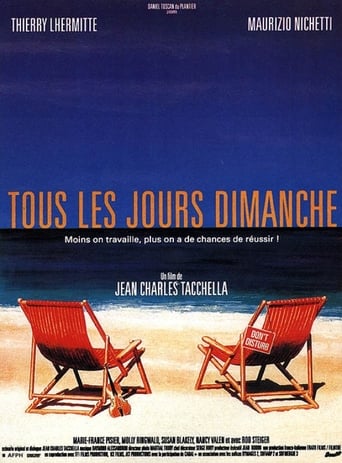
Seven Sundays
Tous les jours dimanche
1995 · Film · 90 min
Directed by Jean-Charles Tacchella
Dodo, a French man living in Florida, has one goal in life: Get by without working. Difficult to implement without the help of some women. Betty is one of them, and a gypsy's bride, who suddenly disappears, changing Dodo's life.
4 positive1 mixed12 neutralfrom 17 commenters
Where to watch
No streaming data for this title.
18 comments on Hacker News
The word unless is unfortunately superfluous in your statement. David Fincher just went through a grueling restoration process for Seven, and he talked about the process and basically said: Eastman Kodak has spent a lot of money to convince Hollywood that if your shoot on film and keep it in a vault that it will never degrade. It’s false.
One of the commercial cinemas recently screened The Abyss and Seven on their anniversaries. I was too young to see The Abyss on the big screen when it released, first time was on VHS.
Both screenings were >90% full, and it was really fun getting to watch them on the big screen.
I'm baffled as to why they don't do this more often. There are tons of movies I love which I've only ever seen on TV because I was too young or somehow missed.
And the younger people who was in the audience with me might have just heard of these classics.
For example I'd love to see the first two Terminator movies on the big screen for the first time.
There is an classic movie theater here but it mainly shows more art films. There are no other cinemas showing reruns on a regular basis.
> Yeah but this is 2022 are there even movie theaters anymore?
My uninformed and probably stupid thoughts:
Hollywood was doing some amazing movies in the 90ish (think Seven, The Matrix, Requiem for a Dream etc). It was a mix of new and established players that were allowed to innovate and be creative. Then Hollywood became more risk averse, I assume because sales were unpredictable and production companies wanted guarantees similar to other industries' large investments. So they started recycling ideas, produce sequels and trading IP rights for dudes in specifically colored spandex suits, which came with a guaranteed fanbase that would watch anything with the brand. This eventually became the MCU-type of crap where everything is a 4th wall joke packed with references to current events, leading to a shelf life less than a year and plots became an afterthought. The sales mindset went as far as putting stuff in the movie for the sake of producing a compelling trailer. At the same time TV was taking the Hollywood's lunch money, but for some reason they doubled down on the approach and blamed streaming for their failures.
The issue isn't the format though, or that everyone has Netflix on their microwave display now. There are still great movies today, and if you get a chance to watch one in a good theatre it's a mesmerizing experience. Me and my partner watched The Joker, 1917 and Dune in Alamo Drafthouse (a theater that has zero-tolerance to texting/talking and serves food & drinks). It's an experience that trumps even great TV shows, when done right. It's just sad that it's so rare.
> Bruce Willis may exist in the Ocean’s universe, but the 1995 film Twelve Monkeys, which co-starred Brad Pitt, does not. Movies like Fight Club, Seven, Batman & Robin, The Perfect Storm, Saving Private Ryan, and The Untouchables can’t exist.
This is horrible logic. Just because the actors may not exist doesn't mean other actors weren't cast for the parts. There is no reason to believe the movies don't exist, just in a different form.
I think the '90s had a bit more variety than the '10s and (for now) '20s. E.g. we seem to have lost good legal procedurals, thrillers, weird fiction, and "small scale" sci-fi.
Fo example, what are the'10s equivalents of "A Few Good Men", "Seven", "Dark City" and "The 13th Floor"?
There is _some_ stuff, but less than before, replaced by a massive amount of super hero movies or long-running franchises.
As a support clue, I invite you to consider the winners of the MTV Movie Awards, which are more "popular" than other Awards:
92 Terminator 2: Judgment Day 93 A Few Good Men 94 Menace II Society 95 Pulp Fiction 96 Seven 97 Scream 98 Titanic 99 There's Something About Mary 00 The Matrix (bonus: not 90s)
compare with the 10s
10 The Twilight Saga: New Moon 11 The Twilight Saga: Eclipse 12 The Twilight Saga: Breaking Dawn – Part 1 13 Marvel's The Avengers 14 The Hunger Games: Catching Fire 15 The Fault In Our Stars 16 Star Wars: The Force Awakens 17 Beauty and the Beast 18 Black Panther 19 Avengers: Endgame
I have the feeling most "risky" movies, for lack of a better word, have moved to streaming services.
I distinctly remember feeling like 1995 was absolutely amazing year for cinema.
Toy story, Braveheart, Apollo 13, Usual Suspects, Heat, Casino, Seven, Clueless, 12 Monkeys, Babe, Get Shorty, Leaving Las Vegas, etc.
A great time to be going to the Cinema.
Movie soundtracks are about as memorable as they've always been. Most producers cheap out when it comes to the music, so you get a "cookie cutter" soundtrack of the day:
* The tinny, mostly brass in the 50s and 60s.
* The mostly silent 70s, or faux disco.
* The primitive, nondescript synths of the 80s.
* The "nouveau orchestra" of the 90s.
* The "deep bass sound" of the 2000s.
etc etc.
You'd be hard pressed to tell the musical difference between "Treasure of the Sierra Madre" and "The Grapes of Wrath". "Taxi Driver" and "The French Connection". "Rain Man" and "Splash". "Sixth Sense" and "Seven".
It's always the same for music, tv, movies, etc: Every decade has its gems, but most of it is crap.
A long, long time ago, I was a male nurse in intensive and trauma care. Around the time, mid to end 90's, that aroma therapy mumbo jumbo began to spread among nurses. We even had one that couldn't stand the smell of rotting flesh on some poor souls trapped in intensive care with heavily infected wounds.
I loved the smell of an infected thorax cavity after partial lung resection in the morning. It smelled of hell.
Which really wasn't that pleasant I assure you. That nurse even installed magic trees and lavender bags. Which I associate till this day with decay. Yes, it was around the time 'Seven' had its theatrical release, but she didn't knew the film.
I left the healthcare trenches around 2000, but I see, not much changed. Still, enough room for nosocomial infection vectors:
https://www.contagionlive.com/view/aromatherapy-in-health-care-settings-source-of-drug-resistant-bacterial-infections
Wasn't the Zodiac brutally simple, the typical Fincher-like precision, almost sterile presentation of the story, with almost perfect linearity? I mean, I love that movie, but I love it especially because it's not "deep". (It doesn't mean there are no interesting questions/plotlines, of course there is the whole who-was-really-the-killer question. Of course there's the whole personal drama of the main character.) But compared to Seven - I think - there's a lot less abstract/social commentary and symbolism. (Even though it's full of the killer's code symbols.)
If you are a fan of Citizen Kane and the whole mythos around this movie, you might enjoy Mank. If not, you will probably find it quite boring and pointless.
Fincher is certainly no art house director. He makes big-budget movies with stars like Brad Pitt or Ben Affleck. He is kind of like Steven Spielberg - a director so talented in the craft he elevates rater middlebrow material to be uniquely enjoyable. Fincher just gets a bit more respect because he is "dark". But dark does not mean deep. For example Seven is really quite silly and contrived, but his excellence at directing makes us forget that.
that just remind me of the movie Seven, maybe the guy was right(?)
I was just thinking that they recently got some good content added.
These were all added this month: Batman Begins, Clerks, Gran Torino, Million Dollar Baby, No Reservations, Stripes, The Aviator, and The Fellowship of the Ring. The entire Comedians in Cars series is a lot of fun. Heat, The Godfather, Gangs of New York, Casino, and Seven.
Maybe you're bored of all that, but it's not like the films on Netflix are universally terrible.
>> Reminder that relying on electronic books means your research and reading habits can be tracked and stored for later analysis.
Libraries don't keep records? That's how the killer was caught in the film Seven
I remember talking with friends after we had seen the movie "Seven" in 1995 (seems like a lifetime ago). They all freaked out about the part where they said the FBI keeps records on what books people check out from the library.
Nobody would bat an eye about it today though. . .
This is one of my favorite kinds of movie. I've never heard a good name for the genre. Psychological thriller? Too broad.
You should add The Thirteenth Floor. A good movie, better than its low budget, that fits squarely in the category.
Glad to see someone suggested The Game. I loved that one. It's a long way down from The Game and Seven to Benjamin Button and The Social Network.
To every generation there is a film technique which defines it. There was the smokey grey/green from the Matrix films. Michael Mann had his desaturated shallow-DOF look. David Fincher uses silver-retention on his film development to extend the dynamic range while underexposing his shots (thats why interiors in Seven were so "dark" yet exposed).
Part of the device of cinema is extending the mise-en-scene outward and upward to the representational devices (projection, development and treatment).
Part of the study of film is tracing how the use of technique defines generations of film makers. Often, technology serves as an impetus for a style (i.e., Robert Altman and the use of multi-track audio on Nashville precipitated very "talky" films from the 70's/80's), or the developments in computer motion controlled rigs.
Or lets not forget: lens flares.
Color grading (ie, the orange/blue compliments in this article) are also defined by outward influences like magazine photography, trends in CGI, etc.
Anyhow, in a few years a new dominate "look" will pervade cinema and we'll all have something new to complain about.
It is a fantastic book! And the setting of the film is different, but the story is surely the same: an emotionally immature protagonist gets swept up in an ever-expanding and quasi-supernatural game. The emotional crimes he plays out on others are played back on himself through this game, causing him to eventually achieve self-realization through a sort of emotional catharsis and resurrection (metaphorically in the book, quite visually in the film with the white suit and the graveyard and all).
Replace Greece with San Francisco and the sexual crimes in the novel with the film's emphasis on corporate greed. Still not convinced? The icing on the cake for me is the fact that both film and book end identically, hanging on a moment of choice in a situation which leaves it ambiguous if "the Game" is still ongoing.
I don't think Fincher really nailed the movie the way he did with Seven and Fight Club, but the connection to the Magus seems obvious for another reason as well: the weak points of the film start making sense if you think about it as an adaptation. The major point of the Fowles novel is in its Eliot quote that, "the end of all our exploring will be to arrive where we started, and know the place for the first time." I don't think the film is as convincing as the book in part because the romantic relationship it uses to do this is incidental to its preoccupation with corporate greed and is not very believable. But the intended structure helps explain some of its weaker dramatic moments, the biggest of which for me was seeing Michael Douglas running around a corporate cafeteria with a gun shouting about the need to protect his employees and their pensions.
What amazes me about the coverage of this film is that David Fincher is getting totally overshadowed by his subject. Case in point, Techcrunch doesn't even mention that Fincher is the director, even crediting the film to Aaron Sorkin who just worked on the script.
Why is this an oversight? Fincher is one of the smartest directors in contemporary American film. Seven was a brilliant critique of how visual media feeds social violence. Fight Club turned a stylish but shallow nihilist novella into a meta-recursive critique of nihilism itself. Zodiac was a narrative masterpiece created out of nothing. The Game was an ambitious attempt to turn The Magus into a film that succeeded so well no-one seemed to notice. And even his lesser works, Panic Room and Benjamin Button, were still films that tried for something and are worth watching.
Yet not a single mention. Amazing.