 Hacker Cinema
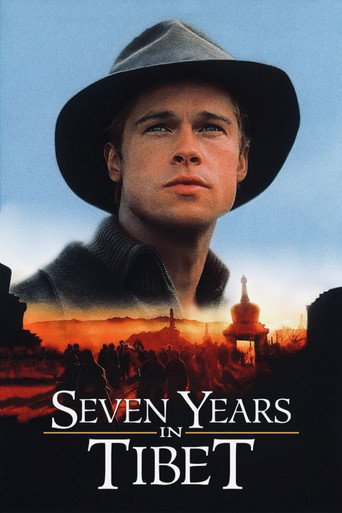
Seven Years in Tibet
1997 · Film · 136 min
Directed by Jean-Jacques Annaud
Austrian mountaineer Heinrich Harrer journeys to the Himalayas without his family to head an expedition in 1939. But when World War II breaks out, the arrogant Harrer falls into Allied forces' hands as a prisoner of war. He escapes with a fellow detainee and makes his way to Lhasa, Tibet, where he meets the 14-year-old Dalai Lama, whose friendship ultimately transforms his outlook on life.
2 positive4 neutralfrom 6 commenters
Where to watch
No streaming data for this title.



7 comments on Hacker News
i want to hear Heinrich Harrer (https://www.themoviedb.org/movie/978-seven-years-in-tibet) take on this.
Thats true, but you do not have to look long to see, that Tibet was a feudal theocracy, with no dissent allowed, either. But that is history. Modern Tibet deserves to make their own choices, I hope they get the chance to make them one day.
And about old Tibet, I recommend "Seven Years in Tibet", real story of a Nazi who fled a british war prisoner camp in india and then spend 7 years in Tibet, also as a teacher for the young Dalai Lama, until the chinese came. I read and recommend the book, but they also made a Hollywood movie with Brad Pitt out of it (which I have not watched yet, it is supposed to be good, but likely not as deep).
Interestingly, the movie was produced by Peter Guber's Mandalay Entertainment. In 2017, China’s Puji Capital invested in Guber’s Mandalay Endurance Media Ventures.
> “We are at an interesting inflection with China’s film industry – we have China becoming the most important market globally coupled with an increasingly more sophisticated Chinese audience who strive for compelling stories and movies that captivate the heart and mind,” said Puji Film director Lily Zhao. https://deadline.com/2017/08/china-puji-capital-invests-in-peter-guber-mandalay-endurance-1202151649/
So yeah, I think that it's very possible that Guber might have more reason not to make "Seven Years in Tibet" nowadays compared to in 1997.
"Seven Years in Tibet" was made without Chinese money, so why couldn't the same movie be made today without Chinese money? It's harder because everyone else is taking Chinese money? I don't buy it.
It's not so much fear of cultural imports as it is about political influence from a foreign government. The article makes a good point about how "Seven Years in Tibet" came out before Chinese money started flowing into Hollywood, and how perhaps that movie might not be so easily made these days.
There's something you didn't mention when you talked about how "USA wants to spread its values too." American companies that invest in Hollywood and sites like Reddit generally aren't partially owned by the government, and certainly aren't subject to as much government control.
Though not along the same lines as the other stories mentioned here, Seven Years in Tibet was an interesting book, also made into a film.
I use Douban myself, so I can see where you are coming from, though I think Douban is very much an outlier in today's Chinese cyberspace, given its main demographic group comprises mainly of 20 to early 30s young adults (the so-called Wenyi Qingnian).
Douban is nowhere near as large or influential as, say, Weibo. Sensational topics discussed on Douban may spread, but their spheres of influence are restricted to the cyberspace, or remain within the confines of its demographic group, the young men and women who generally do not have a voice in a society defined by filial piety.
Popular social networking site like Weibo, on the other hand, has a very tight grasp on what can and cannot be posted on its pages. Weibo's users consists of people from all walks of life, from corporate CEOs to devote followers to the new party chairman. Unlike Douban, sensational topics posted on Weibo can sway public opinions and cause social tensions, and sometimes even press for policy changes in local governments, which is why it is being utilized by CCTV as part of its campaign against Apple in the first place.
And it's not just the government taking control of the Chinese Internet, it's that sites self-censor heavily, or else they risk of being shut down by the government without any prior notice (see the whole Yanhuang Chunqiu debacle from earlier this year). Publishing houses do the same - they are not directly forced by the government to censor stuff, but they have to do it themselves or they get shut down. (though I hear the self-censorship's been loosening up a bit - the new book written by Ezra Feivel Vogel about Deng Xiaoping's policies was recently released in mainland China and in it some passages about the Tiananmen Square incident remained intact, though still heavily-edited.)
Douban also suffers from self-censorship. Brad Pitt's Seven Years in Tibet does not have an entry on the site; Richard Gere's Red Corner used to have an entry, but it did not allow comments, and was recently removed; Lou Ye's Summer Palace also used to have an entry and got removed. (I'm just bitter that I can't add all the movies I've seen to my collection on Douban, because of the permanently-missing entries.)