 Hacker Cinema
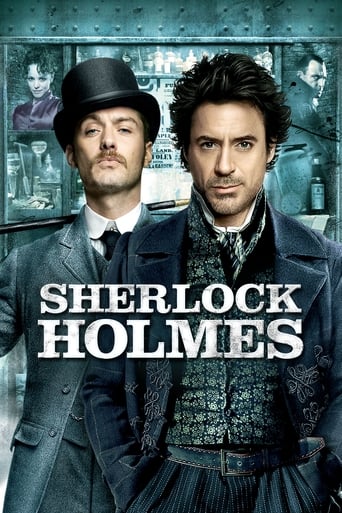
Sherlock Holmes
2009 · Film · 129 min
Part of Sherlock Holmes Collection
Directed by Guy Ritchie
Eccentric consulting detective Sherlock Holmes and Doctor John Watson battle to bring down a new nemesis and unravel a deadly plot that could destroy England.
5 positive2 negative27 neutralfrom 34 commenters
Where to watch
No streaming data for this title.
38 comments on Hacker News
Frightenin' all the dogs, on the Rocky Road to Dublin
https://en.wikipedia.org/wiki/Rocky_Road_to_Dublin
A classic I only know because it was in the RDJ Sherlock Holmes movie.
The High Kings do a good version: https://www.youtube.com/watch?v=0QdbeM2JWYE
> Can't AI autogenerate more content
We have so many old books and movies. Can't AI autogenerate more content so that we had more Fellini movies or at least more Sherlock Holmes stories? Most worthy games have quite some work behind them.
If all you need is more levels for old games, certainly there are competent level generators for Doom and Quake, but don't expect them to produce something like Arcane Dimensions.
I think it could just be that America is a much bigger market with much higher production values in TV and Film, so British people get their fill of competent, triumphant heroes from American media.
America has plenty of beloved sad sacks too. Charlie Brown, Donald Duck, Goofy, George Costanza, Eeyore (originally British but very popular in America and popularized by Disney) to name a few.
British media has carved out a bit of a niche for itself, but British people are also consuming other English language media.
And you also have plenty of British media where the hero is competent, triumphant, masterful, and autonomous with (frequent if not ubiquitous) standard happy endings. Lord of the Rings, Harry Potter, Sherlock Holmes, Doctor Who.
i’m not judging anyone that’s interested in the tech here. it’s pretty neat.
but do you think we were all born yesterday? Are you suggesting _most_ people using a bittorrent client are downloading public domain movies like sherlock holmes shorts? Or linux ISO’s for fun?
You are technically correct. But it doesn’t take a genius to understand that the disclaimer here is a total joke.
A little aside on story writing:
Police and Medical procedurals are the main settings for stories with the character growth flipped. Meaning, that in these procedural tragedies (typically, though some comedies do exist) the growth in the story, the change, is not in the internal lives of the characters, but in the story itself. The birth of this was with Edgar Allen Poe's detective stories [0], but most famously popularized with Sherlock Holmes. In these tales, the characters are very flat and unchanging from story to story, experiencing little growth through an individual episode. Though in recent media, we tend to see growth in characters over the course of a season, belaying the procedural model a fair bit
Some variations exist in the procedural setting with Legal, Journalism, Fire/EMT, Cybersecurity, Coast Guards, Forestry/Game Wardening, and Political setting serving as mostly variations to the Medical and Law Enforcement settings. The most novel and most recent additions to the procedurals are in Historical Restoration and Cooking/Kitchens. If I've missed any, please let me know.
So, to me, thing like copaganda more reflect the dearth of settings that the procedural model of story telling has available. The variations above really aren't as dramatic as the literal life and death stakes that Police and Medical situations come across every story. You can get close with Legal and Fire/EMT settings, and you can also have high stakes and life and death with Political procedurals, though typically off-stage. The nature of the audience's attention is just naturally going to gravitate to the most dramatic stories, and those are the Medical and Police ones, I think.
[0] https://poemuseum.org/poes-tales-of-detective-fiction/
Neat game!
I feel like the “if possible only one word” may make things a bit weird due to no fuzzy matching. I put “Sherlock Holmes” for one thing, and the expected answer was “Sherlock”. Also I misspelled the name of a movie.
Maybe adding some sort of estimation of whether the user’s answer is probably referring to the same thing, could be good? Like, maybe give half a point if the user text has a lot of overlap with the target text, compared to the length of the texts, assuming the text lengths aren’t too different?
Right but all you're doing is demonstrating how silly it really is.
For something like 20,000 years we were all shared owners of our legends and stories, and recently that's changed. It doesn't make sense to me that the kids that grew up on pokemon are prevented by law from making their own stories, art, and games about this shared cultural history.
This idea that the corporation that spawned the thing "owns" the idea is absurd. The creation is borne of the input of our culture, the output belongs to the culture. If you wanna do a capitalism in there 20 years should be more than enough time to do so. 70 years or whatever the USA is at now is absurd, madness.
Public domain "IP" had lead to phenomenal art that's been capitalistically profitable. Sherlock Holmes, multiple profitable movies, tv shows, and videogames. Greek mythology, multiple award winning videogames and movies, same for Norse mythology.
Copyright does not protect ideas, just specific expressions of ideas. So even if something sounds like a derivative work, it doesn't mean it's infringing. You can write stories about a fictional 19th century detective living on Boulanger Street in London without infringing on Sherlock Holmes. You can write reviews of Disney movies without Disney's permission.
Unexpectedly?
The whole point of publishing an idea or art piece is to influence people. Sure, some people will misinterpret it, but it should be pretty obvious that if you make a heroically brilliant protagonist dismissive of an opioid addiction that some people are going to think that's cool, especially if you're portraying that on TV. That's why Burgess wrote:
> I should not have written the book because of this danger of misinterpretation...
Kubrick's film (disclaimer: I've only read the book, I've never seen the movie) has apparently made this problem worse for Burgess. Similarly, Sir Arthur Conan Doyle's Sherlock Holmes was a deeply flawed protagonist, which readers of his books would see, but I believe that the way the character was portrayed by Robert Downey Jr. in the recent film/series adaptations similarly disguised those flaws and had a strong potential for some misinterpretation and more negative impacts.
House drew a lot of inspiration from Sherlock Holmes - both get cases nobody else can solve, Wilson / Watson are their close companion who are essential to solving many cases, etc. It's something acknowledged in interviews by people involved in the show.
The drug use is another thing - Sherlock used cocaine and morphine. House used Vicodin. Morphine and Vicodin are both opioids.
If they had him abuse cocaine, it would be too unrealistic. If they had him abuse Adderall, it might not be obvious to audiences that he has a substance abuse problem - people could write it off as him using it to focus. A prescription opioid is something audiences understood were abused at the time, and maintains the Sherlock connections the writers were going for.
Plus it gives plenty of plot hooks to explore the effects and consequences of addiction to someone we believe to be very successful (success is happiness, right?) in season 1
It'll be interesting to see if Disney tries to stop it. If they do (maybe via trademark [which "should" fail]), it'll mean more publicity. If they don't, then the film will probably quietly make a bit of money and we'll see people playing around with more old characters in new lights.
I'm not super into mickey mouse, but the huge variety of rather enjoyable Sherlock Holmes parodies tells me that characters and stories becoming part of the public domain will be a net good for culture.
> 2 films, the Sherlock and elementary series and now enola Holmes, despite Sherlock Holmes being near (in copyright terms) the end of copyright.
He was already mostly public domain, with only a few stories still copyrighted. (And his estate claims that some character traits like "having emotions" are part of those stories.)
Trademarks are supposed to designate the source of a product or good--not the good itself--and you have to actually use it in practice. The estate could have probably created Sherlock brand corncob pipes and maintained a trademark. But that wouldn't allow them to block someone from making a Sherlock Holmes movie or reprinting the books.
It might work for Disney because they have real products and can use Mickey to brand them. Even that won't stop someone from making Steamboat Willy 2. But it might block someone from making MickeyLand Amusement park.
> The only part of the depiction he’s complaining about is race
Am I?
Are you sure?
Can you quote me on that please?
The blue fairy is an important part of my culture, at least for me.
If someones rewrites it using all the power of a conglomerate like Disney, that puts at risk our shared culture and heritage.
For me she's gonna be a woman with blue air, for someone younger it will be a bald black woman, that has no direct representation in the society where I live.
I don't care who the actress is or what the color of her skin is, it's just not the "Fata Turchina", it's another character.
Simple as that.
Try doing that with Sherlock Holmes and see what happens.
What would happen if a Chinese company made a movie where Martin Luther King is an Albanian immigrant who came to Italy with the Vlora ship in 1991 to become a supporter of immigrants rights and got killed by a mobster in a fight over a pool game?
This makes me think of the camo scenes in RDJ's Sherlock Holmes movie: https://tenor.com/view/sherlock-holmes-robert-downey-jr-chair-camo-rdj-sherlock-blending-in-gif-20775525
Considering they are still making Sherlock Holmes movies and series... Yes they would still be making marvel movies, if they were popular. Other people might also be making them as well.
There are plenty of characters that aren't still under copyright. Sherlock Holmes, Norse and Greek Mythological heroes, Winnie the Pooh (now), most of the fairy tale stories (which Disney used early on) and a huge number of other characters and stories. You are focusing on the small number of popular franchises that are popular because people are creating new content instead of the huge number of stories that are there just waiting for someone to make a movie, video game, etc.
Limited time because it is in the Constitution. But also it allowed others to build on your creation. Sherlock Holmes is a wonderful example. Most of Holmes is in public domain. And recently the has been a rich at of culture created. Movies, television series, additional books. Personally I think the main thing that is broken is the the expiration date. The Constitution says "finite" and while there is a finite limit any limit that is longer than the average lifespan is essentially unlimited. Basically nothing created in your lifetime will be in public domain. And to me that goes against the spirit of "finite"
I've just made this comment myself. It's amazing how much casual violence there is in modern films that you just don't notice because it's everywhere.
I've watched more black and white classics in the last 15 months than I have in the last 20 years. Particularly the old sci-fi, horror, and slapstick films. Harold Lloyd, The Three Stooges, and Chaplin. Plus all the old St Trinians, and Sherlock Holmes. Abbot and Costello and so on. So pleasant to watch.
I mean, I think there's value in protecting a continuing enterprise. Most of the fault of our copyright laws fall on Disney. And to be honest: I think it's okay if Disney retains a near-perpetual copyright on Mickey Mouse, as they're actively continuing to build on and produce content, and otherwise exploit that resource.
I am most irritated about copyright holding on abandoned works. If a book or game or movie is not republished, continued, redistributed, etc. by the copyright holder for a number of years, I feel like their copyright should expire so that others may do as they wish to copy and distribute and build on.
I think there's a place a line could be drawn there: I feel Disney tends to use and continue and redistribute their assets for a very long time. If you want them, you can find them. I don't feel like Conan Doyle's estate should be able to basically copyright troll and just solicit license fees... if it was truly interested in maintaining control of Sherlock Holmes, it would be actively pursuing new stories from within itself, not just trying to tax people who create new content.
Debugging those issues always seems like a Sherlock Holmes episode to me. Especially when errors are logical and more specifically in this case hidden in an upstream dependency!
Thank you for the answer, very interesting and much appreciated.
So I suppose that something like the Judge Dee recent trilogy of movies is closer to Wuxia than stories with a lot of supernatural creatures, then? Would the Sherlock Holmes movies with Robert Downey Jr. qualify as Wuxia, too (especially the first one)?
Also, I find the concept of Wuxia (as "excellence") quite interesting in itself. Would you say it is somehow close to Arete in Ancient Greece? https://en.wikipedia.org/wiki/Arete
The alternative of course is that someone could use the Snow White IP to create new media, in the same way that Sherlock Holmes has generated numerous films. Guy Ritchie's two Holmes movies have netted over $1B USD at the box office. That wouldn't have happened if the Doyle estate still held the copyright.
Not to mention the fact that the Snow White character itself was pulled from the public domain.
> Nobody can tolerate a movie anymore if it has any "slow" parts.
As someone (from several generations ago) who watches plenty of "slow" movies (try a Basil Rathbone Sherlock Holmes or some of the early monster movies), I found 2001 to be profoundly boring and dull - to the extent that it's only one of three films that's caused me to fall asleep in the cinema (the others being "Transformers: The Last Knight" and "Avengers Apocalypse" - neither of which can be said to be "slow".)
The plaza and cathedral of Strasbourg (which you can see at the very beginning of one of the Sherlock Holmes movies starring R. Downey Jr.) has been engineered to channel wind around the cathedral, instilling a devilish, chilling feel and making the cathedral stand out as a safe haven.
I don't mean "on the stage" so much as the way Shakespeare -- and other public domain works, like Sherlock Holmes, Frankenstein, or Dracula -- forms the nucleus of new works of art. Every few years a new director or actor will put their spin on Sherlock Holmes -- two movies starring Robert Downey Jr, one staring Ian McKellan, and two on-going TV series. Romeo and Juliet is the basis for like a hundred movies, sometimes with tragic endings and sometimes with happy ones.
Retelling well-known stories with slight variations or twists is something humans have been doing for millennia.
Yes, because the story is that good. Look at how many Sherlock Holmes stories are going on right now, and movies are being made. In generally there aren't a ton of "shoddily made movies" surrounding public domain. We don't have lots of John Carters or Wizard of Oz or Sense and Sensibility.
I personally read lots of blog posts, news website articles, engineering papers (when required) etc. but find it a real struggle to read novels or lots of short stories. I enjoyed some Sherlock Holmes but lost interest after a few.
I just really prefer to consume fiction in film format and always have.
Part of the problem is the character isn't exactly copyrighted. It is the reason why we just had a recent lawsuit about Sherlock Holmes. You are free to create a book or movie about Sherlock Holmes. Just don't use any of the info from the last few books in the series. I think that Disney should be able to protect Mickey in a trademarked way, and do it at a cost. But it is going to be more complicated than "you can't use the characters"
What actual strong female characters have in common is the fact that they're not showing a huge amount of feminine traits. Take Zoey in FF for instance, if you disregard the female body she is not really female, in a good way. She is a loyal soldier, she is a loving spouse, and she is a good fighter, yet she's not really feminine. You know she's a woman and the writers chose to leave it at that, focus on what's actually important and not the "omg I can't believe she's a woman with a gun".
This is true for beloved male leads in movies as well, in the case of Sherlock Holmes we're not constantly reminded he's a man. The same goes for say, Iron Man. These are people who are introduced to a series of problems they have to solve, and in one way or another they get shit done with all the flare, despair and glory needed to make a good film.
Anti-racism is the new racism, anti-sexism is the new sexism, etc. When people stop focussing on trivialities, deeper thoughts can come to life.
Russian here. AFAIK, there aren't many Russian movies with English subs, although I've seen some, like Russian version of Sherlock Holmes. At the same time there are loads of (pirated) American and British movies and TV series with both English and Russian audio tracks and subtitles, I could help you find them if you like.
The gulf between homage and derivative work is quite wide. Consider a few examples of famous derivative works: Baz Luhrmann's Romeo + Juliet, Alice in Wonderland, Apocalypse Now, Muppet Christmas Carol. Right now there are no less than 3 different ongoing adaptations of Sherlock Holmes (the movie series, the BBC series, and CBS's Elementary series).
These are works that would be patently illegal if the source material were not in the public domain. This isn't just about "remix culture", it's about being able to adapt and interpret what's out there, fully and without restriction. Clearly there is value to allowing such artistic freedom once a work has grown sufficiently old. However, today that age has grown quite impractically long. A movie such as War of the Worlds (a 110+ year old book) can be made without seeking a licensing agreement, but movies such as The Hobbit (a 75 year old book), King Kong (79 years), The Chronicles of Narnia (62 years), Casino Royale (59 years), or The Dark Knight Rises (73 years) still require licensing.
And the sad part is that even in the next 20 years when, say, the Superman IP will be pushing 100 years old and Mickey Mouse even older it seems likely that such things will still require licensing.
The fact that the current IP laws have not utterly destroyed creativity or the productivity of creative industries is not a ringing endorsement. The fact is that they are stifling and they have been responsible for creating an industry which is too heavily controlled by a small group.
> And here’s something no one has stopped to consider: Maybe making movies is too damn expensive. Or rather, far more expensive than it needs to be.
Hmm. I went to the theatre (first time since a long time as the experience feels antiquated and overpriced) with friends to see Sherlock Holmes, and the opening scene perfectly exemplifies the point: for about ten second you see a shot of the cathedral of Strasbourg. Half of it consists of a CGI explosion. I live there, and to produce this shot, they locked this part of the city for one week.
Ten seconds. One week. A whole team plus equipment. To the other side of the world. Seriously.
When seeing the scene I found that downright shocking, especially given the 10€ hole burning my pocket.
By comparison it takes Turn10 Studios three days[0] locally to gather enough information on a track to subsequently work on for one year. That's a full-length, five kilometer track.
I know this is not the same, and various other things come into play, but I just can't help but have an alarm bell ringing when I see movie production costs. See for yourself (budget in $):
- 2001 and Star Wars: 10 million each - Independence Day: 75 million - Transformers: 150 million - Kill Bill 1+2: 50 million - Jurassic Park: 65 million - King Kong: 200 million - Blues Brothers: 30 million - Fast & Furious: 90 million - The Fellowship of the Ring: 100 million - Harry Potter: ~150 million each - Full Metal Jacket: 15 million - Jarhead: 72 million - Apocalypse Now: 30 million - Black Hawk Down: 90 million - Terminator: 6 million - The Matrix: 60 million - Terminator 2: 100 million - Casino Royale: 100 million - Quantum of Solace: 230 million - Sherlock Holmes: 125 million - The Godfather: 6.5 million
I know those $ do not mean the same across time, but still, you can see going from simple to double produces crap (CS vs QoS), or produces twice the length at arguably the same 'quality' (whatever that means) for a significantly smaller cost (LotR vs HP). I don't see either why F&F costs thrice as much as BB, and almost twice as much as KB.
Bottom line: MAFIAA, please produce non-crap and control your costs instead of blaming piracy.
[0] http://forzamotorsport.net/en-us/underthehood4/
> We would have paid good money to watch Sherlock Holmes or Tinker Tailor Soldier Spy. But it simply was not an option. So we went with a TV show that was free and then went to bed.
Free? Surely Fred has paid for his cable subscription. And paid dearly if he has any HD channels. And then there are the loud, terrible, annoying commercials.
It costs at least $50/month to get anything half decent on cable TV here in BC. More if you want HD stuff. Many folks I know spend about $100/month on cable.
I will add anecdotal evidence.... Movies this year suck. We have Grandma the babysitter around and my wife and I only took advantage once. After seeing Sherlock Holmes none of the movies beat Netflix.
It isn't just the context, it's the content too.
No, Sherlock Holmes is the Sherlock Holmes of kicking arse, as demonstrated in the recent movie. Holmes' superior deductive abilities enable him to quickly detect an enemy's weaknesses and capitalise upon them; this serves him well against common street thugs.
When milliseconds matter, though, training and experience beat logic. And Batman has years of martial arts training followed by quite a few more years of practical ass-kicking experience in the streets of Gotham. This is why Batman could whup Sherlock Holmes and Mr Spock. (Sequentially, at least. Put them together and they'd outwit him with some brilliant plan.)
Netflix arrived in Canada yesterday - but their selection is terrible.
The most entertaining thing about them is their suggestions:
Type in say "Sherlock Holmes" and it says - we don't have that but you might like "Miss Marple investigates", then underneath it says we don't have "Shrek" but you might like "cats and dogs - the rip off TV series".
So it somehow matches Sherlock with Shrek - then it actually suggests movies they don't stock - the whole thing is like the monty python (which they don't stock) cheese shop sketch
Became amateur scientists.
Sherlock Holmes is pretty archetypal of a hyper-focused Asperger's type; the recent 2009 movie with Tony Stark in it probably does a better job than most film adaptations of conveying these aspects of his character.