 Hacker Cinema
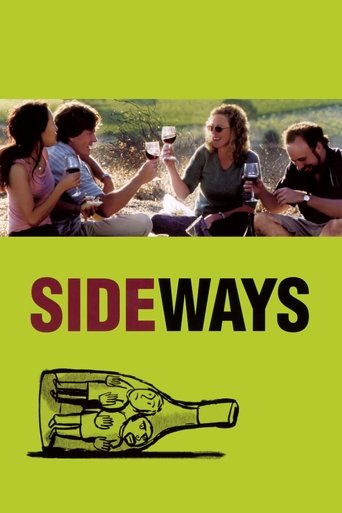
Sideways
2004 · Film · 127 min
Directed by Alexander Payne
Two middle-aged men embark on a spiritual journey through Californian wine country. One is an unpublished novelist suffering from depression, and the other is only days away from walking down the aisle.
3 positive3 negative13 neutralfrom 19 commenters
Where to watch
No streaming data for this title.
21 comments on Hacker News
Yeah, that's it exactly. Films aren't reality, although they can be a reflection of what we might think how reality should go. Af the end of the day, films are made to capture an audience, not to paint a perfect portrait of the real world.
Also, there are counterexamples to that person's claim, such as the film Before Sunrise, which is an excellent romance film that doesn't involve an arc where the characters are indifferent or dislike each other at first. The films Sideways and even Office Space defy that trope as well.
Sideways
Back To The Future
Cinema Paradiso
Spaceballs
Up In Smoke (Cheech & Chong)
The Incredibles
Indiana Jones 1-3
Indiana Jones: Kingdom Of The Crystal Skull (Rifftrax only)
Falling Down
Office Space
Man Bites Dog
Nothing To Lose
Idiocracy
Space Mutiny (MST3k)
Goodfellas
Star Trek IV: The Voyage Home
Groundhog Day
Barbie
Full Metal Jacket
Mallrats
Flight Of The Navigator
The Founder
One Hour Photo
---
I'm pretty certain I've rewatched Sideways more than any other film.
From the end of the article:
> Speaking on the BBC's Sideways podcast in 2021, Kristen had a blunt assessment of Stockholm Syndrome. "It's bullshit, if you can say that on the BBC. It's a way of blaming the victim. I did what I could to survive."
And that podcast episode is very good.
> For Pinot Noir, there are a couple spots like the Russian River Valley that do a good job, but Oregon has a stronger claim.
What about the Pinots from "Sideways" in Santa Ynez area? Paul Lato, Sea Smoke (maybe played out) to name a couple.
Funny enough I'd been to Lompoc a half a dozen times before I realized it was the region from the movie.
> At the release of Sideways, everyone and their brother knew the major wine varieties, and had opinions.
I think it's probably more accurate to say that everyone felt they were supposed to be familiar with the major wine varieties so all had picked up the terms and desperately clung to a few half-earned opinions because they didn't want to appear unsophisticated. But I think most people didn't actually have particularly strongly held or individually acquired wine preferences. (It's well known that even professionals can often not correctly identify what variety or even what color wine they're drinking.)
This is a social situation that's ripe for a radical opinion swing. Because everyone is trying to look like they know what everyone else knows but there's little "ground truth" (i.e. actual personal opinions) slowing down the change. So when a movie like Sideways comes out with a character who clearly cares deeply about wine and knows a lot and expresses a strong opinion. Well, I guess merlot's not cool anymore.
You seem to be paraphrasing what's listed here: https://www.reddit.com/r/FanTheories/comments/7wb8nj/at_the_end_of_sideways_miles_has_actually/
Yeah, there are references to death and suicide in the movie, like there is in most fiction about depression. But there's nothing explicit about Miles's fate, and the film ends on an upbeat note ("Because you were wearing your seatbelt!" Jack says to Miles). I've watched the movie 20x and the stuff you list is very liberal interpretation of some scant events.
I always love how on the show Flaked[0], Will Arnett's character lifts Giametti's speech on Pinots and why he loves[1] them down to the word, and there is zero nod to it in the show.
If you didn't know the speech was from Sideways you'd think Arnett's character is deeply eloquent, and if you did happen to see Sideways recently, you see him for the fraud he is.
[0] https://www.imdb.com/title/tt4973548/
[1] https://www.youtube.com/watch?v=QCS1Gnwbtp0
This article is a weird bit of serendipity for me as I rewatched this movie over last weekend; having only originally seen Sideways in college nearly 20 years ago. College me didn’t like wine and didn’t even really understand at the time why this movie had such rave reviews.
Now that I’m the age of the characters in the movie I realize that the wine is literally the least important factor in the movie (and also that it’s implied Paul Giamatti’s character kills himself at the end.) It’s funny that such a small subplot in a feature film can have a dramatic effect on a major industry like wine making.
Maddox, author of The Best Page in the Universe, wrote about exactly this phenomenon shortly after the movie came out. [1] Warning: It's Maddox, so it's crass.
>In the movie, Giamatti's character is a wine aficionado who drinks Pinot Noir in favor of Merlot, a wine that he despises. Now every idiot who has seen the movie has suddenly become a wine expert, and Pinot sales have shot through the roof. NPR interviewed a guy who said, and I quote: "I used to drink merlot, and after I saw the movie, they say 'don't drink merlot,' so [now] I'm drinking pinot noir... "
[1] http://thebestpageintheuniverse.net/c.cgi?u=sideways
There's a scene in the movie Sideways where the Paul Giamatti character quotes some poetry, and someone complicates him on his brilliance in writing it.
He says, with disgust, "It's Bukowski."
It can give you more accurate response if you generate again and again, e.g.:
Prompt: One movie everyone likes:
Response: Sideways (1998)
What happens on Sideways is a movie I never tire of watching. A very strange, yet somehow touching tale of life and redemption among the poor. The story revolves around an English class that travels in time to a future with a computerized existence. This all starts, however, from the point where no human soul ever existed anymore - that is to say, a woman living in the past. And she is married to a guy by means of cloning, who had died back in 2000 years ago.
Nora Ephron was brought
> I believe it's because politicians get star-struck
Maybe that's part of it, but I believe it's because they know these filmmakers have incredible power to influence.
Remember "Sideways"? A fictional character in a fictional movie said one negative line about merlot and wiped out the market for that varietal[1]. People who liked the wine suddenly didn't like it, because a character in a movie didn't like it.
Now consider all of the semi-fictional movies that are made, like Citizen Kane was about Hearst (which destroyed Marion Davies' reputation as collateral damage). Or all of the movies glamorizing war, soldiers, FBI/CIA/police or politicians. This is something our government has needed and continues to need people to embrace.
[1] - I asked some winemakers about this and they said merlot in Napa "was being ripped up like crazy" after the movie came out. And that merlot often ends up in red blends because selling it as a single varietal still doesn't fly. It's only coming back in the last few years.
I'm not sure there's a reasonable way past the "Napoleon Dynamite Problem". They mentioned, in the article, other movies where it's difficult to predict if someone would like them or not.
The list was “I Heart Huckabees,” “Lost in Translation,” “Fahrenheit 9/11,” “The Life Aquatic With Steve Zissou,” “Kill Bill: Volume 1” and “Sideways.”
Personally, the common thread I see across those is that the viewer would be more likely to enjoy the movie if they had the right context.
Kill Bill, for example, is far easier to enjoy if you've seen (not necessarily liked...but have seen) cheesy old Kung Fu / Karate movies.
Napoleon Dynamite is easier to appreciate if you were socially awkward yourself in high school. There's also some humor in there that's more relevant if you were a kid in the 80's, as well as some humor that might make more sense if you lived somewhere rural, or even more specifically, rural Idaho/Utah/Wisconsin.
All that to say that Netflix may not have enough data at their disposal to know if you have the right context to enjoy movies that almost require it.
Arrested development has seemed for quite a while to be a main source of movie humor. "Sideways" comes to mind that way.
Considering the way adult male authority appeared in a lot of TV shows (60s and 70s) led me to think that the screenwriters were enacting their own conflict with their bosses, men who made them cut down on risque jokes, nixed plot lines, etc. And those weren't great years for adult male authority in politics.
After seeing "Top Gun" ca. 1986, I said to those I went with that Hollywood had forgotten how to make movies. It knew how to make commercials (TG is full of sequences that would fit right into a Navy recruiting commercial) and music videos ("You've lost that loving feeling"), but that was about it. The rest of the movie was negligible, though perhaps I should have added in video games to allow for the fighter-jet stuff.
But was it ever that different? The stuff we still watch is the exception. Hollywood cranked out a hell of a lot of stuff 80 and 70 years ago that nobody but a film studies graduate student could bring himself to sit through. Read for example S.J. Perelman on how the studios worked.
As for "adolescent men coming to grips with who they are", arrested development is one of Hollywood's favorite subjects. I noticed this in watching "Sideways", but would Dean and Brando have ever made their names without it?
[Edit]
On consideration, isn't "adolescent men coming to grips with who they are" a large theme in Western literature? (And I suppose, but can't cite, other literatures also.) The Odyssey kicks off with Athena inspiring Telemachus to independence. Shakespeare's Henry IV plays are all about Prince Hal becoming Henry V. War and Peace follows three men from adolescence to maturity, and one of them, Prince Andrei, to a couple of levels. And I think one could find examples of literature following adolescent women through.
Like many other folks here, I can tell good wine from bad too, in so much as I can tell wine I like from wine I don't like. Even better, I can usually find lots of wines I like that are under $12-10.
I even have regions I know have a higher probability of making wines I'll probably like.
But I've had some pleasant surprises. I don't typically like Virginia wines for example, but I was recently introduced to Virginia Chambourcin wines, most of which I've found great. Likewise I don't typically like most White wines, but the Viogniers from Virginia have typically been to my taste.
More importantly, over the last few years I've gotten to appreciate wines that I may not like on their own, but pair well with certain foods and round out the flavor profile, vs. wines I can just sit with and drink.
The truth is the difference between good and bad wine is not some pretentious expert's objective ranking, but whether you like it or not.
For the record, my three favorite wines at the moment are:
Penfolds Koonunga Hill Shiraz Cabernet - Australia - $10
Cantina Zaccagnini Montepulciano d’Abruzzo - Italy - $12
Santa Rita Cabernet Reserva - Chile - $10
All go well with various foods or just by themselves. And yes I steer towards full-bodied reds.
But context can be just as important, I've also enjoyed cheap house wine while eating just as cheap food at local family eateries in Italy. I probably wouldn't buy that wine, but in that milieu it just "worked".
One rule of thumb I like to use when selecting from wines I don't know is that generally, a deeper punt (the indentation on the bottom of the bottle) on the bottle leads to wines I like better -- it's supposed to help with collecting sediment before pouring. But of course there's always exceptions. Excelsior (South Africa) makes some stupid cheap ($6-7) but pretty good wines with a twist off top and a shallow punt.
There are more "fashionable" wines I just don't like. I've yet to meet a California Pinot Noir I liked for example (the central wine in the movie Sideways).
Just try lots of wines, get a feel for the flavors, start to catalog which ones you like and don't like and you'll eventually develop your own taste. There's no shortage of wines to try, and there's thousands of under $10 bottles you can experiment with.
Just go with that and have fun.
I'm also Irish and I think the original comment is pretty valid - The point is you would never see a "normal" character in an irish/uk made production drink-driving, it is just a complete taboo. However, a massive amount of American produced shows have the protagonists driving home from the bar, and it is just accepted, which I always find quite jarring. If it was part of the character's image to be a law breaker/troubled/etc, that would be one thing, but "Sideways", the newest American Pie movie and "Dan in Real Life" spring to mind as 3 films I have seen lately which have examples of this casual drink driving. Clearly they aren't documentaries :-) but the American Pie movie in particular is pretty mainstream, so it was really surprising. I think it is reasonable to assume that the US attitude to drink-driving is quite a way behind Ireland.
And on your point on Darby O'Gill - That was an American film depicting Ireland, which was obviously full of stereotypes. The films and tv shows we are talking about are an American view of America, which you would assume should be a little more accurate in terms of attitudes/culture...
If you want to experience a weird town, while filling up on pastries, visit Solvang. Los Olivos is next door, which is where the movie Sideways was filmed (and I was born), and has some fantastic wine tasting (try Longoria).
One thought I haven't seen mentioned is the emotional aspect of several of these movies. In my opinion, Lost in Translation was bad, but I made it through it, I heart huckabees & Sideways were so terrible I stopped watching in the middle. All three movies were good in the sense that I could get drawn into the stories, but the characters/storyline just made me want to scream "Get over it you freaking cry-baby".
They weren't bad in the way that a normal bad movie is bad. They were bad in the way that it took talented writing, acting & directing to make characters and situations that were so pathetic and annoying that it was unwatchable to a guy like me.
I can easily see how someone else (who presumably could relate to the emotions of the characters) would really like the films.
I draw a slightly different conclusion than the author.
>I noticed they were all similar in some way to “Napoleon Dynamite” — culturally or politically polarizing and hard to classify, including “I Heart Huckabees,” “Lost in Translation,” “Fahrenheit 9/11,” “The Life Aquatic With Steve Zissou,” “Kill Bill: Volume 1” and “Sideways.”
To me, what all these movies share in common is that they are so original that they are less accessible to the first-time viewer (or, in the case of Farenheit 9/11, completely tied to one's political leanings).
For example, I walked out of Napolean Dynamite and was bored to tears with Lost in Translation. The second time I watched those movies, I laughed my butt off at Napolean Dynamite and I found Lost in Translation to be one of the deepest movies I'd ever seen. Just the thought of Lost in Translation now gives me a yearning heartache. If I used Netflix to rate these movies after my first viewings, I probably would have given them 1 or 2 stars. Now I give them both 5 stars.
(As an aside, I highly recommend all of the above mentioned movies. I'd love to see an expanded list, so if anyone has one, please share. Going by my theory, I bet The Big Lebowski is in there. :)
That's hilarious. The list of movies that are hard to classify reads like a list of my favorites...
[Like] “Napoleon Dynamite” — culturally or politically polarizing and hard to classify, including “I Heart Huckabees,” “Lost in Translation,” “Fahrenheit 9/11,” “The Life Aquatic With Steve Zissou,” “Kill Bill: Volume 1” and “Sideways.”