 Hacker Cinema
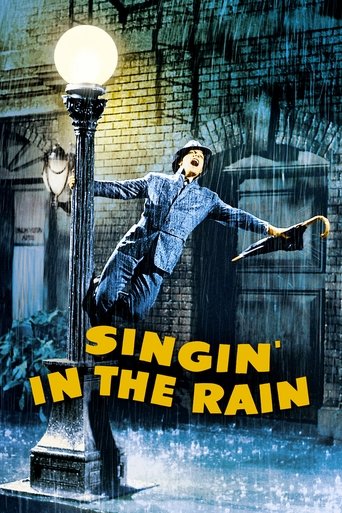
Singin' in the Rain
1952 · Film · 103 min
Directed by Stanley Donen, Gene Kelly
In 1927 Hollywood, a silent film star falls for a chorus girl just as he and his paranoid screen partner struggle to make the difficult transition to talking pictures.
6 positive4 neutralfrom 10 commenters
Where to watch
No streaming data for this title.
10 comments on Hacker News
Thanks! Here's the full list: 2001: A Space Odyssey, 8½, Aguirre the Wrath of God, Ali: Fear Eats the Soul, All That Heaven Allows, Apocalypse Now, Ashes and Diamonds, A Woman Under the Influence, Barry Lyndon, Bicycle Thieves, Breathless, Casablanca, Céline and Julie Go Boating, Chinatown, Chinese Roulette, Citizen Kane, City Lights, City of Pirates, Contempt, Daisies, Damnation, Dishonored, Earth, Electra My Love, El Topo, Eraserhead, Eyes Wide Shut, Film Socialisme, Fitzcarraldo, Fuego en Castilla, Hiroshima Mon Amour, Holy Motors, Inauguration of the Pleasure Dome, In a Year with 13 Moons, India Song, Inland Empire, Irma Vep, Koyaanisqatsi, La Dolce Vita, La Jetée, Late Spring, L'Eau de la Seine, Le Voyage dans la Lune, Lolita, Los Olvidados, Lost Highway, Lucifer Rising, Man with a Movie Camera, Metropolis, Mirror, Mulholland Drive, Night Music, Ordet, Orpheus, Persona, Pickpocket, Playtime, Psycho, Rebecca, Rosemary's Baby, Rumble Fish, Scarface, Seven Samurai, Sherlock Jr., Singin' in the Rain, Stalker, Sunset Boulevard, Taste of Cherry, Taxi Driver, Testament of Orpheus, The 400 Blows, The Blood of a Poet, The Cabinet of Dr. Caligari, The Color of Pomegranates, The Green Ray, The Holy Mountain, The Isle, The Lady from Shanghai, The Night of the Hunter, The Passion of Joan of Arc, The Seventh Seal, The Spirit of the Beehive, The Tales of Hoffmann, The Tree of Life, The Turin Horse, Time of the Gypsies, Tokyo Story, Touch of Evil, Trans-Europ-Express, Ugetsu, Un Chien Andalou, Uncle Boonmee Who Can Recall His Past Lives, Vampyr, Videodrome, Wavelength, Werckmeister Harmonies, Wild Strawberries, Moonlight Sonata, Stellar, The Haunted House Biased toward European art cinema, experimental work, and directors who broke conventional narrative rules.
Mostly, I will watch a movie a second or third time if I am tired and it's on TV and cannot sleep. So there is only a small intersection of films that I have watched multiple times and would admit to watching even once.
So excluding those, from most to least (probably).
- elf
- the Bourne identity
- groundhog day
- ronin
- Willie Wonka (the original)
- the fifth element
- ghost dog (any Jim Jarmusch)
- the blues brothers
- singin' in the rain
- crouching tiger, hidden dragon
- my friend totoro
I am probably leaving out quite a few, but all these films I have seen enough times to reconstruct in my head, scene by scene.
Honestly... I don't think there's much difference between games and other forms of media in terms of longevity in the public consciousness. "Singin' in the Rain" was released in 1952 and might very well still at least ring a bell today, but what about "Monkey Business" or "Viva Zapata!", released the same year? Those films even had some pretty big names (Marilyn Monroe and Marlon Brando). Even nowadays, there are still plenty of "shovelware" movies out there.
That being said, I think the real difference comes down to the fact that games are (by necessity) relatively tightly coupled to the hardware required to run them. Movie projector systems, while complex, are still much "dumber" than a computer. I think it's safe to say that if you have a film print from, say, the 60s, there would probably be a range of projector models from the preceding decade that could play it.
By contrast, if you have a copy of a PC game from, say, 1996, you're going to have to pay a lot more attention to its specific hardware requirements in order to build a system that's capable of running it. That raises the skill floor to run it in the first place. Honestly, I think this is one reason console retrogaming is so popular: to play a game, you only have to get a hold of a working console. The problem these days is that consoles are becoming more PC-like, so they're kinda backing into the same problems as PCs.
If you are not completely opposed to the idea, you could try Singin’ in the rain or Swing time or even The Umbrellas of Cherbourg. Old musicals have some kind of charm which you don’t really find in modern ones. They are such a huge part of cinema history.
My wife has an entire blog of them: https://lockdowntransmissions.wordpress.com/2022/01/03/the-covideo-awards-2021/ ; my faves of that list are The Silencers (Dean Martin does a Bond spoof), and Robo-Vampire (low budget knockoff Robocop fights Chinese vampires, incredible nonsense ensues)
I'd add Theater of Blood (Vincent Price thespian camp horror with a large number of cameos from British character actors of the 1970s), Tomorrow I’ll Wake Up And Scald Myself With Tea (Soviet time-travel twin-swap comedy), and White Sun Of The Desert, which is traditionally watched by astronauts in their last night of pre-launch quarantine at Baikonur. https://24htech.asia/i-was-bored-so-i-watched-the-movie-that-astronauts-must-view-before-launch-s425563.html ; that has some legitimately great shots in it.
To the original question, if you like technicolor you owe it to yourself to see Singin' In The Rain, not just for the title dance sequence but several other big numbers.
These may be a bit far afield, but they are fun to watch anyway:
The movies Singin' in the Rain (1952) and The Artist (2011) are both about response to technological change: the introduction of sound into the movies. The classic noir Sunset Boulevard (1950) touches on a dark side of that.
The musical My Fair Lady (1956) is about education, science, and technology for personal and social transformation. The movie version (1964) shows some early sound recording technology to comic effect.
Warner Brothers were pioneers in the implementation of motion picture sound technology in the 1920s with Don Juan and The Jazz Singer, among others [0]. Which is to say the experience of going and seeing movies was shaped by Warner’s risky investments in those technologies when they were new. There are actually allusions to this in Singin’ in the Rain [1].
[0] https://www.britannica.com/art/history-of-the-motion-picture/The-pre-World-War-II-sound-era
[1] https://en.m.wikipedia.org/wiki/Singin'_in_the_Rain
What I don't understand is how Netflix ended up this way. They attributed the success of a show like House of Cards to their data science capabilities - why would they produce bad movies unless that's what the data points to. Then maybe no matter what, the truth is that the content that gets eyeballs, and why Hollywood makes shallow broad movies is the same: they make money.
If you want to watch some actual quality filmmaking, visit a film festival or watch some Criterion films. Everything else will be "trash". If you want to expand your cinematic palate, explore American noir (The Maltese Falcon), melodrama (Douglas Sirk), musical (Singin' in the Rain), Western (The Good, The Bad, and The Ugly), epic (Lawrence of Arabia). Italian neorealism with The Bicycle Thief, French New Wave with Jean Luc Godard (Breathless). Want to go modern international, City of God, Gomorra, Wong Kar Wai, Park Chan Wook's Oldboy (advisory warning), or my favorite Japanese auteur Yasujiro Ozu.
Any of the above films are considered cinematic gems. Recommendations brought to you by my degree in Cinema and Cultural Studies. The true beauty of filmmaking is conversation over time. Films and directors talk to each other like authors and artists, they write love letters. They become self-aware of their medium (Fellini), "postmodern".
Great film can not fall in the limited boundaries of popular filmmaking. That's why Hollywood films tend to be so broad and shallow, to be palatable by all, no alienation, unless when it comes to race or gender. On the other hand, that problem is not unique to Hollywood or filmmaking.
Agreed: I watched Singin' in the Rain recently. Donald O'Connor's physical comedy is really the standout element in that movie.
I'm not sure I'm able to visualize this correctly. Let's say we have an array of strings containing the top 20 movies from Rotten Tomatoes:
The Wizard of Oz The Third Man Citizen Kane All About Eve Das Cabinet des Dr. Caligari. (The Cabinet of Dr. Caligari) Modern Times A Hard Day's Night The Godfather E.T. The Extra-Terrestrial Metropolis It Happened One Night Singin' in the Rain Laura The Adventures of Robin Hood Inside Out Repulsion Boyhood North by Northwest King Kong Snow White and the Seven Dwarfs
What would this data structure look like?