 Hacker Cinema
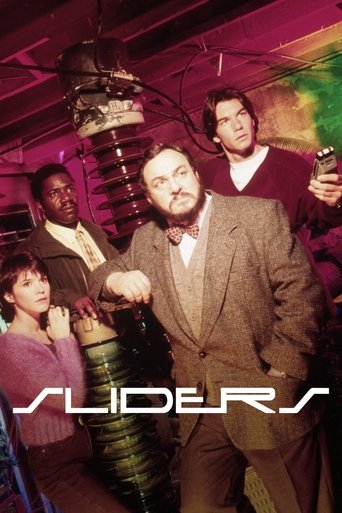
Sliders
1995 · TV series · 43 min episodes · 5 seasons
Created by Tracy Tormé, Robert K. Weiss
ActionAdventureScience FictionFantasy
In his basement in San Francisco, boy-genius Quinn Mallory unlocks the doorway to an infinite number of Earths. During a test run, Quinn invites co-worker Wade Welles and his teacher Professor Maximillian Arturo to see his new invention. But an increase in power and an early departure leave all three, plus a washed-up soul singer named Rembrandt "Crying Man" Brown, lost in a parallel world. Now they must "slide" from world to world, not only adapting to their changing surroundings, but also trying to get back to their world. Will they ever make it home?
4 positive3 negative17 neutralfrom 24 commenters
Where to watch
No streaming data for this title.


28 comments on Hacker News
Domingo Gonsales is flown to the moon by tying himself to wild swans, and meets Lunar Christians - The Man in the Moone by Francis Godwin (1601)
Manned mission to the Moon by giant gun - Jules Verne (1865 ish).
Manned trip around Saturn by comet - Jules Verne (1877).
Time traveller sets off to the future - H.G. Wells (1894)
Martian invasion of Earth - War of the Worlds by H.G. Wells (1905)
Global telephone network reaches as many connections as a human brain and wakes up - Dial 'F' for Frankenstein, Arthur C Clarke (December 1, 1975)
Birth of Dr Susan Calvin, founding of US Robotics & Mechanical Men, development of 'Positronic Brain' - Asimov's robot stories (1982 and after)
British space station under construction - The Outward Urge by John Wyndham (1994)
Portal to parallel universes - Sliders (1994)
Doctor Samuel Beckett steps into the Quantum Leap Accelerator and vanishes - Quantum Leap (1995)
Skynet becomes self-aware - Terminator 2 Judgement Day (August 29, 1997. at 02:14 am Eastern Time)
HAL 9000 AI computer operational (1997), first human voyage to Jupiter system (2001), first landing on Europa and alien life discovered (2010) - Arthur C. Clarke's 2001 A Space Odyssey
Moon leaves Earth Orbit after nuclear waste explosion, taking human-occupied Lunar colony with it - Space:1999 (13 September 1999)
Efficient international flight, using Zeppelins and blimps - Rudyard Kipling (2000)
Global climate disaster - The Day After Tomorrow (2004)
Replicants - Bladerunner (2016)
Keanu Reeves smuggles digital information in his brain - Johnny Mnemonic (2021)
Arnold Schwarzenegger kills to survive in a typical American TV show - The Running Man (2025)
Woman relifed into robot, rich people discover workers' rights - Fritz Lang's Metropolis (2026)
First colony mission to Mars, 100 colonists on the largest spaceship ever built - Kim Stanley Robinson's Red Mars (2026)
Tibetan monks finish listing all the names of God, stars start going out - The Nine Billion Names of God, Arthur C. Clarke (when computers were rentable and could print 1000 names per second)
and many more: https://scifi.fandom.com/wiki/Timeline_of_fictional_future_events
I saw this documentary, it was called 'Sliders'.
I'm old enough to remember people saying that about go.
I pitched the idea of an AI directly generating art sometime around 2008, only to have the idea curtly dismissed.
Deep Fakes (by a different name) were a plot point in an episode of Sliders, and the audio version a throwaway line in an episode of Babylon 5, at the time I thought each were completely impossible.
My bet would be androids doing plumbing around ten years after cars lose their steering wheels; but even then, that's just anchoring on Moore and the available power envelope for a car vs. a bipedal robot.
I think we can know this counterfactual. On bad science fiction shows like Sliders, they visit "parallel universes" where just one or two things are changed from our world.
In one episode, they finally believe themselves to be "home". Until, late in the episode, one of them notices that the Golden Gate Bridge is blue. Supposedly, nothing else is even slightly different than the one they are from.
Well, if we examine that premise, it's pretty dumb. At some point in the 1930s when it was built, someone had to source the paint for the damned thing. The plant that made the paint, even if it was the same one, used different pigments. Mined somewhere other than where they found the raw materials for whatever color of orange the bridge really is. Each of these slight changes, 70 years before the protagonists showed up, would have caused even bigger changes. Trucks taking different routes, causing different traffic patterns, different delays. Suddenly, people are being conceived 5 minutes earlier, or 5 minutes later (or not at all). It's doubtful that anyone born after whenever the divergence occurred (whenever that was) is genetically identical. Doubtful that anyone born even half a generation later has the same birth name.
Pretty safe to say if the dinosaurs weren't godbombed, there wouldn't be humans. The number of magical convergences is too high, even for a shorter period of time.
I am reminded of an episode of the 1995 TV show sliders, where people can withdraw unlimited cash from ATMs but it puts them in the draw for population control measures. https://www.imdb.com/title/tt0702744/plotsummary?ref_=tt_ov_pl
My point is that you can relax constraints such as Gödel's incompleteness theorems if you are going to give it credit when it gets wrong answers.
It might be able to write a TV Show like Sliders but it won't be able to do real physics, for instance.
The actual quality of the currently public models is why they decided to release them.
The worst case scenario of the currently public models is why they want to take it slow.
It's like the lottery in one of the episodes of the TV show Sliders: you probably won't win, but if you do win, you die.
Unfortunately, most people are really bad at grokking probably, and, by extension, risk, especially in scenarios like this.
> Bad actors will have enough money/lack scruples to train their own models or to steal your best ones regardless how "impact conscious" your company it.
Indeed, totally correct.
But this is also on the list titled "why AI alignment is hard and why we need to go slow because we have not solved these things yet".
Saying "it doesn't matter if we keep this secret, someone else will publish anyway" is exactly the same failure mode as "it doesn't matter if we keep polluting, someone else will pollute anyway".
For myself the amount of TV and movies I can watch is pretty limited compared to what I could obtain.
Lately I've been into the silents (Charlie Chaplin, Rudolph Valentino) but also Howard Hawkes movies not to mention things like
https://en.wikipedia.org/wiki/Belle_de_Jour_(film) https://en.wikipedia.org/wiki/Action_Jackson_(1988_film)
feel free to laugh but my son got the family (including my wife who teaches people to ride horses) to watch
https://en.wikipedia.org/wiki/My_Little_Pony:_Friendship_Is_Magic
... and then there are all the Gundam anime since Gundam 79, all the rest of Sliders, at least 200+ hours of video "in the queue".
I think how a few years back I would go see a movie like
https://en.wikipedia.org/wiki/Guardians_of_the_Galaxy_(film)
in the theater. I was talking to my son the other day how we lost interest in Marvel and Star Wars movies... We never had a moment when we said "Marvel Sucks", but they rarely make it into the queue to watch on video. And going to the theater post-COVID seems implausible to me because I don't want to deal with disgusting popcorn mess.
I'm sure there are good movies made today, even more sure there are good TV shows, but they have to fight for every minute of view time they get.
Wow, Sliders... that show was great until they replaced every single character
Also we learn from episode 1 that wormhole travel is better than sex ;)
Sugar being a controller substance was an episode of Sliders.
It makes me think of the first slide in the first episode of Sliders where Quinn Mallory slides, thinks his machine failed, then realizes he slid into a world where the red light means go and the green light means stop and someone yells at him "Don't you know you're supposed to stop at a green light?"
Thanks for the pointer, which seasons/episodes would you recommend?
This overview makes the production seem chaotic, https://en.wikipedia.org/wiki/Sliders
I can't speak for scientists but I can speak as a software dev. I'm also going to expand art to include literature, performing arts, etc.
On one hand my work is about sobriety and precision. But I have also had a rich inner life and attraction to fantasy worlds, fiction, etc.
Today I see that software inevitably lives in more than one world. For instance the most common kind of application program takes data out of a database and displays it in some way. You have to satisfy the compiler AND satisfy the customer.
For software to succeed completely it has to connect emotionally with the user, that's most obviously true in the example of a video game (which has all the attributes and characterstics of literature and art as does a movie) but it is true for a pocket calculator, CAD program, etc.
Literature is the royal road to understanding the tough problems of human living.
Entirely out of necessity and encountering the bounds of what I can accept and not accept I have recently been putting the principle of "life imitates art" into effect.
It might sound like the product of an overactive imagination but I think of the TV show "Sliders" where people visit alternate realities -- practically people experience very different things when they are in the same space and I find art and literature is a magic key that lets me go "sideways" to ordinary experience (and what passes for communications,) circumvent barriers, and take people into places they didn't know were there.
Maybe you don't get that much out of art but I think you should try.
> >he would go on to enjoy something of a late-career renaissance when he was cast as Gimli the dwarf in the Lord of the Rings films
Don't forget his role in 'Sliders.'
there was a very early Sliders episode about exactly this!
https://sliders.fandom.com/wiki/Asteroid_World
There was an episode of Sliders where you can withdraw however much money you want from an ATM, but each dollar is a ticket in a euthanasia raffle to keep overpopulation down. A little different from micromorts though.
A lot of good series have this "open sandbox" format where the context of the show is just a vessel for whatever story the writer wants to tell.
Examples:
* Star Trek Holodeck * The various worlds in Sliders * The infinite worlds in Rick and Morty means there are no limits to what can be written in. * In Community, in a lot of episodes Greendale magically transforms in whatever setting is needed for the story: a court room where the murder of a yam is debated, a western/space battlefield where players duke it out for a grand prize, an entire city made of pillows and blankets, a zombie infested Halloween party etc.
The upside is anything goes, the downside is the perceived lack of consequences (especially in the extreme case of Rick and Morty).
I remember that episode!
Love the Sliders reference. I might stream that all weekend.
There is an episode of Sliders (Fever, Season 1, Episode 3), where they slide into a world affected by an infection with no cure, and scanners have been placed at the entrance to every store to detect if you have it.
In the show the disease is used as a classist thing or something. Anyways, its bacterial not viral, and they discover than antibiotics were never discovered so the Professor scrapes some fungus off some trash and takes it and is cured.
Immediately reminds me of the Sliders S2E2 episode 'Love Gods' where the male main characters are effectively forced into basically being breeding stock because they just happen to be male. Note the article's "to 're-education' camps" and the episodes description "Bureau of Re-Population"
>Story: The Sliders arrive on a world where nearly all men have recently disappeared leaving a global population of 99% women. Quinn, Rembrandt, and Arturo are rare commodities, much sought-after by the romantically-starved female public, and Wade soon needs to rescue them from the "Bureau of Re-Population".
Also the episode Mother and Child:
> The Sliders discover a young woman and her eight-month-old infant trying to escape across the countryside from a Kromagg breeder camp. Will they be able to find a way to return her to her home? How far will she and her half-Kromagg baby get amongst other war-torn and suspicious survivors? And what dark, dangerous secrets do the other survivors harbour?
Looking back on Sliders I find that it really did take a good look at society of the time and often gave pretty plausible potential situations in the near future. Tackling things like ageism (The Young & the Relentless), racism (California Reich), sexual slavery (see above), population control (Luck of the Draw), climate change (Desert Storm), company store/debt slavery (Season's Greedings), forced organ donation/organ harvesting (The Breeder), mass media right-wing zealots (Prophets and Loss), tech addiction (Virtual Slide), mass drug addiction/epidemic (Just Say Yes), etc.
It's crazy that a lot of this stuff existed to some degree in the 1990's (always has really) but fast forward to now and some of the stuff is just... way too close to reality now for much larger numbers of people.
I suspect this is more a matter of what "sci fi" you like. The 1990s had lots of sci fi TV shows, including, among others:
X-Files
SeaQuest DSV / SeaQuest 2032
More Star Trek than you can shake a stick at (TNG, DS9, and VOY cover the whole decade, with most of it having two at once)
Babylon 5
Sliders
Stargate SG-1
Farscape
I think there's a better case that the 1990s were the high-point of sci fi popularity on TV than a particular drought (though I can see a case that there was something of a drought starting sometime in the mid-1980s through 1993.)
The good news is that pregnancy is almost an embarrassingly parallel problem. This gets reflected in polygynous societies and the occasional episode of Sliders.
http://sliders.wikia.com/wiki/Love_Gods
What show was it that discussed what would happen with a large number of very smart engineers and voting? I recall a TV show back in the day that basically said "We don't use electronic voting because it's too easy to game". I think it was one of the episodes of Sliders.
Speaking of managers ignoring things, I'm reminded of the last episode of the 90s sci-fi tv show 'Sliders', apparently the producers thought the network exec werent reading the scripts, so they deliberately broke a rule, and wrote a scene where someone was shot in the head and it wasn't picked up on.
cf. http://en.m.wikipedia.org/wiki/Sliders#section_2
> The goal of a healthcare system ought to maximizing the health of the people.
Everybody disagrees with this. A more plausible statement would be that it ought to offer the best health/price trade-off. But even then only crazy fascists think that would be ideal. Go watch that Sliders episode where the CDC rules America.
> The goal of an educational system ought to be maximizing learning.
Really? Lots of people would disagree. You've avoided the question of what's worth learning, and I'd say it's far more important that an educational system instill a strong work ethic and a sense of morality that I can tolerate.
> Perhaps a free market system (used very loosely) with the goal of pursuing profits would, as a byproduct, maximize the health of the people or of learning.
You have created an impossible standard. No system you describe in three words is going to maximize your utility function, especially not one as absurd as yours. Also the free market vs. non-free market dichotomy is completely silly. With all the government funded research and state schools, you can't say that America's universities are a "free market". But they do have an important free market feature that lower-level public schools lack: choice of what school to attend.
> It is morally wrong for someone to profit from denying someone else healthcare.
I profit by not financing a tunnel through the mountain to the hospital. Sometimes an emergency vehicle takes too long to get to the hospital and this causes the patient to die. How is my behavior morally wrong?
> Indeed, in the case of healthcare I have very strong evidence that profit seeking isn't a great motivator.
No you don't.
There was an episode of the TV series Sliders in which the main cast lands in a crime-free world that is obsessed with reality TV cop and court shows. Since the world is crime free, the TV producers stage crimes and digitally superimpose the faces of unwitting perpetrators, then arrest them, try them, and execute them (IIRC - maybe it was just a prison sentence). I'm sure the theme has been used elsewhere as well.
Behavioral economics taken to a horrifying extreme. I thought that's what he was warning of - until I got to the conclusion and realized he was condoning it. Yuck. It's like a bad episode of Sliders.
Sliders is a tv show from a few years back.