 Hacker Cinema
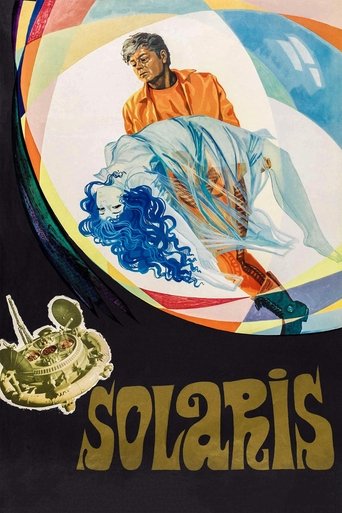
Solaris
Солярис
1972 · Film · 167 min
Directed by Andrei Tarkovsky
A psychologist is sent to a space station orbiting a planet called Solaris to investigate the death of a doctor and the mental problems of cosmonauts on the station. He soon discovers that the water on the planet is a type of brain which brings out repressed memories and obsessions.
82 positive18 negative4 mixed41 neutralfrom 145 commenters
Where to watch
No streaming data for this title.
179 comments on Hacker News
It's clearly in a different category from the "highbrow" examples like Solaris, just by virtue of being entertaining to a broad audience. In contrast Solaris is the kind of movie where there's a five minute unbroken scene that's just a guy driving in traffic and thinking about his life. (Like the author, I like them both!)
> Good science fiction where the aliens are very alien are hard to come by.
Apart from "Solaris", which many probably know because there's been a reasonably well-known movie, I recommend "Fiasco" by the same author, Good science fiction where the aliens are very alien are hard to come by Stanisław Lem. Spoiler: It does not end well. The aliens are too alien, and the humans do what humans often do.
https://en.wikipedia.org/wiki/Fiasco_(novel)
It's the opposite. Modern movies are obsessed with plot. Inception being an example of this. It's everything else, the image and characters that's lacking. You're never going to get something like Tarkovsky's Solaris again that just shows you a highway scene for five minutes.
Villeneuve commented on this a year or two ago in an interview where he pointed out that he hates the extent to which television has infected film with its focus on plot and dialogue at expense of what's visually on the screen.
We haven't been able to decode what whales and dolphins are communicating. Are they using language? A problem SETI faces is whether we would be able to decode an alien signal. They may be too different in their biology, culture and technology. The book & movie Contact propose that math is a universal language. This assumes they're motivated to use the same basic mathematical structures we do. Maybe they don't care about prime numbers.
Solaris by Stanislaw Lem explores an alien ocean that so different humans utterly fail to communicate with it, leading to the ocean creating humans from memories in brain scans broadcast over the ocean, but it's never understood why the ocean did this. The recreated humans don't know either.
Tarkovsky was making the movies he wanted, and stories were just pretext.
Both Lem (Solaris) and Strugatsky Brothers (Roadside Picnic turned into Stalker) disliked what Tarkovsky did.
Stanislaw Lem was far too much of a genius to believe his works were directed by any sort of committee, communist or otherwise.
He is still overlooked far too much - people seem to regard Solaris as his only work of note. But he has so works, all bizarre, imaginative, and insightful. Fiasco and His Master’s Voice are two of my lesser known favorites.
2 years prior, in 1972, Andrei Tarkovsky adapted Stanisław Lem's Solaris to the big screen in the Soviet Union, which may have contributed to Dick's paranoia. Anyway, the film's a masterpiece that I highly recommend, and since it was published before 1975 it is not subject to copyright. You can find it on YouTube [1].
[1] https://youtu.be/Z8ZhQPaw4rE
- Ghost in the Shell (1, then 2)
- Children of Men
- Stalker
- Solaris
- Blade Runner 2049
- Devs (a brief tv show, but just one shot the whole series)
- Contact
- Under the Skin
- Paprika
- Annihilation
- Arrival
- Ex Machina
- The 5th Element
- The Substance
- Primer
- Tenet
- Upstream Color
- 12 Monkeys
- Her
I punched in 1972 and there were some fantastic movies that year (The Godfather, Deliverance, Cabaret, Solaris, Jeremiah Johnson, Aguirre - the Wrath of God, The Last House on the Left, Silent Running, The Heartbreak Kid, Fat City, etc.).
Also tried 1973 — same (The Day of the Jackal, Soylent Green, Westworld, The Wicker Man, Papillon, American Graffiti, The Sting, Serpico, Mean Streets, High Plains Drifter, Don't Look Now, Badlands, The Long Goodbye, Jesus Christ Superstar, The Three Musketeers, Fantastic Planet, etc.).
I think they simply made better movies decades ago.
The star diaries are my favourite, more whimsical. I'm very fond of his robot stories. I've never re-read the Memoirs, they were .. very unsettling. As was the futurological congress. Solaris is too overlayed by the Tarkovsky film for me now, i used to make shredded paper to hang in my office airvents as a homage.
It goes on my list of 'dreamlike' movies, they don't always fully add up consciously but you can feel your unconscious going into overdrive while watching them (or maybe there is a surface plot that mostly adds up, like EWS, but there is clearly something going on at a least one other level). The viewing experience is often downright hypnotic for me.
A few off the top of my head, this is a very personal list and I can't even claim that all these movies are 'good' in any particular sense. Just that they put me into this state: * basically anything in lynch's cannon. I'm not always the biggest fan of his stuff, but sometimes they hit me hard. * Cronenberg's Videodrome and it's spiritual sequel Existenz * Donnie Darko & Southland Tales (objectively just an awful movie) * Prince of Darkness * Enter the Void (not for the faint of heart) * Paprika * Solaris (the original mostly, there are some qualities in the remake) * Stalker * Dark City * Sorry to Bother You * The Fountain * 8 1/2 * The Ninth Gate * and certainly Eyes Wide Shut
On Solaris movies. You may find better luck with the Mosfilm adaptation. It's very beautiful, slow, contemplative.
Best measure is to check out which movies have not disappeared from the hard disk. And that is both Solaris'es and couple of Kurosawas. And Leningrad Cowboys. Mostly because infinite source of funny snippets and memes.
This process has an interesting history. In 1937, Russian engineer Evgeny Murzin created a photoelectronic synthesizer that used images on glass plates to play music. It was called the ANS synthesizer and was used for the soundtrack of the Tarkovsky film Solaris. Somebody made an app version of it, called Virtual ANS, that is generally available.
https://en.wikipedia.org/wiki/ANS_synthesizer
A commercial product called Metasynth released in 1998 was the program Aphex Twin used for his song referenced here and also in the Matrix movie for the bullet time sound effects. It's amazing, but very expensive.
PKD's novel is misunderstood as a result of the movie. This novel and his work in general were less interested in trying to know ascertain who's a robot, and more interested in why one thinks he's human.
The movie was made to play in Peoria, so it was written with a Cartesian conceit of "replicants" as others in the Baudrillard sense of simulacra: the story was designed to reinforce the idea that humanity is a stable fixed point of reference upon which cleverly designed machines are intruding. This was calculated to be assimilated my audiences (the movie functions as a memory implant) who are upon arrival to the theater were already operating under the delusion of thinking they're free because they have endless choices for consumption, including which movie to watch. The love story between Deckard and Rachel seems calculated as a somatic device to inhibit introspection that might further trouble and arouse viewers to the point of rejecting a challenging product.
My recollection of Deckard in the novel was that he wasn't much concerned with what constituted androids outside of narrow technical dimensions—though maybe I mis-recall my own reading? The character had his own problems. He was quintessentially American, preoccupied with status, possessions, work-a-day worries, televangelism, and somatic distractions, like the mood organ.
Stepping up a level, the open question of the story being who is building us as the robots we find ourselves to be? Of course there's no answer to this question: it begs a god a patriarchy, an orthodoxy.
That the movie took on a adoring following which is overly invested in particulars is typically ignorant fan fetish: Robots (fans) touching robots for pleasure. The cusp is the awareness that civilization is robotic.
Lucas's THX 1138 seems well informed by the ideas of PKD's Androids.
The uncanny and nihilistic aspect of the beast-machine was the central theme of Kubrick's 2001; the monolith illustrating a realm of authenticity inaccessible to us, no matter the power and complexity of the garments we attire as tribute to our uncanny of our self awareness. Kubrick's epic comes off as a depressive's longing for an extinction event that would result in a rebirth of the species (self) on some other plane of existence.
Tarkovsky's adaptation of Lem's Solaris tried to go further than Kubrick, with the observation that everything we feel is real is a regress of a universal mind, and our views of ourselves play out in some kind of Klein bottle of nature.
Blade Runner feels trite, but I truly enjoyed Villeneuve's sequel as just stomping ahead with the pre-suppositions of Scott's movie and continuing to build out its world of increasing alienation with some kind of an attractor of family and self-sacrifice in the midst of a gruesomely overdeveloped world: the star child has no immune system and so must live in a hygienic bubble with nothing to do but create memories for everyone else.
21st century Hollywood eating itself.
Reminds me of Solaris, the same thing holds there (Lem's "rational" book vs. Tarkovsky's "impressionistic" movie)
(Mild spoilers)
Both of these were written stories first, but I first encountered them as movies.
Arrival. I really enjoyed the idea that learning something new could lead to other changes in perception that you wouldn’t think are related. It also led me to other works from Ted Chiang, each of which brought unexpected mind bending concepts.
Solaris. Teaches the lesson that we need to accept that there may be things we just aren’t able to understand.
Was Solaris even released to US cinemas in 1972? I can only find information that it was shown at the Cannes Film Festival in the year of its release. And even if Carpenter and O'Brannon knew about the movie it might very well be that they didn't see it as influental as it is seen today in the western world. Apparently Lem didn't like the movie either, so it might very well have been overlooked at the time because it didn't fit the "Zeitgeist".
Am I missing something? Because Solyaris [1] predates Dark Star. Not mention though.
[1] https://www.imdb.com/title/tt0069293/
Or take Tarkovsky: both Stalker and Solaris are based on books, but only loosely. Stalker, for example, was a short sci-fi / horror story, if I remember correctly, and in the movie this is just a remote backstory, setting the scene to more serious topics and mysticism.
I have only read Lem's "Solaris", and I have also watched the Soderbergh movie. But I don't think I've ever read/seen a more profound meditation on the human experience PLUS the possibilities of an encounter with an alien intelligence. Just wonderful, soul-provoking stuff.
I would recommend Stanislaw Lem. He is Polish and Jewish. Solaris is great start. There has been two movie adaptions of his book, Soviet and Hollywood, and both fail to express the main point of the book that is possible incomprehensible strangeness of alien intelligence. I would compare his book to Peter Watts Blindsight in this regard.
> Saying that purists want people to suffer is quite misleading
Not at all. I've watched enough movies where the director clearly wanted the viewer to suffer, based on the idea that only through suffering can the viewer be enlightened. The suffering is in the form of making a bad movie.
Solaris comes to mind. I've tried to watch it multiple times, but the director (and the director's fans) clearly revel in the notion that one must suffer through the movie, and that's the point of it. The movie is boring on every level - bad dialog, bad plot, bad cinematography, bad pacing, bad acting, everything is bad about it. And it's (small) number of fervent fans love it for its wretchedness. They can keep it :-)
I saw a colorized version of Metropolis a few decades ago. The technology to do it right wasn't there, but it was enjoyable in a way the original was not. I've since watched the full version when the missing footage was found, and there's an ideal film that would benefit from the application of modern technology. I bet Fritz Lang would love it.
TCM also ran a version of the silent "Wings". They added some color in a few spots, and some airplane engine sounds. Even just that little bit made the picture much more watchable.
I'd like to see the FM Busby musicals fixed up.
Some movies I wouldn't touch would be Top Hat. It's perfect as it is :-)
I just finished reading this book after someone in Hacker News plugged the book last week. I agree with your assessment. The book explores different types of intelligence.
Similar to the book Solaris (there is a new English translation, and I recommend both the US and Russian movies).
You’re objecting to what I might call “pop sci-fi”, and while I wish there was more “hard sci-fi”, those are just doomed from the start. Big effects budgets just aren’t compatible with the very low expected audience for stuff like that. Hard sci-fi will (almost) always be relegated to low budget indie films (and those may have a better chance on streaming compared to cable tv).
The few notable exceptions include: Solaris, Contact, and Arrival.
At a certain point, you have to be realistic about how closely a big budget production will cater to one’s very specific tastes.
> The question is, when will we feel that those things actually deserve to be thought of as being full-fledged, or at least partly fledged, "I"s?
this LLM thing is more like a collective "we", it is making a prediction in the sense of the relevant training data, it probably wouldn't say anything that contradicts the consensus.
Maybe the LLM's are just a mirror of our society. And our society doesn't seem to assign a lot of value to individualism, as such.
i think that might be similar to the movie Solaris by Tarkovsky. The movie is starring an alien ocean, which is some sort of mirror, that is showing us who we are (maybe it has a different meaning, not quite sure about it). You can watch it on youtube: https://www.youtube.com/watch?v=Z8ZhQPaw4rE (i think you also get this theme with Stalker - this zone is also telling us who we are)
I remember watching Adrei Rublev for the first time, getting more and more pissed the whole time. It wasn't the technique. I had already seen Solaris. It was the hapless passiveness of the main character. However, the bell making sequence really drew me in. I had this immense tension waiting to see how it would turn out. The ending broke me and suddenly the whole movie clicked for me.
I don't wish to spoil it or taint someone else's experience so I'll just say, many films have a plot twist at the end but I can't really think of another movie that manages that kind of an emotional turn. Not without something pretty hammy like a surprise betrayal or death. Andrei Rublev will always stick with me.
You might try the Solaris novel instead. The movie was based on it, but as you know books can be very different.
I liked Solaris well enough, but in the end it was far less interesting than say the better Star Trek episodes.
I need to watch Solaris and Stalker.
Tree of Life was one of my favorite film experiences ever, but I wouldn’t care to watch it again.
I’m curious - why did you feel like Tree of Life was incomprehensible?
I think we have to agree to disagree; I found The Tree of Life (the only Malick movie I've managed to finish) to be a boring, incomprehensible mess of a movie, while Solaris and Stalker have been, in my opinion, somewhat interesting things.
Wait, you hated Solaris? It was the first Tarkovsky movie that I watched and I really connected with its themes of the "real" vs "memories". It's hard for me to imagine anyone hating Solaris...
I still have not seen Mirror, though a few of my film friends have told me to check it out for years.
I liked Solaris while watching it, but it's one of those movies that's kind of "stuck" with me. I find myself thinking about it at random moments, just kind of pondering its themes. I've always been interested in the fine line of "real" and "creation" (my favorite movie is Ghost in the Shell (1995)), and I think Solaris does a good job exploring the interesting themes about how our memories of a person an the actual person are different and the same.
It being free on YouTube is as good of an excuse as any to re-watch it.
I've tried twice now to watch Solaris and fell asleep both times - someone let me know if it's worth it! I've seen every other Tarkovsky film and love his work, this one just felt particularly difficult for me.
You might like the original book Solaris better. It has a unique atmosphere, isolation and mystery of the alien planet, and explores a different idea of alien life than we usually get in movies. This is hard to communicate in a movie, Tarkovsky did well, but it does not hold up as well as the book.
The best way to watch these movies would be by pirating them from the RuTracker, as that way you will be sure that you are not contributing any views or advertisement money to the Mosfilm, with a bonus of much higher bitrates.
Here are the links:
Solaris — https://rutracker.org/forum/viewtopic.php?t=6191155
Stalker — https://rutracker.org/forum/viewtopic.php?t=6182463
Ivan's Childhood — https://rutracker.org/forum/viewtopic.php?t=6194960
The Mirror — https://rutracker.org/forum/viewtopic.php?t=6194964
Andrei Rublev — https://rutracker.org/forum/viewtopic.php?t=6194948
The Passion According to Andrei — https://rutracker.org/forum/viewtopic.php?t=5820633
Battleship Potemkin by Sergei Eisenstein is in public domain, and so you can legally watch any other upload on YouTube instead of Mosfilm's, for example https://www.youtube.com/watch?v=HsQcljysO-8
Tarkovsky's "Stalker" is loosely based on the "Roadside Picnic"[1] a sci-fi novel of Strugatsky brothers.
A. and B. Strugatsky are not that much recognized in the western countries as Andrey Tarkovsky, but they made significant contribution to the Russian literature of XX century, and their books are still popular in the post-soviet countries. In particular, the Roadside Picnic influenced many modern sci-fi works too, including, for example, the "S.T.A.L.K.E.R." and the "Metro" video game series.
Tarkovsky's "Stalker" is quite distinctive from Strugatsky's novel both in style and plot, but the screenplay of the movie was written by Strugatsy brothers too. Basically, they made completely different work in the same setting, but following completely different narrative. Also, they included a lot of pieces from their other (less famous) work "The Ugly Swans" into the screenplay, which is closer to Tarkovsky's film style. For example, the Writer's monologue[2] is just a direct translation of the same monologue from The Ugly Swans.
"Solaris", another Tarkovsky's famous sci-fi movie, based on Stanislav Lem's novel of the same title, was a more controversial work. Stanislav Lem made quite critical reception of this adaptation that simplifies and distorted his novel's original ideas. However, I think that Tarkovsky's "Solaris" is still the best adaptation of this book we currently have.
Aside from this, I would recommend "Ivan's Childhood" a war movie about orphaned child, and the "Andrei Rublev" a historical movie about the famous Russian Orthdox Icon painter set place in the late middle ages, and about survival of artistic people in hard times.
[1] https://en.wikipedia.org/wiki/Roadside_Picnic
[2] https://www.youtube.com/watch?v=uwIoSI1Eqak
Stalker is a beautiful movie but perhaps not the easiest one to watch, especially if you are not used to 10 min long shots of nature (e.g., water in a stream). Possibly Solaris, which you recommend too, would be an easier movie to watch first.
The original Solaris novel had a different ending, a disillusioned reflection by Kelvin, which I found much better. It was probably not dramatic enough for a movie, too analytical.
It's one of his most accessible movie, and usually resonates with tech people for obvious reasons. His best movies imo are Mirror, Ivan's Childhood, Andrei Rublev, Stalker and then Solaris, Nostalgia and Sacrifice.
Now Solaris book by Lem is far superior to Tarkovsky's rendition.
I just bookmarked three of these. I have watched Tarkovsky's version of Solaris at least 3 times (and the American version with George Clooney and Natascha McElhone 5 or 6 times) - I love that story and both movies are so very good!
I really didn't enjoy the ending of Solaris and, for that matter, The Little Prince. You don't need to have a punchy ending for me not to feel like I wasted my time with your movie. It's okay to let the journey stand on its own rather than throwing in a climax that feels haphazard and spontaneous.
Mosfilm actually has 2 channels and the original older one has normal YT subs, but the movies are more geolocation restricted, they are not available in the US, UK, Canada.
Solaris for example
https://youtu.be/6-4KydP92ss
https://polsy.org.uk/stuff/ytrestrict.cgi?ytid=https%3A%2F%2Fyoutu.be%2F6-4KydP92ss&auth=1a0a97d4984aa48141e072e9a6fa339c
IMHO, if you’ll be watching your first Tarkovsky film start with Stalker, which is how my girlfriend (now wife of 27 years), introduced me to him many years ago. I was very much a Fellini person, and the Bergman-Tarkovsky school seemed cryptic (at best) at the time. When finished, ask yourself (1) if you would have gone into the room and (2) what the dreamlike sequences with Stalker’s son meant.
Second one should be Solaris, if you’re into SciFi or The Mirror if you’re not of if you’d like a challenge. I think The Mirror is the better movie, the woman (stand in for T’s mom) looking at the wheat field (T had these specifically planted for the film!) haunts me to this day.
I personally couldn’t relate to The Sacrifice, perhaps his most personal film. His earlier films (Ivan and Rublev) I could not watch at all.
To be a genius artist like him in the Soviet Union meant privileges unheard for art film directors in Europe (let alone US), eg see the wheat field thing above. It also meant you’re at the mercy of the “masses”. I had read an article once that included a comment for The Mirror from a regular filmgoer, saying after 30mins it caused such a headache! The funding was based on such feedback and the movie was labeled as elitist (it is) which greatly impacted his career. It’s infuriating to think T lost time due to such petty interference (OTOH, I could only finish the film on my third try, falling asleep in first two attempts! So she had a point)
Solaris is by far his best movie, even better than STALKER (which is itself excellent). It seems many have not seen it. They are missing out.
Hard to compare. They’re completely different in terms of plot, mood, style… everything, really. Roadside Picnic has the signature Strugatsky Bros dark comedy running through it, while Stalker really has no comedic elements whatsoever. I prefer the book, for what it’s worth. OTOH, I prefer the film Solaris to the Lem novel.
I definitely wouldn’t expect Solaris to be widely known among modern mainstream moviegoers. But when I hear “underrated sci-fi movies” I expect the context to include mainstream critical acclaim. Like if you had a list of “underrated professional table tennis players” you wouldn’t just include all the best players since most people are aware of few if any professional table tennis players.
That's what I would think as well, but I can't count how many people my age (40-ish) and younger that I've spoken to who haven't even heard of Tarkovsky, let alone seen his films. And I hang out with largely artists and musicians in NYC, where I've lived for 15+ years. I've even had actor friends who are successful in their field (Broadway, major film and television) say they've heard of but never seen Tarkovsky -- and of course they're all blown away when they see Stalker.
That's all to say I'd agree with you, that Solaris is one of the best sci-fi films of all time, but time and again I'm surprised that people just really haven't seen it, even in circles with people you'd expect would have a higher probability of encountering it.
Solaris is undoubtedly omitted due to not being underrated. It is one of the most critically acclaimed and influential science fiction films of all time.
Tarkovsky's Solaris is a lot of things but not "cheesy"! Planeta Bur, on the other hand, definitely is. And my personal fave https://www.imdb.com/title/tt0213322/
"The Forbin Project" is available for free on Archive.org. There are also a couple of deliciously cheesy soviet SF movies from the 70s that are worth watching, like Solaris by Tarkovsky :https://www.youtube.com/watch?v=6-4KydP92ss
Lem is one of the most interesting sci fi authors. He is deep and philosophical, but can also be very funny. Solaris is definitely not one of the funny ones.
I also love both the film versions of Solaris. The Tartovsky one is the best IMHO but very long, but I also really like the more recebt Soderbergh one with George Clooney.
For funny, try The Cyberiad. A collection of short stories of two robot inventors who try to outcompete one another.
My connection with Brugel the Elder comes from it being referenced in "Solaris," a Soviet sci-fi film by Andrei Tarkovsky. In this film, Tarkovsky displays the artwork in seminal moments.
Artwork: https://artsandculture.google.com/asset/hunters-in-the-snow-winter/WgFmzFNNN74nUg?hl=en-GB&avm=2
Solaris is a great book and I would recommend everyone checking other works by Lem. The guy has many different flavors, most of his work is actually kind of hilarious, Solaris is probably his most "serious" one, still amazing.
Here's my "please read these Lem books" list:
- A Perfect Vacuum: A collection of Prefaces and Reviews of Non-Existent books (including one non-existent book called "A Perfect Vacuum") and of a fictional scientific talk. A lot of fun. One of my favorites: A review of a book written by an author who decides to write fiction without lying to the reader by affirming absolutely nothing existentially, confining itself to what did not occur, during the whole fictional book. The fictional book begins with the phrase "The train did not arrive. He did not come."
- Imaginary Magnitude: This one blew my mind. An exploration of fictional science models and books, including the idea of building an "AI" model out of bacteria, creating AI models to check how good or bad are novels and papers written by other AI due to their inhumane sizes (millions of pages to check... so little time...), as well as a conversation with the only AI that didn't get bored with us humans and decided to explain how things really work... Really clever stuff.
- The Futurological Congress: No spoilers here. One of the trippiest books ever written.
- His Master's Voice: A bit more serious than the previous three, but still more playful than Solaris. I always felt this was Carl Sagan's Contact but for Grownups. The book is told from the point of view of a Topologist (Combinatorics and Topology if I remember correctly). A signal from outer space is received, a multitude of scientists from many different branches are invited to get together at a certain location to try to decipher the message, among them our main character. The ideas and concepts of the limits of knowledge, the "micro-worlds" of science, the exploration of the human mind, and the origins of consciousness are all explored along the way. Mini-Spoilers: No"they're instructions to build a machine" here.
As a side note, if you like Lem, you'll also almost surely like anything by The Strugatsky Brothers. Their entry point is almost always Roadside Picnic (famous for a rather open adaptation as Tarkovsky's movie Stalker), but all of their books are really good.
Advertising before a democracy's election is hot garbage on fire meandering down a flooded road and floating with old fossil fueled automobiles in the rain. The Master Plan 3 could have an annex to apply Super A.I. to subj/objective positioning of voter options summarising candidate's pro/cons in six paired bullet points addressing the advertised-to audience along the I.Q. bell-curve. There could be a 400-word GoogleGPT blurb extra to make the persuasive case either way for audiences unable to watch scifi movies like Solaris bu able to watch Spaceballs.
For long paced old school sci-fi, The Andromeda Strain (1971) is a much better watch. I wouldn't even call Solaris (1976) a proper sci-fi movie, it's a philosophical drama set in sci-fi space milieu.
It's been so long since I read the novel, my recollection of the end might be wrong. In my memory Kelvin is still alive at the end of the novel, which makes it technically a less bleak ending than what Soderbergh did (although that last scene in the film puts a more benevolent spin on the situation than is warranted, which didn't quite ring true). But it might be time to revisit all of that, I wouldn't mind reading it again.
Watching the film again is easy, but the novel is an interesting case. Apparently the best English translation (the only direct translation to English) is not available in print, only as an audio book.
https://en.wikipedia.org/wiki/Solaris_(novel)
In that case, here's what I'd say:
Tarkovsky, the director, is considered one of the greatest ever. He's not just some random Russian director, or some random 70s director. And he only made seven movies. Based on those facts alone, I would think it'd be worth seeing at least one or two of the seven. If you're into sf your best bets are Solaris or Stalker. Personally I prefer Stalker, but Solaris is also great.
There's plenty more that could be said about Tarkovsky, Solaris, Stalker, or his other films, but for me at least those facts alone would be enough to take a look.
> I saw his 1972 film "Solaris" at the Chicago Film Festival that year. It was my first experience of Tarkovsky, and at first I balked. It was long and slow and the dialogue seemed deliberately dry. But then the overall shape of the film floated into view, there were images of startling beauty, then developments that questioned the fundamental being of the characters themselves, and finally an ending that teasingly suggested that everything in the film needed to be seen in a new light. There was so much to think about afterwards, and so much that remained in my memory.
Much deeper essay, thanks for posting.
One interesting problem in the book is only hinted at in the movie. It is basically a form of moral philosophy science fiction.
The issue is this: According to traditional Christian morality, God can forgive all sins (salvation). Like the fact that Kelvin was partly responsible for the suicide of his wife. But Kelvin doesn't believe in God, this is an outdated thing from the past. So he is left with secular morality, where the only person who can forgive him is the person he affected. But his wife is dead, she can't forgive him anymore. So Kelvin has to live with his guilt.
Except...
Solaris seems to offer him something unbelievable, namely a second chance: A recreation of his wife, so that he can reconcile with her. But if she forgives him, what is this worth? Isn't she just a copy, a different person?
I think there's a (probably US) film that appears to be inspired by "Solaris" but is called something different. Can anyone tell me what it's called because I can't remember and it's annoying me?
Note, he later added it to his Great Movies list and penned a new essay for it: https://www.rogerebert.com/reviews/great-movie-solaris-1972
Yeah. Without seeing the context of the review, it's hard to say why it seems a bit thin. I'd just note that newspapers and magazines routinely ran capsule reviews of things they considered of lower interest to their audience--which Solaris would presumably have been for Chicago Sun Times readers.
Ebert certainly had a serious film critic side but he was mostly pretty mid-brow.
The aliens in the Expanse universe are also very alien and difficult to understand. Which makes their technology and civilization (for the Ring Builders) quite interesting. But yes, the point of the book and even the 2002 movie was that Solaris wasn't human, and yet we keep trying to understand it as it if were a mirror. That seeking out alien life is really just seeking out more versions of humanity.
Which was Lem's way of criticizing popular science fiction. Most aliens are either presented as humanoid or monsters from our nightmares. But Solaris is something else entirely. I would say the Arrival aliens are pretty alien as well, even though they do manage to communicate their language to the main character.
Anyone else prefers Solaris over 2001? Both are great movies for sure but somehow Tarkovsky made everything more emotional and relatable. I love 2001 but to me Solaris is on another level (and Stalker too)
If you have never watched it's on Youtube https://www.youtube.com/watch?v=Z8ZhQPaw4rE (Mosfilm is generally one of the GOAT Youtube channels with their uploads)
There is an older upload on their other channel if you want different subs
https://www.youtube.com/watch?v=6-4KydP92ss
https://www.youtube.com/watch?v=xXa6XpaxBS0
(2 parts because of the original 2 reels)
Solaris inverts the space epic dynamic of the human mind overcoming space with new technology. Solaris presents the human mind as the ultimate limit to our exploration rather than technology. For this reason, Tarkovsky puts a lot of time in the movie to exploring the main characters existing mental climate so that as viewers we feel the claustrophobia, the scientific problem of understanding the planet Solaris proven moot in comparison to the constricting consequences of our own mental model.
Solaris is my favorite Tarkovsky film. Some observations:
* When they assist the exhausted Kelvin to his room near the end, his body blocks the light but occasionally his body moves so the light can come through and blind the camera. This parallels the discussion about destroying the visitors by blasting them with bursts of light.
* Burton's extended unexplained car ride is (in my opinion) a nod to the 2001 star-gate.
* In the old footage they watch near the start of the film, we see stylistic artwork of important figures in the background. These would certainly be informed by Tarkovsky's expertise on Orthodox Iconography (see his "Andrei Rublev").
* Interesting to compare and contrast the visitors with Kubrick's "HAL". The visitors are purely physical and totally unaware of where they are/what's going on. HAL is purely mental and totally omniscient. Both raise all kinds of interesting metaphysical questions about personality and the soul.
* The swirling water-plants at the beginning and end of the film are evoked by the paper strips the crew hang up on their ventilators.
Right now the entire film is available free on YouTube: https://www.youtube.com/watch?v=LutMHAeCfLU&t=5193s (turn on closed captions unless you speak Russian)
Ebert's take focuses on the human aspect of Solaris, but the other aspect of both the movie and the book that is just as appealing to me is our inability to understand the alien ocean itself. All the attempts to anthropomorphize its behavior fail, and in the end Solaris research is abandoned because the ocean is essentially inscrutable to humans. This theme is also covered in another Lem book, "Fiasco."
I love the idea of an alien, presented before us, completely available to us to interact with, and we cannot bridge the gap because we and it are so different.
It just leaves you with "What is it doing?!" which is such a wonderful contrast to the deep emotional impact that its behavior (creating the doppelgangers) has on humans. Does it know? Is it coincidence? Is it malicious? So many good mysteries.
I'm a huge fan of Tarkovsky. Stalker and Mirror are two of my all-time favorite films, and The Sacrifice is great too, but Solaris was a huge letdown.
As I (dimly) recall, at the Google Cinema Club
https://albertcory50.substack.com/p/culture-at-google-part-one-the-movies
I ran a poll once for the movie people most wanted to see. The leaders were Solaris and The Big Lebowski. It was very close, but I, um, "encouraged" some people on the fence to vote Solaris.
Accusations of "election fraud" are misplaced! This is called "getting out the vote."
Apparently he "disliked"* Kubrik's film:
https://faroutmagazine.co.uk/andrei-tarkovsky-solaris-artistic-failure/
* "absolutely hated" was also mentioned /g
I recently watched another lesser known movie based on a Stanisław Lem book (by a Czech director):
Icarus XB 1 (1963) https://www.imdb.com/title/tt0122111/
It also has great set design like Solaris but didnt have such a large budget. I love his style, I should read one of his books.
Edit: the full thing is on YouTube https://youtu.be/WwodJW1ikFo
Something I felt reading the book that I did not feel with the movie was a bit of horror sci-fi vibes. That alone to me is what makes Solaris one of Lem's top works, on which the crude descriptions add to the suspense and horror.
There's a lot in Solaris (at least in the 1976 movie and the book). In almost all sci-fi which contains aliens, they're easily comprehend-able by humans - they have motivations we can describe in our own language, a physical form that while strange is likely a mashup of earth creature characteristics (after all that's where our vocabulary comes from). Solaris asks what it might be like if this isn't the case, and where the limits of our comprehension are.
> Solaris movie review and film summary (1976)
Looks like a review written by a 10 year old.
Day the Earth Stood Still and Forbidden Planet are ‘required’. Haha. Robinson Crusoe on Mars is great.
The Black Hole is a Disney movie.
How about some TV?
Classic: Battlestar Galactica, Buck Rogers, need I mention, Star Trek?
Current: Lost in Space, …
(Yikes. If 2001 is slow and boring, Solaris (1972) is watching paint dry. Sheesh)
… age appropriate is difficult, ahaha. You could also try your local library, the might have DVDs of TV shows and staff usually have kids section, and classics separate.
The 1972 version is one of the best sci-fi films ever made and as a STALKER fan, I think that Solaris is still the best work from this director.
It's insane how modern it seems using a 1972 Soviet budget
That is interesting, please elaborate! BTW, I have watched both Solaris movies many times, and like the book. Awesome SF.
Obviously just a personal opinion, but Do Androids Dream of Electric Sheep is a much more compelling story than Solaris (the only Lem I've read). I loved Solaris. It's a beautiful piece of writing. But Do Androids Dream of Electric Sheep had me on the edge of my seat in anticipation. I'm not surprised that Blade Runner makes a more compelling movie than Solaris's film adaptation.
Brazil, The man from Earth, Moon, The fountain, Ad Astra, Donnie Darko, Ender's Game, Edge of tomorrow, Solaris (the old one), Westworld (70s), Metropolis (the japanese anime), Dark Star (trippy, 70s, great end), Firefly series and Serenity movie, Attack the block, Fifth Element, planet of the apes (the old one), ex machina, children of men
> Can you earn their trust, as in, become pals with them?
It's a very human question.
All living things are friends (except sometimes at mealtime) because we are all part of one singular organism. The separateness and individuality of multicellular organisms is a perceptual illusion.
(This sound metaphysical, and perhaps it is, but it's very literal: all cells use the same chemical language, the same bio-molecular machinery of thought. Cf. Michael Levin's lab's work. Also "wood-wide web", etc. The way I sometimes put it is "We are Solaris". but that only makes sense if you've read the book or seen the movies...)
Anyway, all animals already trust each other. When you can understand how that's true and share that trust then you can "talk" with animals. Like Dr. Doolittle or some fairy tale princess, they will come up and hang out with you.
> It's probably mostly food based priorities to them.
Yeah, but that's the same for everybody? Don't you and your friends spend a lot of time discussing food? Cooking and eating together? "Com-pan-ions" are literally those who eat bread together: "com" is community, etc. and "pan" is bread.
Live long and prosper.
My favorite Soviet/Eastern Bloc scifi novel is The Day Lasts More Than A Hundred Years (1981) by Chingiz Aitmatov.
"Ethnic" writers were accorded more freedom of topic than white Russians, confined to village prose in the Breznev era. Aitmatov's book sweeps the vast steppes of Central Asia and interstellar space, begins from the perspective of a fox, considers traumas of the Great Patriotic War and Stalin's resettlement, thousand-year-old traditions, the quest to give a dead railroad switchman a proper Muslim burial, and an international incident caused in space.
Aitmatov was ethnically Kyrgyz. The book's mostly set on Kazakh steppes.
OP was looking for context on the meat-grinder in Ukraine. He won't find it in the meat-grinder near the end of Roadsite Picnic.
Sienkiewicz (1884), With Fire and Sword, set in 1640s-1650s Khmelnytsky Uprising (Cossacks of Zaporozhian Sich vs Polish-Lithuanian empire) is remarkably good, and geographically contiguous with the current meat grinder in Ukraine. A pre-Soviet book from outside what became USSR (Polish), not scifi, but which clearly inspired Frank Herbert and possibly Tolkein. Scifi and fantasy continued the adventure genre, after all. If you read it, be prepared for Iliad or The Bridge on the Drina-level violence at times.
For more non-scifi lit grounded in war in previous iterations of Ukrainian statehood, see especially Bulgakov's (1925) The White Guard. A love song to Kiev, loving and complex critique of its bourgeoisie that could only have been written by a physician.
Roadside Picnic's a fast-paced philosophical read. Solaris (yes it's Polish, but Tarkovsky painted it in film) has the dreamy, encyclopedic quality of something like Moby-Dick. (Post-Soviet) Metro 2033 is lower quality, more pulpy, feels like it was written to be turned into a series, video game, etc. (it was), but it's an interesting page-turner.
Ok, well since I got downvoted I may as well offer this: If you're looking for something to add to your reading list I strongly recommend Solaris by Stanislaw Lem. The thing that makes that book brilliant is how effectively it captures the futility of any attempt to understand non-human sentience.
The two movies don't do justice to that theme, or at best they do it only in the most glancing of ways before rushing back to a standard deus-ex-machina in the end. In each case, the film makers seem to have lost their nerve, as if the idea of presenting that enigma to the audience in a more direct and accessible way is just too hard of a problem.
But for me personally, it's on the short list of science fiction works that still stick with me in a personal way, and that I like to return to every few years. And, yes, it is an arrogant viewpoint to say that all we ever do as humans is look for mirrors of ourselves. But I think Lem got at a pretty deep truth about the human condition when he did that.
That's because they have 2 accounts a russian and a global english one.
Russian https://www.youtube.com/c/MosfilmRuOfficial
Global https://www.youtube.com/c/Mosfilm_eng
Usually both channels have subtitles but generally the global one is burnt-in while the russian one is selectable from the Youtube interface. Also the russian channel has much much more uploads.
And movies differ too to some extent. For example, Solaris is a single title in the global english channel (restored vesion) https://www.youtube.com/watch?v=Z8ZhQPaw4rE
Whereas it's 2 part title as it was originally back then (2 reels)
https://www.youtube.com/watch?v=6-4KydP92ss
https://www.youtube.com/watch?v=xXa6XpaxBS0
Last but not least check geoblocking https://polsy.org.uk/stuff/ytrestrict.cgi For example Solaris is geoblocked in the US, both versions
https://polsy.org.uk/stuff/ytrestrict.cgi?ytid=https%3A%2F%2Fwww.youtube.com%2Fwatch%3Fv%3DZ8ZhQPaw4rE&auth=cab1c1ecaf461dc11df6a2dce9f142ec
https://polsy.org.uk/stuff/ytrestrict.cgi?ytid=https%3A%2F%2Fwww.youtube.com%2Fwatch%3Fv%3D6-4KydP92ss&auth=cab1c1ecaf461dc11df6a2dce9f142ec
> I enjoy the pace of Blade Runner. Many movies today are just too busy and pointlessly hysterical.
Agree, Blade Runner has perfect pacing for me. It is not action movie, but i do not expect nor want it to be one. Compared to other classic sci-fi movies like 2001: Space Odyssey, or Tarkovsky's Solaris or Stalker, these are slow-pacing movies.
That is the premise of Solaris, from Stanislaw Lem. Great book, and movie too (the original, not the remake).
As someone once wrote about Lem's heritage and making it into cinema: Solaris is the only one with enough sexual context to show to the viewer, other works just do not have enough of it.
I'm just rephrasing this from memory. The audience may be different now and possibly can accept less sex (this is supposedly a new trend in cinema).
Funny this is on the front page, as I just finished Solaris last night. But I honestly was not entertained by it. I found the character actions and dialog to be strangely unmotivated and confusing—why are they doing and saying these things? Is it a cultural, time period or translation difference? Some of the ideas are definitely interesting—I mean, you had me at "sentient ocean"—and I appreciate the historic value of the idea that an alien might just be simply not understandable by humans. The descriptions of the vast, frothing, living architectures were vivid and memorable, but most everything else seemed surprisingly tedious. I haven't seen either of the film adaptations but I can't possibly imagine what the story would be since there's so little story in the book.
>Even the talented people—you could take Dune, made by Denis Villeneuve, an extremely talented, gifted artist, and you could take No Time to Die, directed by…Gary?”
Cary Fukunaga.
Cary Fukunaga—extremely gifted, talented, beautiful artists, and you could take both those movies, and you and I could go and pull the same sequence out of both of them and put them together. The same sequence where the cars all crash into each other. They all have that stuff in it, and they almost have to have it, if they're going to justify their budget. And that's the good films, and the talented filmmakers.
It is interesting but when I watch Denis Villeneuve last films I really ignore all this genre thing because I'm so at awe of his execution. Similarly, when I first watched Tarkovsky's Solaris I quickly lost track of the plot but was drawn to the uniquely crafted cinematography and hypnotized by the deliberate manipulation of pace; at the end I was watching a movie by itself instead of contrasting it with my reading experience beforehand. The same could be said about the seamless implementation of Conrad's "Heart of Darkness" into the Vietnam setting of "Apocalypse Now"
[Arrival has imho a very noticeable weak plot, it is only when you read the short story "Story of your Life" that it fits nicely in. Nevertheless once you ignore that apparent flaw, it is a wonderful shot movie.]
The "marvelisation" has gone so absurd that here you are in 2019 after dozens of franchises watching "Joker" (in parallel with another Joker version at the backdrop of Ledgers last peformance) which subversively utilized the marketing ploy into tricking the audience watching a deeply disburting indie-film about the chasms of our society depicted in a masterfully balanced unstable character drawing by an actor using nearly his whole skill set.
Cervantes as a prisoner of his time quite successfully played with the readers expectations of "chivalry romance" (a popular franchise back then) to express himself artistically in a new way we now call a "novel". You laugh and cry at the same time when reading through the book, a comedy, tragedy, persiflage, psychoanlysis, slap-stick ... it really is a mess. Embrassing the mess is not something you can persuade "rational thinking" types in the movie industry making the decisions, so you trick 'em. Unfortunately nowadays you have to do a lot of lip-service. I don't know about Chloé Zhao but "The Rider" and "Nomadland" were great movies, I wonder what "Eternals" meant to her aside the recognition of entrusting her with a 200$ million budget.
Blade Runner is a total madcap romp compared to Tarkovsky's Solaris, though.
(I love that movie, but the threat of punishing my friends with it is a standard joke...)
I recommend Solaris. I think it's a wonderful book focused on our inability to communicate with other forma of intelligent life. It's a pity that the US movie was such a disaster.
For me, the first part of HMV was quite tiring and difficult to get through. It's a long essay written in a first person perspective, but it gets much easier later on. And it's rewarding, I think it's his best book on the problem of understanding other civilizations. Furthermore, it's a bit satirical and critical of military, government, and scientists.
> It is steeped in symbolism, deep metaphysics and calm, meditative, photography. All attributes that have been essentially banned from the fast food production/consumption chain that has conditioned audiences.
Whoa... this is a bold claim. I can think of western films that use techniques like this: 2001: A Space Odyssey, Thin Red Line, Breathless, anything by Bergman, and The Royal Tenenbaums, for example, and many more that employ some of those traits. Additionally, implicit in the suggestion that not having those things somehow makes it "fast food production" (and thus of low quality), is rather unfair to the many western and non-western artists who have honed they're storytelling craft in a variety of styles. I love Tarkovsky and Solaris remains one of my favorite films, but I also like suspense films like Alien or action movies like Enter the Dragon, and many others which are frenetic, scary, fun or exciting.
I definitely think that Solaris is a bit of an underrated gem. It's a very long movie that I can't watch all the time, but occasionally when I'm in the mood for a slow, cerebral movie I pop that one on.
If you want a more "abridged" version of it, "Memories" by Satoshi Kon is also pretty great. It's unique enough to be its own thing, so I'm not accusing it of being a "rip off" or anything, but it has similar themes about how memories can influence our perception of people, and it's shorter.
EDIT: Sorry, Memories is the name of the anthology movie. Magnetic Rose is Kon's segment.
Tarkovsky was truly one of cinema’s great directors. His films aren’t simple or easy, but they are gorgeous to behold and if you put in the time, you’ll be richly rewarded. As others have mentioned, Stalker and Solaris are his two great sci-fi films, easily on par with Kubrick’s 2001. For history buffs, Andrei Rublev is fantastic too.
Well, I'd take Solaris (1972) over any and all Marvel crap too.
And viewers in general would gain much more subtle understanding of the world, appreciation of art, mature emotions and storytelling, exposure to global cultures (not just heroes-in-spandex-Hollywood-commercial monoculture) and lots of other things besides, if they didn't watch Marvel movies and watch arthouse cinema instead.
Or, as we call it here, just "cinema" (it doesn't need a qualifier, we call the rest "Hollywood crap" instead).
Yes, also let's stop going to see Marvel movies and focus on arthouse cinema instead. I'll see you at the next Solaris (1972) screening !
I was thinking the same thing, but it was at least published after Solaris which came out in '61. Of course, he could have done The Truth before or during the writing of Solaris. It could still be a proto-Solaris. And anyone who's written fiction knows that you produce a lot of material that doesn't make it into the final draft. Maybe The Truth is a bit of Solaris that didn't make the final but Lem liked enough to return to later.
Also, if you feel like more Lem after reading this, I heartily recommend the '72 Solaris film if you haven't seen it. Probably one of the greatest directors (Tarkovsky) of all time filming off of one of the greatest sci-fi authors of all time. Tarkovsky likes long, slow shots the style of which is all but absent from Hollywood today, where they cut like a microtome, so it might seem dull and strange at first, but give yourself a chance to get used to his pacing.
Lem is best known for Solaris, of which there are two film adaptations. imho the book is better than both films, and the first film is better than the second.
I don't see why this is flagged. Is there some kind of convention that in the context of movies "k" must only be used in terms of resolution - but only if it's a well-know resolution? So "5k" movies will be ok to refer to 5000 movies but not "4k" or "8k" movies?
In fact the list contains many interesting movies, for instance Tarkovsky movies such as Solaris, The Mirror and Stalker. Or a film by Peter Greenaway about Darwin.
I am skeptical about the licensing, though, because many movies are probably not free. Also some on Youtube are "not available" (to me?). For instance "Fargo" is most likely not free.
Maybe a bit off topic but wanted to share: For anyone who wants to watch classic and top films from across the world, please check out The Criterion Channel[1]. Their collection has movies such as Solaris and other films from Andrei Tarkovsky etc.
[1] https://www.criterionchannel.com
> But do films (or any art) have to "make sense"?
In a lot of ways I think it depends on your role, and the role of the film in your experience. If your role is to enjoy, then I hope the film was created with your preferred perceptive style in mind.
If your role is to write a paper on a film, maybe the make-sense films make that whole assignment much easier.
Solaris is a tremendous sensory experience on its own. You can pick up on a lot of the implications by interpreting the film's sensory output as metaphor. From facial expressions to positioning, texture, and sound / music.
A lot of people find that relaxing because the metaphor-extraction process is like a background process for them and it feeds their intuitive grasp of what's unfolding in the "big picture" of the film. They tend to take in and process much of life in the same way.
At the same time, not everybody enjoys that, and it will make some people downright uncomfortable. To be comfortable with a film, maybe they need to be able to piece it together logically for example, or at least be able to create by themselves an explanation/exposition of the contents where one didn't exist before.
Incidentally, I find the sensory-experiential/metaphorical approach (my go-to) much less fulfilling while watching films created by people who are more logical and detail-driven.
For example, I was rewatching _The Spanish Prisoner_ the other day and it was painfully clear that Mamet really wanted viewers to track his labyrinth of aphoristic details.
From a sensory-metaphor perspective there wasn't much to work with, and the film didn't seem to "make sense" from that intuitive standpoint.
But it's less painful IMO, and maybe even more pleasurable, when you know the kind of gifts and preferred perspectives the director is working with, and at least you're aware that you can make a decision to change your perceptive focus, or watch something else. That aspect makes sense to me, and helps me watch films that wouldn't otherwise make sense in this way or that one.
I remember watching it (I'd seen it before) with an audience of stoner undergrads at St. Andrews University (not the brightest of people - I was at Edinburgh) and having to explain what exactly was going on, not helped by being somewhat stoned myself.
But do films (or any art) have to "make sense"? For example, I've never really worked out what the original "Solaris" is about, but it doesn't stop it from being both scary and moving.
I once ran across an inner city neighborhood with 4 friends to see Solaris, due to being a bit late. We got in just in time - I watched it raptly, and at the end of the movie, looked to my left to see all 4 of my friends angelically asleep in the front row of the theater. So Tarkovsky movies are at least 80% in this fashion.
I mean… Solaris is amazing and was made into a film at least twice. The book is about the difficulties communicating with an alien in the vein of Arrival, but it predates Arrival by many years and is a better book, in my humble opinion.
The book is much more detailed than the films. For example, in the book they go down to the “surface” of the alien and visit it… more than once as I recall. That’s not in the films.
His criticisms of contemporary American cinema are apt. But on an individual level, he just needs to watch more old movies and more foreign cinema. In my experience, many people can’t name more than one or two movies from Eastern Europe, USSR/Russia, Japan, Yugoslavia, Mexico, etc. Especially older movies from these places, which developed almost independently from Hollywood. Something like Solaris (Tarkovsky version) doesn’t quite have an equivalent Western sci-fi analogue.
A couple sites I recommend are EasternEuropeanMovies.com and CriterionChannel.com. Tons of excellent old films.
Assuming we avoid extinction, computer UIs will probably be symbiotic by then. THE_THING_WE_ARE_TALKING_ABOUT will still be prominent, but only conceptually.
Busy glass blinkies - holo or not - will look about as convincing as the Flash Gordon cockpit does today.
A long time ago there was a Russian movie called Solaris directed by Tarkovsky. It featured a bizarre library-in-a-space-station which completely subverted the usual SF tropes.
I'd expect more of that in the distant future. If you're going to have space travel, you might as well be comfortable, cultured, and brain-interfaced.
https://www.pinterest.co.uk/pin/434034482834578070/
This review is written from a solidly Jewish-American perspective, and your experience of Sebald's work may differ. Just get a copy of Austerlitz and start reading. It won't make sense for a while. Don't get bogged down, skim if you have to. Peer at the photos, as if from a distance of fifty years. The narrator is in a kind of fog, as if the only way he can express his emotions is through some metaphor about European history. I don't know any other book like it - in film, it reminded me of Tarkovsky's Solaris.
I was a little underwhelmed by Tarkovsky's take on Solaris; the book was written with a lot more evocative prose, especially with respect to color, which made the film seem just so plain. But I really liked Stalker - then again I hadn't read Roadside Picnic. My understanding is that Tarkovsky's adaptations are usually quite different from the source material.
After I watched Solaris I decided to space out the other Tarkovsky films over a period of years. They each hit me so hard that I wanted to always know there was one waiting for me that I could look forward to seeing, ideally as a restored print at the local rep cinema. Now I only have The Sacrifice left.
I also very much recommend Chris Marker's documentary on Tarkovsky, One Day in the Life of Andrei Arsenevitch [1][2]. Germane to this thread, he compares aspects of his films to Kurosawa in parts. Marker is also an incredible singular filmmaker, and the documentary is more of a love letter to Tarkovsky while he's on his deathbed. If you enjoy this, then oh do I envy you getting to go down the Marker rabbit hole and watching Sans Soleil and La Jetée for the first time.
[1] English with Turkish subtitles: https://www.youtube.com/watch?app=desktop&v=35lETmPDypI
[2] French https://www.youtube.com/watch?v=_M56i90Q1-Y
I would definitely put Andrei Tarkovsky in the same league of Stanley Kubrick and David Lynch. Watching movies such as Solaris, A Clockwork Orange, 2001: A Space Odyssey, Blue Velvet etc. feel like watching a beautiful and masterpiece art.
This was a case where I thought the movie (Tarkovsky's Solaris) was much better than the book.
Just a few days ago I watched Sci-fi classic "Solaris" by Andrei Tarkovsky and I had no expectations or knowledge about the movie or Director before watching it and it blew my mind. I then looked into other movies directed by Tarkovsky such as "Stalker" and "Andrei Rublev" which nobody in my age group knows or talk about but these are great movies. I am looking forward to finding such hidden gems and watching these films.
Between the almost annoying seriousness of 2001 and the irresistible madness of Dark Star, Silent Running is in an very difficult spot where it's almost impossible to win anything beyond honorable mention for trying.
But once you've sat through Tarkovsky's Tokio driving sequence in a cinema those three all seem kind of superficial (my opinion, and probably mine alone. And I'm not sure that it would survive a re-watch of Solaris, it's been a while)
I don't understand how you can read my comment as anything other than pro-Tarkovsky. I was being slightly tongue-in-cheek by calling them "boring". I hope the cinephiles of the world can someday forgive me.
The real tragedy is that in our hyper-attention-seeking society that calling a movie "boring" is such a terrible insult. A movie that is strategically boring defeats our expectations. Movie makers know what we're expecting, and when we're expecting it, and delaying or flouting the fulfillment of those expectations can be part of the movie-making art. It's been a long time since I've seen Solaris, but I just recently rewatched 2001, and that's a movie that definitely uses boringness strategically. It has long sequences that communicate how long it takes to get around space, so that when you finally get to the Discovery One you can feel how far away and isolated Bowman and Poole are.
It depends if we're talking Solaris the movie or the Solaris the book. The book makes it clear that the ocean is reading the minds of the space ship inhabitants somehow and attempting communications with them by recreating familiar objects through neutrinos that they can somehow physically interact with. Subsequently the book is all about an attempt to establish communication with the ocean while at the same time enduring its phantoms, with the end result being that humans are unable to decipher the intentions of the ocean or communicate with it in any way.
Expanse is more along the lines of "geopolitics in space" with the protomolecule being a MacGuffin to drive the plot along and create space zombies and wormholes. Which isn't to be derisive, as I find it very entertaining, but I don't feel like it's delving deep into the scientific or philosophical ramifications of first contact.
> Don’t quite understand your point. The actors in the supporting roles are also a pleasure to watch.
They’re not nearly as good as the actors in the film, and they’re used to a much lesser extent. (Seems a little mean but you did force me to spell it out.)
The positive comments make me feel I do need to give the series another watch someday soon to understand where the fans are coming from. I think I had a much more positive view of Smiley’s People than some, which I’m curious about too...
> Lol I very strongly feel that the miniseries kicks the movies ass :).
I can clear a room by going on about how Soderbergh’s Solaris is superior to Tarkovsky’s, so I guess I’m not a stranger to your plight.
> Consider that Gary Oldman re-uses the glasses prop for George Smiley which Guinness originated.
He used Guinness’s voice. It’s astonishing, really.
> it’s the definitive performance, and thus the definitive filmic version :)
You’ve got me wishing it was filmic - unless I’m mistaken it’s 576i :(
There’s a series with Helen Mirren called Prime Suspect that was shown intermittently in England over twenty five years. One thing I took away from it was that the evolving aspect ratios of broadcast TV (the show used three different ones over time, inviting some comparison) really have expanded what’s possible on the screen.
Movies with great impact on me:
1. Untouchable - must see
2. Gattaca - are we going there?
3. 1984 - must see
4. Idiocracy - initially looks like joke/stupid movie, but it's more real then we may want to agree
5. Life of others (made in Ge)
6. Amelie Poulain (made in Fr)
7. Turtles can fly (made in Ir)
8. Stalker - the russian original (3 parts) (made in Ru)
9. Metropolis
Other good movies:
Lost Horizon
The Bucket List
The Truman Show
Solaris 1972
Enemy at the Gates
The Hitchhiker’s Guide to the Galaxy
Tips for good movies in general: take countries one by one and search best ever movies from that country.
I highly recommend his other movies too - I love Solaris and Andrey Rublev, but others are great too.
And I think currently in his steps is following another great Russian director, Andrey Zvyagintsev. The Return was mindblowing.
I could not find them on Eastern European Movies but the movies directed by Andrei Tarkovsky left an impression at me. While some were made when he lived in exile and are therefore technically not Eastern European they still fit the genre. Besides the obvious Solaris and Stalker I can recommend Nostalghia and especially The Sacrifice.
On a more lighter note I really enjoyed the children movies and TV series that were made in Czechoslovakia in the 80s a lot as kid and so does my kid today. My favorite is The Visitors aka Adam '84. Classics are also Pan Tau, all the fairy tale movies from Hofman/Polák, Lucie, postrach ulice and Létající Čestmír. Generally everything out of studio Barrandov is worth to have a look at.
Watch Solaris [0] by Andrei Tarkovsky! It's an amazing Soviet era sci-fi movie. While the controls in there are obviously fake, it's interesting to look at how the director and his team imagined a space station to look in 1972.
https://en.wikipedia.org/wiki/Solaris_%281972_film%29
Lem hated Tarkovski's "Solaris".
Strugatski brothers hated his "Stalker" based on their "The Roadside Picnic".
Tarkovski was always making his own movies based on his own (understanding of) stories. Basing them on other people's work was just a pretext :)
I strongly recommend the book version (the films by Tarkovsky and Soderbergh are okay but the book is better) of Solaris. It explores this idea of an alien life form that is decidedly un-humanoid.
[Lem, the author]... wrote that he deliberately chose the ocean as a sentient alien to avoid any personification and the pitfalls of anthropomorphism in depicting first contact.
https://en.wikipedia.org/wiki/Solaris_(novel)
As far as i know Tarkovsky wasnt really scifi fan. Maybe thats why Stalker is so unlike the book.
He made Solaris as answer to Kubrics Space Oddesay and after that he got big budget for another scifi.
Sadly the Stalker was disaster. Very unsafe poisonous conditions where many got sick. Movie almost didnt happen. Its suspected Stalker is reason why Tarkovsky died early.
> I think that a lot of the "understanding" part of these kind of films are quirks to do with constraints that the filmmakers had.
This reminded me of one of my favourite (possibly apocryphal) tidbits about Solaris. People have differing theories about the significance of the very long highway scene, and Tarkovsky had an elaborate explanation for it when the film came out. [1] [2]
At some point he admitted that he and his camera operator mostly really wanted to visit Japan, so he included a suitably long scene to justify visas and a travel budget. I don’t recall where I read that, but it helped me to be comfortable taking my own meaning from a work of art and not worrying too much about discovering the author’s absolute intent.
[1] https://www.quora.com/In-Tarkovsky-s-film-Solaris-what-is-the-deal-with-the-overly-long-highway-scene-through-Tokyo-Is-there-some-sort-of-meaning-or-metaphor-that-I-am-missing
[2] https://viz.dwrl.utexas.edu/old/content/real-world-metropolis-future-city-film-“almost-same-not-quite”-tokyo-solaris.html
My comment was from the view point of the creators (director, writer, and rest of the crew). There were better ways to make money in movies in 2007 then with a sci-fi space thriller inspired by Solaris and Alien.
To be more clear, I don't think the creators were thinking "will this scene make us more money", nor do I think it's their job. And on the topic of realism in a movie, unless it's a historical film or the goal is to educate, then realism should be near the bottom of the checklist when creating a scene.
Funny coincidence, I just watched both the original Solaris and the remake this weekend. They've been on my list to watch for years. I enjoyed both. The original requires a lot of patience, and it's somewhat less accessible I think to non-Russian speakers who have to read subtitles.
Ebert's reviews are pretty spot on.
https://www.rogerebert.com/reviews/great-movie-solaris-1972
https://www.rogerebert.com/reviews/solaris-2002
If you like anything by PKD, or you enjoy 2001, you'll probably like Solaris.
Do watch "Solaris"[0], the 1972 USSR Andrei Tarkovsky[1] science fiction film inspired by the Lem book. Even if you'ree not into science fiction . It's magnificent.
[0] https://en.wikipedia.org/wiki/Solaris_(1972_film) [1] https://en.wikipedia.org/wiki/Andrei_Tarkovsky
Solaris is somewhat satiric, but it's subtle. After that long, encyclopedic summary of solarisist research that spans decades (or is it a whole century? I forget), the protagonist tells us everyone has developed their own theory about Solaris, and every single theory is wrong, because it ultimately reflects the mind of the theorizer. Then, ironically, the protagonist tells us his theory. Lem is deeply cynical here about humankind's ability to understand anything outside themselves. It's a pretty overt critique of modern academia, perhaps especially the soft sciences like psychology and psychiatry. It's not meant to be a very emotional novel, I think. Lem hated the movies, which misinterpreted his intentions and honed in on the love story aspect.
Did you read Lem's His Master's Voice? It goes even beyond Solaris in that way. It's about the infighting, political maneuvering etc. that surround an attempt to decipher what may or may not be an extraterrestrial signal. It's perhaps a bit drier than Solaris, being written as a memoir by one of the scientists involved.
I'd say Lem had two modes of writing. He wrote comic adventure stories like the Pirx stories and The Cyberiad. And he wrote ironic, somewhat cynical or pessimistic criticisms of science, such as Solaris, HMV and The Futurological Congress. The latter is great -- during a scientific conference on the future of human civilization, the drinking water is poisoned with psychedelics drugs, and the main character a future dystopia. It's a short, fun book. Cynical, but fun.
His other novels, such as Eden and Fiasco, reflect this view. He's never struck me as a fan of humankind.
I'm not sure I see much of a Borges connection, other than the fictitious history of Solaris.
Have you read any of the Strugatskys' books? They're like anti-Lem's -- lot more optimistic and unabashedly humanist, I think. Roadside Picnic is a great start, but they wrote a bunch of great novels. Beetle in the Anthill is one of my favorites.
Reminiscent of the exploration scenes in Lem's Solaris, where the fractal-like surface eruptions are explored by spaceship/plane. Unfortunately neither of the movies had those.
Tarkovsky's my favorite director, but I really did not like Solaris. For me, Tarkovsky's Stalker is the infinitely better film.
The Man Who Fell to Earth, Primer, Videodrome, Blade Runner, Brazil, A Clockwork Orange, Open Your Eyes (aka Abre Los Ojos), and Empire Strikes Back would be others I'd put on my favorite scifi movie list.
I don't know about you, but I'm somewhat fascinated by these opinions! I mean, if Inception and Interstellar are "juvenile", what possible vocabulary do they have left for all the superhero films we now have in the cinema?!
In all seriousness, of course Inception and Interstellar are very different films to 2001 (just as 2001 is very different to Kubrick's other films, really), and made I think for a very different audience. There actually aren't all that many films that can easily be compared to 2001 - Tarkovsky's Solaris and Stalker are probably as close as you're going to get, and both of those are, relatively, only a little more recent. Malick's The Tree of Life isn't quite a sci-fi film, but always feels to me like a very good companion to 2001.
Perhaps the reason you won't really see much like 2001 ever again is that modern audiences, on the whole, just can't really cope with it - the pacing is regarded as risible and the ambiguity is too much intellectual effort.
I think it's very unlikely. "Things to come" and "metropolis" were huge in their day, but ultimately didn't have the same effect 2001 did. "M" by fritz Lang is my comparator for a film which defined a genre (film noir)
Elements of many films since 2001 have their moments. "Silent running" was probably the first successful eco scifi. "Dark Star" was the precursor comedy scifi. Nobody much wants to laud "interstellar" or "inception" but both have moments of cinematic genius. "Tron" was Disney lite but a neccesary moment.
I could make a case for the original "Solaris" or "stalker" which are beautiful and more about an inner journey than scifi proper.
While Lovelock himself distances himself from any interpretations of Gaia as either creationist (as in the Earth was "created" to be perfectly balanced) or that the Earth is literally alive (like the planet in the book/movie "Solaris"), it is clear that both interpretations are easy misconceptions for people to make, and are in part responsible for the popularity of the "Gaia Hypothesis" in popular culture.
The actual case it is just turns out that a set of lots of independently evolving organisms just happen to have emergent properties of stability as a system. That's interesting to a degree, but using a hypothesis of the Earth as a single organism is not the most helpful way to get that idea across.
I love the fact that Solaris skips the whole getting to the space station bit - endless shots of Russian motorways, then suddenly we're there. Contrast to 2001 where getting to the moon is a significant chunk of the film.
That was one of the best film critiques I've ever seen. I especially like the fact that:
- the original movie was explained because I had never heard of it; and
- a short version of the re-edited movie was spliced together so that you could see what the author had in mind.
Overall, this is a compelling demonstration of how simply changing the order in which the viewer gets information can make a so-so story great.
Also, it makes me want to see both Passengers (even though it's supposed to be predictable) and Solaris (because it's not supposed to be).
Would like to add Solaris (Stanislav Lem) as well. Not only Tarkovsky has directed a movie based on Solaris as well, but it definitely has that soviet russian desperate hope of ones achievable freedom. Also the sci-fi part is also very organic as it was in Roadside Picnic
> If it's redone (properly, shot for shot, in the right spirit) with updated effects and sound...
In a way, it already has with the 1984 sequel "2010: The year we make contact". That was a fairly mediocre film which simply didn't capture any of the wonder of 2001.
2001 is what it is. Simultaneously an auteur film, a vision of the future from the past, and fine science fiction.
Not everyone's cup of tea, but truly great films even from the distant past (like Nosferatu) can be appreciated today-- in spite of poor special-effects. On the other hand, re-makes (or sequels) are a mixed bag. The Blade runner remake/sequel was stunning but just doesn't have the gritty magic of the original. Similarly with Solaris or even The Terminator for that matter.
Fiasco is also first contact gone wrong and is quite something...like almost an anti-star-trek episode.
It may be an easier entrypoint than Solaris, at cost of arguably not being as "deep" in its reflections.
The book is superb.
But to appreciate the book have to understand that Lem, in his serious mode (he also wrote comedies and light-hearted adventures, which are quite different), is not very concerned about plot, nor about most things American sci-fi has always been about: There are no heroics, no politics, no space wars, no McGuffins, and there's only minimal world-building.
Lem is an engaging writer, but also a somewhat dry one, and Solaris is a sort of essay on science, camouflaged as a novel: Like his other masterpiece, His Master's Voice, it is a critique of science. Whereas HMV attacks the scientific field pretty broadly, Solaris is more of an investigation into the limitations of the human mind: A scientist visits a far-away research station and comes to realize that all previous research (by decades of so-called "Solarisists") isn't even wrong, it's irrelevant. About a third of the book is spent on a wry summary of all the scholarly research that Solarisists have been performing and collecting in journals. Even after many decades, Solaris has funded many scientists, and yielded endless observations, but also zero insight. (At the time the book is set, most scientists have simply given up, and the station is largely abandoned.) Solaris is an inscrutable alien organism that the human mind can simply not understand. Ironically, even the main character comes to think, towards the end, that he has understood Solaris, when it's obvious to the reader that his conclusions are just more of the same, a reflection of our human-ness.
Of course, both movie adaptations got this wrong, or chose to ignore that aspect of the book. They think it's about people reincarnated from memories, and that it's about love. In the book, the "ghosts" are actually dealt with rather simply and matter-of-factly; the scientists find themselves being tormented by them, and quickly move to destroy them. Lem, however, doesn't bother with the emotional melodrama you find in both movies.
I don't remember what Soderbergh's version aimed for exactly (other than being a sort of Last Tango in Paris in space), but Tarkovsky's is very much inward-looking and concerned with the nature of artifice and truth (the "ghosts" are not real, and neither is Solaris, in a way). Tarkovsky didn't really want to create a sci-fi movie, and so you get something which is not entirely convincing.
The book is better than both films, though I liked the films, too. And, yes, the films diverged from the book in significant ways. Lem is a fantastic writer, and Solaris is one of his best. I definitely recommend it, if you like cerebral sci-fi.
Tarkovsky's works are generally demanding works of art. They are definitely slow paced and almost boring, but I've always found myself in a much more thoughtful frame of mind after watching his films.
As for Solaris, it is worth reading the book as well as watching both versions of the film -- they ask and explore different questions. The book is about the nature of intelligence and life whereas the films are more about the human part of the equation -- what does it mean to be a human as opposed to be a "replicant"? Tarkovsky is slower paced, but IMHO encourages deep reflection. Soderbergh's version is definitely more watchable and is actually quite thoughtful by Hollywood standards.
I always thought Solaris was a beautiful and memorable name for an operating system.
Any connection with the Stanislaw Lem novel (or Tarkovsky movie) was always a bit unclear to me... But I guess a book about futile interactions with a planet-sized alien brain that doesn't care about you other than mysteriously experimenting with your memories is a reasonable metaphor for the Unix user experience.
I like to read but I don't challenge myself all that much so I'm afraid I'll be in over my head, would you recommend checking something out to sort of "prepare" myself?
Like watching Tarkovsky straight from Michael Bay is not something I'd recommend, I'd tell them to watch some Nolan for contemporary, then Kubrick and stuff before going for Solaris. Is there an equivalent?
As a big fan of Jodorowsky (L'Incal is one my favourite graphic novels ever), I think we could also unequivocally say that whatever he had made would not have been very faithful to the book. It's quite possible that Dune fans would have been even less happy with Jodorowsky's film than Lynch's.
We also have to remember that this was before Star Wars and Alien. Most scifi at the time was, with some honourable exceptions (2001: A Space Odyssey, Silent Running, The Andromeda Strain, Solaris), pretty silly, childish, often campy stuff: The Black Hole, Buck Rogers, Moonraker. Pulp origins aside, Star Wars introduces a level of violence, maturity and realism to the genre that stood out at the time, and closer to that of contemporary adult 1970s productions like Apocalypse Now, Easy Rider and so on.
For all the considerable talent involved in the Dune adaptation, it's quite possible — and this eases the pain over the loss of the project a bit — that it would have been closer in tone to something like Zardoz or Flash Gordon, i.e. a big, colourful, but ultimately also a bit silly extravaganza. Even O'Bannon's Alien script was also pretty pulpy and silly until Ridley Scott, David Giler and Walter Hill hammered it into shape.
Solaris is one of those rare stories that has been reinterpreted multiple times in very different ways, and they are all interesting. Both films and the book are good, but with different tones and focuses.
This is good. Impressive. It managed to recommend me Soyaris, a Russian film based on the same book Solaris was based on. Great film.
Solaris, by Stanislaw Lem, also seems to qualify. (The novel, not the movies.) https://en.wikipedia.org/wiki/Solaris_(novel)
Thanks for that story - I'll look up that Amazon link. I love the movie but definitely prefer the book. I'm not sure Red is a better character inherently but I'd certainly rather hang out with him than "Stalker".
Tarkovsky always brought his own perspective to things; it's been ages since I read Lem's Solaris but from what I recall Tarkovsky also packed it full of Daddy Stuff that wasn't in the book.
Not such a bad thing; hushed reverence for the source material often yields movies that are no more interesting than reading the book (the obverse of the problem where directors run rampant and screw things up completely; the two best contrasting examples of this are SF Channel Dune vs Lynch Dune).
Mosfilm, the Soviet/Russian film studio also uploaded a lot of their old films to youtube[1] including Stalker, Solaris, and Battleship Potemkin. Many of them also have English subtitles. Here's a small list of more examples: http://366weirdmovies.com/your-guide-to-mosfilm-in-english-on-youtube/
[1] https://www.youtube.com/user/mosfilm
I commented that extensivly also, but only in German: http://rurban.xarch.at/film/solaris.html
Esp. the differences of the two remakes, compared to Lem's work. And that Tarkovsky's set design and choice of conventional horror scenes is not really that interesting.
I have watched the USA version of Solaris 6 or 7 times, the Russian verion 3 or 4 times, and enjoyed the book.
Facinating story and movies. It was cool to see behind the scenes of making the Russian version.
And the book is, more than anything, a bleak critique of cargo cult science.
In the novel, endless volumes of books and papers are written about the planet Solaris, but the literature has produced not a single scientific insight that goes beyond merely anthropomorphizing; the protagonist himself satirically describes the many, futile attempts at analyzing Solaris, deciding that all the theories are incorrect, then, ironically, proceeds to formulate another anthropomorphic theory himself, which he decides is the correct one.
The movies (Tarkovsky's and Soderbergh's) both retain the basic plot, but go for a somewhat literal, romantic interpretation that Lem never intended. For example, the subplot in the book about the "ghosts" that Solaris manifests is comparatively unimportant in the novel, but takes up most of the screen time in both movies.
Lem touches on this theme in many of his books, especially His Master's Voice, which is also about scientists trying to understand an alien intelligence.
Yeah, the quote from one of the characters above summed it up pretty well.
I've never seen either movie version, but Lem's book (and much of Lem's writing) tends to focus not on the boundless possibilities of space, but the fact that even in space, we are still bound as humans to our human experiences.
Solaris is not a space adventure. It's not even an exploration about the future of humanity (2001). As best I can explain it, Solaris is about how massively unprepared we are to experience other forms of life when we are so desperately bad at even understanding any other human but ourselves.
> But I think many expecting a traditional Sci-Fi movie like 2001: A Space Odyssey, or Aliens, might be disappointed. It is more about humans and what it means to be human than about aliens or special effects.
There must be a more clear way to express what you're saying here. I don't think anyone would sensibly claim that 2001: A Space Odyssey was about aliens or special effects; it clearly had a lot more to say about humans and how they relate to technology and the unknown.
But I don't doubt that Solaris is very different, and if I had to guess (as someone who hasn't seen Solaris and who isn't particularly cultured) I'd guess I'd describe it uncharitably as "artsy" or "touchy-feely". Can someone try to say something more charitable, while still making clear what distinguishes it? Maybe a focus on person-to-person emotional relationships rather than single-person emotions and person-to-person plot conflicts?
Re: Stanislaw Lem. You're right, he definitely feels like he belongs in the Soviet writers context. You can tell the difference in culture, context, commercial preoccupations, etc. when you compare Soderbergh's film version of Solaris with Tarkovsky's version. Both films were enjoyable, of course, but Tarkovsky was much closer to the depth of the book.
The reason fantasy (and also much scifi these days) needs the length is partly because once you've gone to all that effort of establishing a world, you'll want to stick that world.
A short novel with a completely unique setting would turn a fantasy story into something closer to a fairy tale or fable, or be entirely about the setting (as is often the case with scifi; Lem's "Solaris" is a great example).
Of course, you can still tell completely separate stories set within a single world. Which authors do: Banks with the Culture books, for example, and I rather prefer that form of non-serial storytelling. G. R. R. Martin himself has written spinoffs set in the Westeros world. Gene Wolfe's novels are often set in the same universe.
The second aspect of serial, "long-form" storytelling that everyone enjoys is the continuity; you may have lots of small stories told over the course of several seasons of a TV series, but it's the same, familiar world, and you don't need to be introduced to a completely new setting every time. As someone who greatly enjoys books (though not so much fantasy) but has a huge problem getting past the opening chapter or even the opening page, I completely understand the attraction.
(That said, there's no excuse for bloat. G. R. R. Martin seems to have entered into a kind of narrative tailspin as a result of having plotted himself into several corners. Rather than chopping away at the narrative and making some shortcuts to get the characters in the position he had planned for them to be in, he apparently decided the solution was... more plot. The end product was the long and tedious boat journey that was "A Dance With Dragons".)
If by "they" you mean Tarkovsky, sure; Stalker doesn't have much to do with the book, and hardly any plot elements survive. However, there is an explanation for it.
Tarkovsky originally shot the film based on a screenplay by the Strugatsky, an adaptation which was, I believe, quite faithful to the novel (this is not inconceivable, considering that Solaris was fairly faithful to Lem's story). But during post-production, the negatives were handled by an inexperienced lab worker who managed to damage the negatives beyond repair.
Tarkovsky fought to find funding to re-shoot the whole film, but at this point he was bored with the material, and essentially improvised the whole shoot based on his own ideas. The Strugatskys were not happy with the final film.
Definitely check out the Andrei Tarkovsky film adaptation of "Roadside Picnic", called "Stalker." He also adapted Stanislaw Lem's "Solaris," which was mentioned below.
If people knew of him at all, I'm afraid the Solaris films really damaged people's perceptions of Lem's work.
I've been reading his stuff since 1986 and he can be as innovative and experimental as Philip K Dick, JG Ballard, or Thomas Pynchon while still being fun and readable.
If you liked "Roadside Picnic" you should really watch Tarkovsky's "Stalker" (though the film is much more mystical and less science-fictional than the book).
If you like Lem, I would heartily recommend "Cyberiad".
Unfortunately, Tarkovsky's adaptation of Lem's "Solaris" was pretty awful, especially compared to the likes of "Stalker" and other great Tarkovsky films like "Mirror" and "The Sacrifice".
Curiously, despite Stapledon's enormous influence, to my knowledge none of his books have ever been made in to major motion pictures.
I am a bit late to the conversation, but apparently Mosfilm has made Solaris available online:
Part 1:
http://www.youtube.com/watch?v=GG9Anstjlro&feature=youtu.be
Part 2:
http://youtu.be/yOGHMmKpASk
(Links are from:
http://www.openculture.com/2010/07/tarkovksy.html
there are more Tarkovsky film links there).
Word of warning: do not expect Star Wars or Inception type special effects. And this is Tarksovky's reading which, if you know Tarkovsky, he was concerned more about the human condition, than technological aspects of Sci-Fi.
I think Solaristics is basically a metaphor for religion or God. How people would be able to communicate with God or a super-being if we get the chance to experience it directly. Solaris keeps cloning the psychic/memories of the visiting scientists. It can’t communicate with people, but it digs through memories to understand, what are the most important thing to each scientist. But this is freaking them out. Memories are the DNA of the individuality. Without memories people would like a bulb of collective consciousness, like Solaris itself. I think Tarkovsky avoided the religion subplot because the Soviet Union's restriction to discuss religoin. Highly recommended read or watch.
funny note: it seems no one reads posted articles on hacker news... people just talk about other stuff related to the topic of the article..
Just an interesting aside: Lem is famously known for Solaris, mainly due to the movie adaptations. According to Lem the movies don't really reflect his vision:
..to my best knowledge, the book was not dedicated to erotic problems of people in outer space... As Solaris' author I shall allow myself to repeat that I only wanted to create a vision of a human encounter with something that certainly exists, in a mighty manner perhaps, but cannot be reduced to human concepts, ideas or images. This is why the book was entitled "Solaris" and not "Love in Outer Space".
http://en.wikipedia.org/wiki/Solaris_(novel)
I watched it! It's hard work in that it takes a very non-linear editing approach, but well worth worth it - a good, unpretentious hard SF movie, which is something you don't see very often. Had a strong Stanislaw Lem feeling to it, for anyone who's a fan of Solaris.
Exactly. It’s a long time since I have seen Solaris, but I remember it as a film about human deficiencies, and especially the feeling of guilt, greatly amplified by the encounter with some “superior consciousness”. For me that’s a very interesting topic, very good angle, even if very different from what’s in the book.
I have only watched "Solyaris", but I believe I can say that Tarkovsky is one of the greatest directors who ever lived. I read the novel after watching the film, and while the film missed a few of the core themes of Lem's masterful piece of sci-fi, it still was able to capture the essence of the planetary being that is Solaris.
Stalker has been on my watch-list for quite some time now, but I haven't got around to watching it. Maybe tonight?
Tarkovsky made films about what he cared about and what interested him. His Solaris wasn't really meant to be about Lem's book, just as his Stalker isn't about Roadside Picnic. Those books simply offer a setting where he could explore his own ideas.
Tarkovsky is my favorite 20th century film director bar none. Here's are some reasons why and why you might also be interested in his films:
(1) He described his art as poetry applied to cinema or "sculpting in time," a fundamentally different conceptual idea of the cinematic art that he went to a great length to clarify (in a book of the same name, highly recommended).
(2) His use of color is incredible. Some films, especially stalker, are near black and white with incredibly vibrant and poignant uses of green. This is a bit like Bergman at his best, but even better.
(3) He was deeply religious in a "mystical" sense, with a lot of respect for past traditions, but not in a dogmatic sense and with appreciation for both Christian and pagan elements (see Andrei Rublev for both aspects)
(4) He knew other European traditions extremely well. Ivan's childhood is a meditation on the war with Germany, including shots of Duehrer's prints. Nostalgia involves his time in Italy traditions including Madonna cults and important artwork. Sacrifice has Shakespearean references, Rembrandt, Japanese samurai, and magical traditions. In general, his films are full of long shots of important pieces of Renaissance art with profound meaning.
(5) He spent a lot of time thinking about the integration of technology and the rest of life. Solaris is the futuristic spaceship version of this. Stalker is the apocalyptic version of this.
I think in a century Tarkovsky will rightly be credited as inventing a whole new type of cinema, his way of approaching it was fundamentally in tune with a "mystical" sense and integrated with other forms of visual art (i.e. the long gaze you have at a painting), and the punctuated, rhythmic reading of poetry.
Watching Stalker may forever alter your taste in cinematography, it's so beautiful. Solaris is also good (watching it back to back with the Clooney remake is an interesting experience); Lem pretty much hated all three adaptations (http://en.wikipedia.org/wiki/Solaris_(novel)), an adaptation that reflects the alienness that he wanted to underline would be an interesting movie. You might want to think about what repressed personification would confront you if you had traveled to Solaris.
Swedes evidently think "too much of a good thing can be wonderful": they have had a Minister of Gender Equality since the 50's (http://en.wikipedia.org/wiki/Minister_for_Gender_Equality_(Sweden)) and there are efforts to introduce a gender-neutral pronoun (http://www.slate.com/articles/double_x/doublex/2012/04/hen_sweden_s_new_gender_neutral_pronoun_causes_controversy_.html, although this has been tried in English, too). In the Global Gender Gap Report 2012, Sweden is named as a world leader in gender equality (http://www.weforum.org/reports/global-gender-gap-report-2012), etc. etc. I mean, the country even has an official gender equality webpage in English (http://sweden.se/society/gender-equality-in-sweden/). It seems they can't go any further. And then this.
Even Jezebel (http://jezebel.com/sweden-introduces-new-movie-rating-system-based-on-the-1459696241) has to admit the "test" is not perfect:
"Sure, the Bechdel test is imperfect (Kathryn Bigelow's The Hurt Locker doesn't pass, for instance, but you could hardly argue that a female-helmed war movie doesn't empower at least one woman), but that doesn't make it useless as a starting line for sniffing out broad trends in gender bias. And that's what we're talking about here. Trends. Analysis. Examination. Critical thought. Information. I'm sure there are plenty of people who consider themselves scrupulously egalitarian who never even noticed that there are only like THREE WOMEN IN ALL OF MIDDLE EARTH."
I understand that this is just a thing introduced by a a few movie theaters, i.e. it's not the law or anything (yet). Yet, that's what riles me most: as librarians are the first to defend any censorship, movie professionals should push back on any arbitrary limitation on what can be shown. Some examples of movies that fail the test are given, e.g. LOTHR Trilogy, Pulp Fiction, Pacific Rim, etc. However, the test would also exclude many art films such as Tarkovski's Stalker and Solaris. How about movies with only a single female lead that don't quite fit the purpose of the test, e.g. Bergman's Through a Glass Darkly? How to handle movies with no dialog, or experimental movies such as Eraserhead? One can easily see that this sort of simplistic testing can have little artistic or practical merit.
The film and even more so the book Solaris describes an alien intelligence that is far more interesting than the anthropomorphic forms that humans fantasize about.
The "alien" in Solaris is a sentient ocean that covers the surface of the planet. All kinds of structures form and dissolve on the surface. The being can communicate with visitors by accessing their minds and seems to alter reality itself to entertain their fantasies.
Whose to say that other lifeforms would be single units (like human egos), or would operate on time scales that we can even comprehend ? Or operate consciously only in 3 dimensions.
that said, there are probably more like us.
Well... speaking about Soderbergh: Solaris was an insult against Tarkovskiy's Solaryis (and Lem?). Sex, Lies, and Videotape was very good and I remember my parents good comments about that movie. In my opinion Kafka (1991) was an excellent movie (9 in my ranking). Erin Brockovich? mmmmmm.... 5. So, in my opinion Soderbergh is prolific but abandoned his art. I would prefer a Soderbergh oscillating between very good and very bad movies but not decaying. I think Woody Allen is a better example.
The topic is very interesting but I believe it is more related to personalities. Some people are more compatible to a prolific personality and some not. Others never release, and only in this case is where the sin appears.
I really like being surrounded by books I haven't read. Books I've read - I put them aside. Put some around and think of it as of an invitation.
In Lem's Solaris they have paper books even on space station. (Love Tarkovsky's movie.)
Heh, the Tarkovsky film is actually the reason I read Solaris, but I rather liked it overall so would still recommend it.
Stanislaw Lem is probably my most favorite sci-fi author. He's very popular in Europe, but not so much in the US it seems. His works are hilariously funny, philosophical and have a certain magic to them. When I saw the robot I was almost certain that it had to be about him.
I don't know about the quality of the English translations of his books, but in German, they are fabulous. There are a lot of word plays that are hard to translate.
By the way, many will recommend Solaris in here because there were two films based on it, one by Tarkovsky and one by Soderbergh. While it's not a bad book it's probably not his best and not entirely exemplary of his other books.
This is a good introduction to his work: http://world.std.com/~mmcirvin/vitrifaxintro.html
Yeah, keep in mind Soderburgh had a budget; Tarkovsky did his on a shoestring budget, and some of the wtfs (like the driving sequence) result from budgetary issues.
Soderburgh certainly improved a lot on the cinematography, no argument.
For people with a lot vested in their critical opinions I'm sure criticism of solaris is a no-go; for a lot of others, though, it's one of those films where you can see how it could be so much better if remade with less budgetary constraints (we don't need a cgi planet, really, but just a second-draft to get it right)...and Soderburgh being Soderburgh he got his chance.
One thing that's worth remembering is just how narrow Tarkovsky cut the book: the book goes on at great length, but Tarkovsky cut everything down to the core human drama:
- you're sent to investigate the mental health of people out on this space station investigating this incomprehensible object, b/c they've basically stopped communicating
- you get there and instead of anything you expect to find, you find your long-dead wife
- that's a pretty incomprehensible thing, no? It's something Lem included as a pretty smart move, but you could -- literally -- write a whole novel or make a whole film just trying to work through the psychological reactions that'd produce
By restricting that attention it humanizes the encounter with the incomprehensible:
- you get to 'cheat'; a cgi orange planet is obviously a cgi orange planet, and thus not really 'mysterious'; using interpersonal relationships for your mystery lets you tap into very primal emotional hooks
- but at the end it's still left deliberately opaque enough to remain an encounter with the incomprehensible
If you have read more by Lem you'll see his pet peeve is comprehensible mysteries -- just about every story he's written can be interpreted in some way as a kind of parable of how even 'explorers' are mostly uninterested in or incapable of encountering or appreciating anything they didn't already know or understand.
Fiasco fits the bill, as does 'Return from the Stars' (though it's harder to pick out, there). Lem was pretty prolific.
Solaris by Tarkovsky is not uncriticizable, in the sense that "yes, it could have done what it tried to do better".
But a lot of what makes Tarkovsky's film sometimes bombastic is also what makes it work.
Solaris is ultimately about encountering something that you don't understand. The ppl studying it have theories, and draw conclusions, but its nature is ultimately a mystery that resists investigation.
Edit: so much so that essentially it's just a mirror (as mentioned)...the theories people have expose much about their own thoughts and preferences but don't seem to be getting any closer to understanding it...
The film is pretty obviously constructed to make you really appreciate the experience of interacting with the incomprehensible, by being deliberately obtuse and devoid of explanation.
Watching the film is as close as most of us might come to being stuck alone on a spacestation dealing with a high mystery; it's long, uncomfortable, wearying, and ultimately unsatisfying, as you don't come away from it with anything resembling a sense of closure...you end up knowing perhaps less than you came in with.
On the one hand, this makes it a crap movie in some ways: you never find out what 'the answer' is (what is solaris? why is it doing this?) or even a comfortable sense of the end (what happens to kris?). On the other hand, if the point of the film was not so much to tell a story as to communicate an experience, then many of the drawbacks and flaws can be seen as working towards that goal.
Contrast with say the monoliths from 2001: there's some kind of 'mystery' in the sense of 'who built them, how do they work', etc., but that's a very shallow mystery; it's understood / hinted at / explained (in the books, at least) almost exactly that they're artifacts that look for conscious life or the possibility of it, and then give it 'forward nudges' as needed.
So there's still a small mystery: 'who, exactly, built these things? how, exactly, do they work?' but for supposedly incomprehensibly advanced artifacts constructed by incomprehensibly advanced beings the reader walks away comprehending almost everything...
You have to decide upfront: is a film something that tells a story, or is it something that provides an experience...assessment will vary depending your choice there.
Oh, BTW, the movies are good too.
The one by Tarkowski is a classic and has an almost cult following (almost impossible to criticize it in certain circles). It is a remarkable movie, but I've found it a bit bombastic at times.
The other one, by Soderbergh, is the movie that opened my eyes to the art of cinema - or rather, to telling stories with the image, framing, and camera motion. It's hard to explain, it was like a revelation. I used to be very much focused on music, sound and words, and was almost blind to visual arts. Seeing Soderbergh's "Solaris" was a turning point to me, along with other major changes in my life at that point. I guess I was just getting ready and seeing the movie was probably the catalyst. Now I can actually take pictures in a conscious way and am able to "say" something by just framing the image in a certain way.
I read the book decades ago, when I was a high-school kid. It had a major impact on my thinking. It's a lot more philosophical than what you would expect from a sci-fi novel. Reminding of Borges in a way.
The being with the fully-cryptic (or almost fully cryptic) consciousness is described in the novel "Solaris" by Stanislav Lem - two movies were made after it, one by Andrei Tarkowski, the other by Steven Soderbergh.
It's a great book anyway, regardless of your interest in the issue of consciousness.