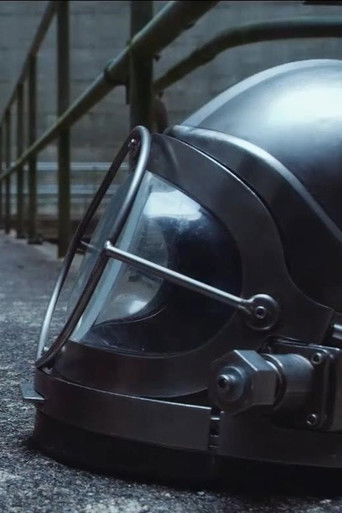
SOMA: Transmissions
2015 · Film · 59 min
Directed by Don Thacker
A live-action series inspired by SOMA, a sci-fi horror video game from Frictional Games
7 positive1 neutralfrom 8 commenters
Where to watch
No streaming data for this title.
 Hacker Cinema
2015 · Film · 59 min
Directed by Don Thacker
A live-action series inspired by SOMA, a sci-fi horror video game from Frictional Games
7 positive1 neutralfrom 8 commenters
No streaming data for this title.
8 comments on Hacker News
I appreciate the experience report, it's interesting to hear the differences, and it's fun to think back on SOMA after not thinking about it for years. There was a funny discussion elsewhere recently about movie tie-in games that this reminded me of. For a 007 game, someone identified as James Bond while playing, but because they sucked at the game and kept dying, they felt very drawn out of the experience and un-immersed. "James Bond wouldn't die."
Do you read novels that narrate with the first person "I" differently than you read novels that don't? (For me there's no difference.)
In games, what matters to me when it comes to immersion or even how much I put of myself into it, isn't anything like camera perspective, but the level of control I have (or think I have). There's two types of control, the first being over the character(s) I'm puppeteering/piloting. It goes beyond just their movements and includes their behavior, thoughts, words, and what they don't do as much as what they do. The second is control over the narrative or story. If the world or story or other characters actually change or react to things I do or don't do, that does help sell me on the idea that I have some control. There's a huge variety in how different games tweak these knobs, and sometimes control is given in just lack of resistance. For example, the Half Life series doesn't offer much meaningful control over either the character of Freeman or the plot, but because Freeman is under-developed and silent, there's no resistance to playing him as you please within the confines of the game. I have the illusion of a lot of control over his character. And the game itself has a good amount of environmental control -- you can close doors behind you, if you want. It helps sell the immersion and makes it easier to self-insert, if desired. I played another game where a character kept sending me text messages, and I would just ignore them all instead of replying, but I wasn't playing "me", I was playing a role, and thought it made more sense for the character to stay mad and give the silent treatment. Nothing really came of it but it was fun, like closing doors.
Solid Snake in Metal Gear Solid is much more developed than Freeman, and you have pretty much no control over his characterization, and only one moment of control on the story, so I've never felt like I was Snake, or Snake was me, I was just simply puppeteering him, and was mostly along for the ride like a movie or book. The immersion was still good even if I wasn't directly, personally in it. And being a game, it could have a certain fight which sticks in one's memory forever. Still I felt with Simon the way I felt with Snake, he was too much his own character for me to inhabit. Geralt in the Witcher series is also pretty well-developed, but the game offers a lot more flexibility and control over him, so you can steer him in directions that more resemble yourself, or what you would like to be, or what you want to pretend to be right now because you're curious what happens in the game if you do so. I still never felt like I was Geralt, or Geralt was me, but it was easy to put more of myself into playing. The world itself also changes based on my actions, so much that you can import saves from the previous game when you start the next game to carry over some things. Two of the most immersive games I've played, Gothic 1 and 2, give you a pretty under-developed nameless hero to steer, and insert yourself into if you wish, and a very reactive world and population. It's third-person.
(Probably the majority of my top-rated games have little of either control. Some are Star Fox 64, Mega Man X, Super Mario World, Ikaruga, and Doom. I never think of myself as Fox, X, Mario, Shinra, or Doomguy, or them as me, or even me as role playing them. I'm just piloting them. Same with Bond in Goldeneye for the N64. In those games I'm not usually thinking of the story or themes from moment to moment. I might not be immersed, depending on how exactly you define that, but I'm totally engrossed in the action. Sometimes there are those narrative moments worth reflecting on anyway (the end of Ikaruga is quite tragic when you think about it), but I had no influence over them.)
I'm easily taken out of the whole thing if the game suddenly offers incredible resistance or otherwise breaks established control patterns. A typical example would be winning a fight and then a cutscene plays and gives a scripted loss instead. (Sekiro's opening fight gets a pass, partly because I did lose the first time playing.) Related is if the mechanism of control suddenly changes. If it's an action-oriented boss fight that I win, then a cutscene, then a quick (or not so quick) prompt for "Press X to finish the big bad", I'm pretty irritated.
For consequences, I'm mainly talking about how my actions or non-actions affect the characters themselves, the world and its inhabitants, and/or the story. In SOMA, these kinds of consequences aren't really there. There's one mostly visual consequence near the end for one choice (and it raises some questions about pressure suit construction or whether such a suit was even needed to begin with), but otherwise nothing really comes out of anything you do with the choices you're presented with (unplugging this, killing that, infecting this, erasing that, answering a survey this way (including asking to die)), you just have your own reasons and thoughts about it (like closing doors, or ignoring texts). These aren't bad and can be nice for immersion, but it could have been more. A game as simple as MegaMan X has, as a consequence of beating Chill Penguin, the freezing over of Flame Mammoth's stage, which makes it easier to traverse...
I agree the remark on death consequences not being particular severe (restart/redo a bit) isn't that fair and applies to many games. (Even BioShock has that consequence, it's another one of my top-rated games, it plays with the distinction of who (the player or the game) has what kinds of control in a unique and memorable way, even if a story-affecting choice is kind of minor and lame.) But you don't need to go all the way to sadistic things like deleting the game or what have you to introduce more meaningful consequence. Dark Souls (another favorite) has as its primary death-consequence an additional gameplay aspect where, besides going back to a checkpoint, you need to return to where you died to recover your unspent currency or risk losing it forever if you die again. That mechanic is fundamental to the "souls-like" genre it birthed. Dark Souls 2 goes a bit further by progressively "hollowing" your character with each death, lowering your max HP and making you look more and more zombified, only reversible with an item not sold in unlimited amounts. Some characters react differently to you (or are interactable at all) depending on your state. It's not a flawless execution; it does tie into the underlying narrative theme of hollowing, but as expressed through other characters, that's more about memory loss and loss of purpose, which mainly applies to the player only if they give up and stop playing the game. Still, it's a nice touch that makes the game feel more meaningful and reactive to how you're playing it, even if how well you're playing it (i.e. are you dying a lot) isn't quite the same level of control as pushing the red button, blue button, or walking away.
Another option I've seen other games do is when you die and respawn, you can come across your previous corpse. Works really well for robots. It can be purely visual, or offer something on the gameplay level with looting your old body. It might have been interesting for SOMA to include something like that, and offer a way for Simon to come to grips with the idea of mind copying well in advance. Or further his instability, having to walk over so many of his own bodies.
Oh god, yeah, that's a great one. Also that one Black Mirror episode where AIs are just enslaved brain scans living in a simulated reality at 0.0001x of real time so that from the outside they perform tasks quickly.
Also SOMA (by the guys who made Amnesia).
I would never be on board with such a thing. Because even if I were to be backed up, I wouldn't get to experience the simulation. I would experience death, and then a backup would experience the simulation.
SOMA is a great game that touches on this topic, btw. It's like a movie, so watching a playthrough is almost as good as the game itself.
Personally, I see it as an equation of Story/atmosphere quality x mechanical pleasure x length where story is the trump card.
A game like SOMA has low mechanical pleasure (it's a walking simulator, essentially) and a short length, but the story and atmosphere are so high that I will forever remember the experience.
Cyberpunk has decent length, decent story/atmosphere (obviously this is subjective) and decent mechanical pleasure so it's a great game.
CoD has a short length, decent to high mechanical pleasure (well at least I hope so for their sake since it's supposed to be about the multiplayer shooter replayability) and low story/atmosphere because it's just a string of action movie clichés. I think that's what makes it sound very mediocre compared to Cyberpunk.
Other gamers might see mechanical pleasure as the trump card, and I can definitely understand their POV (Portal 1 for instance). I'd venture a guess that length is rarely a trump card except if you are stuck with the games you do have. Usually for length to be the most important factor, you need at least a decent degree of the two other factors to go with it. For example, what people love about Skyrim is that the basic gameplay of walking around and doing things is fun and you can just pick up the game everyday for months and still have things to do. The story is nothing special, but the atmosphere is comfy enough. You know the game is there for you when you come back from work.
> it can make you live through a story, which neither books nor movies can. It's a distinct kind of experience.
SOMA is a great example of this; It could maybe also work as a movie or book, but the FPS perspective fits the story and narrative so good that it elevates the whole thing to its own unique experience.
A VR version could turn this to 11, but sadly any work on that seems to have fizzled out.
I have not played any computer game in over more than a decade, but I played a lot earlier.
Anyway, what I did for a while - not recently due to a lack of good targets - is watch Youtube "playthrough no commentary" videos (and with story-less gameplay parts heavily cut out). That's usually 4-6 hours of game movie.
The Last of Us was good, but the very top #1 for me as far as story goes - ignoring the game play completely - was Horizon Zero Dawn. One of many such game movies for this game: https://youtu.be/W6jbYfmQAG4
That story seemed to be good but kind of stupid and the same as always, completely predictable, you already know what happened when you see the start and it's a bit stupid and too far-fetched - that kind. Until it wasn't. Turned out it wasn't just well-made, when you find out what was really going on it was THE BEST.
Not only does it have two very different stories layered (three, if you count the present time story): One about what happened to earth and its people and one layered inside of two people, the MC and a woman in the past, with seemingly no connection, until we find out the opposite is the case.
Both story-parts actually had me crying. When I found out after about four hours what had actually happened on earth, it was a great emotional shock. Same with the ending, that used the connection between the MC and that person from the past.
Even the machines and their (animal) forms make sense, there is a good and IMO satisfying explanation.
The stories in this game and in a handful of others are much better than most movies.
If you are in the mood for something really dark, watch a game movie of "SOMA". Underwater survival. Earth is gone - a giant meteor made the surface into a fiery hell, the only survivors are some researchers in a deep ocean facility. Best small detail: They get the "uploading your brain into a computer simulation" right, see the very ending of that game which shows it one last time (TL;DW: As someone who knows neuroscience, the idea makes no sense anyway, but let's forget that and assume it makes sense. What will happen is you still stand there in front of the computer, wandering what happened, after the "upload". Because you still exist, and the copy is not you. It's a copy. You still die, there is no magical connection between you and your copy.)
I strongly second this opinion. After playing SOMA (and being seriously frightened by it - you need to play it in the dark at night, with headphones, full immersion style) I was an instant fan of the studio and tried Amnesia. But the entire historic-fantasy-style theme turns me off pretty hard. I'm having a hard time continuing to play it, though I want to give it another chance sometime.
But SOMA? Really, really great game. I'm considering repurchasing it on PS4 and replaying it in my home cinema setup for even more immersion. Though knowing the story beforehand probably takes quite a bit out of the experience.
If you don't particularly want to play it, I can recommend watching the SOMA "movie", which is all cut-scenes (and relevant gameplay) collected into a single movie (with zero commentary added).
I did, and enjoyed it, and I don't think I would've enjoyed playing the game as much, despite playing a lot of games in general.
Here's the one I watched: https://www.youtube.com/watch?v=eV_WfrDPUL4