 Hacker Cinema
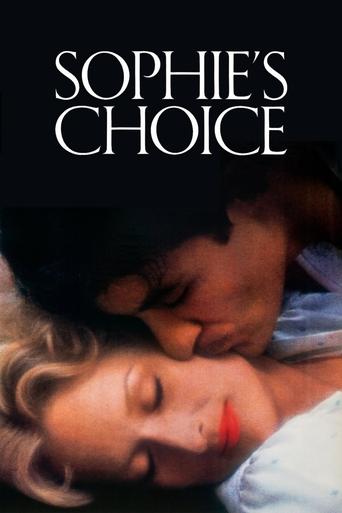
Sophie's Choice
1982 · Film · 151 min
Directed by Alan J. Pakula
Stingo, a young writer, moves to Brooklyn in 1947 to begin work on his first novel. As he becomes friendly with Sophie and her lover Nathan, he learns that she is a Holocaust survivor. Flashbacks reveal her harrowing story, from pre-war prosperity to Auschwitz. In the present, Sophie and Nathan's relationship increasingly unravels as Stingo grows closer to Sophie and Nathan's fragile mental state becomes ever more apparent.
2 positive2 neutralfrom 4 commenters
Where to watch
No streaming data for this title.

4 comments on Hacker News
Zimbardo, interpreted by a wannabe Kubrick.
Are we really talking about whether a story that can only be told by traumatizing the hell out of unwilling people is a story still worth telling? Why assume that the story can only be told that way, rather than that it takes an incompetent hack of a director to decide that the best way to tell a story is to just shoot a million feet of film and figure out the rest in the edit suite? That seems to me at least as likely as the other.
I mean, it's not like we don't know how to tell stories about evil without behaving evilly ourselves. It doesn't take a working extermination camp to make a Sophie's Choice or a Schindler's List. Even if it did, would you think about excusing that?
In which case, cut out the (biased, unreliable, deceptively narrated, and ultimately detracting-from-the-point) middle-man, and cite sources directly.
The problem with fabulatory conspiratorialists isn't that they are always wrong. It's that they are so indifferent to truth that teasing fact from fiction is far more effort than reward. Citing them directly and credibly only feeds the bullshit cycle. See Harry Frankfurt: http://www2.csudh.edu/ccauthen/576f12/frankfurt__harry_-_on_bullshit.pdf
I realised this some years back watching a 3h40m epic conspiracy fantasy which does, yes, contain numerous actual, verifiable facts. It also contains numerous uttlerly unsubstantiated claims, and in either case draws supposed conections between individual items --- the narrative --- that are entirely invalid. One key tell was about 20 minutes in, where a fact (Kennedy's "Secret Society" speech, referring not to some hazy/hazing Ivy League drinking club, as claimed, but the Soviet Union: https://rationalwiki.org/wiki/John_F._Kennedy#.27Secret_Societies.27_speech) was both utterly falsely narrated and very selectively edited. Going a few lines outside the cited bits makes this clear. Lather, rinse, repeat ad nauseam for another 3h20m (and there were likely earlier whoppers I didn't catch).
The reward for my sunk time cost was a realisation of the distinction and relationship between facts and narrative. These can be thought of as a graph or network, whose nodes (facts, real or claimed) and links (narrative relation) can occupy almost wholly separate truth worlds. False facts may fit within a true narrative (an essentially true though fictional novel or film, say, such as Sophie's Choice), true facts, possibly with or without false or invented ones, within a false narrative (a key element of fabulist conspiracies, though often also popular cultural mythologies), both may be entirely invented (usually seen as entertainment fiction, or mad ramblings). The case where both facts and narrative are largely true makes for the most compelling accounts.
There are other dimensions to this: Facts void of narrative or relation are raw data tables. Relationship diagrams tend to narration without facts. There are the various storytelling elements and techniques which strengthen narrative and make it more compelling. All these still seem to work best within the fact-narrative-truth relation I've described above.
The problem with fabulists is that your time is very poorly rewarded, and your own views become slowly warped. Again, going straight to sources, or following more credible narrators (Surveillance-InfoTech ties are not hard to find, recent example: https://news.ycombinator.com/item?id=23435499 ) is a much better use of your own, and your audience's, time.
Again, it's not that Corbett is uniformly wrong, and the directive would be far simpler were he. It's that he's indifferent to, or incapable of distinguishing, fact from fiction.
Use a source that is.
I enjoyed the movie "Sophie's Choice" and I have to say SPOILER ALERT for the above comment.
(I'm hoping the poster edits his comment to include a spoiler alert phrase)
I cannot fathom why this article was titled this way. I skimmed it solely to find out what diabolical damned-if-you-do, damned-if-you-don't, torment-your-soul "choice" could be involved. That's what the movie "Sophie's Choice" was about: A mother was offered the choice that she could escape a trip to the German concentration camps and save her own life and the life of one of her two children. Pick which child lives and which child dies. (The other "choice" in the movie being between a nice but very young man and the abusive drug addict she was already with. Having lost both her children and being a very tormented soul, she chooses the drug addict and, iirc, they commit suicide together.)
As a literary reference, this title is a completely sucky choice in words. Though perhaps the author is, say, half my age, has never seen the movie and has no idea anyone would interpret it as a literary reference. (If so: "Get off my lawn!")