 Hacker Cinema
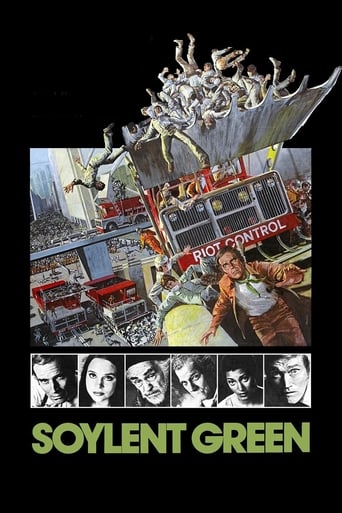
Soylent Green
1973 · Film · 97 min
Directed by Richard Fleischer
In the year 2022, overcrowding, pollution, and resource depletion have reduced society’s leaders to finding food for the teeming masses. The answer is Soylent Green.
12 positive5 negative79 neutralfrom 96 commenters
Where to watch
No streaming data for this title.
105 comments on Hacker News
In some countries, especially less developed ones, poverty levels are declining, but in the US the trend seems to be the opposite. The middle class is being gutted and descending into survival mode if not poverty, while the top few percent become obscenely rich at their expense.
In any case historical trends are really irrelevant to the discussion, which is about the impact of AI, which threatens to take away almost ALL the jobs (this is what Dario's essay is assuming), which has no historical precedent. Some people like to bring up previous waves of job automation such as the industrial revolution, but the difference there is that automation took some jobs but created others. In the case of AI, AI will also be taking the new jobs that it creates.
If AI takes all the jobs - which is what the people like Dario who are creating it assume will happen - then it seems "UBI" is indeed the logical conclusion (other than those able to make a living working for themself, or via self-sufficiency), but this is not going to be utopia where we are all idle rich practicing our hobbies. What it really means is a welfare state, where formerly proud people capable of supporting themself become dependent on government handouts. What comes to mind is the movie "Soylent Green", not utopia.
I'm not sure how anyone imagines this would actually work. Is there any private enterprise left at all, or are all the means of production (AI datacenters and robotic factories) all controlled by the state. Instead of distributing Soylent Green, the state distributes UBI-scrip, essentially food-stamps, that can be exchanged at state stores for provisions?
Seriously, how could this actually work ?
An alternate future, no more optimistic, at least in the short term, but perhaps more realistic, is that in the fairly near future when unemployment and public pain becomes high enough, we reach a tipping point, and the pitchforks come out. Eventually the government concedes that AI is no more conducive to the public good than nuclear weapons, and heavily regulates it, banning the use of AI to replace jobs. This may sound extreme, but surely not a fraction as extreme at the UBI-based welfare state that Dario Amodei is fantasizing about as the best possible outcome (that is compatible with himself becoming enormously wealthy).
JG Ballard, John Brunner (and others) were writing miserabilist dystopias back in the 70s.
Also, Dune, which is certainly not a "The good guys win" story.
And movies like Soylent Green.
The Disney trope turns out not to be a trope at all. The good guys win/hero's journey is much older than Disney, and it's popular because we'd like to be believe it's how the world works.
But GoT didn't do anything really new, except wrap some porn around the various murder plots.
It seems that Yarvin didn't realise -- accidentally or more probably intentionally -- that the society in Soylent Green was not supposed to be taken as a model to emulate. It's not supposed to be a documentary! To even joke about it is telling.
As a tech industry we'll probably be complacent on whatever is coming up in the future, no matter if it's something like this or something far more insidious. But hey, some of our class got very wealthy and got to enjoy material prosperity so it's all good, right? People would chase ever higher wages and shiny trinkets and end up working for Evil Megacorps because "one needs to be able to afford to live comfortably".
Yeah, Star Wars more or less killed sci-fi as we had known it. I liked the weird Logan's Run, the depiction of class stratification in "Soylent Green", the banality of corporate control of "Rollerball".
The idea of a computer virus in the film "Westworld" was, to me at the time, something out of left field. (And speaking of Michael Crichton, "The Andromeda Strain" was "intelligent" sci-fi and we enjoyed it.)
"Mad Max", though it came after "Star Wars", drew inspiration from "A Boy and His Dog", "Deathrace 2000"…
A Golden Age for sure.
Fellow survivor on a bicycle which powers a lightbulb by which you can read the microfiche. Voila.
For anyone who never watched the original Soylent Green movie, it's worth a rewatch because it actually shows a future where people are having to make do without a power grid in cities, by doing things like riding a stationary bike hooked up to a generator to power their TV or radio long enough to get some news.
"Soylent Green is made of people!"
(Apologies for the spoiler of the 52 year old movie)
Soylent?
Strangely based on the movie Soylent green
Small but important correction: the actual quote is “Soylent Green _is_ people!”. Agree with your broader point about the Torment Nexus being a McGuffin, but we do actually know how Soylent Green is people in the film - it’s explicitly revealed that it’s made from processed corpses due to overpopulation.
Since there's talk of euthanasia: Soylent (green) is now available off-the-shelf (Saw it at Walmart yesterday, in a handy half-gallon container):
https://www.amazon.com/dp/B0DF54G8F9/
For reference: the movie "Soylent Green" https://www.imdb.com/title/tt0070723/
I liked this quote:
> "I came to feel that large language models like ChatGPT are intellectual Soylent Green — the fictional foodstuff from the 1973 dystopian film of the same name, marketed as plankton but secretly made of people."
This but unironically. In the movie no one was killed for the purpose of being turned into soylent green, they just used bodies of people who were dead anyway. I remember thinking that it's not such a big deal compared to all the other misery in that movie, and that ignorance was bliss in that respect.
I don't fully remember the movie anymore, but there were many other things that were much worse that actually happened on an ongoing basis and leading to people suffering. Like the poverty.
I used to watch sci-fi films and think: "well this isn't realistic, people simply wouldn't accept eating Soylent Green or a nutrient paste ration"
Now I realise that these things will come to us branded up as desirable and high-status. It isn't ultra-processed pea protein, this is a 'vegan steak'
Human beings evolved to eat whole foods. If you're going to eat something else, you better be very, very sure about the long-term effects.
It brings to mind the classic scifi film Soylent Green, in which we see the last moments of Solomon Roth's (Edward G. Robinson) life journey end to wall screen visuals of nature in springtime, accompanied by Beethoven's Sixth Symphony (the Pastoral).
May you not face your demise or dental work for a long time, but may it be as gentle.
Mad Max, obviously, Night of the Comet, The Quiet Earth, A boy and his dog. I think the early 80s was a good time for the genre.
Planet of the Apes, Soylent Green, and that other Charleton Heston movie with zombies that I can’t remember (not a huge fan of zombies)
The Road is a fairly recent movie that fits.
British TV had Space 1999, lots of early Doctor Who and an attempt at the Tripods series by John Christopher. By far my favorite was “Survivors” written by Terry Nation - who needs zombies when you’ve got actual problems to deal with!
I punched in 1972 and there were some fantastic movies that year (The Godfather, Deliverance, Cabaret, Solaris, Jeremiah Johnson, Aguirre - the Wrath of God, The Last House on the Left, Silent Running, The Heartbreak Kid, Fat City, etc.).
Also tried 1973 — same (The Day of the Jackal, Soylent Green, Westworld, The Wicker Man, Papillon, American Graffiti, The Sting, Serpico, Mean Streets, High Plains Drifter, Don't Look Now, Badlands, The Long Goodbye, Jesus Christ Superstar, The Three Musketeers, Fantastic Planet, etc.).
I think they simply made better movies decades ago.
"Soylent Green" seems more and more prescient. I'm not talking about turning people into food — not even the over-population fracas depicted in the film (that seems to have been a distinctly 70's-era fear).
Seeing the film again I notice the way it portrays the untouchable wealthy classes (briefly) and then the rest of us. (I should read the book [1] because I was intrigued by little scenes like the one with the old people in the library — if you even remember that bit.)
[1] "Make Room! Make Room!" by Harry Harrison
A bit more recent. Soylent Green was set in the year 2022, and was about how humans and climate killed the ocean as the world's largest food source. In the film, they are always sweating and it's 90 degrees F at night.
I noticed the same thing, especially with many of those old authoritative sources that seem to have disappeared or suffered from link rot. It reminds me a lot of the movie Soylent Green, where basic repairs had to be done custom because there were no replacements. Outside of academic journals and printed books, I don’t bother searching for information because it’s just not worth the effort given how hard it is to find reliable sources. The only way I’ve been dealing with this is by relearning my fundamentals. There are only so many ways hardware and software can be designed correctly, so I rely on recurring patterns, motifs, improving my reverse engineering skills, and adopting a clean-room design approach.
Not related to the guy at all....
Loved the book, "Mrs. Frisby and the Rats of NIMH" when I was a kid.
I see echoes of his work everywhere from my childhood though. Or was overpopulation just in the 70's Zeitgeist with movies like "Soylent Green", etc?
I remember a traveling demonstration presented to us in grade school. Some guy arrived with a kind of computer (this being the early 70's). He set it up on a desk (and if I am remembering correctly, it may have been kind of vertical ... and say the size of a Pachinko machine). I believe it was some kind of custom, single-purpose, machine. In my fuzzy recollection it had knobs that could control rates of population growth, perhaps controls on resources, etc. The operator would adjust the knobs and the machine then seemed to give dire predictions of the future.
Now go and enjoy recess, kids.
It's wild to think of how many scifi stories and novels there are about immense, completely unmanageable world overpopulation and then give numbers that are lower than what we have right now.
The classic example would probably be Make Room! Make Room! (the very loose basis for the film Soylent Green), where a United States of 344 million people is so massively crammed and overpopulated that the average person lives on strictly rationed water and food.
This is sickAF, in my humble opinion: depression is curable. Is it too early in the year to mention the movie "Soylent Green" ?
It's never been about anti-Asian racism, either. It's largely targeted at vegans but soy is also an extremely common ingredient in processed foods, and is probably associated more with them because of Soylent and the movie Soylent Green.
More to the point, I've never seen a single soyjak meme that was targeted at Asian people. It's not about Asian people. It's about a specific type of white person.
> By 1986, the Reagan administration had gutted the research and development budgets for renewable energy at the then-fledgling U.S. Department of Energy (DoE) and eliminated tax breaks for the deployment of wind turbines and solar technologies—recommitting the nation to reliance on cheap but polluting fossil fuels, often from foreign suppliers.
Crazy. You see all these wind turbines all across the U.S. If not spread across the plains or along foothills, they're being shipped along the highways one blade at a time. I look at the transformation going on and figure we could have had this tech in the 80's. What happened in the last four decades? Talk about a lost generation.
It was so weird to grow up in the 70's when they were teaching us the Metric System in public schools, when National Parks were adding meters, kilometers to signage. Reusable spacecraft, renewable energy, (and nuclear energy), computers, micro-electronics....
To be sure there were warnings of an ominous, overcrowded, polluted future ("Soylent Green", "Silent Running", just to call out a couple films of the era) but as a kid I was infused with the optimism of the time. Buckminster Fuller, NASA ... even the hippies and their communes.
I think I still live in that world in my head. I hope maybe I have expressed a part of that optimism to my kids as I raised them.
Released 50 years ago, “Soylent Green” is an eerie prophecy : https://www.economist.com/culture/2023/02/02/released-50-years-ago-soylent-green-is-an-eerie-prophecy
https://archive.is/eQaOX
"Soylent Green"
Soylent Green (1973) - IMDb : https://www.imdb.com/title/tt0070723/
Soylent Green - Rotten Tomatoes : https://www.rottentomatoes.com/m/soylent_green
"Soylent Green"
Soylent Green : https://en.wikipedia.org/wiki/Soylent_Green
Soylent Green (1973) - IMDb : https://www.imdb.com/title/tt0070723/
Soylent Green - Rotten Tomatoes : https://www.rottentomatoes.com/m/soylent_green
Relatedly, I feel like "Soylent Green", "Logan's Run", and more in the 1970s all had climate change related concerns/worries and/or messages. A lot of it got lost in the action/thriller genres, especially in the film adaptations, and a lot of it still inherited mistakes and traps from the Malthusians of previous sci-fi generations (50s/60s sci-fi especially was prone to believing in the since-disproven Malthusian trap), but even in the 1970s you can read a lot of early climate change anxiety from the more intended-to-be empathetic parts of pop culture. (The 70s is where I generally draw the boundary line in sci-fi between Malthusianism and Climate Change concerns.)
Climate change fears have been in the pop culture air for longer than a lot of people realize.
I quote from TFA:
Coinbase also writes in great detail in the S-1 about the risk that the SEC might bring a lawsuit exactly like the one they just have:
[W]e could be subject to legal or regulatory action in the event the SEC, a foreign regulatory authority, or a court were to determine that a supported crypto asset currently offered, sold, or traded on our platform is a “security” under applicable laws… [W]e could be subject to judicial or administrative sanctions for failing to offer or sell the crypto asset in compliance with the registration requirements, or for acting as a broker, dealer, or national securities exchange without appropriate registration.
[T]here is regulatory uncertainty regarding the status of our staking activities under the U.S. federal securities laws.
It's pretty clear they knew they were operating in a shady area from their S1 filing -- and so now you're surprised the regulatory hammer fell on them?
Imagine if a company was selling "ground human meat" (see the movie "Soylent Green"). And they did it well because the market for ground human meat was suddenly exploding. I mean, in their S1 they might say "Sure this might be illegal, the FDA might take regulatory action against us." But also "Ground human meat is one hot market right now, you don't want to be left out on this rocket that's going straight to the moon!"
A lot of commentors here saying these are not underrated movies... They might not be if you were alive in the 70's. If you were not then there is an incredibly high chance you don't know of many/most of these. I'm a big sci fi fan and movie fan and I've HEARD of most of these but have only actually SEEN Westworld, Logans Run, and Soylent Green.
I'm 31 for context.
Was born in 1991 and really had to go out of my way to pirate digital versions of these when I was in college. I was trying to think about why I sought these films out. I think the answer is that they are actually science fiction, as opposed to most “sci-fi” films now that are just based in escapism rather than speculation. The thing is that it’s pretty inexplicable because I can clearly see the flaws of these movies, they look corny, a lot bad dialogue written by nerds. But I have a real emotional attachment with these movies. I cried during Soylent Green and even Rollerball. There’s something about the corniness of these movies that’s very claustrophobic and tense, they are exciting because the movies have a thesis that’s like reading a serial killer’s manifesto, dark. The casting was crazy back then to male lead actors like Charlton Heston look haggard and old, and talk a lot, they sometimes just flip out, actresses are on the other hand usually just sexy young starlets who can’t act. It’s just such a different situation then like Adam Driver, or Chris Pratt stumbling through being Mr.Likable with a female lead who’s can act but only there because it would be weird if the script didn’t have a romantic arc.
Honestly I just love all movies but I do think Star Wars ruined it. It’s a good movie, certainly it shaped my childhood, but aside from the more “meta” mythopoetic elements of deconstructing the hero’s journey, it’s pure escapism and obviously was a huge hit and set the tone for the future.
Oh, Alpha-Centauri. Didn't think of that.
Thought of https://en.wikipedia.org/wiki/Logan's_Run instead.
And maybe a bit of 'Soylent Green' ;-)
Edit: I meant the movie https://en.wikipedia.org/wiki/Logan%27s_Run_(film) , the book(s) I've read much later only.
I get it is bad but isn't Soylent Green where they turn old non-sick people into food with a nature documentary in color as payment?
Basically there is ZERO accountability to making batshit insane predictions. So one is much better off as an alarmist than as a skeptic -- alarmism draws attention/funding.
But we did get an interesting movie out of the fake population bomb hysteria: Soylent Green.
I'm surprised we've got this many comments without anyone mentioning Soylent Green.
SPOILER
Soylent Green is both the name of a 1973 science fiction film and of a wafer-like food product in the film. The film is a police procedural set in the future, based on the 1966 novel Make Room! Make Room! The food is a processed protein ration made of human beings and distributed to an unsuspecting populace.
Isn’t this kind of like Soylent branding. Not sure if that shake company name was tongue in cheek or if they didn’t know there’s a Charlton Heston movie called Soylent Green where the Soylent refers to the color of the edible substance made from humans
Soylent Green? (referring to the original 1970s movie, not the faux-food thing some grifter tried to flog a few years ago)
> I take it you would take offence if I ate your kids, though?
Uhhh what? like... Is that a threat? Are you a cow? did I eat your kids? Are you planning to? Do you mean like sperm? are you coming on to me? Do you mean in a plane crash where you had to eat each other to survive... in which case, yeah, I'd probably feel bad about the whole thing clearly. Or maybe I'd have to call the cops... or for a reservation IDK.
> This is mostly a myth, by the way. Reading up on nutrients and where to get them can get you a long way. You don’t need „animals“, you need a mix of different nutrients and you can absolutely get those from a variety of sources. Meat contains plenty easy energy, but just because it’s easy doesn’t mean that’s the only way.
Mostly is key here, if its an unavoidable eventuality, then you can't treat it as a spectrum. This is a binary thing, its either a myth or it isn't. You will have to take supplements.
> Have you ever seen the movie Soylent Green? The protagonist learns the cheap food their whole society is nurtured with is actually made from deceased people. They are horrified by it, and obviously wouldn’t consider eating it again.
I have not seen the movie soylent green, and yes, morality is key here, morality can be made and unmade as society wishes. Would I eat a dog or a live octopus? no. But if I was born in a society where that was acceptable I would. the fact that the people were horrified was a failure of that society itself, they should have been educated from the start about it.
> Please don’t immediately dismiss this: It really feels similar to really understand what it means that your food had dreams, hopes, and feelings. This isn’t just some fancy lifestyle change, but a shift in moral values.
What dreams does a fish dream of? swimming? what has value here? anything thinking? should we try creating braindead animals? would you eat nonthinking meat? if we're talking movies and hypothethicals, would you be okay via removing the animals brain and it being kept alive in some sort of matrix?
> You know, I’m well aware I need carbon from somewhere, something has to die so I can live. But that doesn’t mean I can’t try to reduce suffering of others just for my pleasure.
Speaking of buddhism, life is suffering, and it seems to me that if you want to remove suffering, then death is by far the only solution.
With all that said, most counterarguments here were mostly trollish, and thanks, I'll probably read up on hindu recipes... though I doubt I have any of the spices.
> Animals are not exploited for food, animals are food, you are also food.
I take it you would take offence if I ate your kids, though?
> You do need to eat animals to live. You can live without, but you have to take supplements. because again, you need to eat animals to live.
This is mostly a myth, by the way. Reading up on nutrients and where to get them can get you a long way. You don’t need „animals“, you need a mix of different nutrients and you can absolutely get those from a variety of sources. Meat contains plenty easy energy, but just because it’s easy doesn’t mean that’s the only way.
> for vegetarians/vegans you are either in, or you are morally bankrupt. It reminds me a lot of religions/cults shaming.
Have you ever seen the movie Soylent Green? The protagonist learns the cheap food their whole society is nurtured with is actually made from deceased people. They are horrified by it, and obviously wouldn’t consider eating it again. Please don’t immediately dismiss this: It really feels similar to really understand what it means that your food had dreams, hopes, and feelings. This isn’t just some fancy lifestyle change, but a shift in moral values.
> prove to me in 500 years that humans don't need to eat meat and I'll believe you, we'll both be dead. but I'll believe you then.
I mean, it’s not like a vegetarian diet is new or something? There are many cultures that did, and continue to, eat pretty much exclusively vegetarian. Just ask a Hindu or a Buddhist…
> It's not like plants are not completely unsentient either, they have defenses (an aspect of organisms that don't want to die), they do chase water (thirst).
They don’t have a central nervous system however, or pain receptors, or even a brain, for what it’s worth. So, by all practical means, they don’t feel pain, or experience being alive as we do.
You know, I’m well aware I need carbon from somewhere, something has to die so I can live. But that doesn’t mean I can’t try to reduce suffering of others just for my pleasure.
Maybe enjoying cooking really helps, though. I can conjure up a lot of tasty stuff that just works well without meat, so it’s not like I’d miss anything.
> The fictional population of NYC in Soylent Green (released 1973, set in 2022) was 40 million, whereas the actual population today is 8.8 million, but even 40 million would give it about the population density of Manila today and wouldn’t look like it was portrayed in the film.
Another example is Isaac Asimov's Trantor, a world-wide city enclosed with globes which requires the resources of multiple agricultural worlds to sustain it. It has a population of 45 billion, and a surface area of approx. 40% that of Earth.
Do the calculations, and the population density is, as Wikipedia says: "similar to the current population density of Germany or Connecticut. " I can't speak for Connecticut, but Germany certainly doesn't feel crowded. Even in central Berlin we have a huge amount of green space.
Even Coruscant in Star Wars, with a population of 1 trillion people (1 000 000 000 000) has a population density less than New York City.
Only in the sense that people are bad with numbers and timescales, and that the fears themselves directly led to funding for research that happened to be successful at creating affordable solutions.
The fictional population of NYC in Soylent Green (released 1973, set in 2022) was 40 million, whereas the actual population today is 8.8 million, but even 40 million would give it about the population density of Manila today and wouldn’t look like it was portrayed in the film.
With sufficient industrial farming effort[0] and only existing technology, we could support something like 10 trillion on Earth, but if we did that then everything that wasn’t a farm would look like the top of the Wikipedia list of highest density city districts.
As for the correspondence between the rat experimental world and the human world, as the article itself says:
> Given these wildly varying (even contradictory) readings, it’s hard to escape the suspicion that personal and political views, rather than objective inquiry, are driving these critics’ outlooks. And indeed, a closer look at the interpretations severely undermines them.
Also, we aren’t mice, so while we are doing various — and in some cases, unhealthy — things in response to our world of high abundance and low child mortality, we are doing different things, more slowly, and with the ability to discover and respond to the big picture.
[0] the material requirements are on par with paraterraforming the Moon, because the first step is “make enough greenhouses for most of the land on the planet”, but it could be done.
I'm not sure how many Computer Space machines were made, but one ended in the corner of my smokey late 80s arcade. It sorta worked for a bit before glitching out.
The game is also seen in the movie Soylent Green (1973) as one of the "furniture" in a rich man's apartment.
I mean, maybe? But I don't really think so. Here's a list from IMDB:
https://www.imdb.com/list/ls009003184/
Let's take a look at a few of the entry's from the 1970's that actually had practical effects:
Logan's Run - Here's Logan fighting a robot: https://youtu.be/USADM5Gk9Gs?t=106 Star Wars - : https://www.youtube.com/watch?v=1g3_CFmnU7k Soylent Green - https://www.youtube.com/watch?v=6Z2txLk0ybo Invasion of the Body Snatchers - https://www.youtube.com/watch?v=vc_0dlmSq7I Alien - here's the chest buster scene - https://www.youtube.com/watch?v=nPQ7om598OM
I don't think these hold up as well as nostalgia would suggest, the exception being the alien chest buster scene, which is amazing. The others are much less ambitious and simply don't look as good as modern movies. Many of the practical effects look small or toy like. Maybe there's a sweet spot in the 90's?
In the book that the movie is loosely based on, Soylent Green is made, as its name suggests, from lentils and soy. They changed it to people for the movie, without telling the author.
Soylent Green (https://www.imdb.com/title/tt0070723/)
"In 2022, Earth is overpopulated and totally polluted; the natural resources have been exhausted and the nourishment of the population is provided by Soylent Industries, a company that makes a food [...]"
> 4. John Brunner - not really "cyberpunk" but some of his work is often described as "proto-cyberpunk". The Shockwave Rider is one of his most famous works, and it is really good IMO. I haven't read Stand on Zanzibar yet, but it is also highly regarded.
Brunner's work is sometimes a bit of a downer, Stand on Zanzibar is matched or exceeded in that regard by The Sheep Look Up.
However, if that's your thing I can suggest George Turner and Paolo Bacigalupi, and Harry Harrison's Make Room, Make Room! (which was turned into the movie Soylent Green).
> 5. Pat Cadigan - I haven't read any of her stuff yet, but she is on my short-list of authors to start reading. Gets recommended a lot in these circles.
Cadigan is great, but her ouvre isn't all that large. Linda Nagata is a similar author well worth reading.
BTW, from my perspective Stephenson's real contribution in Snow Crash wasn't the Metaverse per-se but the huge dose of irony and insider humor, which reinvigorated a subgenre that was starting to take itself and it's RainyGrimDarkness a bit too seriously.
Then again, others have since explored similar territory (Tad Williams' Otherland series, Diane Duane's Omnitopia Dawn, etc.), but Stephenson's return to these stomping grounds in Reamde was a bit... turgid, by comparison.
I may not be in my right mind, but there is a #nofly tag on twitter.
Edit: tourism is a low productivity, low value, environmentally harmful industry. Fiji's coral reefs, for example, were beautiful, diverse, and productive, according to old National Geographics. Now they are gone.
We could do better with VR, as in the film "Soylent Green".
Edit. I agree with your point, which is that all technology choices have costs. There are no Disney miracles.
Technically, Soylent Green was made of people (the plot of the movie). The premise of it though was Soylent (Blue, Yellow,...) foods were (supposed to have been) made from vegetable and seaweed protein -- which is not so much science fiction anymore w.r.t. Beyond Meat and other such products.
(spoiler alert, if you want to watch Soylent Green and you haven't already, don't read my message. I recommend this movie)
Well, maybe it was a joke but I'll take your comment seriously for the sake of the argument.
I don't think so, if your premise is that since it's made of human, it must contain everything a human should need. You need the input, not the output (and the output is not the same as the input here). Moreover, let's hope they don't include brains in Soylent Green, because you would rapidly get prion-related diseases.
Scientists and science-fiction has been dealing with/talking about climate crisis since the 50s/60s. A lot of the early stuff is tied in with some wrong (since disproven) Malthusian beliefs, but a since of post-fossil fuel-related climate change is an undercurrent through a lot of sci-fi. Even just looking at well known pop culture artifacts, climate crisis is a component of the films Logan's Run and Soylent Green in the 70s.
One of my favorite graphs on the subject remains xkcd's: https://xkcd.com/1732/
You can't read an exact "degree increase" around the 70s on that chart, but you can clearly see the seventies is in a notable slope/gradient as is everything post-world wars.
>When you think about it, pork allegedly tastes like human.
I know what you're thinking... Impossible Human could make Soylent Green a vegan movie.
There are many ways to prepare for climate catastrophe, but here's one you could try: 1) Read Paul Ehrlich's book "The Population Bomb". If you don't have time, just watch the movie "Soylent Green" to get the gist of it. 2) Look around you for any sign of planet-wide famine. 3) ??? 4) Profit!
You can't keep up with demand until the amount of housing (and thus people) is so high that the place becomes miserable enough that people start rejecting it.
Different people have different thresholds of misery. Consider that people live in Manila, Mumbai, Guangzhou, and Dhaka. People even used to live in Kowloon Walled City, which looked like something out of the movie Bladerunner or maybe Soylent Green. That is what you'd get.
Funny how you can be right about future facts (world population) but wrong about the consequences.
Make Room! Make Room! [1966]
The world is overpopulated at 7 billion people, with 35 million people in New York City alone. The inspiration for the film Soylent Green (1973).
Maybe not surprising, but worth noting anyway just how pessimistic these stories are.
It's a reference to the film 'Soylent Green'.
In the '70s, movies like Soylent Green depicted how people thought Earth may turn out: more and more people supported by limited resources, food riots, etc. e.g. China introduced the one child policy to head this off.
In the '80s, movies like War Games and The Day After depicted how people thought Earth may turn out: nuclear war triggered through Mutually Assured Destruction. (Source: I lived through the '80s.)
you get the idea.
We had the same thing being reported in the late 70's.
There was a travelling exhibit that visited my high school which was an analog computer - you could set your energy sources (coal, hydro, nuclear, solar) and see how long society could run before we re-entered the Dark Ages (literally - no more electric lights!). Thinking about it - the consumption side was likely a rising wave function which predicted steadily-increasing use of electricity.
This was around the time when the EPA's Energy Star program got started, and I suspect it did a lot to counter the increase in demand.
You can also look at the films of the 70's to get some of the zeitgeist of the era - "Soylent Green", "Silent Running", "No Blade of Grass", "Damnation Alley", and so on, all with the theme that the Earth no longer nourishes life.
In the movie "Soylent Green" (the book its based on is different, in fact I don't even think there's cannibalism in it) there are a variety of meal-replacement foodstuffs known as Soylent, including red and yellow, that are made from soy and algae. Green is the only one made from humans.
I'm curious about the naming choice as the end of the movie with Heston reveals that eating "Soylent Green" is a form of cannibalism. Does the term "Soylent" signify something outside of the movie?
Most people on Earth will certainly be forced to change their eating habits because of increasing prices. The more people we are, the more food must be produced. But space on Earth is limited. All prices are defined by supply and demand. If supply is low, but demand is high, prices will increase.
Everyone should have seen the film "Soylent green". It shows us our future. And i don't like this future.
I think we should try to reduce the world population to 3 or 4 billion people. This would solve a lot of problems. We also wouldn't be forced to think about food security, genetically edited or modified foods or crop losses because of climate change.
I am ready to help.
Besides, it's not called "Soylent Green". Green was the cause of the shock twist in the movie, but there was also Soylent Red and Soylent Yellow in the movie, which were pretty much what Soylent, the product, is trying to become.
The name is appropriate in the context of the movie, although I would have never chosen it.
You feel that way because you're on the Internet. I've never seen the movie, it was way before my time, and it exists in the tiniest amount of public consciousness today. The only reason I know what Soylent Green even means is because people on the Internet reference it occasionally.
I've talked to quite a few people about Soylent and I've said "you know, like the movie" and most of the time they have no idea what I'm talking about.
Algae? Yeah right. Soylent green is made of people.
Seriously though, how can a food supplement (sorry, meal replacement) company expect to prosper with a brand based on a sci-fi movie about cannibalism?
Clearly there is a market for this 'super convenience' food/drink if people are still willing to buy this product after it made them sick. Even when their own stomach is the guinea pig. The company could do with better marketing though, reading things like this:
In 2013, he raised capital to turn his full attention to Soylent, which he named after the science fiction novel that served as the basis for the 1973 movie featuring Charlton Heston as a detective who discovers that a new type of food called Soylent Green is made of people.
..certainly doesn't help.
Everyone knows that we're eating up our resources and dump the rest into the seas all the while doing so. The result is that a lot of things available today will be luxury super rich items in the not too distant future.
Not sure how old you are, i.e. did you live through the '70s "Limits to Growth" Zeitgeist era? If not try, say, watching the 1973 movie Soylent Green, where the two protagonists just marvel at a jar of strawberry preserves they found in the dwelling of a rich person, and then go to your favorite grocery store's jams and jellies section....
Maybe someday we'll see that future you envision, but having already lived through at least one cycle of this, not to mention the ongoing global cooling -> global warming -> climate change one, I don't worry quite so much (and by now have a lot more than just these surface level observations to base that on).
ADDED: And this was a major theme of Heinlein in his '50s juveniles, most directly his 4th, published in 1950, Farmer in the Sky, but also see his last really good book, The Moon Is a Harsh Mistress in 1966, where it was plot significant that the moon colony (or was it colonies?) grew wheat and shot it back to the Earth using a mass driver.
Trolling? Soylent -> Soylent green -> Movie where you grind up poor people and turn them into food -> Cannibalism -> Known vectors for prion diseases.
The name is derived [1] from the science fiction novel that the movie Soylent Green was loosely based on [2].
The book doesn't include the cannibalism aspect of the movie at all. However, one wonders how you could be familiar with the book and wholly ignorant of its much more culturally significant film adaptation. Especially when it makes your product's name totally unappetizing.
[1] https://faq.soylent.com/hc/en-us/articles/201541809-Why-is-it-named-Soylent-
[2] https://en.wikipedia.org/wiki/Make_Room!_Make_Room!
I really wish they didn't name their company 'Soylent'. Soylent Green was a gross concept for a movie, and, unrelated, I really can't stand the sound of the word.
Wrong, it came from the book Make Room! Make Room! by Harry Harrison in which "Soylent Green" is based off of.
However, in the book the soylent is not made from people. The movie added that for....drama
The name "soylent" comes from Soylent Green, a 1973 sci fi film about overpopulation, where people survive by eating mass-produced plankton, which later turns out to be made out of old people.
Naming a product "soylent" has always struck me as borderline sociopath. In this light, the company’s slogan "healthy, convenient, affordable food" is an outright mockery of its costumers.
Actually the name was derived from an earlier book to which the movie was based on [1]. On the other hand, Soylent Green (as a movie) is pretty low in pop culture, and I can't say I've really seen any issue with the name. I'm fairly certain Soylent (as a company) has done market research on whether the name is worth it.
[1]: https://en.m.wikipedia.org/wiki/Soylent_(food)
Sorry - I'm going to say it. These guys need to change their name already. It's just too much. (their name is derived from a dystopian film called Soylent Green, which I won't give away and other replies shouldn't either. It's really really famous.) I thought it was bad enough when everything was going dandy but when we read about this kind of PR / damage control, it's just too much.
They have a choice about it. This is a conscious joke on their part. They need to take the next step, please.
I got downvoted but I'm going to keep this (it's quickly heading to -4). Go watch the film, in the canon of filmmaking, and then come back and tell me I'm wrong.
No, that twist exists in the book, too. That twist is even spoiled in the book's title: "Make Room! Make Room!". Soylent Green is always people, book or movie.
(It's a sci-fi exploration of Swift's "A Modest Proposal". It always has been.)
(ETA: Yes, Soylent Red is not people. But the point of the book and movie is Soylent Green's "easy" solution to famine.)
To be fair, the name seems to be based on the book Make Room! Make Room!, not the movie (extremely loosely based on the book) Soylent Green. Soylent in the book (also, the forms of soylent other than soylent green in the movie) was not made from people.
On the other hand, the movie probably has more cultural currency than the novel, so its still probably fairly poor branding.
I assume he means the name... it's basically a reference to Soylent Green and cannibalism. "Soylent" is a portmanteau of "soy" and "lentil", but "Soylent" specifically is most commonly associated with the movie about a similar meal replacement where the secret ingredient was other humans.
Because of that, I literally thought the "Soylent" thing was a joke, I didn't think someone would ACTUALLY try to sell a meal replacement called "Soylent"... it's just... a bit macabre.
Yes, they do have to go somewhere. There is a solution for this in the movie Soylent Green.
Logan’s Run, Zardoz, Soylent Green, Fahrenheit 451
Lovely films. Something about the pacing or the cinematography of the films from that era appeals to me.
Ah… Zardoz… Nothing beats Sean Connery running around in weird sci-fi shorts. Also, Beethoven.
SPOILER ALERT
There is no Theranos. It's a marketing campaign for a sci-fi movie being released in 2016. (Look at Elizabeth Holmes' (an actress, btw) dress code. Look at their website. Try to find a reference to the company before 2015. It simply doesn't exist!).
After the surprising success of Soylent, MGM decided to cash in with an updated version of Soylent Green. In the future, instead of eating food, people just insert their finger into a machine which analyzes their blood chemistry and makes a delicious beverage optimized for your individual needs. Of course, it also scans your calendar (final exams? Add some ritalin. Important business presentation? Add some xanax. Hot date? Add some viagra).
I don't want to give away any more of the plot, but it stars Elizabeth Holmes and Will Smith (note this is the second remake where he replaces Charleston Heston, the first being Omega Man/I am Legend).
> I know the name is a movie reference. Still doesn't make sense to me.
It should, since you recognize the reference, and the name fits perfectly. For me, Soylent Green pretty much the first thing that comes to mind when thinking about this type of product.
The alternative to grain (grocery store waste) doesn't seem like its going to work either. Its a feedback problem - we don't waste as much as we eat; we can't produce the food we eat from its waste. Like the movie Soylent Green - can't use people to feed people.
It has nothing to do with a fascination with doctors and everything to do with a fascination with death. Death today in first world countries is so far removed from what death ought to be, that it's almost unrecognizable. Dying in a sterile white room, in a building that houses thousands of sick people, with bad food, busy nurses, and often alone, is what I'd imagine a dystopian future from a Hollywood movie like Soylent Green would look like, but instead it's what Death looks like today. There is no need for this, and if most of us were asked in advance, few would choose it as the outcome. Yet very few people have living wills created, nor plans communicated with close family for these circumstances.
You can't avoid Death, it happens to everyone. So it's bizarre why so few people plan for the only truly predictable event in their entire life.
Prevention of malnutrition is not the same as treatment of nutritive deficiency diseases. Prevention of malnutrition is more simply termed "eating food".
Products like Soylent or Plumpynut are foods, not drugs. Replacing one's entire diet with Soylent is logically equivalent to choosing to eat a banana rather than an apple with your lunch today.
If you have kwashiorkor or beriberi or scurvy or pellagra, it is unlikely that you could be effectively treated with Soylent, because it is formulated to satisfy daily needs, rather than to correct a deficiency that may have taken many months to manifest symptoms. It is designed to be a complete food, using a recipe.
And if you watched the movie (it doesn't hurt all that much), you would know that only Soylent Green was made from people, rather than algae, as was claimed. The Soylent company sold other types of food products, and everyone ate mostly Soylent-brand foods, because they could not afford anything better. In the film, all the extras got most of their nutrition from Soylent Orange or Soylent Blue, or whatever those grubby-looking flakes were in the bins. Soylent Green always sold out early, and was in short supply.
Still... not the best naming decision. Most people haven't seen any more of the movie than the scene where Heston cries "You've gotta tell 'em. Soylent Green is people!"
I used one of those as an undergrad. It was really a programmable calculator. It was incredibly slow for an all-electronic device; square roots took seconds. You could write simple programs for it and get homework done, though.
It was beautiful. Olivetti had great industrial design in the 1960s and 1970s. Their typewriters and calculators were works of art, and you can often find them today in the collections of major modern art museums. Olivetti tried to get into computers, and even had a good-looking IBM PC clone. The nice design didn't help.
The Mathatron came out a year earlier, in 1963. (http://www.oldcalculatormuseum.com/math8-48mII.html) Unlike the Programma 101, the Mathatron had trig functions built-in. The Mathatron had enough compute power that they offered a remote-access shared programmable calculator with a phone modem. (http://www.amazon.com/Wright-Mathatron-Computer-Calculator-Memorabilia/dp/B0086U6EFG)
The shared-calculator approach reached its peak with the Control Data Remote Calculator. (http://www.oldcalculatormuseum.com/a-cdc-11-65.html) This was a scheme to have 2000 calculators share a CDC 6600 mainframe computer, an excellent supercomputer of the 1960s. It was not successful, and surplus units appeared in the movies Soylent Green, Westworld, and Marooned.
None of these were very powerful, but the alternative at the time was slide rules and trig tables.
Maybe Naomi Klein can clear her mind with some old classic films:
How about Soylent Green (overpopulation, 1973), or Silent Running (climate collapse, 1972)?
Maybe something more upbeat like Logan's Run (overpopulation AND climate collapse, 1976)?
Very good point, but soylent actually goes a bit too far on the opposite directions. It's a nerdy, mechanistic answer to the problem and, because of that, it won't solve it. It's clearly a strong byproduct of the messed up American way of eating, which is, as you said, the outcome of a long term strategy by the food and distribution industries.
The answer is well priced well balanced and tasty food sold next door to your daily fast food. So, if soylent would really want to change the way America eats, the should be funding a lobby, hire some philosophers and become a politically active think tank. Now they're just a nerdy company that will not appeal to anyone. Not to obese fast food goers, nor culturally elevated liberal people that are aware of the importance of eating well as a social activity and a pleasure, and can make the terrible connection to the much too famous movie -- soylent green.
Thanks for posting this Colin.
Once the subject of Soylent came up, I've been thinking of contributing this myself but I don't think I have enough karma to make a difference.
Too expensive for me to use as a meal so I would use it as a supplement. I've been formulating my own mixtures for years and this is one of the helpful ingredients. I test every supplement under extreme conditions, and this is a proven performance enhancer to me.
Currently at formulation #22 according to the label, the website still shows #21 in their JPG of complete ingredients. Take a look at the components to see if you are already getting these in your diet. If not, maybe that's what supplements are for.
Thanks to HN I looked at Soylent, too bad it is not free of artificial ingredients.
Add some of this to Soylent and it sure would make it green though. Now I'm no youngster and I do remember when the original movie of Soylent Green came out. It was in response to the 1970's meat crisis, which was along the lines of the Arab oil embargo. Heck, I even remember when the NFL was still drinking Kool-Aid and only the Gators had Gatorade. By the time I got there they had an extreme system which made it difficult to rise to the top unless you were likely to be able to invent something as popular. Regardless, I've not been interested in popularity but I do formulate my own sports drink too, which has none of the artificial components of Gatorade, and excels in performance trials.
But... this isn't Soylent Green. And if you recall, the other variants of Soylent products from the book/movie were NOT people. So... let's not focus on that one and focus on this one.
Just in case:
Original Book: http://en.wikipedia.org/wiki/Make_Room%21_Make_Room%21
Movie: http://en.wikipedia.org/wiki/Soylent_Green
It's an allusion to Soylent Green, from a much earlier cult sci-fi film.
I found this one funny:
“Ordinary agriculture will keep up with great difficulty and there will be ‘farms’ turning to the more efficient micro-organisms. Processed yeast and algae products will be available in a variety of flavors.”
Reminds me of Soylent Green (wasn't the original Soylent in the movie supposed to be processed algae?)
>We should be upset that our society has managed to put in our pockets supercomputers connected wirelessly to the world's knowledge?
Sure we should, if the tradeoff required to create a society that can produce such devices is that the vast majority of people have no say in the workings of the system, or spend their whole lives teetering on the edge of insolvency, or transfer huge environmental and economic burdens onto people either close to home or far away.
It's like watching the movie Soylent Green and coming away asking "we should be upset that their society managed to feed everybody consistently and inexpensively?" Ends can't be judged independently of the means used to achieve them.
> He gave it the self-deprecating name Soylent — after the dystopian movie Soylent Green where Charlton Heston discovers that society has been living off rations made of humans.
I wish he had chosen another name, not because I dislike the name Soylent but because people will always make this association with the movie. Any time I tell people about this project I get 'hur hur is it made of people?'
Regarding the quote, the name is not self-deprecating (at least by my understanding it is not intended to be), and Rob's influence is the book, not the movie.
From http://www.vice.com/en_uk/read/rob-rhinehart-no-longer-requires-food:
> Actually, in the original book Make Room! Make Room! Soylent is made of soya and lentil. The movie changed many aspects of the book, though it's still one of my favourite movies. My Soylent is human-free.
I haven't seen Soylent Green in a long time and all I remember is "Soylent Green is people". I'd guess that many people who haven't seen the movie know that line and nothing else.
Doesn't someone already own the trademark for Soylent? Here is Rob's trademark application dated February 21, 2013: http://www.markhound.com/trademark/search/sBxK5WeM7 It seems (to me) incredibly unlikely that someone hasn't already at least tried to trademark it for use in protein shakes or other foodstuffs. And whoever owns the rights to the movie Soylent Green might want to have a word with him if his food supplement ever becomes popular.
Additionally, Soylent Green wasn't even in the book that the film was based on ('Make Room! Make Room!'). The book was about the impact of unchecked population growth.
It's an apt name. In the film "Soylent Green," soylent was just a line of meal-replacement rations. The green variety was the newest one released, and the one that happened to be made of humans.
I really don't understand this Soylent nonsense:
1. I like food. The smell, experience and taste. Why in god's name would I eat powder to save myself the "hassle" of eating food? That's like promoting adoption as a method of avoiding the "hassle" of having sex.
2. Why the hell would you associate the brand of a product that you believe is healthy with a movie that is about feeding dead people back to us? That's the first thing I think about when I hear the word Soylent - that "Soylent Green is people!" Yum! Let me rush right out and get me some of that.
To me personally, Soylent is the very antithesis of the idea of living this short life I have. With like 40% of people too damn fat for their own good, I don't get how anyone sees a positive outcome for them.
The name has nothing to do with Soy, its a reference to a movie titled Soylent Green (http://en.wikipedia.org/wiki/Soylent_Green)
The movie glossed over some details. In the book, Soylent was a variety of different things, with a soya and lentil base (hence the name), and only Soylent Green specifically was the problematic one, it being the newest release. (I haven't read it myself, just summarizing what was discussed in the last thread.)
I'm confused. Is soylent the same thing as soylent green? In which case, this is a satirical post (but I don't find it very funny)...
If not, isn't soylent just about the worst possible name for a real food product (with unknown/nonspecific ingredients), because of the movie?
But Soylent Green wasn't people. That was a hollywood fantasy to sell more tickets. It was actually an artificial meat product engineered to taste like people. The book was awesome, the movie sucked. I remember in the movie that a front-loader was scooping up people to slaughter.
I agree that this is most likely a scam, but just wanted to point out that the 'market name' is just a reference to a movie called 'Soylent Green': http://en.wikipedia.org/wiki/Soylent_Green
Harry Harrison's novel "Make Room! Make Room!" was the basis for the 1973 science fiction movie Soylent Green.
Soylent Green - "It's people!"
http://www.imdb.com/title/tt0070723/
(not sure if you were being sarcastic)
Would you happen to have a list of the movies available?
And just a few recs (not really 'hidden', per se): Moon, Pi, Soylent Green, The Producers (2006), and Thank You for Smoking.
Soylent Green is made of People[1]! At the very least it's a clever name.
Really smart, interesting concept. I'm not sure I trust other random people to correct my grammar though.
[1] Thanks to Mr. Kenuda, 11th Grade Physics teacher, who convinced me to watch that movie.
>Every discussion I have with Americans about healthcare leads directly to these imagined totalitarian futures, as if "everybody" knew that this was what happens. I don't understand it. Where did you all learn this narrative?
Pre-WWII footage of Nazi health programs, Aldous Huxley's Brave New World, the movie Soylent Green and pretty much everything William Gibson has written. We've seen just about every distopian outcome imaginable.
Star Trek counters this to some degree, but it's considered "nerdy".