 Hacker Cinema
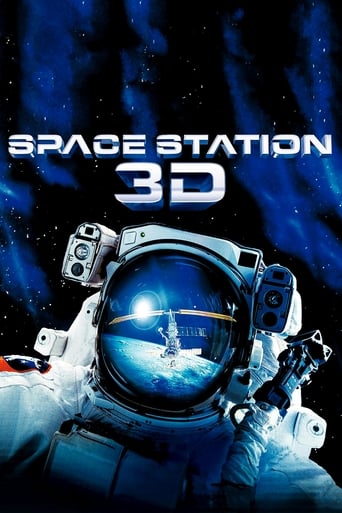
Space Station 3D
2002 · Film · documentary · 47 min
Directed by Toni Myers
Some 220 miles above Earth lies the International Space Station, a one-of-a-kind outer space laboratory that 16 nations came together to build. Get a behind-the-scenes look at the making of this extraordinary structure in this spectacular IMAX film. Viewers will blast off from Florida's Kennedy Space Center and the Baikonur Cosmodrome in Russia for this incredible journey -- IMAX's first-ever space film. Tom Cruise narrates.
2 positive1 neutralfrom 3 commenters
Where to watch
No streaming data for this title.



3 comments on Hacker News
The movie industry got stuck in a terrible place with 3-D as an "add on" to a regular movie that contextualizes 3-D as just another money grab. The trouble is somewhere around 5-10% people find stereo movies uncomfortable and 20% or so people are stereo blind and don't get anything out of them.
So you have to show the same movie in both formats which, as it see it, is something that costs money instead of making money, and is only going to work for movies big enough and theaters big enough to be able to do that. (e.g. the multiplex at the mall is part of a chain that teeters on the edge of bankruptcy so the local arthouse theater sometimes shows movies like "Deadpool & Wolverine" in their first run)
People associate 3-d with that kind of movie but actually the rapid cuts and motion of movies like that don't give your brain time to lock onto stereo whereas documentaries (see https://en.wikipedia.org/wiki/Space_Station_3D) and dramatic content are really powerful.
I have some software that works like Disney's multiplane camera (see https://en.wikipedia.org/wiki/Multiplane_camera) that I use for synthesizing stereo scenes (and other things) and one problem that turns up is that the curvature of objects hides some pixels from one eye but not the other eye. You can't just cut some objects out of the scene and slide those parts relative to each other but you've got to have something for those pixels or make something up. The flip side of that however is that a stereo picture of a close up of a person shows maybe 10-15% more area of the face which means more of the little muscles that indicate emotion. You are seeing a little bit more in a 3-d movie just as you see a little bit more when you see actors on stage and even if you're not aware of it consciously I think it adds to your emotional reaction.
(... so far that software has used a simple rendering approach but I'm very likely to upgrade it to do ray tracing because I want to get very accurate depth of field effects including occlusion)
TLDR; The biggest problem with 3D, though, is the "convergence/focus" issue. A couple of the other issues -- darkness and "smallness" -- are at least theoretically solvable. But the deeper problem is that the audience must focus their eyes at the plane of the screen -- say it is 80 feet away. This is constant no matter what. But their eyes must converge at perhaps 10 feet away, then 60 feet, then 120 feet, and so on, depending on what the illusion is. So 3D films require us to focus at one distance and converge at another.
While I agree with this, I've to say I generally prefer 3D versions of the movies for that extra oomph. There is no particular reason left to visit theaters otherwise. Especially it's just super cool on IMAX (I mean "real" IMAX). Movies like Space Station 3D would miss out on too much fun without being 3D.
I watched IMAX 2D & 3D films on the biggest screen (600 m2) in Europe. *
It was impossible to see the whole screen, that was especially great with 3D movies (Space Station 3D, etc.). Also the 2D movie premiere of The Matrix Revolutions in IMAX DMR film was awesome.
So I would prefer movie theatre/TV/monitor screens with almost 1:1 or 4:3 ratio over 16:10 or 16:9.
* The IMAX Vienna had a 600m2 screen, 24000 watt 6 channels surround sound, 458 seats, demolished in 2009: http://de.wikipedia.org/wiki/IMAX#.C3.96sterreich , http://web.archive.org/web/20030422003546/http://www.imax.at/home.html