 Hacker Cinema
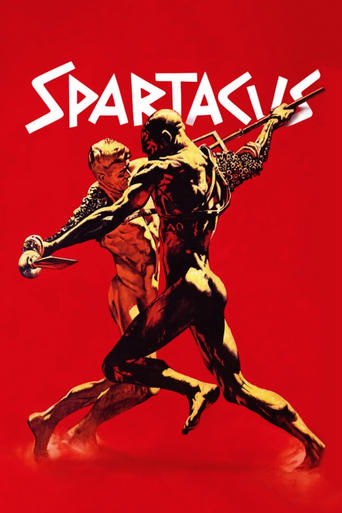
Spartacus
1960 · Film · 197 min
Directed by Stanley Kubrick
The rebellious Thracian Spartacus, born and raised a slave, is sold to Gladiator trainer Batiatus. After weeks of being trained to kill for the arena, Spartacus turns on his owners and leads the other slaves in rebellion. As the rebels move from town to town, their numbers swell as escaped slaves join their ranks. Under the leadership of Spartacus, they make their way to southern Italy, where they will cross the sea and return to their homes.
4 positive2 negative1 mixed10 neutralfrom 17 commenters
Where to watch
No streaming data for this title.
17 comments on Hacker News
And T.S. Elliot was a Bostonian, but adopted British!
Kubrick made all his iconic movies (except Spartacus and Paths of Glory) while settled in Britain, and shot most of them in British studios.
I think you might be looking at the film through rose tinted glasses without the broader context. Kubrick's films had been nominated for 9 Academy Awards and won 1 (he was personally nominated 3 times) by the time Barry Lyndon started filming. (He had also directed a certain Spartacus.)
Warner Brothers were keen to bankroll whatever he wanted to do, even tolerating moving the country of production due to the Troubles.
He was given some artistic freedom due to previous commercial success - ie. a "data- and money-driven approach". He also really wanted to be making a Napoleon biopic, but financing was pulled when a similar film failed at the box office, so he didn't get it all his own way.
Barry Lyndon was only a modest commercial succes. So much so that Warner Brothers hooked him up with a much safer bet for them for their next venture. He was given unfinished manuscript of The Shining, from the wildy popular best seller King for his next project, which was also simpler to produce ie. "relentless pursuit of revenue".
TLDR Making films is expensive and needs to be a commercial activity, but every now and then there's a fortunate crossover of quality and funding. This still happens but you need to look out for it.
2001 Lolita Barry Lyndon The Shining Spartacus
these "mid" films would be among the top 10 ever easily
but according to him "tough" guy Eastwood can surpass it
Kubrick’s results were all over the map. He made maybe three great films:
Dr. Strangelove
Full Metal Jacket
A Clockwork Orange
A bunch of not bad films:
2001
Lolita
Barry Lyndon
The Shining
Spartacus
One real turd of a film:
Eyes Wide Shut
And a bunch of forgettable filler:
All the other films he made.
Compare this to the Anti-Kubrick, Clint Eastwood, who made:
Unforgiven
Mystic River
Million Dollar Baby
Letters From Iwo Jima
Gran Torino
And a bunch of okay films:
Pretty much everything else
And it’s pretty obvious that you don’t need to be an abusive taskmaster like Kubrick to make great art.
Love that film. "No, I'm Spartacus!" Classic.
Some movies benefit greatly from having room (runtime) to breathe.
Historical epics like Laurence of Arabia, Ben Hurr, The Ten Commandments and Spartacus immediately come to mind. Their length adds to their "epic" character.
I can think of plenty of films that are overlong and suffer for it too of course. A recent example is the Danish film Godland. There were people literally asleep by the end of that one in the cinema showing I attended. I wished I could have done the same.
It's not that people only go for theme park rides, they'll also go for "kino" movies. That's why Tarantino can still do it. His movies are all about completely immersing the audience in the movie's world and making use of tech and techniques that make for an epic viewing experience.
No one wants to go to the theater for a "basic" (maybe intimate?) movie where the cinematography doesn't really matter, the sound and visual effects aren't interesting, there's no grand cinematic vibe, etc. Don't get me wrong, it might be a great movie, but why would I want to see it in theater instead of at home?
People will go to theaters for Spartacus and 2001: A Space Odyssey, not for Life Is Beautiful or The Pianist.
A more modern example: I'm really stoked to watch The Whale, but I will absolutely watch it at home. I don't see any point in going to the theater for it.
Yeah.
Spartacus: Swords and sandals.
Paths of Glory: WW1 anti-war.
Strangelove: I don't know what genre that was.
2001: Space opera.
A Clockwork Orange: Dystopian sci-fi.
Barry Lyndon: Picaresque costume drama.
I haven't checked, but I think the gaps between his movie releases roughly doubled with each release.
There are some scenes in these movies that scream "Kubrick". There always seems to be a perspective shot in which the camera is pointing down the centre of some tunnel or corridor. In Paths of Glory it's a trench; in 2001, it's the aisle of the shuttle. It's usually some grand corridor.
Say what you will about the Hays Code, but I would hardly consider Gone With the Wind, The Great Dictator, Casablanca, It's a Wonderful Life, Sunset Boulevard, The Ten Commandments, The Bridge on the River Kwai, Ben-Hur, Spartacus, Psycho, West Side Story, Lawrence of Arabia, To Kill a Mockingbird, Paths of Glory, It's a Mad, Mad, Mad, Mad World, Mary Poppins, The Sound of Music, or, you know, Citizen Kane to be especially "crappy" movies.
But implied translation into the language of the audience is a long-standing convention. We don't watch Ben Hur or Spartacus or I, Claudius and wonder why the Romans are all speaking English instead of Classical Latin.
But it might jar to hear a group of aliens natively speaking Dutch, for example. (Unless it's a Dutch film for a Dutch audience, of course, in which case it might equally jar to hear them speaking English.)
For me, "Fellini Satyricon" is his most remarkable film, even if not his greatest and certainly not his most popular. No film about the Roman world has conveyed so graphically what must have been the actual, enormous strangeness of classical times. It's a disturbing film, both a picaresque sex comedy and a nightmare of everyday superstition and casual violence.
In comparison, the most famous works of cinema about ancient Rome -- Ben-Hur, Spartacus, I Claudius, and so forth -- are laughably sanitized and similar to our own world, which is the common failing of most historical drama of course. Fellini ditched the convention by, among other things, staying extremely faithful to the original source. The Satyricon of Petronius Arbiter is a jolting and bizarre read. A lot of the humor and wordplay, I'm told, is lost in translation.
> Give them some true classics like Spartacus or Orson Welles and they are more intrigued.
I don't think your proof works as well as you expect. Counterpoint: pick a random person, tell them to watch Citizen Kane, and tell them that it's "the greatest film ever made". I think they will have... opinions about that title. On a quick search, "A new hope" has higher audience ratings that "Citizen Kane" in IMDB, Rotten Tomatoes, and Metacritic.
The original trilogy is not perfect, but it definitely is a true classic under any definition of the term.
> "Deepfakes can be used for many of the things we already know," [co-director of the Nixon film Francesca] Panetta says, "but also to create kind of alternative histories or have the potential to kind of rewrite history as well."
Movies, from Hollywood and elsewhere, have been convincing people of rewritten histories since their inception. How well known is the story of the real Spartacus compared to the Hollywood Spartacus? How many people's vision of the antebellum US South came from Gone With The Wind rather than from historical documents and interviews with former slaves and slave-owners? Birth of a Nation inspired the revival of a terrorist organization that lasted decades; Triumph of the Will painted the Nazis' rise as a matter of noble heroism triumphing over cowardice. Last week I argued with some epistemologically incompetent person who wanted me to watch an anti-vaccine movie about Gardasil, apparently unaware that YouTube videos are not really a publication venue used by medical researchers.
So, what should we do about it? Well, the Soviets had an answer: since movies were so powerful, people would be carefully vetted before they got access to the equipment needed to make them, and if someone made a movie with harmful contents anyway, they would go to GULAG. Is that the solution we want?
Website overloaded... here's a cache.
http://webcache.googleusercontent.com/search?q=cache%3Ahttps%3A%2F%2Fweb.law.duke.edu%2Fcspd%2Fpublicdomainday%2F2017%2Fpre-1976
"What books would be entering the public domain if we had the pre-1978 copyright laws?"
Harper Lee, To Kill a Mockingbird John Updike, Rabbit, Run Joy Adamson, Born Free: A Lioness of Two Worlds William L. Shirer, The Rise and Fall of the Third Reich: A History of Nazi Germany Friedrich A. Hayek, The Constitution of Liberty Daniel Bell, The End of Ideology: On the Exhaustion of Political Ideas in the Fifties Arthur M. Schlesinger, Jr., The Politics of Upheaval: The Age of Roosevelt Dr. Seuss, Green Eggs and Ham and One Fish Two Fish Red Fish Blue Fish Scott O’Dell, Island of the Blue Dolphins John Barth, The Sot-Weed Factor Jean-Paul Sartre, Critique de la raison dialectique
"Consider the films and television shows from 1960 that would have become available this year."
The Time Machine Psycho Spartacus Exodus The Apartment Inherit the Wind The Magnificent Seven Ocean’s 11 The Alamo The Andy Griffith Show (first episodes) The Flintstones (first episodes)
Also listed: songs from 1960 (e.g. Elvis's "It's Now or Never"), and copyrighted scientific research from 1960 still behind paywalls (e.g. 1960 papers on the structure of hemoglobin and myoglobin).
One thing I was hoping this series would shed light on was an oddity in demographic voting patterns with the ratings system.
From my own (anecdotal) observation, there's a class of films where the 'Females 45+' rating is a big outlier in the voting, with a large proportion of '1' votes. it's as if there's a gang of a few hundred users consistently downvoting films who are classed by IMDB as being part of that demographic - I don't know if it's a default setting that some bots or trolls have used or if there really are a bunch of cinephobic old women out there just watching and hating on films, but it did spark my curiosity as to what the pattern was. It doesn't happen in every film, and it's rare that you see any other demographic sticking out like this.
The best examples are critically acclaimed films with low voter counts. More popular, or less well-received films tend to have a lot of negative noise to begin with, so the effect is less noticeable, if it's there at all.
Here's some examples:
Army of Shadows : http://www.imdb.com/title/tt0064040/ratings?ref_=tt_ov_rt
Spartacus : http://www.imdb.com/title/tt0054331/ratings?ref_=tt_ov_rt
Ikiru : http://www.imdb.com/title/tt0044741/ratings?ref_=tt_ov_rt
Passion of Joan of Arc : http://www.imdb.com/title/tt0019254/ratings?ref_=tt_ov_rt
Breathless : http://www.imdb.com/title/tt0053472/ratings?ref_=tt_ov_rt
Z : http://www.imdb.com/title/tt0065234/?ref_=fn_al_tt_2
Barry Lyndon : http://www.imdb.com/title/tt0072684/ratings?ref_=tt_ov_rt
Ancient Rome had a fire brigade, run by Marcus Licinius Crassus, who you might remember as the villain from the 1960s Spartacus film. He and his crew would arrive at the scene of a fire to save your home from going up in flames...if you sold it to him.
http://en.wikipedia.org/wiki/Crassus
Kubrick's films before 2001 (Spartacus, Paths of Glory, etc) tended to tell the story with words and pictures. From 2001 on, with the notable exception of Barry Lyndon, he seemed to become obsessed with imagery, or as you say, creating visual poems (and even Barry Lyndon with its simple plot was a visual powerhouse), but I'm afraid his storytelling became secondary.
For those of you who haven't read Clarke's book 2001, you should consider putting it on your list. As garyrob has implied, it's very different from the movie - very concrete - and yet, possibly as a result, almost more hallucinogenic than the film could ever be.