 Hacker Cinema
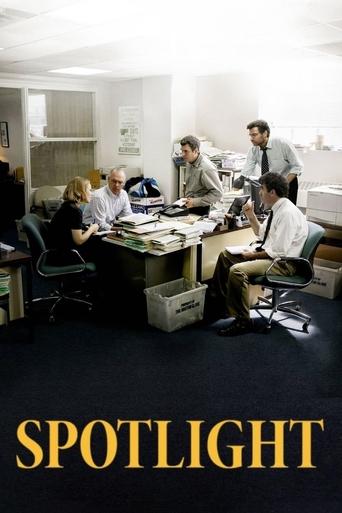
Spotlight
2015 · Film · 129 min
Directed by Tom McCarthy
The true story of how the Boston Globe uncovered the massive scandal of child molestation and cover-up within the local Catholic Archdiocese, shaking the entire Catholic Church to its core.
7 positive1 negative12 neutralfrom 20 commenters
Where to watch
No streaming data for this title.
20 comments on Hacker News
on the other hand, that's what the pulitzer prize for public service is for, to highlight the efforts of journalists who do precisely this; the truth, and the willingness and effort to put their careers, and sometimes lives, on the line, for the truth - or so my idealist side would like to believe.
e.g. watch the movie "Spotlight", https://en.wikipedia.org/wiki/Spotlight_(film)
Examples off the top of my head:
https://en.wikipedia.org/wiki/Argo_(2012_film)#Historical_inaccuracies
https://en.wikipedia.org/wiki/12_Years_a_Slave_(film)#Historical_accuracy
https://en.wikipedia.org/wiki/Spotlight_(film)#Historical_accuracy
Every era is an era of horrible films. That’s Sturgeon’s law for you.
Looking at the 2010s as a whole, we got to watch some amazing films.
We got great hard sci-fi like Gravity, Arrival, Ex Machina. The coming of age genre saw entries like Ladybird, Eighth Grade and Booksmart. Animation reached new heights with films like Inside Out, Spider-Man into the Spiderverse, and Kubo and the Two Strings.
We got comedies like The Artist, Grand Budapest Hotel, Death of Stalin, and Jojo Rabbit. Dramas like Moonlight, Fences, Spotlight, Parasite, Blue Jasmine.
Even in the ever-popular comic book genre, we got Logan and Joker playing at a very different level.
But also, it was the decade of the MCU. Let’s not underestimate what Disney has achieved with that — one big overarching story spanning over twenty films, bringing much deeper character development and more serious themes than what we’d gotten used to from blockbusters.
Obvious answer: Spotlight https://en.wikipedia.org/wiki/Spotlight_(film)
That’s a pop star you ran out of town. The BBC or Der Spiegel weren’t falling all over themselves to be first to let everyone know that the Catholic Church had a giant problem. There’s a reason Spotlight was an important movie.
Telecoms traditionally published the name associated with every landline in the metro area. Local governments publish the names and addresses of property owners, registered voters, and participants in court proceedings.
In old movies, and some newer ones (Spotlight), you'll see the heroes traveling to drab government offices in the middle of nowhere and standing in line for photocopies. Data brokers [0] in their simplest form are just running this ground game "at scale" and caching the result in a convenient place.
Basic demographic information like you're describing does not require any of the sophisticated conspiracies of modern ad-tech, which is more focused on associating these 20th-century profiles with information about preferences, personality, and even current emotional state in order to bid exactly the right amount to show exactly the right ad at the right time.
https://en.wikipedia.org/wiki/Information_broker
I completely agree with you. I do think China is becoming more and more the example people are looking at how to make progress. Politics aside the growth in wealth and it's distribution over the last 30 years have been magic.
Most people living outside the USA are very negative about the United States because this president is a very "bad guy". I'm not under such a opinion but I find it increasingly hard to have a normal conversation about the USA and it's form of the human experiment without hitting a wall of generalised criticism that ends up in stalemate.
Considering what we know what the CIA has done in the past. What kind of shadow government is functioning without consent of the people. The media institutions that suppose to keep that power in check never really informed the public on these developments. And on top the revelation of the catholic church being the biggest pedofile network that hitted the American society probably a lot harder than Europe because of stronger religious sentiments. All things combined for me it is not strange an anti establishment campaign won the presidency.
Friends, family, people that have watched movies like the Irishman, Spotlight, the Good Shepherd are not really open to adjust their point of view on the States. Iran, China and Russia are however topics where nuanced opinion still is expressed.
The company's a lot more than just Peppa Pig, though.
https://www.theguardian.com/media/2016/may/24/peppa-pig-on-track-to-be-2bn-brand-after-making-splash-in-uk-and-asia
> The character is owned by Entertainment One, which makes and distributes TV and films including Grey’s Anatomy, Spotlight and The Hunger Games. The company said Peppa pulled in more than $1.1bn in retail sales, adding that it struck 500 new or renewed deals with TV and product licensing partners in the year to the end of March.
Reminds me of the great film Spotlight when the reporters start cross-referencing records to find out where accused priests had been moved or placed on leave.
A friend posted screenshots from the movie Spotlight, before the credits the list of churches and it got deleted for hurting religious sentiments. He tried to fight it but didn't win. The caption was just "something needs to be done about this"
Anyone seen the film Spotlight?
And of these 31 remaining almost half are missing in the Swedish Netflix:
5. Back to the Future 6. Gladiator 7. Sunset Boulevard 8. Cinema Paradiso 9. Django Unchained 12. Reservoir Dogs 13. Braveheart 17. Amadeus 21. Trainspotting 24. There Will Be Blood 25. Spotlight 26. The Princess Bride 27. Zootopia 29. Jaws 31. Pirates of the Caribbean: The Curse of the Black Pearl
And yet Netflix want the same monthly cost for less of a service. Why?
Movies seem to really be hollowing out the middle more. You've got a lot of very low-budget fliers and indie prestige stuff and a lot of $100M+ mega-movies, drifting now into attempts at Marvel-esque cinematic universe perpetual money-printing machines for increasingly dubious IPs.
I'm not sure I agree. Those two types have certainly risen, but if you look at films from last year, there a are still a ton of "middle" films with decent budgets (10-30M) and high praise from the critics - Selma, Spotlight, Carol, The Big Short, etc. I don't see a hollow middle.
Data/notes retention in journalism has not historically been a natural part of the workflow. Sometimes it's because of logistical reasons, as it appears to be in this case. But there's also the (IMO, justified) mentality that keeping notes for long past stories and interviews can put your sources at risk of being subpoenaed.
How I've heard it explained by various media lawyers is that juries and judges are not pleased when a journalist doesn't destroy notes on a regular basis, but happens to do so in just the specific case that the journalist happens to be under scrutiny for. I guess the technophile equivalent would be using Tor regularly so that if someday you're accused of impropriety in a specific situation, you can't be accused of using Tor that one time to hide your alleged malfeasance.
Again, having a get-rid-of-notes mentality doesn't seem to be the problem here. Just lack of workflow and practice in keeping information around -- in an era before cloud file backup and services such as Github, keeping track of backups on floppies/zip disks/CDs was non-trivial for most people.
If you watched the movie "Spotlight", there's a powerful scene in which the reporters rips a lawyer (Billy Crudup's character) for covering up for the Catholic Church because his willingness to settle the abuse cases privately, and he rips them right back:
> Years ago, after the Porter case. I got plenty of calls, I had 20 priests in Boston alone but I couldn't go after them without the press. So I sent you guys a list of names. And you buried it...Check your goddammn clips, Robby
(The real-life lawyer posted a lengthy Facebook post in which he elaborated on his role and critiqued the way the movie made him complicit in the cover-up: https://www.facebook.com/eric.macleish/posts/922406084502403)
I don't know enough about the people in the real-life case, but it sounds like the reporters on the Spotlight team were unaware of what their colleagues had known and published in the past, or else they would've been less dickish towards the lawyer. Malicious cover-up from the top of the Boston Globe's editorial chain (before the Marty Baron days), or just another case of one hand not knowing what the other is doing, is up to interpretation. This is a tangent to the topic of why can't people keep better track of their old files, but it's just an example of how non-trivial the work of information organization is.
John Oliver's recent show on "Journalism" included references to the Spotlight movie: https://youtube.com/watch?v=bq2_wSsDwkQ
Thanks for the answer! Interesting to hear what you're doing now, as it's something I've been eyeing myself. Aside from money, do you find interesting opportunities/problems to look into?
(one recent little example of what made me think of this was the scene in the documentary Spotlight where the journalist analyze volumes of data on priests' assignments and whatnot - all by hand. I couldn't help but think it'd be so much easier to OCR the pages and analyze the data with some basic scripting.)
> When Hollywood mythologizes a real story that has captured the public imagination and is emblematic of our era, it's Hollywood at it's finest. It's Hollywood doing exactly what it ought to be doing but rarely does.
The problem is that Hollywood sometimes "mythologizes" a real story in the vernacular, non-academic sense of the quoted term: It adopts a false narrative, often in the form of a conspiracy theory, which then gets embedded in our collective cultural memory for a long time. (Examples: Amadeus; Zero Dark Thirty; Oliver Stone's JFK [0].)
Another version is when Hollywood creates a false narrative, or sub-narratives, in the name of "making a catchier story line" and with the excuse of "artistic license," which unjustly damage the reputations of real people. (Examples: Spotlight and All the President's Men. [1] [2].)
[0] http://www.livescience.com/27364-oscars-innacurate-historical-films.html
[1] http://news.wgbh.org/post/how-hollywood-distorts-reality-spotlight-example
[2] http://www.mhsmantra.com/2014/04/06/history-vs-hollywood-miracle/
In the film Spotlight there's a similar worry about disappearance of public records and a race to get them when they are released before a sort of Boston/Catholic Omerta makes them disappear.
I'm no fan of this sort of trickery.
However, while I was watching the documentary 'Spotlight', which was The Globe's 2002 expose on the Roman Catholic church, it occurred to me - How are good newspapers to survive and turn a profit? Readers are unwilling to pay/subscribe and online ad revenue is falling.
It's a genuine problem and I sure hope some of these newspapers survive and are still around a decade from now. The WSJ, NYT, and WaPos will, but what about some of the the others?
This will blow over. Every person that has wealth has done this. Journalists don't have wealth and have recently watched the movie 'Spotlight'