 Hacker Cinema
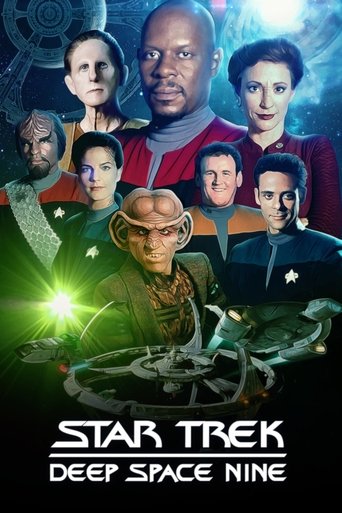
Star Trek: Deep Space Nine
1993 · TV series · 45 min episodes · 7 seasons
Created by Rick Berman, Michael Piller
Science FictionFantasyActionAdventureDrama
At Deep Space Nine, a space station located next to a wormhole in the vicinity of the liberated planet of Bajor, Commander Sisko and crew welcome alien visitors, root out evildoers and solve all types of unexpected problems that come their way.
9 positive16 neutralfrom 25 commenters
Where to watch
No streaming data for this title.
26 comments on Hacker News
Eh, the current 10-hour seasons are the worst of both worlds.
Telling a story in a "tight 90" means making very deliberate choices about what to include, what not to, and how to make scenes do double duty. Having 23 episodes a season lets you slow down, spend time with the characters that's not all focused on the season plot, it lets you have B-stories in every episode. A 10-hour season doesn't get to do that, but it doesn't enforce the same discipline as 90-120 minutes.
Compare Star Trek: Deep Space Nine to Star Trek: Discovery or Star Trek: Strange New Worlds. I greatly enjoy SNW, but the characters and their relationships with each other are in no way as substantial as in DS9 (or even TNG, which was much less character-focused than DS9).
> Star Wars is a beloved movie, with a huge honest fan base. Thus, it was remade with love and attention to detail.
Agreed. Star Wars Uncut exists because devotees wanted to set the record straight regarding controversial changes in later versions, and their efforts were laudable. Still, the image and sound quality cannot match the latest, greatest studio versions, so watching Uncut versions on the newest home theatre gear means accepting the warts and all.
Star Trek: Deep Space Nine's remaster was also a labour of love but with a different purpose (image clarity and upscaling):
https://news.ycombinator.com/item?id=19453745
Agreed, Season 1 was by far the best. I'm re-watching the whole thing with my spouse and in some ways it's more fun the second time around (surely biased because of the shared experience).
Some shows are like that - I didn't think Star Trek Deep Space Nine was all that hot first time around, appreciated it much more years later on a rewatch (the supporting characters are awesome). Maybe in part it's adjusted expectations ;-).
The only Star Trek splitting story-line that I recall [1] was not actually resolved! Lt. Riker just sort of disappeared into the background at the end of the episode, with Cdr. Riker and the writers never mentioning him again.
EDIT: apparently Lt. Riker showed up in a DS9 episode[2]!
1 - https://en.wikipedia.org/wiki/Second_Chances_(Star_Trek:_The_Next_Generation)
2 - https://en.wikipedia.org/wiki/Defiant_(Star_Trek:_Deep_Space_Nine)
Hey unrelated but check out Star Trek Deep Space Nine. I think you'll enjoy it. It's sort of a criticism of the utopianism in previous Star Treks. It's gritty and the characters have to make hard choices, where "everybody wins because it's a utopia" isn't an option. Some characters are literal terrorists and the show does a pretty good job of letting that be morally gray. It asks the question, "what happens when a utopian society must go to war? Is the benevolence a facade masking a core which is authoritarian or fascistic?"
Also check of Andromeda. It's similarly critical, it's like Star Trek if it was a dystopia where the federation had collapsed because their utopianism had made them vulnerable to betrayal by their closest allies (who are literal nihilists). My understanding is Roddenberry came up with the idea but passed away before it could be realized. It asks the question, "okay, we have this techno-utopian concept, but how does that grapple with the existence of evil in the world?"
Don't sleep on TNG either. Did you watch until the Borg were introduced? The Borg are a foil for the Federation I think you'd enjoy, a dystopia of enforced uniformity, a grotesque socialism. Each receives according to their need and gives according to their ability, but through means sickening and unconscionable. Skipping around to just the Borg episodes might be interesting.
I also bet we've both enjoyed the novel Animal Farm, I'm due for a reread.
I'm sorry if I said anything hurtful or frustrating. I hope next time we see each other around HN there won't be hard feelings. I consider your commentary on the intersection of aviation and software development to be must-read, and I have a lot of respect for you.
Star Trek: Deep Space Nine had a couple of episodes set in San Francisco of the twenty first century that's looking more and more of an accurate prediction. It even had a wall to keep the impoverished away from the rest of society, so who knows how much more predictive it will end up being.
> There’s a Star Trek Deep Space Nine episode about government run homelessness camps on the US West Coast in 2024.
IIRC the in-episode description, every major city in the United States, not just “on the US West Coast”.
There's a Star Trek Deep Space Nine episode about government run homelessness camps on the US West Coast in 2024. I see we're working on making this happen.
I'm thinking of a Jadzia Dax in Star Trek: Deep Space Nine. Jadzia is among the lucky few among her race, the Trill, implanted with a "symbiote" carrying the memories of all of its previous hosts. Carrying a symbiote is an unrealized dream for many Trill who wash out of the rigorous application and training process and are told they're incompatible. In one episode, one such disgruntled fellow tries to steal Jadzia's. In another, we learn a twist: compatibility is actually very common. There just aren't enough symbiotes to go around, so they lie about it.
My pet theory is that grossly-paid C-suite executive jobs are like this. Plenty of middle-managers could do as well as the average CEO. But there's only so much room at the top of the hierarchy, and we need to pay them hundreds of millions of dollars.
It's a losing strategy though, with whitelabeling of streaming services it's easy for a content holder to just stick their stuff behind their own label or play Netflix vs Hulu vs Amazon Prime vs HBO.
Content generation was a good move, but they seem to be pursuing a strategy of trying to always have some mega-hit. This causes them to cancel shows that could grow into valuable content anchors.
Consider "The Office." I'm not going to say that everyone loves The Office, but a lot of people like it and enjoy tossing it on the TV when they are just looking for some background noise or just want to binge something they find enjoyable.
How much of Netflix's content fits this mold though? If you take a look at their longest running shows https://screenrant.com/longest-running-netflix-originals-ranked/ they just don't run their series for very long. On the plus side this means that they can go invest in other series, but it creates series that don't have the same sticking power.
They also seem to have a real hard time keeping quality up within a series, so you can have a show start off really strong with a great season 1, then season 2 is meh, and then they cancel it. I think this fundamentally makes their catalog less sticky because instead of their original content being something you can come back to again and again, it is disposable.
I've watched my fair share of Netflix original series, but where other series have grown to hold a special place in my memory and I can watch them over and over (Deep Space Nine, King of the Hill, {fill in your favorite long running series here}) I rarely find myself rewatching their original content. With 2 or 3 seasons, the series end up feeling like long mini-series, and not a whole arc that you can sit down and enjoy again and again.
And when I compare Netflix today to Netflix of year's gone by, the thing I find myself missing from the external content catalog was more of those "old favorites" of just watching through Breaking Bad again or enjoying the episode of Bones where they somehow scan a computer virus off of a bone and into their hologram thing.
We all saw this coming. Even if this instance is low-quality, eventually a similar scenario will happen with one that is good enough to fool most people. I think it is not long until official videos come with cryptographic signatures.
I am just realising that Star Trek: Deep Space Nine actually had a similar scenario in an episode that aired in 1998. Essentially, a deepfake of a meeting of military leaders is created in a plot to persuade a neutral nation to join a war: https://en.wikipedia.org/wiki/In_the_Pale_Moonlight
I've thought Hawking was being a bit over-marketed since the Star Trek Deep Space Nine episode where they place him next to Newton and Einstein as three great physicists in history. That scene was a lot of fun and I'm glad they did it. But there's a lot of room for being a great physicist without being a Newton or an Einstein, and that does seem to apply to Hawking, even if you agree completely with this article.
There was an episode of Star Trek: Deep Space Nine that addressed this something along the lines of, "the smarter you are, the easier it is to talk yourself into doublethink".
Homelessness has always been a problem in this country; it just wasn't as visible as it is now. That visibility is from a bunch of reasons (the Internet makes all things more visible, cities became more popular instead of "white flight," sprawl in more areas). All the way back in 1995--jesus, that's 25 years ago, I feel old--Star Trek: Deep Space Nine had a two-part episode on "Sanctuary Districts" and staggering wealth inequality. Those were depicted as having gotten particularly bad in the year 2024 (the year our heroes were transported back to) but the episode was commenting on the state of society around the late 80s and early 90s. We've had hobo slums, tent cities, and the like as long as I've been alive.
It's not a California-specific problem. Dallas had tent cities in the mid-90s that the local news would occasionally report on. Seattle has had a variety of encampments, from "the Jungle" to "Nickelsville" to "Skid Row" and older.
We see the problem more now. We don't like it, but we also don't do much to deal with it. So it festers, because we're too self-centered to spend the tax dollars at the state and federal levels to do programs like Housing First, but too polite to just round up the homeless population and drop them in a woodchipper like most people on Nextdoor seem to want. Instead, we leave cities and counties to work it out for themselves while their suburban neighbors spend tax dollars on luring businesses out of the urban core because it is "so dirty."
Babylon 5 is a bit of an oddball. They were originally told they'd have a fifth season. Then they were told they wouldn't, so they wrapped it up in season 4 (and season 4 is quite compressed as a result, which might be what you like). Then they ended up getting that fifth season. They used it to do all kinds of fun 'post show' things.
Star Trek: Deep Space Nine went 7 seasons. They could have done it in 3-4; especially if they could have had modern 50-60 HBO-style shows, rather than 35-40 minute network television shows.
I'd like to see creators target 3-4 seasons and contracts be written for them to create all those seasons. The really good, fan-centric ones could then do the Babylon 5 style post-seasons or a contract could be written for additional seasons to cover the next story arc. (I'm sure this is impossible for some reason, but I can dream.)
As things stand, I generally don't watch any new show that doesn't already have a few seasons under its belt. I really dislike watching a season of a show, falling in love with it, and then finding out its already gotten the axe.
There was an episode of Star Trek: Deep Space Nine that made the argument that high intelligence actually made it more likely, because they have more tools at their disposal to explain away discrepancies.
There's so many layers to that question. The major influencer though was most likely syndication.
Shows were designed to onboard viewers at any point in the series. This would enable shows to appear in random order across multiple networks and viewers would just accept them as they were.
Shows which juggled long term serial arcs while staying accessible to the random viewer seemed to be viewed retrospectively as the best of that era. Shows like X-Files, Star Trek: Deep Space Nine, Babylon 5, etc.
Shows which were purely episodic such as Star Trek: TNG or old Doctor Who don't hold up quite as well. They're still enjoyable episode to episode, but there's something missing that we've become accustomed to in modern television. Perhaps if you feel the rose colored glasses starting to slip into place in the future, you could look back on some of those shows that didn't age as well.
We've thrown out syndication as a concept, so what we're left with is almost lazy writing since they don't have to put a bow on every episode after exactly 46 minutes.
But ultimately I think there are those that feel that the 90's were the pinnacle of Hollywood. I recently read an article claiming '99 to be the best year in cinema. We're just living in a perpetual era of disruption and it's going to take a few more decades until people consistently figure out the new successful formulas that are unbeatable until the technology fundamentally shifts again.
This was the article linked in the thread from yesterday.. It relates to upsampling TV show special effects but I think similar tools could be used:
https://captrobau.blogspot.com/2019/03/remastering-star-trek-deep-space-nine.html
> Edit: as per the other comment, if the original exists only on video and not film, perhaps this is the best we're going to get.
I don't think that's quite right, at least it doesn't jibe with what the DS9Doc people have been doing (which consists partly of remastering pieces of DS9 scenes):
https://www.indiegogo.com/projects/what-we-left-behind-star-trek-deep-space-nine-doc#/
I think the footage really was on film, but the issue was that it was composited with low-quality CGI effects, or something like that. So you can rescan the film, but you have to redo all the compositing (and probably with your own models because I'm guessing the original CGI didn't look that good). That's why a DS9 remaster is so expensive.
It's called "Growing the Beard", with Star Trek: The Next Generation and Star Trek: Deep Space Nine getting better around season 3.
https://tvtropes.org/pmwiki/pmwiki.php/Main/GrowingTheBeard
"In 1970s you would just create plastic models of spaceships and film them with normal camera"
Are you sure? For example, from the ILM history at https://en.wikipedia.org/wiki/Industrial_Light_%26_Magic we see:
1975: Resurrected the use of VistaVision; first use of a motion control camera (Star Wars Episode IV: A New Hope)
Following the link to https://en.wikipedia.org/wiki/Motion_control_photography gives us:
> The first large-scale application of motion control was in Star Wars (1977), where a digitally controlled camera known as the Dykstraflex performed complex and repeatable motions around stationary spaceship models. This enabled a greater complexity in the spaceship-battle sequences, as separately filmed elements (spaceships, backgrounds, etc.) could be better coordinated with one another with greatly reduced error.
That doesn't sound like a normal camera.
The text immediately before that quote is:
> The 1968 film 2001: A Space Odyssey pioneered motion control in two respects. The film's model photography was conducted with large mechanical rigs that enabled precise and repeatable camera and model motion. The film's finale was created with mechanically controlled slit-scan photography, which required precise camera motion control during the exposure of single frames.
And in Close Encounters of the Third Kind, the mothership was made of wood, plastic and metal, and wasn't cheap.
Now, to be sure these are high budget movies, but your broad description makes it sound like it was true for all movies in the 1970s.
I think a better comparison would be to look at the model-based special effects in Star Trek: Deep Space Nine with the CGI effects in Babylon 5; both produced at about the same time. Quoting https://en.wikipedia.org/wiki/Star_Trek:_Deep_Space_Nine :
> DS9 was the first TV show in the Star Trek franchise to use computer-generated imagery (CGI) for exterior space shots. Although a few other television series, like Babylon 5, were using CGI exclusively to avoid the high expense of model photography, the Star Trek franchise had continued to use primarily physical models for exterior space shots because producers felt models provided more realism.
Reminds me of "Bar Association" from Star Trek Deep Space Nine[0]: "Bashir says casually that he should petition Quark to add vacation time and sick leave to the bar's employees by forming a union to help them stop being exploited, however Rom tells Bashir that Ferengi do not fight against exploitation but instead work to become the exploiters. "
[0] http://memory-alpha.wikia.com/wiki/Bar_Association_(episode)
The Original Series (TOS) has a level of camp that people either love or hate. The original films (1-6) don't rely too much on the series, though I do recommend watching the TOS episode "Space Seed" before The Wrath of Khan. If I recommend a single episode out of all of TOS, it would probably be "The City on the Edge of Forever".
The Next Generation (TNG) took a few seasons to really hit its stride, some will recommend starting at season 3 - though I personally recommend suffering through the first two seasons at least once. Like TOS, TNG is highly episodic is mostly devoid of major story arcs. My favorite series, but probably more for nostalgia than anything else. "Best of Both Worlds" is a fan favorite episode, though I will recommend "The Inner Light" for anyone - even someone who has never even heard of Star Trek.
Deep Space Nine was a bit controversial when it came out, as it moved away from Roddenberry's idealistic "Wagon Train to The Stars" model of a show and more into conflict and gritty geopolitics set in the same era as TNG. There's a story arc and the characters experience far more development throughout the show than the cast of TNG ever did. I've come to enjoy it more as an adult than when I first watched it on the air as a kid.
As for Voyager or Enterprise, I haven't really watched either of them.
Season 2, Episode 12, "The Royale." This was subsequently tangentially referenced in an episode of "Deep Space Nine," which means "explanations" about Wiles never being born in the timelines are wrong.
Quoting from Wikipedia:
In "The Royale", an episode (first aired 27 March 1989) of Star Trek: The Next Generation, Captain Picard states that the theorem had gone unsolved for 800 years. At the end of the episode Captain Picard says,
"Like Fermat's theorem, it is a puzzle we may never solve."
Wiles' proof was released five years after the particular episode aired. This was subsequently mentioned in a Star Trek: Deep Space Nine episode called "Facets" during June 1995 in which Jadzia Dax comments that one of her previous hosts, Tobin Dax, had
"the most original approach to the proof since Wiles over 300 years ago."
This reference was generally understood by fans to be a retroactive continuity for "The Royale".
Nothing radical here, even for 1994. Not long ago I was watching an old episode of Star Trek: Deep Space Nine (around the same year) in which the commander's son is doing homework on a slightly smaller tablet with a color display. IIRC, he was using a stylus.
American Pie ostensibly takes place in the real world. That's no use to a geeky personality--if a geek wants to get into the real world, he does programming or learns about science or gets into trainspotting or something. But a fictional world means you get to speculate about physics and categorize all the different alien races and starship types you see and so forth, and build vast databases and just lose yourself in what is ostensibly an entire world. This is the type of person who watches Star Trek: Deep Space Nine and makes a mental note of each time they see an Akira-class starship, and then complains when Enterprise comes out because they anachronistically made the Enterprise look like an Akira-class starship. American Pie doesn't have anywhere near this kind of depth of subject--it's just a bunch of dumb teenagers in the real world. (Which is exactly the kind of setting geeks are escaping from in the first place!)
(There's another, largely unrelated appeal to Star Trek and Star Wars: they have genuine heroes. It's very hard to find a TV show or movie today that has genuinely heroic people, it being considered "more realistic" to have flawed heroes.)