 Hacker Cinema
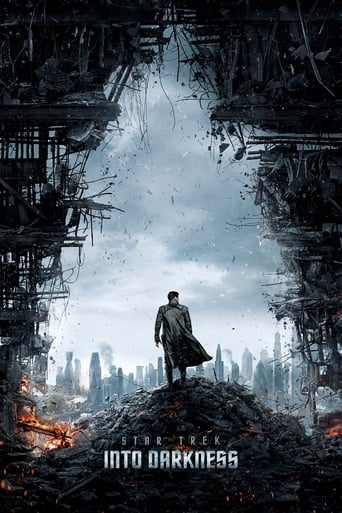
Star Trek Into Darkness
2013 · Film · 132 min
Part of Star Trek: Alternate Reality Collection
Directed by J.J. Abrams
ActionAdventureScience Fiction
When the crew of the Enterprise is called back home, they find an unstoppable force of terror from within their own organization has detonated the fleet and everything it stands for, leaving our world in a state of crisis. With a personal score to settle, Captain Kirk leads a manhunt to a war-zone world to capture a one man weapon of mass destruction. As our heroes are propelled into an epic chess game of life and death, love will be challenged, friendships will be torn apart, and sacrifices must be made for the only family Kirk has left: his crew.
5 negative11 neutralfrom 16 commenters
Where to watch
No streaming data for this title.
16 comments on Hacker News
I have no idea what you're talking about. Star Trek stopped with the roman numerals after VI, because everything afterwards was TNG or JJtrek. The TNG movies (Generations up to Nemesis) had no numbering at all, though people gave them informal numbers. The JJtrek movies restarted the numbering since it was set in a different universe as it was a reboot (one not worth watching), but here again they didn't include the numbers in the titles (e.g., "Star Trek Into Darkness").
Star Trek VI was the last of the Roman numbered ST movies.
Three movies were referenced in the comment I responded to: Return of the Jedi, Star Trek: Into Darkness, and 2001: A Space Odyssey. Two of those movies are definitely not focused on future technologies.
Many people call Star Wars "science fantasy", but I'm extremely confident that this is used less frequently than "science fiction" to describe it and I am absolutely confident that I'd be able to find marketing copy by LucasFilm or distributors describing it as science fiction, even if that aggravates people who are really into more cerebral sci-fi.
> For example in the JJ Abrams movie Star Trek Into Darkness we see the Enterprise operating at depth in an ocean, then dramatically zooming away into space.
Subverted in Futurama: https://www.youtube.com/watch?v=7GDthiBGMz8
Grossly increasing the factor of safety is a subtle way that science fiction stories connote a feeling of very advanced technology.
For example in the JJ Abrams movie Star Trek Into Darkness we see the Enterprise operating at depth in an ocean, then dramatically zooming away into space. Then later another ship falls from orbital height and plows through San Francisco without losing its hull shape.
In Star Wars the Millenium Falcon is constantly doing things that would seem to be outside a normal design for a spacecraft, and it survives (aside from the radar dish).
Even as far back as the movie 2001, the monolith is made out of a material that humans can’t dent or cut. Why so strong? It’s basically just an automated radio.
The idea is: this advanced civilization has such command over physical technology, that they can effortlessly engineer unnecessary strength without losing any of their designed performance.
Close, he was in the movie before it (Star Trek Into Darkness) with Benedict Cumberbatch playing Khan
Wow.
This is, at the largest, a state level issue. Mostly, it is a county or city level issue.
Here, I'll go with a story. I was watching 'Star Trek: Into Darkness', the 'new' set of films. There's a scene where they chase Benedict Cumberbatch about on the top of a flying ambulance in the skyscrapers of the future San Fransisco. My brother, who lived at the time on Geary st. and was running for a seat on the business commission, was telling me that scene was too fantastic for him. Not because, you know, aliens and star ships. No, but that in a mere 200 years the SF housing and construction boards would allow that many skyscrapers. Proper city planning to him was more fantastic than Star Trek.
Now, people really want to live in SF these days. It's not a political climate that is keeping them from building more apartments. It is real stupid, very tiny, small world and small people, corruption and bribery. It is the same story as it always has been. People complain but don't do anything about it.
Since the new series is being exec-produced by Alex Kurtzman, who was a producer and co-writer on both the 2009 Star Trek and Star Trek Into Darkness, it seems pretty safe to assume the series will be set in the new timeline/continuity those movies established. I'd read "not related to Star Trek Beyond" more as them saying it won't be tied in any specific way to the plot/characters of that film than that it'll be completely outside the rebooted continuity.
> If the algorithms are actually any good, they should lead to more, not less, diversity. The algorithms would be able to detect that enough people want to watch a Kung-Fu thriller set in medieval South India starring Summer Glau to be viable
They don't want "viable", they want blockbuster.
When a film in a series makes only half a billion it's seen as a failure and people are called in to make the next one a success.
http://uk.ign.com/articles/2015/05/19/simon-pegg-says-original-star-trek-3-script-was-too-star-trek-y
> “They had a script for Star Trek that wasn’t really working for them,” [Simon Pegg] told magazine Radio Times (via The Guardian). “I think the studio was worried that it might have been a little too Star Trek-y.
> “Avengers Assemble, which is a pretty nerdy, comic-book, supposedly niche thing, made $1.5bn. Star Trek: Into Darkness made half a billion, which is still brilliant. But it means that, according to the studio, there’s still $1bn worth of box office that don’t go and see Star Trek. And they want to know why.”
> He further explained “People don’t see it being a fun, brightly coloured, Saturday night entertainment like the Avengers,” adding that the solution was to “make a Western or a thriller or a heist movie, then populate that with Star Trek characters so it’s more inclusive to an audience that might be a little bit reticent.”
That's like saying "code is bad nowadays because of SublimeEdit."
The actual reason is more often Save the Cat by Blake Snyder: http://www.slate.com/articles/arts/culturebox/2013/07/hollywood_and_blake_snyder_s_screenwriting_book_save_the_cat.html
"Yet once you know the formula, the seams begin to show. Movies all start to seem the same, and many scenes start to feel forced and arbitrary, like screenplay Mad Libs. Why does Kirk get dressed down for irresponsibility by Admiral Pike early in Star Trek Into Darkness? Because someone had to deliver the theme to the main character. Why does Gina Carano’s sidekick character defect to the villain’s team for no reason whatsoever almost exactly three-quarters of the way through Fast & Furious 6? Because it’s the all-is-lost moment, so everything needs to be in shambles for the heroes. Why does Gerard Butler’s character in Olympus Has Fallen suddenly call his wife after a climactic failed White House assault three-quarters of the way through? Because the second act always ends with a quiet moment of reflection—the dark night of the soul."
I watched "Star Trek: Into Darkness". At first I was like "Kirk should be fired." Then I was like "Everyone on the Enterprise should be fired." Then I was like "Everyone in Starfleet should be fired." Then I was like, "Wow, I've never wanted to fire an entire civilization before, and this movie has given me a new appreciation for the importance of rules and regulations in real life."
* This is from the scene where Khan has caused Kirk (along with his son David, David's mother Carol, and his officers McCoy, Saavik, and Chekhov) to become apparently marooned without hope of rescue inside an artificially habitable cave on an otherwise barren planetoid. The scream is (well, maybe not "is", as the entire explanation... but at least in some large part, not entirely unintended, is) meant to sell the idea that the Enterprise is too badly damaged to survive Khan's coming attack, and communicate Kirk's supposed anguish at the fulfillment of Khan's plan to maroon Kirk on a dead planet, as Kirk had previously left him and his wife (a highly debatable sentiment [0]).
Spock is alive on the Enterprise, hiding on the other side of the planet from Khan, and dies later in the film, after retrieving Kirk and participating in the ensuing space battle. Right youtube link, though.
You might be confused by it's counterpart in 'Star Trek: Into Darkness' (also represented by this service), where it's said by Spock on Kirk's death.
----
[0] but one which is explored more fully in a set of recent "prime universe" comics: http://memory-beta.wikia.com/wiki/Khan:_Ruling_in_Hell
Exactly right.
At the beginning of the new film Spock is lowered on a rope into a volcano hanging from a little shuttle. Everyone knows this situation exists for the immediate drama and for the ramifications further on in the story, not because it's in the least bit plausible (let alone necessary). In the future they couldn't have had a robot deliver the package? Maybe just drop it in with a timer on board? The trouble is that it wouldn't have served the story, and it wouldn't have been Star Trek.
Today Star Trek is a brand, a flavour. Maybe once upon a time it was meant to have something to say about our future, but now any reasonable extrapolation would lose the essential character of the property. Hell, maybe Star Trek has never been about the future anyway. I'm sure everyone caught the bit about the morality and legality of extrajudicial killing in the new flick... I'm sure plenty of people would say the series has always been about the present as much as any other time.
From paragraph one: "the hero dressed down by his mentor in the first 15 minutes (Star Trek Into Darkness, Battleship); ... the moment of hopelessness and disarray a half-hour before the movie ends (Olympus Has Fallen, Oblivion, 21 Jump Street, Fast & Furious 6)."
Paragraph 10: "Look at January’s Gangster Squad. After an opening image that sets up the conflict between Josh Brolin’s hard-charging cop, Sgt. John O’Mara, and the criminal forces of mob boss Mickey Cohen (Sean Penn), O’Mara is called in to see his gruff police superior. “We got rules around here, smartass,” the chief growls. “Do yourself a favor. Learn ’em.” That’s Snyder’s second beat, theme stated. And it’s right at the seven-minute mark, almost exactly when it’s supposed to happen in a 110-minute movie....an all-is-lost moment—including a death—between the 75- and 80-minute mark..."
Did you guys read the article, or just skim it looking for a table of data? The examples are there, with the minutes. You actually have to read numbers written as words (gasp!).
> Recent films have started focusing more on the roller coster ride of the visuals, and will do any distortion of the story necessary to motivate a visceral impact on the audience. Good storytelling takes a second seat to putting the audience into the most intense situations possible.
I thought that all of the movies listed (Star Trek Into Darkness, Battleship, The Dark Knight, The Avengers, Skyfall, Star Trek Into Darkness, Olympus Has Fallen, Oblivion, 21 Jump Street, Fast & Furious 6) had awful plots, but for some of those movies the visual spectacle made them tolerable.
None of the movies listed (well, I haven't seen 21 Jump Street) obeyed the rules of physics, which is a huge turn-off for me because it breaks the suspense. The best suspenseful movies they tease you into thinking that you can predict what is going to happen next, as if they were a puzzle.
I'm not saying that I don't enjoy every movie that can't be taken literally; I just don't like movies that are logically inconsistent. Star Wars doesn't follow the rules of physics, but at least it does so consistently; you understand the capabilities of the technologies that they use and can reason about how the characters might use them. I find movies that violate the rules of physics inconsistently to be intolerable; if you don't know what behavior characters are capable of, you lose your sense of immersion because you can't relate to the characters, and can't predict what they are going to do at all.
That's just my opinion, though, and obviously enough people don't agree with me because those movies (listed in article) made lots of money.
Interesting science fiction will not be available at the cinema in the forseeable future. The reason is that it doesn't pay at the box office. If you wonder why so few big action movies have an engaging sci-fi script, then the answer is: Because studios can get away with having bad scripts.
For more on the topic, I recommend: http://redlettermedia.com/half-in-the-bag-star-trek-into-darkness
>While I love sci-fi featuring white male protagonists
It's interesting that Star Trek was actually quite progressive:
>Beyond Star Trek's fictional innovations, its contributions to TV history included a multicultural and multiracial cast. While more common in subsequent years, in the 1960s it was controversial to feature an Enterprise crew that included a Japanese helmsman, a Russian navigator, a black female communications officer, and a Vulcan-Terran first officer.
You would expect a little bit more now. The latest Star Trek film is basically about two white dudes battling two other white dudes plus "hey let's find an excuse to get this blonde chick in her underwear."