 Hacker Cinema
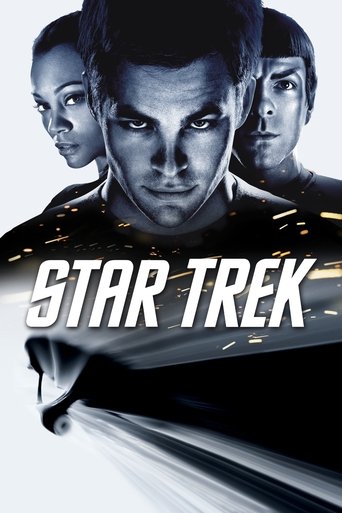
Star Trek
2009 · Film · 127 min
Part of Star Trek: Alternate Reality Collection
Directed by J.J. Abrams
Science FictionActionAdventure
The fate of the galaxy rests in the hands of bitter rivals. One, James Kirk, is a delinquent, thrill-seeking Iowa farm boy. The other, Spock, a Vulcan, was raised in a logic-based society that rejects all emotion. As fiery instinct clashes with calm reason, their unlikely but powerful partnership is the only thing capable of leading their crew through unimaginable danger, boldly going where no one has gone before. The human adventure has begun again.
22 positive45 negative12 mixed86 neutralfrom 165 commenters
Where to watch
No streaming data for this title.
184 comments on Hacker News
NCIS used to use my English department building at University as their Hospital. Star Fleet Academy in one of the Star Trek movies was the front of my school's library.
Considering how much they did there it wasn't nearly as inconvenient as you would think. The school had a good process in place for controlling the chaos. It's still weird watching the movie and seeing my old library in it.
Even physical controls can be a downgrade if poorly implemented.
R.I.P. Anton Yelchin, who brought us joy with his portrayal of Chekov in the Star Trek films, before losing his life at only 27, from a switch poorly masquerading as a brake lever.
I think Hollywood has been churning out derivative content for a while, and catering for "modern audiences" (as opposed to the silent majority) too much.
One or two exceptions - Project Hail Mary, for example.
But the decline of Marvel, Star Trek and Star Wars franchises has been stark.
https://www.youtube.com/@TheCriticalDrinker has some great commentary on the problem.
Also, a number of other factors:
* massive TVs are cheap now * people behave disrespectfully in cinemas * cinema tickets are now unaffordable for the low end of the market * the experience hasn't modernised and become luxy enough to retain the high end of the market * streaming services have high budgets now
> Cut copyright to 15-20 years by default.
This alone will kill off all chances of that ever passing.
Like, I fully agree with your proposal... but I don't think it's feasible. There are a lot of media IPs/franchises that are very, very old but still generate insane amounts of money to this day with active developments. Star Wars and Star Trek obviously, but also stuff like the MCU or Avatar is on its best way to two decades of runtime, Iron Man 1 was released in 2008, or Harry Potter which is almost 30 years old. That's dozens of billions of dollars in cumulative income, and most of that is owned by Disney.
Look what it took to finally get even the earliest Disney movies to enter the public domain, and that was stuff from before World War 2 that was so bitterly fought over.
In order to reform copyright... we first have to use anti-trust to break up the large media conglomerates. And it's not just Disney either. Warner, Sony, Comcast and Paramount also hold ridiculous amounts of IP, Amazon entered the fray as well with acquiring MGM (mostly famous for James Bond), and Lionsgate holds the rights for a bunch of smaller but still well-known IPs (Twilight, Hunger Games).
And that's just the movie stuff. Music is just as bad, although at least there thanks to radio stations being a thing, there are licensing agreements and established traditions for remixes, covers, tribute bands and other forms of IP re-use by third parties.
The article suggests Larry thinks his son has demonstrated brilliance as a media executive:
Their relationship grew warmer as David Ellison achieved professional success, they said. Larry Ellison has always considered himself wise about Hollywood, and one of his best friends, Steve Jobs, mentored the son about the business as well.
Larry Ellison was initially skeptical of Skydance, the Hollywood company that his son started and that bought Paramount. But he has told friends in recent years that he considers his son to be one of the smartest people in the business world, trusts his judgment and tends to agree with him on corporate matters, several people with knowledge of the Ellisons said.
Is Skydance/Paramount under Ellison ahead of other Hollywood firms in terms of successful development of profitable film/streaming properties? A quick look at the list of successes shows IP that was initially developed outside of Skydance ... Mission Impossible, Terminator, Star Trek, etc.
We used to say this about Star Trek movies as well before determining that they're mostly bad. I've moved on from Trek and I'm fine with moving on from Windows.
You are aware that there a number of contemporary star trek movies and tv-series (as much as I wish they wouldn't exist), right?
Besides, real nerds very much are into older media and not just current pop culture. Which is why things like trek (and blade runner for that matter) end up getting sequels - because there is an audience for it.
About a decade ago I started watching Star Wars movies for the first time, when there were "only" 6 movies to finish. But by then there were already 12+ Star Trek movies plus TV series. I decided that I'd "choose" Star Wars, and that was enough for me. I am sure Star Trek is a fascinating universe, and I see it mentioned all the time, but I don't think I care about it enough to ever go into that world.
> But modern Star Trek is by and large nothing like that. The Abrams movies I'm ok with, because to be honest the old Trek movies had plenty of "it's just a fun action movie" too. But DIS and PIC both seem to positively revel in a pessimistic vision of the future where everyone sucks. Where we once got stories where the writers were smart enough to let viewers draw their own conclusions and apply them to real life (mostly, there were preachy episodes too), the modern shows are a blatant soapbox for the writers to preach to us about their views on the world. Where we once had teams of competent professionals using their skills to solve problems, now we have characters who act like children and only know how to apply "hit it real hard" as a solution.
I've not noticed a difference in the preaching, TBH, but otherwise yes.
And also that PIC took many interesting side characters from TNG, and used them as redshirts. Maddox, Hugh, Icheb, Shelby… and both Picard and Data in season 1 — and worse for both. Data because Data was (a) brought back the wrong way (should've been him in B4's body properly and not the simulation), and (b) that version of him wasn't given an appropriate reason for seeking his own death, and they really could've done it quite easily by writing that Data to have a plot point of ~ "I don't want my friends to die, I will choose death again to save them". Picard because it was such a missed opportunity, not only to give Patrick Stewart the same makeup that Brent Spiner had had for all those years, but also because Q said he still had a synthetic body in season 2 and yet they had him getting a "neural stabiliser" for "his brain".
I think that while each show was different, all the Star Trek shows from TOS to VOY had a certain feel to them that made them feel consistent. Yes TOS was more swashbuckling and DS9 was more interested in continuity and shades of grey, but they all were similar in that they were thoughtful shows where teams of competent professionals solved problems in the context of a generally positive vision for humanity, all while trying to offer moral dilemmas for the viewer to wrestle with.
But modern Star Trek is by and large nothing like that. The Abrams movies I'm ok with, because to be honest the old Trek movies had plenty of "it's just a fun action movie" too. But DIS and PIC both seem to positively revel in a pessimistic vision of the future where everyone sucks. Where we once got stories where the writers were smart enough to let viewers draw their own conclusions and apply them to real life (mostly, there were preachy episodes too), the modern shows are a blatant soapbox for the writers to preach to us about their views on the world. Where we once had teams of competent professionals using their skills to solve problems, now we have characters who act like children and only know how to apply "hit it real hard" as a solution.
It is a very damning statement that the best (and for a while, only) modern show to live up to Star Trek is The Orville, which isn't even a Star Trek show! But say what you will about him, Seth MacFarlane gets Star Trek and he loves it (unlike Alex Kurtzman, may he never get another TV series). So he made something which (comedy tone aside) could easily be a successor to the Star Trek shows of old.
The only exception to the dismal trend is SNW, at least the first season. I haven't gotten around to watching more yet, but that show was what CBS should've been making all along instead of the garbage that was DIS and PIC. Suddenly we are explorers in the positive future, we are competent professionals again... it's actually a worthy Star Trek for once. I would say I think that some of the casting choices aren't always great (their Kirk is... not suited to the role), and I would enjoy if they could move further away from the action show tropes and have more thoughtful writing (though not preachy please, I'll take dumb action over the writers preaching to me). That is why I said Star Trek has largely sucked, because SNW is an exception. But in general I have felt like the current creative staff doesn't understand Star Trek at all and can't make a good show to save their lives.
It seems to me that most people say, "don't reinvent..." because they believe there is an existing, ubiquitous, sufficient solution (well, that's why they think it. Why they say it out loud as a response to someone's project, I have different theories on that).
But in ubiquitous solutions, we also find assumptions and trade-offs that require constraining the application to fit the solution. Thus it is there, in those assumptions and trade-offs, as these literal wheel examples demonstrate, where we find the ability to usefully reinvent.
I have to laugh a little seeing your reference to Mecanum wheels and your post being dated 6 hours ago. 12 hours ago, I rewatched the Star Trek reboot film. In it, there is a scene where the characters are all loading into shuttles to head off to their assignments. In the background, we are supposed to be impressed with the technical advancement of the machinery in view, e.g. how something as familiar as a forklift has "futuristic" details like strange wheels. And those wheels on that forklift are Mecanum wheels. In-story, that makes them something like ~300 year old technology.
Ah, so it's like Star Trek movies.
>I wonder how many people have literally been injured or died due to this pursuit for better "design".
One famous example is Anton Yelchin, who played Chekov in the new Star Trek movies. The new Jeep shifter design made it less obvious whether you put it in neutral or park, and so it rolled toward him when he got out and pinned him to death.
https://www.bbc.com/news/world-us-canada-36572649
no, because i didn't watch it. I've never really been into star trek. i watched a few of the movies - nemesis and the one before it, the jj one(s) and then i was done.
If i can remember the review it was "this is a capstone on TNG and probably the entire franchise for most of the older fans" and the first two seasons being disregarded, seasons 3 is "passable"
Looks very much like something out of an older Star Trek movie.
It wasn't a sudden change, it's been a gradual tendency towards them. James Bond was already 19 films by the turn of the century (or 20 if you include the other Casino Royale), King Kong and Star Trek both got to 6, Batman 8, Star Wars had just had the 4th, Friday the 13th had reached 9 films.
Even BttF itself was three films, and in the second one was parodying the tendency towards sequels with the holographic Jaws 19.
Crowds generally like sequels and canon even if it makes films worse.
We did get a reboot of Star Trek with someone else playing Kirk. It was technically an in universe reboot and it was dumb. It probably would have been just as dumb if it wasn’t an in universe reboot.
>Nobody in the article mentions Star Trek movies, though.
So I saved even more time by not reading it
Nobody in the article mentions Star Trek movies, though. That guy mentions "They Live" and somebody else makes a comparison to Dementors in Harry Potter movies, but Star Trek was gratuitously inserted by your cranky chatbot.
I don't disagree that there is a divide between people who prioritize mechanics and those who prioritize emotions, but I think it's overstated. I think if you're thinking about mechanics, it's because the emotions failed you on some level. For example, I thoroughly enjoyed the JJ Abrams Star Trek, even if I don't think it's a great movie, because it's basically dramatically functional. Halfway through Into Darkness I was squirming in my seat thinking about the plot holes, because the movie doesn't work on any level.
With the Last Jedi, I honestly don't think the central problem is that the creators were trying to appeal to everybody at once. I think that better describes the Force Awakens, which miraculously succeeds at doing so at the cost of being kind of forgettable (see my point about Star Trek 2009 above). I think the issue with the Last Jedi is that it makes a very specific set of choices that don't please everybody.
The thing is, in some ways I'm the kind of old fan you're talking about, though I may be younger than you. I pored over books of EU spaceship schematics, read the Star Wars Legacy comics, played the video games, etc. Maybe my experience was different than yours because I watched the prequels at a similar age to the originals, because they were coming out in theaters when I was a kid.
I am not a casual fan, but I'm also not a superfan. I think it's easy to dismiss people who liked The Last Jedi as casual, but Star Wars is such a dominant cultural phenomenon that there is a massive spectrum of how much people care about it and what it means to them.
This has all been kind of a scattered argument. I'm not sure what my conclusion is. Maybe that the real issue with The Last Jedi for many people isn't that it ignores the lore. The prequel trilogy already directly contradicts loads of aspects of the original trilogy that EU creators and fans had to no-prize away. I think it's more to do with how The Last Jedi conceives of Star Wars as a story, and what it considers important and what it does not.
Ain't been no country music since Hank* died; Nashville is just last decades' pop, with a twang.
(exceptions made for Waylon and Willie and Natalie and the boys and girls, but they weren't really Nashville, were they?)
Lagniappe: https://www.youtube.com/watch?v=gwti7-cEHh8
* The Williams are the opposite of Star Trek movies; the evens are weaker. (exception: https://www.youtube.com/watch?v=kzi-FcFEao8 ; even a blind pig finds an acorn now and again)
EDIT: I need to write Beyoncé to convince her to cover "Coat of Many Colours" https://www.youtube.com/watch?v=HYAdKXzGtcY
"Archaeological Dig Uncovers Ancient Race of Skeleton People"
https://www.theonion.com/archaeological-dig-uncovers-ancient-race-of-skeleton-pe-1819565415
"Trekkies Bash New Star Trek Fillm as Fun, Watchable"
https://www.theonion.com/trekkies-bash-new-star-trek-film-as-fun-watchable-1819594814
"Jurisprudence Fetishist Gets off on Technicality"
https://www.theonion.com/jurisprudence-fetishist-gets-off-on-technicality-1819586446
Most sci-fi films (heck, most films) require some level of suspension of disbelief. If you're unable to do that you'll find it hard to enjoy much at all. Do Marvel films seem realistic to you? Star Wars? Star Trek? Cartoons?
Which nu trek? I mean Discovery is to me nearly unwatchable and I activly dislike almost all of the characters. Strange New Worlds on the other hand feels like classic trek with a better budget it is well cast and well written. Picard... I liked parts of it, it got better the farther along it went. Season one was actively bad, bad with good moments though. Season two was better Q stole every moment he was on screen. Season three legitimately was great star trek. Lower decks... if it weren't considered cannon it would be better, as is it a fun adult cartoon comedy. Prodigy is a kids show that I put on for my small children but could not be bothered to actually fallow. The Nu trek movies are brainless popcorn flicks written by people that wish they were writing starwars/fast&the furious crossover fanfiction instead.
Give strange new worlds a shot you won't regret it.
> doesn’t cheapen or weaken the original
I'm not a huge objector to the continued outchurn of the Star Wars or Star Trek or MCU franchises, for example, because there's an academic sense in which the existence of bad stuff doesn't negate the existence of good stuff.
BUT...
I think restraint and scarcity can make things more special. Food is more enjoyable when we are hungry, absence makes the heart grow fonder, etc..
Narratively, it's good to leave some questions unanswered. A successful franchise leaves the fans wanting more, but actually giving them more can leave us over-satiated and uninterested.
There's no more magic or mystery left when every character has had their own mini-series to fully flesh-out every aspect of their arc.
I got into Pinball because my work had a handful of machines in our breakroom. This author is not joking about how different an experience it is playing pinball when you don't have to worry about pumping in quarters or being elbowed out by the next player. Pinball machines from the 90s on are reasonably complex games. They have levels, modes, and lots of goals to attain. Multiball is a reward
> I’m fortunate enough to live near the biggest publicly accessible pinball arcade (Pinball Hall of Fame)
In danger of being rude, I'd say the Pinball Hall of Fame is about worth the price of admission (it's free to enter). Maybe I visited on an off day, but it seemed to be just a warehouse full of privately own machines, about half of which were operating. My local pinball place (Next Level Pinball Museum, outside of Portland, OR) has a very large collection which spans the history of Pinball from very early games to machines that have HD video displays on the backboard.
I strongly recommend if you've never given it a try, find a pinball place that'll let you pay a flat fee for admission and spend some time on some games. My personal favorites:
- Attack From Mars
- Cactus Canyon
- Medieval Madness
- Creature from the Black Lagoon
- Star Trek (based on the Abrams movies)
- Super Mario Bros (the full size table from 1992)
Having used literally every Microsoft operating system aside Xenix (even their portable OSs) I’ve come to notice that Microsoft OSs are like Star Trek movies, they’re generally only released well 50% of the time.
Since no one's mentioned it, another interesting incidence of this was when Anton Yelchin (who played Chekov in the newer Star Trek movies) died from mistakenly putting his Jeep into neutral when he thought he put it in park. Chrysler was using a new (and overclever) shifter design where you couldn't easily confirm by look or feel what gear it was in, and so was prone to being misidentified.
Yelchin death reporting https://filmindustry.network/star-trek-actor-anton-yelchin-dies-fatal-accident/31377
Consumer Reports article about the issues behind the recall: https://www.consumerreports.org/car-safety/fca-recalls-confusing-shifters-in-chrysler-dodge-jeep/
Blade Runner, Avatar, Ender's Game (which sucked, but still), Aliens movies/Predator movies, Edge of Tomorrow, Matrix movies, Star Trek movies. There are plenty of "not Star Wars" examples out there, some of which are extremely successful.
It's the same for sci-fi. We have a million Star Wars series and movies, a billion Star Trek series and movies. But we can't get anything else that is out there that could be so much better. Dune was a good start, but really, each of those books is a series on its own.
The Culture series by Iain Banks would be amazing, especially considering that the world is way more accepting of race/ethnicity, sexuality, and gender issues than it has been historically (not even to mention that we could use some hope for the future in our media instead of dystopia constantly). But instead we get baby yoda series 3. (for reference, I do like The Mandalorian, I just felt like being snarky).
What I don't understand about the movie business is the cost of making them. The most important ingredient to the success of a movie is the plot. We've all seen low budget movies that made lots of money - because of the plot. Casablanca, Psycho, Blair Witch Project, Cloverfield, Primer, ...
Star Trek TOS was a very low budget affair, and produced excellent results, because they hired the best scifi writers. When they threw money at the Star Trek movies, they were all terrible.
It's the plot that matters. Nothing else.
Hank Williams are the opposite of the Star Trek movies: the odd numbered ones (Hank, Hank III) are a lot better than the even (Hank Jr).
It is an interesting topic why those markets are separate. My assumption is that music is way more casual and affiliation to labels and distributors is a lot smaller than with video. Some big stars aside there is lots of interchangeability ... that song not available, well then I listen to something else, but if a Star Trek movie isn't there I won't watch Star Wars. But that's speculation.
As a consumer I very much prefer the Spotify/Apple Music model. I don't want to have 20 subscriptions. I want to go into Blockbuster or some other video retailer and get any movie and pick what I want. I don't want to think about studios and distributors and rely on external services to even figure out what to use (in Germany: https://werstreamt.es which tells me where I can watch/download)
Super 8 has a coherent reveal of the mystery box. Lost did not and disappointed at the end.
The kelvin timeline from when he rebooted Star Trek is sort of mystery box but then we learn who Nero is in a coherent way early on as well. I did not like that JJ destroyed Vulcan and frankly made a confusing alternate, darker timeline at all. The reboots are good movies but they were not good Star Trek movies. Missed opportunities to explore the Roddenberry style themes of humanity and deep moral questions under a backdrop of optimism.
What differentiates the older Star Treks from the shows that have come out in the last 20 years is the optimism. Instead of a depressing vision of the future, Star Trek dared to show a better future. Instead of only having conflicts drive the story forward, Star Trek's main drive was the thrill of discovery, asking questions about what it means to live in this Galaxy.
I miss having shows that convey a feeling of hope for the future. The current mostly dystopian grimdark sci-fi is an easy way for unimaginative writers to make their world feel more real at the expense of destroying that hope.
It's sad that even the new Star Trek movies (post 2009) and shows courtesy of Alan Kurtzman and J.J. Abrams have completely lost that spirit of the previous Star Treks. Instead it's a bland insipid take on the Star Trek universe by people who have no clue of what makes Star Trek Star Trek and do not respect it.
It’s like Star Trek movies and Windows versions. Every other one is good.
I did like Expanse, but I tried to watch a few of the older Star Trek and/or Star Wars movies (don't remember the difference), and I didn't like them at all.
I did exactly the same thing and had a similar experience.
I think this is broadly applicable to most, probably all stylized movie user interfaces. Minority Report, Tron and Star Trek come to mind. They look really cool on the big screen and are inspiring but once you get home and try to actually use something like it in real life for something productive and it's an impediment more than an inspiration.
One of the Star Trek films included a moment where they asked a bunch of extras some question. She wasn't supposed to answer, but nobody told her that, so she replied totally normally. I mean, they were back in time in the "present day" (for when it was filmed) so her answer made sense for the scene.
They loved it and kept the shot, but then realized- whoever this was, she now had a spoken part in the film! They had to find her, get her to join the actors guild, and then pay her some minimum amount for having a line in the film.
I'm sure someone will reply now with the correct version of this story, the woman's name, which Star Trek film it was, and a link to proof of this all.
This is going to be terrible. I can't imagine the SHEER FUCKING HUBRIS modern TV writers must have of they think they can write a fanfic that stands next to Tolkien's greatest work.
These writers' only experience is working on a 4th film in JJ Abrams' Star Trek reboot universe which ended up getting cancelled too.
I find Ep 7 to be mostly unwatchable because it’s almost all fan service without a real story to be found. There was no plot for Ep 8 to hang itself on, just a few coathooks widely spread.
Ep 8 had some really interesting character arcs, but also made some basic errors. As a movie, I think that it’s the strongest of the three sequels. Given a lack of plot points to really hang off, Johnson seems to have done something interesting, but left even fewer plot points to hang off than Abrams left him. Let’s be clear: if Lucasfilm had disagreed with his direction, they would have taken him off the project.
Ep 9 was more fan service (who can we throw into this scene?) with an even more inexplicable plot hook (if the Emperor was coming back in any way, there should have been hints of that in Ep 7).
I do not understand the fascination with J J Abrams. He claims to be a fan of various media, but IMO he is the shallowest type of fan out there, appreciating only certain aesthetics without looking any deeper. His Star Trek films are the absolute worst of all the Star Trek films, even worse than Star Trek V: The Final Frontier. Why are they the worst? Because they have become Generic Action Films with a Star Trek veneer. (This is more or less my complaint with Picard.) I dread the idea of seeing J J Abrams touch any more science fiction properties because he just doesn’t get them and turns them into Michael Bay films (but with lens flares instead of explosions).
Not sure others, but Netflix is the Apple in streaming. They are able to churn out mega hits like Squid Games. Look at Apple TV, reminds me of Steve Jobs effort in Ping the Apple Fecebook years ago. Bezos got other interest in space for now. Google isn't famous for ability to create hits....ahem G+ and G-glass. Disney+ has built-in goodwill from their past. I see many kids these days not into Mickey Mouse stuff compare to 20yrs ago. Disney is trying to build more legacy by buying Marvel and Star Wars. Reminds me a lot of their effort of securing Pixar back then. Problem with this franchises are that they tend to fizzle out years later. See what happen to last few Star Wars movies. However if you have consistency in generating hits like Netflix in the pasts decades, that sounds a lot like Apple. That means they will be able to survive to adapt with new stuff. Unlike those milking the pasts like Star Trek, Bobba Fett, adsense, prime, etc.
> The latest Star Trek reboot was enjoyable.
they were pretty terrible star trek movies - because they didn't have anything of note to say about humanity and society like the old star trek would.
These reboots are merely action/adventure movies with a star trek setting. In fact, they use the star trek name to generate marketing hype. Those films would not have done nearly so well had it not borrowed it.
So ... like Star Trek movies?
>Except that Star Trek is a TV show.
Last I checked, there were several feature films with the title of Star Trek. Do I live in a fantasy world where this isn't true for you?
>>> I wanted to see what a real East Asian hero in the movies could look like
K-Pop Star Rain in Ninja Assassin: https://en.wikipedia.org/wiki/Ninja_Assassin
Lee Byung-Hun as Storm Shadow in the GI Joe movies (a villian, but a damn cool one): https://en.wikipedia.org/wiki/G.I._Joe:_The_Rise_of_Cobra#Cobra
John Cho in the new Star Trek films: https://en.wikipedia.org/wiki/Star_Trek_(film)
^Just in case you want to work through a back catalog of kickass Asian dudes in blockbuster films.
I've seen both of the Wolf Warrior films as well. I was curious how they would handle the size/physical strength disparity with the presumably-former-spec-ops American mercenaries. I like the approach taken, where the Chinese protagonists overcome them with agility and dexterity.
As an American, and one who has to deal with the Chinese military as an adversary on a regular basis, I still enjoyed these movies.
Make the Star Trek movie, Q!
It could be that our pop culture has been frozen in time as "THE pop culture" for 50 years now. Rehashed, rebooted, remade, and reimagined over and over again to become your pop culture too.
How am I supposed to NOT feel "stuck in the past", when the The Matrix is coming out next month? When there's a bunch of Star Wars and Star Trek and Indiana Jones (!) next year. We're on our third or fourth Spiderman franchise, and every other teenager that I walk past is wearing an Iron Maiden or Metallica t-shirt? The most exciting new video game on the horizon is Knights of the Old Republic. Geeze, Tom Brady is the defending Super Bowl MVP!
Sure, somehow I went from "liberal" to "bigot" without actually changing my social views, and somehow we determined that comic book movies never exist before Robert Downey Jr. But otherwise, I look around... and this really DOESN'T look all that different from the 90's, you know?
I recently played out this scenario where I run out of money and then just end myself instead of begging. I concluded that I'm extremely likely to be doing something meaningful and would rather have the survival money. So that's what I'm focused on now - working on my bucket list, moving towards meaningful activities already and figuring out how much I'd need to becoming financially independent. The Bogleheads website has proven useful.
Edit: My message for those who think that killing themselves might be a reasonable choice: There are those who wish for just that one extra day for meaningful work or to be with their loved ones. While not all may have loved ones, a person could find something meaningful to do. For those who like the Marvel movies, I think Tony Stark ended up doing rather well with the gift of life that he'd received in the first Iron Man movie. Another inspiring quote for me was from the Star Trek movie: "Your father was captain for a total of 20 minutes. In those 20 minutes, he saved 800 lives. I dare you to do better".
You ask a good question, and to be honest: I don't have a good answer to it yet. I'm still trying to work out a consistent position on the whole topic. Therefore I'm going to give you a rather tentative view.
I currently feel there's a spectrum of cultural importance on media. On the one end, you have your sonnet, that few people even know exists. On the other end, you have Game of Thrones.
At some point a piece of media becomes so widespread that it becomes a part of shared culture. It could meaningfully affect everyone[0], like Harry Potter or even Game of Thrones (I'd expect everyone to be at least aware of its existence). Or a subculture, like Star Trek or Star Wars for people with even passing interest in science fiction (or STEM), or StarCraft for people into PC video games. These works weave themselves into the fabric of society - people lift phrases from them, make metaphors referencing them. Hogwarts is the modern Troy. Being unable to access these works - especially at the same time everyone else around you is perusing them and talking about them - becomes cultural isolation.
With books, we have it solved, thanks to libraries. Almost anyone can get legal access to almost any written work - where they don't have the money, they can substitute it with effort, to get to a library (and possibly convince the library to buy the work, or fetch it through inter-library loan, etc.).
With music and movies, we had it solved in the past too. You could be exposed to popular works through radio and TV, both private and public. This worked better pre-Internet, because while media distribution was regional, the culture was also regional. Not so today - with the spread of the Internet, the culture became international almost overnight. With Internet, enough of us in Poland can enjoy Game of Thrones simultaneously with the rest of the world that it becomes expected of everyone to enjoy it in lockstep with the whole planet.
Videogames gained mainstream popularity around the same time Internet did, so there was never an equivalent of a library, or public broadcasting, for games. You either buy one or pirate it. If a game suddenly gains worldwide popularity[1] and every one of your friends is playing it, you'll either buy it or pirate it, just so you can feel included in their conversation.
And that's ultimately the main justifying factor I'm currently exploring: entertainment media are social objects. One of their most important roles is to glue communities together, by giving people shared experiences to talk about. Once a work becomes popular enough, I can't really blame people who pirate it because they too want to be a part of the conversation.
The sonnet from your example? It isn't popular at all, it isn't part of culture, so I'd consider pirating it as an act of malice. My view would change if I suddenly started seeing it mentioned on the news.
--
[0] - Not everyone everyone, as there are plenty of people with little to no access to Western media. It's much less than 50% of the planet, but much more than "the West", so I don't feel writing the latter would be right either - so where I say "everyone" in this thread, it is to mean "everyone within the broadly understood sphere of influence of the Western culture".
[1] - Which doesn't happen by accident; a lot of money and effort goes into marketing, in order to make this happen. And piracy was historically a part of it, too: few people actually bought originals of Diablo or StarCraft or Red Alert in Central and Eastern Europe, and yet they were hugely influential there, all thanks to folks with CD burners in their trucks.
There is a difference between saving a show and saving a franchise.
The Star Trek movies saved the franchise which lead to TNG, DS9 and Voyager, they didn’t save the original series tho.
I only hope is that they won’t turn Stargate into Discovery like show.
I first met Dan in Santa Clara at some event when he came over to our table and showed off some ssh fu. We’d reconnect at events every so often and he’d always share his latest interest. I recall once Dan turning me on to the unique world of software produced and shared primarily by doctors who code by opening a video of a jet engine crash landing in an MRI viewer app. The time after that, he was telling me about going to see the new Star Trek movie that had just come out and how his friend couldn’t see the green alien lady, which led him to build one of the first truly useful applications of augmented reality with his colorblindness app.
When people say Dan Kaminski was a hacker’s hacker, it’s with good cause. Not only did he defend the Internet from itself, but he changed the way people see the world. He put a noticeable dent in the universe.
Somewhere in storage I have a perfectly legitimate VCD release of one of the original Star Trek movies. It's split across two discs!
The comparison with Laserdisc always amused me. Laserdiscs usually have to be turned over half way through, VCDs only play on one side, so you have to swap it out for a completely separate disc in the middle of the movie.
This is so true! I never was as big a Trekkie as I was a Star Wars fan, so I didn't really see it with JJ's Star Trek. I actually liked his first movie.
And then came Star Wars. I kind of could accept his remake of Episode 4, but after that, man they made me like the prequels so much more. Not that the movies itself were bad, they just totally ignored the fact that 6 other movies already existed, not even speaking about all the legends stuff. He could have easily used ships, characters and locations from Legends, all the designs were there. Using them would have had the same effect on new viewers while eing great for oldtimers like myself. He didn't, everything had to be his, and bigger and faster and with more bang.
That it can be done differently was shown by Feloni.
This sums up some of my problems with the JJ Abrams take on/Kelvin-verse Star Trek, existing character traits seemed to consume the characters entire presences instead of being elements in parts that made up the whole.
Kirk getting the worst of it, the risk taking, jovial and daring Starfleet officer who sometimes clashes with his superiors? Let’s just turn him into a total renegade who disregards authority and gets into bar fights while jamming to 20th century hip hop and end the trilogy with Kirk on a motorcycle...while jamming to 20th century hip hop.
And I know: the movies were trying to give us younger versions of the crew but sheesh..
About the only character who seemed like someone who could even remotely come close to growing into the character of old was McCoy, and that’s probably just due to Karl Urban absolutely crushing the role—-even though I thought the scripts gave him almost nothing to do until the third movie.
Jeff Katzenberg, the co-founder, has been 'making content and selling to kids' for 40 years to the tune of literally Billions. Star Trek films, The Little Mermaid, The Lion King, Shrek, How to Train your Dragon etc. etc. - just huge, monster titles.
Whitman was the 'Business Person'.
That said, the content format is really quite different, and it's hard to predict how '5 minute bits' would work, and they spent possibly way too much money on it, it would have been better to 'start small', to find the format that works, and then spend a fortune - which is probably something that Meg should have understood given her background in the Valley.
> The movies have forgotten they are fantasy, and come to the conclusion they are Sci-Fi.
You seem to have forgotten that it's entirely possible for "fantasy" to have more complex themes than "evil space wizards vs. good space wizards," or that something must be only one or the other. Star Wars is solidly both, and as far as its sci-fi aesthetic goes, it's more grounded than Star Trek, which runs entirely on nonsensoleum sometimes.
>The worst moment, by far, was in the 2nd of the latest trilogy, when the chinese girl (Rose?) monologues about how the real evil in the world was greedy war profiteers and evil capitalists. ffs.
I mean, the actress is American born, of Vietnamese descent, but sure, Chinese is basically the same thing, right?
And that was one of the best themes of the Last Jedi. Of course there would be war profiteers - we already know this because the OT gave us Mos Eisley and Jabba the Hutt and bounty hunters. "greedy war profiteers and evil capitalists" aren't at all unknown to the franchise. The problem here is this sudden dump of complexity should have been a throughline with Rose for the entire trilogy. It certainly would have been better than "This time the Empire is even more fascist and the Death Star is huge."
>This is a universe in which the more powerful faction outwardly identifies itself as the Dark Side, fueled by the power of Hatred, and known for destroying planets at a time.
The "faction" doesn't identify itself as the Dark Side. It identifies itself as the Sith. the Dark Side and Light Side are aspects of the Force, like yin and yang (in fact, probably exactly like that since so many elements of SW mysticism are Zen Buddhism with the serial numbers worn off.)
Also the Sith and the Dark Side weren't known for "destroying planets at a time." The Death Star was built by the Empire, and yes, while Palpatine turned out to be a Sith (as a retcon) they even made a point of having Darth Vader point out how insignificant the "technological terror" of the Death Star was compared to the Force - not the Dark Side specifically, but the Force in its entirety.
>(although the real worst part was, surprise, 100,000 star destroyers, all of which can destroy planets)
Yeah, that was stupid.
But Rose wasn't, she was just badly misused as a character.
The point he tries to make loses a lot of credibility right off the bat by calling a movie with 94% approval by critics in RT and 82/100 average rating in metacritic "mediocre". That's higher than many award/festival winners... And, amusingly enough, on par with the movie he prefers, Mulholland Drive.
It gets weirder when he later says that we should go by the average rating and what a minority found great instead of what a majority found out to be ok... Except if the movie is Star Trek (2009), I guess (it has a lower rating in imdb than in either RT or MC).
And then he says that we should like stuff that has stood the test of time... But all the examples of his favorites are within a decade and a half of each other and the oldest is 33, which is young if we take in account the history of motion picture. In fact, his anti-example is closer to most of his examples than any of them to our time. And, of course, people are still talking about that movie, including him even if to disparage it.
He finally gets to what I assume is his thesis that we should pay attention to what has stood the test of time... Except if we do that we miss a ton of great content.
Sturgeon's law is a thing and it has always been. For every Godfather part II there were a hundred exploitation films. All the time, most of what's produced is garbage, but also every year (except, of course, the anomaly known as 2020) more media is produced. So, again by Sturgeon's law, that means that more great media is produced every year.
Apropos of nothing, my two favorite movies are a biopic/lawyer drama and a campy spy action movie. I can't choose between the two, and both were released the last decade (2010-19). I've also watched dozens of classics and I've liked most of them, but I've also hated a few.
So, ultimately, this is a matter of taste, and there's nothing wrong with having different tastes.
IMDB's DB is big, but owned by Amazon (possibly biased due to Prime), and not accurate (see below). I've been using that website for 20+ years tho. I go to there out of habit. But I also used to continue to go Slashdot out of habit.
I read a comparison (linked on HN) between IMDB, Rotten Tomatoes, and Metacritic which used statistical analysis and concluded Metacritic was most accurate.
The movie you mentioned (I don't know about it) gets 82/100 on Metacritic [1], and a must see reward (whatever that means). 82 is high.
The director of the movie is JJ Abrams who seems to turn anything he touches into gold (with one recent exception, IIRC).
[1] https://www.metacritic.com/movie/star-trek
As someone who apparently frequents much more pretentious online film circles than OP, the idea that the highest rated films and shows on IMDB represent the "best" of the mediums is kinda silly.
The article uses Star Trek (2009) as its example of a mediocre film. Its IMDB rating is 7.9/10 from over 500k votes over 11 years -- surely this would place the film squarely in the "tried and tested" category.
If I look on some smaller sites I see a different story. Letterboxd: 7.2/10, 234k votes RateYourMusic: 6.4/10, 3k votes The first site has a higher ratio of capital f Film fans and the second site is a much smaller site focused on music. Using these three data points I can deduct that Star Trek (2009) is probably a decent franchise action movie that most will find enjoyable but won't stand up to scrutiny as a stand alone film or for those expecting something more substantial.
The article is right that it's so much easier to access the history of a medium than in the past. It's interesting to me when a previously unknown work from 25+ years ago is rediscovered and entered into "the canon". In alternative music a recent example is Long Season by Fishmans from 1996.
But going through the canonical "best of" lists for a medium is more-or-less a gateway to developing and discovering your own taste in these things (a process that never ends). You shouldn't put much trust in any single source.
Something that's missing now with this intermingling of old and new art is historical context. A film streaming platform is just a directory of video files attached to 250px images and paragraph blurbs. What is Netflix saying about film and its viewers when it has less than 50 films pre-1980? Now that watching 2000+ films before the age of 30 is common for film fans, what will that mean for the future of film?
Nailed it. This is why the most recent Star Trek movies don't count as actual Star Trek to me. We had the 'pretty' and 'explosiony' action sci-fi movies in the form of Star Wars. Star Trek was supposed to wrestle with just a little bit deeper themes.
But now they've devolved into beautiful looking action movies which exist just for the sake of action, with the story being secondary.
Is that a Star Trek movie reference?
> I loved TFA because of the nostalgia, sure it copied many things. But history itself repeats sometimes. I thought it was a good way to reignite the story by having familiar elements.
It's a fun watch, like Abrams' Star Trek reboot, but has the same problem of extremely lazy plotting. Not that the original trilogy never ever has something happen purely because it's convenient for the writer and they can't be bothered to think of something better, but that's the underlying motivation for a lot of the writing in TFA and Abrams' other films, while it's usually rare or absent in a well-plotted film, including the original trilogy.
He'll even, sometimes, write in nonsense because it's convenient, then have to come up with other nonsense to find an excuse to get rid of the first nonsense, without bothering to try to make any of that seem reasonable or natural. Example: Han and Chewie show up in a big ship just because we need them to be here now and can't be bothered to write them into the plot some more natural way that doesn't require introducing a new ship, but we don't need that big ship around past this scene because it only exists in the first place for the writer's convenience in the moment, so we'll just... make up some plot-irrelevant reason for them to abandon it suddenly, at exactly the time we need them to. Boom, problem—which we created due to laziness—solved, by applying more laziness! It's basically a whole movie of that, ground up, from a plot perspective, and it really grates once you notice it.
About the best thing I can say about Abrams is he runs one of the the best casting operations in the business and seems to be a good director of actors. I mean, damn. And he's about 100x better than, say, Michael Bay at creating good, popcorn-dumb but not dumb dumb or hard-to-follow-for-no-reason-but-laziness, action scenes. He's no master of action, but he does entirely serviceable work, which is more than a lot of directors manage. His plot writing is just god awful technically speaking. About as bad as it can be without suffering outright incoherence.
One final insight I'd add here, regarding innovations that make walls irrelevant: cryptocurrency may very well soon enable end-to-end networks of totally-anonymous transactions and communications. This wasn't so possible before because a) the tech is really hard to do, if possible at all and b) the incentive structure is even harder. But if we can actually create communication and exchange platforms that are totally anonymous, then suddenly the whole book on copyright legislation (or any legislation) is completely unenforceable and irrelevant. Aside from tracking people directly in their homes (and best believe that's in the works), any digital work will be completely valueless from day 1 as soon as some hacker can copy it once. We have this already in a lesser extent via Bittorrent/Tor networks, but I'm talking a possibility of a considerably better user experience and wide use amongst the population. Suddenly no TV show / movie / game / invention would be worth anything anymore, because it can be copied from day one. Funding models would have to completely change to be on-demand Kickstarter/Patreon-style donation-based mechanisms rather than rental/viewer/purchase-based, since owning the rights to anything will be fairly impossible (without a totalitarian government enforcing it).
Of course, if that fully anonymous economy gets created, then taxation will be pretty impossible too - nobody can even track how much you've earned. But of course, once again the weakest point - and the place where all value might aggregate - is in the physical world. Nobody can catch you online, but they sure can in reality! Digital money might be a dime a dozen, but it's hard to replicate physical goods (until we get a real life Star Trek replicator of course... James Burke, famous historian who predicted the internet, predicts that's coming in 50 years!)
Oh - damn - one more paragraph caveat that I've just realized: reputation will still be worth a damn. Anonymity might become cheap and superfluous, but reliability and reputation will still be big (provable identity will be hard to fake - even if usability/technology will be instantly copyable). People/brands that are actually actively liked for their reputation alone will be valuable as attractors of funding - maybe moreso than ever before.
Whew, big rant! Hope it's interesting.
Entertainment still isn't a commodity, though. Just because there are hundreds of sci-fi movies and TV shows, doesn't mean I can pick up any of them and enjoy it as much as one that I wanted to that wasn't available.
If I really want to watch, say, Star Trek movies and Continuum TV show, then if CBS decides to pull the Star Trek movies from Netflix and spin off their own streaming service doesn't mean I'll just find something else on Netflix, or that I'll subscribe to CBS too; I'll keep watching Continuum on Netflix and head to TPB for the missing movies.
If movie studios want to stop piracy, they have to stop being so greedy. Streaming services shouldn't be allowed to get exclusive licensing deals on movies/shows. The market would sort itself out and people would be able to watch all they needed from one or two services whose UI they most like.
(And honestly, UI should be unbundled too. Streaming service's crappy four-button player can't beat VLC.)
Amazingly done, and without text. He also made these for various other movies including Indiana Jones, LOTR, Star Trek, The Shining. [1] I'm not fan of any of these franchises (anymore) but if I were... (read: in my younger years) I'd want such poster(s) :) the artist also has a shop.
[1] http://www.andrewdegraff.com/moviemaps
Sorry, I must have left out private entities, which led to downvotes. Snowden is likely to have caused an exodus of hoarded intent of knowledge towards private global interests, away from governments. So the quantum race, then, would be going on behind the scenes with both private and public interests.
How hard will it be to switch to post quantum encryption globally once it’s clear publicly that there’s at least a proof of concept for a quantum decryption supercomputer? How do you differentiate between cloned 210 iq babies in massive underground communities (as an example) working on decades in the future tech, and safeguards amongst the destructive forces of the powerful hegemonic incumbency. There’s an applicable abstraction here, generally, about containing superior intelligence, whether artificial or biological. I do believe recent Star Trek movie touched upon this
I was very frustrated watching the first of the newest Star Trek movies when Checkov runs to grab control of the teleporter to catch the two falling crew members plummeting towards the planet surface: as though in the age when it’s possible to decompose matter and retransmit it to some other location they do not have computers fast enough and accurate enough to calculate a trajectory of objects falling at terminal velocity. Seems exactly like the sort of the thing a computer should handle not a human.
Also this: https://m.youtube.com/watch?v=XlXXoq7N4UQ
I don't think Star Trek isn't a similar franchise. It's not centered around a single storyline like Star Wars or Harry Potter.
Star Wars is a similar franchise, but I think it shows the opposite, because the fandom was strong during the 16 year gap between movies from 1983 to 1999, which shows that once successful, a fandom like that will stay intact for years, whether or not anything new gets added to it. Harry Potter fans can ignore the new stuff that's coming out. A lot of Star Wars fans disliked or didn't pay much attention to the new movies but remained part of the fandom.
In literature, maybe (and mostly because of Game of Thrones and Lord of the Rings) but space travel themes are still big in tv, film and video games.
Of course, in real life, space travel got boring. We couldn't afford the lunar colonies or spinning orbital platforms or missions to Mars we all thought we would see in a few years. It was only in Star Trek and Star Wars that space offered endless variety and new frontiers, but reality offered nothing but dust, and the billions of dollars we were spending flying people to go stand on the dust started to seem like a wasted effort.
Pretty sure parent comment was specifically referring to violence as I don't recall explicit nudity in Star Trek movies (just suggested nudity).
Star Trek movies are like if the Titanic had to fight off the combined fleets of all WW1 and WW2 powers.
There's a reason the ships get blown up.
I was too young for Voyager or even Enterprise. I was introduced to the Trek through JJ Abrams movies. Later when I watched Enterprise, Voyager and the Jean-luc movies, I did realize why people criticize JJ movies. However, they still do a good job of introducing new people to the Star Trek Universe. Considering the revival of Star Wars, I do feel Star Trek could use some new fans.
This has always been Star Trek's dichotomy. Many ships called Enterprise have been blown up (in a permanent, non-time travel magic way), and it happened in the movies.
The movies are action. The series are where the characters and universe are built.
I said when the first Abrahms Star Trek came out that it was one of the best Star Wars movies in years.
I guess someone at Disney agreed with me...
Are the Abrams movies even Star Trek? Feels nothing like ST.
Very tricky. Tourism is still a very big industry in San Francisco. One of the reasons people go there is to see the charming old houses and nice old neighborhoods.
While we think SF would look great if it were like in the Star Trek movies, that would pretty much destroy a large part of what makes San Francisco San Francisco.
But did you notice Star Trek movies suddenly disappearing? Check back the movies and series you've watched and meant to watch again at some point. Chances are, you won't find them anymore.
That's the thing with Netflix - objectively, it's the best streaming service available. The complaints are mostly relative to what they could be, and about the direction in which they evolve.
>> "Discovery", well... it would stand on its own as a general sci-fi show, but it just isn't Star Trek.
Clearly. Such a shame too, to waste the first Trek series where the main character is a black woman, and also not a starship captain. Unfortunately, it's all just one big cheese-fest from start to end.
>> The same applies to the JJ Abrams reboot movies.
As a long-term proud trekkie (sorry) I wonder what the general opinion is about the rebooted universe. I personally agree with you, that it's Trek without the Trek, like an ice cream cone without the ice cream, but I wonder what others think.
"The Orville" is on my to-watch list. "Discovery", well... it would stand on its own as a general sci-fi show, but it just isn't Star Trek. The same applies to the JJ Abrams reboot movies. IMO they butchered all the good things about Star Trek, while retaining all the bad ones. So for me, Star Trek franchise still ends at Nemesis (movie) / Enterprise (series).
> Just ease the regulations on...
My brother lived off Geary for a few years and went to a few public meetings on the proposed subway line they want to put under it. He was interested in the idea, as the N-Judah is a methadone clinic (last he was there a few years ago, caveats apply). He never saw such NIMYism and such tight resistance by the property owners on Geary to any improvements whatsoever.
You don't just ease regulations or really do anything 'big' in any city. Palms must be greased, and if you do not it is a horrific process that takes at least a decade.
I'm not saying that you are wrong about the free market. However, my brother thought that the most fantastic thing about the new Star Trek movies (esp. the new Wrath of Khan) was not the warp-drive, nor the aliens, but the very tall building in SF. Even in 400 years, there is no way the planning boards would allow such things.
Remembered watching an old Star Trek film where the Cochrane character wouldn't launch without playing "Magic Carpet Ride" on the way up and thinking that space travel could never ever be so glib...
Well played Mr. Musk. Well Played.
The increasing prevalence good guy bad guy dichotomy is probably driven by the conatraint of the shorter forms. There's a great videoessay on why star trek movies are awful (all of them except I and IV have a villain, and only II pulled it off well) while the series deep space nine pulled off an incredibly complex villain by virtue that they had 7 years to develop his story arc.
Even Darth Vader, the example from the OP essay got complexity as the franchise spanned decades.
One of the many problems is Hollywood trying to target Millenials who only watch YouTube instead of watch movies or TV shows. Then the movies and tv shows flop and they can't understand why.
Ghostbusters reboot failed because they tried to target social justice warriors and feminists who don't watch sci-fi or horror movies. Trying to make Ghostbusters 3 was really hard and got delayed as they could not get the formula correct in the first two movies. Now Star Wars and Star Trek are suffering.
Just know your target market and cater to them.
My mother watches old movies on Hallmark and TCM etc. She does not like Ghostbusters, Star Wars, Star Trek anyway. She likes mysteries, drama, soap operas etc.
Yeah Amazon and Netflix are making their own movies for a good reason as Disney buys out Fox and will pull all of their IP from other sources to put them on Hulu it owns 60% of now or make their own movie streaming platform.
> You don't think there's any such thing as nerd culture?
Nothing is ever black or white. I'm most certainly a nerd, but that doesn't mean I have the same sense of humor as every other nerd. Think of it like inheritance vs composition. Just because I'm a nerd, doesn't mean I inherit everything other nerds have. I only have some components. And while I appreciate Sci-Fi movies, I don't participate in wars between Star Wars and Star Trek (I think Stargate SG1 was better anyway).
One thing that bugged me about the 2009 Star Trek film was why Checkov runs over to take manual control of the teleporter to beam up Kirk as he’s freefalling towards the planet: surely a a machine at their level of technological sophistication would be able to calculate the trajectory and beam them up in real time without too much trouble.
I should have clarified: there's no sampling bias. These are incredibly popular movies. Here are some movies not on Netflix streaming that I've wanted to watch this year: Gladiator. Star Wars IV. Shawshank Redemption. The Wizard of Oz. When Harry Met Sally. The Princess Bride. All Star Trek movies. Goodfellas. Lord of the Rings. Gone with the Wind. All Godfather movies. Monty Python and the Holy Grail. Airplane. American Graffiti. The Usual Suspects. All Jim Carrey movies except a bad one (the Grinch) and one I've never heard of (the Number 23). Toy Story. There's Something About Mary. All Austin Powers movies.
The last time I tried searching for a good movie to watch on Netflix streaming, I gave up after 10 minutes. I'd think of one movie after another after another. Nothing was there. All it could suggest was "related titles," as if that's what I would want.
It's a quote from the Star Trek movie clip. We are starting to believe that we have "Star Trek" like medicine, but we're no where near what they did in the movies/series.
On a side note, I recall a story told by Chris Pine being surprised by all of the bodyguards surrounding an extra on the set of Star Trek. That extra was Jeff Bezos who had a small part in the movie. Chris Pine had apparently never heard of him.
There's also a huge difference between telling a formulaic story with traditional style and some sort of sermon like moral statement, vs photographic memory of a "where's waldo" book.
For example, look at formulaic rebooted sequel Hollywood movies. Given less than a paragraph outline, you can recite the details of most movies pretty well. Consider the first Star Trek Reboot movie, doesn't that compress down to only a couple lines, even if you talk for hours about lens flare and pew-pew sound effects? The second reboot movie compresses down to perhaps one or two complete paragraphs worth of raw data, its at least twice as complicated as the first movie.
Something like the iconic original Star Wars was tight because it provided a new formula, a pretty cool formula, but within that formula which admittedly is difficult to learn, the story is also not terribly long.
I guess I'm getting at teach a Bard about Hollywood Star Wars films for awhile, then learning specific movies only takes one viewing and is easy to memorize.
If you know the Adventure Time world and in-jokes, each episode is like two lines of text to memorize, maybe.
People here are really missing the point... This isn't another ipad it's a different way of interacting. It's not just video message either, it's a new human interface for interacting with software. You can communicate with someone and get suggestions at the same time. Think conversing with a friend and having Alexa aid in the discussion.
Friend 1: Where do you want to go to the movies tonight? .. Friend 2: I dunno Alexa have any good suggestions? Alexa: Star Trek is playing x:00 at X theatre. Things of this nature.
> Yeah. The "mainstreaming" of sci-fi has been kind of a mixed blessing. We got all the PEW PEW PEW lasers and blinking computer lights but none of the thought-provoking stuff.
I'm inclined to agree with you, but then I also saw a couple of big Hollywood sci-fi movies this winter that were actually thought-provoking.
1. Arrival - adaptation of a really challenging short story. Drops most of the physics stuff, but keeps the linguistics, and the human element. Only adds a little action.
2. Passengers - lots of action, but centers around an ethical conundrum that will give you plenty to talk about afterwards.
Agree on the new Star Trek reboot. It really offers me nothing of what I like about Star Trek.
> I want those space opera and space ship and hard stuff.
Yeah. The "mainstreaming" of sci-fi has been kind of a mixed blessing. We got all the PEW PEW PEW lasers and blinking computer lights but none of the thought-provoking stuff.
God, I want some space opera. Doesn't even have to be "hard" sci-fi that aspires to realism (though it's a bonus)
I liked the first Star Trek reboot movie, but I saw STAR TREK EXTREME or STAR TREK BEYOND or whatever it's called a few weeks ago and it was just atrocious. Just mind-numbing, generic action. Reminded me of the Transformers movies. I love me some giant robot fights, but the Transformers movies are just a big visual mess to me.
But the science fiction I know and love is not what is mainstream. Consider the new Star Trek movies. They're bad action movies.
I can live with odd chess layouts, but the one that always gets me is the Symbol barcode scanner that's mounted as a dash ornament in the new Star Trek movies.
Every time there's a bridge scene I can't help but look for it and "fondly" remember my barcode development days.
I have always wanted to get ratings from a selected group of viewers who has similar tastes as me. For example, I like SciFi movies that involves planetary travel, ie Star Trek or similar style movies. If I can get ratings from folks with similar interests as well, then the rating system would make sense for me. Otherwise, it is still a hit and miss for me.
Gravity was spectacular in 3D, but I have a much larger list of films (many of which aren't great) that have immersive and not distracting 3D. Off the top of my head:
Life of Pi
Pretty much every Marvel movie
The new Star Trek films
Star Wars: Episode VII
The Martian
The Hobbit films
How to Train Your Dragon and sequel
Finding Dory
The LEGO Movie
Yes but if you go into a discussion of Star Trek movies complaining loudly about how bad you think the new Star Wars is, you're completely irrelevant at best.
Pretty sure I heard that noise or something very very close to it in the latest Star Trek film.
I couldn't find a good example of it in the trailer, but I did note that the trailer is, unsurprisingly, loaded with BRAAAM.
Do you by any chance mean Star Trek and Alibaba films?
Thank JJ Abrams for screwing things up for everyone and keeping to do it. The last three Star Trek movies are Star Trek only in name, they're cheap action flicks and go completely against the spirit of the whole franchise.
They seem okay as brain-dead action flicks, but they're star trek in costume only. I would to see a star trek movie in the style of a star trek TV episode, with suspense and strange phenomena and whatnot...
Dialogue in Jason Bourne movies has always been low. But in this movie, it's approaching zero. The new Star Trek movie, "Fast and Furious in Spaaaace!", is not exactly dialog heavy. That's new for that franchise. But there are other movies.
There's a new Harry Potter book out today. Kids were lining up at Barnes and Noble for it last evening. Words are doing just fine.
Suppose an environment e.g. stimuli/education was difficulty adjusted as you went up a grade so you were always on the very bleeding edge of your cognitive abilities.
You'd throw out the entire education system in order to do that, but would it mean that children would have higher IQ as adults?
tldr; if by modern standards we were cruel to children could we maintain high IQ levels?
I'm reminded of Dr Spock as a child in the 'education pits' in that new Star Trek movie ;-)
Goldsmith makes the key point at the end of the interview: film scores are trying to do two things at once (1) do what the film needs and (2) stand alone.
To me, this completely clarifies his conflict with Ridley Scott. The director doesn't care at all about #2. And yes, Scott is right: no one is as close to the film as the director and editor. It's not their job to pad the composer's portfolio, although ironically it seems the composers are rewarded for this "tight coupling" that they strive to avoid.
p.s., I never saw Alien, but I liked the OP and I am a Jerry Goldsmith fan from the Star Trek scores, which I used to love listening to on CD. It seems he was happier with those collaborations because he was allowed to express the "romantic" view that he had of human space exploration.
The general line between fan fiction (or any type of fan work) and a professional one is whether the production is trying to make money.
That's why fan films and series are likely to be shut down if they try and market them via Kickstarter or Patreon or a similar service or distribute them on a service where money is involved (like Steam, or as a published work on Amazon).
If they're trying to make money from this Star Trek film and don't have permission from the franchise owners, then it's not particularly surprising that they're being sued. It's a similar situation to a certain Zelda movie that got shut down when it tried to sell tickets to cinema screenings.
I thought we were talking about a Star Trek movie, not series, my mistake. I don't think a price comparison in that way is completely fair. You make the purchase from iTunes and it's yours for life. You have to continue paying Netflix when you want to watch it. There are also other limitations (can't watch the Netflix version when flying for example). My point though is that, even though it's expensive, buying it is a viable option. You may not be able to afford to binge it in a weekend this way but it's a perfectly viable option as purchasing content for a similar price has been for people for decades.
> It's funny how all the real fans agree that 3/6 movies were terrible.
I don't think this is a unique phenomenon. Although the real fans hate it, I'm sure that some Star Trek viewers enjoyed Spock's Brain, or Threshold (well, I take that back; no one liked Threshold).
It's also "cool" to dislike Special Edition versions, and the Clone Wars show, but that doesn't mean they're bad, or even that fans actually dislike them.
Additionally you have people who watched the originals so many times that they were just disappointed with the prequels (it's hard to make a prequel right, and even if it was nearly perfect, it wouldn't be what the True Fans hoped for). Star Wars was never made for the real fans, because that is too small a niche to really target; in the same way as Star Trek 2009 made True Fans feel betrayed, I think the prequel trilogy disappointed them.
I'm not sure we're social enough though.
Content industries have killed themselves by selling content as objects-you-own (or rent briefly.) Even Netflix etc work on this model. And torrents are just objects-you-steal.
If the content industries had done more to sell content as an element in a social network - share with friends/family, meet strangers, enjoy relationships of all kinds - they wouldn't be so threatened by P2P. The breakout franchises - Star Trek, Harry Potter, Star Wars - all have this personal and social element. Direct-to-DVD crap movies totally lack it.
Ironically - or maybe not - P2P provides more of that social element. People make requests, comment on uploads, build reputations, and sometimes organise private sharing clubs.
I'm sure torrenting wouldn't have become as popular without that social sharing element.
Is this the inspiration for the planet-imploding "red matter" from Star Trek (2009 film)?
But what to believe and what to ignore? Because that documentary called "Star Trek" showed us the true potential of red mercury. They clearly tried to disguise it's true nature by calling it "Red Matter", but we can see through such obvious lies.
Produced by Alex Kurtzman who was also the producer of Michael Bay's Transformers , Star Trek remakes which are basically the lowest common denominator action movies, and Scorpion the series about incredibly incorrect portrayal of hacking and hackers.
This is going to be action schlock, a series like TNG will never be made again.
I don't want too sound too depressing, just letting you know to adjust your expectations.
Trek at it's best:
1. Isn't afraid of being slow, talky, and philosophical (Sorry J.J.). TNG had many excellent episodes specifically because it was willing to risk being "boring", while DS9 evolved Trek into the homogeneous "action" formula that has dominated Voyager, most of Enterprise, and the recent movies.
2. Is a force for idealism. The captains of Star Trek are paragons of humanity, and are supposed to find the high ground when tackling murky issues. The original series featured the first on-screen interracial kiss. TNG dove into many thorny ethical issues. While TNG took a hard stance against torture, Enterprise portrayed it as a useful tool.
3. Boldy goes to new places. Star Trek (2009) did nothing new geographically, but at least it went off the reservation by destroying a storied and beloved Trek locale. Not everyone liked that, but at least it was daring. Into Darkness (2013) aped Khan badly, completely missing out on what made the original character and movie special. In general, the Trek movie franchise has been chasing Khan for too long, and needs to focus on other aspects of Trek.
4. Is smart about technology, and self consistent. Nerds pay attention to this stuff. Khan beaming directly from Earth to the Klingon homeworld functionally obliterated the vastness of space in the rebooted Trek universe. Trek doesn't need to blow previously imagined sci-fi tech out of all proportion to be interesting. It's strength, historically, has been inventing new technologies and examining their impact on humans. Is there anything in the new Trek movies that, in a few decades, we're going to be saying, "Hey, Trek predicted this!".
5. Doesn't solve everything by modifying the deflector dish. (Corollary to 4) Voyager, I'm looking at you. All of the series occasionally penned "tech" into their scripts to lazily magic their way out of situations. At some point this became standard practice and as much a part of the formula as always having at least a few minutes of "action trek", no matter how inappropriate it was to the episode. This is a crutch that should be used as sparingly as possible.
6. Features interesting, well-developed alien cultures. The original series may have debuted the Klingons, but it was TNG that fleshed them out into a living, breathing culture. TNG debuted the Cardassians and Bajorans, but DS9 benefited greatly from exploring the cultures of both these races. The formula of Voyager forced a return to shallow portrayals of "species of the week", and the show suffered greatly as a result.
What did you dislike about the reboot films? I really liked them, I thought they were cast well, and were over-all pretty good.
edit: others in the comments have noted that the reboots are basically just action sequences with none of the underlying social themes that made Star Trek significant in the first place.
I, for one, am optimistic. Even though the JJ Abrams reboot movies sucked, he's not the only one who can do the work. There are hordes of people in Hollywood who grew up on Star Trek, love it properly, and want to bring back the spirit of exploration and optimism and the ensemble cast work that make the older series so compelling. I think the world needs a new Star Trek - one that isn't just shiny effects, but holds true to the sense of hope and courage that I loved and still love. And I know it can be done.
On the plus side, the quality of ensemble-cast science fiction tv writing has exploded over the past 15-20 years, starting with how Babylon 5 and Buffy the Vampire Slayer built season and multi-season story arcs that depended on character growth. I would love to see the sort of rich, passionate writing that made Firefly, Walking Dead, and other shows so effective applied to Star Trek!
And I'm a little biased toward the development of web-only series - some friends of mine are doing Cartoon Network's first web-only series, and I'm really hoping it succeeds spectacularly and points a new direction for CN. Fixed timeslots in general are a dated way of doing shows now. Timeshifting is the norm.
So yeah, hope for a bright future. And screw the Prime Directive.
> I really hope that this won't be in the rebooted universe because it was well kinda meh
I'm not a hardcore Star Trek fan, but was very disappointed with the new films. They're mostly generic action in space with some familiar names and Starfleet uniforms.
Every little thing that made Star Trek entertaining has been stripped away.
Not too surprising considering JJ Abrams told in an interview that "I would watch episodes but it always felt too philosophical to me".
I was a big Trekkie when I was younger...but I'm surprised at how poorly the show has held up when rewatching on Netflix. I think what spoiled me was the revamped Battlestar Galactica. It's not the dated special effects that bother me, it's the way the utopia of Star Trek's future and technology began to provide way too many plot crutches. By the end of TNG, it seemed like every crisis resolution involved reversing the polarity of some piece of equipment or weapon at the last minute. DS9 was my favorite series up until the latter seasons, where again, fancy technobabble would save the day over well-written plots. I never watched much of Voyager or Enterprise...but it seemed the technobabble only increased, with time travel being thrown in for variety. With Voyager, the absurdity of tech continued from the beginning...IIRC, even though Voyager was banished in the middle of nowhere with purportedly limited resources, some technicality about how the holodeck worked allowed them to basically use the holodeck all the time, as if it ran on magic and dreams (which is basically what the holodeck stood for in all the new series). Even the utopian future of no-currency was rendered a bit absurd with DS9 and the introduction of Ferengi as main characters, and constant mentions of "gold-press latinum"
BSG spoiled me because it showed, credibly that a space-faring future is unlikely to be clean and sanitized. I think one of my favorite aspects of BSG were the mundane ones, such as how having everyone spread out on different ships hampered logistics and communications. In Star Trek, of course, this was solved with instant communication devices, though the impact of instant communication in TNG-and-on seems rather limited compared to what we experience in the Internet-age.
Since the OP states that the new series shares the same writers as the rebooted movies, I'm assuming that the altered timeline will be adopted by the new TV series? The reboot Star Trek films were flashy and entertaining in the way that modern action films are entertaining...but they took up the technology-as-deus-ex-machina to the next level...Scotty created a teleportation device that rendered starship travel moot and, of course, life-giving Tribbles.
Well that's pretty much what the last movie was.
That being said I thought it was quite good when you didn't think of it as 'star trek'
Since the new series is being exec-produced by Alex Kurtzman, who was a producer and co-writer on both the 2009 Star Trek and Star Trek Into Darkness, it seems pretty safe to assume the series will be set in the new timeline/continuity those movies established. I'd read "not related to Star Trek Beyond" more as them saying it won't be tied in any specific way to the plot/characters of that film than that it'll be completely outside the rebooted continuity.
The Plinkett reviews, on Red Letter Media?
http://redlettermedia.com/plinkett/star-wars/ http://redlettermedia.com/plinkett/star-trek/ http://redlettermedia.com/plinkett/other-movies/
The company argues that allowing people to alter the software—even for the purpose of repair—would “make it possible for pirates, third-party developers, and less innovative competitors to free-ride off the creativity, unique expression and ingenuity of vehicle software.”
In fairness, this is perfectly true, and they have a legitimate economic interest in making it difficult for people to do that - although I don't agree that this should extend to being able to use the DMCA. I feel like tinkering with your own machine is an obvious case of fair use, and the DMCA should be used in cases where large chunks of one firm's software turn up in the equipment of some other firm without an appropriate license.
On the other hand, If GM or John Deere were to respond with a shrug to reports of people bricking their vehicle through firmware experimentation - a risk which I think should fall firmly on the shoulders of the hacker - then there would be howls of outrage about the gear being engineered to fail, tinkerers held hostage, lives being put at risk and so on.
[unsanctioned modifications could alter their vehicles in bad ways.] They’re right. That could happen. But those activities are (1) already illegal, and (2) have nothing to do with copyright. If you’re going too fast, a cop should stop you—copyright law shouldn’t. If you’re dodging emissions regulations, you should pay EPA fines—not DMCA fines.
Hmm, that's true as far as the fines go, but the reality of our litigous society is that when other people become the unwilling victim of a negative externality, they'll go after whoever has the greatest ability to pay, so GM will get sued for allowing these things to happen. If they're legally protected from such suits, then every vehicle accident investigation will start with a software audit and if there's any deviation from the official firmware whatsoever the manufacturer will eschew all liability. If nobody can be sued, the the negative externality will fall upon the public.
And saying that this or that branch of the government should enforce prohibitions on illegal activity is facile; this overlooks the cost of detection and enforcement, since we can't track every vehicle. Experience shows that when people know there is a high probability of getting away with some anti-social action, there are enough trolls out there that it will become a fad; for example, look up 'coal rollers' on youtube - people who modify their pickup trucks to produce as much dirty exhaust as possible, and amuse themselves by making their vehicles belch smoke at people they don't like. Offsetting this tendency at the legal level would require one of two mechanisms; either lengthy sentences designed to offset the low probability of detection (which we have now, with dire consequences), or an a priori assumption of liability where vehicular misbehavior is reported and a vehicle is found to be running non-standard firmware (which would rightly be seen as an attack on due process). Since neither of these are palatable alternatives, the likely actual response is that either prices will be raised to offset the increased tort liability claims that will be brought against the manufacturer of the original equipment, or manufacturers will invest more and more in locking down their systems by physical and digital means, which will push courts (and especially juries) closer and closer to treating modification as evidence of criminal or tortious intent.
Basically the author is acknowledging the fact that there will be problems, but handwaving them into being 'someone else's problem'. Sorry to say so, but this is a common blind spot in the hacker mentality: when the marginal costs of modification fall asymptotically towards zero (because once you have knowledge and access, modifying one bit of code is as easy as any other in labor terms), the economic incentives for abuse rise, and so the probability of abuse taking place (not by you, dear reader, but by your less-scrupulous friend in the black hat over there) asymptotically approaches 1. When that abuse results in economic loss, the costs tend to land on other people as described above, and lots of hackers heap blame on the original manufacturer for not making the product sufficiently secure (the 'burglars are doing you a favor by showing you how easy it is to break into your house' argument, which is advanced with depressing regularity here).
Meanwhile, outside of Bizarroland, actual technology experts—including the Electronic Frontier Foundation—have consistently labeled the DMCA an innovation killer.
Indeed, but this argument depends on a hypothetical - that there would be even more innovation going on if not for the DMCA. By historical standards we already live in a period of astonishing innovation, so it's just as easy to make the argument that the DMCA has been followed by an increase in innovation. Look at the expansion of the internet, communications services, and the fact that many millions of people carry around smartphones and tablets that are far more powerful than state-of-the-art workstations were in 1998 when the DMCA was passed. One could argue that the time was right for Star Trek reboot when affordable personal technology became so good that the original TV show didn't look futuristic any more.
Thankfully, we aren’t alone. There’s a backlash against the slow creep of corporate product control.
Wow, talk about biting the hand that feeds you. A purely market-based response would be not to buy products that are sold this way, ie to do like those farmers who prefer older tractors, albeit somewhat less efficient ones. But realistically that's not going to happen because farmers are squeezed by debt cycles and automation pressures as much as anyone else, so if they don't use the latest technology sooner or later they end up having to sell the farm to an AgBiz conglomerate - which is, honestly, what I think this story is really about, although the writer isn't aware of that.
The reality is that everyone wants the latest and greatest technology (because more often than not it's objectively awesome even when it's not perfect), but few people have access to the increasingly vast sums of capital required to develop it. Fortunately the ever-increasing R&D costs of ever-shrinking hardware are offset for the hacker by the ever-increasing quality and accessibility of the software stack, so modern tinkerers can do at their desk what their grandparents used to do in the garage, so to speak. This is a Good Thing, but whereas previous generations of tinkerers and innovators tended to get a working prototype and then offer it to the existing manufacturers, new investors, or the public in order to raise capital to go into production, software hackers are in the novel position of having near-zero marginal costs of production and distribution, and don't seem to recognize that this creates a major economic disincentive for the manufacturers who develop the underlying technology platform in the first place, since any floating liability is likely to fall upon them.
There's been a fundamental economic dichotomy emerging with increasing clarity on HN over the last few years. Corporate and institutional actors that act as capital stores are regarded as oppressive when they deploy technical or legal security measures (DRM, DMCA being two obvious examples), but also blamed for security failures that result in breaches of custodial responsibility (personal data theft* or allowing their IT infrastructure to be used as an attack vector by malicious actors). I would argue that it's this increasing technological asymmetry that is driving the increasing economic asymmetry in western capitalism. To put it in a nutshell, when you are only one hack away from seeing your profit margins collapse to zero, you have every incentive to suck up as much cash as you possibly can on the front end before your incentive to produce any given product disappears.
We don't have a good theory of digital economics yet, and we're not going to get one as long as stakeholders on different sides of this complex question refuse to acknowledge any other interests but their own. Producers and manufacturers must respect their customers rights to adjust and adapt the high-value capital items they've paid for to the individual problems they were purchased to solve. And hackers need to recognize that every new hackable box of tricks that appears on the market actually involved a large collective effort by other people, and stop conflating discovery of how-it-works or how-to-copy-it with authorship.
* Funny how nobody has a problem with calling it personal data theft even though they strenuously object to use of the term as regards piracy. after all, when your personal data is stolen from BigCorp and resold to identity thieves, it's not like BigCorp has lost their copy of your data. I have yet to see anyone speaking up in favor of 'identity sharing' when it comes to their own data.
What you're pointing out is that Star Trek makes no sense. The original Star Trek technical manual stated that they had what Neal Stephenson would later call "matter compilers" and used them for everything (the same technology that allows transporters to work creates food and clothing and recycles waste).
And Star Trek only gets more contradictory baggage as it goes on (in one episode of TOS they essentially resurrect the bridge crew using transporters; so I guess they could replace all the dead security officers too). It's explicitly stated, many times, that there's no money. But none of the implications of this are followed through.
And this nonsense suffuses the entire show, not just the economics. The new J.J. Abrams movies manage to be even worse, but at least they're fast-paced and the actors are trim. (Why does the Federation need to make deals with Khan when Spock just gave them interstellar transporters that can penetrate shields and target starships moving at warp?)
About the only thing that makes sense in Star Trek is that their security teams are utterly incompetent. In a world with infinite wealth and resurrection machines, there's little incentive to stay in shape and learn difficult (and painful) combat skills.
Taking a cynical view of the paradox, saying that not having already detected ET means that ET couldn't exists, opens a new paradox. What if every intelligent civilization looked at the same problem and reached the cynical point of view: why bother looking?
And what's to say we're not aliens ourselves? That Prometheus movie hinted at the possibility, so did Star Trek. Both point to an original creator that uses simple biology and knowledge of evolution to seed planets with life and let it grow. Modern astrobiology, as documented in the recent Cosmos reboot, thinks that life has already been traversing the galaxy on space rocks; crashing into planets in an ice ball and taking hold where it can. While not intelligent by human standards, it still spreads ET life. With the time scales involved, it seems like space rocks with simple life on them might be spreading ET fairly evenly through our galaxy and beyond.
As smart as we are, we have only recently been able to hurtle some space junk out of our solar system and into deep space. The distances involved and the limitations of our current understanding of physics make it seem likely that we wouldn't be in direct contact already. It's taken 2 generations for Voyager 1 to travel that far.
Using ourselves as the perfect example, our own broadcasts haven't reached very far into our own galaxy. If we are typical and our understanding of physics is reasonably accurate, there could be numerous human-like civilizations broadcasting and sending out probes constantly and we just haven't waited long enough -- the distances are too vast for us to have heard them. Or worse, we're not intelligent enough yet to listen to the broadcasts that are being sent to us already.
I say we build these magical self-replicating probes and send them out and hope we don't accidentally create the Borg. The only way to beat the paradox is to play along. And if we don't find anything, then we'd better get to colonizing!
They want their beer back :) http://www.theguardian.com/film/2014/mar/25/star-trek-warnog-official-klingon-beer
It may be sad for any aliens living around the star itself and nearby solar systems. The rest of the galaxy won't feel a thing.
This is not the 'Star Trek' movie where, for some weird reason I'll never understand, a supernova was a catastrophic event, for civilizations with FTL travel.
If our own sun turned into a supernova (not possible btw), the nearby star wouldn't even see that for about 4 years, best case. And that would be just the radiation, matter would take hundreds, if not thousands of years to get there. So it is not like they wouldn't have any warning.
And that's for the closest star.
I thought Microsoft OS releases were generally agreed to be like Star Trek films - you really only need to see every second one.
The thing that really is frustrating is the phenomenon of nostalgia that tends to unfairly poison reboots or even continuations of treasured classics. Admittedly, sometimes the film makers work hard to ruin it themselves (Jar-Jar, CG monkeys, etc.), but it's hard to make a movie that will feel as good as those originals on first run. I think a key will be big action, sparse drama/politics, and lots of 'fan service' in the form of old character cameos that will almost force a smile onto our faces. Those three things are what made the Star Trek reboot so sucsseful IMHO.
> I personally really like what he did to Star Trek
You mean the new ST movies where people rush and run the whole time from one place to another ? Where there's no time for thinking, silence and reflexion ?
Um....Not trying to be negative or put the partnership down, but sort of logically, isn't this a guy who one one hand (co)wrote the best of the original trilogy, but didn't see the coming evil of the worst of the trilogy? Which a naughty person might suggest he was basically lucky?
Cheekiness aside, it has to be a good thing that Abrams is smart enough to included a creative flavor from the originals. Kind of ego-less as well.
Have to say, I personally really like what he did to Star Trek, I like what he does in movies, so Im very interested to see what he does with Star Wars.
First up, thanks for the response!
So for myself only, and that is all my post will explain, I've ripped every cd i ever had (never had vinyl so not an issue) into ALAC and FLAC files (did both cause why not).
Then I just let itunes deal with keeping them up to date. I also generally purchase music from itunes or amazon and just dump it into itunes in general for syncing. Itunes radio is also passable for discovering new songs so streaming works ok.
For video, to be honest I have 2 that I have on my phone right now. One is the original star trek remake movie as I wanted to see what an itunes movie was like. The rest are just a bunch of ripped via handbrake dvd files on my nas server.
As to vlc being a pita to setup for streaming, my annoyance with it is in regards to setting up ftp, or http to get it to stream video files that I honestly can't be bothered to convert just so that I can play them on my iphone. I managed to get things working but the amount of effort was quite ludicrous to the point that i'd rather just use ffmpeg and convert the file manually then dump it into itunes to sync it. VLC on ios is not very useful.
My main issue with vlc is that it can't mount the existing afp (or nfs for that matter) share that my fileserver has for all my video files. And setting up transcoding to mp4 just made me realize that there are better uses of my time than dealing with such piddly issues. I'd rather be learning rust for example than dealing with streaming/transcoding issues to my phone.
I'll look at the three apps you mentioned, but overall the music app in particular works for my use cases. The video app is also, ok enough for me not to hate it. But I generally just download some videos and then dump them onto my phone for playback when in a line and then immediately delete them. I'm a pretty basic user in that regard.
It's okay to be a huge fan of some property and revolt against new entries or "reimaginings" of that property, but here's what it sounds like to people who aren't huge fans of the original property:
http://www.theonion.com/video/trekkies-bash-new-star-trek-film-as-fun-watchable,14333/
i honestly don't care any more - abrams clearly wants to make action movies, and is doing his best to shoehorn star trek into that mould despite the fact that action is not what trek is all about.
I don't know what other people think. But as someone who loves Sci-Fi, I loathe this man and his approach to what he calls "art". I can't stand the many series and movies he's made.
Did not like Lost, I tried to watch a couple episodes of Fringe, I just hated it. It was bland, boring and feels so calculated. And Star Trek was a great example on how Hollywood movies are made nowadays, piece together a buncha action scenes and hope the story makes sense(I'm looking at your Iron Man 3).
Now I say this because I am not that big of a fan of Star Trek, I really liked TNG, Voyager and Enterprise, but I barely know anything about Star Trek(haven't even watched TOS) like many people do. But this man claimed on TV that he didn't like Star Trek, how on Earth can you expect someone to even understand it well enough to make a half decent movie. Especially considering the level of quality Star Trek is suppose to have.
Oh, so you have a teleportation device? Antigravity machines that let you fly and hover without aerofoils or rockets? FTL communications? Disease-adaptive medicines? A volume-based universal positioning system?
It seems to me that the author a) took a highly selective reading of the technology on display in the film, and simply omitted anything that didn't suit his argument and b) ignored the fact that the Star Trek franchise has about 40 years of 'world data' that it needs to maintain a fair degree of continuity with if it is not to piss off the large fan base.
People carry tablet computers in Star Trek not because we have iPads now, but because characters in Star Trek were using tablet computers (albeit large wedge-shaped ones with stylii) from the very early episodes.
I do agree that Star Trek tech has been boring, but its tech predictions have always been boring, mostly just extensions and upgrades to what we have now, or invented as plot contrivances (i.e. the Holodeck)
It's too bad we have to hope that Hollywood invests more in thoughtful edgy fiction rather than marquee fan service vehicles mainly intended to make millions for the industry. If only there was some other form other that movies and TV that fiction could be communicated in...perhaps someone in the future will invent such a format that is ubiquitously consumable and intellectually stimulating.
Just another formulated Hollywood movie, not an eyeglass into the future.
I don't want to nerd out on this, but realistically if we were however many hundreds of years down the line where we had the technology to do interstellar travel, it's unlikely it would resemble what's on Star Trek.
As far as devices go, they're getting smaller and more integrated so at some point they'll jump the bio-tech gap and just be integrated with your physiology. But who wants to watch a bunch of spandex laden crew walking around like schizophrenics? Gotta give a general audience something they can understand and relate to.
I think it's because it's 'Geek', not Geek.
Folks who play video games, and have seen the new Star Trek movie. Not targeted at those who have an opinion on Haskell and have an opinion on Torvalds.
When it comes to Star Trek movies, I recommend watching the red letter media reviews of them, and skipping the movies themselves. First murderous Picard, now punchy Spock; no surprise that the females regress as well.
I think that's where we're headed. Theaters are learning to appeal to distinct audiences. The Alamo Drafthouse, for example, takes pride in kicking out noisy people, and they don't allow children at most screenings. They also have special screenings where infants and children are welcome, so they're already specializing for more than one audience. Some theaters achieve a similar specialization through their location and their programming. In the long run, I don't think the commodification of blockbusters will kill movies for the minority who want something different, any more than McDonald's makes it hard to find great food. Formulaic, standardized mediocrity will be a choice. A popular one, to the frustration and grief of progressive people everywhere, but still a choice that can be declined by those who prefer something else. And the internet will come to the rescue of those poor souls who in the past would have been limited to whatever showed up at their local two-screen theater.
There may be a couple of drawbacks to this future, though. It may mean that big franchises like Star Trek and Superman are doomed to be mutilated on this 15-beat bed of Procrustes, because a producer who intends to produce an industry-standard movie to tight tolerances can outbid anybody who wants to do something creative with it. And it may mean that most "mainstream" theaters give up on the idea of watching a movie quietly in the dark, simply because they don't have the will or the means to enforce it. I can see movie theaters turning up the lights a little bit, moving the concessions into the theaters, and changing the seating to make it easier for people to move around like they're in a club. I think the outcry against that would be a big screaming silence, because people who don't like hearing teenagers talking on their cell phones or noisily sucking face have already stopped going to big cineplexes, at least in places where there's an alternative. I call it a drawback only because I'd hate to see most of the country deprived (via price or distance) of the experience of being immersed in the big screen and transported for an hour or two into a movie, even a bad one. But there may be enough demand for such an experience to keep "quiet" theaters running even in small cities.
Movies: Rocky, 8 million. Star Trek, Infinitum.
Everyone knows Star Trek films are terrible. :)
The toaster example is relevant. It is a physical thing, like a particular git repo would be, too. In contrast, an idea is not relevant. It just happens that in US, ideas are patentable - which is nonsense. A nonsense that you happen to agree with. Yet you contradict yourself - on one paragraph you want to protect the implementation, and in another you wish you could protect the idea.
I'm not stuck on the title, and I know just as little about AI as only there are strong and weak forms of it. But if I happen to look at Star Trek tonight I should not be allowed to go and patent 30+ "ideas" that I saw in that movie or that I dreamt of.
My guess is this is the background research for a future product something like google glass for blind people. Leveraging 1980s text adventures, fed thru a speech synth.
"You are facing north in the center of the sidewalk, toward the intersection of main and 1st streets. Standing 40 feet in front of you is a brown dog and 72 feet in front of you there is a woman standing on the other side of the road. Twenty seven feet ahead is the front door of mcdonalds. Would you like to hear the latest google locations reviews of that restaurant? Your apartment building entrance is 157 feet ahead. 34 feet ahead and to your left a graffiti artist has tagged a brick wall with the QR code pointing to the goatse website and there is a billboard with an advertisement for the latest star trek movie to your right and 50 feet upward. Also it is dark and you are likely to be eaten by a grue."
It's a movie set in an already defined universe, you can't just start adding new technology because we invented the cell phone. There's still a bloody lot we're missing, and just because those things are way above the comprehension of a non-physicist doesn't make them any less inspiring. It'll just inspire future generations to become physicists, to build things like transporters, artificial gravity, phasers, warp drives and huge spaceships. Just because we have tablet computers doesn't degrade the rest of the inspiration Star Trek still provides, and I think that's where this article completely misses the point. If you look at faster than light travel as a 70s idea, there's something seriously wrong with your view of the future.
I think theme of action movie is taking over sci-fi genre by the storm. Repackaging a legendary sci-fi movie into an action packed one does not give justice to Star Trek's reputation. I am not saying that action is bad but it should not be the most vibrant component but sci-fi, what this article trying to point, should be the one.
> The latest Star Trek movie was meant as a prequel
It was a sequel to the immediately previous Star Trek movie, which itself was, by its own terms, later in causality (though earlier in time) than the last appearance of Spock (or, for that matter, Romulus as an existing planet) in the earlier canon (and, also, later in both time and causality than the most recent TV series.)
The latest Star Trek movie isn't a prequel to anything, since none of the pre-existing canon follows it in causal sequence, its a sequel (though an alternate-universe-earlier-setting-date sequel, for some of the earlier canon) to the earlier canon.
In immigrant circles, we lament this notion that the first generation works its ass off, the second generation studies its ass off, and the third generation parties its ass off. I think that what we see in cinema is kind of linked.
America post-WWII worked and studied its ass off. Then it defeated the Soviets. You ask people today though, what they think of the future, and I think that the picture is bleak not merely because of the economic malaise, but because people don't know what to strive for.
In a competitive sense, who are we fighting? Our ostensible enemies are (1) the lunatic fringe of Islam and maybe also Christianity, and (2) China/India, depending on who looks more fearful in any given year, except the West also trades and intermarries with those cultures. I think the kicker is that Westerners don't even fetish after Chinese and Indians the way they used to.
Now in a purely constructive sense, what does the future hold? Well we've already seen that the tech industry simply isn't providing jobs for most people the way that manufacturing did. And why should it? Lets face it, our culture is not one that really values math or science or engineering. Most of you weren't popular when you were kids, am I right? It's not nice to hoard all of the pie, but it's not easy to share it on these terms either. The best programmers are supposedly 10x-100x better than the average ones, so even if more people did get into tech, they'd probably be discouraged and see it to be insurmountably difficult, and they might be right.
Tech has increased the productivity of workers in the West, but it has not necessarily increased the well-being of the average person, and that's what cinema was originally made for. It is a mass media. It caters to the common man, and the common man probably thinks better of the past than the future. I think it isn't surprising then that the latest Star Trek actually feels strangely like a retro-future, or that the tech in it is just shiny polished toys. I think that's the real danger here, that in tech, we will simply just relegate ourselves to making shiny toys for people, and all they do is consume. That's probably not the path to a healthy future for our society.
It may be instructive to look at a series like Firefly, or even BSG. When people are feeling down, they want to be empathized, and Firefly assuages that in a way. In the future, even if things all go to hell, some people will still make it out, by the ties they share and their ingenuity.
Of course when you take out convenient and safe space travel, it's easy to say there's nothing to strive for, technologically. Try having the same opinion while leaving space travel in the conversation, especially with FTL travel. And infinite non-polluting energy sources. And superior medical technology. And the end of hunger and poverty. And dozens of other innovations in the Star Trek world that are pipe-dreams right now. There's plenty left to invent and innovate. If all you focus on is furniture and hand-held devices then you're not thinking big enough, and you will be disappointed.
Personally, I think the fact that you didn't even notice the more world-changing advances in the background to be a credit to the movie; a world like that was so believable that you didn't even notice how far away it actually is.
I think Star Trek is a bad example, as it's seen as such a prime example of 'good' that it's hard for modern directors/producers to deviate too much from the original feel of the material (beyond modern cinematic tropes).
Prior to seeing Star Trek, I watched Oblivion, which seemed to me full of futurism -- it had a ship that had a novel (to modern cinema) ship design, 'drone' design, antagonist design. I think we live in a world that is quickly gaining the capability of creating our ideas, so those things that were fantastical in the 70s but trope today are not as easy to devine today.
I was just thinking the other day that I sincerely enjoy how Scifi is quickly becoming a mainstay of modern film, because it means more scifi films to invent some novel idea of the future. You really should not be basing your assumptions of modern cinema off of a remake.
I had this very thought while in the movie theater. However, I chalked it up to being a re-launch of a franchise with a very established lore and universe.
This isn't just a "movie about the future". It's Star Trek. With legacy comes baggage. I'm sure there's a small encyclopedia detailing the available technology at the time the movie takes place, as well as potentially canonical books, stories, graphic novels, etc. In this context, the writers have limited wiggle room in which to dream up "tomorrow's technology".
On the flipside, it's also a bit inspiring to see that some of that which was considered sci-fi less than a generation ago is now hum-drum reality.
I would argue that that's actually what the directors want, though. They want you to feel like the technology is something you can relate to. It makes you way more immersed in the film when you can relate to the emotions of the characters and their surroundings. If everything is too far futuristic, I think it doesn't allow you to focus on the movie's plot, but makes you over think small things. Things the director doesn't want you to spend time thinking about.
Also, I could easily see the opposite of this article being written if the movie was indeed doing what you asked for, from the technology and futurism standpoint. For example, if everyone just teleported everywhere (or something crazy like that), people would just call it ridiculous and fake. They would just complain that the movie doesn't relate to a realistic future.
I, personally, loved the new Star Trek, and thought it was incredible. I think they hit a great balance of innovation and futurism, but also still made it relevant to things we see everyday (iPhones, minimalistic designs, etc).
The latest Star Trek movie was meant as a prequel, so if the movie showcased advanced tech that's not in the original, it would look weird to the Trekkie purists.
This is a great point. I was wondering what about the new Star Trek movie made me unhappy, beyond the Michael Bay-esque explosions and off-topic banter between characters, the annoying contemporary compulsion to be "dark" and the fact that the plot was drawn out in crayons. This is it!
The original Star Trek blew my mind -- warp speed, teleportation, colored people on the bridge! Even TNG had the replicators and the AI computer and Data. What do we get now? Tired, topical tropes of terrorists and characters recycled from the Wrath of Khan. For a recycled franchise, there isn't anything mind-blowingly new.
I DNRTA, but I was listening to the radio and the lyrics sung were sung to the contrary but I wasn't sure which one I agree with: "By a lady in black / And I held my tongue / As she told me 'Son, / Fear is the heart of love'".
Not sure what to make of the number 72 being featured in the new Star Trek film though since I only read the plot on Wikipedia.
I've been confused by Netflix's business strategy for a while. I'm not much of a business guy, so maybe I'm just missing something.
I've made do for movies with the channels that came along for the ride when I subscribed to the minimal cable TV package that got me the nerd channels (Science, Discovery, Nat Geo, History, and so on). I've got quite a backlog of movies I'm waiting for.
Recently, I caught a movie (How to Train Your Dragon) on TV that I liked so much that I simply had to go buy a copy on Blu Ray. This also necessitated buying a Blu Ray player. I picked a Blu Ray player that also plays streaming content from the internet and supports pretty much everything other than iTunes.
I then started researching the streaming services (both subscription and rental), seeing how well they covered the movies I'd seen in the last couple of months on TV (HTTYD, Star Trek, Kung Fu Panda, District 9, Watchmen, Shrek Forever After, Happy Feet, Tangled, Bolt, Despicable Me, Monsters vs. Aliens, Fargo, Fantastic Mr. Fox), as well as how well they covered movies still on my backlog, plus assorted movies I'd like to rewatch.
Here's what I found. Neither Amazon nor Netflix subscription streaming provided good coverage of the movies I'd recently seen, the movies on my backlog, or the movies I want to rewatch.
The streaming rental services were a bit better, but still missing a lot.
Netflix's disc subscription service, on the other hand, covered pretty much everything.
So here is where I get confused. Netflix seems to think their future is in their streaming subscription service. This seems to me to be a pretty risky basket to put all their eggs into, because it seems to me that Amazon will have an easier time fixing their weaknesses compared to Netflix than Netflix will have fixing their weaknesses compared to Amazon.
Amazon's weakness compared to Netflix is that Netflix apparently has more content (that's what people tell me, although for the movies I'm interested in they seem about the same). To fix that, Amazon just needs to make some licensing deals. They don't have to build out a lot of new infrastructure or enter a new line of business or anything like that. It's a "write a check" problem for them.
Netflix's weakness compared to Amazon is that Amazon subscription streaming is part of Amazon Prime--and there are good reasons to have Prime besides the streaming. I got it for the shipping savings, and I'm also enjoying the Kindle lending library. (Brick and mortar retailers, like Barnes and Noble, and Best Buy, seem to be doing their best to drive people to Amazon, and so I see Amazon Prime becoming more and more common--but this is best left for another rant).
This makes the question for a lot of people "Netflix in addition to Prime?" rather than "Netflix or Prime?". That's a much harder case for Netflix to make. As I said, for the movies I've checked there are very few on Netflix that are not on Prime--it would cost me less to simply rent those movies. As Amazon closes the gap on content, "Prime plus rental" will become a better choice than "Prime plus Netflix" for more and more people.
It seems to me that Netflix's best weapon against Amazon is their disc subscription service. It provides the most content (both recent and older). It provides the highest quality content. It provides extras (commentary, deleted scenes, and all the other nifty things that come on disc besides just the movie).
Yet Netflix treats their disc service almost as if it is an embarassment. There's no link on their main page for it. It only seems to be mentioned in their FAQ, where they imply that it is an add-on service to the streaming service, and give no link to details.
Awesome! Loved JJ's Star Trek. It seems like everybody that grew up with the original hates it, but the original series feels so outdated. Maybe JJ's Star Trek is dumbed down to reach a wider audience, but I thoroughly enjoyed it. I am excited to see how he adjusts his Star Trek storytelling for his soon to be released movie, and am extra excited for Star Wars. On a side-note, I was really let down by SWTOR as much as everybody else. Oh well. They'll get it right next time?
I normally love to complain about J.J.Abrams, but this could be a great fit.
He demonstrated most of the necessary skill set in Star Trek. It seems unlikely his creation could be anywhere near as bad as Episodes 1 and 2
I wondered something like that as well, in the last Star Trek movie the young Kirk jumps out of a space ship onto a planet. If you could match the orbital velocity could you jump without heat shield and survive?
This article dodges (willfully ignores) the every-other good-bad release schedule that has tended to be the pattern of Microsoft (and Star Trek movies).
2000: good ME: bad XP2: good Vista: bad 7: good 8: bad
> I am struck by the dissonance of the video.
A minor thing, but using Star Wars motif at the end in movie about Star Trek kind of surprised me.
It's a reboot of the franchise. Just like the new Star Trek movie wasn't called "Star Trek 11" but simply "Star Trek." It would be odd to keep the same version numbering scheme when they threw away the old system, no?
It is properly the same as the Star Trek movies -- one sucks so the executives crack the whip and the next one is great and then he lets go and so the next one sucks.
The Reddit/HN style is better when there are small number of most interesting or most correct replies, forums are better when there are a large number of valuable contributions. They're also better for long-running events and the ongoing discussion of broad topics.
Basically, Reddit style is better for "New Star Trek Movie announced", forums are better for "Let's talk about Star Trek".
> It has the only recommendation engine that actually works.
I wish it let you split out recommendations based on users, with the option of "recommended for the whole account." I like Sci-Fi, and I've watched a fair amount of it on my Netflix account, including 10/11 Star Trek movies, but the last time I went into the Sci-Fi section, it was recommending me random kids shows and things I'd clearly not like.
This is because my girlfriend uses it a lot and has watched a lot of older, especially teen (nostalgia), shows. To quote from A Christmas Story, Netflix "labor[s] under the delusion that I [am] not only perpetually 4 years old, but also a girl."
Not knocking their engine, just a random anecdote.
Didn't Netflix run a competition once for people to come up with a better recommendation engine a while ago? Maybe that's why it's so good. Crowdsourcing.
Yeah, I'm hoping this doesn't turn into a Star Trek-esque prolonged battle in space. Ender's Game is a character-driven story; let's hope the movie is as well.
I've been using computers since the days of tape drives. Personally, I've tried to use a touch screen on occassions only to find it's a regular computer screen.
I think there needs to be some recognised international symbol that touchscreens could show to indicate they can and should be touched - pointer icon (index finder extended hand symbol) with emanating circles appears to be the de facto standard. They do rather lack affordance.
I've never yet tried to pinch zoom a magazine cover or whatever though.
Reminds me of the Star Trek movie scene when Scotty picks up the mouse and talks in to it.
Interesting... but I'm not convinced this "proves time travel is impossible." I am not sure we know enough about time, and how it operates (if that's even the right word) to really speculate about how time travel would work, if it were possible.
I mean, Superman movies, Star Trek movies and Doctor Who aside, how much thought has really been given to how we would travel in time, even hypothetically? I know there has been some but is this something serious scientific minds spend time considering???
"There is a good moment in one of the otherwise terrible Star Trek movies..." - a knife to the heart in an otherwise interesting article. ;)
Didn't read the article, just the title, but I'd like to chime in to say I'm pretty sure I saw around a dozen good movies in the last year. Subset includes Inception, Social Network, King's Speech, True Grit, Star Trek (too far back? not sure), and The Fighter.
I think Star Wars has been exceptional at pulling in young boys. The story line and characters are part of it, but I think the light saber has had an outsized impact on its popularity.
As an eight-year-old in 1977, I liked Star Wars but wasn't a true fanatic (I liked reading sci-fi more, and when I was a teen became hooked on Blade Runner).
However, my best friend who was just a year younger went crazy for 1977 Star Wars. He saw the movie dozens of times and bought every piece of merchandising he could convince his parents to buy.
When I introduced my own son to the original movie at age five, he was similarly hooked. I noticed that the light saber concept seemed to be especially attractive to him. I didn't indulge him on the merchandise, but did spend $20 on Lego Star Wars for the Wii and have rented or borrowed the remaining movies and Clone Wars discs, which he also likes. We also discovered what seems like hundred of YouTube videos showing boys and teenagers acting out lightsaber fight scenes:
http://www.youtube.com/watch?v=k4_qTO5Q1do&feature=related
A few months ago I showed my son the 2009 Star Trek movie, which he liked but not nearly as much as Star Wars. The sword scene on the Romulan drill bit did not really register with him. I wonder if Kirk and Sulu had been carrying light sabers if it would have been different?
Voyager and Enterprise got (and deserve) a lot of criticism, but DS9, at least while it was airing, was very widely respected as possibly the best Star Trek series ever produced. And that's because the writers realized that, at the time, the premise of space travel to strange alien worlds was not fantastic enough to hold viewer attention. Where TNG and especially TOS featured some new, strange thing each week (be it a fantastically powerful noncorporeal entity or a planet killer or a Dyson sphere), DS9 mostly took its world as a given and built a compelling, continuous drama out of those elements. It's quite similar to how the new Battlestar Galactica was constructed, and BSG developed a small, passionate fanbase during its run. (Not coincidentally, BSG had a number of DS9 writers on its staff.)
I also disagree that it's too late for a reboot. The reboot was the single most successful Star Trek movie ever produced.
I dunno—the Star Trek reboot reinvigorated the series after lackluster box office performance. If you're looking for things ignored by the active user base and promptly forgotten, I think a better comparison would be the Ewoks movie... :-)
If you watch the opening scene from the new Star Trek movie closely, you'll see Randy Pausch in a cameo. (If you miss it, turn on the audio commentary, which points it out at the time.)
Not to review a review, but this is not a very good review. Much more interesting is the linked wired article.
I have always been disappointed in the Star Trek films, being a fan of Dune. Yes, it does seem to me to be a rip-off of Dune, and a poor one at that. I think Avatar is a much better movie than any of the Star Trek series. I wouldn't say that it is the best movie ever, but it is certainly at the top of the list for special effects, by a large measure.
(Don't forget that James Cameron did Aliens, Titanic, Terminator one and two.)
8 for me. It's a very good sci-fi/fantasy movie, but I was probably more impressed with the CGI than immersed in the story. Star Trek was a better movie in terms of story and I actually felt fear, suspense and other emotions while watching it.
The uncanny valley can be used to good effect though: zombies for instance. It's very hard to make a zombie scary if you've got it too low on the uncanny valley that people can't get past going "aww it's so cute!"
I haven't got the creepy feeling I have from other attempts, so I'd likely put them on the upward exponential out of the uncanny valley. I believe this may be greatly helped by the fact they're not supposed to look human.
It's like the aliens in the new Star Trek, the absolute weirdest was the comedic throwback of the green chick. The lack of prosthetics to modify her made her feel so much weirder than any of the others.
The fact that people are going to be going into the movie seeing spaceships and humans rendered in CGI before they see any of the aliens may help the aliens out of the uncanny valley. After wading through Disney Land and finding one of the humanoid robots they don't appear as false as the highly realistic androids being made in Japan despite not being of as good craftsmanship, why? Well I just walked through a mile of talking humanoid mice, anything remotely human is now believable!
However something to point out: Capgras syndrome gives the sufferer this 'uncanny valley' effect to anyone the person knows, they'll believe the person has been replaced by a duplicate.
Apparently not, and i'm somewhat dismayed at the lack of opposition to this point of view ... so i'll try to make a case against it.
Creating smarter than human AI would be humanity giving up its dominion, and who can say what will happen as a result of this. It is not being melodramatic to say that there is a major chance that it will be the end of humanity, the end of history and the end of everything that most humans value.
I would submit that our values, what we find wise, beautiful, kind, humurous or otherwise virtuous, our appreciation of the natural world and our legacies, they are all relative to our human condition, and that jeopardising this - for everyone - is wrecklessness without comparison. Yet enough of us would do it
Were is this complicity in our own demise coming from. Are supporters of ai and the singularity misguided - by their own values - or do we have irreconcileable philosophies on the matter.
My suspicion is that a lot of support for the singularity comes from death anxiety - the way things are, in the long run i'm dead anyway so may as well have a punt (50-50?) on immortality, with humanity as the stakes. That is the singularity is a plausible alternative to an after life. Call me a wanker, but i think that one should take fatality like a man (i.e and die), and not be so selfish.
For me, one good, or at least indisputable reason, is disillusionment with humanity... i would not be able to argue against someone who lived through the trenches in WWI and had such an opinion, that this world as we know it is just not worth it. However I would not agree.
Finally I think a lot of support for the singularity comes down to pure hair-brained optimism and reading too much sci-fi. It actually made me a bit sad to watch the recent star trek movie and its clumsy attempts to make the characters relevant (a sword fight? come on!). Traditional, speculative, science fiction used to be about final frontiers and buckaneering captains, now its struggling to reconcile the future and anything that we might want from a narrative.
Smarter than human AI may be our story is coming to an end ...
I enjoyed your take on Star Trek, even though I loved it I am much more able to understand why my good friend Paul detested the film. I suppose I expected little, and some of the characters were likable (Chekov, Scottie, Kirk wasn't that bad). Give them some time, the original series only got cooking after we appreciated the characters. Films are far too short for proper character dev (especially of a large cast). I consider this film more of a new character introduction (the villain was flat, the story limited), but it served it's role as just that-> an intro.
I'll keep my personal opinion of REST to myself, as I've had that flamewar before and it isn't particularly productive.
But I will share something a colleague just said because it made me laugh: "I have kids dude, so I'm used to hearing people argue vigorously about stupid stuff. This whole REST dicussion has the feeling of a bunch of nerds arguing about which Star Trek movie is worst."
Again, I don't really want to get into a discussion with you REST fanatics, hopefully the upvotes from people who chuckle will cancel out the downvotes from the REST people.
A different selection of 10 posted many days ago.
http://news.ycombinator.com/item?id=554044
If I didn't know better I'd say there's a new Star Trek film coming out, and all the "journalists" are trying to find something new and different to say.
Great marketing, timed for the release of the new Star Trek movie. (Assuming that it's not an old demo, and its just proximity to the movie responsible for it being posted and up-voted here.)
I worked as a reviewer, games and movies, for a few years and my personal opinion is that the quality of good games has remained the same, the problem is that there are so many games being released that for the average person it is very difficult to tell what is good and bad.
I got out of reviewing when I felt there was too much pressure to rate certain companies high. I got to play some genuinely great games, but some were flat out awful to the point that it was painful to play. When I felt like I couldn't tell people not to buy certain games (hello EA) and when it got to the point that review material was being embargoed to give certain companies the advantage (I presume for giving high reviews) I couldn't take it anymore.
I believe it may take major layoffs and some companies going bust before we see some improvement. I doubt it would get as bad as the '83 crash, but then perhaps it should. This does seem to cycle in that so many games come out and then companies start trying to sell the chaff as grain and people stop buying.
Like you said, this happens in the movie industry. No movie has hit quite as high as Titanic, however the fan following for Star Trek could help it along, not to mention that I know a lot of people (including my wife) want to go see this despite my doubting they'd ever want to go see it. My wife can be particularly annoying to convince to watch a DVD or TV series, so the fact that she actually told me she wants to go see it (seconds after the trailer finishing in the cinema) gives me the impression it could do huge. My wife is literally a fan waiting to happen, so if Abrams can pull it off I might have a free ride for the rest of the franchise's life. Then there's just Stargate left to get her fully converted on and I'll have the three Stars (Wars, Trek and -gate).
I would find it quite ironic if the release of Star Trek saved the economy by getting sales well beyond the $2 billion mark.
"In the case of the latest Star Trek movie, the trailer clearly shows the construction of the Enterprise – on earth. This is the source of Nerd Rage for many who will not-so-calmly explain that a Constitution-class starship could not possibly be built on earth because it is too large to escape the earth’s gravity."
Wha?
So when the Enterprise comes near to the Earth what happens? It just can't escape the Earth's gravity, or does it only get stuck when it's near the Earth's surface? It's not the moon you know; it has engines.
NCC-1701-D is supposed to weigh about 400,000 tonnes. Leaving the Earth's surface to reach LEO requires a delta-v of 10km/s so you've got to accelerate 400,000 tonnes to 10km/s. The Space Shuttle does this and it weighs around 2,000 tonnes. So are we really expected to think that a vehicle 200x the size of the Space Shuttle could not be launched into orbit?
I couldn't find the original article but the scene in a Star Trek movie where a photon torpedo is reconfigured is a utopia of what programming/integration could be in the future...
http://pragmaticprogrammer.com/articles/star-trek-and-adaptable-systems