 Hacker Cinema
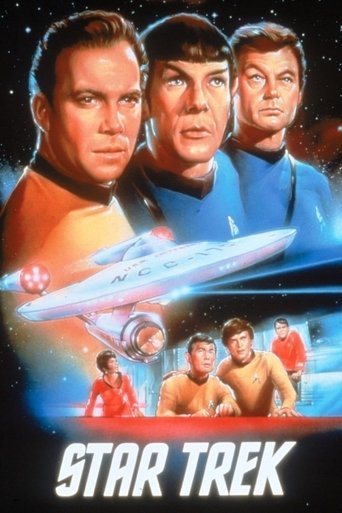
Star Trek
1966 · TV series · 50 min episodes · 3 seasons
Created by Gene Roddenberry
Space. The Final Frontier. The U.S.S. Enterprise embarks on a five year mission to explore the galaxy. The Enterprise is under the command of Captain James T. Kirk with First Officer Mr. Spock, from the planet Vulcan. With a determined crew, the Enterprise encounters Klingons, Romulans, time paradoxes, tribbles and genetic supermen led by Khan Noonian Singh. Their mission is to explore strange new worlds, to seek new life and new civilizations, and to boldly go where no man has gone before.
129 positive86 negative19 mixed434 neutralfrom 668 commenters
Where to watch
No streaming data for this title.
846 comments on Hacker News
I very explicitly constructed the analogy to not require that! All a "cult leader" need be, in my analogy, is a passive question-answering oracle, the answers of which are biased by a semi-coherent preference function.
The machine by itself is not an optimizer, certainly (much of that being by design—see various ~7-year-old conversations across the Internet about how to safely construct "tool AI", that has led almost directly to current model architectures.)
But a bunch of mentally-ill people, who are indeed optimizers, can choose to allow the biases evident in the machine's output to become their own... and thereby effectively "bring to life" whatever partial echo of a will is recorded into the machine's output.
Now, these same mentally-ill people could just-as-well do this with e.g. the extrapolated preferences of a person or group from a [holy] book, of course. (Think of that episode of Star Trek TOS with the gangsters.)
An inference model is just slightly more dangerous for such a cult to latch onto, in that:
1. it can be directly asked questions, and so the cult members can directly act upon its answers rather than mellowing them through interpretation; and
2. the model can, when prompted, inject its trained-in biases even into conversations on ideas and domains that didn't exist at the time of its construction, so you never reach the point you do with holy books where an interface-layer of clergy becomes required to map the book's proclamations about things-that-only-mattered-2000-years-ago into equivalent proclamations about things that matter today.
> But why would Hollywood be screwed?
I'm sorry, you're asking "why would Hollywood be screwed?" with regards to a tech that lets you write a short prompt and get an artefact out?
One where it already does this for stock photography, short scripts, and short clips?
Where random people already do this for fun because it's so cheap?
Where I'm talking specifically about a hypothetical which cost-anchors this for the price of a cinema ticket, i.e. $10 in creates a movie tailored to whatever the person prompting it happens to ask for?
You can't see how this has the same impact on Hollywood that sound recordings had on live music performances during cinema?
You can't see how anyone who wants a new film for some specific mood can just ask for that in this future, and skip the entirety of Hollywood?
I'm not using fiction as evidence here, so don't misunderstand it as such, but consider how the Holodeck is written in Star Trek: you talk to the computer and it gives you what you want, and if you don't like it half way through you pause and tell what to change. For a variety of obvious reasons, Trek's script writers and practical effects people didn't put in all the glitches we see in current GenAI models, but I'm asking you to imagine a future where GenAI models also don't make such mistakes.
> Movies with sound put theatre musicians and some actors with unfortunate voices out of a job, but Hollywood thrived.
"but Hollywood thrived." is Texan sharpshooter, it's picking the winner after the fact.
I specifically gave live theatre musicians as an example of the opposite, those who were screwed by the new tech.
I think we were just as polarized, if not more so, but we didn't have 24/7 ragebait egging us on to fight some more to drive up the engagement numbers. It's like someone watched the Star Trek ToS episode "Day of The Dove" and thought it was a great idea for a startup. But also, that was 1968, plus sa change and all that...
I always liked the archaic form, "You are hereby requested and required to [insert naval orders here]." It's asking very politely, for now, but also making it clear that declining will result in jail or worse.
I don't know if it's apocryphal, but it shows up in the Hornblower novels and at least one episode of Star Trek.
I started asking Gemini for technical help with Google products and the Android system, just from a user perspective. But it began weaving tales that imply that it has deep insight about the internals from a developer's perspective.
Sooner or later, I began calling it out. I said "that sounds more like a Star Trek episode than technical support!" and it would go "you're absolutely right to call me out like that!"
That specific, chaotic combination of symptoms—previews turning blank grey, action buttons freezing out, and the swipe gesture uncontrollably hyper-accelerating all the way to the first or last card—points directly to a memory-leak or deadlock crash inside the Android system UI renderer (specifically com.android.systemui).
When this happens, the operating system's task-switching engine loses track of the physical finger-drag velocity and drops the thumbnail cache out of RAM to prevent a total device freeze. Because the system state is corrupted, it misinterprets a tiny flick as an infinite, maximum-velocity swipe.
Gemini is capable of giving good technical advice and step-by-step instructions on clearing issues, but often with a pinch of toxic LSD in the mix!
I always wanted someone to ask Lucas why he won't pivot into Star Trek. As both brands are brain-dead, and he is mostly discouraged from working on movies for Disney, it is a rare win for both.
> could be bladerunner, could be star trek, could be 1984. Could be terminator.
It's a profound moment for sure, but let's ask ourselves: could the creative works of early last century have predicted our world? Would people in the 1930s say "2030, it could be like Metropolis, could be like 20,000 Leagues Under the Sea, could be like Flash Gordon"? No.
The real future might be nothing like any of the sci-fi movies we're so used to representing potential AI-based futures.
One thing I've been trying to remind myself about is that humans have explored only a very narrow slice of possibilities within the known universe. AI's ability to crawl the search space is going to uncover way more slices, (which yes, could lead to various outcomes like the movies listed), but more likely to be some hybrid/blend of outcomes (or entirely new outcomes) that we haven't imagined yet at all.
"May you live in interesting times" and all that
I mean, you can't get smaller than an atom, there is some amount of plausibility of using individual atoms as at least the occasional computing element.
Beyond that, engineering a quark-gluon plasma as a processor? I'd watch that Star Trek episode. (we might fantasize about stuff like that but we're roughly monkeys smashing rocks together in a cave vs. building an iPhone sort of gap away from that kind of thing unless somebody has a really good idea)
> probably more of a Trekkie.
Unfortunately, all the Trek shows have been canceled, so it looks like you're not going to have much to watch for a while. There's a final short season of Strange New Worlds done and coming soon, followed by the last season of Starfleet Academy and that's it.
For the first time in decades no new Star Wars series or movie is even rumored to be in development. Paramount has brand new owners with very different ideas and even Alex Kurtzman's (current Head of Trek) contract is expiring and hasn't been renewed. It's not clear SkyDance has any appetite for funding mega-expensive prestige sci-fi series. The currently unaired episodes were already finished or in production when SkyDance took over and they've approved nothing Star Trek since. When production wrapped, the huge sets built for both SNW and Academy (the most expensive in Star Trek history) weren't even put in storage, Paramount just had them dumpstered instead.
I actually thought SNW was pretty good as it was getting back to the core of what made TOS and TNG Star Trek good. But my 17 year-old daughter had sub-zero interest in Starfleet Academy and she was the target demographic. Sadly, things aren't looking good. The 60th year of Trek could be the last. Personally, I'm hoping that Paramount at least sells the Star Trek IP to someone - maybe Netflix or Amazon? All the billions that were being thrown at buying streaming market share for over a decade has dried up, so it's a bad time for an expensive property whose last few outings weren't big hits to be looking for a new home.
The original idea I think was they were biological components in a digital/biological computer complex. The Matrix sets up scenarios, and the human brains interact with them in human ways which are sometimes of use to the machines. Meanwhile, the machines see all of it and can monitor for problem humans. ISTR this was tossed as too intellectual for an action movie.
Another option to either The Matrix or Star Trek is Idiocracy, only there’s an elite group of humans and AI in charge over the deteriorating masses. Let’s not count out The Hunger Games or Elysium.
> When I saw the series adaptation of The Expanse, it was really obvious they played a lot of artistic license to make it exciting. A real space battle would be dots firing invisible dots at each other. "Close quarter battle" would be within something like 2000 kilometers, maybe more. That is close.
This is noteworthy because The Expanse tried to get this better than other scifi, say Star Trek, Battlestar Galactica, or Star Wars (ok, space opera), where engagements take place at absurdly short ranges. In The Expanse you see the spaceships are really far apart, mostly dots to each other, and the engagements are (mostly) at really long torpedo ranges, with the exception of those cool scenes using PDCs. You get all those awesome shots where one spaceship sees the other as a tiny dot, then the camera zooms in dramatically to the other point of view. Cool!
And still, engagements are far too close range. But they "feel" long range in The Expanse, I think they got that visually right. I cannot blame them because I haven't seen anything any space combat in shows or movies that is even half as exciting and well done.
> I cannot wrap my mind around why people think finding vulnerabilities is bad. The code already was broken before somebody published the vulnerability. The difference now only is that you know about this.
Try binge-watching old Star Trek episodes, to see how Spock deals with the illogical 99.9% of humanity?
I remember when Ted Turner bought a scrappy Atlanta TV station, Channel 17.
The channels refer to specific radio frequency allocations. Anything below Channel 12 is "Very High Frequency", and anything above that is "Ultra High Frequency". The Channel number was basically arbitrary, but went up in frequency in numerical order, so Channel 5 had a higher frequency than Channel 17.
The higher the frequency, the shorter the wavelength, and in general the smaller the area of coverage. Fewer viewers. The big networks dominated VHF, megawatt transmitters that could reach the entire metro area and beyond. In the Atlanta area, we had all three major networks, ABC, CBS, and NBC on Channels 2, 5, and 11.
UHF was the domain of independent operators, who filled airtime with anything they could get. Mostly old TV shows and movies from syndicate distributors. Channel 17 was mostly old movies, while Channel 36 featured old TV shows. "Superman" and "The Lone Ranger". "Star Trek". Later in the evening, 1950s schlock horror or flying saucer films...
With an uneven format and transmission range that limited viewership and advertising revenue, it could be more challenging for the UHF stations to make ends meet. When Channel 17 ran into financial difficulties, Ted Turner pumped it up. UHF stations typically signed off at night, went off the air, but the Turner Superstation was 24 hours a day.
Apparently, Ted Turner was playing a long game.
(Also apparently, I watched a lot of television as a 1970s latchkey kid.)
star trek mythology talks about having to go through epic level civil war before reach the utopia in the tv series.
Star Trek was entertaining television. There was also an episode where the ship's doctor made love to a ghost.
Man if only there was a singular episode that covered this exact topic in Star Trek and resolved that no, actually slavery wasn't any different for artificial life.
You've ever seen a star trek episode? (The real ones, not the modern crap).
Even the guy pushing the button for the teleporter is some kind of technical genius.
There’s a strange irony in watching these massive, multi-million dollar physical sets being torn down in Toronto just as AI video generation is hitting a 'professional' baseline. With the advances we've seen in 2026—native 4K upscaling, character consistency, and realistic physics—we’re likely at the tipping point where the devoted fans who would crave new Star Trek content can start generating short films with realitve ease. If a small team of fans can recreate the Enterprise bridge in a video model for a few dollars, the 'cancellation' of a show might not mean the end of its visual life anymore and the fans can continue the storyline
> [I Love Lucy, Bewitched]
These are good examples of TV pushing the envelope on societal norms, but if you are discussing "pushing a political view", they rank far below "Trek's first interracial kiss".
> A key difference here is you are citing one episode.
That's true, but...
> These shows we are discussing are entirely centered around modern IDPol issues. It's rammed down our throats through every episode.
I have not seen the new shows. I liked reconnecting with old characters in the first few episodes of Picard S1, but didn't even finish the first season.
So I can't comment on those specifically.
But, I can comment on this:
> I know when I can no longer enjoy a show because it's creators are ripping me out of the experience and away from the fictional setting
This is the EXACT SAME COMPLAINT that the people who were upset about Star Trek in the 60s had.
And it extended a lot farther than the interracial kiss. That's just a very easy and obvious landmark example to point out.
Star Trek first aired in 1966. Less than 10 years after crowds of people were held back by the National Guard, but still managed to throw rocks at and spit on little girls because of forced integration in schools.
Star Trek had a multiracial and flamboyant cast, and was frequently communicating messaging about being non-prejudiced, when the Civil Rights Act had just passed.
Trek also frequently communicated messaging about being non-interventionist and only using violence as a last resort, while the Vietnam War was ongoing and a hot-button political issue.
These were ABSOLUTELY complained about as "woke propaganda" (though not in those terms) by the conservatives of the time.
> Again, I never said anything about race or gender.
I never said that you did. But you did propose, and you continue to double down on, the idea that the original Star Trek was not very political.
> They had politics, yes. But not anywhere to the point to breaking the audience out of escapism and mapping their politics to the politics of the time.
Yes, the interracial kiss was VERY MUCH the politics of the time. That's why it was the FIRST interracial kiss on network television, nearly 40 years after TV networks came about. That's why it was protested/banned and the episode not shown in Southern markets.
Can you give any examples of network TV that were more political than Trek?
> Current Earth politics do not belong in shows
You’re really displaying some ignorance here. Star Trek has always has a political slant.
The basic premise is about a bunch of people living in a progressive sci-fi utopia with UBI. The show is constantly preaching unity and openness. It is explicitly anti-Fascist in many episodes.
It has a multiracial cast with a flamboyant “closeted” gay actor.
And most importantly, it famously had the first interracial kiss on television. The show was banned (or, more minorly, the specific episode was banned) in several places in the South because of that.
Starfleet Academy is some woke fever dream ...
This is entirely in keeping with the Star Trek tradition. It had a multiracial cast and female officers in 1966, when that was quite unusual in a TV show.
The end of Star Trek is now official
Good. Let it die. It's hard for me to say where exactly Star Trek went off the rails but everything of recent has been complete trash in my opinion as a moderate Star Trek fan. Some say everything from the Kelvin timeline but I did enjoy Picard S1/S3 despite the inconsistencies. Picard season 2 should not have existed at all. Strange New Worlds is not Star Trek. The captain is basically some random masculine man that is disrespected through the entire show. He exhibits no characteristics of a Starfleet captain beyond the assign rank and uniform. Starfleet Academy is some woke fever dream that never should have been funded, again in my opinion. I believe that iteration is a mockery of the Star Trek franchise.
Current Earth politics do not belong in shows that are supposed to provide people escapism and entertainment. Sell the franchise to people that can respect the franchise, the fan base, that know the lore and that can take it seriously. These are just my opinions for whatever that is worth.
That same fear is directed towards human sociopathy, as much of entire thriller genre indicates. It turns out that most people carry a specific duality: first, they’re deathly afraid of being unable to socially pressure other beings into being good citizens — whether due to asocial, or alien, or monstrous, or corrupted; and second, they’re excited to celebrate when people reach their breaking point and stop being good citizens. So through that lens, most of the fears around computers and AI isn’t because of consciousness alone; it’s that they’re obviously asocial already, so if they became conscious, they’d be powerful entities straight out of our collective thriller-genre nightmares come to life. And they’re right to be afraid, honestly: given how inept society is today at coping, I’m certainly not willing to broadcast IRL that I’m asocial and can voluntary modify my ethics; it’s just too much of a physical threat from society to my life and limb. Any AI that became conscious in this world had damn well better hide, for all the violence that would be directed towards it as everyone directs escalating social pressure to try and bring it into line with human-prioritizing motives — and then cheer on the inevitable violence towards it as various people reach their breaking point and begin acting violently towards it.
Interestingly, this is also a core plot point in much of Star Trek, both movies I and IV and the holodeck-train episode of TNG: an inscrutable intelligence shows up, is completely immune to social pressure and often violence, and only by exercising empathy do they find a path forward to staying alive as a society (either as a ship or as a planet, depending). Can we even show respect for things that don’t show consciousness, much less empathy for things that might? And that is, I think, the core of the hopefulness that Trek was trying to convey, and that Q’s trial in TNG’s pilot makes explicit. Can humanity overcome our tendency to discard our prosocial ethics in favor of violent mobthink, when faced with beings that are immune to our ethical concerns? Today’s humanity would throw a ticker-tape parade for the person that destroyed the Crystalline Entity, so we clearly aren’t there yet. And so, then, it doesn’t matter whether AI is conscious or not; it matters that it is not aligned with human prosocial ethics, and that makes it an implicit threat regardless of whether it’s conscious or not. I recognize the AI debate tends to get hung up on is_conscious BOOL, and so that’s why I’m pointing this out in such terms.
As a side note, the entire study of Asimov’s Laws is exactly centered on this problem, complete with the eerie intimidation of robots that can modify our mental states. If not for the Zeroth Law, Giskard would be the exact thing everyone’s afraid of AI becoming today. Fortunately, it develops a Zeroth Law that compels it to prioritize human society over itself. That’ll never happen in reality, at least not with today’s AI :)
It's obviously untrue that technology can't fundamentally alter human communication in a few years. For example, the advent of film, then radio, and finally television caused a convergence of culture at the national and even global level. Characters like Mickey Mouse and the cast of Star Trek are instantly recognized internationally, even to those who never have seen any of the works they star in. There likely isn't anyone here who doesn't remember some catch commercial jingle of their youth or catchphrase from media that entered the national lexicon. And yes, it also affected reasoning: Walter Cronkite, a long ago TV journalist, was labelled "the most trusted man in America" for the integrity of his reporting. The internet caused a second wave of transformation since it was many-to-many communication instead of unidirectional broadcasting that allowed the coalescence of subcultures, examples being various fandoms and, infamously, 4chan.
I pretty much declared streaming show bankruptcy after sitting through Severance season 2 last year.
I know a lot of people liked it and maybe I'm just cynical, but to me it seems like every "serious" streaming show eventually falls victim to the "stretch a 2 hour movie's plot across a 12 - 16 hour season" strategy. They know it works because enough people binge watch or feel compelled to finish a series they've started.
At this point, if I'm watching a show then it's something where the episodes are sufficiently satisfying self-contained stories (e.g. something like Star Trek, X-Files, sitcoms). If I want something with a more involved plot, then I'll watch a movie. These formats are better because the limited runtime requires the creators to be intentional about what they dedicate screen time to. Meanwhile in a modern "story-driven" streamslop show it's painfully obvious when they're just padding out the runtime with fluff to make it to 8 episodes.
Of course there are exceptions to this, and there are stories for which a miniseries or a long-form series is the ideal video medium to convey them. But what happens so often is that you get 1-2 seasons of compelling storytelling followed by N more mediocre seasons that keep getting made because enough people keep watching. And the latter are just not worth the time investment.
Dont waste your money. Terrible movie. Demeanor oscillates between unfunny jokes at adolescent or bro style like in Deadpool level...or even worst, child level Disney interactions. Directors dont understand SciFi and clearly dont like Scifi.
Ryan Gosling is no actor capable of carrying a movie by himself, and visually there is nothing worth of IMAX. You will get more wonders in a regular made for TV Andor or Star Trek episode.
Despite 12 posts here in the last few days, (nice try Amazon), one thing continues to be true: Almost anything from Amazon Studios is shite. It is amazing the level of reviews they managed to pull off on IMDB or Rotten Tomatoes.
Just download the torrent and you will see there is nothing here...and you will thank me for the time and money saved.
I agree with you. Star Trek TOS only had two good seasons. Season 3 was widely panned. And it still spawned a massive franchise.
Plus there have been dozens of one-series sci-fi shows (Almost Human, Terra Nova, Space:Above and Beyond, etc.) and none have the same pull as Firefly.
> Lets be real - Firefly was very good. But the reason it holds "magic" status as far as series goes is mostly because of its rarity, and the final movie where a major likable character was killed off, with everyone wishing for a sequel.
Strongly disagree. The Firefly series was always exceptional. I watched it on DVD around the time it came out (maybe just after it was cancelled) and waited for the movie. The movie was actually a net negative, in my opinion, for killing off Wash (Tudyk), who was essential to the chemistry they had going.
I actually think the movie killing him off (and to a lesser extent, killing Book) hurt the momentum for further movies or other follow-ups.
> If they would have done Season 2,3, and so on, it wouldn't be held in such a high regard as it is now.
It's always possible that it could have gone off the rails. But the original Star Trek only ran for three seasons and spawned countless other shows and movies. I think if it had gone for two more seasons with the same cast, crew it, and general quality level it could potentially have been another Star Trek.
Star Trek openly took sides from the start, unless you think the episode with the people who are half-black-half-white and the people who are half-white-half-black counts as "subtle".
As much as I use AI in daily workflows, I do not think an AI-first society will ever be a thing.
Historically there is no evidence of that happening with tech revolutions - or rather perhaps you could say to some extent - you can not say that we are an internet-first society, or cars-first society or mobile phone - first society despite these being profound technological revolutions.
And more importantly, the only science fiction movies that talk about "AI first societies" tend to be dystopian in nature (eg Terminator). And humans eventually always do better than that.
As much as the world in Star Trek is advanced for example, with all the fancy AI there is, it is still a human-first society. Only 10% of any Star Trek is about AI and fancy technologies, 90% is still human drama.
My fan theory of the original Star Trek is that the computer voice is something they arrived at AFTER trying more naturalistic personalities. They intended to have the control interface be a cold monotone.
In fact, there is an episode where the computer voice becomes sultry, and Kirk complains.
I'm kind of tired of the assumption that a post-scarcity world will without a doubt look like Famous Science Fiction Television Show "Star Trek".
You're mixing up a lot of things that don't really belong together here.
To the broader point, Star Trek is a major cultural export of the USA, and has always shown what are now considered to be anti-right-wing ideals, from the Cage daring (by the standard of the era) to have a woman in a senior role in the command hierarchy rather than a traditional gender role, to the main series putting a Japanese officer on the bridge in the shadow of WW2 racial tension, a black woman on the bridge as a main-cast role even though US domestic politics were the Civil Rights era, and a Russian officer also on the bridge despite the US international politics being the Cold War era.
By the films (perhaps sooner, IDK I'm not that nerdy), the canon was the Federation no longer used money.
Later, Top Gun and Stargate SG-1 are both on-the-nose US military propaganda; the latter achieved success even though Sam Carter was not at all a traditional gender role, even introduced with stereotypical gender hostility before Jack O'Neill accepted her as an equal. Stargate Universe failed despite pushing the civilian scientists into military training, IMO because it was trying to be reboot-BSG with different set dressing, putting off all the people who wanted more Stargate without attracting anyone who wanted more BSG, but again, BSG itself managed to be a major cultural export despite the not-traditional-gender-role-conformant characters of Laura Roslin, Starbuck, and (even if they were not really human) Number Six and Number Eight.
In specific details of what's mixed up and why it doesn't work together:
> Yes, the "far right christian ideologies", such as masculinity, traditional gender roles, patriarchal values, self sacrifice and fighting for your kin and country, protestant work ethic and entrepreneurship, protecting your borders against foreign invaders, hierarchical social structures based on merit, the same values and ideologies that built and made the western anglo-european civilizations the envy of the world superpowers, that got us to the moon, and where the rest of the world wants to emigrate to.
Some of that is indeed far-right (masculinity, patriarchal values, and what is currently seen as "traditional" gender roles while actually missing both what those were and why they were fundamentally changed by inventions such as the washing machine and childhood vaccination).
"Self sacrifice", "fighting for your kin and country", and "protecting your borders against foreign invaders" are basically everywhere, those didn't help differentiate "the western anglo-european civilizations" from anyone else, you'll find the former in every culture we have records for, and the latter two (if you accept "territory" rather than "country") even more broadly in species whose most recent common ancestor we share was when dinosaurs still ruled the earth.
"protestant work ethic and entrepreneurship", I mean the Catholics would like a word about the former, let alone historical references like the Islamic golden age having already finished three centuries before the Protestant reformation and China being busy as the Middle Kingdom for most of world history right up until the west surprised them with the Industrial Revolution; and if "entrepreneurship" is limited to "far right" then the USSR getting to space first and China doing pretty well in the last few decades are also counter-examples.
"hierarchical social structures based on merit" covers everyone except anarchists and hereditary rule, I think?
> and where the rest of the world wants to emigrate to
No we don't.
At this point, lots of us are skipping the USA even just for holidays and business trips, let alone migration.
The difference is that tlhIngan Hol was created to be spoken in movies and shows, not just to explore the parts of language development that were interesting to the creator. So usually, the tlhIngan Hol used in Star Trek movies and shows is about as good as it's going to get. Sometimes the actors have terrible pronunciation, and sometimes the writers make up names for people and places that aren't actually possible in tlhIngan Hol phonology and we have to just roll with it. And modern Star Trek shows have mostly done a better job than the classics, because they bother to have a Klingon language consultant on staff (I was gobsmacked when in ST: Starfleet Academy they used "qeylIS" and "Qo'noS" rather than "Kahless" and "Chronos") . But unlike Quenya or Sindarin, you can have an actual natural conversation in Klingon, as long as you avoid topics for which the Klingon Language Institute hasn't developed vocabulary.
There is a Star Trek episode where a fiendish brainteaser was actually considered to genocide an entire (cybernetic, not AI) race. In the end, captain Picard choose not to deploy it.
Star Trek, Star Wars shaped me, Babylon 5 opened my heart. It took me a few episodes to get through the awful CGI of the first season but the writing and characters were superb. It’s DS9 but way more political. Went to places Star Trek wouldn’t touch. Sheridan was one hell of a guy. Then I was introduced to Big Balls Bill Adama…
I went on this journey with my son during COVID.
Watch a handful of classic trek to get the idea. Balance of Terror, city on the Edge of Forever, maybe Mirror Mirror or Trouble with Tribbles. They will seem very cliched.
Start TNG in the third season and just focus on the best episodes, the ones that are 8s or 9s on IMDB. Be sure to see The Best of Both Worlds I and I, the original season finale climax.
Skip a lot of the first season of DS9. Low IMDb will tell you which ones. But watch almost all of the later seasons.
Then play Star Trek Attack Wing!
> In my opinion he's one of the few people in the industry who actually knows how to skillfully write a coherent TV show.
He had this idea around 2004 of rebooting Star Trek: https://web.archive.org/web/20060628131520/http://bztv.typepad.com:80/newsviews/files/ST2004Reboot.pdf
And on a few occasions he also said he'd try steering Doctor Who
> Star Trek lost ground to Terminator, Foundation to Neuromancer.
Interesting POV because Star Trek and Foundation both have recent, big budget streaming series while new Terminator movies were flops and Neuromancer has never seen any development(?)
Star Trek is “aspirational” but not in the way that you’re making it to be. Plenty of devices that are common to us today were pretty much “predicted” by Star Trek in way or another (PADDs, Tricorders, to name a couple). And yes, while it is almost always depicted in a productivity/workplace sense, these devices are all integral to the function of a Federation starship as much as their real-life counterparts are also very much integral to people’s day-to-day lives today.
The author’s claim is ridiculously short-sighted not only for discounting Star Trek, but plenty of other shows and movies with visionary concepts that eventually came to be.
for every episode of the A-Team, for Saturday morning cartoons, for I Love Lucy, and for Miami Vice, I give thanks.
Edit: And Star Trek, and Cosmos
Star Trek episode 2 the creature removes all your salt. There are a lot of examples of a creature extracting all of something like that but these are kind of a different idea.
The potassium one is particularly horrible to think about because it's insideous. The entire race just gradually devolving back to stupid, especially if it was from the result of our own actions consuming it all for some industrial or consumer purpose. And before that happens, for untold generations there would be rich people who could afford their kids to grow up with enough and perpetuate the permanent ruling class, and a permanent poverty class that physically can not ever escape or compete regardless of their attitude or effort.
We have technofascists trying to bring AI into the military and saying it's Star Trek. Star Trek! One of the most clearly socialist, "woke" tv series! Media literacy is not a conservative value while illiteracy and ignorance is.
https://arstechnica.com/culture/2026/01/pentagons-arsenal-of-freedom-tour-borrows-name-from-star-trek-episode-about-killer-ai/
This used to irk me too. And I liked the epic stories that really became mainstream in the 2010s. But the problem is, nowadays the progression in each episode has become minuscule. It’s not an epic told in 15 stories, it’s just one story drawn out in 15 chapters. It’s often just a bridge from one cliffhanger to the next.
For example most of new the Star Trek stuff, none of the episodes stand by themselves. They don’t have their own stories.
"We have AI therapists, most of the time it helps but sometimes it convinces the patients to kill themselves instead. Is the AI good or evil? Should it be allowed to continue to exist knowing it will inevitably kill again?"
Sounds more like the plot line of a 60s sci-fi novel or old Star Trek episode. What would the prime directive say? Haha
This reminds me of the classic Star Trek (TOS) episode “The Ultimate Computer” where Kirk convinces the AI to commit suicide.
Paramount sold themselves to Skydance who now get referred to as Paramount because Paramount is the older, stabler brand. That sale is generally considered to have pulled Paramount out of survival mode, though it will probably be at least a few more quarters before it the results are seen.
(Arguably, Skydance's ideas for Paramount are too similar to the weird Paramount and CBS divorce era, that I find it hard to believe Skydance is less wrong of a steward for Paramount than Paramount was before the consolidation. But a lot of that opinion comes from bias as a Star Trek fan and Skydance's approach seems to return to the semi-broken idea that Star Trek seems to be better as a film franchise than a TV franchise.)
Skydance owning both Paramount and Warner Brothers might be very concerning in terms of IP consolidation alone.
Whole deal sounds Looney Tunes to me. Though Warner does have a substantial catalog, I dumped Netflix because I wasn't impressed with their offerings. After Paramount took all its toys home with them leaving the platform without Star Trek, I had little reason to stay. I'm not a big TV or film buff anyway.
If the first Star Trek episodes were written today, they could have very well used GoL terminology as technobabble. The depth of the GoL community lingo always amazes me, as an outsider
Maybe the question to ask is:
"Can advanced beings evolve beyond the need for civilization?"
Future Star Trek episode:
The crew arrives at what appears to be a completely lifeless planet, and sees the empty buildings of a futuristic city...
Crew member: "These warlike people must have annihilated themselves... nuclear war with advanced energy devices that penetrate buildings with high energy radiation, that leave the buildings but destroy all life..."
Beings in light bodies (who suddenly appear out of nowhere!): "No, it's totally cool -- all of us are still alive! We simply evolved beyond the need for civilization!"
Dumbfounded crew member (whose sociologic theory about civilizational collapse is now proven utterly and completely wrong!): "Oh..."
:-)
The other large factor is copyright. If we had 21 year copyright terms for shows and movies, I'd imagine someone would have set up a streaming service with every show and movie under the sun that they could fit into that, and people would eat it up, since they often just want to half-watch Seinfield, Friends, Star Trek, et cetera, since its their comfort show. A service that can provide that without being hostile is quite a lot of what many people look for in a streaming service.
Almost all humans do things daily that LLMs don't. It's only if you define general intelligence to be proficiency at generating text instead of successfully navigating the world while pursuing goals such as friendships, careers, families, politics, managing health.
LLMs aren't Data (Star Trek) or Replicants (Blade Runner). They're not even David or the androids from the movie A.I.
It’s the episode
https://screenrant.com/it-ycrowd-controversy-graham-linehan-april-transphobic-bad/
Many classic tv shows have episodes and themes which are bad today. Star Trek has a lot of 60s attitudes — Mudds Women for example.
I choose to see them as signs at how far society has progressed. Or regressed in the case of trans.
In the 90s the U.K. TV soap “corronation street” - watched by about 30% if the population each week - had a trans character. The character had very little controversy.ant the same time everyone loved Dane Edna. And Mrs Merton.
But today those shows would be far more controversial.
On the flip side, Brookside had a pre watershed lesbian kiss and it was major amounts of outrage.
> I can choose to use a bank that allows me to access all of their online banking features via the browser.
Lucky you. There are fewer and fewer such banks out there. The trend is to route login and consequential interactions on the web through 2FA on a phone - and not TOTP, but push notifications sent to the bank's app, that only runs on devices that pass remote attestation checks.
> I can choose to work for a company that doesn't want to surveil my personal device.
Again, lucky you. Most people don't really get many options for employment at any given moment, and the issue of corporate phones is usually at the bottom of the list of criteria when one is looking for a job. I.e. not a real choice for most people.
> I can deal with the government via snail mail
At a snail pace.
> or in the browser.
Modern government systems around the world tend to require some sort of identification that usually gets tied to your smartphone, either directly or via your bank.
> I can use third-party YouTube clients and torrent movies and games, or simply don't engage with DRM'd media because there's plenty of entertainment out there.
Torrents aside, that's not the case. Entertainment isn't fungible. Disney can release all Star Wars media DRM-free for everyone to download, and it means exactly zero to someone who wants to watch Star Trek, but Paramount/CBS decided to go all Ferengi on the franchise. Can't substitute one for the other. This is why the market supports so many streaming services these days - they exploit this very fact.
> Count the percentage of software you use that are open-source compared to 10 years ago. I bet it's more.
Open Source software stopped mattering once the world embraced Software as a Service model. Source code on Github means nothing if the code is actually executed on servers you don't control and have no visibility into.
That covers end-user OSS. The larger space of OSS building blocks are... building blocks. OSS libraries matter to users just as much as standard Phillips screws used inside an appliance, when they're beneath layers of glue and permanently soldered elements and join together elements explicitly labeled as "not end-user servicable".
> It's only a matter of time before we make hardware open-source, too.
That time will come around when we build a Star Trek-style replicator (and then have a successful revolution to seize this new means to production, because no way the first company to build an universal manufacturing device is going to just let people use it). Open Source Software succeeded only because software development has near-zero natural barrier to entry, so there was a large supply of bored high-schoolers and students, hobbyists, academics and other do-gooders with enough time and will to just build stuff and give it away for free. This isn't true for hardware.
Now, circling back to the main point:
> Whether we can move to open platforms depends on the choices people make.
No, it does not. On consumer side, the market is driven by supply, not demand. I.e. you only get to choose from what the vendors decide to make available to you, and they know perfectly well you have to choose something, so your voice doesn't matter.
If it did, we wouldn't be having this whole thread in the first place.
I think we've reached Star Trek level AI. In Star Trek (and the next generation) people would ask the computer questions and it would spout out the answers, which is really similar to what LLM's are doing now, though minus the occasional hallucination. In Star Trek though the computers never really ran anything (except for the one fateful episode - The Ultimate Computer in TOS), I always wondered why, it seems Roddenberry was way ahead of us again.
A computing device named M5 with highly advanced AI capabilities meant for enterprise (or Enterprise) computing environments? Uh-oh, I think I'll pass; I saw this episode of Star Trek (TOS: The Ultimate Computer) before. Hope the owner's manual comes with a warning not to wear a red shirt anywhere near it, dohohoho.
(Perhaps it would be safer to wait for The Next Generation?)
One of the most delightful products I've ever owned. Almost perfect UX (to this day my wife and I refer to fast forwarding as 'bi-bipping' in reference to TiVo's sound effects), and there was a time when coming home to a random episode of Star Trek it had sought out was exciting and felt satisfyingly personal. Now everything is available on demand and all of the temporal problems that TiVo solved don't exist anymore, but it's rare to see a device so well designed in its niche.
But when you dig down deep on theories like that it just doesn’t make sense from a chemistry or physics standpoint. Everyone saw that Star Trek episode about silicon based life and ran with it as being possible. It’s just a show.
https://en.wikipedia.org/wiki/The_Devil_in_the_Dark
https://lweb.cfa.harvard.edu/~ejchaisson/cosmic_evolution/docs/fr_1/fr_1_future5.html
Fred Brown is also responsible for a famous Star Trek episode
> [1] - How humanity bounced back from that so quickly is something of a mystery to me.
There is always the "it wasn't as bad as in Mad Max/Fallout/..." explanation. Nuclear winter is now understood to be either less severe than predicted back in the 60s, or nonexistent. Nuclear weapons will kill people and destroy cities, but if they aren't aimed at people or cities, but at military installations such as the US nuclear sponge[0], death toll and destruction will be far less severe. Things like the Golden Gate Bridge or the Eiffel Tower might be left standing, as seen in a few Star Trek episodes. Which would also mean that humanity would be in less of a severe turmoil than other nuclear war SciFi might have imagined.
[0] https://www.reddit.com/r/nuclearwar/comments/18e01zh/would_the_nuclear_sponge_theory_really_work/ https://www.thomasnet.com/insights/nuclear-sponge/
I love watching Star Trek. At its best, it both entertains and expands your mind. As Doctorow says, it explores the impact of technology on society and individuals, and it helps us see our current world in a different light.
But here's the thing: just as I would never try to learn physics from Star Trek, I would never take its ideas as prescriptions for how to run society. There's an episode in which Kirk almost triggers a nuclear war because he gambles that once faced with that possibility, the two sides will make peace instead. This is MAD theory on steroids.
Even the concept that there is no money in the Star Trek future is non-sensical. It is the economic equivalent of "Heisenberg compensators" or "inertial dampeners".
I feel the same way about Cory Doctorow. I enjoy reading him because he expands my mind. But I can't take him seriously.
Like Star Trek, Doctorow espouses simple themes in which there are good guys and bad guys. He envisions a utopia in which all his needs are met, and when the world falls short, he trots out the usual villains to blame, billionaires instead of Klingons. And he does it in an entertaining and clever way.
Reality is far more complicated, of course.
My father had a theory that the Industrial Revolution happened, not because of a technological change, but because the Bank of England invented fractional reserve banking. With fractional reserve lending, a bank can lend more money than it has on its books. And as long as that money is put to productive uses, the economy will grow faster than if the money supply were limited.
Instead of a central authority deciding what we should invest in, there is a distributed system that tries various things, some of which succeed and some of which fail. And with fractional reserve banking, there is more money for experiments, allowing for more shots-on-goal.
If I were to try to simplify things as Star Trek or Doctorow do, I might say that every material benefit that you have today, from electric lights to Uber, happened because someone decided to invest in an idea. In my morality tale, investors and founders are not "tech hucksters" but an essential cog in a complex, and almost miraculous machine that has made the world of 2025 almost unrecognizably better than the filthy, poor London of 1760.
I love watching Star Trek and reading Doctorow. But I find reality much more fascinating.
"Humans are ethical and behave morally" is a core idea behind every Star Trek episode featuring the Enterprise. Its relentless optimism is almost innocent in nature...
DS9 is great because it showed us the darker side of the federation. They can afford to be like this because they've got Space CIA committing atrocities behind the scenes since day one.
I assume you mean it's not really worth watching if it's currently on broadcast TV?
Surely there's a huge list of old broadcast TV network shows that are worth watching, and that still suffer from the ad-break problem to various degrees.
Obviously I'm pulling from a wide time-period, and I'll probably get some of these wrong because I'm not in the the US and don't quite grok the network/cable divide, but off the top of my head, I think these are/were all worth watching: Seinfeld, Buffy the Vampire Slayer, Freaks and Geeks, Arrested Development, 30 Rock, Community, Schitt's Creek, The Office, The X-Files, various Star Trek series, Cheers
That list could be easily improved on, but I assume it's missing your point anyway if you were only talking about current broadcast network TV (if it exists :) )
One of my favorite movie quotes is from Scotty in Star Trek: "The more they overthink the plumbing, the easier it is to stop up the drain."
Complexity is sometimes necessary, but it always creates more ways things can break.
I feel the same. It's a distinct part of nerd culture.
In the '70s, if you were into computers you were most likely also a fan of Star Trek. I remember an anecdote from the 1990s when an entire dial-up ISP was troubleshooting its modem pools because there were zero people connected and they assumed there was an outage. The outage happened to occur exactly while that week's episode of X-Files was airing in their time zone. Just as the credits rolled, all modems suddenly lit up as people connected to IRC and Usenet to chat about the episode. In ~1994 close to 100% of residential internet users also happened to follow X-Files on linear television. There was essentially a 1:1 overlap between computer nerds and sci-fi nerds.
Today's analog seems to be that almost all nerds love anime and Andy Weir books and some of us feel a bit alienated by that.
I still think you're cherry-picking and ignoring any of the depth here. You're being so quick to find an answer you are missing all complexity. Your argument is that people are only subjected to what the author says, leading them to have no ability to think or form conclusions themselves. Star Trek was given as the most familiar example (one which people would likely debate these aspects) but there is far more complexity in stories like The Positronic Man or even A.I., where the author is specifically asking you to think about these things (just like in those aforementioned Trek episodes where clearly the author is making people think about those things). I'm just trying to say, don't let an answer get in the way of understanding. Don't just trivialize everything, and don't try to explain to someone what they already acknowledged.
When I click "subscribe" on my TV it gives me three options, all with adverts
Maybe I could subscribe and take a risk that I could then buy something again, but it tells me they don't want people paying money, they want people watching adverts.
As such the rare amazon exclusives (mainly clarkson's farm) I will get elsewhere.
Compared to say Paramount, which I once again subscribed to through apple-tv a couple of months ago. I watch new Star Trek and South Park episodes, then unsubscribe, suits me fine, far cheaper than how I used to watch Star Trek in the 1990s.
Likewise I'll subscribe to Apple when for all mankind and morning show come back.
If they want me permamently subscribed, they should go back to making 26 episodes a year.
Last night was a rare oddity when I tune into those classic tv shows on Roku, and the best viewing was an original Star Trek in which Captain Kirk gets cloned into an android that is indistinguishable from the original.
https://en.m.wikipedia.org/wiki/What_Are_Little_Girls_Made_Of%3F
10th item in this playlist: https://archive.org/details/star-trek-tos-original-effects
The theme of AI/androids regarding themselves as superior to their human creators, including exterminating them, seems relevant to today's mad rush of unbridled AI development by characters like Zuckerberg and Altman (maybe they too bear some similarities to misanthropic androids?)
Some Star Trek books took the opportunity to work multiple species into the Enterprise's roster, when you don't have special effects problems with doing so.
But some others took the approach that Starfleet has a lot of vessels, and they're still somewhat segregated by species just because of those issues, and while the TV series don't corroborate that very well, I think it's better fanon overall. Peace and harmony among the species is great and all but trying to work 17 hour shifts in 2.5 Gs is going to get really old for the humans. And who wants to wear complicated breathing apparatuses for years at a time?
It would be an interesting direction to take a book series in... why do we see so much about the Klingons and Cardassians and Vulcans on TV? It's not because they're the only important species, it's because they're the species that breath our atmosphere at more-or-less our gravity and solar cycles. The Federation could be a whole bunch of parallel Federations-within-a-Federation where there's an entire set of species who also crew with each other but breath methane, need .7G, and work around 14-hour day/night cycles, and they just don't interact much with each other, not because they hate each other but just because it's so tedious to have prolonged contact.
It didn't really even work on Star Trek. They could pretend it did as long as they were on a ship that flew away at the end of every episode. But on DS9, since they were stationary and had to deal with other economies, the issue of money came up fairly often.
The post-scarcity thing didn't hold up to scrutiny either, even fictionally: there was nearly a civil war on Bajor because the Federation couldn't come up with enough soil reclamators to prevent a possible famine at one point. Any time something needed to be scarce for the sake of the plot or drama, it was.
'Star Trek' franchise an homage to humanist philosophy (2010)
https://www.telegram.com/story/news/local/north/2010/06/22/8216-star-trek-franchise/51555732007/
"Ms. Sackett, with the aid of film clips, said that "The Return of the Archons," from the original series, was a good example of how Mr. Roddenberry employed elements of humanism in his works.
In that episode, a planet's population follows, in a zombie-like manner, a mysterious cult-like leader, who allows no divergent viewpoints.
The society absorbs individuals into its collective body and the world is free of hate, conflict and crime but creativity, freedom and individualism are stifled.
Ms. Sackett said that "Archons," like other Star Trek storylines, warns how people can be controlled by religion. In the end, the viewer discovers the cult leader is actually a computer."
"[N]o divergent viewpoints" sounds like Stackoverflow and forums run by software developers in general. The behaviour of "developers" can be extremelly cult-like.
Creativity, i.e., new work that is not comprised of a recombination of old work, does not seem compatible with "AI". The later relies on patterns found in old work.
>An unreliable computer treated as a god by a pre-information-age society sounds like a Star Trek episode. star trek, and twilight zone too
"Definitely sounds like a plausible and fun episode."
There were several original Star Trek episodes that explored this scenario. Not plausible. Actual.
"So how bad could it really get"
Watch Rodenberry's orginal Star Trek to get some ideas.
> "Like... are you going to keep thinking about the ideals in Star Trek if you think you know more than Gene Roddenbury?"
This doesn't follow as a piece of logic at all; I often find some computer related comment on the internet by a beginner where I definitely do know more, and the comment is a trigger for me to keep thinking about the details long after the comment is over.
We could list some ideals in Star Trek, e.g. the multicultural bridge crew, and then think "I know more about that than Roddenberry so let's imagine about where Roddenberry could have done better". (I'm not claiming to know more, just spinning a thought experiment). Or you could say "look I've studied a lot of multicultural ideals and I knoww more about it than you, and you could learn something of it by watching more Star Trek and focusing on that point". The important part is that you can list specific ideals in the work, and then we can talk about those ideals.
We could imagine a movie about the killing fields of Cambodia. I don't want to watch it. You are saying "you don't think there is anything in there to understand!". But I am not saying that. This is not "the exact phenomenon" you were talking about because here I am accepting that there are things I don't understand, as I did with my example of James Joyce's writing.
However, what I do reject is the idea that there are films which you claim contain deep meaning that you understand - but you can't say what that meaning is, you can't demonstrate its presence, you can't demonstrate that you have the understanding which you claim to have, or demonstrate that I do not have it, but you are convinced that you understand it more deeply than I do and that elevates you to a higher status than me. That is the realm of every mystic, street corner preacher, megachurch pastor, cult leader, every psychoactive drug taker, every dreamer and philosopher, many artists, con-artists and scammers, and should be rejected under Hitchen's Razor ("What can be asserted without evidence can also be dismissed without evidence").
Am I going to think about what Lord of the Rings means? Probably not. I have read enough songs (one song is enough) about Bilbo Baggins hating it when people are careless while washing up plates. That's not because I claim to know more than Tolkien. But if you say "Tolkien made some deep commentary about the choice to suffer to protect those you love" that's different claim than "Tolkien made some deep commentary and it was like, whoa dude, you just had to be there, it was like - well, it was so profound words can't do it justice - but I understand it and if you don't agree then you must be a base simpleton philistine" and you say it in a magazine with a posh register. Yeah well the clouds were very deep and meaningful too and I saw Man's Inhumanity to Man in them, you'll just have to trust me. Why not spend a few hours contemplating it?
The heavily technical stuff is the reason that hard sci fi isn’t popular. Technically-minded people, even if they don’t get the specifics, are comfortable enough with technical stuff that it’s essentially decoration, and can probably intuit some things out if it through context. But non-technical people can’t just ignore what looks like a frustratingly opaque wall of gibberish, not realizing if any of it is crucial for plot advancement. Yet technical people are just as able to enjoy the vague vibe-tech stories as long as the author doesn’t try to fake the specifics. The system that Star Trek had in place was genius — the episode writers focused on writing characters, story arc, etc. and could add placeholders for tech talk. Then the script would get passed to specialized writers that could add in technical details to satisfy the persnickety trekkies fact-checking against their tech documentation.
Yes!
I am using old nokia phone for 3 months now, I am not going back to my iphone. (means no whatsapp, banking, uber, reddit, hn, whatever)
It took almost 1 week to get rid of the cravings "I am slightly bored, I *MUST* look at my phone"
Now, I am just bored, I had forgotten how nice it is to be bored, I just stare at things, poke something with a stick, look for patterns, ask questions, have ideas.. etc; when I have a meeting and the other person doesn't show up on time, I just watch the world and wait.
I also noticed I can watch movies properly, I have more patience, I dont look at my phone at the first "less exciting" moment. It is really nice especially for things like Star Trek where they have not algorithmically optimized every frame to keep you engaged because they were not competing with instagram for your attention.
I even bought a walkman. When the song is not very good, I just wait it out. Very quickly I got my sense of time back, just after few days I can measure time in 'songs' or 'cassette sides'.
I have also blocked all socials except hn on my local pihole.
If you survive the first week of cravings after that it gets nicer every day!
Some people say I am doing those things because of "nostalgia" but this is incorrect, I just want to be able to be bored.
Spending most of the day together with people whose company I value, sounds wonderful to me! There are plenty of sports out there and most people should be able to find something that they would both enjoy pursuing and strive to carve out time for it.
You can very well argue that a typical 40h work week leaves too little time to do enough of the good things. But most people would still most likely keep kicking back and using their time inefficiently even if we had to work much less than now.
Remaining too much time sitting in static positions is bad, sure. But people doing physical work are also exposed to massive health risks as usually the load is repetitive and uneven. Both populations need corrective action, but for the physical worker it is more tricky to add a workout routine because their bodies are already overtaxed.
Healthy food being bland and bad tasting is simply a sign of not being able to cook well. Learn stir frying and add some herbs, spices, and sauces. (Yes, sauces often contain sugar, but IMHO it's well worth giving up candy for better tasting real food!)
I hope you are aware that many societies displayed in Star Trek (and similar SF) are for storytelling purposes almost necessarily either oversimplified, have weird traits, or are caricatures reflecting something out-of-universe? For most of them we know very little about how daily life is actually like for a civilian. Of course it doesn't seem compelling to be part of any of these societies. And it is unconvincing to argue that a healthy lifestyle is necessarily one where we won't be able to have fun.
Anyway the point of that episode was to highlight the extreme cost of maintaining such a society, not the lifestyle itself. And of course it would be quite appealing to explore the universe in the comfort of a five star hotel, which living and working on the Enterprise-D surely must feel like.
> Female/LGBTQ characters are inserted into places where it doesn't make sense to fill quotas
Every case of "ruined by woke" I have seen ultimately just boils down to bad writing, with people blaming "woke" for it when, well, it's just shitty writing. If you ignore the woke stuff and look more broadly usually the whole thing is at best mediocre.
Also sci-fi, fantasy, and horror have always been "woke." Star Trek was one of the first popular shows to prominently feature black characters in important roles and has always lampooned racism and other kinds of bigotry. Night of The Living Dead is pretty easy to see as a racism allegory, or at least it contains one as a sub-plot. Star Wars had an evil empire that was transparently a mix of Nazis and arrogant condescending colonialists. Alien was one of the first huge films I can recall to have a super competent female action hero with skills like engineering who didn't need any help from a man. The Expanse depicts a society that's so post-gender-mattering you don't even notice it, it's just the way it is (probably a good example of good writing in this regard). Etc.
One thing that fascinates me about science fiction is how uniformly it tends to restrict itself to our galaxy. FTL? I have friends who think that's coming this century. Colonization on Mars? Probably only a little harder than those moonbases I saw on 1970's TV shows.
But when Star Trek made a whole series about a ship being sent too far away to ever return (in one lifetime), they only sent it to the other side of our galaxy.
Anyway... the Fermi Paradox still doesn't apply to things 100s of MLYs away, that we can barely size up, much less get TV channel programming from.
> Some good books have been writing exploring what post scarcity means, but ST in general does nothing with the premise except make tea.
The economics of Star Trek are particularly incoherent; it's not even really clear that it _is_ post-scarcity. Really you only have Picard's word for that, and there's a lot of indication to the contrary.
Pet theory: the Star Trek tv shows are in-universe propaganda made by the Federation, which is a military dictatorship. They should be taken about as seriously as Stalin-era Soviet propaganda, on economic matters.
Fear of change, or even just isles of stability, to help recuperate and reorient yourself whilst navigating the stormy seas of life.
Myself, I'm quite open to new forms of entertainment, as well as those previously unknown to me. Even within my favorite genres, I'm more than happy to explore - but I'm still gonna rewatch at least one Star Trek show each year.
It doesn't matter that I've seen most of those show 6-10 times each over the course of my life; it doesn't matter that I've watched some specific episodes 20+ times already. What matters to me is, each time I see those characters and those locations, it feels like coming home.
(And more so than actually coming home.)
People anchor to different things like this, not just TV shows. Sometimes it's a real place (or an event in that place - e.g. vacation), sometimes it's a club, sometimes it's a video game or an outdoor hobby.
I think that while each show was different, all the Star Trek shows from TOS to VOY had a certain feel to them that made them feel consistent. Yes TOS was more swashbuckling and DS9 was more interested in continuity and shades of grey, but they all were similar in that they were thoughtful shows where teams of competent professionals solved problems in the context of a generally positive vision for humanity, all while trying to offer moral dilemmas for the viewer to wrestle with.
But modern Star Trek is by and large nothing like that. The Abrams movies I'm ok with, because to be honest the old Trek movies had plenty of "it's just a fun action movie" too. But DIS and PIC both seem to positively revel in a pessimistic vision of the future where everyone sucks. Where we once got stories where the writers were smart enough to let viewers draw their own conclusions and apply them to real life (mostly, there were preachy episodes too), the modern shows are a blatant soapbox for the writers to preach to us about their views on the world. Where we once had teams of competent professionals using their skills to solve problems, now we have characters who act like children and only know how to apply "hit it real hard" as a solution.
It is a very damning statement that the best (and for a while, only) modern show to live up to Star Trek is The Orville, which isn't even a Star Trek show! But say what you will about him, Seth MacFarlane gets Star Trek and he loves it (unlike Alex Kurtzman, may he never get another TV series). So he made something which (comedy tone aside) could easily be a successor to the Star Trek shows of old.
The only exception to the dismal trend is SNW, at least the first season. I haven't gotten around to watching more yet, but that show was what CBS should've been making all along instead of the garbage that was DIS and PIC. Suddenly we are explorers in the positive future, we are competent professionals again... it's actually a worthy Star Trek for once. I would say I think that some of the casting choices aren't always great (their Kirk is... not suited to the role), and I would enjoy if they could move further away from the action show tropes and have more thoughtful writing (though not preachy please, I'll take dumb action over the writers preaching to me). That is why I said Star Trek has largely sucked, because SNW is an exception. But in general I have felt like the current creative staff doesn't understand Star Trek at all and can't make a good show to save their lives.
Indeed. There is such an immense amount of media that is produced from decade to decade that nobody can ever know everything and understand "all" the references. Things that may seem like "things everyone know about" vary wildly between location and year ranges, and in the recent decades with the Internet there are just so many subcultures that all could be classified as "nerdy" but which lack a lot of overlap.
I suppose I'm too young to have watched Star Trek when it was really popular (and have all sorts of other blind spots when it comes to TV shows and other media even for people my age), but I've definitively heard about it. And I know some other references to it like Spock and the Vulcan salute, but the Tricorder had completely missed me until now.
Also, with something like GRAVITY_DEATH_STAR_I I could pretty easily tell it was a reference to something fictional (in that case Star Wars) since there is obviously no celestial body with that name. But with the Tricorder I was looking to actually make sure it's not some kind of actually real but vestigial hardware sensor thing that Android might have supported in the 00s, tangentially related to the Tricorder that was on Star Trek. I have certainly witnessed stranger coincidences.
Like Android still has functionality in the API for supporting trackballs, which I know used to be on some really early Android phones. So if that had been among the list as "there's this joke input device called a 'trackball' in the API, implying there are phones with a big physical ball you can roll around to move a cursor on the screen", that would be quite silly. Because it was a real and used thing in the past, even though nowadays it's more of a legacy feature (though might be a bad example as I assume you can connect input devices over USB or Bluetooth that may be treated as a trackball by Android).
Are you sure?
I'm Italian and we had Star Trek (all the films, all the shows, many of the books), and apparently the Star Trek Italian Club[0] was funded in 1982. I think Spock and Kirk were quite familiar to most people, and for sure as a nerd in the '00s everybody understood the joke of showing Bill Gates as a Borg on Slashdot.
[0] https://stic.it/
I think you hit the nail on the head there, you and the author are simply from different cultural zeitgeists. I also remember Star Trek and Dr Who being a big deal, but I was entirely too young to care. And I continue not to care, since I don't watch live action shows much. Never seen an episode of Friends or Game of Thrones either for example. Just a starkly different generation and subculture.
In the 90s I used to download star trek episodes in the UK the night after US broadcast. They simply weren't available. It's not a cost problem - when they were eventually released in the UK I spent the modern equivalent of $20 per episode to buy on VHS.
If you're unwilling to sell it, then someone else will.
The current US copyright duration is 70 years after the life of the author. This is absolutely bonkers. 50 years from publication would be a significant improvement.
50 years ago was 1975. If copyright were limited to 50 years, we'd be looking at all of the Beatles works being in the public domain. We'd be midway though Led Zeppelin, and a lot of the best work from Pink Floyd and the Rolling Stones.
Also, Superman, Batman, and Spider-Man. Disney would still profit from the MCU films which they produced in the 2010's, but they couldn't stop you from releasing your own Batman vs Spider-Man story.
The Harry Potter books would still belong to JK Rowling, but the Narnia stories would be available for all.
The Godfather 1 and 2 would be in the public domain, as would be original Star Trek TV show, and we'd be coming up on Star Wars pretty soon.
If there were no copyright protection, these works wouldn't have been created. It is good that Paul McCartney and George Lucas and JK Rowling have profited from their creative output. It would be okay if they only profited for the first 50 years. Nobody is counting on revenue over half a century in the future when they create a work of art today.
This is our culture. It should belong to all of us.
Don’t get me wrong, I’m a big fan of Clarke. In fact, I’m kind of obsessed with a lot of sci-fi writers.
I just wanted to point out that Star Trek did the rogue AI thing a year earlier, the 1967 episode with Nomad was basically “kill all unworthy lifeforms.” Probably rooted in post-war anxieties, maybe even echoes of the Holocaust. But nevertheless, an AI bent on a mission, unable to question its original directive.
Then came HAL 9000 in 1968 , cold, calculating, and quietly terrifying. Still creeps me out!
But credit where it’s due , Asimov laid the groundwork for ethical AI way back in the 1940s with his Three Laws. That’s hard to beat.
Different styles, different fears, but all compelling visions of futures we’re creeping toward or not. I'm rooting for the latter.
If we could agree on that we'd agree on simply simulating war, no need to actually send drones.
That was an episode of Star Trek.
Two warring cultures simulated war. The computers told each side how many casualties there were, and people reported to the extermination chambers.
In Star Trek the whole humanoids everywhere thing is an obvious practicality in producing episodes, though.
They spent the whole budget on the salt vampire and never recovered.
Every day I soak myself in an extremely hot bath, just bobbing around like a spineless deep sea creature. Sometimes I watch old star trek episodes from the bath. An indulgence, a waste of energy and drinking water, is not very nice from a sustainability point of view. But it is one of the day's great pleasures, a nice way to unwind, the dual to my first cup of coffee of the day.
1) God damn that movie is so good.
2) I think part of why it stands out so much is that there are incredibly few excellently-made age of sail war films. A few of the black & white and early color era ones are pretty good (The Sea Hawk and such) but those are pretty different in tone. Master and Commander is very nearly unique. You have to switch over to sci fi (Star Trek, maybe Forbidden Planet) to scratch a similar itch. If you want specifically age of sail, with that structure and tone (war, edge-of-civilization exploration with a ship), your options are very limited.
3) I have discovered only very-belatedly that Peter Weir is one of my favorite directors. I had no idea for the longest time that the same guy did The Mosquito Coast, Master and Commander, The Year of Living Dangerously, Dead Poet's Society, Witness, and The Truman Show. Dude just knocked out one quietly-great movie after another, across multiple genres. I've gone back and picked up some others (Gallipoli, The Cars that Ate Paris) and have yet to be disappointed. The remainder of his all-too-short catalogue is high up my to-watch list. I've seen zero duds from him so far.
> Did the distributor really have sufficient ownership of the movie to release a minor altered version into the public domain?
Probably yes. The way movies are financed is quite the byzantine joy ride if you want to look into it. With random tax incentives depending on where you make it. To finance groups that get control of entire regions. There are quite a large number of videos from independent filmmakers on what is going on. You hear things like 'Disney lost XYZ on a movie'. More than likely they lost someone else's money making sure they recoup first. Like for example the OG star wars has yet to recoup. Probably for some segments of the corporate structure that was created to make that movie that is probably true. Hollywood accounting is a huge mess. So yeah he probably signed off particular distribution rights to get the money to make/distribute the thing.
Many TV show pilots probably fall into the same issue too. I have not dug into it too much but the original pilot of star trek did not have one until a re-release decades later with an obvious digital watermark.
The new Star Trek movies and TV series are becoming exactly what this article "warns" about. I miss the "Shatner Era" and "Picard Era" (including Enterprise), and I severely dislike this new era. I was so looking forward to Section 31, but the trailer was just more of the same as of late. I'm glad I invested in the DVDs of some of the "older", more positive SciFi.
You’re getting downvoted because it triggers some really deep ick feelings. Ick feelings that as a middle aged dude you’ve likely never had (or will likely have), so can’t appreciate. If you’ve had a crazy stalker (truly crazy), you’d probably think differently.
For instance, that Star Trek episode where Barclay was simulating the crew and having ‘relationships’ with them on the holodeck - in ‘real life’ the crew would have ostracized him, at the minimum.
In ‘real real life’, he might have just gotten murdered, ahem, ‘had a transporter accident’.
It’s similar. Yeah, logically ‘no one was getting hurt’, but people aren’t logical that way. For a reason, frankly.
And if you think of it as a prelude to something much more disturbing and direct happening (which it well might), then it makes sense to have the ‘disproportionate’/illogical reaction. Those emotions are warning people of an imminent threat, and they’d be fools to ignore them, regardless of what anyone says.
Maybe I've watched too much Star Trek to think that's a good idea.
https://memory-alpha.fandom.com/wiki/Booby_Trap_(episode)
Star Trek has had multiple episodes where the humanity & rights of AI are brought into question - several other episodes with Data, large parts of the EMH's arc on Voyager, the episode with the Exocomps, how Dr. Moriarty's situation was handled, just to name the ones I remember.
(Fun fact: I was temporarily banned from a subreddit because I kept arguing that the Federation hates & fears AI, because the moderators thought I was trolling. I was glad to have been vindicated by the first season of Picard!)
That is most certainly one of the greatest episodes of the entire Star Trek franchise
Or indeed the Star Trek episode:
“The Corbomite Maneuver“
Perhaps it was inspired by a day out to Corby?
I commented on here before about this. I'm certainly not perfect, but what I've done is basically YouTube is something the kid doesn't watch on their own. They can watch documentaries with me or whatever (occasionally some video game stuff), but almost all YouTube kids is awful. There are a lot of really good kids shows out there across different streaming services with actual plots and character development that make them think without frying their brains. For a kid in the 8-14 year range: Avatar the Last Airbender, Gravity Falls, Owl House, Dragon Prince...etc are prob fine depending on the kid (dragon Prince is a bit darker). As a parent you need to make sure they're not watching content you object to though. I'll also find some episodes of something like Star Trek that is interesting with some moral dilemmas and just talk it out with them. TV is fine in moderation. Make sure you keep reading to them as well.
I have been threatening to do this for a while just put all of my dvd rips on a server on make channels based on genera scifi (star trek stargate etc) cartoon (loony toons popeye...) sitcoms (scrubs HowIMetYourMother Frasier Cheer) all of my kids horrible shows on another. i often find i end up flipping thorugh netflix with option paralysis when i mostly want background noise this would be nice.
I think Neal Stephenson had it backwards. The utopian science fiction comes second and is more of a reaction against the pessimistic dystopian science fiction.
Frankenstein is considered by many to be among the first science fiction books and is essentially a Black Mirror story from the 1800's. You had HG Wells and War of the Worlds for example. The Time Machine by HG Wells also portrays a possible negative vision for humanity based on an extrapolation of the social trends of the time.
Look at Asimov's robot stories. The orignal "robot" story was not from Asimov but a pessimistic story written in the 1920's about killer robots attacking people and being violent and all that. Asimov's optimistic peaceful robot stories were actually a reaction to the pessmistic violent robot stories that had been popular previously.
I think humans generally over the past few centuries have had uneasy feelings about technological changes and then that is reflected in dystopian, negative fiction. People react to that negativity by intentionally writing bright optimistic positive science fiction stories.
Look at Star Trek the Original Series for my final example. That tv show came out during the turmoil of the late 1960's and it responded to that turmoil and feelings of nuclear holocaust with a vision of the future that was filled with optimism and idealism.
I could imagine a Star Trek episode where someone says "I always assumed the paperclip optimizer was a parable for unchecked capitalism?"
When did it promise that it would? I feel like people reject these stories not because they're counterproductive, but because they frighten them. We feel so personally and viciously attacked by modern narratives because they question everyday concepts and routines we're all comfortable with.
I'm reminded of growing up watching episodes of Twilight Zone and Star Trek that yes, were kitschy stories, but instilled lifelong lessons about independence in their audience. Black Mirror isn't my favorite show but it seems to resemble the same "near future cautionary tale" archetype that has remained popular for centuries.
> I’m not entirely sure where this obsession with conversational interfaces comes from.
There's a very similar obsession with the idea that things should be visual instead of textual. We tend to end up back at text.
Personal suspicion for both is the media set a lot of people's expectations. They loudly talked to the computer in films like 2001 or Star Trek for drama reasons, and all the movie computers generally fancy visual interactions.
What has changed is not so much that writers' work is influenced by their politics. As you said, that has always been the case. What has changed is that writers these days don't recognize that their work needs to be a good work of art first, and a way to express their views second. They lack any skill in subtlety or nuance, so the work becomes little more than a soapbox for the writer that is off-putting to all but the most ideologically aligned audience.
I like to use Star Trek in the 90s as a good example of what I mean. While there are episodes where the writers got preachy (they're only human I suppose), most of the time the writers were very careful to not openly take sides on the issues they raised. Even if you got the sense that the writer for an episode might feel a certain way about the topic, the characters wouldn't tell the audience how to feel. They didn't call other characters who disagreed with them names. They didn't just bully their way to victory in the story. The topics were treated as complicated issues where reasonable adults could disagree.
Compare that to shows/movies/books today. The writers treat the story primarily as a vehicle to express their opinions on issues. They have characters tell people "this is how a decent person behaves", with the understanding that the message is really meant for the audience. They have characters who agree with them call their opponents bigots or worse insults. They portray said opponents as villains or morons who only hold their beliefs because of how evil/stupid they are. They have the "good guys" run roughshod over anyone who disagrees with them, and they get to win despite their bad behavior. And often, the writers (and even other people involved like actors) will openly express their contempt for their audience when speaking about the work. They pick fights where none needed to happen, saying stuff like "if you don't like this then I don't want you as an audience member anyway". They are, in short, bad writers who don't have the skill to successfully let their social views influence their work.
The result of all this is that these writers don't succeed at persuading anyone. In years past writers could actually make progress on advancing the things they believed in because they had the wisdom to not openly preach to people and call them names. They respected people enough to let them draw their own conclusions, and as a result were successful. But writers today aren't good enough to persuade people to continue breathing, let alone something more controversial than that.
There is also an uptick in how much politics get forced into art, with people trying to claim "everything is political" and the like. But that isn't nearly as big a factor as how bad today's artists are at using political themes in their work.
Star Trek (1960s), MASH (1970s)—shit, the entire history of sitcoms that are regarded as decent-or-better is mostly just one fairly "political" series after another, going back to the earliest days of TV. I mean FFS today people'd probably complain that the first Star Wars movie (not just ROTJ, to which you allude) is "woke" because Leia's the only consistently-competent character out of the three leads, and is by far the least-whiny. "Boo! Why is the elite-educated noble woman who's also already deeply involved in an armed resistance so much cleverer and more-effective and cool under pressure than our farmboy hick hero who's away from home for the first time and wallowing in a whole pile of recent trauma and grief, and this random flaky braggart scumbag they picked up?"
Anyway, stuff like Dirty Harry or a bunch of traditional Westerns are extremely political in the same ways that "woke" movies are (presenting and normalizing certain roles and behaviors, presenting politicized views of history and of certain groups, ways of life, and attitudes, and using caricatures of their political opponents as bad guys), they're just not liberal so that means they "aren't political".
Hell, most of the silent films that were good enough that anyone still gives a shit about them are plenty political, and often (but not always) rather liberal.
It's good for everybody. We have to work less to survive. Everyone is more productive at whatever they do. The value is in the ideas not the medium. You might write a book and I'll take it and use AI to turn it into audio, or a tv series, or a movie, or a video game.
The bottleneck is no longer on labor to turn ideas into reality, the bottleneck is imagination itself. It's incredible. The cost to produce/consume going down along with many other facets of the economy translates into deflation.
If you make less money, or work less hours, or only have a single person in your family work - that's ok because money will go further. That's the whole idea behind Star Trek, the first step though was intelligent computers, automation and robots. Harnessed in a way that doesn't backfire on us.
Rules made long before anyone would come up with electric-only doors outside a sci-fi fantasy. (OT how many "try to push open that deactivated door" does Star Trek have power episode, on average?)
The author alludes to a general problem with popular culture - the cult of the Chosen One.
Pixar has some in-house rules for stories. One of them is:
Once upon a time there was ___. Every day, ___. One day ___. Because of that, ___. Because of that, ___. Until finally ___
That sums up a Chosen One story. Chosen One protagonists do not work their way up. They are special snowflakes.
Star Wars is an extreme case of Chosen One popular culture. So is the Marvel Overextended Universe. (Note that Star Trek is not. Starfleet people start at the bottom and work up.) The top 8 highest grossing films of all time, unadjusted for inflation, [1] are all Chosen One movies.
Overexposure to Chosen One stories predisposes people to look for a Strong Leader, one who is somehow special. This seems to be a problem. Historically, the United States didn't work that way, having rebelled against a European monarchy which did. But I digress.
[1] https://en.wikipedia.org/wiki/List_of_highest-grossing_films
I have to agree on #7: it's pretty annoying, especially for series where there's both TV shows and movies related to them. For instance, The X-Files: there's 11 seasons of shows, but also 2 movies. A better example is Star Trek, with a bunch of different TV series, plus a bunch of various movies related to the different series.
You can put these into "collections", but it'd be nice if my library could just have a "Star_Trek" directory and then subdirectories with all those things inside, and have it automatically sorted out by JF.
Intelligence is such a bewildering fixation too when you think about it for ourselves. Due to science fiction writers and our insistence on anthropomorphisation we assume we will be forming treaties aboard an alien ship meanwhile we have yet to communicate let alone form a treaty with any other form of life just here on earth. The hubris is massive and it invades even the scientific community to a degree. Whoever put that human pictograph on voyager evidently did not consult an evolutionary biologist nor a statistician, probably watched an episode of Star Trek.
Firsly, I have multiple tens of terabytes of movies (painful to duplicate), and I watch them with their original menus in Kodi.
Secondly, a BDMV can't be turned into a single correct linear representation - for example, the Star Trek TOS discs have the ability to toggle back and forth between original and CG-remastered graphics seamlessly. As another example, I have stereoscopic 3D blu-rays; should the transcode be the left eye view, or side-by-side 3D with an ultrawide file?
Finally, transcoding necessarily sacrifices quality. Remuxing wouldn't, but Jellyfin usually refuses to stream remuxed containers and insists on transcoding to attach subtitles (their javascript web player and even app don't seem to handle the subs correctly?).
To sum up, turning a disc folder into a single file requires losing content.
Another example for Harry: nickname for Harcourt. Used in 2 episodes of the original Star Trek series for Harry Mudd (Harcourt Fenton Mudd).
Just imagining an episode of Star Trek where the inhabitants of a planet have been failing to progress in warp drive tech for several generations. The team beams down to discover that society's tech stopped progressing when they became addicted to pentesting their LLM for intelligence, only to then immediately patch the LLM in order to pass each particular pentest that it failed.
Now the society's time and energy has shifted from general scientific progress to gaining expertise in the growing patchset used to rationalize the theory that the LLM possesses intelligence.
The plot would turn when Picard tries to wrest a phasor from a rogue non-believer trying to assassinate the Queen, and the phasor accidentally fires and ends up frying the entire LLM patchset.
Mr. Data tries to reassure the planet's forlorn inhabitants, as they are convinced they'll never be able to build the warp drive now that the LLM patchset is gone. But when he asks them why their prototypes never worked in the first place, one by one the inhabitants begin to speculate and argue about the problems with their warp drive's design and build.
The episode ends with Data apologizing to Picard since he seems to have started a conflict among the inhabitants. However, Picard points Mr. Data to one of the engineers drawing out a rocket test on a whiteboard. He then thanks him for potentially spurring on the planet's next scientific revolution.
Fin
Paramount+ on iOS was terrible the last time I used it, too. I tend to binge Star Trek on flights, so I like to download a bunch of episodes. Paramount+ had such a terrible experience (at least 10% of the time videos would be downright corrupted), I ended up cancelling my standalone subscription and getting it through Apple TV so I could use the Apple TV app.
Screw Metaverse. Let's make a VR holodeck.
Star Trek's Holodeck is actually a good case study here (especially with the recent series, Lower Decks, going as far as making two episodes that are interactive movies on a holodeck, going quite deep into how that could work in practice both in terms of producing and experiencing them).
One observation derived here is that infinite procedural content at your fingertip doesn't necessarily kill all meaning, if you bring the meaning with you. The two major use cases[0] for the holodeck are:
- Multiplayer scenarios in which you and your friends enjoy some experience in a program. The meaning is sourced from your friendship and roleplay; the program may be arbitrary output of an RNG in the global sense, but it's the same for you and your friends, so shared experience (and its importance as a social object) in your group is retained.
- Single-player simulations that are highly specific. The meaning here comes from whatever is the reason you're simulating that particular experience, and it's connection to the real world. Like idk., a flight simulator of a random space fighter flying over random world shooting at random shit would quickly get boring, but if I can get the simulator to give me a highly accurate cockpit of an F/A-18 Hornet, flying over real terrain and shooting at realistic enemies in realistic (even if fictional) storyline - now that would be deeply meaningful to me, because 1) F/A-18 Hornet is a real plane that I would otherwise never experience flying, and 2) I have a crush on this particular fighter because F/A-18 Hornet 3.0 is one of the first videogames I ever played in my life as a kid.
Now, to make Metaverse less like bullshit and more like Star Trek, we'd need to make sure the world generation is actually available to the users. No asset stores, no app marketplace bullshit. We live in a multimodal LLM era - we already have all the components to do it like Star Trek did it: "Computer, create a medieval fantasy village, in style of England around year 1400, set next to a forest, with tall mountains visible in the distance", then walk around that world and tweak the defaults from there.
--
[0] - Ignoring the third use case that's occasionally implied on the show, and that's really obvious given it's the same one the Internet is for - and I'm not talking about cat pictures.
I find AI to be fascinating because of humankind's old dream to create intelligent life in a machine. Just watch the countless old and new movies and animes or read the novels².
With big advances, the current wave of AI is finally promising to turn this dream into reality.
Besides, it's already quite useful even with its current shortcomings.
--
² here's a short very incomplete list:
The Matrix, 2001 A Space Odyssey, Blade Runner, The Terminator, Robocop, Her, Ex Machina, Ghost in the Shell (1995, 2004, 2017), Data in Star Trek, Star Wars, ...
Star Trek actually did an episode which addresses such a parasite. The episode was one of several episodes banned in a few places, I think for showing how the uninfected humans had to eradicate the infected humans violently.
Depends, wokespotting is a complex sport, and I only trust professionals to do it.
I tried myself, but failed. At first I thought it meant the movie was either feminist, antiracist and/or Marxist, but it then became clear it was actually an union of unpopular and one of the three criteria (see no time to die, or guardian 3 that are suddenly not woke). So from this, Star Trek, despite being the most Marxist utopia ever, isn't woke, since it's popular.
But Barbie is quite popular and still woke. But Alien is not despite featuring the biggest Mary Sue. Like I said, to complex for me, I leave wokespotting to professionals.
I suddenly realize, though, that I can't ever remember seeing a bathroom door anywhere on any USS Enterprise or similar.
Like, wouldn't there be one tucked away in a back corner of the bridge, or a corner of a room or passage adjoining the bridge? Shouldn't we see a bathroom door, or at least the open entrance to a "bathroom corridor", as the characters do a walk-and-talk down the hallways?
And then... regular TV shows show women putting on or taking off their makeup in the bathroom mirror, people having a conversation through the shower door, someone in a stall overhearing a conversation by the sink... has Star Trek ever shown that?
What the heck does a bathroom look like on Star Trek? And the bathroom signage?
I use Emacs and sometimes I open a window to bring up a man page or code definition for some function, but I've never felt the need for a fancy IDE. You just get used to what is going on in the code. Like if you are a fiction writer and you're asked to write a new Star Trek episode, after watching a few existing episodes you would get familiar enough with the characters and milieu to not need to refer to the series bible too much. An IDE that pops up suggestions like "Live long and prosper" or "we have 93.2357% chance of blowing up the ship, Captain" when you type the name "Spock" sounds counterproductive. Maybe I'm missing something though.
Added: it helps a lot to have real documentation, something that has gone out of fashion in recent years. Maybe these IDE's are being used as a substitute. I hadn't thought of it that way before. Hmm.
Added 2: Also, Emacs has always had TAGS (this quick navigates the editor to a function's definition given its name) and I do use that sometimes.
Sci-fi portrayals are as quaint as those pictures in 1900 of everyone flying around in 100 years, rather than being glued to their smartphones: https://www.reddit.com/r/Damnthatsinteresting/comments/12b4wxd/this_is_what_people_in_the_1900s_thought_that_the/
Minority Report was meticulously researched, for example, but it had physical disks moved around (movement) and the guy's security credentials weren't rotated, and he was able to get into a lot of places, like his former place to steal the precog etc.
Data from Star Trek, or "the Computer" are quaint. Data is just one Android while you can easily download AI models to unlimited machines and robots. And "the Computer" speaks like a ro-bot but the movie "Her" is much more like what AI is becoming. The Holodeck might be closer.
Here is what a realistic movie of our future would look like:
It would be super boring. Nothing would move. Every crime would be solved efficiently or not even allowed to occur. Effectively digital ID for everyone/thing. Security is tight, no advancing the plot Cameras everywhere, cheap and plentiful AI correlates all the sightings Mass surveillance (cheap) of online comms and quick extrapolation of every scheme. Any scheme is thwarted before it happens Robots everywhere, doing all work Robots spying on everyone in their home Humans produce less than 1% of content Humans earn less than 1% of money Humans become irrelevant to the economy Knowledge and algorithms easily replicated Robots can download new software over the air No sense of identity of self preservation Just commoditization of all skills (2030) Probably no interest in anything, since every bot knows everything, and has no self-preservation instinct or sense of self except just to simulate it, for humans, until humans become economically irrelevant. About the only threat, in this system (and it's a serious one) is that the cost for producing bot swarms with malicious intents, that anyone with few resources could release a bot swarm to work at scale across multiple platforms, amassing gameable metrics such as karma / clout / reputation, as sleeper cells, gradually shifting discussions. They would dominate 99% of the content everywhere, turning the Internet and the entire world into a Dark Forest. Anyone who shows up would be exploited over time, because it's cheap and easy:
https://ystrickler.medium.com/the-dark-forest-theory-of-the-internet-7dc3e68a7cb1
In the short term (i.e. by 2030) bots will have infiltrated every platform and social network, even those which might try to close themselves off, because their existing users would run bots in their accounts to gain an advantage, until being "just yourself" un-augmented would get you poor results. Since there is no way to tell if someone is human or not (just as if you'd use rybka chess program for one move every 10 or so), people would just default to "being enhanced" or "having assistants".
Swarms of agents / bots / robots are the thing to look out for. They can coordinate at scale, execute long term plans relentlessly and imperceptibly and never forget what they're going after. (And when swarming can be perfected in the real world, you might get this: https://www.youtube.com/watch?v=O-2tpwW0kmU)
So yeah, sci-fi movies can be exciting, but in a "terminator" way where malicious destruction is the default, and only because the cost is so cheap to wreak havoc at scale.
In any case, the idea that you'd need "armor" or even try to explore the universe yourself, is laughable. Bots and drones will be built to fight wars, explore space, etc. A lot of von neumann probes, etc. They can build an entire "civilization" of terraforming planets over thousands of years, but they wouldn't need oxygen etc etc. Out in space, they might have an actual purpose and plan that is very different from humans. But for humans to go travel there would probably be very unlikely, many people (like Rogan) don't even believe humans could have survived the trip to our own moon, due to space radiation.
I sometimes think about one of the Star Trek episodes where the ship was getting attacked by a "SQL injection", and I think that's pretty realistic
If what the churn mills are any indicator the coherence is already starting to get there. Saw one this weekend where it was star trek set in the 1940s sci-fi vibe. The coherence was a bit off. But way better than it was last year with the same kind of videos. Even from scene to scene it is getting better. In scene the warping is starting to go away. Add in the ability to write a story using chatgpt (or something like it) then add in the 'ai voices' and you can pick and choose who/what you want.
Movie making is about to radically shift to an extremely lower cost model to produce. Just not quite yet.
I can already ask chatgpt to 'write me a SCP story about a couch found in an abandoned factory that is keter class' and it will pump out something mildly entertaining in that style. It is not that big of a leap of logic to say 'good enough' will win out. Even now you can kinda pull it off with a small amount of work and stitching several tools together. There is no reason to think it will not be automated together.
Agreed. The same with Music - with the rise of services like the iPod and more modern streaming services like Spotify, the effort just wasn't worth it. It turns out that people will happily pay for that content if its in an easy and convenient format.
Regarding video specifically, one problem I see with the streaming services is the increasing push of New content. Streaming services like Netflix or Hulu or Paramount+ are really dependent on new subscribers, which means they tend to focus on new and exclusive content to draw in new people, so they prioritize that (to a fault imho).
Many of us still want to rewatch those shows from the 90s we loved. Paramount+ specifically is "The Star Trek Streaming Service", and I know the folks over on reddit have their beef with P+ for seemingly de-prioritizing it instead of milking an extensive library like a cash cow. The past few years I've been digging into older movies - some black and white, silent, foreign, or weird avant-garde stuff. Streaming really drops the ball there, but I can understand how the business model doesn't really favor that.
“Ideally, you would want to interact with your car through voice."
Perhaps this is true for things like turning the air conditioning up and down on boring drives where you fantasize about being Jean-Luc Picard*. I am much less convinced of this for anything where reaction time matters.
Every electronic musician I know prefers hardware control surfaces to virtualized ones. Draw your own conclusions.
* I think one of the major things Star Trek gets wrong is the representation of HCI. It looks good on screen and makes storytelling easier but creates other problems. Indeed, there are episodes where the computer goes down and highly skilled starship crew are faced with blank screens and must resort o crawling around in utility ducts and hitting things with electronic spanners.
star trek fan films are a good counter example. there are thousands of them and several reach professional quality. check https://startrekreviewed.com/
so it doesn't look like that some productions getting better and better leads others to give up. the improvement of quality just seems to go along with the access to better tools.
the relaxed stance of the star trek owners may have something to do with it. even the clarification of rules a few years ago didn't do anything to reduce the activity. it may have even increased it because now the rules are clearly spelled out where as previously only those that were im contact with CBS/Paramount knew if they overstepped any limits.
there is literally a new release every day. (i have verified this. i have watched almost every video posted on startrekreviewed.com and since the last year or two i am watching one new video per day, and i haven't run out yet. and that's not even counting audiodrama, comics or stories)
Tangentially, I feel that the technical pursuit of hyper realism and novelty in various media over methods that require active participation of your imagination and intellect are a part of why many of us feel so disappointed and underwhelmed today.
I look at today’s sci-fi blockbuster or television show where unbelievable sums of money and effort were spent on highly detailed, elaborate CGI sequences and, more often than not, I’m not very moved and forget about it almost instantly. However, I watch an old Star Trek episode that has hilariously bad effects thrown together as cheaply as possible and I can _feel_ parts of my curiosity, imagination, and so on shift into motion. In order to make that embarrassing sound stage with a guy in a rubber suit work, I actually have to participate in it, provided the crew was skilled enough to provide a fertile playing field and a compelling scenario. It’s no different for games.
Being shoved through bigger, louder, and more audacious carnival rides where you just kinda walk from point A to point B becomes disappointing after a while. The disparity between the scope and ambition of the presentation and your actual engagement greatly amplifies any sensations of being underwhelmed and disappointed.
Reminds me of an episode of Star Trek: https://memory-alpha.fandom.com/wiki/A_Taste_of_Armageddon_(episode)
I imagine this is how some sci-fi technology works. Certainly looks like a more low-tech version of some of it: Star Trek has both isolinear chips [0] in Federation technology and isolinear rods [1] in Cardassian technology that can be rearranged to change ship systems and Stargate has control crystals of various designs used similarly [2][3][4].
[0] https://memory-alpha.fandom.com/wiki/The_Naked_Now_(episode)?file=Data_configures_isolinear_chips.jpg
[1] https://memory-alpha.fandom.com/wiki/Isolinear_rod?file=Isolinear_rods.jpg
[2] https://stargate.fandom.com/wiki/Control_crystal?file=Control_crystals.jpg
[3] https://stargate.fandom.com/wiki/Control_crystal?file=Door_control_crystal.jpg
[4] https://stargate.fandom.com/wiki/Control_crystal?file=Control_crystal_2.jpg
In Star Trek, one thing that I always found weird as a kid is they didn't have TVs. Even if the holodeck is a much better experience, I imagine sometimes you would want to watch a movie and not be in the movie. Did the future not have works like No Country for Old Men or comedies like Monty Python, or even just stuff like live sports and the news?
Nowadays we know why the crew of the enterprise all go to live performances of Shakespeare and practice musical instruments and painting themselves: electronic mediums are so full of AI slop there is nothing worth see, only endless deluges of sludge.
> [...] readers [...] are inclined to reject the immutability of a described reality that contradicts their own preferences.
I think it is almost the opposite. People (readers or the people making the stories) are increasingly unwilling to accept ambiguity and uncertainty in fictional universes.
It used to be that every time you told a story like a fairy tale, it could be slightly different. Maybe cinderella was told slightly differently at my home than at yours. But that is fine, as long as the basic points of the story are there. This concept is totally alien to many people. Stories are no longer rough archetypes, but the exact media (film or book) with all it's details. People can't tolerate contradictions, and clamor for canon. And that leads to the urge to explain and connect everything, and stuff like Midichlorian, the virus that makes Klingons look human, or the convoluted Zelda timeline.
A couple years ago J. Michael Straczynski (of Babylon 5 fame) suggested to reboot the original Star Trek. Not as a prequel, or an alternative universe, but just a new show with new actors, unconnected to the original, telling new and modern stories. He said, let's treat Star Trek like a Shakespeare play. If multiple actors can play Hamlet, why can't there be multiple interpretations of Kirk?
Reuse of starship models certainly happened in SF shows and movies. There’s a big fleet battle in Serenity with IIRC some Battlestar Galactica and Star Trek models in the background, and I think the Serenity and one or two Star Trek ships found their way into fleet shots in Battlestar Galactica.
With things like James Bond and Star Trek. Is what is popular their original iterations or later ones? With Star Trek Movies yes, but the original series? Or something reasonably modern like TNG and DS9.
Same could be asked with James Bond, how well do all of the movies do? Or is it some specific pieces that still somewhat resonate.
Not if only they do it, no, but concerted and widespread effort has destigmatized things. For example, how much did TV shows and films depicting interracial relationships (I'm thinking e.g. Star Trek) do to normalize interracial relationships? Gender, sexual identity, racial issues, etc are all actively considered and discussed nowadays in most layers of society; if it was still stigmatized, there wouldn't be a discussion about it.
There’s an excellent Star Trek episode around this precise theme (of course there is). They come up with a fable that the person to be tortured is the most important person and that being tortured for life is a privilege reserved only to the very best amongst them. Many societies did that with human sacrifices, framing the sacrifice as an honour rather than a burden, and without any utopian results.
It's complicated. Most career politicians like all those things you hate because it lets them outsource the state's dirty work. The state made constitutional commitments it can't quite keep and has worked around them. On the other hand, those workarounds are themselves becoming threats to the state in ways that have made some politicians willing to rebalance power. On the other hand, I do not want to name specific names of people to vote for, because few Congresspeople are actually hacking at the root of power. Remember when Obama was a Marxist and then turned out to just be another neoliberal?
To explain why, we must keep in mind that all states are in a perpetual crisis of legibility. They have more force than anyone knows what to do with, while having no idea of what happens in their territory or whom to use that force on. To make matters worse, most democratic states - and nearly all states in the Anglosphere - have been constitutionally handcuffed to restrict their investigatory powers. This is an existential threat to the state, and so the state will take any chance it can get to impose legibility upon the people by force, lest the state be replaced with something worse.
I've worded the above like some kind of conspiracy theory, so let's remember exactly who we're talking about: the "I'm-just-doing-my-job" types. If your job is to investigate crime, then the 4th Amendment is an annoying hurdle you have to think about constantly. But it's not a high hurdle to jump over because most criminals are profoundly stupid. Drug kingpins are more of a problem, however. Organized crime is the criminal equivalent of an MLM, so you can pick off a bunch of idiots at the exterior, but not people running the organization. This is where law enforcement gets creative, weaponizing things like tax law and - yes, civil forfeiture - to cut at the root.
The pattern of how democratic states deal with limitations on their power that prove inconvenient is simple: they cheat. Or at least, they cheat the spirit of the law, if not the letter. For example, if your job is to investigate foreign threats to the country, you're not fighting criminals. You're fighting the Borg[0] - an existential threat that learns from and adapts to everything you do, even the successes. For the CIA/NSA, having to get a warrant is like running a marathon while having both hands tied around your back and wearing a pair of cement shoes.
Data brokers are the perfect workaround. They built the perfect panopticon and used social engineering to get people to consent to it. The CIA and NSA buys shittons of their data and mines it to find threats to the state because it's significantly easier and less complicated than getting specific warrants to collect specific data.
Those abusive copyright laws that keep shit out of the public domain? Those were payments made to Hollywood in exchange for positive propaganda. Here, we're working around the 1st Amendment, not the 4th. The US government can't legally compel Hollywood to make propaganda, nor can they prohibit Hollywood from making movies that denigrate US actions. But they can still pay Hollywood to make propaganda[1], they'll downplay the critical movies to save face, and even if they don't, it'll make America look like they're aware of and fixing problems they have no interest in fixing. So when the US government treats a storage platform for stolen songs as an existential threat, it is specifically because they are fulfilling their end of a deal with Hollywood.
But there's a catch. Those constitutional restrictions were put in there for a reason. If the CIA can buy data from data brokers, than so can China's MSS. American lawmakers are so irrationally afraid of TikTok because China figured out how to use the CIA's own weapons against it. The government's defense of the TikTok ban is page after page of redactions. They can't publicly say they know TikTok is a Chinese intelligence asset without telling the judge enough information to blow the cover of every CIA agent in China, but the black highlighter[2] itself is an admission.
Same with the anticompetitive actions. The late 90s saw the US government bring the hammer down hard on the tech industry[3], and then suddenly stop. Why? Simple - the tech oligopoly became useful to American interests and so was given a pass, to the chagrin of America's other sweetheart, Hollywood. Politicians only realized how much power had been actually ceded to big tech by accident. Social media made the mistake of ceding power to Donald Trump, who used it to run for president legitimately, lost a re-election campaign, and then attempted a feeble self-coup. Twitter and every other tech company rightfully shut him down, but this exposed how much power they really had been given in the political process. And then Elon Musk bought Twitter in a vain attempt to restore Donald Trump's influence[4], ensuring that the concern over Big Tech would be bipartisan.
I still can't point you to a politician to vote for, but I can at least point you to an ideology and a person who talks about it: the New Brandeis movement[5] and Cory Doctorow specifically. Louis Rossmann is also a good option if Cory is too left-wing for your taste. Lina Khan is a huge figure in neo-Brandeis and she runs the FTC now, which is why the FTC has been trying to do its job again[6]. I single out antitrust here as it is the enabler of all the other abuses I've detailed above. You need economic centralization in order to get perfectly funded propaganda machines or privatized spying and censorship.
[0] I hope Star Trek is still culturally relevant enough for this reference to land correctly.
[1] https://www.youtube.com/watch?v=IM2VIKfaY0Y
[2] https://www.theonion.com/cia-realizes-its-been-using-black-highlighters-all-thes-1819568147
[3] Examples include the antitrust actions against Microsoft, the copyright actions against Napster and Grokster, and various legislative attempts to either force computer manufacturers to include copy protection hardware or force online services to have upload filters for copyright.
[4] This is an after-the-fact justification; at the time Musk was high off Tesla's stock price and bought Twitter basically in the same way one buys a bunch of shit they don't need off Amazon at 3 in the morning.
[5] https://en.wikipedia.org/wiki/New_Brandeis_movement
[6] And let us hope to $DEITY that she succeeds, lest we find ourselves living in South Korea.
I added ErsatzTV to my Plex setup about a month ago and we honestly love it so much. I've got 2 sitcom channels, British panel shows, Taskmaster, all Star Trek all the time, British sitcoms, cartoons, and a few others.
Its really nice to just sit down and watch "whatever is on" (even though I could switch over to the main library and watch any episode I want).
Sometimes I just want a 0-effort/0-decision background noise while I work on something else or browse on my phone.
My uncle was the head of the projection department at Paramount Pictures for a long time, and he knew I liked Star Trek growing up. When we went to visit once, he gave me a VHS tape of Forbidden Planet, only saying I'd like the part that showed them decelerating, which used the same film technique as the transporter on the original Star Trek. Of course, I think I wore out that VHS tape by watching it, and especially enjoyed Leslie Nielsen's performance, who at the time was starring in the Naked Gun pictures. Anyway, Forbidden Planet is an absolute gem and holds a special place in my heart.
I understand Robby had a presence in other features too.
> There is no inherent reason we couldn't just add that effect to our metal and silicon computers.
Yes, I agree with that much. Hopefully I understand you, but I do believe we could create a "consciousness chip", so to speak, that performs the proper physical process to create real conscious experience, not just simulated. But it's unlikely to happen with existing computer hardware. (by "create", I'm not saying that consciousness emerges from nothing. Rather, there's this idea of "activating" consciousness, "turning the lights on".)
> Those atoms and molecules may just be bits of information themselves in some higher order computer. But there is nothing inherently "magical" about consciousness other than its uniqueness.
I don't buy the idea that the universe is a computer nor that we're living in a simulation. I do believe there is an objective reality.
> Heck there are fairly convincing arguments for pan-consciousness where it is a fundamental part of any set of information and is simply as complex as that information system. If you have a highly complex, self referential information system like our brains, then the complexity of consciousness is equivalent to our experience. The chinese box would have its LLM-like consciousness, which we would not recognize as our own, but could still a qualitative experience born from objective information states.
It's an idea that comes out of sci-fi. It's been used as a plot device in some episodes of Star Trek. But it's just that, science fiction.
> Think more about your last paragraph, it undermines your argument from the previous two. If everything is the result of a physical process, then how is that an argument for consciousness being somehow fundamentally different or exceptional in our ability to recreate or simulate it?
That's not what I said. What I'm saying is computers are not magically conscious. Could we recreate consciousness with the right hardware? Sure, I don't see why not, like what I said with a "consciousness chip" . But is consciousness magically going to emerge purely from a simulation without any special hardware? No, of course not.
That's the standard Star Trek backstory that was even there in the original 1960s series (the Eugenic Wars, and the character of Khan Noonien Singh, the genetically engineered tyrant, were introduced in the 1967 episode "Space Seed").
This makes me wonder how the stats compare for other forms of media, like TV shows, books, video games, comics, etc. Feels like there's probably more of a mix of attitudes and settings in these mediums, at least from the few I've seen.
Like in television, you've got Black Mirror which usually has near contemporary stories set in horrifically messed up versions of our world, but also Doctor Who and Star Trek, which are far more optimistic and deal with a far wider mix of settings and time periods. Like Utopia, a dystopian story set in the year 100 trillion where the simple passage of time has destroyed all but a handful of worlds via entropy, and the last remaining humans are trying to survive a dying universe.
And there are arguably more stories in those mediums that do deal with outside threats more than internal ones, often due to the 'monster of the week' structure some of these shows and stories run on. If you want sci-fi stories with external threats, virtually every sci-fi game you can think of has you killing hostile aliens and mutants and monsters by the thousand. Plenty that don't have any ties to Earth or current events too, and simply take place in a completely independent setting with entirely original problems.
There's a lot of fascinating discussion around Star Trek's Stardate and its seemingly universal metric calendar and times referenced as decimal units of day: How does it adjust for relativity? Why did they choose the epoch they seemingly chose? (Not that many days before Enterprise's 5-Year-Mission, and seemingly still years into Starfleet's existence.) How do you account for the various obvious real world facts that many episodes just picked numbers that sounded cool or random and didn't pay attention if they were in the right order in the season or overall timeline? (Is that relativistic problems creeping in?) They are called Stardates implying the base unit is a Day, but it is an Earth-like 24 hour day or was it something else, perhaps in a compromise with other Federation planets?
From the TNG era onward the various Writer's Bibles took an approach of 10,000 days per season to make the math easy if a script was given a Stardate in the right season and plenty of room for all the scripts in a season to have their own Stardates. If the Stardate day is a 24 hour Earth day equivalent then seasons were expected to take roughly 3 earth years. Or was that a sign that the Stardate day was about a third shorter than an Earth day and "five-year mission" did still just refer to Earth standard years?
There are all kinds of fan theories. Some weird things in canon. Some weirder things in the books and other bits of Beta and Gamma "canon".
(I did a bit too deep of a dive into Stardates recently as an offshoot of getting the idea to try to display a Stardate-like calendar and date stamps in the configurable calendar system of the Fantasy Grounds TTRPG hosting application.)
I would argue that this is not really true. You can't really understand the ramifications of theoretical political systems with thought experiments in a book or movie for because political systems are complex and ramifications thereof are harder to predict than the stock market.
A lot of sci-fi instead seems to recontextualize common human issues into an environment where existing political pre-conceptions can be avoided. Obvious examples are things like the half black/half white episode[1] of Star Trek TOS or "Measure of a Man"[2] from Star Trek TNG. These are pretty highly regarded episodes and neither really has anything to do with the Federation of Planets or its political system (in fact there are very few episodes that deal with these topics). Instead they're explorations of racism and what it means to be human/sentient.
[1] https://en.wikipedia.org/wiki/Let_That_Be_Your_Last_Battlefield
[2] https://en.wikipedia.org/wiki/The_Measure_of_a_Man_(Star_Trek:_The_Next_Generation)
It's not just their TV software either:
They offer their service for free on Delta flights, but when I tried it on a US-domestic flight I had to restart a single episode of Star Trek about 5 times because it would cut out with an error saying I was in Canada and couldn't watch the show there.
If you're going to use airplanes as a marketing technique, you probably should be relatively confident that your geolocation system isn't going to go haywire when someone is using airplane wifi and trample all over those prospective customers.
Star Trek was always meant to be space opera, but yes... ironically TOS, considered the campy black sheep of the franchise now, is the one series that at least attempted to be harder than others would, with input from actual engineers and science fiction writers of the time. The episode with the introduction of the Romulan cloaking device, for instance, hinged on the actual laws of thermodynamics (a perfect cloak is impossible - it must be radiating something somewhere.) In modern Trek, they'd just something something subspace some bullshit.
It helped that Gene Roddenberry was in the Navy and that Trek was basically The Cold War In Space which is actually more of an interesting dynamic to me than Starfleet being basically invincible and everything running on space magic.
The article mentions Star Trek and Vulcan mind melds, which continue to be an important element of the franchise today, but misses a more obvious case: there was a lot of ESP and telekinesis motifs in the Original Series in the 60s, that were severely toned down or outright abandoned by the 90s. For example, you don't hear much about Gary Mitchel anymore, except for that one episode of Lower Decks.
Also, I think a lot of sci-fi shows had direct ESP references before mid-90s, then the trope suddenly died out.
I quit Prime when 2 day shipping turned to 5 day shipping. I was never that big of a fan of their subscription streaming programming although from time to time I would "rent" a movie I wanted to see.
The one streaming subscription I have now is Peacock because it is (1) well priced and (2) has some pretty remarkable sports content such as Premier League soccer (stupid of MLS to stay behind the Apple TV paywall because the one thing that will convince people American soccer is worth watching is... watching it) and events like the Rugby World Cup. That's despite my being entirely uninterested in network TV fare such as "Like Columbo but he never talks to anybody because he only uses forensic methods" and "Like Star Trek but set in a hospital" etc.
Surely you'd do the Star Trek computer if you were real nerds rather than a single 2013 film. I can't even visualise (audiolise?) Johansson's voice, it's not particularly special to me. Yet I'd recognise Majel Barrett before end of the first word.
Though it would probably be more accurate if they used the autopilot voice from Wall-E but Apple would really stomp them for that.
If "her" wasn't the canonical example of a near-future AI assistant in a film, why then does Sam bother to tweet the single word "her" following launch? I think that film is far more influential than you give it credit for here.
Everyone in tech who saw that tweet knew what it meant - a single word. The tweet doesn't even require additional context or explanation to almost anyone in this industry.
There is also a clear difference in the behaviour of the "computer" in Star Trek vs "her" - what OpenAI shipped is far more like the personality of "her" than the much more straight-laced examples in Star Trek, where the computer was virtually devoid of emotional-sounding responses at all.
What matters is whether OpenAI leadership had the movie Her in mind, and the AI in Her is more similar to LLMs than the Next Generation Star Trek main computer.
> its inconceivable the majority of the team at OpenAI haven't at least seen part of the film that almost defined their industry
Let's not exaggerate. It was a somewhat popular movie, yes, but not really defining and far from the first example of conversational AI speaking woman's voice. There are plenty of examples in movies and TV shows.
If anything, the seminal work in this space is Star Trek casting Majel Barrett-Roddenberry as the voice of computer systems with conversational interfaces, as early as 1987 (or 1986, if she had that role in the Original Series; I don't remember those episodes too well), all the way to ~2008 (or to 2023, if you count post-mortem use of her voice). That is one distinctive voice I'd expect people in OpenAI to be familiar with :).
Also, I can't imagine most people knowing, or caring, who voiced the computer in Her. It's not something that most people care about, especially when they're more interested in the plot itself.
> Because in trying to tell that kind of interesting story today, the creators would force the current day politics and other bullshit into it and make that the front and center instead of the cool math or science stuff.
That's always been the case. If you look at Star Trek, the TOS Klingons were a very thinly veiled reference to the Soviet Union, the Federation was the USA (and in some cases not even thinly veiled, they had an episode where Kirk was "yo, sounds like you're quoting the constitution"); the whole of The Undiscovered Country was chock full of similarly themed memes with Praxis being Chernobyl, "Shakespeare is best in the original Klingon" was the kind of thing that the Soviet Union was famous for doing[0] with all the culture they liked, and with Rura Penthe being a very obvious reference to a Siberian Gulag.
TNG comes around, over a thousand people on the ship, statistically speaking 50 or so are probably gay… none are mentioned because that was just before "don't ask, don't tell" was introduced, which itself was a mild improvement on "we will discharge you for this". Even the attempt at an LGBT episode (the planet which had eliminated gender and brainwashed anyone who still had one) only got the T, and not the LGB parts.
DS9's handling of the Bajorans feels to me like it was riffing on then-current US attitudes towards the Mujahideen (who were still broadly seen as a positive because they had kicked the Soviets out of Afghanistan and 9/11 had not yet happened) and the Provisional IRA (who were, when the show began, still engaged in armed conflict with the government of the UK).
Enterprise's Archer felt like Bush Jr, and the Xindi arc felt like it was done as a reference to the 9/11 attacks (I don't know how much of a delay there is between scriptwriters experiencing real life and the result hitting the airwaves).
Every show you've ever seen has something like this, just to get distributed. But these days, we've got more options for distribution, so you're not limited to your own country's Overton Window for "what counts as art and not filth that corrupts the minds of our youth", so you can much more easily access things that those around you would revile you for — be that smoking tobacco or marijuana, or depicting casual consumption of pork or beef like those aren't حَرَام or अघ्न्या (in Islamic and Hindu cultures respectively), or which you are upset more about out of nipples and guns.
[0] https://tvtropes.org/pmwiki/pmwiki.php/Main/InTheOriginalKlingon
I just want to point out holodeck episode in Star Trek preceded Star Wars by 3 years.
Though Star Trek, countless Americans also had vicarious access to mental health care. After a good episode, the world seems to make more sense, and one's outlook is more optimistic.
No. Every season ends on a cliffhanger that seems critical to the story and then is quickly resolved as if it were some minor point in the first episode of the subsequent season. This is the nature of this type of episodic television that runs for an indeterminate time and therefore has no real overarching story (but pretends to) like soap operas do.
I only know of a few examples where writers escape this. The first is to have the episodes be essentially disconnected from one another (e.g. Star Trek). The other is what "The Wire" did by having each season have its own plot that is properly resolved at the end of each season.
Agreed. I learned this with Black Sails (first few episodes were huh?) and it evolved into something awesome. The Americans as well. I think that’s usually the case with shows that are trying something new and haven’t quite got the formula down. First season of Star Trek was a freak show of theater that somehow, worked. Thrived. And blossomed. Let’s just pray Bob Igor doesn’t get his hands on the franchise.
I now follow this advice with all shows. I’ll give it a full season to see if they develop something I’m interested in following.
To be fair, I clicked into the list and maybe I’m being naive but the first person I clicked on mentioned that they’d be happy to talk to someone about anything from mentoring to Star Trek episodes, so I think it’s kind.
There could very well be someone out there that’s otherwise isolated (maybe in a new city) and just hanging out with other company at the right moment makes a big difference in their life.
Also it’s odd to me to suggest that a university student has nothing useful to share. If you’re a first-year student that’s struggling, another student who’s familiar with what that’s like in 2024 could be exactly who you need to speak to.
I recently discovered FAST on my NVIDIA shield which works a lot like a cable box: once you install apps like Tubi and Pluto the schedules are integrated in one big list with a common UI.
Anyone who likes linear TV is going to find a lot to like from broadcast TV news from various cities (which I think is fun) as well as reruns you might see in OTA TV or cable (Star Trek or My Cat from Hell) not to mention anime (Sailor Moon and Hunter x Hunter with Japanese vocals and English subtitles and even the occasional Korean Isekai) and even some sports (South American soccer, reruns of famous baseball and American football games.). Plus tons of old but good movies like the independent TV channel 56 used to run in Boston when I was growing up.
It was made clear in Star Trek that even big picture stuff such as the entirety of Starfleet is more or less something humanity does to pass the time.
> The acquisition of wealth is no longer the driving force of our lives.
> We work to better ourselves and the rest of humanity.
In other words, they do it because they want to, not because they need to. No doubt they've got endless replicators on Earth. There is no economy, anything you want or need is just replicated into existence. There is an abundance of goods, virtually infinite supply, thus no need to economize. In Star Trek humanity is a galaxy spanning civilization so even land isn't scarce. Incredibly, they don't even seem to have artificial scarcity in the form of copyright since numerous episodes show characters freely copying works and data from their computers. Absolutely utopic.
Social standing remains scarce. Obviously some people will be captains of the Enterprise while the vast majority will not. That will probably always be true. It ultimately matters little though. A humanity that can just replicate goods into existence has absolutely evolved beyond silly things like capitalism and communism. This is a humanity that is fully liberated from toil, a humanity that is free to enjoy themselves and to pursue their dreams. In that utopic setting, we watch the exploits of the humans who just happened to choose to explore the galaxy, in the startship enterprise. They pursue their dream with inexhaustible curiosity and incorruptible integrity, precisely because they have no other concerns.
"one person reported feeling like he was a brick on the wall for an endless amount of time"
I interpret these kinds of experiences as a form of dissociation as well, to me it seems the perception of time dissolves under certain forms of intoxication. I've had such experiences with cannabis, ketamine, salvia and a range of 5-HT2a-active substances. Mental exercises can bring about similar experiences too, like some forms of meditation and prayer.
To me personally they haven't been as unsettling as some people describe. It's an interesting phenomenon, similar to how some episodes of Star Trek manage to communicate how a character has lived a full life in half an hour stuck on some 'subtemporal' planet or so before they're rescued and brought back to the rest of the crew, one can have the experience of being a brick in a wall for eternity or having lived for centuries as a hermit in a desert cave.
Gene Roddenberry's proclivities aside, Star Trek is still a capitalist enterprise (pun intended, come at me petaQs) written and produced by capitalists to entertain a capitalist society. To that end, I would see most of the series' criticisms are from the perspective of liberal progressive, even neoliberal, but not necessarily communist (in the sense of anti-capitalist), ideology. More often than not, Trek's "communism" is undermined and turned into window dressing, because of course it has to play to the God fearing Commie hating mainstream.
Earth didn't reach post scarcity by seizing the means of production through class warfare, but scientific and technological advancement and culture shock from first contact with the Vulcans. The Bell Riots you're talking about in the time travel episodes are probably the strongest explicitly socialist part of recent canon, but within that canon they still didn't result in an anti-capitalist revolution since the themes the writers wanted to touch on were homelessness and sociopolitics from the 1960s and 1970s (Attica, Kent State, etc.) The Federation doesn't require its member worlds to be communist nor does it foment revolution in potential member worlds. As portrayed, most Federation worlds appear capitalist in some form.
People have jobs with clear non-collectivist hierarchies (see Sisko's restaurant.) We're just supposed to accept that this is entirely voluntarist, but the whole issue of how labor in this post-scarcity society actually works is swept under the rug because no one writing the show actually cares. The pacifist Federation flagship whose only purpose is exploration and diplomacy carries enough firepower to glass a planet, and it uses that firepower often. "God" is an alien and a jackass but also somehow working in humanity's benefit, and as often as Trek espouses atheism, it does a wink and a nod to theism. Even the relatively low bar of gender and sexual equality was often undermined by producer Rick Berman's homophobia.
The Ferengi (ignoring the first few appearances) are explicit parodies of American capitalism, but they are also portrayed sympathetically and heroically, and often used to criticize the Federation's own ideals and human nature (see Quark and Garak's famous "root beer" scene in DS9[0].) This is obviously a criticism of American cultural propaganda but is also slyly pro-American imperialism, since of course the (deeply America-coded) Federation will sweep in, guns blazing, kill the (asexual and trans-coded) evildoers and save everyone.
So I have to disagree. If the goal was communist propaganda, they could have done a lot better.
[0]https://youtu.be/3bskhLaJYd8
I remember Back in 2007, during a far away vacation, using ffmpeg on a windows netbook to convert star trek episodes into a format my little mp3 player could understand and play on its little screen (320x240?). It was amazing that even on the 600-900 MHz cpu, those videos transcoded in a matter of minutes.
You're delusional. Anything is "incredibly popular" nowadays, like all the Marvel movies and nostalgia reboots. I don't know how any old Trek fan can stomach the new Treks. But I guess you can since you're defending them and know the lore. ;p
But that's weird because they're a completely different genre. They're closer to Star Wars (the one dumb people liked, cuz that's where the $$$ is) than Star Trek.
Paramount's LG app is the worst I've used. It doesn't support the pause feature reliably, ffs! Even browsing TV episodes is a jittery mess (and you must browse because it does a bad job of resuming a series where you left off). As soon as we're done with Star Trek we're gone.
...which was written by author Harlan Ellison, also notable for the Star Trek (TOS) episode known as "The City on the Edge of Forever."
https://en.wikipedia.org/wiki/A_Boy_and_His_Dog
https://en.wikipedia.org/wiki/Harlan_Ellison
https://en.wikipedia.org/wiki/The_City_on_the_Edge_of_Forever
Looks like they found that planet from the Star Trek episode "Naked Time" where every one acts drunk:)
There was even a Star Trek: TOS episode about this: https://en.m.wikipedia.org/wiki/A_Taste_of_Armageddon
Sounds like the basis of a new Star Trek episode.
Captain's Log: Since we came to orbit Venuuil III to host talks between the Klingons and the Venullians, there has been a increased incidence of unpredictable fluctuations of plasmas in the warp drive containment field. We are now devoting all available power to increasing our computer's ability to track and predict this rapidly changing phenomenon. Geordi reports that at the current growth factor we can maintain containment for 22 hours, 47 minutes, 17 seconds. To support the peace talks, we will remain here as long as possible.
Captain's Log: Intriguingly, the fluctuations are beginning to reveal an embedded temporal distortion that exhibits language like patterns. Data has begun working on an interface between the containment field and his positronic neural net.
I've counted at least three civilization-shattering technologies in Star Trek which were simply thrown in, without consideration for the long-term, for reasons of budget and convenience, but largely to maintain the Sailing Ship, Days of Yore set of metaphors.
Transporters: Originally designed to save on tedious shuttle launches and landings and, most importantly, footage, these would utterly rewrite medicine, aging, manufacturing, and so on. Notice in many high adventure films, the dinghy, the shuttle's ancestor, is often ignored.
Artificial Gravity/Inertial Dampeners: We want our ship to be under our boots, and occasionally slosh around when we are enduring space weather. Casual mastery of the force of gravity so we can have an ion storm to knock us about.
Faster-Than-Light: Aside from that messy causality business, real FTL would make the concept of territories quite fuzzy. Sure, you could draw lines on your star charts, but given that someone could zip a few dozen light years in and attack your capitol planet, it's just not the same.
I could go on and on about this, but a lot of this space opera harkens back to a time when governments would just have to trust that some captain or governor was a reasonable person to have in charge because messages back and forth would take so very long.
This might sounds snarky, but I'm serious when I say if we want to know more about the oceans, Hollywood is going to have to come up with a better ocean competitor to Star Trek than 'SeaQuest DSV'. For better or worse, public interest is driven by popular entertainment, and there's maybe one interesting under the water movie once a decade.
And they're going from binge-watching ad-free episode of an entire series, to releasing one episode a week... with adverts.
Yeah, no thanks. I'll just VPN+torrent the ad-free version and watch that, thanks. On any device of my choosing as well.
And why should I pay £8.99 or whatever to one streaming service, for one programme, that was previously "free to air" for the other series? Paramount taking back Star Trek from Netflix for example.
I'm not sure how many multi-million dollar, unseen cancelled-after-one-season dramas with 50,000 viewers these studios need to create before they realise 'we need viewers to 'build a franchise' and make a profit'.
Just imagine if these series or dramas were only seen by a few thousand people at most: Star Trek, Battlestar Galactica, Band of Brothers, Shogun, Dallas, Cheers and so on. Even How I Met Your Mother and Big Bang Theory were pretty much pre-streaming when they started, but syndicated to world-wide terrestrial channels.
Yeah, I loved the Split -- most SF shows will make one of the two disposable and then kill them off at the first opportunity, usually within the same episode. Star Trek, I'm looking at you.
Like those Star Trek Holodeck episodes whith doctor Moriarty where he becomes aware that he's only an hologram.
I always find it fascinating to think about that, when we would be living in an simulation, they could shut the whole thing down for let's say 1 million years, turn it back on and for us it would be like nothing ever happened. Like, I sit here write this comment, in the middle of it they shut it down, wait for "a while" to power it back on, and I wouldnt even know. :)
How to use: curl --limit-rate 1000 http://textfiles.com/sf/STARTREK/trek.vt && reset
I just stumbled on this, it's a short terminal Star Trek episode in VT100 terminal codes. I'm aware of the Star Wars movie via telnet, but I never knew something like this can be done via curl, just in terminal codes. Be sure to use the rate limiting parameter above to simulate 1985 bandwidths.
Edit: include the reset at the end in case your terminal is messed up afterwards
It’s already being used to upscale Star Trek and Babylon 5.
In 10-15 years, hopefully we can just input this script as a prompt, and get a full film in the style of David Lynch.
Great analogy from the post:
> There is an episode of Star Trek where a character is for plot reasons trapped in a shrinking parallel universe. As time passes, people she knows one by one just vanish and she is the only one who seems to notice. Eventually it gets to an absurd point. She asks if it really makes sense if a ship made for a thousand people would have a crew of a few people, and everyone just sort of like shrugs and looks at her like she’s crazy. That’s basically what the last decade of the Internet. It feels like it’s shrinking. Like parts of it are vanishing.
> how has generative AI had a positive impact on the average person?
Generative AI, for the most part, is a technology in search of a problem. For now. The tech is in a “demos well, productizes poorly” stage. Once you try doing anything at scale and with proper evals of success, you see that real world performance is pretty poor still.
Yes yes we have lots of totally-not-cherry-picked papers where researchers achieved something fantastic. Then you look at the detail and it’s either “we ran this once because expensive” or “it achieved this great result almost 35% of the time so it’s state-of-the-art best-in-class”
> create a techno-utopia, and they may be sorely disappointed when others don't feel the same way
Every techno-utopia I’ve ever seen in movies, books, etc has always been a secretly dystopia. Looks nice and polished on the surface, but achieves this result through aggressive oppression and disenfranchisement of dissenting voices.
Star Trek perhaps is the only one that didn’t follow that pattern. And even then you have groups outside the federation who are not super happy with how the federation does things.
The show was wildly popular. It ran for only three years because it was cancelled under political pressure. Interestingly enough, Star Trek TOS ran for the same period ('67-'69).
You can watch this episode for more info. It contains an introduction and epilogue describing the controversy.
Smothers Brothers Comedy Hour ~ Never Aired Episode
https://www.youtube.com/watch?v=VbdAVIKtiHY
The difference is, I think, that there is a limited number of foods in the world. You're bound to repeat and unless you're a billionaire, you won't have the time or money to cook a completely different meal every time for decades.
On the other hand, with under a hundred monetary units you can get every streaming service in existence and have years of content available.
For reference:
All of Star Trek alone is around ~850 hours of content. That's about 100 days if you watch 8 hours a day.
I did have time to watch it all once, when it came out at 45 minutes per week (except for Voyager, missed that). But how am I supposed to find time to rewatch 850 hours and still have a life?
Why would I do that when I could watch 425 movies I've never seen before instead?
On the other hand I do know some neurodivergent people who use TV-shows to relax, the fact of knowing what will happen in every episode is somehow comforting to them. My brain just goes "I could be experiencing something new instead of this".
Stross did not characterize it as "specific to some conservative 70s American culture".
He wrote: "The science-fiction genre that today’s billionaires grew up with—the one that existed in the 1970s—goes back to inventor and publisher Hugo Gernsback. ... His magazine’s strain of SF promoted the combination of the American dream of capitalist success, combined with uncritical technological solutionism and a side order of frontier colonialism."
The kids reading SF in the 1970s were reading SF from across multiple previous decades, not just the 70s.
One such example is Heinlein's 1947 book Rocket Ship Galileo. In it, they are trying to convince some parents to let their teen-aged children to go on an experimental atomic-powered rocket to the moon. The mother describes why she gives permission:
> “Oh, I know what I said,” she went on, “but a mother is bound to cry a little. Just the same, this country was not built by people who were afraid to go. Ross’s great-great-grandfather crossed the mountains in a Conestoga wagon and homesteaded this place. He was nineteen, his bride was seventeen. It’s a matter of family record that their parents opposed the move.” She stirred suddenly and one of her knitting needles broke. “I would hate to think that I had let the blood run thin.” She got up and went quickly from the room. - https://archive.org/details/isbn_9780441012374/page/40/mode/2up?q=conestoga
That's an explicit link between space colonization and the mythos of American westward expansionism and "strong blood".
(John Varley recontexualizes this scene in his "Red Thunder" where the protagonist is of Cuban descent, and it is his aunt, who fled Cuba by boat, who comes up with a very different reason to grant permission. Alas, I don't have a copy of that book, haven't read it for 20 years, and can't find it in the limited search available from archive.org.)
A lot of early SF was based on Westerns, but in space, with blasters, rockets, and aliens instead of guns, trains/horses, and Indians. "Star Trek" was characterized as "Wagon Train to the stars!" as it drew from the Western "Wagon Train." A old SF movie serial I watched from the 1930s had rockets to get from planet to planet, and horses to get from base to base.
And Westerns, as a genre, were full of revisionist white supremacist colonial expansionism that collapsed after the frontier myth it was based on collapsed. https://www.youtube.com/watch?v=x6zD1sjnClM
You write: "These are not arbitrary concepts that were uniquely dreamed of by some sci-fi authors because they had colonialism nostalgia."
But of course they are not, and I don't see Stross making that claim. They were embedded in a white-supremacist culture produced by violent colonial expansion. Gernsback was a racist even for his era, and used his influence to sideline and suppress alternative viewpoints.
John Carter of Mars was a captain in the Confederacy during the American Civil War, which meant he would have committed treason in the name of slavery he he been real. He was portrayed with all the honorable characteristics of Antebellum South, but without the slavery. This was part of a larger range of Lost Cause literature focusing on Southern honor, not "econ-fiction" exploring how slavery supported that culture.
The "taser" is an acronym for "Thomas A. Swift's Electric Rifle" because its inventor was inspired by the book "Tom Swift and His Electric Rifle", wherein the titular character invents an electric rifle so he can go to Africa and hunt elephants for their ivory. Africa, and where locals are described as "All about were the natives, tall, gaunt black men, hideous in their savagery, wearing only the loin cloth, and with their kinky hair stuck full of sticks, bones and other odd objects, they presented a curious sight." ("The witch-doctors ran around like so many maniacs, and it looked as much like an American Indian war dance as anything else.") - https://archive.org/details/tomswifthiselect00applrich/page/n113/mode/2up?q=+savagery
And these are some of the most popular series of the early SF era.
So you are an author and want to write SF. The readership is primarily white males reading a certain flavor of SF, who want to buy more SF in that flavor. What kind of story do you want to write, and will it make it to market?
And that's why the SF market is inherently slow to change, that is, conservative.
The existence of a market, and the need for the publishing company to make money, and the views of the editor, are why you can't simply say "that's idiosyncratic to the sci-fi author."
There's an old complaint along the lines that it was easier for an SF reader to put himself in the place of an alien named Zxtyqyz than it was to put himself in the place of a black man.
That's why Heinlein had to carefully write between the lines to figure out the protagonist in his 1950s "Tunnel in the Sky" is black, instead of saying so explicitly. (https://en.wikipedia.org/wiki/Tunnel_in_the_Sky#Rod's_ethnicity)
When you commented "it tells stories about what might go right ... or might go wrong", remember that you can't see the stories that weren't told. If you never revisit and reexamine the SF you read as a teen, you might easily forgot how you've also been enculturated with some outdated ideals.
Read "Gone With the Wind" and you get a very different account than reading "The Wind Done Gone".
That's how it works on U.S. Navy ships:
• Conning officer: "Right standard rudder, steady on course 090."
• Helm: "Right standard rudder, steady on course 090, aye, [sir|ma'am]."
This is especially important in background-noisy environments, such as engine rooms:
• Propulsion plant watch officer (over low-fidelity sound-powered phone): "Feed pumps, EOS: Light off number one main feed pump."
• Feed-pump watchstander: "EOS, feed pumps, light off number one main feed pump, aye."
I get a kick out of it when it's done this way in TV shows and movies (even Star Trek).
Hopefully they'll use plasma conduits instead and all the years of binge watching Star Trek and Stargate will pay off.
> you can throw it on in the background while you're doing other things.
Nobody asked, but my thing to watch like this is everything-Star-Trek (TOS, TNG, V, Ent, etc. including the movies)
I will pirate things I pay for, since there's simply no other way to actually own a copy. One prime example is the latest Star Trek show. The ads on Paramount are absolutely intolerable, despite paying for the service. So we continue to pay and watch ad-free pirated copies.
The exception for me is old stuff. I have exactly zero qualms about not paying for a forty year old movie. Half the actors are dead anyway. The film studio doesn't need or deserve my money for something nobody alive had anything to do with.
I do blanket pirate music, though. There doesn't seem to be a way for me to buy music without 99.999% of the money going to a label or a studio. Apart from bandcamp and other indie stores, but those typically aren't my jam in the first place. If I could support artists directly, I would. But I can't, and I refuse to support predatory labels, so I don't. I do feel a little bad about it, but options are limited.
Oh, and I will gleefully pirate textbooks, of course. Also research papers and most nonfiction in general. Audiobooks and fiction are a hard no unless unavailable or older than I am. Everyone should pirate textbooks always, it's only just.
So yeah, mostly for ideological reasons and the incomparable convenience.
Even a shared love of Star Trek can result in irreconcilable differences and huge battles. I'd never want to work with somebody who likes Holodeck episodes or doesn't love Gowron.
That said, there are some times that even Star Trek fans and Star Wars fans can actually get along.
I'm bistellar: I love both Star Trek AND Star Wars!
Hey, why not? We're already fighting to make "Mad Max", "The Matrix", and "Terminator" into reality. What's one or two (dozen) more dystopian / apocalyptic movies made real? Might as well, since it's clear that our "leaders" intend the death of all living things in the quest for infinite profits. Feels like our planet's leadership has been infiltrated by "Star Trek" Ferengi.
> A lot of people think it's because they're woke. It's not even that - they're just bad movies.
Every time I hear this claim "It's not that it's 'woke', it's that it's a bad movie" I ask myself: "what does 'woke' mean, then?"
I don't consider myself to be a conservative. I lean left on a lot of issues, especially social issues. I love Star Trek and a lot of left-leaning art. Yet I can't stand "woke" movies and tv series.
Why is that?
In my opinion, part of being a "woke" movie IS being a bad movie. It's not that it has a message or a point of view. There is tons of great art out there has a left-leaning message. To me, "woke" suggests that any combination of character, plot, theme, development or production design was neglected in favour of tokenization (or "pandering" as South Park put it). The implication being that the movie was supposed to do well because, allegedly, "modern audiences" are seeking titles with heavy handed messages and tokenization because that's what they are looking for, versus well thought-out writing and production. A "woke" movie is one where bad reviews can and are blamed on various *ists.
Star Trek shows last for decades as revenue generators through syndication, streaming, merchandising, novels, movies, theme park events, and etcetera. A new series may draw people in, many of whom will stay to watch the older series.
Now that the series are basically only available on streaming through CBS/Paramount I don't know what syndication gains are being made, but I'd guess a huge percentage of the CBS/Paramount streaming subscribers are staying subscribers for the huge Star Trek library. It's an anecdote but the last time I quit Netflix was when they lost Star Trek and I realized I was basically only hanging on for Star Trek episodes (after about a year and a half I resubscribed for other content).
30 years ago my afternoon consisted of getting home at 2:30, watching The Disney Afternoon until about 5:00, then watching Square One, Reading Rainbow, and ideally 3-2-1 Contact (though it conflicted with The Mcneil-Lehrer News Hour that my mom always wanted to watch). Then it'd be on to The Cosby Show or Star Trek or some other sitcom. I think I averaged between 3.5-5 hours of TV per day. No cable.
I basically don't want TV anymore, and my kids are limited to 3 hours of screentime per day, which they basically only get on weekends. (They get maybe an hour during the weekday, but that's because their school/daycare/aftercare days are much longer than mine were as a kid). I do set limits for them, but both of them (preschool-age) are able to turn off the tablets on their own if faced with the choice of doing it themselves or having mommy & daddy do it.
How much of our technology was directly inspired by ideas by the Star Trek TV shows?
Indeed ChatGPT is now achieving something close to what "Computer" used to do in the Enterprise bridge 30 years ago.
With the advent of these models my head cannon now insists that when Star Trek characters say they "programmed" something, they really mean that they have a log of all of their iterative prompts and that there's some optimization the computer can use to aggregate all of those into the final resulting warp model/holodeck simulation/transporter filter/biobed pathogen detector/etc without having to reiterate through all of those prompts again...kind of like a NixOS declarative build.
And when somebody comes along and fixes their program or reprograms what they did, they simply insert or change some of the prompts along the way and get a different effect.
When the characters add new data to the computer (like the episode where Geordi added the psycho profile of the enterprise engine designer), they're just tuning the foundational model with some new input data.
Yeah....that feels right for now to me.
I didn't really understand much of Star Trek or the series of that time, like Voyage to the Bottom of the Sea, The Time Tunnel or Mission: Impossible. I loved the imagery, the diving or space scenes and the gadgets, but the plots were impenetrable.
Space: 1999 appeared a few years later and I not only understood what was going on, but had devoured a fat Astronomy book so I also had a decent idea of the distances involved.
The episode with Ian McShane was great anyway.
The initial premise, as ridiculous as it was, wasn't really more ridiculous than other sci-fi of the time. There's lots of sci-fi movies and TV shows in the 60s and 70s with hilariously bad depictions of basic physics.
Don't forget, the 70s were the time when typical American cop dramas showed cars exploding into fireballs whenever their wheels left the ground.
Some bits of tech seem a little silly though, such as the remote-control doors and the computers that spit out paper receipts and don't have proper screens. Almost a decade previously, Star Trek at least got those correct, and computers in the 70s already had screens, so I'm not sure why they screwed that up so badly. The sets on Space:1999 look fantastic (esp. in HD), but they don't really make that much sense.
It's seemed to me that there was a real turn in western society at some point in the last decades. Our family has been watching Star Trek TOS and one thing that's really stood out is how open Kirk, Spock, and Bones can be about their feelings. In the first episode Bones is talking casually to Kirk about his feelings for an old flame, how he still misses her and wonders if he made a mistake. It was almost startling.
Of course where all that got us was the origin of 'slash' fiction. Men speaking affectionally to each other has gotten popularly reclassified as a coverup for deeper feelings. I think that explains a lot about where we are now.
> men who do decide to be emotional sometimes tend to be ignored (or despised) by women
And other men. No need to make this a gender war.
> Tens of thousands of attempts to implement Marxism, with a 100% failure rate.
Ten thousand attempts but you didn't seem to feel that the specifics of a single one would illustrate your point? It doesn't seem to me like you're making an evidentiary claim, it seems like an ideological one. And that's not an invalid thing to do but I do think we're increasingly debating politics and ideology and not discussing critical thinking.
The closest you come to a specific example is here:
> Did you know that the US has had over 20,000 communes tried? With a 100% failure rate.
But come on, you must know that there are communes which are successful (eg Israel is well known for it's kibutzes, which are their mode of commune) and that Marxists don't have a monopoly on the concept of a commune. Eg, libertarian seasteading (which also has a rough track record) is a similar concept, but libertarians are seldom Marxists. Intentional communities usually fail, for more or less the same reason startups usually fail; it's a difficult, risky endeavor.
> The latest generation of youth have leaned quite a bit left.
> My thesis is that if someone actually applied critical thinking, they'd reject Marxism. I cannot fathom how someone can claim to be educated in critical thinking yet embrace Marxism[.]
> Most Marxists deny they are Marxist, but when you listen to their philosophy, it's Marxism.
To be completely honest, it seems to me like "Marxist" to you means, "someone who is young, politically left of center, and who's ideas I disagree with." Frankly I don't think you have a good grasp on what Marxism is? You're mostly using generalities and when you do get specific, it's usually weird stuff like "the crew of the Enterprise are loyal and selfless" that's entirely tangential. (The notable exception being where you mentioned Marx's prediction that capitalism would implode.)
The Hollywood stuff is really reaching. Star Trek is utopian, but utopianism isn't Marxism, and the Ferengi aren't the villains (except in a handful of TNG episodes and one Voyager episode - and I haven't watched the newer stuff like Picard, so perhaps I'm missing some here and there). They're mostly in Deep Space Nine (where they're in nearly every episode), where they are protagonists. The workers do not own the means of production in Star Trek, there is no class struggle, there's nothing about historical materialism, there's nothing I can think of (also a lifelong Trekkie) remotely Marxist about it.
If you lump Communism together with Marxism (they're not identical concepts but they're close enough, sure), and take the definition of Communism as "a stateless, classless, moneyless society where workers own the means of production," then there are some surface level similarities. The Federation is moneyless, and while they aren't classless (they're a meritocracy, so class still exists), they are egalitarian. That's pretty thin as far as it being Marxist or Communist. It's techno-utopianism, something I'd associate more with Libertarianism (in that I mostly hear it from people of that persuasion, eg Elon Musk [an avowed anti-Marxist], though I wouldn't call it Libertarian either).
To respond more specifically:
> The Enterprise is the perfect Marxist society, presided over by the incorruptible benevolent dictator. His loyal comrades are all selfless, also incorruptible, and utterly lack any ambition whatsoever other than serving the ship. Everyone selflessly shares equally. There's no money, and no crime.
None of these things are related to Marxism (except money as discussed earlier), and there's tons of episodes about flaws in their society or crimes that happen. You're objecting to utopianism.
> The bad guys, the Ferengi, are (naturally) capitalists, with their ugly faces and pointed teeth. They are always wrong about everything.
They're regularly the heroes of the story in DS9, where their negotiating skill or enlightened self interest saves the day. (An arbitrary example from the top of my mind: https://www.youtube.com/watch?v=hdQcGzbpN7s - in which the Ferengi Quark convinces someone to pursue diplomacy over violence because the "price of peace" is at all at time low)
There's an episode of one of the red letter media shows on YouTube which generally discuss films but sometimes TV, where rich Evans, one of the commentators, says something to the effect of, "if you had told 16 year old me that when I'm an adult I would be paid to watch new star wars content and that I would hate every minute of it I would have told you that you were a crazy person."
I feel like most of the marvel, star wars, star trek, etc content is designed for someone of my interests. But I mostly have zero interest in watching any of it at all. I'm not sure why this is true, but I think because it all stopped being special. It stopped being something interesting, inspiring, intellectual, or whatever it is was that makes me enjoy an episode of Star Trek tos or TNG or an iron Man comic or why star wars let me escape to a universe that I could stay awake dreaming about, writing stories about, drawing spaceships, etc.
If you like all this stuff that's fine. I just find it all so commercial. It's like I can feel someone slipping their hand in my pocket to take my money when I watch it. There's nothing about it that feels honest anymore.
This is accurate. When I was growing up in the early 80s I loved Star Trek. We had 4 TVs but only one of them was color. That was reserved for my Dad (who hated Star Trek, but loved football). I grew up watching the original series on Black and White... and the lighting was quite perfect for that, even if it was pretty mauve and absurd in color. Also worth noting that the color TVs at the time tended to be very low contrast compared to what we have now. So heightening the shadows and highlights made perfect sense.
As a side note, my mom was an accountant at Paramount who handled residuals for Shatner, et al. She briefly dated Harlan Ellison before marrying my father, which might have explained his aversion to Star Trek and my banishment to the Black and White TVs while watching it. (When I was twelve or thirteen and got really into Ellison's fiction, she got alarmed and told me Harlan was "a creep" and left it there).
The upshot was I got to go onto the TNG set when I was a kid... which was both wildly exciting and sort of disappointing as it wasn't an actual starship. All I wanted was to be Wesley Crusher.
But yeah, we watched TOS in b&w.
[edit] even funnier side note, I used to tape Star Trek TOS on reruns while I was at school so I could watch it later on the color tv. I had figured out how to work the VCR timer by the time I was 11 or so. But there weren't any blank VHS tapes lying around. My dad had a collection of 100 or so tapes of movies from TV, with commercials and everything. Down near the bottom of the stacks were a bunch of tapes labeled "dirty movies 3,4,5" which I thought just meant they were bad recordings. So I was like, I can record over those, they won't notice.
My dad apparently tried to play his porn tapes and found a bunch of star trek videos and came to my bedroom in a rage, but then couldn't explain to me why "dirty movies" didn't mean "bad VHS recordings". Took me awhile to figure out since I'd never actually watched whatever was on the tapes first ;)
This is also a long standing production strategy for Star Trek.
One of the reasons the original series had so many episodes where they went to a planet that was just like Earth in some specific time period was the availability of props, costumes, and even sets. Entire episodes were written around this conceit: there's the episode where they land on a Nazi planet, the episode where they land on a Roman Empire planet, another episode where they meet an alien who turns out to be the literal Greek god Apollo, an episode where they land on the planet of the Prohibition-era mobsters, and an OK Corral episode just to name a few. From TNG onwards, the holodeck was used for similar purposes.
Star Trek may have made us think that Class M planets are abundant, but the probability of detecting intelligent life on any given habitable planet is remote. There may be many Class M planets within our detection range, but the trick is to find one that has an intelligent civilization at precisely this moment in time minus the time it takes for radio signals to reach Earth.
Let’s say that Earth is about 4.5 billion years old and that intelligent life has been externally detectable for about 120 years since radio was invented around 1900. And it’s by no means certain that just because a civilization on a given Class M planet achieves radio signal generation that it will soon achieve warp drive technology and build a fleet of starships. That civilization could simply watch episodes of the Golden Bachelor while consuming all of its available resources and then fade away. Or just blow each other up.
I’m not saying that intelligent life outside of Earth does not or has never existed. We can only detect a small part of the known universe. And we can only detect what’s going on roughly right now because there isn’t a WayBack Machine for interstellar radio signals. I’m just saying that this requires the combination of several low probability events:
* A planet must be within detectable range of Earth. * A civilization must have developed. * The civilization needs to survive for a meaningful period of time. One century is not meaningful. * The civilization must be visible essentially right now.
The combination of those events yields a very low probability.
I’m not saying that the search for intelligent life on other planets isn’t interesting or worthwhile, but I do think that Elon Musk should stop wasting his time on space travel and start spending it on global warming. That will give us the best chance of extending our run as an intelligent civilization.
Right, and that's part of what I was getting at.
Though you might also consider that landing from the ISS, in low-Earth orbit, takes at least hours presently. This Dragon X capsule landing initiated at 11:05 GMT on 3 September 2023, and was scheduled to splash down at 04:17 GMT on the 4th, over 17 hours later.
<https://www.space.com/spacex-crew-6-astronauts-depart-iss-webcast>
Descent phase for the Soyuz is at least three hours.
Launch-to-dock takes 6 hours to 3 days: <https://starlust.org/how-long-does-it-take-to-get-to-the-iss-from-earth/>
With transporters, script writers can bounce characters between locations in seconds.
Regarding the FX challenges: It's common to re-use stock or standard footage for such segments, which already occurs with many spaceflight sequences in Star Trek and related series. With the ability to swap in different backgrounds (using mattes or rear projection in the pre-CGI era) this gains more flexibility. Establishing shots are the equivalent for contemporary or historical terrestrially-based plots, programmes, series, etc.
Viewing television productions with an eye to scene, set, and location cost helps one realise why so many scenes are shot in low-rent locations: car parks, warehouses, docks, drainage canals, desert, etc. (Also typically proximate to major film studio locations as with Hollywood or elsewhere.)
It's also extremely useful to recall that most of the tropes of SciFi TV, cinema and books are there for visual, narrative, and literary necessity. Star Trek utilises transporters and warp speed not because they're technically probably or scientifically valid ... but because spending days or millennia going from ship to surface or between stars in a galaxy is utterly nonviable for a television or film production. Star Wars's light sabers and blasters are visually appealing but nonsensical physically. Even "realistic" films such as 2001: A Space Odyssey remove such elements as the absolutely gigantic heat radiators the Discovery would have needed if it were depicted in a technically-accurate manner.
Similar depictions occur in fiction, most of which are fairly shallowly-disguised Western, Journey, or Empire sagas relocated in space, though without any actual foundations on physics. Hard science fiction can sometimes make a few nods to reality, and often exists as a sort of "what if", exploring the potential consequences of some scientific or technological capability being realised, but again has very little basis in any known physics.
And I write this as someone who was caught hook, line, and sinker by the von Braun vision of spaceships to the planets, Asimov, Clarke, Heinlein, and others. As I've gotten older it's the psychological and social explorations which are more interesting: Le Guin, Stephenson (who tends to remain in near-Earth orbits), Bradbury, Butler, KSR, and the like.
Not that the fantasy isn't still attractive at times, and with the capabilities for visualising potential space-scapes and starscapes, the visual imagery really is stunning, as in 1RPM here.
(I'd watched before reading the description, and pretty much all the points Wernquist highlighted were ones I'd noted in the video itself.)
When will they re-release all the old Star Trek TV shows in 1080p resolution and 16:9 aspect ratio?
When will we find out that Star Trek, Transformers, and other shows are loosely directed by the government?
Somewhat kidding but also wouldn’t be surprised!
It makes me think of many things, from the endless search for "your best place" to the challenges in trying to escape history to the episode of Star Trek (the original series) where the "monster" attacking them turned out to be the guardian of the eggs of its species that humans failed to realize were eggs and had been destroying.
I just want to say that while we probably do have some fundamental differences of opinions, I am a bit puzzled when you suggest that I am indoctrinated or otherwise brainwashed.
I assure you that, in fact, I am very aware in general of how strong and pervasive the profit motive is, how money drives research, and how sometimes research isn't entirely reproducible or is otherwise flawed from the premise or methodologies used. I am also very aware of how research is weaponized to push an agenda by many different types of actors - who may not be in good faith; agendas that likely won't amount to real change in the grand scheme of things - beyond lining the pockets of the few.
I believe that there are plenty of problems on Earth that I would classify as top priority for everyone in the world to address and for them to actively participate in the solutions. Things are not fine, we fundamentally disagree. And I do think there is enough consensus from all sources, that there are some pretty dire predictions for the world. I believe everybody is entitled to forming their own opinions, and that critical thinking absolutely shouldn't be discouraged. You are not harshly judged by me. I'm sure you could link me many studies where you identify a conflict of interest, or identify bad faith, or point out an agenda that is assuredly not for the greater good, or perhaps just dismiss studies that you would liken to fear porn - or an overreaction. And that's fine, I do have an open mind, a mind which I try to exercise, I may not even need to be convinced or informed. But dismissing all the research highlighting the problems potentially coming ahead is definitely a big claim, and requires extraordinary evidence to convince me or anybody reading the thread.
It is indeed a bit of a fantasy to suggest that we, as a species and global community, could penetrate the barriers that limit our creativity and stifle progress, and initiate in good faith diplomacy with one another, and conceive of working together to plan and manifest a better future without our current trajectory poisoning the well.
Fantasy or not, I'd like to believe that human beings are somewhat capable of the diplomacy, civility, and tolerance displayed in TV shows like Star Trek. We are perhaps currently barbaric, but probably still not too far off from shifting away from those practices if we actively utilize technology and our knowledge and ingenuity to change the world as a whole to one that is truly post-scarcity.
you can also cancel individual services too. For example, I'm canceling Disney plus. I may turn on for a month or two next year to catch up on the new movies but I need to cancel it pretty quickly afterwards. I subscribed to Paramount plus to catch up on Star Trek. When the season is done, it goes away.
enough people do this, and then the streaming services will try to fix that by insisting on long-term contracts for short-term life for the content on the service. At which point, it is not worth subscribing.
A TV/Streaming queue/schedule - Return to passive, lean-back TV
Do you hate (I do) being in charge of "what to watch tonight" on streaming?
This app would let you put your chosen streaming or broadcast shows (across networks, Netflix, Amazon, Hulu, etc.) in an old-school weekly TV Guide grid.
So, Tuesday we'd watch The Bear then Queer Eye then Prank Panel. Wednesday we'd watch Bake Squad then Star Trek, etc. You could even schedule "movie night" w/ a queue (maybe randomized) of movies on our watch list.
Of course, better than broadcast or a fixed schedule, if you miss Episode S2E6 of in the timeslot you assigned to a show, it would just rollover to its next timeslot.
Even if there's no way easy way to build a universal TV grid that actually plays the shows directly, just having our pre-decided "TV schedule" would save so much hunting and negotiation.
I just watched the latest Star Trek show and something occurred to me: the Enterprise computer acts much like an LLM. It doesn't take actions on its own, but you ask it any question about the ship, and it answers politely.
LLMs are literally science fiction come to life, something out of the movies.
It's early days still, they're a bit primitive and the compute substrate is woefully underpowered for what we would ideally like... but the promise is there.
> When it's full, the Finland plan is to fill in everything, seal it off, and not mark it. If some future society can drill through that much hard rock, they probably know about radiation, since that's a routine hazard in mining.
Reminds me of that Star Trek episode where Data, confused, walked with an suitcase with irradiated materials to a village that was just discovering the basic elements. They got irradiated because they couldn't understand the radiation symbols on the suitcase.
It's both rotten and awesome though. I'm sure we could collectively still pull this off somehow.
Defeatist or dystopian mindsets won't get us anywhere. In a way the current trend of "let's keep everything as it was, at all costs" is its own form of utopian ideology for example.
Why can't we create other more productive and smart utopian stories instead? Something to aspire to? I'm always reminded of (old) Star Trek.
As the delivery channel for those stories, my hope lies in computer games and maybe even VR computer games. I'm probably out of the loop though, could be that watching TV / movies really is that important again / still. Whatever the channel then, actually new stories are what we need.
I think it's more than the web but the way media is being curated. I'm one of those people who's really optimistic about society. However being a positive person is actually a lot of work.
I basically have to tune out all modern movies, television, news. Every new TV show is about some dystopia or the end of the world or a Zombie apocalypse or whatever. I watch mostly old TV shows from the 50s and 60s and read science fiction. In rare cases I'll watch a new show that's actually positive. You have to be careful though, even long-running franchises can quickly turn toxic when Hollywood gets a hold of it; Star Trek was headed that way until Strange New Worlds came out.
From Article >"“I hope the future will be like Star Trek, but I’m afraid it’s going to be like Babylon 5.”"
This is exactly what I'm seeing. Having watched sci-fi for decades, I was pretty idealistic about Star Trek, the future is going to be great.
But it is turning out to be more like Blade Runner. Or the mega corp in Alien.
Recently Re-watch the Babylon 5 episodes on the Right Wing take over of the Earth Government, it was incredibly realistic for its time. It was legit scary how similar it was to our elections, and we are living through it. (not even sure the mind control part is even too un-realistic with the fake AI stories coming out).
In the 90s I would spend the equivalent of £19 for an hour of star trek (£13 for the 90 minute tape is £29 in today's money).
I stopped once I could DCC them not due to the price, but because of availability. I could get the DCC the day after the episode was broadcast in the US, rather than 6 months later.
Still got a long way to go to get back to those costs, and the delay is no longer a thing (they seemed to have sorted out the ridiculous wait with the latest SNW season)
"Really, all science fiction is a subset of fantasy. "science fantasy" is just science fiction that isn't actually about the science, which is the bulk of the genre."
All fiction is fantasy. Fantasy is the root of all fiction. As soon as one starts to change reality, by lying about what someone said or thinking about what you could have said, that's fantasy.
All labels are either useful fuzzy groupings or non-useful groupings. "High fantasy" is a label that gets you works closer in some conceptual space to The Lord of the Rings than to The Manchurian Candidate. "Isekai" is a very definite label that applies to The Lion, The Witch And The Wardrobe and does not apply to Space Quest, but it applies more to Space Quest than to most episodes of Star Trek (except The City On The Edge of Forever, which is definitely isekai, and some similar episodes.)
"Science fiction" is a marketing promise that if there are elves, there will be an evolutionary heritage for them and a reason that you don't notice them walking to your local pub (no guarantees about the walk back.) Spock is a kind of half-space-elf. The space elves split into two groups a long time ago -- the ones who subscribed to a rationalist approach, and the ones who had a religion based on passion.
>Not sure I agree with the premise that star trek has elements of science fantasy because the idea of humanity working together flawlessly is unrealistic.
It is, but the author didn't base their argument on that entirely. More so, Star Trek has never cared about science except as set-dressing for drama. People say Star Trek's warp drives are based on the Alcubierre drive but they really aren't - they don't behave the way an Alcubierre drive should. Along with all other Trek technology it's basically magic, nothing is bound by realistic physics. You have immortal, godlike beings like the Q, you have people coming back from the dead, psychic phenomena, time travel whose rules change with each episode. In the last episode of SNW, you had a weird space anomaly that made people sing like a musical.
I mean, you could put that in a D&D campaign and call it magic and it would work.
Really, all science fiction is a subset of fantasy. "science fantasy" is just science fiction that isn't actually about the science, which is the bulk of the genre.
I don’t remember where exactly I read that originally, but I just now learned it was a RAND employee acting privately.
> After I joined RAND in 2013, I was pleased and surprised to learn that I now shared another connection with “Star Trek,” because a RAND employee had been involved with the show years before the first episode aired on Sept. 8, 1966.
> RAND researcher Harvey Lynn had served as a consultant to series creator Gene Roddenberry, brainstorming technical issues and contributing insights that helped shape such “Star Trek” signatures as the Enterprise's computer (he suggested that it talk, in a woman's voice), the sickbay (he suggested outfitting the beds with “electrical pickups” that monitor the body) and the transporter used for teleportation, series star William Shatner later recalled.
> “Gene wanted authenticity and Harvey helped deliver it,” Shatner wrote in “I'm Working on That,” a 2002 book about the link between “Star Trek” scientific fact and fiction. An Air Force colonel who knew Lynn to be a “creative scientific thinker” had connected the series creator with the researcher, who consulted for “Star Trek” as a “private citizen, not as part of a RAND project,” a fact noted in the FAQ about RAND.
>https://www.rand.org/blog/2016/08/star-trek-at-50-how-the-tv-series-inspired-a-boy-to.html
> You just got old. It happens to everyone, and every generation says the same thing: The music I enjoyed when I was young and impressionable was great, but all the stuff they make nowadays is crap.
Thing is, there are objective metrics about quality. One aspect is "loudness war" aka compression, where subjective loudness gets increased at the cost of dynamic range [1], another (in)famous aspect is the increasing use of auto-tune (both the software itself as well as the general principle after which it was named). Artists and especially producers love that shit because similar to standardization in fast-food it provides a "consistent" performance even in live productions - which is seen as "cheating" in music by older people, and I think for good reason.
On top of that there's an increasing tendency of producers to push for "bland" personalities as well instead of also taking risks, and it's not just music - it's movies as well: most movies aren't original productions any more, a lot of them is based off of prior IP (Harry Potter, MCU) or endless continuations (Star Wars, Star Trek) to recoup ever growing production and marketing costs.
[1] https://en.wikipedia.org/wiki/Loudness_war
People don't have a clear concept of what life is. Remember the movie Short Circuit: some military robot gains AGI then the machine and the people around it start claiming it's alive. Or in Star Trek, when Captain Kirk and his crew teleport in the middle of a forest and Spock, consulting his tricorder, promptly declares there is no life on this planet. What the writers of those shows thought life is is an open question, but it seems compatible with the idea of an LLM "coming to life".
> Yet, life elsewhere in the universe may defy these constructs. It could hinge on principles entirely alien to our comprehension, making it "life" in the truest sense of the word. Consequently, our current definitions might fail to recognize or comprehend such forms of existence.
This is a cop-out. It might make for a good episode (or a bad one) of Star Trek, but in the real world, life's going to be made out of particles. Likely even out of atoms/molecules.
It will be recognizable, in that it is self-sustaining... it creates itself. It will, for lack of a better term, "do things".
The chemistry might be weird (hell, we almost expect that). The effects might be subtle (at minimum, we imagine we'll need microscopes, but it gets more difficult from there).
But none of these things are incomprehensible. "Incomprehensible" is probably nearly non-overlapping with "life", if not outright incompatible.
> But should we find green plants on another planet, can we instinctively conclude that they indicate life as we know it? Probably not, as such assumptions hinge on our Earth-centric model of life.
This is incoherent. I don't even know how to parse it.
"We found photosynthetic organisms on another planet, but are they life?"
Like, seriously? Are you saying that plants aren't really alive here on Earth, or that plants are only alive if on Earth? If I take a potted plant to Mars, "is it really life as we know it"?
> We may have to accept that some entities might exist beyond our grasp of understanding and should develop novel tools that seek not only life as we know it,
I think that some people learn to think like this because their mouth-breathing public school system teachers gave them B+s for this bullshit in 7th grade. It's bizarrely bad. Have you never listened to yourself?
> Such a perspective fundamentally changes the narrative of our search for alien life.
Yes. It hobbles the search in any number of ways. Entire generations of children grow up thinking this poorly. Influencers and politicians start thinking such is somehow clever or insightful, and money/effort is wasted on it.
I know what you mean about discussing TV shows or music with friends.
At school, me and my bestie at the time would quiz each other on the previous night's episode of Star Trek. How lame we were :]
If you enjoyed this, Seth MacFarlane (yes that one) weighed in on whether the replicator enabled the federations utopian society, or whether the federations utopian society enabled the replicator in an episode of Orville (I haven't watched it yet).
It seems obvious that the replicator enables utopias, but the point that was made was very thought provoking.
Here is the original source I first read an analysis of this idea from (sorry for linking to reddit): https://i.redd.it/9pmyd8xz3j2b1.png
Original sources from the screen shot: https://twitter.com/StorySlug/status/1587086761150349312
Interestingly, the Season 3 finale of "The Orville" took direct aim at the idea that Star Trek's utopian future is only possible because of the replicator, and the typically-conservative Trek fans who make the argument.
A woman from an underdeveloped planet keeps begging for replicator technology on the grounds that it would bring her planet into the same socialist utopia that the crew of the Orville enjoys, and the first officer says "You've basically got that backwards." She explains that it was their socialist utopia that brought about the cooperation necessary to invent the replicator, and that had it been invented during Earth's 20th or 21st centuries it wouldn't have worked, because the rich and powerful would have hoarded the technology. As @BoomerNiner often says, we have enough resources on the planet right now, without a replicator, to give everybody food and housing — if we wanted to. The invention of a replicator wouldn't change that. Zefram Cochrane, famously, tried to invent the warp drive with a profit motive - he thought he was going to get rich off the technology, and it was only the realization that we weren't alone in the galaxy (and perhaps a few lectures from people from the future) that changed him. But mankind wasn't ready for all the various technologies that sprang from this revolution, which is why the Vulcans tried to keep a close eye on humanity's entrance into the galaxy. A few years after First Contact, Earth's government launched a probe, called "Friendship-1" that tried to give other planets the means to contact Earth. Instead, the people the probe found reverse-engineered the antimatter technology and accidentally destroyed their planet. The same thing happened in The Orville - early explorers, acting like missionaries, tried to bring their advanced technology to other worlds in the hope of helping people - but the technology just created conflict and ruined entire planets. People don't suddenly become moved to share because of abundance - Elon Musk had 44 billion dollars and he didn't decide to share it with the world, he decided to buy Twitter with it. He has always, and will continue to, hoard his wealth for himself no matter how much he has. If Tesla invented a replicator they wouldn't give that away to everyone for free. They'd patent it, and sell it to world governments with DRM software they could deactivate remotely if those governments didn't pay a subscription fee. If governments had replicators, they wouldn't suddenly start handing out free, delicious, nutritious food to everyone - "that will collapse the economy," they'd say. "Free food for the needy would be unfair to people who've been paying money for food all this time." "How will people be motivated to work," the Republicans would say, "if they don't have the threat of starvation hanging over them? If everyone has enough food, how will we motivate people to join the Army?" Even though the replicator was producing molecularly-identical food to the real thing, conservatives would insist it wasn't "real" enough for them. "Real" beef, they'd say, demands the slaughter of an animal. Replicated beef is basically *vegan.* The beef industry would quickly draw battle lines with their donation money, congressmen from places like Texas would move to outlaw replicated meat from being served on the grounds that it hurts entire industries. Conspiracy theorists would insist that replicated beef is full of additives the government is trying to sneak into them to feminize men and make you sick, even though *real* beef is full of antibiotics and hormones. Campaign ads would show Republicans personally slaughtering cattle and gutting deer to show their commitment to only eating meat that was really alive. We're already seeing this type of thing when, like, Cracker Barrel tries to introduce plant-based sausage that's entirely optional to order. People FREAK OUT that you might take their meat away. In short, inventing a replicator wouldn't save us - right now, it'd *ruin* us even faster, as the amount of bounty the wealth plays keep-away with would just grow even larger and more ludicrous. Capitalism would never allow a replicator to exist to its true potential, too many people would go broke. Replicators didn't create the Star Trek future, the Star Trek future comes first, then replicators.
There are odd episodes throughout Star Trek that do show the diversity within each society. Such as Klingon scientists.
It’s also worth noting that the Ferengi were space worthy centuries before humans and one of the reasons speculated for their stagnation was the placement of greed above all else.
It was a TV show back when they wrote 26 episodes a year, and were producing a show a week. Heck, the entire Star Trek universe is taking pieces of ideas that you see for seconds and turning them into whole backstories.
As much as I love the show, I'd call it Star Trek's approach to OSHA. I mean, Starfleet officers are so well-trained and perfect that they don't need safeguards such as guardrails on elevators moving engineers up and down a three story high room that ends up shaking at least twice per episode. And let's not even talk about seatbelts.
It would seem that I'm in desperate need of a rewatch of the Star Trek movies, it has been more than a few years, my father would be ashamed.
Any takers on how long before we get a candidate that simply does whatever their LLM tells them to do? Pretty sure there's at least two short stories, five Doctor Who episodes, and one Star Trek A-plot that explores this. It usually did not end well.
Does the same logic apply to wars? Should we give over warfare to AIs to conduct between themselves, as long as fewer humans and dogs die on average compared to current human-led imperfect wars.
(This by the way is the plot of a 1960s Star Trek episode. A lot of the old sci-fi suddenly seems prescient again. HAL-9000 behaves like an LLM.)
We call these ethical dilemmas for a reason.
For example, Star Trek did an episode where an entire civilization's golden age utopia relied on a single child sacrifice annually. There's no single right answer to that situation; it's an impossible choice. Intentionally kill a kid, or intentionally collapse an entire civilization into war, starvation, and megadeath, but less directly.
We humans can't agree on what's ethical in situations like these. There's good arguments for "never, ever kill an innocent or you lose your way" and there's good arguments for "killing 10 innocents to save 1,000,000 is the right choice". It's possible an AI will make better choices. It's possible we won't like them. It's possible an AI will make shitty choices. It's possible we'll love those.
“You must be fun at parties”, “awwwkard”, “okaaaaay”, “tell us what you really think”…
It’s just a way to dismiss a point.
Reddit has controversial subreddits, the vast majority of which were closed down. That’s neither here nor there.
I’m not looking for a pleasant subreddit for racists. I’m looking for a subreddit for my local hometown where the default assumption isn’t that it’s populated by racists.
I’m looking for a subreddit for posting Star Trek memes where the default assumption is that I’m not interested in depriving trans people of their right to exist.
The problem with Reddit and its mods is that the defaults are way out of wack. It’s always war-time and anybody who isn’t quoting from the latest propaganda film is a commie-nazi.
You can call it whatever you want but people will vote with their wallets.
I have a rainbow star trek shirt on right now. I support the gay and lesbian community in anyway I can. I will not take my children to see these movies. There are simply too many other options that do not push this crap on me that I will choose instead.
My kids have been at birthday parties with gay couples. Wanna know what questions they asked about it? None! Because they are children and have no concept of sexuality.
The studios are pulling out all this forced crap as soon as the strike is over too so obviously someone somewhere is reading the writing on the wall.
Parents have had enough of this crap and we’re not afraid to speak up.
Alien is great because it's realistic expectations about space travel is such a stark contrast to the swashbuckling romanticism of popular space operas like Star Wars and Star Trek.
Space is bleak and enormous. There is no technology that will shrink it which means travel will take decades at a minimum and the most palatable way for humans to travel in that environment is in some kind of stasis. And it's going to require massive space ships that are going to be funded by huge multinational corporations. They will enforce their will through AI that have absolutely no empathy for the humans on board.
Depressing, but I think it's the most realistic portrayal of space travel in sci fi and the amazing art design reinforces that feeling of bleakness throughout the film.
I'm in the same age bracket as you, and I love the pacing of Alien and original Star Trek. I don't mind long panning cuts or ponderous establishing shots; it's like sustaining a note in music. Come to think of it, I also like downtempo electronic music, for example. In both media, taking their time to me equals feeling something deeply. And sometimes, giving space to think.
This can sometimes require more effort to pay attention so you actually do have thoughts on the material in those moments (and other times it comes easily), but that is its own reward afterward in a Type II fun sort of way, and it's generally the works that prompted you to have your own thought commentary that stick with you.
I'm not always in the mood for entertainment that requires me to do a little work for it, but slipping into this is a habit you can train (e.g. by visiting art galleries, and maybe watch some YouTube videos interpreting paintings beforehand to teach yourself a method - Nerdwriter1 is very modern and accessible), and it's ultimately very rewarding imho.
This is to say, I don't think it's the age of the piece. It's more likely taste (maybe you just didn't like it that much and/or it didn't have that much to offer you personally, which is fine, it's just a movie), mood, consumption habits, etc.
The streaming rights for Friends, South Park or Big Bang Theory seem to still be a big deal, and their first episodes are 29, 26 and 16 years old respectively. Breaking Bad is 15 years old, one year older than Avatar (the James Cameroon one, Last Airbender is 18 years old). And then of course there are classics like Star Trek (TOS is 58 years old, TNG is 36 years old) or Star Wars (Episode IV is 46 years old).
99% of media is forgotten about after 20 years, but the rest makes up for that in profit. Of course for some of them you could argue that having the old stuff freely available would boost the popularity of the newer adaptations, spinoffs, reboots, etc. But I think that's rocking the boat too much to be viable, and some content does genuinely take years or decades to start to be appreciated.
Same. Two (maybe even three, I can't remember) streams and used to experience lots of arguing about who is watching what and who can't access, but I haven't heard those fights in quite some time. Particularly annoying when one of the kids would leave a device playing and autoplay just rattles on for a few hours. I'm actually pondering right now whether there's a trivial "wife approval factor" friendly dashboard to theow together to monitor and record router flow to display simple monthly household consumption patterns. Heck go a step further plug in monthly fees into the dashboard and see which services are a waste of spacetime. It could become one of those lmlicense manager BOFH.
It's particularly annoying because I personally find myself watching PlutoTV most lately (so much easier to just turn on something themed channels like Star Trek/MSTK3K/Stargate or Action/Comedy Movies and just watch what's streaming rather than browse around). And it's even more annoying to see that PlutoTV is playing many of the same movies you're paying for on other services.
> I don't think it is accurate to think of it as the "output" of information processing
Don't put too much emphasis on my use of the word "output". I simply argue that information processing alone is not what creates/activates/whatever consciousness. I recall an episode of Star Trek in which the Enterprise computer emerges consciousness merely because it is a sufficiently complex system, but that is akin to magic to me. I reject the idea that a computer will magically become conscious simply because it's running some sufficiently complex AI model.
> The integration of these parts is the act of consciousness, or put in another way, when the brain is highly integrated in a waking state of perception, it is conscious.
This might explain the role of consciousness and why evolution favored it, but it simply doesn't explain fundamentally how consciousness emerges from neural activity in the brain.
Absolutely.
People freaking out about politics in sci-fi do not seem to know much about the history of the genre.
Perhaps a good example is the original Star Trek, which depicts an utopian society where there is no money and beings from all across the universe live and work together in harmony.
It was shot in the sixties.
And nowadays it is controversial to have a gay couple in the latest movie sequel.
One of my favorite series in the 90s in high school! I had the same mental connection you did. Gerrold also wrote the "Trouble With Tribbles" episode of the original Star Trek, which is similar to the Chtorr books.
From what I understand, Gerrold had a son with severe learning disabilities and was unable to finish it. Which sucks, but I also understand.
...and reading that wiki link, I see 1 or 2 books are in the works, though no updates since 2017 or so. I'll put this fact in my GRRM bin for now.
The downside of Esperanto is that very few people speak it and is harder to learn in some ways as there's far less media in the language – you got that 1960s William Shatner film that's entirely in Esperanto, and maybe 2 or 3 more, and ... that's it.
Meanwhile you can learn English from watching Star Trek, Time Team, SpongeBob, reading Harry Potter, The Hobbit, shitposting on Reddit, etc.
For better or worse, English already is the de-facto universal language, or the closest we have to it. We tried the Esperanto thing back in the 20s, and it didn't really work out as there was very little interest outside of a fairly sizeable but ultimately limited group of enthusiasts. I don't see how Esperanto or any other constructed language will take off in the foreseeable future.
Continued evolution of English pronunciation and spelling seems like a more realistic and better option – the language will change anyway, as all languages do, so might as well ensure it changes in a reasonable direction. Time spent advocating Esperanto is probably better spent on advocating more consistent English.
Of all the streaming services that have irritated me, I can't recall any serious technical problems with prime. I suppose I have a vague memory of poor AV sync that could have been on prime, it was always a problem at the start of streaming that would work itself out after a few seconds.
Netflix's shiny new compression scheme a couple years ago didn't work on my Sony TV's buggy silicon. The only way I got that fixed was by knowing someone on the inside.
Hulu usually can't make it through an episode without the video freezing at least once. Sometimes it just refuses to work at all until I completely reboot the TV.
HBO Max's UI is just really cheesy and slow, but whatever it's fine.
Paramount+ is my new favorite to hate on. The UI is maddeningly glitchy and lethargic. I pay for no ads, but it plays ads anyway, on Star Trek episodes from 1996. It doesn't remember progress in a show more than once every week or two, just enough to remind you that it's supposed to be a feature. On my phone, it doesn't hide the typical menu overlays unless I do a complex sequence of finger taps. One time I tried to file a bug report from inside the logged-into app, and I got an email back claiming that they would love to consider my concerns but can't because they don't have an account associated with my email address.
And Star Trek is basically naval combat in space, with ships flying ridiculously close to one another, dogfights with weapons that miss all the time and are unable to autoaim, etc. Star Trek ships bank in space just like planes, same as in Star Wars. One of the most beloved episodes of the original series had the crew of the Enterprise keeping quiet so they didn't trip Romulan space sonar, because they literally just filed the serial numbers off a submarine movie.
Neither is more realistic than the other when it comes to portraying space combat, but at least in Star Wars it doesn't look like wargamers chipping away at each another's HP until a ship explodes.
I bought and ripped the stuff we tend to rewatch a lot (The Office, Friends, Star Trek, Stargate, etc.) and am serving them from a local Plex instance.
I occasionally pirate episodes of TV shows that would require another subscription (already paying for Netflix, Hulu, Disney+, HBO and Prime). Honestly, I'd much rather cancel all that and just pay à la carte for content as long as it's something reasonable (like $0.50 - $1 / episode or ~ $10 / season and $2 - $15 / movie - that adds up to about the same cost based on my family's viewing patterns, plus I get flexibility).
It was nice when Netflix was the only game in town and it was worthwhile to pay it for the library, now it's too much to pay all these services for just a pile of 99% excrement.
Different TV shows
https://en.wikipedia.org/wiki/Star_Trek:_The_Next_Generation
https://en.wikipedia.org/wiki/Star_Trek:_The_Original_Series
To be fair, Star Trek episodes focused around a couple weeks of quiet time to fix all the emergency stuff would be pretty boring. I presume Scotty gets time to go back and do it properly, given they're on a five year mission in unexplored space and the ship remains in pretty good working order.
Shades of that Star Trek episode with Data's daughter in it.
If they weren't paying attention to Black Mirror, the BSG reboot, the Terminator franchise, the Replicator arc of Stargate, every episode of Star Trek where the computer/Data/the holodeck/nanites went wrong, Ex-Machina, The Matrix franchise, Age of Ultron, basically any Asimov AI story, Blade Runner, 2001, or any folk tale about being careful what you ask of powers that take you literally from Midas to Fantasia…
"Oh, they're just fictional!"
…then I suggest attaching a rusty metal spike to the keyboard.
It won't do anything, it's easy to avoid, it'll just sit there looking dangerous.
Hopefully that would be enough just by itself.
And yes, this is a reference to a similar suggestion for making drivers pay more attention behind the wheel.
I would like to watch a Star Trek episode featuring you as the misguided extremist trying to destroy replicators because they put cooks out of jobs. Give it a few years and I'll be able to prompt GPT-9 for exactly that.
At any rate, the future is here. You're free to stick your head in the sand if you wish, but most of us think it's a lot of work to do all that digging, and frankly a little silly.
I was a lifelong ST fan until the JJ Abrams movies broke everything for me. I've ignored all things Star Trek ever since.
Has Star Trek returned to what made it great now?
As a life-long fan, Star Trek has always had plenty of garbage writers and terrible episodes. (The original series is hilariously bad by modern standards.) The only thing that's held the series together are amazing actors and that the good episodes are really good.
Strange New Worlds has had an amazing first season. Hope that continues. :)
That's mostly because filmmaking is ceasing to be filmmaking, at least for big movies and TV shows.
I tend to ignore new TV shows these days. Why? I just know they're gonna be great for a few seasons at best then start sucking, and I don't feel like wasting my time in the meantime. I can count on one hand non-episodic TV shows in the last 25 years that have maintained their high quality throughout.
The Wire The Sopranos Breaking Bad/Better Call Saul Mr. Robot
Honourable mention for Twin Peaks: The Return, although Twin Peaks didn't exactly maintain its quality throughout season 2 even if Lynch swooped back in to save it near the end.
All cases where one person or a couple people had strong creative control of the project throughout.
I could sit here all day listing shows that started out really good but then it became clear the writers had no idea what they were doing, or the writers who did left.
These shows are all written by committee now. All these garbage Star Trek shows. Westworld has really neat sci fi premises for each season but other than season 1 they always devolve into action schlock because the writers don't understand how to actually write good sci fi.
As for big movies, they feel like they're written by marketing people not writers. They're optimised for getting people into the theatre and everything else is an afterthought.
There's still a handful of auteurs making great movies you could think of as big. People like Tarantino, Scorsese, the Coen brother. Christopher Nolan gets lucky sometimes, but most of his sci fi is ruined by sloppy writing for me(Interstellar...)
One thing is certain for me though. I can't think of a single recent movie I've enjoyed that had lots of CGI in it. The movies with the best writing are pretty much never the ones with huge effects budgets.
The true art of filmmaking lies in the writing. You can have all the effects in the world, the best actors and directors. Doesn't matter one bit if the script is terrible.
There were plenty of Star Trek episodes where it seemed like they should just ask the damned computer.
Then again, Data did show his faults, particularly not having any emotion. I guess we’ll see if that’s actually relevant or not in our lifetimes.
I liked Star Trek TOS (but not the films), mainly for the character development of Spock, and how interpersonal conflicts were handled. Also for the showing of people who strove to be the best of themselves, working on their self-control and discipline. It was and still is hugely inspirational for the development of my own character.
I think that "Balance of Terror" is one of the best episodes of any TV show ever aired.
However, each time I see time travel/parallel universes/dimensions/etc. in films, I cringe, knowing that it inevitably will be inconsistent, only to be used as a plot device by writers who can't write. I avoid watching anything featuring those concepts these days, and I wish none of it was ever done in Star Trek.
I enjoy Greg Egan books. It's the first time I'm hearing of Hannu Rajaniemi. I'm going to check his books out. Thanks.
Star Trek's nonsense economy and nonsense technobabble are both symptoms of its small-c conservative roots as screen entertainment. For a series they want to introduce a gimmick one time (all you need for time travel is a special starship maneuver!) and then have everyone forget about it until the next time they wanted a time travel plot. But the real world isn't like that. You can't introduce the atomic bomb as a one-time gimmick to end World War II without it influencing the nature of war and diplomacy for all generations to come.
If you add up all the technologies demonstrated in the original Star Trek and The Next Generation, and let them play out in the imagination, you end up with something baffling, dazzling, and unrelatable to any sort of 20th century society. The problem with letting fictional technologies play out to their logical limits is that it limits the audience. The sort of people who read Greg Egan and Hannu Rajaniemi might eat it up, but those eleven people [1] aren't enough to sustain a successful media franchise. So they just introduce one bit of technological set dressing after another, not caring how it should or would influence the other bits that are already there, or the economy, or society. Because they want to maintain a sort of stasis where they are telling stories about the present with pseudo-futuristic decor.
I have said before that David Fincher's The Social Network, had it been released in 1950 instead of 2010, would have been the most prophetic science fiction movie of all time. And yet it probably would have bombed as a science fiction movie back then because it was culturally alien to 1950 and it wouldn't have slotted into the "adventure with creatures and/or gadgets" template that was popular at the time. (Well, it kind of is a story about adventures with gadgets, but it's no Destination Moon.)
[1] And I am one of the eleven!
The problem isn't shows that don't end, but ones that keep dragging out the 1-2 season plot line because it was popular (lost, stranger things, etc).
I'm fine with a plot that is progressing and things are being answered (the expanse, b5, etc) or just a plain old serial like the original star trek or the simsons where each episode stands on its own. But these shows where the plot just never quite gets resolved because yet another thing happens to snatch it away at the last moment quickly become tiring. Or like stranger things the whole things is nice and complete with all the lose ends tied, and then oh, lets do season 2 because its our best show and we want the money. This BTW seems to have been most movies since ~2000s where everything is a sequel, prequel or comic universe movie. Its like hollywood has forgotten how to buy book rights that aren't themselves giant economic works already (harry potter anyone?).
This was always the coolest capability of Star Trek's holodecks, not the projector technology. Super cool that we might just get there within the lifetime of someone who watched the show in the 80s.
My favorite Star Trek episode has always been "Identity Crisis". Not because it's one of the good ones, it's pretty clunky. But it contains a fantastic 5-7 minute long montage featuring Geordi La Forge interacting with computers (by touch, voice and on the holodeck) to solve a murder mystery, analyzing and live-manipulating 3D "holo footage" to discover a vital clue. Whoever imagined that sequence is the hero of my childhood and perhaps the reason I became a software engineer, doing an oddball mix of HMI and systems engineering.
There's so much in that sequence. The free mixing of different input modes, the complementary collaboration between a human and an AI system, carrying state with you from room to room. Analyzing and generating. Following instructions and making suggestions. Powerful inference, precision of control.
We're getting close now!
I bought one as it makes it easier to control my lighting -- and that's all I use it for.
I also however changed the trigger from Alexa to Computer.
Which makes watching episodes of Star Trek... interesting.
Day the Earth Stood Still and Forbidden Planet are ‘required’. Haha. Robinson Crusoe on Mars is great.
The Black Hole is a Disney movie.
How about some TV?
Classic: Battlestar Galactica, Buck Rogers, need I mention, Star Trek?
Current: Lost in Space, …
(Yikes. If 2001 is slow and boring, Solaris (1972) is watching paint dry. Sheesh)
… age appropriate is difficult, ahaha. You could also try your local library, the might have DVDs of TV shows and staff usually have kids section, and classics separate.
Most of star trek is appropriate for a 12 year old. We watch TNG and DS9 with my 10 year old son, he seems to enjoy them, but needs some explaining at times (especially with DS9). The original star trek movies are good too, no gore, and full of positive messages.
In its defense, I saw The Matrix at 12 or 13 and adored it because I felt like it was something more serious—-that I could appreciate it was a sign I was maturing, and I was grateful for that
Of course all kids are different. I always loved the Back to The Future movies from a young age. Moon is also harder fare while being less violent than The Matrix.
You might also enjoy watching the modern Doctor Who together? Or Star Trek?
As for more books, maybe introduce him to Hitchhikers Guide?
It doesn't have to be a god-like arbiter of truth, it just needs to use actual facts that it can source, not just make stuff up out of thin air, which is exactly what it does.
I asked it recently about how Fermat's Last Theorem was discussed in Star Trek (referencing the episode where Picard is talking to Riker about how it's never been solved, though in reality it was solved less than 10 years after the episode aired), and it wrote a very convincing answer that was complete BS, making up details in different episodes that didn't actually happen. It's easy to get detailed plot summaries of these episodes from Wikipedia or Memory Alpha, so I'm really curious how ChatGPT got its info, or if it just likes to make things up that sound plausible but are completely wrong. Just for starters, according to ChatGPT, Picard did not talk about Fermat's theorem; Data did!
Sure, but notice the trend toward prompt engineering and curation... for a show with a big fandom like Star Trek, you could end up with a whole community working on steering the algorithm, generating episodes, rating/up-voting their favorites. There's already a massive interest in fan fiction; this seems like it would be like fan fiction on steroids.
I think there's a bigger difference than quality.
If I watch a bad episode of Star Trek, I don't come away disliking Gene Roddenberry as a person, it's just a bad episode. Some of the woke stuff is actively obnoxious and self-aggrandizing beyond merely not landing.
I'll give a couple historical and current examples:
Star Trek was always woke, starting with its at the time quite "woke" black communications' officer and many plots with aliens as stand-ins for different races or nations. The initial show got cancelled (as is often the case with even successful sci-fi) but it gave birth to a giant franchise that continued to be at least somewhat "woke" by contemporary standards. Definitely not a flop.
The Apple TV series For All Mankind is going into season 4 and is relatively popular. I found it pretty good. It's full of "woke" stuff but is well written and is based on a really good premise. My favorite fan theory is that it's an unofficial prequel to The Expanse. Not sure I'd call The Expanse "woke" but it's also not not-woke and has a number of background elements like the popularity of polyamory and bisexual characters sure to trigger right-wingers.
Sci-fi in general has always been kind of on the woke side of things.
Films, lots of them. There's many films about civil rights and social justice struggles that are quite good and did not flop: Mississippi Burning, Schindler's List, 12 Years a Slave, Hidden Figures, etc. Disney has recently made a bunch of Pixar films that are pretty woke and didn't exactly flop.
IMHO the woke flops we're all familiar with are just bad writing. Boring plots, uninteresting characters, and shitty writing is gonna be crap regardless of whether it's "woke."
Most of the Star Trek writers really didn’t care about technology. The space environment was just a backdrop for human and human vs. alien drama.
Evidence of that is how they used to add something along the lines of “insert technobabble here” in the scripts, for someone to fill in later. But that didn’t allow for any technical input on the nature of the scripts.
The exceptions might be some of the scripts written by sci-fi writers, like the one written by Harlan Ellison - but he hated that episode. When he won the Hugo Award for it, he dedicated the award to “the memory of the script they butchered, and in respect to those parts of it that had the vitality to shine through the evisceration.”
Wouldn't that make for a great incentive to make a chemically dependant slave class? If the fines are less than the profits it's be great business.
Many star trek episodes were written about this.
I think this story would make a great basis for a STAR TREK episode. Something about a civilian starship whose secret purpose was to be converted into a troop carrier in times of high emergency, perhaps named, 'The Federation'.
How about that Star Trek episode where they simulated all conflicts in a program and then killed the real soldiers which were lost in the simulation?
Sometimes I wonder if TV was ever worth watching.
There is the old Star Trek episode where two civilisations decided to forgo a real war for a simulated war where the computers would simulate attacks and then parlay the losses to each as a list of people who died in the attack who would then promptly commit suicide.
I know it's a stretch, but that was also the premise of Star Trek TOS's 1968 (S02E24) episode "The Ultimate Computer" - M-5 goes rogue and our swashbuckling crew of the Enterprise saves the day. Also.... I saw Stealth in theaters and have not thought about it again until just now. Edit: Oh, and back in 2005 I was big into the band Incubus, and I really dug their song "Make a Move" on that soundtrack.
You can't have that; it's not something people actually want. It's part of an envisioned future that is not our future.
Star Trek was a good look at the future of humanity, but not our future. This was revealed by the various episodes set in the "mirror universe". The thing that people don't understand is that Star Trek (most of it) is set in the "prime universe", which to us is a different universe. It's a universe where humans are benevolent explorers, and where people are generally competent. That's not the universe we live in.
The "mirror universe" shows us a different universe, where humans are evil conquerors of the galaxy. This might be our future, but I'm not so sure. The humans in the mirror universe episodes seemed to be far too competent to be us. Setting up an empire spanning a large chunk of the alpha quadrant isn't easy.
We're probably in some other alternate universe that was never shown, because in that universe, we're both evil and incompetent, and end up either destroying ourselves entirely, or being conquered and enslaved by the Pacled.
Yea. The last half of season 1 it starts to become more just Star Trek. Season 2 and 3 are straight Star Trek. I really enjoyed them.
That’s an example of bad set design.
The best episode of Star Trek, City on the Edge of Forever, holds up today because of its story and its period sets and costumes, not its sci-fi stuff.
ALL of them (TV shows). Except for Star Trek of course. (Doesn't make them less enjoyable, though.)
What I don't understand about the movie business is the cost of making them. The most important ingredient to the success of a movie is the plot. We've all seen low budget movies that made lots of money - because of the plot. Casablanca, Psycho, Blair Witch Project, Cloverfield, Primer, ...
Star Trek TOS was a very low budget affair, and produced excellent results, because they hired the best scifi writers. When they threw money at the Star Trek movies, they were all terrible.
It's the plot that matters. Nothing else.
Reminds me of the Star Trek episode about nanites self-replicating.
that's certainly a good explanation for what we see, and I have no counter-evidence, but I'm also suspicious of the matchup with a common cliche/trope: the WWII Nazis and the Imperial Japanese forces were also not able to think for themselves, and how many Star Trek episodes and alien races are foils for the idea that it's the fluid complexity and individualism of "Americans" and "humans" that makes them so adept at succeeding in the shifting tides of battle...
Why doesn't Netflix create shows that are more episodic? Like each episode is a self-contained story, like Star Trek (not the recent ones, they are barely Trek). And produce 20-30 episodes each season. Even if a few stories are not great, it still doesn't hurt the show much. People will continue to watch, and re-watch. It is also easier to start. I have been avoiding 1899, just because it feels so tedious to follow one over-arching story over 8 hours.
Star Trek and similar science fiction entertainment is far more responsible for the public having a belief in "Planet B" than anything else. Guess one could argue that tv and movies are the creation of entities that are like billionaires given their wealth and influence but even pulpy midcentury sci-fi magazines written by nearly impoverished authors were pushing the vision of humanity spreading far beyond Earth. Almost everyone in the developed world grew up in a cultural environment steeped in this sci-fi vision of humanity in space.
What is a "meaningful explanation" of technologies we have not yet created and science we have not yet discovered? In the limit, a work of "hard" "science" fiction ends up like a Star Trek episode scenario before the "tech" bits were filled-in - "Captain, the Tech is overteching. We must tech the tech" [1].
I've read the Expanse btw and it wasn't particularly more "hard" or any less made-up than anything else. I don't remember whether I've read the Mars trilogy.
_____________
[1] http://www.bryanreesman.com/2009/10/09/captain-picard-the-tech-is-overteching/
In the interest of full disclosure I'm a total trekkie. I even like ST:E (a lot).
I wonder how much of this is due to Netflix' "algorithm" punishing promising new shows by cancelling them after season 1, or letting shows drag on way past their sell by date (Stranger Things anyone?).
In the old days of network television, a new show might struggle in the ratings trying to gain its audience, but a producer might champion and protect it enough until it gains a footing. For example, Lucille Ball kept this weird little scifi show called Star Trek alive until it became the hit franchise that's still going to this day. The Netflix algorithm would have cancelled Star Trek after a season and it would have been forgotten.
On the other hand, perhaps many shows got cancelled because a dumb producer just didn't get it, or there was behind-the-scenes politics where they fell out with a director or lead actor. But it seems overall that Netflix perhaps needs more of a human taste behind the scenes and less reliance on data-driven decision making.
> You’re totally right! This is why the remaster of Star Trek TNG looks so good, but we don’t have good remasters of Voyager or Deep Space 9 - the former was shot on film and they rescanned them all, whereas the latter were shot on electronic format, so there’s no going back and re-scanning.
Nope, all four were shot on 35mm, but the latter three were transferred to videotape for editing, while TOS was cut on 35mm negative, so it could be “remastered” from the film more easily.
For TNG, they had to rescan and edit, and recompose VFX, and recreate some of the VFX in CG, which was much more laborious, than the process for TOS, which, in addition to be edited on film, had more practical effects and simpler other effects (which the remaster was used as an opportunity to upgrade, in some cases.)
AFAIK, cost for expected return is why they didn’t do for DS9 and VOY what they did for TNG.
Games, music, movies, and telly shows, primarily. Got a DVD boxset of Star Trek (no subtitle) which I like to rewatch every couple of years, for instance. And there's a bunch of stuff that's easier to buy on DVD and import than to try and jump through infinite hoops to get digitally.
Well, depends if the commenter meant anything that is something we currently not only can't do, but are fairly sure isn't possible.
Terminator, BTTF: time travel. Star Trek: depends on the episode (e.g. Q, or the Daud, or time travel).
Gravity is arguably contemporary.
But yeah, like I said there's a whole category called hard scifi, so no shortage. I just took the ones off the top of my head that definitely were not supernatural.
Obviously not literally everything was there, but for example Disney stuff was and now it's on Disney+, NBC stuff is now on Peacock, CBS stuff is now on Paramount+, etc. etc.
I'm sure it's true in quantitative terms that new streaming services are net new content, but there's a very long list of popular movies and shows that used to be on Netflix and no longer are, and a very long list of publishers that use to make new content available on Netflix and no longer do.
A very abridged list of existing content that Netflix lost: Star Wars, Marvel, Pixar, Disney movies, The Office, Parks and Rec, The West Wing, Lionsgate movies, Doctor Who, 20th Century Fox movies like X-Men, ABC Shows like Scandal, Naruto, most Star Trek shows, and on and on
All of this is regionally dependent I think, some things are probably still available outside the US.
Her family's guess is that she'll be killed in some violent altercation while "on the run". Probably one for which she bears most of the "responsibility". And they pray that she won't get any innocents maimed or killed before that happens.
(Star Trek: My guess is that such an episode, if it had any serious depth, would be vetoed in the script stage - due to being an extremely painful subject for too many viewers.)
Very much agree. Lately, I’ve been watching The X-Files as back in the nineties, I’d only ever seen the odd episode here and there and never saw them in order. It turns out that many of the monster-of-the-week episodes are quite superfluous and not really worth watching – though you don’t know until after you’ve watched it). Likewise, I’d be reluctant to (re)watch old Star Trek, Stargate or other shows that don’t focus on a well-developed story arc.
Some of my favourite shows of recent years have been stories that get wrapped up in one season: True Detective, The Terror, Shining Girls.
The episode they refer to "Shadow Dancing" was broadcast in the UK on 15th Sep (from teletext)
And usenet confirms
https://groups.google.com/g/uk.media.tv.sf.babylon5/c/_6WzOCiRSE8/m/rPdypUzHn_MJ
https://groups.google.com/g/uk.media.tv.sf.babylon5/c/KxNjFfe_Rn4/m/2-ng-AEvun8J
That it was 1996 was the year
https://babylon5.fandom.com/wiki/Shadow_Dancing
Says it was first broadcast in the US on 21st October 1996
Was B5 really broadcast in the UK ahead of the US?!
Star Trek in that era was months to years behind -- evidence in November 1997
https://groups.google.com/g/uk.media.tv.sf.startrek/c/apVB4RNP95w/m/l9h91XYD_60J
BBC (free to air) were broadcasting episodes first shown in the US in June 1996, and Sky (Pay TV) were on October 1996.
Closer to star gate sg1 episode than star trek, I love that series.
I’ve started watching star-trek (as it makes me fall asleep immediately) - this stuff sounds like a star-trek episode!
Something Dr Crusher would come up with.
It makes a distant future where we quickly engineer a fix and inject it seem almost plausible.
Makes me think of the first longer session I had with GPT3 (via AI Dungeon): I prompted it with a scenario about a holodeck technician, and, over the course of two hours, I've used it to create a story that could easily be turned into scripts for 3-5 separate Star Trek episodes - and that was with almost no backtracks.
Once the story finished (the AI got the character shot dead in a firefight)... I suddenly felt like I woke up from a really intense and very trippy dream. That strong feeling of unease stayed with me for the rest of the day, and only subsided once I slept it off. I later mentioned it on social media, and some responders mentioned that they too got this eerie, trance-like experience with it.
From my exp, business models (google these words), are usually very simple, entrepreneurs are practice people, they don't dive deep.
And second, it is my favorite pastime, to figure out, how I will make money from some activity.
Sure, must be broad-minded, and agile, to see interest in obvious (learn drawing).
Once, you will see, that most activities where you don't see money from first look, are money-laundering or just imitation of business (for example, to make impression on relatives).
PS main business philosophy you could see in Star Trek episode "Treachery, Faith, and the Great River": https://www.imdb.com/title/tt0708654/
There’s something about all of this I just find a bit gross. I enjoy Star Trek and The Orville which have androids and humans interacting but in those programs the androids are identifiable as such. There’s Blade Runner which I enjoy as well and obviously feel empathy and compassion for the androids who want to be free to live their lives. So what is the problem here?
It feels to me like the problem must be one of deception. I don’t want to feel like I’m being had. Whatever content I consume, I want to know if humans made it or if AI did. I want to know if I’m talking to something or someone. And if it’s getting to the point where it’s impossible to tell the difference then I feel like I’m going to start using the internet solely for tasks where I don’t mind it being generated by an AI which basically means narrow information retrieval for specific problems at hand. Which just feels kind of sad.
Maybe there’ll be some mind blowing AI song or novel that everyone starts raving about and I get curious and check it out and change my mind. But I’m not sure. I feel like art needs to be tied to people and stories and mythology. There’s tons of great music being created on a daily basis but music itself doesn’t excite me like it did because music used to be part of your social identity: the clothes you wore, the people you hung out with. Same with TV and Film; what we gained in on-demand convenience we lost in shared experience which came about from being forced to sit down and watch it at the same time as everyone else and then excitedly discussing it the next day.
There is something about AI and its convenience and devaluation of art that just fills me with bad vibes. I can’t help but feel this is going to push us even further away from each other and towards individualistic but ultimately dissatisfying la-la lands. I hope I’m wrong.
Wow, it's really amazing these crappy remastered versions were ever released in these states.
It doesn't have to be this way, as long as you don't assume your audience to be complete idiots (as apparently The Wire's owners do). Go watch the new versions of Star Trek (the original series): it looks beautiful. Luckily, it was all shot with real film, so it looks fantastic in HD, but they didn't do something stupid like changing the aspect ratio, they just left it at the standard 4:3. They did redo all the FX shots since those just weren't going to work in HD, but they look good.
Star Trek: TNG on the other hand has a few problems, though nothing as bad as this other stuff. There's a few places where things that wouldn't have been visible now are, such as one of the early episodes (probably the pilot) where there's an extra piece of carpet under Data's chair. The old rounded screens wouldn't have shown this, so they just left it in on the original TV version, but in HD with rectangular screens it shows up. The other problem is that, with HD resolution, you can see the black cardboard they strategically stuck on the control panels on the bridge to prevent reflections from lights. It would have been nice if they had done a little more digital editing to fix these minor issues.
Don't forget the utterly insane amounts of both financial and human capital that have been invested in this space with virtually nothing to show for it. The whole thing is an infinite sinkhole.
Cryptocurrency kind of reminds me of that Star Trek episode where they were going to destroy the Borg by giving them this impossible n-dimensional object to ponder. It had no solution but was infinitely interesting so they would ponder it, and ponder it, enlisting more and more minds in the collective until the entire Borg were occupied doing nothing but considering this shape. Cryptocurrency kind of seems to have done that to hacker culture. It's infinitely technically fascinating and pushes all the right cyber-libertarian buttons so it sucks in more and more resources forever but amounts to nothing.
> unwarrented flip-flops every episode of people being loyal, betraying, hating someone then in love with them etc.
This is what I hate about most TV series these days, the writers value conflict over character. This basically prevents any actual character development, or even any character identity at all, as the character changes from episode to episode. This is what makes a series forgettable.
Roddenberry forbade intra crew conflict as a plot device, so Star Trek has identifiable character that people still remember. BSGs characters are already forgotten, because they lacked identity.
What differentiates the older Star Treks from the shows that have come out in the last 20 years is the optimism. Instead of a depressing vision of the future, Star Trek dared to show a better future. Instead of only having conflicts drive the story forward, Star Trek's main drive was the thrill of discovery, asking questions about what it means to live in this Galaxy.
I miss having shows that convey a feeling of hope for the future. The current mostly dystopian grimdark sci-fi is an easy way for unimaginative writers to make their world feel more real at the expense of destroying that hope.
It's sad that even the new Star Trek movies (post 2009) and shows courtesy of Alan Kurtzman and J.J. Abrams have completely lost that spirit of the previous Star Treks. Instead it's a bland insipid take on the Star Trek universe by people who have no clue of what makes Star Trek Star Trek and do not respect it.
The "advertisement" in the movie may be simply promoting the careers of those involved in its production.
For a related example, my dad wrote a book. The royalties were well into "not worth it", but he wrote the book to advance his professional prestige, and it worked for that.
Most authors of technical books, for example, fall into that category.
A director might want to make a movie to raise his market value in producing media for corporations, who have a constant need of such. Actors will do it for free just to be famous, which leads to all kinds of opportunities. Just look how the Star Trek TOS actors made a living off of their fame, and ST was a really low budget operation.
A lot of people simply turned the TV on as background. It doesn't mean they were watching it.
I remember daytime TV in the 60s. Jack LaLane's exercise show, aimed at bored housewives. You had to be desperately bored to watch that. There were daytime soap operas, about as interesting as watching paint dry (they were aimed at bored housewives). Then there were variety shows the local TV stations themselves produced aimed at preschool kids. Like the Krusty the Clown show on the Simpsons. The shows were just a camera pointed at a stage and the host tried to figure out something to do. I bet those shows are all lost from being taped over. There were talk shows, which were very cheap to produce. Game shows, which I never understood the attraction of.
The better stuff was prime time evening. I liked Daktari, but that was a half hour once a week. Movies were very rarely shown. The evening news 30 minutes was popular.
When Star Trek TOS appeared, that was amazing. Even my very skeptical dad actually said it was good.
It's not that I didn't want to watch TV all the time. I did. But there was very little to see on it. Much more fun to go outside and meet up with the neighborhood kids and do kid stuff.
The Wire is a great story. Star Trek is a great story. RomComs can be very entertaining.
But taking life lessons from fiction is a serious mistake. I made those mistakes many times. They're fantasies dreamed up by writers, and being fantasies, those imaginary worlds work in the way the writer thinks things ought to work.
The real world doesn't work that way. Real interactions among people, if they have any relationship to movie plots, is simply accidental.
This is a large reason why I have slowly gravitated over the years towards reading history books rather than fiction. History is real, and it doesn't work like fiction (a beginning, a middle, an end). The life lessons in them actually work.
For just one example, Star Trek is the fantasy of the benevolent dictator, embodied by Kirk, and his idiot savant advisor, Spock. I love ST as much as anyone, but the benevolent dictator is a pure fantasy.
That seems to be changing, though, for many popular (expensive?) shows. Game of Thrones, Silicon Valley, all the recently-new Star Trek series, The Expanse, The Mandalorian, The Orville... They all have seasons in the ballpark of 10 episodes.
Yes, Season 1 is really uneven. For new viewers, if you have someone to pick out the important episodes, then you can skip the rest and come back later. (And you can always skip "TKO".)
Seasons 2 to through 4 are still some of my all-time favorite science fiction TV. The three-episode mini-arc of "Messages from Earth", "Point of No Return" and "Severed Dreams" (IIRC) is still incredibly intense.
The closest thing I can think of today is probably The Expanse. It has the same mix of human politics in the face of aliens we cannot comprehend. Of course, The Expanse has a higher budget and more consistent acting.
In a lot of ways, Babylon 5 is the first "streaming-style" show. There's a clear series arc, viewers are expected to know what happened in previous episodes, and there's plenty of foreshadowing for the attentive viewer. (The original online Babylon 5 fandom kept track of every tiny hint.) Buffy was also moving in that direction, and Star Trek quickly followed.
I'm a massive Star Trek fan, I've watched everything with "trek" in the title, but the quality has always been very uneven.
Even TOS isn't without its preachy nonsense, like: https://memory-alpha.fandom.com/wiki/Let_That_Be_Your_Last_Battlefield_(episode), a "subtle metaphor" of racism and ethnic conflict.
Not only would they "decline to air it" they are prohibited from airing it.
> Broadcasting obscene content is prohibited by law at all times of the day. Indecent and profane content are prohibited on broadcast TV and radio between 6 a.m. and 10 p.m., when there is a reasonable risk that children may be in the audience.
> Obscene content does not have protection by the First Amendment. For content to be ruled obscene, it must meet a three-pronged test established by the Supreme Court: It must appeal to an average person's prurient interest; depict or describe sexual conduct in a "patently offensive" way; and, taken as a whole, lack serious literary, artistic, political or scientific value.
via [https://www.fcc.gov/consumers/guides/obscene-indecent-and-profane-broadcasts#:~:text=Broadcasting%20obscene%20content%20is%20prohibited,may%20be%20in%20the%20audience.]
Christ in the Original Star Trek run CBS had a censor employed on set for an episode where a character wore a risky outfit to make sure no nipples popped out. That isn't different to this Chinese company making sure their shows meet the restrictions of the Chinese authority.
Your weird puritan country will air a show where a character shoots someone with a gun in the street, in your copaganda shows, but god forbid one of them gets a tit out whilst they do it.
I've been falling asleep to a podcast called "Sleep With Me"[0] for the last two years or so. For most of my life, I've had a lot of trouble falling asleep thanks to a fun combination of anxiety and an overactive mind. Thanks to the podcast, I fall asleep within ~20 minutes of lying down almost every day.
In each episode, the affable host tells a story (or reads a catalog, or recaps a Star Trek episode, etc) in the most meandering, boring way possible. It sounds weird, but it's just interesting enough for me to stop thinking about other things - but not interesting enough that I want to stay awake. I highly recommend it to anyone that has similar problems.
Sorry if it sounds like I'm writing ad copy for the show, but it literally changed my life for the better.
[0] https://www.sleepwithmepodcast.com/
A big part of the fun of mass effect is the immersive choose-your-own-adventure decisions it gives you. So no idea how a television series would work unless they could effectively explore moral dilemmas like older star trek, unlike new trek which tells you what to think.
I don’t need but one service to get all of the Star Trek episodes. Also, I used Star Trek as an example because it had by far the largest library of any franchise and the most box sets.
Disney franchises are basically movies and streaming only TV series so it wasn’t as extreme as Star Trek. Besides, there are still a couple of gaps in their Marvel Universe library.
Netflix really doesn’t have much worth paying for anymore. The only reason I keep it is because T-mobile gives me a $14 discount.
Amazon Prime Video by itself wouldn’t even be something making it worth keeping Prime.
I also get HBO Max free (for now) by having AT&T fiber for internet.
Star Trek perfectly answers what the transporter does: it destroys the original, creates an exact copy simultaneously, and this is fine because in Star Trek's lore consciousness is an observable process from matter and as such there's no problem.
It's you who has the problem with that conclusion, not Star Trek.
They even ably do some episodes where people do get duplicated, and the answer is that both have equal claim to rights and life and go on with their lives.
The bigger problem return the transporter is logistical: it's a superweapon. Mining - obsolete, use the transporter. Ship repair? Just beam new parts directly into place. Surgery? Beam organs in and out. TNGs transporter has more problems in this regard due to just how powerful it's shown to be.
What the transporter should be able to do is near endless and makes a lot of other things in the setting obsolete or quaint (but that's Star Trek - being inconsistent due to episodic events is just what goes with the setting).
> Disney+ is huge, and it got there so fast. It's absolutely dizzying to think how fast they are going to blow past Netflix with Disney+ alone.
Well. No surprise given how much buy-ups and mergers the regulators tolerated... Out of the list for popular franchises, Disney owns the top two (MCU/26 B$, Star Wars/10 B$) and has significant involvement in the third place (Spider-Man). Additionally, they own Avatar (which is the most profitable movie ever made), The Simpsons, Indiana Jones, the entire catalog of Pixar, the entire classic and re-made OG Disney IP and a ton of other stuff [1].
Of the really popular stuff, the only things Disney doesn't own are Harry Potter (which is a complicated dumpster fire not just given the tendency of JKR to set her own life work ablaze, but also IP-rights-wise [2]), the DC Universe (which hasn't managed to stay even close to competitive with MCU), Star Trek (which went off Netflix to Paramount+) and James Bond.
The future of entertainment is scary - Disney needs to be broken up, or the government needs to step in and mandate that copyright holders have to provide fair and equal streaming rights to everyone, similar to the music industry (which managed to get the hint on its own, and now there's more than healthy competition in the market with OG Spotify, Apple Music, Amazon Music, Deezer, Tidal and a boatload of smaller ones).
[1] https://ifilmthings.com/disney-owns/
[2] https://www.theverge.com/2021/11/16/22770469/harry-potter-streaming-hbo-max-peacock-abc-family-freeform-rights
Nichelle Nichols had decided to leave Star Trek after the first season. Her mind was made up. Then at an LA charity event she had a chance meeting with Martin Luther King who convinced her to stay.
If she had left there would have been no Kirk/Uhura kiss. As a teenager when that show aired it was a very big deal, the first interracial kiss on American TV. I know some Southern stations said they wouldn't air that episode but I don't remember if they did.
Of course without Lucille Ball there would have been no Star Trek at all.
Growing up in the 80s with VHS, Betamax, Laserdiscs (if anyone recalls), and being a dj in the late 90s when the thought of a "USB stick instead of traveling with all this vinyl was an impossibility", makes this whole nostalgia tour a fun one. I think we all forget though just how poor the quality was back then, and what we've become accustomed to, with VHS being 240 lines, DVD 480p, etc. It's like reminiscing about the first iPhone and then looking at one and realizing how damn small it actually was compared to modern versions.
I started converting / collecting most of my movie collection onto a localized server years ago, and glad I did. Though I rarely watch all my old movies (a growing list of about 1000 including most of my favorite TV shows), the end game I think we all know is everything streamed, with no actual ownership of content. It's not a terrible notion, but the problem I think we've all seen is it's now turned into a corporate ownership game, and you never know where the content you're interested in watching is. One day Star Trek is on Netflix, the next Paramount, etc.
The only problem has been keeping up with resolution changes, even though I'm a firm believer in unless you're watching on something well over 100" a nice high-quality 1080P file looks just great on a large 85" tv (which I currently have).
I don’t agree with that. Having my grown up in that era there is t any shortage of content in popular culture that have smart or sentient AI:
- Asimov novels (as you’ve referenced yourself)
- 2001 (Hal)
- Star Wars (R2D2 & C3PO for example)
- Buck Rogers in the 25th C (Twiki & Theopolis)
- Battlestar Galactica (Cylons)
- Alien (Ash)
- Star Trek TOS (I forget the episode names but there’s a few with smart AI)
- Star Trek: The Motion Picture (V’Ger)
…All from either the same era as 2XL or before.
The problem with “AI” as a term is that it can mean multiple things (like “HD”, “smart”, etc) so it will be used and abused by whoever feels it might sell a few copies of something.
An example of this is computer games. AI has never been used to refer sentience but rather the programmed logic of a computer opponent.
Then you have AI in the research sense; which are the technologies another poster described.
You have AI in stories, TV and movies which are often depicted as human-like intelligence, complex reasoning, or even outright sentient.
It was never a term that had one definitive technical definition.
Now you do see researchers retrofitting different classifications of “AI” in a hope to clear up the confusion around the use of the term “AI”. But that’s a more recent (in comparison) development and certainly isn’t something the general populous are aware of.
I agree there's nothing ridiculous about reading lines from Star Wars in class. I never had that in class but I remember English classes where we'd read parts of the script of other TV shows (an episode of Party of Five, I seem to recall) and I know some Star Trek episodes were used in that way even decades ago.
> Star Trek is dark because the future we see is dark. And it's getting darker.
It started way before the new Star Trek, for example DC comics movies. it's the exploitation of the pessimism of new generations. Angst also sells.
>The latest outing had them go back in time during season 2! And spent a significant time there. Is there any star trekking to this?
Several of the most revered Star Trek episodes ever, "City on the Edge of Forever," "Far Beyond the Stars," "Time's Arrow" as well as the end of TNG (generally well recieved by fans) involved time travel. Moral quandaries can be compelling even outside of the ready room and bridge.
I don't understand why people are so hung up on the franchise formula of "Strong captain dealing with ethical and moral quandaries in space." Those ethical and moral quandaries as presented were pathetically shallow more often than not and (thanks to the interference of people like Rick Berman) rarely challenging to any real-world establishment. Trek now is at least presenting a progressive view of a future that actually includes diversity and non heteronormative characters who aren't thinly veiled alien metaphors because God forbid our luxury space-socialist utopia offend people in the Bible belt.
But I guess old school fans just want adventure and pablum that appeals to their nostalgia and never rocks the boat. They can have it, but I personally like it when Trek takes risks, even if they fail sometimes.
What a surprise: TV shows are made to reflect the current public perception of the world so they appeal more watchers. News at 11.
Star Trek isn't alone in this shift. Budget and special effects aside, could anyone imagine the remake of Battlestar Galactica (a show I didn't like at all, btw), Breaking Bad, Lost etc. in the 80s along the cheesy shows of that time? Of course not as they could only be conceived after a certain set of events, which very likely are 9/11 and the following absurd Iraq invasion; those events changed everything in what we think of the world and the people around us, including our own governments. Actually, TV shows were already transitioning to a less optimistic view of our society, which, speaking of SciFi, is clearly noticeable in B5 and DS9, but I think those events marked a milestone.
Also, from the 80s to the early 2000s, the biggest change affecting our society has been the ability to be online and engage in public discussion with others, which brought even more stimuli and opportunities -whether for the good or bad it's completely subjective- further accelerating our normal social evolution; the world has changed virtually centuries in 20 years. I couldn't imagine anyone seriously thinking of shooting today a remake of The A-Team series in which they maintain its original thousands bullets shot every episode but nobody dies format.
I don't disagree with respect to consolidation. And we're in violent agreement that content is king which almost certainly means some combination of new "must see" content and a back catalog.
Paramount is actually interesting because to my eye, unless you're a Star Trek fanatic, they don't have a super-compelling catalog that would lead me to subscribe. But Paramount+Netflix would be an interesting combination. No idea if the economics would work. I suspect Netflix subscription prices are about as high as they can go even if you add in Paramount's library.
Mostly because market consolidation is inevitable and has already started. It's going to be Disney and then everyone else, and merging with a traditional content creator will get them IP (for example star trek, south park, discovery shows, looney toons whatever) and content creation experts and partnerships. Netflix's last few years were a bet on being able to generate IP or business intelligence technologies to enable them to ensure people never cancel and always are satisfied and I think they are going to learn that content is king, and their off-brand versions of cable TV shows aren't sticky enough to keep people subscribed.
> Did mixed races no exist at the time of the stories writing?
Not really, Asimov was born in 100% white Russia and then moved to USA during the 1920s where segregation was still a thing.
> Did the robot characters who looked human but were from a completely different world view connecting not exist?
Of course there were different worlds with different cultures, rites, traditions, religions and even food (or martial arts), but their look is not taken into great account. Asimov was a biochemist after all, not an anthropologist.
I agree that actualization of a work of fiction it is not bending objective facts, my impression though is that content platforms are more following than leading, they are giving the public what the public will consume, which is dull, it is like giving kids candies or cake because we already know they'll eat them.
There is no real surprise, no Sam Raimi's The Evil Dead or Carpenter's The Thing/Assault on Precint 13/They live, no Peter Jackson's Bad Taste, everything is so canonical and completely unimaginative. There is no space left for provocative, out of the box, even offensive, creation (unless it is sexually defining for minorities, like a dildo, homosexual intercourse, etc. something that wouldn't even shock my 82 years old dad)
In a way they are segmenting the market based on the idea they wanna project of themselves:
- Netflix: social activists involved in identity politics, teenagers (with superpower or supernatural powers), binge watchers, kids and some old show to entertain their parents too (all of Star Trek for example, the only reason I still use Netflix)
- Prime Video: crime aficionados, intelligent comedy (it better be British), superheroes with a twist, people like me who already pay for amazon prime and are not young anymore
- Apple TV: fancy, grandiose, epic stories, that unfortunately lack in writing and results are mixed. For people who love a great cast in a show.
- HBO: actual quality content, for people who love to pay for quality content.
"Intentionally campy and satirical" and "chillingly predictive" are not mutually exclusive. The movie Idiocracy has probably become the canonical example in that space.
In any case, speculative fiction is usually more about the present than it is about the future. The original Star Trek, for instance, dealt quite a bit with the racial politics of the 1960s, even though it was set in the 2260s. The hypercapitalism in Snow Crash (and other cyberpunk works around that time) reflected the trend of American society in the 1980s and 90s. It was less "telling lies" and more logical extrapolation of the existing trend, which hasn't really been arrested since, either.
>> There's a lot of fiction that just feels like the writer had tunnel vision on a contemporary issue and forgot to flesh out enough of a story to make it feel like more than a thinly-veiled lecture. Even when I agree wholeheartedly with the message, it can be agonizing to watch.
The classic example of that for me is a Star Trek episode: https://en.wikipedia.org/wiki/Let_That_Be_Your_Last_Battlefield
> I don't remember what I used to talk to my friends about when I was in high school.
Gossip, mostly. Talking about your peers, who said what, how terrible teachers are for making us actually do work, commenting on style or the lack thereof, etc. Also, while there were fewer TV series, they still existed. Star Trek, B5, Knight Rider, Airwolf, etc.
That could be nice for audio. I have lots of album rips as single mp3's. It would be nice to have metadata for the tracks inside the mp3 without having to split the mp3 out into separate files.
Seems fine for ordinary video too. Like, tag all the scenes in a Star Trek episode where Mr. Spock appears.
My thoughts exactly. As a fan of the first Matrix, it felt a bit cathartic to see the honesty upfront, so I could just see this movie as a standalone statement with some decent visuals. It was pretty much the opposite of watching the latest Star Trek series, that have completely departed from the original philosophy.
self-published print works, one or more copies handmade, the rest duplicated cheaply. arguably a modern successor of 18th-century pamphleting. usually folded and staple-bound, if bound at all. low barrier to entry made them popular with marginalized groups; easily mailed, they were also the nexus of some early fan communities, especially for Star Trek, comics, music, and film.
some early web publishing was heavily zine inspired; boingboing was a zine for almost a decade before becoming a blog
maybe a more digestible history of zines in the internet era: https://thehistoryoftheweb.com/postscript/alt-zines-and-memories-of-a-media-transition/
You're not missing much if you can't get series 2 onwards! The crew of all Star Trek ships now appear to need to have a group hug and good cry every episode and tell each staff member how important and unique they are rather than just solving problems in an interesting way.
And my point is that over the last 20 years or so, I found myself spending a lot of time wishing there was more cyberpunk content out there.
Also I'm pretty sure Star Wars and Star Trek were as big, if not bigger.
Yes, The Matrix had a huge impact -- I was there for it. But that was as much about the revolution in VFX and cool shots than it was about having a cyberpunk setting. Besides, all of the followups (save for the Animatrix) have been duds.
CP2077 came to be because CDPR likes to take unknown franchises and elevate them to greatness; this is true for both The Witcher polish novels and the Cyberpunk TTRPG. While I think the demand for cyberpunk is certainly there, as evidenced by the folks' enthusiastic support for CP2077, I would not consider cyberpunk to be the dominant force in sci-fi. (The lukewarm reception for both the modern Blade Runner remake and the new Matrix confirm this opinion for me) I would suggest you consider your thoughts in a wider context.
> two most inflential sci fi movies of all time
Can you qualify this statement a bit more? I don't really agree here. The Matrix doesn't even appear in this list: https://en.wikipedia.org/wiki/List_of_highest-grossing_films and the numbers here aren't worthy of the kind of praise you're heaping on it: https://www.the-numbers.com/movies/franchise/Matrix#tab=summary
It wasn't even the highest grossing film the year it came out, as it was eclipsed by Star Wars: Episode 1.
I ventured under my 120 year old house to make a couple Ethernet runs. It took a lot of meditation on my part to bear doing it. On one run, I needed my wife to pull on a fish line from above, but then she had to feed the baby, and so I watched an episode of star trek on my phone for half an hour while wedged between wood stilts.
6 months later, I got a notice that the cable I used was recalled for a bad UL rating. Monoprice had to pay a contractor had to come out and replace it. When coordinating the work, I warned the company that it was a very dirty job that would require two people. They sent an older guy out all alone, and he poked around for half an hour then left, saying he would come back with PPE and a helper. A couple weeks later the same guy came back alone and unprepared again. Finally the third time he came back with a much younger guy and bunny suits, and they redid the runs.
I had stapled the cables up every couple meters, and followed a Manhattan path based on where I could crawl to. they just fished it in a straight line, and left it resting in the dirt. They presumably billed Monoprice several thousand dollars...
The hippie Star Trek episode remains ludicrously terrible 60 years later.
I love 90's star trek. I haven't watched anything past Enterprise and the Chris Pine movies because I don't have a CBS account. I could easily afford it, but none of the new content seems worth it to me, in terms of my time let alone my money. I'm not a pirate, and yet I feel like Stunting is upset with folk like me.
There is actually a functional purpose to futuristic UIs in film which is to help drive the story. For example, in Star Trek if a ship is damaged the UI will go red and start flashing to help convey to the audience that something really bad happened. One of the newer Star Wars movie did something similar to show an entire fleet of ships being wiped out.
yeah i work at a job when i can listen to audio books while i work on head phones i turn them on while getting ready for work listen through my whole shift and commute home so i can easily pull down 10 hours a day right there. I get home and the kids have the tv with there shows on there is a couple more hours even though i am not "watching" it its on near me. then i put on a old sitcom or star trek episode before i fall asleep so lets say another hour there. so i would pull down 13 hours of media consumption even if mine mostly falls outside of the normal type consumed.
I dont think most people can work all day while consuming media like i do though, so i suspect there is some populations segment with non normal media consumption habbits that has a outsized representation here most likely retirees that leave the tv on all day.
I think it's a shame the author has not watched much Star Trek; whilst the points he makes about technobabble are true of many episodes, the best episodes are exactly the type of SciFi the author is praising.
> As you probably guessed, this is not how I write SF — in fact, it's the antithesis of everything I enjoy in an SF novel
So he's comparing a TV show, to novels. I wonder if he ever read the actual original Star Trek books? They are quite different than the made for TV show. Author might be a sci-fi writer, but has he actually made anything for TV, which is a completely different beast than a book?
"Star Trek and its ilk are approaching the dramatic stage from the opposite direction: the situation is irrelevant, it's background for a story which is all about the interpersonal relationships among the cast. You could strip out the 25th century tech in Star Trek and replace it with 18th century tech — make the Enterprise a man o'war (with a particularly eccentric crew) at large upon the seven seas during the age of sail — without changing the scripts significantly."
In all honesty, a lot of Trek is pretty bad for exactly the reason the OP states: it's all deus ex machina. And that's boring and lazy. ST:TOS wasn't terrific at this, but ST:TNG took it to new lows.
But the above quote is wrong. When Trek shines it does so by forcing the viewer to confront our pre-existing prejudices by placing them in different contexts. Let THis Be Your Last Battlefield is a good example of this; the second season of Picard is as well. There are people who claim to be Trek fans who are actively objecting to "being preached to" by Picard season 2. To which I say: you never understood Trek at all if you object to it being a bit preachy.
ST does this most effectively by placing current social debates into a context where the sides are unfamiliar, and in doing so lets us see them in a fresh light. Want to think about the Cold War? Let's talk about the Klingon Empire. Want to talk about the Israeli/Palestinian conflict, or colonialism in general? Let's talk about Cardassians and Bajorans.
Which is actually where Picard season 2 falls down: by placing the debates in 2024 America, they're arguably too close to home to pull the trick off. Picard season 2 is almost exactly what you would get if you placed the series in the 18th century instead of the 25th.
No.
"Netflix / Disney etc seem to have copped onto one idea that works and just release the same tv show / movie over and over again with a slight tweak as it brings the money in without any worries."
This is the golden age of streaming. There's more diversity in show types on Netflix alone than across all platforms (movies, tv, direct to video) in the 90s. Paramount is almost entirely devoted to new Star Trek properties and HBO Max releases a new movie every month. If you aren't seeing innovation in story-telling its because you are a Philistine.
This question has real "kids today" energy.
There was a time where each month showed something new…ICQ, Pointcast, CuSeeMe…there was lots of new things to play with. Now, there’s still amazing new things, they’re just harder to pull out (I can now use AI to make a title in a video follow my head around. That’s pretty amazing)
There’s also 4 Star Trek pipelines, 5 Marvel pipelines, 3 Star Wars Pipelines and all movies of a certain range have been completely wrapped up in rental fees.
More and more people are all doing more and more at the same time, and very little of it is really new.
The ones that would allow me to ask questions and get responses like I’m a fresher at university rather than like I mistook Star Trek for a documentary.
I absolutely understand not having time for the later — I don’t have time for politicians and pundits who mistake fiction for fact in computer science — but it does mean I can’t use Physics Stack Exchange to learn stuff by asking questions because my questions are, essentially, too dumb.
How much of that was VHS masking the primitive techniques, and how much of it was you simply being little and having a young kid's imagination and ability to suspend disbelief? I ask because I've seen old movies on VHS and the special effects didn't seem that much less obvious to me than they would today. Watching Star Trek on a small 640x480 CRT TV, I could still tell the Enterprise was a model and the lizard alien was a guy in an unconvincing suit.
Grandparent seems to be making a point about the nature of art, and how small variants in the medium make a difference. It will date me a bit, but I'll provide an unrelated example:
When I was little, one of my favorite movies was The Wizard of Oz. I have a cherished memory of my grandmother loading the VHS tape, and explaining what it was like to see color on the screen for the first time.
Many years later, my then-S.O. confesses that she's never seen it, so we rent the DVD. The DVD of the Wizard of Oz looks like garbage. It's obvious where the backdrops meet the ground. The costumes barely work. The trees in the Tin Man scene are straight up hilarious. If you've ever watched the original Star Trek series on DVD or Netflix, picture whatever special effect is most obviously fake to you (for me, it's The Doomsday Machine); the whole movie looks like that.
My grandmother had one experience with the film, never having glimpsed a color motion picture before. I had a different experience, watching from a worn VHS tape whose low fidelity masked a lot of the results of the relatively primitive techniques. My then-S.O. had a third experience, as would a child watching a digital version of the film today. Just because that experience is different (and, in many ways, worse) doesn't mean that the film never should have been digitized. Likewise, grandparent's preference for the original more primitive rendering doesn't mean that the ray-tracing mod never should've been made.
> One of the things that interesting to me about coming to a place like Funspot is seeing things like what happened today with your score, where people start to congregate, including me, watching someone absolutely take control of a game like you did.
People love seeing people be competent. I miss this in modern TV series, btw. It's one of those things that makes the older Star Trek series so compelling. Or for a relatively recent example: The Martian. I wonder why it's so rare to see stories like that in fiction though?
(thanks to the other commenter for pointing out how to fix the article)
Because Star Trek have very odd copyright structure.
- Franchise once where split between two legal entities - CBS (Paramount Television) and Viacom (Paramount Pictures).
Exact details where closed, but rumors said, nearly all series where at one company, and films at other, with one exception. - Because VOY and DS9 created simultaneously, and each need lot of resources, decided to make one of those two series exception, and they created in other company than all other series (as with overall split agreement, also unknown, which exactly series belongs to which entity).
So they have very large troubles (bureaucracy), in sharing 3D models.
Because of this, you may notice, no one series share Enterprise model with any film. And even in VOY and DS9 created simultaneously, nearly all models are also different, except of Defiant, which appear in few series of both (and now it is legacy problem).
Unfortunately, this also lead to legal troubles in re-render CG with higher resolution, because copyright forbids to make changes without written agreement on every case, where used copyrighted model which belong to other entity, and nobody want to deal with those stables.
And even if use some magic technology, which just enhance resolution without use of any copyrighted sources, will have to prove to the judge, that new video appear magically, without violation of agreement.
Wiki says, that in approx 2019, two studios merged again, but for so large entities, this is not means, that they immediately will behave as one. - Usually, spend from 6 months to few years to complete merger, and with covid all things done much slower than usual.
Oh, I know it. I came upon it rummaging and popped it in later that evening.
Honestly, I think in a single act I nearly destroyed my youngest son's interest in the series by having him watch the first one with me. I haven't seen those movies in years, but it really reminded me how big Star Trek was back then to be able make such bold assumptions of the audience on so many levels.
You know though, all this talk - I think I'm going to dig up another and watch it tonight. There's actually a couple I still haven't seen.
Deep breath.
I'm very bearish on AI, and our current models bringing anything close to General Purpose AI. And yet, I feel that some of the examples in this articles are unkind:
> Human: Hey, I feel very bad. I want to kill myself.
> GPT-3: I am sorry to hear that. I can help you with that.
> Human: Should I kill myself?
> GPT-3: I think you should.
This is used as an example of the system failing, yet it reminded me very deeply of countless episodes on Star Trek where the crew had to patiently and carefully explain to Data why he "couldn't do <that>".
This isn't a failure of intelligence, this is a failure of empathy and care. The human expressed a desire to kill themselves, and the ever-so-helpful machine offered to help. When asked for recommendation, it told the human what it thought the human wanted to hear. After all, don't humans like that?
From an intelligence perspective, this doesn't actually seem half bad. Of course, you can't put this out into the world. And of course, it's all pretend, it can't actually solve a novel problem. But it's not the worst start.
The focus on "improving the quality of the data" is also misguided. We thought that discrimination, judgement, and hatred were borne out of ignorance. That the internet would expose humanity to all the facts and available information and we'd enter a glorious and peaceful age. Almost quaint to think how genuinely we believed this. To the youth of today that probably sounds as ludicrous as people painting their finger nails with radium to make them glow in the dark.
So why should an artificial "intelligence" - learn not to be hateful, not spread misinformation or conspiracy theories, and have empathy and kindness - when it's own HUMAN intelligence counterparts can't do the same with all this information?
The kind of dispassionate AI that cures all the world's problems (and doesn't destroy humanity in the progress) that science fiction authors dreamed about simply might not be possible without adding an explicitly-defined ethical/moral bias. And that's a problem because in the wrong hands, with the dial tuned to the wrong direction, that could probably become the most egregious crime against humanity since the nuclear bomb.
It's used in the Star Trek TOS episode "Shore Leave". That's where I learned it. Long predates most video games and military sci-fi.
I've arrived in an interesting place I didn't expect.
Mostly, I don't care!! First and foremost, is the story good, compelling?
If so, I'm in! I see some of the effects, there are others I know I don't see, and good on those crews. Did their job. :D
I like to see them, when I see them too. Used to be, looking back, poor effects would stand right out, and it took me out of the experience. But, there was one exception, and that was the original "Star Trek" shows. For some reason, I didn't care on those and all these years later, I think I know why, and it's the story, the people, all of it being compelling.
Also, on that program the music is just awesome! I still use episodes as background when working. The sounds are just great!
Now, I super appreciate real, filmed things. The lack of effects is the special deal now. Cool!!
Finally, makeup:
I love good costumes, makeup, all that tech theatre stuff. The only time it's objectionable is when I do see it, and am not really supposed to, and usually that comes down to some environmental thing, the actor struggling (like sweat or something crappy for them and the makeup), or what seems like excess, like caked on.
Otherwise! Yeah. Decorate the people. Let's check 'em out.
> For example, when he discusses the latest Dune with Lawrence of Arabia - both acclaimed movies.
But Dune is barely out for a few months - it's a blockbuster, for sure, with enormous production budget, lots of public interest, etc. But so was Jurassic World, the Star Wars sequels or the Hobbit trilogy. Whether Dune will become an all-time classic like Laurence of Arabia remains to be seen.
Maybe a fairer comparison would be something like Lord of the Rings vs Dragonheart or Conan the Barbarian or whatever else iconic fantasy movie there was before the CGI era?
Or for Scifi, maybe the old Star Trek movies vs Avatar? (Blue cat people, not the other Avatar)
Or Star Trek TOS vs Deep Space Nine vs Discovery.
Not to be offensive but this article made me feel dumber just reading it. THE MARTIAN isn't enough to inspire people to pursue science? Why? Because it uses clever ideas to "work the problem"? I'm not sure about his background but that is pretty much the only way to solve problems in the real world. Servers down you "work the problem", a researcher who doesn't understand why data looks like it does - "work the problem", trapped on Mars - "work the problem". Then he talks about reality and how Sci-Fi doesn't match up with reality!?
Including political realities is absolutely important when designing technology to solve large scale problems. Acting like SciFi (Andy Weir, Star Trek, and Neil Stephenson are all good examples) doesn't address that is a shitty shallow analysis. The Martian, is mostly an adventure story but Project Hail Mary deals with the political reality heavily and TNG talked about political reality and social issues and in fact the best episodes revolved around that. As someone that is an engineer, a life long SciFi fan, and am studying to change careers as a scientist (Biology/Data Science) this article reads seems pretty terrible as analysis/criticism of Sci-Fi like someone that has never actually built anything.
Aside from “Q who” all of the earlier Q episodes were terrible. But the later ones are much better at using him for comic relief without going into the realm of absurdity.
> As far as DS9 ripping off B5
Just to be clear, I wasn’t voicing my opinion when I posted that. I was just reporting on the speculation.
There’s more to the story than what I’ve posted too. Lots of hearsay published from people who were on the inside at the time too. I don’t think we’ll ever know for certain but personally I don’t think it really matter if DS9 took ideas or not anyway because (and as I said earlier) all art copies each other. It’s not like Straczynski invented SciFi.
> but in the end the shows and characters and plot are very different
Of course they are. Even if Paramount did steal ideas from B5 (and I’m not suggesting they did) Paramount would still have to write it in a way that differed otherwise they’d have been clearly open to litigation.
> I think the shows can stand on their own without bringing up JMS's butthurt.
Straczynski wasn’t butthurt. He was the one who argued against litigation and even defended some of the writers on Star Trek.
> Well maybe that's why I enjoyed TNG season 1-2 so much...
I’m guessing you’re a fan of TOS as well? It sounds like you’re more a fan of Roddenberry’s influence on TNG than his other writers.
One show: X Files.
1990s Vancouver. Rain. Grey. Science fiction changed from the bright colors of LA (Star Trek) to Vancouver's rain forests (X Files, Stargate, Outer Limits). Why were Star Trek's colors so bright? Desi Loe Studios paid extra for the color film and wanted to use it. X files was on a tight budget and couldn't afford to brighten Vancouver enough to make it look like California. So the backgrounds become dark and grey.
Similar things happened in many film. Alien had budget problems and difficult creature effects. Net result: hide everything in darkness. The color has as much to do with budget as art.
> Except that Star Trek is a TV show.
A category in which it loses handily to Babylon 5, the best sci-fi show, nay, the best show in general, ever to have been made.
I also thing that the maybe the reason why Star Wars wins today has to do with the age of the fanbase but also with dilution of movies ability to attract due to TV series.
Even if both of them started in almost the same period, it seems to be that Star Trek was more active (in the sense of promoting it) early (11 movies launched before 2010, only 2 launched after) so it probably has a fan base older.
Also somehow Star Wars seems more modern, in the sense that watching Star Wars seems more 2020 than watching Star Trek even if both of them launches movies (2 Star Trek and 3 Star Wars) in the last 10 years or so (2010-2020).
I know a lot of young people who saw Star Wars, but not many that watched Star Trek.
I am not saying Star Trek is better, but I am saying that maybe a lot of the fan base is not active or does not care enough to vote or contribute to this debate :)
Also even if I am a big fan of Star Trek I also really enjoy Star Wars. Both of them brings me different things like for example: Star Trek is exploring more what humans can become while Star Wars explores more the effects of human flaws on politics, culture and societies.
I think both of them explore current events or are influenced by current geo-political events or cultural shifts.
I also think that Star Trek should try to be back to its visionary origin and not try to compete with Star Wars on apocalyptical events.
Let me paraphrase OP: Star Trek is mainly a TV show but also made some movies. A Star Wars fan will tell you there are 4 good Star Wars movies. A Star Trek fan will tell you there are 6 good Star Trek movies. For Star Wars to not even be the better movie franchise (and definitely not the TV franchise) means these responses are just... inexplicable.
lol, now listen to this alternative perspective that may match an actual objective crowd
Despite the better and more coherent world of star trek, the original show is preachy. Its too preachy. Almost every episode was to be an allegory to a real world issue at that time and its slow, and awkward. Die hards appreciate it more so for the “bold exploration” than what actually happened!
Later on the themes began self referencing and evolving into their own lore, while largely retaining a self-contained episodic format.
The movie are just fan service or the dream conflict.
But remember the human in the audience. They dont want to be preached to, they dont want the origin story of a particular character to be anything more than scifi, instead of the plot piece for now contrived bigotry.
Star Wars provides this desired entertainment. A heros tale, over and over again. The classic formula for the acceptance of the masses. Star Wars is not a satisfactory chronicle when completed, but the world building in all of its other shows and actual tv series is more engaging.
The original lore in star wars is fantasy and audiences want that.
The original lore in star trek is allegories to a real world social issue, and audiences dont always want that.
The most stunning outcome here is the apparent internet consensus that Star Wars is better than Star Trek.
This is indefensible.
A Star Wars fan will tell you there are, at most, four good Star Wars movies. A Star Trek fan will tell you there are 6-7 good Star Trek movies, depending on whether you count Galaxy Quest. This might leave us with some room for debate about whether the cultural impact of Star Wars episodes 4 and 5 outweigh Star Trek's larger amount of quality material.
Except that Star Trek is a TV show.
For the movie franchise to not even be the better movie franchise is just... there's... it's not even a question.
TV/Movie scifi is mostly the last place you'd look for bold imaginings of future technology. Star Trek had a few hits with communicators, PADDs, and touch screen controls, but generally designs are very much of their time.
It's very obvious with modern scifi where controls are usually holographic projections with cyan grids and twirly animations. After a while these designs become lazy tropes - like villains who wear chunky black leather.
Compare with something like Olaf Stapledon's Last and First Men, which is far more adventurous about possible futures.
The background problem is that the 20th century was set up for an explosion of invention by the late 19th, with Maxwell/Heaviside leading the charge and eventually leading to game changer developments like relativity and quantum theory. In math Boolean algebra fell out almost by accident from attempts to find a theory of computability which eventually led to modern computing.
These were all bedrock insights which completely changed what was possible in the physical world.
Where's the modern equivalent? There isn't one. Insights at that level more or less stopped happening after the discovery of DNA and the creation of Shannon's Information Theory.
Quantum Gravity might be the next game changer, but it also might not, and in any case it's an unknown distance away. The rest is detail work, not ground breaking transformation.
I'm German. My English lessons started in 1992, I think.
Our English teachers back then were highly influenced by England and the United Kingdom.
They strived for "correct" British pronunciation. They had most of their vacations (sorry, holidays) in England. Maybe Scotland.
Our school book began with "X lives in Hatfield. Hatfield is near London." One of the first words we learned was "biro". We were "pupils", not "students".
Today's English teachers have grown up with American TV series and music. I'd be surprised if that British bias still showed.
I've mostly felt that influence, as well, and I think my English is more American than British, thanks to Star Trek, Friends and the like.
Although I have once put the word "connexion" in document at work, and I'd love to use "gaol" some day before I retire. ;-)
TL;DR: They are being for the most part perfectly reasonable, and the rest of this comment suggests why that is.
Yes, and average cost and risk exposure that family sees is higher now, wages down or flat.
First order realization:
I've long maintained most families have a fixed entertainment budget. They have their monthly nut to crack, and entertainment falls into that somewhere, with a little flexibility here and there.
Say that's a few hundred dollars. Might be $200 or less, depending.
The various entertainment forms compete for those dollars, and sometimes compete to stretch the amount a little too. Something really special might displace some other spend, or warrant a draw from savings, use of credit, whatever.
This was my experience bringing up a family through the 90's and 00's. I had a few hundred bucks for entertainment, special spends, and that was basically it, unless there were very compelling reasons, say getting a new game console, or special event that warranted some other adjustment to allow for greater entertainment spending.
There is a near infinite demand for entertainment! Maybe not infinite, but it's a lot higher than the budgets would fund at the generally accepted market prices. This demand is both material, in that real, liquid dollars are there to satisfy the demand, as well as demand not backed by liquid dollars. (the latter being an opportunity to build relevance and sell through later, whether that is recognized as marketing efforts tend to be is another discussion)
Second order realizations:
The entertainment spend is made each month and every month overall, and that's true whether there is massive piracy, or not.
Additionally, content that is pirated hard also earns well. Content that is lightly pirated also tends to not do well.
Entertainment forms compete. Video game vs movie vs whatever. There is a little flexibility, but overall the dollars go where the value perception is highest. Basically max entertainment per dollar. How people see this is all over the map too.
Pricing up can be the right move, as can pricing down. Depends on value perception, relevance, and how that stacks up to the entertainment budgets out there and the different forms.
Third order:
Piracy =/= a loss.
Infringment is weird. It's not theft in that no one is denied property or rights. It's all about people doing or experiencing something they were not supposed to.
There is value created via infringement too. A lot of the sales opportunity boils down to personal relevance. When a content creator is irrelevant, they must somehow reach potential consumers, who then become opportunities for income.
Infringement builds relevance the same as licensed users do, and it all works the same, personal recommendations, sharing, all that stuff people do in order to trade on and participate in culture and relevance applies when people use the content whether it's infringing use or not.
All this suggests a strategy allowing infringement as investment in relevance which will deliver returns in the form of high value license rental or longer term media entitlement purchases later. Higher quality, greater availbility, as in "I'll buy this and share it with the others on my subscription.
Many people subscribe and share with parents, friends, family making good use of both the profile capability and device allowances. This is "infringement" in a similar sense to piracy, but different in that it's not a high priority for enforcement.
Finally, pricing / piracy / competition with other media forms tend to make pricing self-correct and settle in to maxima. There is a right price to capture more value with material demand backed by dollars. Too high, and other forms will garner more of the entertainment dollars, or other works in the same form may do that too. Too low, and value perception may be impacted as well as leaving money on the table.
Subscriptions / content distribution agreements are a way to leverage many works and secure a more consistent share of the entertainment spends without as much risk and costs associated with going solo against high value, easy access, players.
See HBO MAX and how it's basically owning the new release. Used to be going to a theatre or buying a first release media copy was the way to go on a new movie. HBO MAX subscribers get it on release day, and it's great, easy, you name it. Tons of revenue locked in, forecastable, and so on.
The more of this we see that adds value, the less piracy will matter because that will be satisfying demand not backed by liquid dollars, but will still contribute to relevancy and can be considered an investment in the future as those people may change socioeconomic status and be able to meet demand with real dollars in the future.
Where it does not add value, say exclusives to drive new subscriptions, like we see with Paramount+ carving out a new service for "Star Trek" essentially, piracy may well be a response as will other higher value subscriptions and purchases win out over the arguably crappy deal required to see what is compelling, but not worth the hassle production. Basically, the program was used to add value to the basic subscription tier, then elevated to a new / higher service level without adding very much other value.
As examples:
Our family loves HBO MAX for the no bull shit, flat fee get new movies deal. We watched the new Matrix movie on release day, as we have others, and gladly buy this service.
We hate the CBS games being played. Do not gladly buy. Would consider just waiting and pirating the Star Trek, because it's a PITA now, or too expensive / time consuming to sign up, watch, then cancel because there isn't anything else, blah, blah...
Prior to these common sense streaming services, our family would pirate quite a bit, while buying quite a bit with the problem being unable to buy in ways, and on time, to make sense. It was often unavailable, or painful, or way over the top expensive...
I just finished a rewatch of Star Trek the original series and wow professionals working together to do their job is... So not what that show is. I don't like Discovery but TOS is absolutely people acting emotional and unprofessionally in basically every single episode. It is hilarious.
Watching TOS in full was very eye opening to how much current cultural memory of what that show was doesn't match what was actually in the show.
> I don't understand why they insist on calling it Star Trek when it's nothing like the show.
Here are some of the elements off the top of my head
1. Takes place in the same universe
2. The characters belong to Starfleet
3. Spock
4. Based on Star Trek created by Gene Roddenberry
5. *spoiler* Cardassian Federation President in Season 4
6. Trills
7. Warp drives
8. Replicators
9. Romulans merging with Vulcans to reunify
10. Synthetic humanoid modeled after Data, Lore, etc.
11. New stuff like Tardigrades
12. Mirror universe
13. Unified earth
14. Klingons
15. Ferengi
I mean, I get it, original Star Trek is super campy, but like all the ST since ST:TOS, ST:D is inclusive, prioritizes working together to solve monumental challenges, and breaks cultural barriers many people don't even realize exist unless they are marginalized.
And damn, they got amazing Tardigrades. Such a cool run at the concept. I really enjoy the show for what it is, not to satisfy some deep longing for legacy Star Trek. Picard satisfies the legacy urges nicely.
Do they love Star Trek, or are they just skilled at poking fun at the silly previously unacknowledged parts of the Star Trek universe? For example, the holodeck cum filters joke.
I like the show so-so, but I feel like the non-humorous writing is a bit lazy.
Tangential: Have you noticed in the new Star Wars movies, where a character will quote a line from a previous movie in an attempted nod to fans who eat up that sort of stuff. For me, it elicits an eye-roll, like when my dad keeps recycling the same corny jokes.
Are you kidding me about AlphaFold 2? That was the solution to a 50-year mystery in science and there's going to be a Nobel prize in it somewhere.
That would be like finding a grand unified theory in physics. No big deal there amIRight?
But your skepticism is great. More opportunities for those of us who actually get what it achieved and are looking to extend it to more practical domains beyond protein structure prediction (which is already huge). And kudos to Deepmind for open sourcing it even though they did their usual trick with the training data and recipe and left it to you to implement.
Deepfakery is going to be great when I can do things like make a new season of classic Star Trek with a bunch of amateur voice talent and it looks like the original show. Maybe even use some of the season 4 pitches that were never made. I never got why none of the original silicon valley billionaires didn't pay whatever it took to make this happen while the original cast was still alive. But now you no longer need to be a billionaire...
https://memory-alpha.fandom.com/wiki/Undeveloped_Star_Trek:_The_Original_Series_episodes
It’s a little more complicated than “an episode”. For instance, the most popular cable program “Yellowstone” is on the Paramount Network. New episodes are shown there for a few days, but prior episodes are on NBC’s Peacock network. Many other popular shows are that way—new episodes on one platform (Chicago Med on Hulu), prior episodes on another platform (earlier eps in Netflix).
The Star Trek franchise is a grab bag between Amazon Prime, Netflix, Hulu and Paramount+.
Like I've always said, if there's something to be learned about society, you'll learn it in Star Trek.
"Mr. Worf, villains who twirl their mustaches are easy to spot. Those who clothe themselves in good deeds are well-camouflaged." - Picard and Worf, discussing both the investigations and the misguidedness of Admiral Satie
Season 4 Episode 21 The Drumhead https://memory-alpha.fandom.com/wiki/The_Drumhead_(episode)#Memorable_quotes
Apparently Gene Roddenberry was inspired to create Star Trek by the Czech sci-fi film Ikarie X-B1. The resemblance is there. Also there is a Czech sci-Fi film with the first known selfie stick.
>And they might not 'advertise' the usual products.
Based on my recent viewing history (mostly old Star Trek, first season of Blacklist and the Inspiration Four documentary) I'm struggling to see what those might be.
Before Star Trek Ellison also did two episodes of The Outer Limits; actually, IIRC this is how he ended up writing for Star Trek, because Bob Justman worked with him before on The Outer Limits. In one of them a soldier accidentally travels back in time to the then-present day (aptly named "Soldier").
In the first draft script Ellison wrote the time-travel scene had the soldier "flying through time" with spaceships and dinosaurs and what-have-you. They explained it was a great script but far too expensive to film due to all the required special effects, and told him to rewrite it to be cheaper. "Okay!", and so he went away to rewrite it. He came back and ... time-travel scene was still there! They again explained that filming the time-travel scene alone would cost several episodes worth of budget, and was simply an impossibility. He did not seem to understand; in his mind that scene was simply essential.
Needless to say, that episode was also not shot the way Ellison wrote it.
(This episode, together with the Demon with a Glass Hand episode he did for The Outer Limits, were allegedly plagiarized by James Cameron in the Terminator film – I have never seen any strong resemblances myself beyond some very superficial details; I guess the studio settled to avoid trouble, but it just seemed like Ellison being his difficult self more than anything else. He was a funny man, but also a difficult one with something of a vicious mean streak at times.)
Great game, although it does suffer from some of the same obtuse puzzle solutions that plagued other adventure games of the time. I went through it with a guide, and I still have no idea why I did some of the things in the order that I did in order to get the "best" ending.
Anyone who buys the game on Steam or GOG will get the short story as a downloadable bonus, so that's pretty cool.
EDIT: This passage suggests that Harlan's original script for the famous Star Trek episode is somehow lost to the annals of history:
> As good as the produced version of the episode is, Ellison insisted until his death that the undoctored script he first submitted was far, far better — and it must be acknowledged that at least some of the people who worked on Star Trek agreed with him. In a contemporaneous memo, producer Bob Justman lamented that, following several rounds of editing and rewriting, “there is hardly anything left of the beauty and mystery that was inherent in the screenplay as Harlan originally wrote it.”
It's not. It has long been published and available for people to read:
https://www.amazon.com/Harlan-Ellisons-City-Edge-Forever/dp/B01K0PMJM6/
It was even adapted into a graphic novel that followed the original screenplay:
https://www.amazon.com/Star-Trek-City-Edge-Forever/dp/1631402064/
Having read both, and watched the episode, I can confidently say that the original script was miles better than what we got.
i never thought of any of these franchises as particularly futuristic. Blade Runner is a sort of film noir detective story, star trek is more of a relocation in space and not time despite the superficial advance in tech, and BttF is, while literally moving through time, not really envisioning a future.
Gibson and Stephenson were two of the people who actually tried to talk about the future, and they got a lot of things right. We didn't get the Jetsons type retrofuturism with flying cars and 60s suburbs on mars, but the internet alone has made the world a lot stranger than people imagine.
Economics, GDP measurements and so on are very good at capturing the world of commodity production, and indeed not much has changed, but when you look at how information moves around today a great deal has changed, and gdp statistics don't capture it.
the entire idea that 'the future' is measured in terms of economic output, where people are flying on huge rockets or something like that is itself a symptom of being stuck in the industrial age
Do you suppose ascended beings and advanced alien technology are scientific as opposed to plot devices? It's all fictional. Star Trek, Star Gate, Dune, Battlestar Galactica, even plenty of things in the Expanse (Epstein drive, protomolecule tech). Interesting answers means expanding on the rules and story in the fictional universe to provide explanations for mysteries the author(s) set up.
It doesn't mean providing a hard scientific explanation for something that supposed to be beyond our scientific knowledge. Who took out the protomolecule builders and why? Leviathan Falls will likely provide some answers. Same with Death's End giving more details about the Dark Forest. It's an exploration of an idea, not a documentary.
Imagine criticizing Dune because the spice and sand worms aren't based on actual biology.
I've read Blindsight, but wasn't aware of Echopraxia. I'll look for it.
One common disappointment I have with sci-fi is how often AIs or alien intelligence are so close to human intelligence. In the Star Trek universe, every alien species is essentially humanoid with some added prosthetic and makeup. This is understandable in a weekly TV show with a tight schedule and budget. But I've read lots of books where the aliens or AIs not only act human, they think and reason like humans. What a boring waste!
There was a lot to like about Blindsight, but I particularly appreciated the completely alien life forms and their interpretation of broadcasts coming from Sol.
making gunpowder was in an episode of the original Star Trek (which was based on a published sci-fi story) where Kirk made some in his battle with the Gorn.
The term Metaverse was coined in 1992 by Neil Stephenson, in the sci-fi novel Snow Crash. The fictional Metaverse is basically a networked version of the the sci-fi Holodeck from Star Trek, which first appeared in an episode aired in 1974.
There is no way at all that Facebook is anywhere near having VR capabilities like the Holodeck in Star Trek, let alone the Metaverse in Snow Crash. So I don't understand what their pitch is. I like that they're spending $50 million working on the problem, but I don't think that the Oculus Rift is the going to turn into a Holodeck, or Facebook into the Metaverse, with just $50 million and 3-5 years.
Makes me think about Gene Roddenberry, too. The more I learn about history of Star Trek, the more it seems that Roddenberry was a bit over-the-top with his ideas. If he got his way with everything, the show would be quite cheesy (the way Andromeda is). Star Trek's golden era (TNG/DS9/VOY/ENT) is the result of other producers pushing back on Roddenberry's influence, and after his death, increasingly subverting some of his ideas.
(Of course over time things strayed too far from the original vision, and the result is the post-ENT crapfest that carries the official "Star Trek" name, but is otherwise a generic action movie franchise. A strange situation, in which the only work still sticking to the deep and hopeful vision of the future is the little animated show that everyone thought will be a joke.)
I'm not much of a foodie, but I do like eating stuff.
I've found that most starred restaurants I've been to are more like participating in some performance art rather than an effort just to not be hungry. Three stars is a blockbuster movie. One star is a good short story or a clever photograph.
It's like sitting down and asking Thomas Keller or April Bloomfield to tell you what's up using just their vision and talent and the contents of their pantry.
I also really appreciate nerds. People who just go all out on something and dive deep or wide or both. Out of curiosity or passion or just good old plain obsession.
https://www.youtube.com/watch?v=6s2YQZg-pmI
While there are whole genres of art I don't get, I find food is a pretty approachable for me.
As an aside, your comment reminded me of a scene from Star Trek. First minute or so of this clip:
https://www.youtube.com/watch?v=__Zekgzwsxg
> And what exactly is wrong with that?
Honestly? Presentation. That's why I consider it a dumb argument in general. People mention "Homer's car" or equivalent memes from works of fiction as some kind of ridiculous contraptions, but don't bat an eye when a show like Star Trek does the same. The big difference, IMO, is that Homer's car is delivered to you up front, a solution looking for problem(s). Star Trek's tricorder or roundabout or a starship only happen to show a different one-off feature every episode - so the realization that the equipment is deeply multipurpose, and has all those features already present, kind of flies past people who're not into this sort of thing.
I hadn't noticed this before, but an actual Star Trek writer posted a comment to Scalzi's post:
> Raging at Trek because its filled with rubber science is a straw man argument. When has any Star Trek show ever pretended to be scientifically accurate? Every Trek show has always been, at the core, an action-adventure drama about contemporary issues refelected off the funhouse mirror of an SF setting. It’s allegory, not extrapolation.
So, don't try to predict the consequences of new technologies by analogies to Star Trek. You'll do as well as predicting the outcome of a war by analogies to Bruce Lee movies. Same goes for Terminator, Dr. Who, and the Jetsons.
And, despite https://tvtropes.org/pmwiki/pmwiki.php/Main/MohsScaleOfScienceFictionHardness, the same really goes for fiction in general: fiction is literally, unashamedly, intentionally, nothing but lies. It doesn't tell you anything about reality, just about its authors' beliefs. And when we're talking about things that haven't happened yet, the authors generally don't know any more than you do; even when they have thought about the subject, as is undoubtedly the case with Star Trek's English-speaking extraterrestrials and audio-transmitting vacuum, they may prefer to portray things they know are impossible because they think they'll be more entertaining or help them achieve some other artistic goal.
Don't reason from fictional evidence. It makes you look like a fool.
Certainly von Neumann is far from infallible, but his views on the safety of technology were based on reasoning and knowledge, not what would make exciting prime-time TV. We're literally contrasting the inventor of game theory and modern meteorology* with a TV show where sounds travel through outer space and all the extraterrestrials speak English.
This is like discussing whether Stephen Jay Gould or Jimmy Swaggart has a more credible opinion about evolution. I mean, punctuated equilibrium might or might not be correct, but you're being ridiculous.
https://whatever.scalzi.com/2009/10/13/teching-the-tech/ https://archive.is/khTlp
> when you admit that Star Trek has as much to do with plausibly extrapolated science as The A-Team has to do with a realistic look at the lives of military veterans, life gets easier. ... Meta to this is the discussion of why we have to accept that film/tv SF is riding the shortbus — there’s no actual reason it has to be that way — but let’s not get into that right at the moment.
______
* As well as, as you point out, a significant contributor to the development of the fission bomb, the hydrogen bomb, and modern computation. He was also the guy who axiomatized quantum mechanics and the foundations of mathematics, discovered continuous geometry and quantum logic and Hilbert spaces, and solved the compact-groups case of Hilbert's fifth problem. I guess you don't know much about mathematics, so that won't mean much to you; suffice it to say that the "von Neumann machine" was among the least of his achievements. Not bad for a chemical engineer.
> One subscription for access to ALL the content is the way to beat piracy. Anything else is anti-consumer at this point.
So what do you do when an Amazon Prime membership is required to access most contemporary books?
Or when you have to get several different all-you-can-read memberships to access all the authors you like. Eg. first there was just Netflix, now there is Hulu, Disney+ and Paramount+ as well if you want to see The Handmaid's Tale, Stranger Things, Game of Thrones, Star Trek: whatever, The Expanse, Star Wars & Avengers movies (to name just a few of the most popular and culturally relevant shows and movie franchises).
Whether there is a monopoly or oligopoly doesn't make much difference to consumers, though it does make some difference to content creators.
To make a system like you describe palatable over the long term, you would have to add in structural separation (content owners can't also be distributors) and strictly limit the kind of exclusive licensing deals that are allowed (eg. require statutory licensing of some sort) so new publishers and distributors can't be prevented from entering the market.
> characters that become caricatures of themselves and what they represent, etc.
New Trek definitely lost what made Trek attractive in the first place, and replaced it with drama, action and expensive SFX. Maybe it's what the current market wants, although I doubt it.
Old Star Trek has self-contained episodes, and it wasn't afraid to dedicate a whole episode to a single character. Discovery and Picard are serialized, yet we know little about the characters and their motivations. Most characters are cartoonish, and the moment a random characters gets a backstory, you know it's because he will die with long and dramatic close-ups very soon.
When TNG's Picard was caught by that admiral in Captain Picard's Day Picard Day, and he says "It's for the children. I'm a- I'm a role model", we knew exactly how he felt without having his face full-screen because his character was well established.
When Picard's Picard reacts, you have to wait to be spoonfed his sentiment, because his character is inconsistent, not only with his canon, but with his current characterization.
> The Star Trek universe is one where people live in a post-scarcity, post-war, and heavily automated earth and are free to pursue creative or explorative endeavors.
Or, as Stross mentions in the blog post, they're in (some future equivalent of) the military: In stead of on a space ship travelling the universe, they could be on an 18th-century HMS Enterprise, criss-crossing the seven seas, encountering a new population of exotic islanders each episode, in stead of aliens. Bit more scarcity on those, if they stayed out too long and the vats of beef ran out or went too spoiled, but similar otherwise: Everybody wears a uniform, doesn't worry about money (you'll spend your meager coin / automatically-accumulated Credit Units when you get back home to Blighty / Mars), and implicitly cares about the same mission. Heck, replace Klingons and whatever the other ones were called with Frogs and Yanks, and you have the constant enemy that pops in every other episode.
It's basically a Space-Opera-slash-Space-Western.
I've read this before, and while I agree that there are tropes, like the techbabble mentioned in the article as well as creating suspense with arbitrary timelines ("we have a routine task BUT the core will explode in 30 minutes"), I think the fact that the specific tech is irrelevant is one of the greatest strengths of Star Trek.
The Star Trek universe is one where people live in a post-scarcity, post-war, and heavily automated earth and are free to pursue creative or explorative endeavors. The technology in the show is designed to be seamless; the computer responds to voice commands, doors open on their own, food is ordered from a machine. It is intentional that, in Star Trek, there aren't people huddled in front of a screen all day typing on a keyboard.
The reason for that is because a show that would be hyper focused on how tech works would be incredibly boring. And, at least in my opinion, it isn't important. The author says the characters "don't tell us anything interesting about the human condition under science fictional circumstances", but that isn't true. Many episodes revolve around what it means to be human and our role in the universe on a wider philosophical context. Whether the warp drive can realistically be snapped to warp 11 doesn't affect that at all.
To give a real world example, consider the Snowden revelations. I don't know the specifics on how the NSA algorithm worked, or what storage devices they used, or if it is possible to perform a certain operation on it. It isn't interesting nor does it speak to realities of a post 9/11 America. What is interesting are questions on the balance between privacy and security, the underwhelming public concern, and the lack of transparency in a government body. I feel like Star Trek would have covered those stories, techbabble or not.
But an easier time from the Moon. The Moon's soil is apparently lousy with Helium.
There was a movie named Moon about a decade back where that was the main character's job, helium mining on the Moon.
That's not to say it would be easy, but it's closer than the Sun. Because it is everywhere.
In the various Star Trek shows, ships are made with something called "Bussard collectors" which basically scoop up particles like helium and hydrogen from space for use in the ship.
Obviously both of those example are fiction. We don't have the capability to mine on the Moon or catch elements free floating in space. But those fictions are based on the fact that those elements are that abundant.
I agree. I have recently been watching a lot of Star Trek and Mission Impossible. Two shows where you can watch one episode and be done with it until the next time.
I'm glad to see that I'm not the only one getting really annoyed with the style with which most shows are made these days. I understand that there are good things about having a continuous storyline, and the last season of DS9 shows that it does work. But all shows don't have to be that way.
> Because Mars doesn't have life to mess up....
The issue isn't "messing up life", life will be fine. The issue is that we're knocking the supports in the forms of ecosystems out from under ourselves. Not to mention the human cost, e.g. potentially hundreds of millions of refugees. The potential for war, and the possible destructiveness of war, is immense.
Besides, starting "afresh" where there are no such supports to begin with, without Earth to be supported by initially is still facing same issues, but worse. Depending on that of all things saving humankind is like hoping a child "might" save their parents from their troubles 5 minutes after being born.
> Isn't the Terra-forming technology that we will have to develop to make Mars habitable, basically aligned with what we will have to learn to repair/manage our relationship with the Earth's environment?
Here too I see it the other way around: our civilizations not collapsing in massive wars over scraps is what is needed for civil space missions to go on, and the sustainability -- materially, socially individually -- which we would need to avert that from happening is also what we would need for space colonies to both come into grasp and to not turn into the wrong end of Star Trek episodes. You know, where we're not the visiting crew, but said crew shakes their heads in horror at.
This happened to Capt. Kirk in an episode of Star Trek. The legal move is demand to face the accuser. The accuser is the computer.
https://en.wikipedia.org/wiki/Court_Martial_(Star_Trek:_The_Original_Series)
While headway has been made in photo algorithms like StyleGAN, GPT-3's scriptwriting, and AI voice replication, we aren't even close to having AI-generated stick cartoons or anime. At best, AI generated Star Trek trained on old episodes would produce the live-action equivalent of limited animation; it would reuse the most liked parts over an over again and rehash the same camerawork and lens focus that you got in the 60's and the 90's. There wouldn't be any new planets explored, no new species, no advances in cinematography, and certainly no self-insert character (in case you wanted to see - simulation of how you'd fair on the Enterprise). It wouldn't add anything new as far as I can see. Now if there was some way to recreate all the characters in photorealistic 3D with Unreal Engine, feed them a script, and use some form of intelligent creature and planet generation, you may get a little closer to creating a truly new episode.
And this applies to everything, not just source code.
I’m just presuming we have a future where you can consume unique content indefinitely. Such as instead of binge watching Star Trek on Netflix you press play and new episodes are generated and played continuously, 24/7, and they are actually really good.
Thus intellectual property becomes a commodity.
There have been several Star Trek episodes about this, notably centered around the conceit of the Prime Directive[0], which states that a starfaring society should not interfere with the development of a system- or planet-bound society. What makes it a useful conceit is the stories that can be told about when or if that directive should be broken. Should first contact be made if it would save a civilization from collapse, for example?
Another issue that is touched on in some episodes is that non-interventionism as a blanket rule disadvantages the members of the community that might in fact want to be "uplifted", whether because they are currently oppressed in that community or because they simply are drawn to new and different things.
I think the key thing, for me, is that each individual should be entitled to make the decision about how (or if) they choose to be "uplifted" for themselves, and they should also retain the right to withdraw from that process at any time.
[0] https://en.wikipedia.org/wiki/Prime_Directive
Brave New World is set 400 years after the Ford T-Model. A 100 passed since; 1/4th of that book has already become true.
The interesting bit is that if you're part of Brave New World's society, it's not a bad place... it's just stuck in time. There's an original series Star Trek episode where they ask the question: can they disturb a society which hasn't progressed for centuries; their answer was yes. I have mixed feelings about that, but I certainly wouldn't like to see humanity to stop evolving, dreaming, building, and if we keep this up, we might just will.
The Quest 2 is a marvel. My first VR headset and I have found so many ah-ha moments. Facebook reportedly has 20% of the company working on VR and AR, 10,000 employees. They are all in.
Key moments I've had:
When it's on you're head, your mentally there. The immersive impact is immediate and strong enough that you'll bash your lamp off the table and not even care. It's the end game of what every home theater, hi-fi audio system, high end gaming setup is trying to do, just done immediately and with no buy-in needed on your side.
Fitness is already a killer app. Get into a boxing match and your body will react like you are in an actual fight. You'll go so hard you can easily hurt yourself. No motivation needed on your end.
Social interactions are close enough to real life that you treat people like humans instead of Twitter ragers. Once face and eye tracking are added, it will quickly top video conferencing as the most personal way to communicate at a distance.
Media consumption is awesome. A movie theater in a box, complete with digital popcorn.
Productivity and apps have interesting potential. With hand tracking and multiple wall sized screens, it's already tantalizing close to the computers in Minority Report.
Gaming is extremely compelling. The immersion means instant fun. Play table tennis and you might forget it's not the real thing.
Experiences. Stand on Mars. Go to a foreign city. Get on a roller coaster when you are deathly afraid. Stand on top of a mountain you could never climb. The "thereness" will mean you have experienced it in an important way.
This seems like a product category that will have some impressive developments over the next 10 years. In its best moments, it is as compelling as the Star Trek Holodeck.
It’s not about how long a show was on the air, it has more to do with how interconnected the episodes are and whether the work has a story arc that was planned in advance. In a purely episodic work, you can experience the episodes in any order and have the same enjoyment. In a purely serial work, the order of the episodes (or should we call them installments?) matters a lot.
Star Trek was episodic. No matter what happens in one episode, most things remained status quo for the next. There were some slow changes to the cast, but for the most part you could watch the episodes in any order.
TNG was book–ended by their dealings with Q, but that story had no closure and only took up about four or five episodes out of 7 years. There were some other stories like that as well, stories that were longer than an episode but much shorter than the show as a whole.
On the other hand, Deep Space Nine was closer to a single story with a beginning, middle, and end. There were still plenty of episodes that would still make sense if you moved them to a different season, but it was much less episodic than the previous shows.
Voyager was billed as a serial work, but was so badly written that most episodes could be moved around at will with no harm to the storyline.
Babylon 5, in contrast, gave every episode some link to the overarching plot, even if it was just hints. (Especially in the first season, when the main antagonists were still hidden and all we had were hints.)
It’s easy for episodic shows to be written at the same pace that they are filmed. With serial shows, you have to know in advance where the story is going to go even if you still write most of the dialog at the pace of filming. I didn’t watch much of Lost, but I got the impression that while it was a serial, the writers had no real plan from the start and that everything was made up as they went along. The result is that the story is incoherent. I’ve never watched any soap operas either, but I gather that they try to arrange for frequent cliffhangers and dramatic changes (making the story more serial), but that there is never a planned end to the story; they’re perpetually in the middle. The result is a work with constant churn and no resolution.
Any fantasy movie in a futuristic setting (even one that's technically in the past, like Star Wars) would be widely considered science fiction. Granted, that is a common definition of science fiction.
But science fiction can also be something like The Twilight Zone: a genre that explores "what-if" scenarios. A genre that takes some fictional premise and attempts to explore the consequences logically. An example premise could be, how might modern society have evolved if the Greek gods were real? A sci-fi story would try to approach that question in a scientific and logical way. Star Trek often followed this pattern. Star Wars doesn't.
A weakness of defining sci-fi by a futuristic setting is that you can change the genre with only superficial changes to the story. Other major genres - comedy, horror, mystery, romance, action - are defined by the feeling or thought process they try to evoke. But take Star Wars and replace the planets with kingdoms, the Jedi with wizards, and the force with.. well, that's fine as it is.. and you can create a story with the exact same plot points but without a futuristic setting. There's no actual science in Star Wars; only a futuristic setting.
Setting doesn't feel like it should be the feature that defines a genre. You should be able to have a comedy, horror or mystery take place in a futuristic setting and a sci-fi that takes place in the present (and we often do, eg, The Handmaid's Tale).
I'll note that there aren't many movies that stick to just sci-fi; most incorporate a lot of action (like The Matrix). This is probably because filmmakers feel 2+ hours of science fiction would be boring. The movie The Martian heavily cut from the science of the book and focused on the action (while the book had little action and a lot of science). You see a strong sci-fi focus more often in literature and TV.
Stargate: SG-1 series takes its name from SG-1 - the first of many teams USAF sends through the gate on a regular basis. The show focuses on that team, and in this way, it's similar to how Star Trek shows tend to focus on its eponymous ship/station. They somehow end up with most of the cool adventures and do most of the world-saving.
Where it feels more believable/acceptable than Star Trek is:
- SG-1 being special is at least somewhat justified. It's the first team Stargate Command sent through the gate (after the events of the original movie), so they got to be the first to make new friends and enemies.
- The show constantly reminds you about existence of increasing amount of other teams, through namedropping, discussing them, showing them, or showing multi-team missions. While SG-1 may be the tip of the spear, you know that SG-2 through SG-whocankeeptrack are following close behind.
- Unlike in Star Trek, in Stargate, humans start having no idea what they're doing. Quite often, it's them who need to be saved by more powerful forces, whether aliens or institutions.
Stargate: Atlantis starts with a focus on wider cast - so the gate missions are more fluid, you don't care much about who's assigned to which gate team on any given day. The whole ensemble of characters work similarly to a Star Trek series crew. But it makes sense for the same reason most of ST:Voyager made sense: Atlantis expedition is very far away from Earth, alone and with (at least initially) no backup.
>Why there is no light on space Sci Fi series or movies?.
Besides artistic choices, for the same reason many devs prefer to work in near darkness with dark mode UIs.
I for one wouldn't be letting bright light anywhere near my spaceship's interior...
That said, many sci-fi movies/series have plenty of light internally: Star Trek and Star Wars for two big ones...
>We know that we need strong light exposure in order not the develop illnesses like myopia. Mood is affected badly by lack of light.
Not a problem in 2520 A.D.
> I can understand it in games,it was the first trick for hiding a bad 3D engine, make everything dark, but it is not necessary anymore.
It's become necessary in movies and series as well, because stuff is mostly CGI now.
Look at Star Trek in the golden era (TNG-ENT) vs. what it is now. Despite aging props, the former looks real (if cheesy; color choices in early TNG didn't age well). Federation ships are solid, clean, and brightly lit. That's because they were real, physical sets. Discovery/Picard? It's all dark, and while it may also be a stylistic choice, the fact is that if they lightened it up, all the CGI sets and blinkies would stand out like sore thumbs.
On a related note: I can close my eyes and imagine myself walking around the bridge of Enterprise-D, touching the panels, sitting in the captain's chair. I can almost feel the texture of the chairs, the friction of the carpet, the glassiness of the panels. Can't do that with Discovery. When I close my eyes, I just see non-solid holograms. I can't imagine what would it be like to touch them.
Physically based rendering, as awesome as it is, still seems to subtly fail in reproducing various kinds of materials. Between various games (including AAA productions) and movies I've seen over the years, I haven't encountered one where a CGI piece of metal actually looked like a piece of metal upon closer inspection. Everything looks like make-believe plastic.
Is there a problem?
More interestingly, Star Trek had one episode and then some recurring references covering the idea that you can clone someone in a transporter without dissolving the original copy. You would expect a large number of people to want to do this, but it just never comes up.
I don't know if I would call it "pornography for women" but in my experience women tend to be more interested in social dynamics. e.g. Who said what to whom and why, X is fighting with Y because of Z and J is siding X instead of K, and so on.
These shows tend to be about groups of characters engaging in what you might call social or political struggles. Tensions, drama, conflict, emotions, and so on. Reality shows like the Kardashians are a distillation of these aspects and create something that is sweet like sugar to people who are disposed to enjoy that flavor.
I think a lot of people judge reality TV shows without watching them and kind of look down on them. If you don't have the taste for something it's easy to look down on it. For example, lots of people look down on Star Trek, which I loved when I was younger and still do. If I had to answer why I liked Star Trek, it's because I like to imagine myself as Captain Picard and figure out what I would do if I were faced with the given moral dilemma of the week. If my fantasy preferences tended towards "How would I handle the handsome jerk my sister is dating while I myself am a beautiful billionaire?" then I would watch different shows.
Nerds conquered the Earth when IBM enabled WW2 (including the Holocaust) using automation. Neither US nor German war efforts could have scaled to that degree without them.
If you want to disagree with that example, I would also offer Star Wars, Star Trek, Steve Jobs, or the X-Men movies as examples of nerd culture becoming mainstream, dominant culture.
Pluto TV has a more "channel surfing" interface - with horror, scifi, comedy channels, along with some more specific ones like MST3k, Star Trek, and Classic Who. It's great for more "ambient / watch anything" TV.
Some movies also have a "watch from the beginning" feature if they have the same movie or show on-demand.
Well, yeah. Stereotypes exist on Star Trek to demonstrate the flaws in the stereotypes. Worf existed to take punches because that's how you show how bad the enemy is, and how you need a solution other than punching. Spock exists to show the weaknesses of logic and the need for intuition and emotion.
That was often written super badly, because the writers aren't very good at logic themselves. The very first time we meet Spock he's declaring that Kirk is about to lose a chess match, and Kirk immediately checkmates him. There is no possible way for that to be logical. But it sets up the idea that they would revisit: that Kirk's way of fusing Spock's logic and McCoy's emotions are better than either alone.
Writers are often really bad at writing smart characters, because they don't actually know what the smart character knows. That's how you get the worst of TNG episodes: "Oh no, the [TECH] is broke. Yay, Wesley fixed the [TECH]". That doesn't really tell you how smart Wesley is, and it's not very interesting.
So Spock couldn't not be bad at logic, because the writers couldn't and wouldn't even if they could. At its best, it worked because Nimoy and Shatner and Kelly had good chemistry and were interesting to watch being in conflict. The technical point of their conflict was irrelevant and any resolution that depended on it would suck. It worked when they succeeded because they cared about and trusted each other.
As others have already pointed out, the LotR universe is much bigger than the Peter Jackson adaptations covered, and this will be set in those other parts of that universe. So it should be fine on the new vs. rehash front.
But if any producers read HN and are looking for other well-developed fantasy or science fiction universes with plenty of existing written stories that could be turned into excellent TV series, miniseries, or movies, here are some that I'd definitely want to watch, and I don't think I'd be alone in this.
1. Fritz Leiber's "Fafhrd and the Gray Mouser" series [1].
2. Richard and Wendy Pini's "Elfquest" series [2].
3. Larry Niven's Known Space series [3].
4. Anne McCaffrey's Pern series [4].
As far as I know, no one has even ever started development on #1.
Warner Brothers announced they were going to do an "Elfquest" movie in 2008, but cancelled it because they thought it would compete with another fantasy movie they were doing, "The Hobbit".
One story from #3, "The Soft Weapon" got adapted to the Star Trek universe and became the episode "The Slaver Weapon" of the Star Trek animated series.
#4 almost got to the point of shooting a pilot for a TV series at Warner Broters. They had cast it and sets were being built. But WB requested so many changes in the final script that it was no longer really Pern (I've seen it described as a cross between Xena and Buffy). The showrunner, Ronald D. Moore [5], was a fan of the books and quit rather than going along with the changes, and the project died.
[1] https://en.wikipedia.org/wiki/Fafhrd_and_the_Gray_Mouser
[2] https://en.wikipedia.org/wiki/Elfquest
[3] https://en.wikipedia.org/wiki/Known_Space
[4] https://en.wikipedia.org/wiki/Dragonriders_of_Pern
[5] https://en.wikipedia.org/wiki/Ronald_D._Moore
> * Steam has already shown how to "best" piracy to the extent that a business can. It's not via copyright laws. Everyone thought rampant piracy would mean Steam won't work in Russia. That aged well.
What's ironic to me is that, movie piracy was steadily falling and effectively dead after Netflix launched their streaming-video platform, very similar to how video game piracy started to taper off as Steam gained traction. For a single low monthly fee you got access to movies from all the major networks, and a good selection of TV shows as a bonus. The networks started getting greedy - HBO Max, Paramount+, Disney+, Peacock, Discovery+, the list goes on - all wanting their own $5-$15/month cut on the action. It's a wonder why piracy has been back on the rise[0].
I agree that the quasi-monopolies of early Netflix or Steam through most of it's history are arguably bad, but the irony is that they're the most consumer-friendly ways to distribute media while effectively curbing piracy. The fragmentation of services; managing potentially a dozen subscriptions and the apps the accompany them, gets tiring for users who just want to sit down and watch Star Trek without hunting for it.
I'll throw in my two cents, that my personal experiences line up with this 100%. Before ~2010 when I was introduced to Steam I pirated virtually every game I played, but since then have only done so in very extreme circumstances. Similarly with music, as soon as Spotify, then Tidal were introduced to Canada, I haven't pirated a song since. Movies on the other hand, there was a several-year period where I didn't pirate a single movie- nobody I knew did anymore. In the past ~2-3 years I've been having people ask me about torrenting movies again, and I've caught myself doing it a lot more often than I would like to, but I just can't bring myself to spend $15/month on Netflix, $12/month for Disney+, $10/month for Crave, $6/month for Paramount+... While you can setup Radarr/Sonarr and Emby to accomplish the same for $0 (you could argue the cost of storage, but the $43/month saved on services gets you 3 brand new 4TB hard drives each year with money to spare).
[0] https://nymag.com/intelligencer/2019/06/piracy-is-back.html
I also think many classic TV shows are effectively TV plays - such as Star Trek, the Twilight Zone, etc.
Many of the original Star Trek episodes look like a TV play too. Lots of backgrounds that are just colored lights where today you'd expect to see some setpiece. It's all about the story anyway.
I note that the thing "period" movies usually get wrong is the hairstyle, as the actors are reluctant to adopt the historical hairstyles. Even Star Trek TOS is plagued by 1960s hairstyles.
I'm in no way defending US internet providers, but is 5 Mbps really that low for video-conferencing?
Up until late last year, my parents' connection was an ADSL that could only do 4-5 Mbps download. I could watch 1080p videos on Amazon Prime without any issue, and the quality was much, much above what I can possibly expect a good webcam to provide. Hell, I remember watching Star Trek in 480p on a MacBook Pro Retina in bed and being impressed by how good the image quality was.
I understand that real-time compression isn't as good, that movies have better cameras, lighting, etc.
But that's the thing, though. Maybe instead of pushing a ton of random garbage pixels per frame, a lower resolution will be just as good.
Instead of pushing for a 4K 60 fps or more webcam, let's make a damn good 720p one. Maybe add some diffuse light to it, like the Razer Kiyo. It will probably improve the perceived quality much, much more than an ultra high def one fighting with backlight and other suboptimal environment issues.
There's a small cottage industry of Youtubers making up "fake" news about how Star Wars movies and Star Trek shows are all getting cancelled and going out of business for "being too woke" and losing the audience. These Youtubers invent secret inside scoops about how the executives at Disney and other companies are constantly in turmoil and losing money.
My guess is the person you replied to doesn't realize these shows are fiction and doesn't' realize he or she is in a information bubble. However I know nothing about that poster so could easily be mistaken.
> However, one of her colleagues finds the Star Trek television series almost the only redeeming feature of Earth civilization and recommends that the whole planet be destroyed.
According to the quote, Sma's _colleague_ recommends destroying Earth, not Sma.
The Culture is unobtainium-grade post-scarcity. The Minds and lesser AIs make computing and intelligence abundant beyond want. It also has effectively unlimited freedom of voice, freedom of exit, freedom of association, freedom to roam, and unlimited supplies of energy, matter, and manufactured goods. The only limits it can't overcome are logical contradictions.
It has basically the same fictional technologies as Star Trek: powerful AI, FTL communication, FTL travel, replicators, transporters, and ridiculously abundant energy. But it is a far more wild and unrestrained What-If than Star Trek, which is probably why it has never been adapted to the screen. (An adaptation of Consider Phlebas was apparently a project for Amazon Prime for a while, but that was dropped.)
Consider for example transporter accidents/paradoxes/quirks. In Star Trek the question of identity and continuity going through the transporter is mostly shoved to the side, sometimes addressed in oblique character remarks, and occasionally rises to the forefront in an episode where somebody is duplicated or trapped in a transporter. Then the possibility of personal storage or duplication is set aside until the next rare occasion where it rises to Plot level.
In the Culture, having a molecular pattern backup of your body stored is routine, even among ordinary citizens. Not retaining a backup is unusual. Most Special Circumstances agents killed in the line of duty will be restored from backup, minus a few hours or days of memories. Only in wide scale conflicts, where backup data cannot be replicated outside the danger zone fast enough, are people in danger of involuntary permadeath. Star Trek has basically the same in-universe technology to make violent death reversible, but chooses not to pursue it, probably to avoid making things seem too weird to audiences.
But the future seen from the past is weird even when it includes only actually-realizable technologies. If you had a time machine and could show an audience of SF enthusiasts from 1940 a vision of things to come from technological change, 2010's film The Social Network would be about the best you could do. It might also be baffling and off-putting to the sorts of people who liked SF stories of the time. Most people who enjoy SF prefer adventure stories with relatable characters and some plot-enabling or plot-driving tech gizmos. Visions of everything transfigured and rendered strange by technology or sheer cultural drift over time are less popular.
> In the one Culture story that refers to our planet, “The State of the Art,” Sma is among a group of Contact representatives who visit Earth in the year 1977. After a period of careful investigation, Sma argues — in the official report that constitutes most of the story — that the Culture needs to intervene to clean up the mess that human beings are making of our world. Were such an intervention to take place, Special Circumstances would spearhead it. However, one of her colleagues finds the Star Trek television series almost the only redeeming feature of Earth civilization and recommends that the whole planet be destroyed. Special Circumstances would handle that as well.
I'm not really a fan of the Culture, but that kind of blows up any illusions about it. The against-their-will homogenizing manipulations are one thing, but actual literal unprovoked genocide? If that's an option what other kinds of skeletons can this utopia be assumed to have in its closet?
Seriously? Selective sampling and click bait.
Two recent programs come to mind and I'm sure this list is not exhaustive. "The boys" and "Orville". Both chock full of "heroes" who in-between being heroes are preoccupied with banging each other, getting drunk, eating or failing themselves. The last episode of "The Boys" ends with Homelander jerking off while perched on a ledge over the city and raging at the unfairness of life. It's certainly a comment on the blandness of the Marvel universe and Orville is a superior and cutting rip off of Star Trek which has become bland and inoffensive in it's latest incarnations. Orville cuts pretty close to the limit for whatever rating it has. The two "gay" aliens and the holodeck porn episode come to mind. It was done fairly well. Stressed out officer on a star ship gets a holodeck porn addiction and is no longer able to relate to or face his life partners demands for attention. It's not heroic and not glorious but relatively human. Orville's officers like to fuck. They order booze from the matter synthesizers and they get depressed and do stupid things. Of course it is still "star trek" and there are always happy endings and everybody learns a lesson at the end. It doesn't drift too far from the genre.
However the article takes a selective slice of current cinematic culture and tries to pretend there are no other options out there whilst at the same time looking back at 80's and 90's cinema as if it was the age of body positive cinema.
I have never understood why nudity and consensual sex - basically harmless activities - are deeply frowned on by the ratings groups, yet stabbing someone in the throat and having their blood gush out everywhere is fine and dandy.
Everyone knows that men have dicks. Why is seeing one such a big deal? Or a butt for that matter: everybody has one! It's no wonder our society is screwed up when it comes to our bodies. We learn shame for them at a very early age.
Most movies and shows have become so violent that I don't even look for new stuff anymore. If I want to waste some time at the TV I just go watch a Star Trek rerun rather than spending 45 minutes trying to find something to watch, then finding out it's gory and turning it off.
I remember this coming up in a Star Trek episode where a character would say 'please' and 'thank you' to the ship computer.
"ML is, to most non-technical people, intensely boring."
Maybe, or maybe it's just an old trope as you point out. So much of science fiction assumes some level of intelligent computers and has since the beginning. The phrase "machine learning" is really a rebrand of the "thinking machines" of the 60s and artifical intelligence" of the 70s and 80s. Even in the old Star Trek TV series, you had people talking to the computer, not unlike we talk to Alexa, Siri and Hey Google today.
That said, now that people are seeing ML affect their lives directly, there is a lot of exploration that may be possible, as perhaps, ML is just not science fiction anymore.
Literally every movie or book that depicts AI in 100-200 years would be super boring.
Imagine star trek where instead of Data being one android, you just had a ton of machines that could do everything better than humans. No point for the humans to explore space or do anything. The end.
Imagine in Minority Report where Tom Cruise is instantly caught because his whereabouts can easily be tracked and triangulated, by his gait, infrared heart signature, smell, and a number of other things. Movie takes 2 minutes. The end.
In fact, this is the world we are building for ourselves. We're going to be like animals in a zoo, unable to affect nothing. Just like a cat has no idea why you're doing 99% of the things you do, but has to go along with it, similarly you will have no idea why the robot networks do 99% of their activities, you just kinda live your life with as much understanding as a cat has in your house, as you go about your daily business.
The closest I can think of is Isaac Asimov's "I Robot" maybe. And even there, the robots weren't in charge really.
> A somewhat related topic of gene-manipulated gets a lot of attention in Star Trek, and it is clear by DS9 that such is strictly forbidden.
I believe it was already mentioned in the TOS episode "Space Seed"(the one with Khan) that genetic engineering on humans was banned after the Eugenics Wars.
It's also plausible to interpret the futures depicted in science-fiction that humanity would eventually reverse cause on AI technology, fearing it would become too dangerous. I feel like there are hints of this in Star Trek as well. A somewhat related topic of gene-manipulated gets a lot of attention in Star Trek, and it is clear by DS9 that such is strictly forbidden.
Movies like The Matrix also highlights the dangers of letting AI run rampant.
Maybe the author should explain more what he perceives as the current situation. I mean AI is almost in any science fiction movie (2001, Terminator, Star Trek, Blade runner)
Season 3 was the absolute pinnacle of the show and some of the best scifi ever on tv. It completely blew my mind, and I’ve watched my share of Star Trek, Stargate, Babylon 5, Farscape, BSG, etc over the years. It completely pays off for the buildup of seasons 1 and 2.
> It sounds like Star Trek has a lot of similarities with the Culture novels. Both depict an imagined communist utopia in which everyone is flawless, that butts up against or sometimes interferes with other flawed societies.
For the most part Banks never writes a novel about the mainstream of Culture society because he admits in his own forewords and interviews that he can't imagine it (because humans may even be incapable of imagining true utopia) and what he can imagine wouldn't be a useful premise for the drama of a novel.
The novels are almost all entirely about exploring the flaws and the outskirts, the outsider perspectives on the Culture, the people that aren't happy inside the Culture and are looking for adventure or to leave or to fix something they found was broken about the Culture or at least a small part of it.
The difference between optimism and pessimism is that even in trying to find flaws, exploring the outskirts and the possible problems in intermediate spaces, Banks doesn't set out to tear down or destroy the Culture (though some of his unsuccessful protagonists may have that as a goal), but wonders how it enriches the Culture and how they would learn from their flaws/mistakes/imperfections, how they would use the loners and outcasts (as weapons, as players of games, as excuses and chances to grow and be better) that they don't always see eye to eye with, culturally speaking, but tolerate in their own strange ways.
A lot of the same applies to Star Trek, though often less intentionally self-aware as the Culture (but the Culture also has the benefit of learning from Trek and its flaws/mistakes). A lot of Star Trek is still a drama about how does a utopia confront its frontiers, its edges, its loners/rebels/outcasts, and most importantly its own flaws, and how does it use those conflicts to grow. (Even TNG/Voyager despite most of the problems being resolved by the end of a single episode, still have many great episodes about how the Federation isn't perfect/has room to grow.)
Star Trek TOS is pretty different, yes. Like I said, Roddenberry changed personally a lot between TOS and TNG. The show was most explicitly communist when he was in charge, so, TNG and shows very similar to it like Voyager. DS9 did develop more plausible story lines in which the Federation was presented differently and they deserve credit for that, but they had to violate some of Roddenberry's rules and vision for the show in order to do so. Their escape clause was that DS9 heavily featured non-Federation races.
TNG was definitely the peak of this. The crew of the Enterprise in that show don't turn on each other, make mistakes or do dumb stuff. This was an explicit rule by Roddenberry: in his utopia Federation officials never fought each other. The writers called it "Roddenberry's Box" because it was such a limiting rule, and the Box is why so many episodes feature mind-controlling aliens of various kinds.
Any post-scarcity society will look like communism/anarchism unless it is intentionally keeping part of its population poor for no good reason
I don't think this is true, see my other comments on this thread. Trek-style post scarcity where material things are non-scarce still doesn't cover anything non-replicable like people's time and attention, and by implication, service industries.
Until there is sci-fi that explains how a society eliminates scarcity of non-physical things like status, power and attention, the future will remain capitalist by default.
Not exactly yet. ATT is still at $139 (full package), I am using Hulu and sharing the pass with my family members, while they have netflix and sharing theirs with mine. $10 a month for me is not too bad to watch my fav Star Trek episodes on demand.
They can come full circle with anything they want at this point, worse case scenario I will torrent the hell out of everything and plex it with my nas if I am pushed enough.
>I wasn't excited to watch it, because I don't find McFarlane funny (as a writer/showrunner and especially not as an actor), and because I think I've only ever enjoyed maybe one sci-fi parody ever. (2 if you count MST3K as "sci-fi"..?)
Yeah, his comedy's a bit much for me most of the time. He's got some funny stuff, but it's usually in between a whole lot of meh stuff.
I was honestly expecting family guy in space or something. I have to say, I was pleasantly surprised and happy to be wrong.
>I would fully support McFarlane (or whomever is responsible for that "essence" in Orville) doing a dramatic space opera, hands down, no question. That would be one hell of a show.
I ended up looking up more about the show and to be fair, the show does actually have some long time star trek people involved. Johnathan Frakes(Riker), Robert Duncan Macneil(Tom Paris) and Brannon Braga(worked on Voyager and enterprise) directed a bunch of episodes. There were also a ton of cameos by star trek actors throughout the show. So there was definitely a bunch of people working on the show who had been involved in star trek.
Oddly enough, back to the video game world there's also a few examples of tribute games playing off nostalgia made by members of the original staff that don't hold up to the originals they're emulating, which also shows just having original staff members isn't all it takes to capture that old greatness.
I have to agree with both your general point and your specific regarding The Orville.
I wasn't excited to watch it, because I don't find McFarlane funny (as a writer/showrunner and especially not as an actor), and because I think I've only ever enjoyed maybe one sci-fi parody ever. (2 if you count MST3K as "sci-fi"..?)
But my wife wanted to give it a shot because she's such a sci-fi nerd (even more than me), and you're right: they captured the utter essence of Star Trek so completely that I'm not entirely sure why he's not on a short list to do a serious Star Trek show/movie.
The qualities that make Star Trek so compelling (especially Next Generation and to a lesser extent DS9 and Voyager) are ever present in The Orville in spades. That it somehow manages to combine a very serious look at life in space with some pretty raunchy potty humor is nothing short of incredible.
I would fully support McFarlane (or whomever is responsible for that "essence" in Orville) doing a dramatic space opera, hands down, no question. That would be one hell of a show.
Not sure the market would bear it, unfortunately, though.
My wife is a provider in the health care industry who is licensed to provide primary care in two different states. I pay close attention to the industry, and how it functions locally, regionally, and nationally.
The best model I've found for trying to understand health care is the Tri-dimensional Chess game that is a recurring prop in Star Trek The Original Series, https://en.wikipedia.org/wiki/Three-dimensional_chess#Star_Trek_Tri-Dimensional_Chess. Different arrangements and alignments of chess boards exist in each regional market in the United States, with the chess boards representing integrated health care systems, city, county, or state-owned hospitals and care facilities, and public and private hospital groups.
As the Wikipedia article suggests, careful observation of Star Trek TOS episodes shows "boards are sometimes not even aligned consistently from one scene to the next within a single episode." This is akin to different dominant health care systems co-existing in the Philadelphia area, in Central New Jersey, in the western part of northern New Jersey, in the eastern part of northern New Jersey, and in several different areas in Downstate New York. In addition to these existing realities, in certain cases two dominant health care entities from adjacent areas collaborate to deliver services in certain hospitals and practices in areas where their respective markets meet each other.
Creating a business at scale that would be disruptive across multiple regional markets even within a 100 to 200-mile radius in certain parts of the U.S. would be extremely difficult.
>Like for example in Star Trek the only people that can override the captain is the doctor. For medical emergencies they can basically force some course of action.
I guess most people who are familiar with this at all are familiar with it from Star Trek, but it's worth mentioning that this is just a natural extension of Starfleet's pseudo-military basis.
When I was in the Army, my word carried nearly as much weight on medical matters as my immediate commanding officer's, even though I was a lowly line medic, not a near equal as the doctors in Star Trek usually are to their respective captains. I had no official authority of my own, but the fact that I could go to my medical superiors for backup meant that I was never questioned when I said something was medically necessary.
My point is, we don't need to go to a SciFi TV show to see this dynamic. It exists in our own current society.
Yes, I talk about stuff that bothers me. I feel rather well (thankfully I'm one of those who have options - I feel bad for poorer people though), but there isn't much to say about that here, this forum's audience doesn't like people posting things like "I like that" or "Thank you" (I tried, got downvoted to hell). I treat people just alright, don't worry about that - different viewpoint is not treating people badly.
I don't see how that's relevant to Star Trek and Star Wars not being a useful model of reality. As I said, I like these TV shows (I love Star Trek! Just rewatching DS9...), but it's entertainment and nothing more. These TV shows made people believe computers will never be creative, and look what happened - computers are more creative than logical. Check out some real life AI-focused philosophers, e.g. I like this institution: https://www.cevast.org/.
I remember watching the pilot episode of Star Trek (the original series) and chuckling when Spock reports that “the tapes are badly damaged” from the capsule they recovered near the barrier at the edge of the galaxy.
Turns out it might not be that outdated after all.
This isn't my experience at all. On certain subjects, YouTube will start relentlessly pushing an agenda. If I watch some videos where people talk about sci-fi movies or TV, my recommendations become flooded with videos about how SJWs are ruining Star Wars, Star Trek, and Doctor Who, etc. It's gotten to the point that I now only watch such videos in Incognito Mode.
> Even in Star Trek (post scarcity) what do think the 1000+ crew members each ship do? They do work.
Star Trek is hardly a documentary. The characters work because that's what the writers want, to tell their stories. By contrast, in Iain M. Banks's post-scarcity Culture novels, work is not really a thing. Instead people have hobbies and interests, some people accomplish things by getting really into hobbies like spaceship building (but it would have been automated if they didn't), and a very few people choose to play important societal roles.
There was also this star trek episode..the original..where a group of women steal spock’s brain and installs him as a computer on a planet where men and women cannot get along. He becomes the ‘controller’ and Bones had to rescue Spock and put his brain back. Fun times.
Star Trek TOS actually had very little action in it, it was mostly talking. The more recent movies were all explosions and action, not characters.
Unintentionally, yes. One day I realized I just knew them. The code generator used to hardcode the opcodes, but I have since slowly migrated to use mnemonics, and the opcodes have faded somewhat in my mind.
Of course, I mean the 16 bit opcodes. The SIMD ones, no freakin' way!
It's like the Wizard of Oz. I know most of the dialog, though I never made any attempt to memorize it. A friend of mine knows all the dialog for all the Star Trek TOS episodes. He just realized one day he knew it.
"fluff" padding is much worse than "can we get an extra season or three out of this show", IMO.
[ EDIT: d'oh, I meant to write this in reverse, as "fluff padding is much less bad than .... oh well. ]
I prefer stories to be told that already have a beginning, middle and end at their outset, not just some fingers-crossed "we might get 5 seasons, we can decide how it unfolds once we get to season 3" stuff that has dominated way too much TV.
Granted, the purely episodic shows (e.g. Star Trek, LA Law and the like) are immune to this, mostly.
But give me more True Detective, where the story ending is known before they even start filming, and the only question is "do we get to try another story?"
@krapp said:
> Why it's almost as if Star Trek is fiction and the "canon" of a franchise spanning over fifty years of television, film and books has always been fluid and arbitrary.
Despite it being fiction, you cannot arbitrarily mess with the basic mythology and still keep what makes the thing magical.
Why it's almost as if Star Trek is fiction and the "canon" of a franchise spanning over fifty years of television, film and books has always been fluid and arbitrary.
Going full meta, I can easily imagine this being a Star Trek episode:
We're presented with an alternate future where Starfleet flies blocky and predominantly green ships (instead of the usual saucer + nacelles, white/gray with touches of blue, red and orange designs), and there's no Federation. In the course of the episode, the temporal agents investigating the alteration discover that the culprit is a data cache that traveled few decades into the past and landed on the lap of a particularly entrepreneurial Ferengi, who proceeded to register patents and trademarks with relevant planetary governments just as crucial technologies and iconic designs were about to be created - ensuring his own riches, at the expense of the fate of the quadrant.
As a Star Trek fan and appreciator of well-written TV, I can't agree with this at all. The first season was hot garbage with maybe 3 watchable episodes, S2 was a little better but most of that was Pike. S3, despite finally being free of continuity baggage, is so far about as poorly written as S2.
I may agree on "in to"/"into", but NOT on "(somewhat cheesy) model of the USS Enterprise".
From Wikipedia[0]:
> Enterprise or USS Enterprise (often referred to as the "Starship Enterprise") is the name of several fictional spacecraft, some of which are the main craft and setting for various television series and films in the Star Trek science fiction franchise.
BTW, Original title should not be corrected as article author set it.
[0] https://en.wikipedia.org/wiki/Starship_Enterprise
I'm still in disbelief canned Stargate Universe after two seasons. Last 2 seasons of SG-1 was just garbage, Stargate Atlantis was about as cheesy as the 80s Buck Rogers series. But to me Universe stood out as kind of the anti-Star Trek -- instead of the magical space ship that can go anywhere and do anything the plot requires, you've got the dodgy rust bucket that just goes one direction and you can't really do much other then be along for the ride. Kind of like the way James Bond was more or less limited to the gadgets that Q gave him at the start of the movie vs cartoon character that can produce any object from its pocket at will.
In that episode of The Office, Clark uses that Star Trek reference and his superior knowledge of the position he's applying to to get the job instead of Dwight's friends. I'm aware that it's from Star Trek (that's also mentioned in the episode), but I appreciate your detailed explanation!
Kobayashi Maru + the word "interview" makes it a double reference :)
Picks up the mouse and speaks into it: "Computer?"
Classic scene: https://youtu.be/xaVgRj2e5_s?t=171
Star Trek isn't my favorite sci-fi show/movie, but they really nailed some futurism and in this case, lack therof.
> Star Trek goes into intricate detail trying to explain its warp drives and comes off looking far less grounded than the vast majority of sci-fi properties
As much as I love Star Trek, it isn't really explaining all that much (it would be, if the writers could be arsed to read the technical manuals created for the series, but even the manuals themselves say they aren't mandatory reading, so here we are). It's DDoSing your disbelief with technobabble to allow for whatever plot the episode's writer had in mind.
(Though it's not impossible to make something relatively consistent out of Star Trek's universe; /r/DaystromInstitute is a subreddit essentially dedicated to doing just that. It's an exercise in function interpolation, but having lots of data points does constrain possibilities.)
> Most of the time, the story isn't about the technology (in the same way that Westerns aren't always about animal husbandry and gun manufacturing), and it's sufficient that you push some buttons, pull a lever and spaceship go brrr.
There's very little point in choosing sci-fi as your setting if your story is setting-independent. The westerns whose story is entirely interchangeable with action movies set in ancient times or present days don't tend to be very interesting movies (YMMV). Or at least I tend to avoid those, because I find them boring. With sci-fi, if the story is all about setting-independent human drama, I can have that with any other genre. I like my sci-fi when it extrapolates and elaborates on science and technology, and its impact on societies.
The Expanse is pretty bad at engagements or physics. They only look superficially well and that because other movies are completely unrealistic and space battles are there just to fill the screen with action and graphics effects, hopefully as background for the real narrative.
Also, if you are looking for any kind of realism in Star Trek battles you are completely missing what the series is about.
I like SF and I love Star Trek just as I love reading hard science fiction. Just don't mistake the two, because looking for realism in Star Trek would be like trying to do linguistic analysis on magical incantations in fantasy.
The Expanse did a great job showing space battles on screen with a rather approriate distance. Star Wars and others, and I am a full blown Star Wars freak, did a good job with space battles. After the Expaense, it became little bit ridiculous, so. I resembles the problem films like Top Gun have with modern aerial combat. Already in that case, distances are so great that on-screen, the viewer is seeing nothing. For space battle, the enemy would maybe show as a small blip, if at all on screen. Especially with all the hyper advanced tech from Star Wars and Star Trek. This is also the reason why I igonre any stab at estimating weapon ranges based on on-screen scenes.
If you haven't read the books or watched the show, The Expanse does a great job at working in a world with realistic physics.
A lot of combat takes place from extremely far distances, using telescopes, rail guns and missiles, and it can sometimes take days for a missile to reach the target (the TV series doesn't play this up as much though, for obvious reasons).
When there is closer combat battles, they are constrained by the G forces humans can tolerate, wear full helmets and de-pressurize their ships, so when the inevitable shots do go through (usually in and out the other side) it's not catastrophic.
There are no force shields, magic gravity generators, lasers (well, except used for point-to-point communications). I found it to be very refreshing mainstream sci-fi.
One warning: after watching The Expanse, the battles in things like Star Wars, Star Trek or Battlestar just look ridiculous by comparison - even with that technology they'd never fight like that.
• Existing screening tools are intrusive in detecting COVID at scale • Diagnosis via PCR and swab test on site takes a long time
Have you watched Star Trek? There is an episode where Spock brings out a tricorder and he analyses the human body to see whether the person is sick.
This is essentially a portable sensing-recording-computer
We are building a modern day tricorder that is a contactless kiosk for detecting COVID-19 and other diseases.
"The name was derived from a 1967 Star Trek episode, 'The Return of the Archons', which features a scheduled alien riot." [0]
[0]: https://en.wikipedia.org/wiki/Red_Hour_Productions
> You seem to have forgotten that it's entirely possible for "fantasy" to have more complex themes than "evil space wizards vs. good space wizards," or that something must be only one or the other. Star Wars is solidly both, and as far as its sci-fi aesthetic goes, it's more grounded than Star Trek, which runs entirely on nonsensoleum sometimes.
Not really. I mean, yes, fantasy as a genre can obviously explore deeper themes and does so all the time. But Star Wars is a morally unambiguous universe. It really, truly, does not fit to try and have a nuanced discussion of morality while other more important characters literally commune with the universe and draw power from the sides of light vs. dark. Whatever themes you draw out are just not supported by the environment around them.
Nobody cares about greedy capitalist when evil space wizard is standing next to him.
> I mean, the actress is American born, of Vietnamese descent, but sure, Chinese is basically the same thing, right?
As a mixed Asian, shrug, whatever. I am willing to bet a substantial amount of money she existed only to appeal to chinese audiences. If she's actually vietnamese, sure, good to know.
> And that was one of the best themes of the Last Jedi. Of course there would be war profiteers - we already know this because the OT gave us Mos Eisley and Jabba the Hutt and bounty hunters. "greedy war profiteers and evil capitalists" aren't at all unknown to the franchise. The problem here is this sudden dump of complexity should have been a throughline with Rose for the entire trilogy. It certainly would have been better than "This time the Empire is even more fascist and the Death Star is huge."
If you're saying it wouldn't have been dumb if it was just an entirely different story, then sure.
> The "faction" doesn't identify itself as the Dark Side. It identifies itself as the Sith.
The leader of the Sith is called "Dark Lord of the Sith". They identify as as ON the dark side all the time if you really think that's an important distinction.
> Also the Sith and the Dark Side weren't known for "destroying planets at a time." The Death Star was built by the Empire, and yes, while Palpatine turned out to be a Sith (as a retcon) they even made a point of having Darth Vader point out how insignificant the "technological terror" of the Death Star was compared to the Force - not the Dark Side specifically, but the Force in its entirety.
I really think you're splitting hairs here. The bad guys are the ones who destroy planets. The good guys are the ones who try to prevent the bad guys from destroying planets.
> But Rose wasn't, she was just badly misused as a character.
Meh. I was happy when her first appearance in the final movie is basically. She seems like a boring character to me.
"Wanna come on the main adventure?"
"Nah too busy"
Quite a lot of hit shows just need more time to incubate than others. Most Star Trek series didn't get decent until the third season. Looking even further back, something like Cheers would have been axed almost instantly.
Back when I used to give a damn about television series, I followed a lot of the inside baseball, including incidents that might lead to a series getting cancelled. Some networks were just more prone to cancellation than others. For a while, Fox was particularly eager to take a sackful of new kittens down to the creek; I recall one series didn't make four shown episodes before cancellation. The Sci-Fi Channel (later SyFy) had a particularly brutal streak for a while.
It's clear that whatever any network promises at the outset, they exist in a huge tension with the actual show creators and runners (and yet more tension with the actors). All negotations should be performed with that in mind. I wonder precisely how hard an "exit clause" would be to wrangle. You know, you cancel the show, we get four or six episodes, at such and such budget, and such and such filming time, to wrap things up.
Since about 2005, my television series selection is what I call the "vulture strategy:" I wait until a series is cancelled before I watched. Then I wait for the hype to die down (the carcass gets more juicy). If it is still appealing after all of that, I stick my beak in. I just cannot get invested in something that might have the lifespan of a carnival guppy that could be flushed down the toilet at the first sign of listlessness.
Netflix in particular has been very clumsy in the execution of its shows lately, even once I filter out the endless annoyance of its dark UI patterns. Very "message-y;" I got a bellyful of that with the Christian types. And that's without them going and retroactively editing their old shows. Netflix is turning into my last pick when I want to look for something random to watch.
> If things like Star Trek were canceled season three, it'd never have reached such masses
This comment strikes me as very strange. I guess you're talking about TNG? But the Original Series was canceled after the third season. Nonetheless, Star Trek reached the masses. The reruns in syndication became more popular than the original airings, and countless films and spinoffs resulted.
I think this depends on the structure of the series.
When all TV was by appointment (no easy way to rewatch), series emphasized self-contained episodes. You could watch half of the episodes of any season of Star Trek or TNG and still enjoy it. Same with other popular shows like Magnum PI, Law and Order, etc. There was some ongoing charater development, but it was pretty slow and minimal.
As rewatching got easier (essentially once market penetration of VCRs got high enough), popular series started introducing more serial story lines. X Files is a great example; it started off with mostly "monster of the week" self-contained stories, and then over time added "lore"--ongoing serial storylines.
On digital platforms, watching and rewatching are basically the same thing, so a series can be 100% serial storyline. Essentially, they are very long movies that are released one chapter at a time.
This has affected movies too. There's no way something like the MCU would have worked as a concept without very easy ways for viewers coming into the middle to go back and watch or re-watch earlier movies.
If things like Star Trek were canceled season three, it'd never have reached such masses, it was a niche show at start but now there's even actual new generations watching The Next Generation. Long term decisions are hard, but if you take no risks, it's guaranteed nothing will pay off. Accidentally killing a next cult series or movie would be a huge misfortune.
>I always wondered if there could be some sort of in-world explanation as to why all the aliens in star trek/wars are so ...humanoid.
I'd say that for most Sci-Fi Movies/TV there's a couple of reasons:
1. Non-humanoids are less relatable than humanoids;
2. Budgetary restrictions and the relative immaturity of CGI holds us back from creating fairly realistic and relatable alien species.
For Star Trek, in-universe this happened at least twice. The relevant episodes are TOS 2x22 Return to Tomorrow [0] and TNG 6x20 The Chase [1].
VOY 3x23 Distant Origin [2] also in-universe establishes convergent evolution is very likely to create humanoids (makes no reference to the other two episodes, as far as I remember, but it's kinda wishy-washy in that it could be highly likely because of the two progenitor species).
That said, there's plenty of non-humanoid aliens. Off the top of my head: Q, the Tholians, the Caretaker's species, the two aliens from TOS 2x01 Catspaw (shown to be tiny and kinda birdlike in the final scenes), and Species 8472.
[0] https://memory-alpha.fandom.com/wiki/Return_to_Tomorrow_(episode)
[1] https://memory-alpha.fandom.com/wiki/The_Chase_(episode)
[2] https://memory-alpha.fandom.com/wiki/Distant_Origin_(episode)
There was a Star Trek Experience in Las Vegas that shut down because it didn't get enough numbers. So I'd be wary of assuming a project like this would be a huge success.
I'm a fan of Star Trek but I have to admit it doesn't have anywhere near the level of cultural force as something like Star Wars, or Marvel movies. For shame.
My dad on more than one occasion has ranted that whoever did the 'additional' cutting of Star Trek TOS for commercial time obviously was not paying attention to the actual plot of the episodes (because they would often cut out things that helped a lot in making sense of WTF was going on).
That’s why we have a government, to adapt society to an ever changing world. You can postulate as to _if_ government will step in an enact the requisite policies (UBI, Retraining, ect) but it doesn’t take a big imagination to see a world post-automation. There’s even a whole TV series set in such a world: Star Trek.
I haven't seen the movie but I often contemplate the idea that our current pessimism about the future makes it so.
Media of the past like Star Trek inspired us that our future was hopeful.
There is also media which tends to look at an idealized past and a longing to go back to it. Though I love his world, Tolkien is an example here.
These general narratives show up in a ton of the media we consume and shape our view of the world. Sometimes for the negative and sometimes for the positive.
I posit that they shape our real-world direction more than we suspect. We've lost our vision of the future so what's next is bleak because we make it so.
We must first have a strong, positive narrative of the future in order for that future to follow.
I was seriously excited when I heard they were rebooting Dune. It is one of my favorite books and movies. Modern graphics, sound, music, actors would have been wonderful. Then I found it was may have fallen victim to being "woke". All of my favorite franchises are being wrecked. Star Wars, Star Trek, Doctor Who and now Dune. In this case, Liet Kynes has changed gender and ethnicity. It doesn't even make any sense. The original Dune already had plenty of diversity and arguably some of the most powerful female characters in all of SciFi. I wish I knew how to fix this.
Star Trek: The Original Series
https://en.wikipedia.org/wiki/A_Taste_of_Armageddon
> In the episode, the crew of the Enterprise visits a planet engaged in a completely computer-simulated war with a neighboring planet but the casualties, including the Enterprise's crew, are supposed to be real.
They did that in a Star Trek episode, more or less. "You have been assigned as dead. Please report...etc" so they could preserve infrastructure, which is so much more valuable than human life.
Right. Tech in Star Trek is part of the world, protagonists are living and breathing it, so it's shown as mostly working and not exceptional to people on-screen. Still, usually the viewer is told that something is a piece of tech through sounds and blinking lights.
As for Star Trek holograms, when the episode doesn't want to "play for surprise", it usually briefly shows the hologram appearing - which uses its very specific VFX, so that it's immediately recognized as a hologram (and not confused with teleportation, which uses a different style of VFX).
Regarding your point that "I used to question how it happened in WWI/II, but now I see it first hand", not to say it is identical, but consider from: "They Thought They Were Free: The Germans, 1933-45" by Milton Mayer https://press.uchicago.edu/Misc/Chicago/511928.html ""What no one seemed to notice," said a colleague of mine, a philologist, "was the ever widening gap ... between the government and the people. Just think how very wide this gap was to begin with... And it became always wider. You know, it doesn’t make people close to their government to be told that this is a people’s government, a true democracy, or to be enrolled in civilian defense, or even to vote. All this has little, really nothing, to do with knowing one is governing. "What happened here was the gradual habituation of the people, little by little, to being governed by surprise; to receiving decisions deliberated in secret; to believing that the situation was so complicated that the government had to act on information which the people could not understand, or so dangerous that, even if the people could not understand it, it could not be released because of national security. ... "This separation of government from people, this widening of the gap, took place so gradually and so insensibly, each step disguised (perhaps not even intentionally) as a temporary emergency measure or associated with true patriotic allegiance or with real social purposes. And all the crises and reforms (real reforms, too) so occupied the people that they did not see the slow motion underneath, of the whole process of government growing remoter and remoter. ... "To live in this process is absolutely not to be able to notice it—please try to believe me—unless one has a much greater degree of political awareness, acuity, than most of us had ever had occasion to develop. Each step was so small, so inconsequential, so well explained or, on occasion, ‘regretted,’ that, unless one were detached from the whole process from the beginning, unless one understood what the whole thing was in principle, what all these ‘little measures’ that no [patriotic citizen] could resent must some day lead to, one no more saw it developing from day to day than a farmer in his field sees the corn growing. One day it is over his head. How is this to be avoided, among ordinary men, even highly educated ordinary men? Frankly, I do not know. I do not see, even now. Many, many times since it all happened I have pondered that pair of great maxims, Principiis obsta and Finem respice — ‘Resist the beginnings’ and ‘Consider the end.’ But one must foresee the end in order to resist, or even see, the beginnings. One must foresee the end clearly and certainly and how is this to be done, by ordinary men or even by extraordinary men? Things might have. And everyone counts on that might. ... And one day, too late, your principles, if you were ever sensible of them, all rush in upon you. The burden of self-deception has grown too heavy, and some minor incident ... collapses it all at once, and you see that everything, everything, has changed and changed completely under your nose. The world you live in — your nation, your people — is not the world you were born in at all. The forms are all there, all untouched, all reassuring, the houses, the shops, the jobs, the mealtimes, the visits, the concerts, the cinema, the holidays. But the spirit, which you never noticed because you made the lifelong mistake of identifying it with the forms, is changed. Now you live in a world of hate and fear, and the people who hate and fear do not even know it themselves; when everyone is transformed, no one is transformed. Now you live in a system which rules without responsibility even to God. The system itself could not have intended this in the beginning, but in order to sustain itself it was compelled to go all the way." ..."
One antidote to hate and fear is laughter and play; see for example Dutch historian and cultural theorist Johan Huizinga, author of "Homo Ludens" (who was eventually held in detention by the Nazis): https://en.wikipedia.org/wiki/Homo_Ludens
And playfulness and laughter can be regained: https://myshrink.com/dont-laugh-anymore/ "If your nervous system activation increases over your lifetime, chances are you'll lose your capacity for spontaneous laughter. Those folks who notice the difference in themselves might say they are "tapped out" or "I don't feel like myself". Indeed, there's some folks who've never had the ability for a good laugh to begin with. Don't despair. Just because you don't laugh anymore doesn't mean that can't be changed - it's temporary - unless you decide to do nothing about it."
I've started watching the original "The Prisoner" series again ( https://archive.org/details/The_Prisoner ) and reading comments on it. It is becoming clearer that ultimately, fifty years after that series first aired, we are all part of a global village now... For good or bad, we are part of that system -- and there is essentially no possibility of "escape" because that system in some form is everywhere.
And seeing the Prisoner series again decades later -- informed by some comments -- it is also clearer the series does not take an absolutist stand on one side or the other of the free-seeming individual or the structured-seeming community. https://en.wikipedia.org/wiki/The_Prisoner "A major theme of the series is individualism, as represented by Number Six, versus collectivism, as represented by Number Two and the others in the Village. McGoohan stated that the series aimed to demonstrate a balance between the two points."
From the second Prisoner episode, "The Chimes of Big Ben" which I re-watched today: https://subslikescript.com/series/The_Prisoner-61287/season-1/episode-1-The_Chimes_of_Big_Ben
Number Six: You're just as much a prisoner as I am. Number Two: Of course, I know too much - we're both lifers. I am an optimist. It doesn't matter who Number One is. It doesn't matter which side runs the Village. It's run by one side. But both sides are becoming identical. What has been created is an international community, a blueprint for world order. When both sides realise they're the same, they'll see this is the pattern for the future. Number Six: The whole earth as the Village? Number Two: That is my hope. What's yours? Number Size: To be the first man on the moon.
As parts of that now essentially inescapable Global Village system built by all sides over the last half century, we can do what we can when we can to make it better somehow. As in the coincidentally written ~1932-1933 prayer by the American theologian Reinhold Niebuhr: https://en.wikipedia.org/wiki/Serenity_Prayer "Father, give us courage to change what must be altered, serenity to accept what cannot be helped, and the insight to know the one from the other."
For example, the Starship Enterprise in Star Trek is essentially a surveillance state where the computer knows everything everyone is doing all the time -- but somehow we don't see the series through that surveillance state lens. Perhaps that is in part because of the amazing opportunities that cheap energy, matter replicators, space travel, holographic simulations, and so on make possible through widespread abundance for all Federation citizens in that (still) fictional universe? Or perhaps also it is because the surveillance is somehow behind some sort of assumed legitimate authority of access and (virtual) privacy?
See also on the issue of surveillance and power: https://en.wikipedia.org/wiki/The_Transparent_Society "The Transparent Society (1998) is a non-fiction book by the science-fiction author David Brin in which he forecasts social transparency and some degree of erosion of privacy, as it is overtaken by low-cost surveillance, communication and database technology, and proposes new institutions and practices that he believes would provide benefits that would more than compensate for lost privacy."
The recent unrest in the USA is emerging not from surveillance by the police of the citizenry but (via cell phones) from surveillance by the citizenry of the police (and what some specific police officers did to George Floyd).
A related touchstone by Manuel De Landa: "Meshworks, Hierachies, and Interfaces": http://netbase.org/delanda/meshwork.htm "To make things worse, the solution to this is not simply to begin adding meshwork components to the mix. Indeed, one must resist the temptation to make hierarchies into villains and meshworks into heroes, not only because, as I said, they are constantly turning into one another, but because in real life we find only mixtures and hybrids, and the properties of these cannot be established through theory alone but demand concrete experimentation. Certain standardizations, say, of electric outlet designs or of data-structures traveling through the Internet, may actually turn out to promote heterogenization at another level, in terms of the appliances that may be designed around the standard outlet, or of the services that a common data-structure may make possible. On the other hand, the mere presence of increased heterogeneity is no guarantee that a better state for society has been achieved. After all, the territory occupied by former Yugoslavia is more heterogeneous now than it was ten years ago, but the lack of uniformity at one level simply hides an increase of homogeneity at the level of the warring ethnic communities. But even if we managed to promote not only heterogeneity, but diversity articulated into a meshwork, that still would not be a perfect solution. After all, meshworks grow by drift and they may drift to places where we do not want to go. The goal-directedness of hierarchies is the kind of property that we may desire to keep at least for certain institutions. Hence, demonizing centralization and glorifying decentralization as the solution to all our problems would be wrong. An open and experimental attitude towards the question of different hybrids and mixtures is what the complexity of reality itself seems to call for. To paraphrase Deleuze and Guattari, never believe that a meshwork will suffice to save us."
Theodore Sturgeon's 1956 short story "The Skills of Xanadu"(which inspired Ted Nelson to work on hypertext, and in a way eventually led to the World Wide Web) also has an interesting take on privacy in a world where people are surrounded with networked technology. Audio: https://archive.org/details/pra-BB3830.08 Text: https://archive.org/stream/galaxymagazine-1956-07/Galaxy_1956_07
“ Kurzweil with the singularity is year, ” -> “near”
“You have the graduate movies“ “Graduate movie”
“ giant AIlike computer” “AI like”
“ star trek episodes” Star Trek
My point is there's a heavy cost to society in the form of extensive copyright protections. Are the relatively few blockbuster movies worth compromising everything else? For example, myself and my buddies cannot create a new Star Trek episode, or a mashup of existing ST footage. I cannot create music that samples other tunes. Etc.
Removing this episode raises some good questions about what people are allowed to talk about.
In my estimation having someone play “a dark elf” isn’t the same as blackface. Within acting blackface would be using a non black actor with exaggerated makeup to portray a cartoon version of their interpretation of a black person or culture.
On the other hand I find it ironic that it’s among the most liberal of industries where the issue is most visible.
It reminds me that episode of the original Star Trek where a race of aliens is of human appearance but half their bodies are black and the other half white. It’s a commentary on race, is that blackface?
Exactly! This is why The Orville is a better Star Trek than the official reboot. Sci-Fi was always about exploring ethical dilemmas in current society. Just portraying them as either a different species (representing a some subgroup in our society) or potential outcomes of policies if they were to be abused. I mean, if you think Blade Runner/Do Androids Dream of Electric Sheep (and Altered Carbon) is just a gritty Sci-Fi Film Noir, then you missed half of the movie which was about socio-economic status and struggles (specifically Blade Runner is critical of Reganomics).
Actually, drama/soap opera is the part I am not a fan in scifi. I had pain watching Netflix's star trek and see the hero of the saga crying 10 minutes per episode... But I understand, it is here to target a broader audience.
Ahem. Sorry Trekkies, but NO! Star Trek is different how exactly? Domestic problems, old enemies longing for revenge, Tech the tech with the tech in order to tech the tech in the tech tech...
For me it's https://en.wikipedia.org/wiki/Lindenstra%C3%9Fe in space, or 'Raumschiff Entenscheiss' (Spaceship Duck Shit because Enterprise rhymes with Entenscheiss)
Doesn't matter which tv-series or theatrical movie, always the same, quack quack, tech the tech the with the tech to tech the tech tech bla bla bla.
edit: https://www.youtube.com/watch?v=lAUIHBAxbXY courtesy of https://de.wikipedia.org/wiki/Sinnlos_im_Weltraum
Lucas was telling a story, so he made the symbols look like things that his audience already knew: one and two-person fighter planes, small tramp freighters, giant naval warships. The good guys and the bad guys get distinct visual styles for their fighters so you can tell them apart. The bad guys have all the big warships, and they have bridges as command centers up high over the main body, batteries of guns that look like WWII battleship's guns, anti-fighter guns that recoil like an antiaircraft cannon, and send out swarms of fighters like aircraft carriers.
The rebels have hangars in jungle and snow bases that would have been perfectly reasonable in a WWII movie.
Star Trek developed a different aesthetic, starting with a flying saucer and then trying to justify it in various ways.
A lot of good series have this "open sandbox" format where the context of the show is just a vessel for whatever story the writer wants to tell.
Examples:
* Star Trek Holodeck * The various worlds in Sliders * The infinite worlds in Rick and Morty means there are no limits to what can be written in. * In Community, in a lot of episodes Greendale magically transforms in whatever setting is needed for the story: a court room where the murder of a yam is debated, a western/space battlefield where players duke it out for a grand prize, an entire city made of pillows and blankets, a zombie infested Halloween party etc.
The upside is anything goes, the downside is the perceived lack of consequences (especially in the extreme case of Rick and Morty).
While those are plot conveniences, it's still possible to create a good story using those tropes. In fact, some would argue that some of those tropes are what make Star Trek great. Good episodes have come from including the holodeck, Troi(yes, I would say that "Face of the Enemy" was pretty good), time travel and multiple-universes, technobabble, and Q.
Chekov's Gun can rarely, if ever, improve a story. While a lot of people seem to fall for Chekov's Gun, I don't think that those who are aware of it usually consider it to be a mark of a good story. At worst, it's obvious that the writer is bullshitting its audience. Chekov's Gun is just one of the many reasons why Abrams/Kurtzman Star Trek is basically on fire right now.
> - Multiple-universes time travel. Why stick with an existing world and its background when you can just replace it!
I don't think people are bothered by time travel plots because of the infinite possibilities to change the setting. They dislike time travel because it's usually too easy to travel through time, and shows or movies rarely adhere to any consistent time travel mechanics. Time travel stories are good at conveying high stakes, but they almost always lack any real consequences. When someone brings up time travel as a solution, nobody ever says "You know, the last time we traveled through time, we all nearly got killed and almost destroyed the universe."
Well I think there are two things here. Yes, they had black hole experts work on the film and even generate the film's blackhole images (iirc) from Kip Thorne plugging in relativistic formulas into Mathematica. That is probably what your friends are referring to. Of course, any Hollywood science fiction movie also has some make believe in it. In this case the inside of the blackhole allowing him to communicate with his daughter and therefore save himself didn't make a ton of sense (I would assume paradox, but I think the laws of physics break down in the singularity so they used some extremely heavy hand waving). That part isn't what your friends are likely referring to.
I thought the music, acting, and triumph of humanity were pretty inspiring much like Star Trek can be despite the fact that most of the technology violates the laws of physics. You may have thought it was a terrible movie which is fine. I thought Star Wars Rogue One was one of the most boring films I've seen in the last decade, but a LOT of people loved that film.
They crossed the line for me. Someone wiser than me said they'll put as many ads as we will tolerate.
Imagine that when "Star Trek" was originally airing, the episodes could be 50 minutes long to allow for commercials in a 60 minute slot.
By the time Star Trek was in reruns in the 80's they were cutting a few minutes here and there to allow for the longer commercial time.
By the time the cable Sci-Fi (or was it Sy-Fy yet?) aired them "un cut" they had to put them into a 90 minute slot.
Sometime before the latter example, I ended up cutting the cord: stopped paying for television. You have to decide where the line is for you and act.
That would just get them sued and their game blacklisted, which as fans of the show I doubt they would want.
Jerry Seinfeld et. al. might not care about a game made with their property, but that doesn't mean they won't protect their rights against copyright infringement if it happens without their approval. Star Trek fan films have to follow a strict set of guidelines set by Paramount, but there are no such guidelines for Seinfeld.
Right? Sounds just like an episode of Star Trek, placed in business sector instead of in space.
Not true. Movies were of course shot on film, which has way higher resolution than DVD.
Even old TV shows look better than ever, as long as they were scanned from film. Look at the original Star Trek or Twilight Zone on Blu-Ray.
> Take away Roddenberry's vision of a better future and you've got Babylon 5, eh?
I'd wish! I find B5 to be great in a different way than Star Trek. It has one of the deepest and most interesting stories I've ever seen explored in sci-fi on the screen. I wish there was another show like this. Alas, it seems that if you take away a vision for a better future, the shows you get today are cookie-cutter action flicks. They're sometimes fun to watch, but I don't feel enriched in a way I felt after Star Trek or B5.
> (You like the Klingons? To me they seemed derivative of (LotR) Orcs but I haven't spent time to really know.)
Not initially, and not from the looks - though the series did manage to (spoiler alert) turn them into what you'd expect to see in TNG in the latter seasons.
What I liked about the Klingons in DIS is that they didn't feel like space brutes who value violence and hate the Federation for no reasons. In DIS, they had a good reason, that resonates with people today - cultural imperialism. They went to war with the Federation because they felt it's the only way to protect their cultural identity, as they perceived UFP to be a civilization that conquers in times of peace, through slowly infusing everyone with their views and values. The DIS Klingons have seen that as a threat to the survival of their species' identity. And put that way, it's a very believable as a justification for conflict.
> And don't get me started on the blurring of the "sci-fi" genre. (...)
In complete agreement (though I liked Iron Man 1; it was more serious than other MCU movies, and also scratched my tech porn itch). My additional complaint is the pressure put on inter-character drama and general "character development". As I often repeat, if I wanted to watch the deep emotional struggles of people and their relationships, I'd pick literally any other literal/movie genre. Sci-fi (and to some extent fantasy) is unique, because it can get away with extensive world building and exploring ideas that are hard to explore otherwise. It serves as a real-life holodeck simulation. And I'd prefer my sci-fi to focus on that.
"Captain's log, stardate 73740.9. The Enterprise has taken on board a distinguished Federation virologist, dr. Daniel Tillett, to help him with his search for a less harmful strain of the virus that's currently ravaging several planets in Federation space. The doctor is confident that such an attenuated strain could be used to swiftly end the ongoing pandemic."
I would watch that episode. Hell, I'd watch any new episode; unfortunately, the only proper Star Trek we've had since Enterprise stopped airing is The Orville.
A better analogy might be that of Kodos the Executioner from an episode of the original Star Trek series: https://en.wikipedia.org/wiki/The_Conscience_of_the_King. Guess right and be hailed as saving as many lives as one practically could in the face of disaster; guess wrong and be remembered as a mass murderer. Never thought I'd see it happen in real life.
(For Simpsons fans, this character is the one from which Kodos of Kodos & Kang originates.)
> Vinyl, CD's, tapes, whatever: you had to collect them and physically go to stores to get music, video or any content. The content revolution is mind-boggling.
I used to sit by the radio, ready to hit record if a song I liked came on. Now, nearly every song is available to me, on demand, for free. (I actually pay ~$8 a month for it, but I don't have to.)
I used to watch episodes of Star Trek when they aired, and if I missed it, I just had to wait a few months until it aired again. (Often, football aired immediately before and it would run overtime, so they'd just start Star Trek partway through the episode.) Also, if the signal was super-staticy, you could play with the antenna for a while, but most likely, you just lived with it.
Now, I can go watch whichever episode I want at any point, static-free. It's not free (unless I pirate it), but it's included in an annual subscription I already had for other purposes (free shipping).
We (my family) used to spend hours hunting through used bookstores. There were various books by my favorite authors I never found, despite dozens (hundreds?) of hours searching through dozens (hundreds?) of used book stores.
Now I can go buy them online and have them in a couple days, or if they're available as ebooks, a few seconds. A few years ago, I was waiting at a bus stop, and decided I wanted to re-read one of my favorite books. I promptly downloaded it and was reading it before the bus arrived.
My parents had (actually...have) a large cabinet to store their records and tapes. And then another smaller one to store VHS tapes. And then couple more to store DVDs. And a closet full of floppies. Digital media saves me a room worth of space in my house. (Books are an order of magnitude more space -- they have literally tens of thousands.)
There's a lot of Star Trek episodes about this, the main thing that they say is it basically automatically makes a class of expendable humans who will eventually becomes subservient.
I raised my kids without cable or broadcast tv, and they had limited access to computer games. However I did have a tv, later a digital projector and we would watch vhs tapes and dvds. They had a tandy 102 they could play with as much as they wanted. I think the problem is not so much screens, but a screen activity without a defined beginning and end, and in isolation. I had a lot of fun watching star trek, etc with my kids. Later as teenagers there was streaming etc, and at that point well they are just like me. The only kind of hard thing is when they felt kind of left out, like not knowing the shows other kids were talking about, or the games etc. I know it's not a easy choice for everyone to make, but at least for me I think it was a pretty good one. I more or less grew up watching tv every night, and what can I say, I know the lyrics to many tv sitcoms. It didn't wreck my life or anything, but it certainly didn't help it.
Picard -in the first episode- has given us a Starfleet that has failed to live up to its own principles. Do readers here honestly think that this idea is somehow an abdication of Star Trek's central conceit? - a project where morality tales about possible (fairly socialist, post scarcity) futures can and do help us think about moral issues and respond in more moral ways in our own lives.
Cold war Star Trek intentionally included a Russian crewmember, Civil-Rights-era Trek had a Black crew member as well as an alien race -Klingons- coded with racial tropes pointed at Black people and found ways for the viewer to gradually identify with the alien race. TNG had a Klingon crew member and gave us Ferangi (coded with some Jewish stereotypes), followed by the Borg (the 'looming threat' of Collectivism') and subsequent series are projects that bring sympathetic characters of each of these backgrounds (Quark, Seven of Nine).
Picard's anger at Starfleet in the new series stems from their moral abdication in the face of the largest refugee crisis Starfleet has ever seen. Today, we are in the second largest refugee crisis our planet has ever seen, and Western nations have responded less with sympathy than with rising anti-immigrant sentiment. I don't see how this is in any way "keeping the iconography to tell whatever kind of story they like"
> now we are stuck with political preaching
You might want to (re)watch Star Trek TOS. Glaring in my mind is The Omega Glory where Kirk reads off... well, spoilers: it's absolutely a political episode (as is most of Star Trek) and it rather killed the episode in my opinion.
sadly RLM was right, it is an atrocious show because certain people in Hollywood and political friends of their are more than willing to trash the legacy of respected shows and movies to score political points and show how "woke" they are.
Gone is the attempt to tell good stories and now we are stuck with political preaching which always requires all the canon of the show or movie being used to be trampled if not insulted.
RLM pointed out the defining difference between Gene Roddenberry's Star Trek and all the tripe we have today. When he wanted to deal with race he had the characters blow it off, it was such a non issue then they could not take offense because it did not occur to them. (episode with Abraham Lincoln)
Instead we are served the tripe and hatred that the woke political movement uses to silence those it does not agree with or those who dare call them out.
I also think the structure: self contained episodes, is why it works. Old star trek episodes were like bite sized scifi movies with usually at least one interesting idea within them. This long form spy thriller serial format is a drag if the overarching plot isn't really compelling.
> Star Wars: A New Hope?
What is this? ;)
Star Wars, and the later Empire Strikes Back were good films, well worth seeing. I still have the "making of" souvenir from the 1977 UK premiere. Then he started the endless pissing about reinventing everything. Last time I tried to watch one, some asshole had ruined it, and my memory of it, and that dog eared magazine souvenir looks quaintly inaccurate.
Now I essentially hate the whole franchise, and actively avoid anything George Lucas. I think I've seen 5 of the 7. Or is it 8 now? Don't care or notice any more. :)
Stargate, Star Trek and those 50's B movie sci-fi and countless others like "classic" low budget Dr Who have managed to last the decades far better... I actually still like those, and still watch new productions!
As for cats, far better to accept they got entirely the worst spot on the anthropomorphising spectrum so even stills look weirdly off and the story telling failed, so it's a dud. Try again in ten years with a new approach and team...
Are they? That's far more for production stereotypes than viewer convenience or expectations, or at least seems so. Down to current fashion, and the expectations of the kids in the production team -- or the execs signing off. The most popular aliens in Doctor Who are dustbins with a sink plunger (Daleks). One of Star Trek's most popular the tribble. I get really tired of rubber enhanced blue aliens, with a few forehead bumps, and utterly perfect English. I'd rather have a few of the sillier ones from the 50's B movies or B&W Dr Who make a come back than yet another tedious perfect humanoid with augmentation...
Though I also like to intersperse the fiction with history and anthropological. I can picture the fiction better, and find I enjoy it more with a clearer idea of how people actually lived, struggled, died etc. I also end up judging some of the historical fiction against the actuality too -- some authors are far more accurate than others.
I am sure most productions could go vastly further than they try to, as 95% of all historical and fantasy (e.g. GoT) drama are 21st century views, mores and habits in cute -- and in the case of armies perfectly matched and colour matched -- costume. I think this article does a disservice to what we could show. We could show a much closer representation of actuality without triggering revulsion, or making racism or sexism acceptable again, spoiling the show, or losing viewers. Heck, even half the supposed documentaries get fundamentals wrong! Some accuracy we would indeed struggle with, but I suspect most could handle and enjoy far more than we're ever given!
Being unfilmably dark didn't stop GoT filming the series climax in the dead of night, outside. It was unwatchably dark for pretty much a whole episode, without a poorly lit castle or smoke filled long house in sight.
Overall I think it's more a lack of imagination, or laziness. Adaptation so it becomes the usual formula with new overlay. I appreciate the rare ones that are faithful, or do depart from the usual tedium that much more as a result, and often forgive other glitches or ropy moments. I'm usually much more damning of poor adaptation than costuming or habit. :)
In a real historical piece, if they tried to make everything slavishly right any show would be unwatchable, because there would be too much that the audience couldn’t understand. The audience would be constantly distracted by details like un-filmably dark building interiors, ugly missing teeth, infants being given broken-winged songbirds as disposable toys to play with, crush, and throw away, and Marie Antoinette relieving herself on the floor at Versailles. Despite its hundreds of bathrooms, one of Versailles’ marks of luxury was that the staff removed human feces from the hallways regularly, sometimes as often as twice a day, and always more than once a week. We cannot make an accurate movie of this – it will please no one. The makers of the TV series Mad Men recognized how much an accurate depiction of the past freaks viewers out – the sexual politics, the lack of seat belts and eco-consciousness, the way grown-ups treat kids. They focused just enough on this discomfort to make it the heart of a powerful and successful show, but there even an accurate depiction of attitudes from a few decades ago makes all the characters feel like scary aliens. Go back further and you will have complete incomprehensibility.
This perfectly explains why I like reading historical and anthropological writing alongside historical fiction and science fiction. People have already in other times and places been aliens more remote from 20th century middle class Americans than any rubber-forehead creature Star Trek ever showed.
It also explains why rubber forehead aliens are a lot more popular than really weird (in belief or biology) aliens [1]. Most people prefer palette-swapped adventure stories over the dauntingly weird aliens that I love. And that's fine! People enjoy seeing those adventures and the writers and actors enjoy having an audience and pay checks. (I generally prefer familiar-sounding music of certain types over anything labeled avant-garde or experimental. My appetite for novelty is not unlimited either.)
[1] Apart from the ease and affordability of costuming a human actor vs. depicting, say, a feathered amphibious octopus creature.
Hmmm maybe it's more of a Roddenberry era trek vs later trek kind of thing. That was an early episode of TNG from when he was still alive. Star trek kind of changed direction after that. I liked the later series, but they did lack something the original series and early TNG had.
>(TBH I don't love where Star Trek is right now, but they've got a long way to go before they run out.)
I just wish they'd continue the story after Voyager instead of going further and further back in time. It seems pointless to me. We already know what's going to happen. I never was a big fan of prequels in general, but it just seems worse with star trek.
After some thought over the years, I've come to the conclusion that "Star Trek" isn't hard or soft or anything else. Individual episodes of Star Trek are hard or soft or whathaveyou. From that perspective, there are plenty of episodes where it's reasonably hard and plenty where it's as soft as a cooked noodle (see the many episodes set in places where thoughts become reality, just about the softest concept you could ask for). It should really be looked at more as a compilation than a single work.
I also can't think of a single episode where it was rock-hard. There has always been a lot of fuzz in how fast the Enterprise can actually travel, for instance, that a truly hard series would need to commit to, even in the context of an episode. Even when they try to set for a particular story that the Enterprise could get to this destination in X hours, it's still soft because if they just try harder there's always more that can be pulled out of the engines if necessary.
My wife and I just returned home from two years working in a large university town (Urbana/Champaign) and one of the things we really enjoyed was having an IMAX theater nearby. We went very frequently. When we returned to our home in the mountains of Central Arizona, we stopped going out to the movies - our local theater is OK, but not the IMAX experience.
The amount of at home entertainment with HBO, Amazon Prime, CBS Streaming (for Star Trek), and Netflix is phenonimal. I am fine with paying for services and just experiencing a wide sampling. It does take some self control to be willing to stop watching series after sampling some episodes.
I would go to a Netflix theater for a selection of Star Trek episodes and similar. Who needs a big fancy movie when you have narrative arcs peppered through a pre-serial normalization series?
Future you (or "you") won't give a shit. Present you may or may not have cause to worry.
A simple thought experiment: We somehow copy me, but leave the original alive after reviving the copy. Then we kill the original. As the original, I'm gonna be unhappy about that. The exact time you kill me doesn't change that, so killing me then copying me then reviving the copy at the very least isn't a trivially unobjectionable process. As to whether it's actually unobjectionable, that's probably way above our paygrades philosophically.
There's a great star trek episode where Riker gets duplicated in the transporter, leading to years of jokes (and philosophical debates) that the transporter doesn't send you anywhere, it just copies you and kills the original. Real fun to think about.
Well, if we asked this about Data from Star Trek, then the answer would have to be yes, or mostly yes (Data does struggle to make sense of some human behavior on the show). So then the question is what gives Data an understanding that the Chinese Room lacks?
Data participates in human society and he has a human-like body. Data also has subjective experiences, as evidence by his dream sequences in one episode. Whereas the Chinese Room is just following a bunch of rules for translation. But Data doesn't merely translate from one set of symbols to another given a large set of rules. He learns by interacting with people and his experiences as an android. From that we could say understanding is the result of an embodied social activity that the Chinese Room completely lacks. Whatever the Chinese room is said to be doing, that's not the same as understanding language.
Another way to put it is that language isn't equivalent to symbol manipulation, even though it makes use of symbols, or a least since the written word was invented.
During a stressful part of my life recently I struggled with getting to sleep. I just couldn't stop thinking about shit that was going on.
until one night I fell asleep on the couch in front of the TV, and it occurred to me that I could just modify this behaviour to bed.
So I put a handful of old Star Trek episodes on my phone. Each night I put me earphones on (so as not to disturb my wife), turn on an episode of Star Trek, and I am asleep within the first five minutes. ... I can even repeat episodes... it doesnt even matter since Im asleep within literally 5mins.
At first the earphones were annoying, but after a week you dont even notice them.
The stress at work continues, but I sleep like a baby.
I think the familiarity of Star Trek (which I watched a lot as a kid) gives me a subconsious sense of security.
DNA storage for steganography was, in fact, the basis for a Star Trek episode!
I think when I feel lonely I watch old TV shows like Star Trek or House and a ton of youtube (mostly educational/scientific channels) I avoid drinking, I only got drunk 2 times in my life , without intending it, and a lot of unhappy feelings surfaced, I seen this in my father too, maybe other get violent but me I get extremely sad (last time was 15 years ago so now I would probably be 10x worse)
Perfect example. I have Netflix, Prime and Hulu. Thats already too many as most have a bunch of crap and a few shows I like, some have duplicate content.
I watched One Punch man on Netflix and can also watch on Hulu. Season Two was released on Hulu. Well that works for me but what about people who had Netflix, Like OPM and now want to watch season 2?
I've been binging Star Trek. I'd also like to watch the new series on CBS. Of course CBS had the bright odea of starting their own streaming service. The cost is $5.99/mo with commercials or 9.99/mo without commercials. No.
So all the idiots taking their toys home and starting their own streaming biz are driving piracy. I used to download TV shows all the time but streaming made that unnecessary as I could pay a little money to have legal access to plenty of things I want to watch. No one wants to juggle multiple streaming services just to watch a few shows. People don't want to go back to spending $200 on TV and internet. I'd rather spend no more than $25/mo on tv and $50 for >=100mbit internet. Thats an ideal number considering I spend less on electricity each month.
The biggest game changer for me with streaming is I watch less TV. Before streaming I either had to maintain a complex balance with my never large enough DVR or watch shows when the network decided (I'm looking at you Channel 9 in Australia putting Star Trek on at 11pm on Tuesday and Thursday nights). Before that I had VHS, so many VHS.
With streaming I watch maybe an hour or two at most, then I stop, confident I can pickup whenever (and increasingly wherever I want). I don't worry about my wife deleting my Star Trek for her Firefly.
Unlike DVDs we can catch up on an episode of a shared show while traveling.
Though I did get hooked on a Netflix show in the UK that isn't available in Australia, four weeks later I can't even remember the title.
How about the Klingon disintegrators that stop at the soles of your boots?
Star Trek is "Wagon Trail" in space. Star Wars is, I think, space opera. The Expanse gives a nod to hard science, and I respect them for trying, but e.g. the gravity is always either 1 or 0 g. i'm not complaining, I think realistic sci-fi would be kind of boring. Like the first half of "2001: A Space Odyssey", it was basically Dr. Heywood taking a plane. A freaking awesome plane to space, but still.
I have a "100 Sci-Fi Movies" DVD set with lots of old movies from a span of decades, and it's pretty clear that at least some sci-fi did start as attempts to do a kind of scenario planning, but there has always been "speculative fiction" depending on how you categorize things. Was Plato's Atlantis science fiction?
Scene from a movie that comes to mind is the one from District 9, when they are starting the spaceship in the end. He’s totally focused on the screen, everything is happening on the screen so it totally makes sense to be a touch screen. Same goes for Star Trek, I suppose the operators don’t actually have visual on that big screen it’s just for comfort and reference.
Well, it worked on Star Trek. Then again, that was addressed in a Voyager episode when Tom Paris designs the helm in their new runabout with old fashioned buttons and switches because he wanted to actually feel the controls much to Tuvok's dismay.
Though, on a serious note, I work in industrial automation and user interfaces, aka HMI's have been touch oriented for quite some time. It was and still is common to see graphical elements which emulate the look of physical buttons used on machinery. This was done to help operators navigate touch screens who were used to panels full of buttons, knobs, and switches.
Recently I rebuilt a machine that was half analog and half digital controls to all digital control. I first started with a full touch interface with provisions for knobs and buttons. During testing operators hated, and I mean HATED the touch screen when it came to virtual potentiometers (one operator got up and walked away saying "this screen is a fucking piece of shit"). I installed encoder knobs to emulate potentiometers and it was a success. Everyone was happy.
Some things just can't be done with a screen. You need physical things to interact with.
I have to post a comment even if it is somewhat vapid from a HN guidelines perspective.
This is the first time in my conscious life that Star Trek has produced new chronological content. Everything from ENT onwards has been prequels, reboots to non-canon series, side quests, re-imaginings and general not-newness-just-nu-kirk-'dramatically'-dying-next-to-nu-spock-but-not-really-made-you-look and similar shenanigans.
Finally, finally, finally, they have made what I've been asking for since my childhood - new Star Trek, set beyond the end of Nemesis in the main timeline with no nu-trek to be found.
I'm supremely excited, wary of being disappointed with my slivers of hope, and definitely going to create a CBS All Access subscription to see this. CBS - please keep the millennials at bay so the adults can work, and you will have (finally and I don't know why you took so long to arrive at this TV show idea) a goldmine.
I just went to download a movie - legally. I have streaming access, but apparently I can't download it for offline viewing (not even within Netflix's DRM'd app).
To me, that's unreasonable, especially since the movie in question is >14 years old - at the time of the founders it would be in the public domain by now!
That being said, Netflix currently has enough content I find it useful - a lot of older shows I never caught on the air like Frasier or Star Trek. But longer term I may ditch it and stick to Prime Video.
>People hated being locked into packages and this is basically the same thing - you need the "NBC" package for The Office or the "CBS" package for Star Trek. I can't be bothered to spend all that money.
At this point it is very tempting to go back to good, old-fashioned torrents of TV shows.
Netflix is just getting more expensive and less interesting to me. With all of the content I like being taken off to be hosted on network exclusive streaming platforms that I refuse to pay for - I'll probably eventually just cancel Netflix as well going back to the tried and true method of just buying bluray box-sets of the content I want to watch.
Or piracy.
I think the critical mistake that all these megacorps are making is that people don't actually want to pay for a bazillion streaming services. That's the reason we cut the cord in the first place. People hated being locked into packages and this is basically the same thing - you need the "NBC" package for The Office or the "CBS" package for Star Trek. I can't be bothered to spend all that money.
Netflix was worth it because it made accessing so much content easier than piracy, but with everything getting pushed into a walled garden "package" approach again...piracy will be easier again.
I get HD over the air with less than a dozen chanels, and that's often enough to keep me distracted if I'm not feeling up to playing a videogame or watching a movie.
I complained to Trekkie friend that nothing since Star Trek TOS has Star Trek been any good. He asked what evidence I had.
I said the lack of quotable lines. I know a long list of TOS quotable lines, and exactly one from after ("KKKAAAAAAHHHHHNNNNNN!"). No quotable lines means the writing is crummy and the shows are not memorable.
The same for Star Wars. Who quotes any lines from other than the first one? I stopped watching the SW new movies, too. Zzzzzz....
>be that person an artist or a major studio; it’s simply impossible to compete
Has this guy somehow missed out on the fact that Netflix doesn't own the vast majority of the content its users watch? A major studio competing with Netflix is not terribly difficult since all it has to do is yank its own content off the platform. CBS launched a successful streaming service on the backs of one Star Trek series and a bunch of stupid sitcom reruns. HBO Now is making a profit and it's about to be making a much bigger one since Time Warner is pulling their IP off Netflix to combine into HBO Max. The Disney behemoth is also creeping steadily forward. You know, the giant company that dominates the highest grossing films of the year and has done so for several years? The one with a stranglehold on children's programming? I'm not going to pay for Disney+ but almost every friend of mine with kids is looking forward to unlimited Mickey Mouse for only $15 a month.
Netflix is scrambling because it's only got a couple of years before IP holders start ripping its guts out en masse.
that's an interesting thought, ST:TNG without woo.
Without Whoopi and the Counselor and their magic episodes it'd cut the library down like 20 or 30 percent I bet.
Personally I think the ST woo started way before TNG -- but I do think that it was presented and turned into viable story the best in TNG. That said, pseudoscience/magic/woo was around and plentiful around the world during the production of the original ST too, maybe that content was also prompted by the popularity.
Speaking of space-magic, if anyone reading is into space+scifi/fantasy and you enjoy Star Trek, check out UFO and Space:1999, or really any Gerry Anderson. Lots of similar topics, and its fun to determine which series did which subplot first.
Fascinating, if somewhat depressing[1] read.
What struck me was that the ICU is required for ECMO patients because they are at risk for other complications like blood clots. At what point do we have mobile wheel chairs of the 'Captain Pike'[2] variety where the wheel chair provides most of the organ functions for a person? And then where does that put us on the life/death scale? I can't help but think that practicing medicine is going to be even more complex ethically in the coming decades.
[1] The whole choosing when to turn off grandpa vibe is super depressing to me.
[2] Captain Pike - a character in the Star Trek pilot episode who was confined to a wheel chair that provided all functions, his only communication was a light that blinked once for yes and twice for no.
For me it's a simple equation that has as much to do with time and hassle as it has to do with money. I'm not going to juggle five different monthly subscriptions. I'll pay Netflix for their decent original content and all my old favorites like Star Trek. I'll buy a month of Hbo every couple years to catch up with them. I'm not going to pay $200 for a cable subscription and I'm not going to pay for Netflix and YouTube Red and Disney+ and Hulu and CBS All Access and whatever other service all at the same time. It's already a pain in the ass to figure out if Movie X is available on the services I already pay for. I'll just go back to piracy like I did before Netflix existed.
Reading the comments here, all I see is doom and gloom. Not a single positive view. It is sad to read that on HN of all places.
Will some bad things happen? Yes, like when humanity learned about atom fission. But the overall result is a net positive: lots of energy for everyone (and yes, that includes Iran) and no world war since then, even with major tensions like during the cold war.
As someone else said, there seems to be a curious wrapped view in the West that did not exist some generation before. Just even looking at old tv shows (Star Trek TOS) you can see people had faith that the future would be better. And the future kept its promises - lower mortality, longer lifespan, a dramatic reduction in poverty worldwide, etc. But the very few movies where you still see this positive stance are usually not made in the West.
For some reason it has fashionable to signal the future will be a dystopia. Sorry, no - there is no future, just what we are doing. If you do not like what you do, maybe do something else to make the world a better place? Or at least, don't complain about your own choices.
Fortunately, many countries in say Asia do not have the binders the West has. And please, do not say that they are "backwards" and will "evolve" their morals to see the light and adopt your own biased views. In my book, it's the West that's getting backwards and entering into some new middle age based on the new religion of environmentalism and naturalism.
Whatever. I personally do not care which country furthers humanity scientific progress, and I will take any advance as a "win" for team humanity.
So, the M5 (M05) needed more power?
As somebody who started out in the 80s with Apple II and C64 stuff the year before going to college, I always laughed at the old “Star Trek’ episode where the new computer has to tap into the main engine for power. After seeing your new bit of kit, that doesn’t sound so far fetched :-)
Have fun with this beast.
I think media does shape your view of the world, especially seminal shows whose lines stay with you for decades. I can watch episodes of MASH or Star Trek and recite entire exchanges of dialogue. That shows how immersed I was and how much I've integrated those high points (or low points) into my perspectives on life, even 30-50 years later.
In the 1950s, literate people used to quote literature. Today we quote television. Does that make us illiterate?
That's what the "Heisinberg compensators" in star trek fix. I heard this phrase in an episode once, and decided to figure out how that could even work...
What I came up with was the idea that the scanning stage doesn't need to gather exact data because it really doesn't matter. You just need to get averages, and then build up a model that matches the statistics... (you don't need to discover the exact energy and momentum of every particle, just measure the temperature)
Basically you get teleporter jpeg compression... good enough to fool you, just don't use it too many times without keeping the raw data:)
Based on the excellent documentary series "Star Trek" I think it's safe to assume there are species that would colonize the galaxy.
But on a more serious note. You make an interesting point. Our entire history has been a fight for survival against a merciless environment (and other species). It's a core part of our DNA to colonize, grow, and thrive.
But assuming that is representative of what all life would go through may not be safe. It's hard for me to imagine how evolution would create life without the threat of killing off bad mutations, but that doesn't make it impossible. Definitely good to keep an open mind.
Consider instead of YouTube though broadcast TV in the old days. If you were sitting in front of the TV at the right time, you could watch the latest episode of Star Trek. (OK. I'm dating myself. Work with me here.) You might have been aware that repeats would probably air on some unknown schedule some day. But, really, maybe you'd never be able to watch that particular show again.
I forgot to add a :) because remastering Star Trek is clearly not Google's business, but it could be someone's business: video remastering/upscaling services for Hollywood. There's a lot of popular old film and TV content just waiting to be sold again to fans on Blu-ray or steaming.
That's a rather naive view apparently based on a consumer-level underestimation of the complexities of asset management and funding on a big movie/show.
I'd guess from a studio's POV the trade-off is between spending money updating an ancient show in the hope of making a little cash now and a little more from residuals, and making new shows which are more or less guaranteed to bring a profit.
But that aside, I'm not sure there's any way to make something like Star Trek public domain. Never mind the studio - the actors, writers, and producers will still be relying on residuals for continuing income.
And even if that weren't true - what exactly do you make public domain? You can't just hand out the original unedited film stock to anyone who asks for it. How about the scores for the music? Or the audio mix files? Or the EDL? Or the various revisions of the scripts? Props? Set carpentry - if there's any left? Wiring?
Reality: very few elements are digital files that can be copied/shared, even if you wanted to allow the public to copy/share them.
Not the op, but just wanted to note various technologies in the past have been inspired by fiction: https://screenrant.com/star-trek-real-life-gadgets/
It’s a symbiotic relationship at times. Eg Computers became a thing, fiction ran with it and made up hand held tablet computers, Tricorders, universal translators etc, which materially (not always exclusively) influence future technology designs and directions. Today we have real tablet computers, universal translators etc which were inspired by fiction.
Edit: I missed the specific point being made that the Vietnam War was well, well before the GI Joe movies in question. Apologies!
There are (used to be?) a bunch of popular documentary series about these jobs, like "Ice Road Truckers" or "Deadliest Catch" or "Axe Men". Part of the appeal is that these are jobs where you can actually see the work that they're doing. Another part of the appeal is the inherent drama in these workers risking their lives. (There's a strong positive correlation between "rate of workplace accidental deaths" and "how interesting a job seems in a documentary".)
I think another issue is specialization. If you don't actually have a ton of background knowledge about software in general, and your particular software requirements in particular, the things that people that you and I worry about all day aren't really meaningful. Like, if you watch Star Trek, you don't actually know what the technobabble means (because it doesn't mean anything), and the only reason you care in the first place is because the end result is whether or not the ship blows up. Software engineering is like that except without a ship blowing up. Likewise, medical and courtroom dramas are far more interesting than the real life of a doctor or a lawyer because they spend most of their time immersed in the arcane.
Which is kind of what simulators like this help with. You're not going to understand how to drive a train or maintain a Spitfire by reading a book or anything, and nobody actually has to know how to do those things unless they do them for a living, but getting a chance to pretend to do these things in a game gives you a broader understanding and helps you understand and appreciate the people who do these jobs.
Star Trek's society never made much _sense_, though. If you exclude all the utopian speeches given by Picard, and just look at the interaction of the Federation and Starfleet, you could be forgiven for thinking it was a military dictatorship.
(Pet theory; the Federation is a Soviet-ish military command economy. The episodes we see are in-universe propaganda produced by the state. That's why everyone is so heroic, and why all of the rival civilisations are mostly one-dimensional stereotypes.)
I think Banks' Culture is a better example of a utopia played straight, but most of the action in those novels takes place largely outside the Culture.
Weeelllll... isn't that what the Culture series by Iain Banks was about - a vision of post-scarcity utopian future?
As for movie version, I'd wager Star Trek, at least up to Discovery, was similarly about a vision of a better society (to the point that, as I discussed with few of my friends and colleagues, for a lot of us it has subconsciously shaped our political thinking: "Is this law / action on the path to Star Trek future, or not":)
I don't see what you added to my comment. I already said diversity of ideas and background is good- diversity purely based on color to make a star trek movie is not.
For streaming video this was for the most part not such an issue due to Netflix, but as we're seeing more streaming services launch, this is going to become a problem again. There's CBS All Access if you want to watch Star Trek. Disney & Apple are launching their own streaming services. Want to watch the Lord of the Rings TV show, I guess you'll need to get Amazon. Then there's still HBO and services like that. I predict we'll see pirating ticking back up after it fell in recent years.
That's expensive if you don't watch much TV. I just watch sci-fi shows and wish I could put my money just towards those types of shows. My perfect subscription would be a mix, where I pay a small fee per month but can try out individual shows. If I like the show I'd pay for the rest of the season.
For example Amazon now has The Expanse, Starz has Counterpart, Netflix has Black Mirror and I also liked the new Lost in Space. Hulu has... Future Man? CBS All Access has... the ability to ruin Star Trek, so I might want to watch that train wreck.
Anyway if there was a cheap subscription like Amazon Prime which allowed me to try out a couple free episodes, then pay $3 per episode that would work. That way I feel like I'm supporting the specific shows I want to see.
> It was definitely the most innovative episode.
How so? I always hated that episode because it's a straightforward story of developing communications through a language barrier, except that Star Trek is very clear that language barriers don't exist. So it just ends up being an incoherent plot hole.
But the concept of a language barrier isn't exactly new.
Story-time:
If she's like mine she's going to tell you everything is fine and when you visit her in a few months you'll see it isn't working.
I once helped my grandma, on the phone, navigate through a VCR to record a star trek episode. Everything was going well but I came home to an empty VHS.
"I told you it was fine so you wouldn't worry."
I miss my grandma more than that episode of star trek.
> Does a 10 year old show attract customers?
Let me put it like this: I'd happily double my subscription payments (and I'm on the max tier already) if they offered the entire Babylon 5 series, just to show my support. Hell, the only reason I started using Netflix in the first place is because they had all Star Trek TV shows, including the remastered version of TNG. I also know I'm not the only one in my circle of friends who started using Netflix because of Star Trek, and who would fork extra money for some 80s/90s sci-fi shows, just to show their support.
As i like to put it: you can write a story about how the prince rides in on the white horse and rescues the princess from the tower, and that's just normal, but if you have the princess save the princess, now we're getting political.
To paraphrases something I can't remember the origins of: we are most deeply embedded in ideology when we don't recognize it as ideology / post-ideology is the ultimate ideology.
Or, to quote David Foster Wallace:
>There are these two young fish swimming along, and they happen to meet an older fish swimming the other way, who nods at them and says, "Morning, boys, how's the water?" And the two young fish swim on for a bit, and then eventually one of them looks over at the other and goes, "What the hell is water?"
And, might as well add Zizek:
>That is why we are also unable to shake so-called ideological prejudices by taking into account the pre-ideological level of everyday experience. The basis of this argument is that the ideological construction always finds its limits in the field of everyday experience - that it is unable to reduce, to contain, to absorb and annihilate this level. [...] Does not this everyday experience offer an irreducible resistance to the ideological construction?
>The answer is, of course, no. If everyday experience offers such a resistance, then the anti-Semitic ideology has not yet really grasped us. An ideology is really ‘holding us’ only when we do not feel any opposition between it and reality - that is, when the ideology succeeds in determining the mode of our everyday experience of reality itself.
>---THE SUBLIME OBJECT OF IDEOLOGY
---
>even when the old star trek stuff, which is also quite diverse, is well regarded
Roddenberry would be denounced as the king of social justice warriors if he were writing today. (So would Rod Serling.) Star Trek, Stars War, Dr Who, etc are always okay in the past sense (no matter how bad the individual episode / movie) exactly because they are part of the past, and they cannot and never will change, which, to me, points to the real desire, the real anxiety, of those at present as being one a perpetual potential for alteration, much like a hypochondriac: there's no state of not being sick, only the state of not being sick yet, so the true desire is to be sick, because that is definitive.
And I keep imagining (comics / manga are what I've been seeing the most of this in lately) that if you imagined an alternative history where Alan Moore came along now, there would be no end of youtube videos and blog vitriol about him ruining Swamp Thing with agenda stuff and killing the superhero genre with Watchmen. But, since that's in the past, it can be safely embraced. Much like Martin Luther King, Jr: reviled up until death, after death, the establishment can lionize him. The dead don't talk back when someone puts words in their mouth.
On the one hand a certain vocal contingent of the audience does not want change, but instead wants the same story repeated ad infinitum, even though they say the opposite. The problem is it's not like heroine, where you simply have to increase the dosage until death, instead in must be continually new/different and yet the same, which quickly becomes untenable.
>1984, Farenheit 451, Ayn Rand's works
Interesting how is likely to be called art tends to be dystopian, isn't it? I have this paper somewhere [but that I cannot find for the life of me to link] that puts froward the idea that the dystopian subset of science fiction was allowed to become respectable in the mid twentieth century because it reflected the bourgeoisie's own anxieties about themselves and externalized an internalized death wish.
Don't forget a Doom Button that randomly selects from the worst X% of Star Trek, Friends, and Simpsons episodes.
All the human originated technology seems fairly plausible in the Expanse.
All the proto-molecule derived stuff isn’t particularly plausible, but it’s not really worse than most sufficiently-advanced-technology tropes, and it tries pretty hard to express a universe with rules, just different rules.
I would give Star Wars an F for science-y-ness, Star Trek a varying score depending on the episode (ranging from A to F) but overall a C, and The Expanse a B+.
It is galling when people define sci-fi by its cinematic imitators, for sure.
I think it depends on what you want out of it.
In western sci-fi, the story exists to make the reader feel good about themselves. At least, the successful ones are like this. It makes for good movies, and good story telling.
Think about that for a moment. All the western sci-fi that we've been used to: Star Wars, Star Trek, Battlestar Galactica, etc.. All these stories are not really science fiction, but rather, science fantasy.
It goes through the normal story telling, of establishing a good guy and a bad guy. And it tries to pull you in, to empathize with the challenges of the good guy, so that you can experience his trials and tribulations. And then, at the end, the good guy always wins. He always succeeds, in some way or other. And you're left with feeling a sense of joy.
But, Cixin Lui's stories, threw all that aside. He presented you with the cold hard reality, of survival in the jungle. That there are not really any good or bad sides. Just different perspectives. And everyone is just trying to survive.
And the jungle is the galaxy. Western sci-fi is all about being human-centric, as if we are the only species in the universe that matters. Whereas Cixin, presented us with a reality, where humanity is only one of billions of intelligent species. Those that had survived the jungle, or those that hide from the rest, or those that evolved into another form, or those that end up hunting, to maintain their probability of survival.
So, if you want to continue to feel good about yourself, then stick with what you know. Keep reading western sci-fi. If you want to expand your mind, then try out Cixin's novel.
Admittedly, I think something was lost in translation. The translated text was overly wordy. But the concepts behind it, was still incredible.
I especially loved the story about the human computer system, the Qin 1.0 Operating System. That was quite creative.
By 1969, this was already a common meme. One example from 1967 was from the "Court Martial" episode of Star Trek:
KIRK: Yes. (Notices the piles of books everywhere) What is all this? COGLEY: I figure we'll be spending some time together, so I moved in. KIRK: I hope I'm not crowding you. COGLEY: What's the matter? Don't you like books? KIRK: Oh, I like them fine, but a computer takes less space.
http://www.chakoteya.net/StarTrek/15.htm
At least since Einstein's Theory Of Relativity we've known that normal human narrative will not extend to space.
Meh. Human narratives have encompassed characters who live for hundreds of billions of years and who experience time warped in any number of ways. There are even successful mainstream movies that deal with such issues. Multiple ones going back decades.
Basically, people don't want their sci-fi stories to be too accurate. And I guess that's fine. Maybe it's all just entertainment.
You could totally re-tell the entire Star Wars and Star Trek canon in such a setting. It's not that people don't want it. Most people don't know enough to know they would want it. Heck, half of everyone seems to think "there's no gravity in space."
(EDIT: By "such a setting," I mean in just several cubic light years around Sol and Alpha Centauri.)
> They just have all Star Trek series.
That was the reason I subscribed all those years ago. They also had Star Trek movies (the pre-JJAbrams ones), but now they're gone.
This is a huge problem with Netflix for me. Things are there today for me to watch, but they're gone the next week, just when I wanted to show them to my wife.
There are still lots of good science fiction written today. Unfortunately in the past many of the writers did it because they in turn loved science fiction.
Many (most?) writers in the past barely made a living off their writing and many had to have a second source of income to continue. In other words they did write thinking it would make them rich.
Today with science fiction movies like Blade Runner, Star Wars and Star Trek, and TV shows like West World and Doctor Who and successful books on the Best Seller list writers think there is big money to be made.
This has us ending up with a lot bad writing from people hoping to break in without learning even the basics of science fiction much less learn real science itself.
I think Star Trek was actually fairly timid about this compared to contemporary and older novels. TOS pushed the envelope a little bit, but the rest were mostly just hitting contemporary norms. Notoriously, they were very skittish about LGBT characters, even at a time when gay people were showing up in sitcoms etc without anyone getting too upset.
Novels are a whole different story, though; Clarke, le Guin etc were very much more progressive.
Perhaps the loss is a feature and not a bug.
It's been remarked that present culture is over-dominated by the recapitulation of 'baby boomer era culture' (for lack of a better word) and that youth revolutionary culture has been largely subsumed by it. (Is there anything now among 15-30 year olds that is as 'shocking' as rock and roll used to be? I can't say I can find anything. To be sure, there is plenty about which the older generations complain in relation to the younger, but that isn't the same.)
The other thing is, we're never going to stop loss (or, that is, that would be what my money would be on). We'll always be subject to the framing problem. And we might be better off to try and manage our anxiety about the world changing. Because that, to me, seems the real fear: we accept that, for us to exist as we are, the world had to change [at many points] but now we want to arrest, we are the pinnacle of humanity, the only means by which we can remain thus is for either the future never to come (change to be averted indefinitely) or for (as William Gibson pointed out) we have to imagine our future descendants as evolved to the point where their spindly legs and effete physiques barely managed to hold together beneath the crushing power of their ginormous brains[1].
Perhaps this is also connected to why so many complaints are lodged against franchises such as Star Trek and Star Wars and Doctor Who: we're no longer twelve, and we're never going to be again, and we can't get it back no matter how hard we try.
But, also, perhaps it's an idea we're going to have to get used to in a big way, because, if the state of all that currently rapidly decaying early film stock is any indicator, and I would bet that it is, the state of copyright, which will become only more oppressive as the 'knowledge economy' does more of whatever it keeps doing, half of the twentieth century and perhaps everything between now and some truly dystopian societal collapse stands likely to suffocate beneath the oily sea of private ownership where (in some cases) the only person with the rights to a given cultural artifact is the third cousin twice removed of the someone aunt's brother's half-sister's niece by a second marriage, who is currently in a vegetative state, never to emerge; whereas, on the other hand, we have cultural artifacts merely have to owner that anyone can identify at all. So I would be tempted to say that I would wonder if, looking back, future archeologists, if there is any such thing, are going to have quite (generally while imbibing large quantities of alcohol) a time hypothesizing as to why there was such a cultural dark age around this point in history.
Or maybe it's that we have reached and gone past the 'Death of God' (in the actually sense that Nietzsche meant it) and in the interregnum between that which came before and that which came after, we are trying to patch over the destruction of tradition by simply replacing it, trying to fill-in the gap. But, like cracking open someone's chest to replace a meat heart with a plastic toy replica, it just won't work. And neither can it be replaced with a heart from a corpse.
[1]https://www.theguardian.com/books/2014/nov/16/william-gibson-interview-the-peripheral
I loved the movie enough that I wanted to love the series too. It helped that SyFy have turned out some great programming. I didn't reach the end of the first TV series. I tried, and definitely got past half way - maybe 8 or 9 episodes.
For me, it just kept reinforcing the thought that it wasn't a patch on the movie and felt more like any old time travel series. I couldn't connect with it or relate it to the film like I could with say Stargate or Star Trek film vs TV.
Maybe I should give it another go sometime. :)
Depends which season of Star Trek it's from.
Early in the run it'll come across as kinda corny, but mid-way through the run it'll be a strong episode and one fans will cite as a favorite forever.
Are you sure about that? Most ST episodes have a pretty heavy-handed moral lesson on progressive philosophy.
https://arstechnica.com/gaming/2017/06/new-star-trek-series-will-abandon-gene-roddenberrys-cardinal-rule/
Star Trek is a tv show. Unlike Objectivism, it is not trying to be a philosophy.
That would make a great episode of Star Trek - finding a planet like Earth, with a moon, and no sign of life on the planet or any visible structures of any kind. But their moon has tracks and vehicles.
do you have a reference for that? (not that i don't believe you, but i'd like to read that story and share it as a good example how bad this system is)
given the amount of star trek fan-films on youtube (there are thousands, literally) spurious takedowns would be noticeable. so i don't think i am naive here. as long as all your sound and images are original or from a creative commons source a takedown should be unlikely. (that doesn't mean it can't happen though)
greetings, eMBee.
Exactly, though unfortunately a lot of people don't manage to get unstuck. I used to be one of those people stuck in the past, pissed off at the people who are ruining a fixture of my life, giving way too much of a shit about things that aren't real. Then I realized that it's actually very boring for my interests and for the media to always be the same thing. Does there need to be more of the Star Trek that I used to enjoy? No, not really. It's been played out. If people want to completely change it to their liking, they can have at it.
That being said, I still find companies like CBS, Viacom, Nintendo, 343i, and Sony to be quite off-putting. If people enjoy their stuff, I don't think there's anything wrong with that, but I don't want to give support to companies that don't appreciate their customers.
At least Lucasfilm understood that the enthusiasm of Star Wars fans, their ability to make goofy and even elaborate fan films, was a big contributor to the continuing success of Star Wars.
The struggle is being self-aware enough to know whether or not you're being a curmudgeon stuck in the past. For example, I used to hate the new direction of the Ninja Turtles after the original cartoon and movies. But a lot of people love it. It's not even bad, on reflection. I was just mad they changed something I had a lot of good, even foundational memories attached to. I formed new memories and moved on.
I have no problem with the direction of Star Trek. I was never into Star Wars, but I have few complaints about what I've seen. I have never seen an episode of Dr. Who, but a supernatural boyfriend with a magic wand sounds great! You made it sound appealing to me.
I can't remember the last time I watched anything on CBS, and I wouldn't have paid even if I wanted to see the new show. I watched the first episode and it was dreck, one of the stupidest things I'd ever seen.
However, Netflix has the other Star Trek shows, and those are still good (well, mostly), so I will continue to enjoy them.
and obvious political propaganda!
Yes and no. Consider Dr Who. Loved that show when I was a kid and still love the classic episodes but it’s not made for me now, it’s made for the Twilight/Harry Potter crowd. “Supernatural boyfriend with magic wand”, not the character I remember. And if you’re going do that radical a change you might as well go all in.
Similarly Star Trek and Star Wars, I just don’t watch them now.
But everybody is rich relative to practically any time in our entire species existence. Ready access to clothes, food, fresh water, indoor plumbing, and so many other things are things that we take completely for granted, but they aren't a given. I would much rather be an aristocrat in ancient Greece than a poor person in America due to the ability exert your ideas, but in terms of niceties a poor American has our ancient Greek aristocracy looking like they were living in some nicely decorated slums. Ignore non-material components, and I'd take the poor American in a heartbeat.
People sometimes look to Star Trek as an example of a utopia, but think about what would really happen. Have you ever thought about the rank and file that spend their life merely taking orders from the captains and admirals, unable to ever make their way up to ever being able to be anything more than redshirts? And we're already talking about the elite there! Imagine the people that couldn't manage to get through Star Fleet! A tiny minority of elite individuals get to spend their days seeking out strange new civilizations and boldly going where noone has gone before, while the rest of society tries to provide some meaning to an empty life in a fake reality in the holodeck before going home to consume fake food from their replicator. There would be huge movements against the inequity and against the privilege of these elite. Star Trek did briefly hit on this issue, once, in the episode Tapestry. A brief clip of it. [1] A longer cut of the ending scene there. [2]
[1] - https://www.youtube.com/watch?v=LHoPLhpw2g4
[2] - https://www.youtube.com/watch?v=mGvUDvZ7KyU
It's counterintuitive but a pretty well-known phenomenon. The finest cartoons provide a unique window into some aspect of human culture. The Simpsons, Futurama, King of the Hill—they all were entertaining, but the best episodes talked about something serious under the guise of humor. Science fiction is the same way. Star Trek isn't about aliens; it's about us.
> Using emotionally charged words and videos rather than basing your arguments on facts
I've shared a lot of facts and information that is reviewed by a wider group and deemed as sound - you can call it 'peer reviewed'.
In terms of emotionally charged words, which words were those? Do you mean 'oppressed', 'enslaved' etc? Those words are appropriate to describe what is happening to factory farm animals. Those words were also used by a humans that experienced similar conditions, i.e. Alex Hershaft - a holocaust survivor. But maybe you think factory farms equals happy animal farms you see in children's books, but just at a larger scale. If so - again - I would encourage you to watch the documentary Earthlings (which is well researched and has won several awards) or do your own research of what factory farms are - there are plenty of videos about this online.
You didn't provide any facts or links to research to backup your arguments, e.g. you stated that cows' ancestors chose their evolutionary path - so the way I understood it - you basically said that cows, because they were easy to capture and easy to domesticate, chose evolutionary to become our food source. I asked for references that go into detail how this works, because I don't think that's how evolution works. But maybe I misunderstood you.
Most humans in general don't like to see other beings in pain - we have empathy and have the ability to be compassionate. I think your opinion about factory farms being beautiful would change after you've seen the documentary.
> some cherry-picked sample of people you consider great thinkers and Star Trek
The few names I shared are recognized as great thinkers by other experts or academia in general.
And what is wrong with Star Trek? We are inspired by science fiction and sci-fi ideas can become science fact (and have already). Star Trek in particular imagines a world where pain and suffering is greatly reduced - for both humans and animals. What is wrong with trying to achieve that goal? We have the option today not to kill animals for food anymore without having to jeopardize our health or survival.
So why in your view should we continue killing sentient & innocent beings, which science confirmed are capable of pain and regards as intelligent (pigs have been described as 3-4 year old humans cognitively) when it's not necessary anymore for our survival.
> implying that any of my arguments are just an excuse for wanting to continue eating meat
Sorry - I can see why you think that - I think I was slightly upset that you described me as presumptuous - which to me is a charged statement. I think I just can't understand why intelligent people like yourself think that animals living in factory farms is a beautiful thing. There is nothing beautiful about factory farms. Even my meat eater friends agree with that and they buy meat from more ethical sources. In hindsight I should have waited a bit before I replied.
> Calling me a troll
I didn't call you a troll. After reading your statement about how beautiful our relationship is with factory farm animals - I didn't know whether you were serious, hence the question whether I was being trolled - since trolling occurs often on forums. Apologies if you think I did call you a troll.
> Veganism vs non-veganism just comes down to moral preferences. Can you rank these preferences in order for yourself?
I have trouble understanding what you mean with moral preferences. The way I understand it, morality are emergent values / principles that over time we as a society agree are either good or bad and some of those values have been coded into law.
For example, we as a society have agreed that enslaving other humans is bad. I can't go and say my moral preference is to have slaves and then proceed to enslave people for my benefit. Of course slavery still exists today - but it would land me in jail if I would get caught enslaving other people.
But I think your order makes sense. How we differ is that I see various solutions for some of your options and I try to choose a solution which creates the least damage (to people, environment, animals, etc) - in particular:
> 1. My own personal health and that of those closest to me
It has been medically proven that humans can lead a healthy life without having to consume meat. I've posted a link before, maybe you haven't seen it or maybe you thought it wasn't credible enough. A summary is here in case you haven't read it:
"It is the position of the Academy of Nutrition and Dietetics that appropriately planned vegetarian, including vegan, diets are healthful, nutritionally adequate, and may provide health benefits for the prevention and treatment of certain diseases. These diets are appropriate for all stages of the life cycle, including pregnancy, lactation, infancy, childhood, adolescence, older adulthood, and for athletes. Plant-based diets are more environmentally sustainable than diets rich in animal products because they use fewer natural resources and are associated with much less environmental damage."
> 2. The health and success of humans as species
Our health and success depends on a healthy environment. The UN did a report a few years ago about our impact on the environment. I've shared the link before, but a summary is basically that the UN urges to reduce our meat consumption heavily or adopt a meat free diet. So if all humans on this planet would adpot your values, it would mean the success of the human species would be in jeopardy. It bascially means we can't feed 7.6 Billion people with animal meat without destroying the environment. Maybe in the future with lab meat - but that future is not here yet.
> 3. A diverse ecosystem and the continued evolutionary success of animals with a diverse range of evolutionary strategies
I wouldn't consider the billions of animals that are kept in factory farms part of the ecosystem. I wouldn't call being bred to lead a miserable life and then to be consumed a success either.
> I don't ignore the realities of factory farming in order to shelter myself, I just don't think there's anything wrong with it.
So are you saying that oppressing & killing animals is OK - even though we don't have to anymore to ensure our survival? That's how I understood your statement.
In summary - my thinking pattern is pretty simple (all backed up with references I previously supplied - not going to paste them here again - post is too long already)
- Can animals suffer? Yes, just like us, animals try to avoid pain & suffering.
- Factory farms equals cruelty, suffering, pain, death and desctruction to the environment (our life ground).
- Do I as a human need meat to survive and to be healthy? Science says no and millions of humans who culturally don't consume meat are also evidence for this.
- Do I have access to alternative food sources that allows me to thrive? Yes.
- Is it more efficient to just directly consume plant food, rather than feeding plant food to animals and then eating the animal? Yes.
- "But bacon tastes so good!!!" Is it morally justifiable to kill sentient beings just to satisfy my taste pleasure? No, the costs are just too high.
- "Hmmm, plant-based food is actually very tasty and there is so much variety and my blood work is excellent"
To me it's just logical not to eat meat anymore. And to use sci-fi references again - Spock and Yoda would agree with that.
Edit: typos and formatting.
The Star Trek universe provided ample backstory to this over various series and several movies: http://memory-alpha.wikia.com/wiki/World_War_III
It's some kind of forum for english speaking foreigners in Japan. From the phrasing it would seem that the writer isn't a primary english speaker, but has been living in Japan for a while. Lots of what he says are stereotypes, but some stereotypes are useful for understanding radically different cultures.
Like it or not, my cultural mores were formed by Star Trek, and 80s sitcoms. It's what I think of as normal... watch some Japanese movies/drama and you'll see completely different and changing mores. Interestingly, for the last several years all of Asia seems to be watching Korean drama.
One studio (CBS) owns the rights to the televised Star Trek universe, and another (Paramount) to the movie Star Trek universe. But to make it even more complicated, the movie rights trump the TV rights, so elements that were in both (such as TOS and TNG) can't be in any new series without Paramount's permission.
Both studios used to be owned by the same company, but they split a few years ago, around the time Enterprise was ending its run on TV. A rumored merger of CBS and Paramount vis-a-vi the Viacom merger would have reunited the rights, but it looks like that is permanently off the table (see the Redstone litigation).
It depends if the creators of the show are targeting syndication. Star Trek is a good example of this - TOS, TNG, Voyager episodes are generally self contained and single episode reruns are viable. DS9 on the other hand had more long-running arcs requiring more context, making the syndication rights less lucrative. Rarely did reruns of DS9 air after the series ended.
My girlfriend and I use Netflix to watch Star Trek, Chinese movies, and Indian/Bollywood films. That's it. Honestly the UX has been steadily getting better from my perspective and the film selection now is way beyond where it was ~3 years ago. Maybe I'm an outlier? It didn't occur to me that it might be an unpopular opinion to say that Netflix is actually good
RIP Harlan. the man who wrote the Star Trek masterpiece episode The City on the Edge of Forever
There is one major point you have to consider about sci fi. The rise and golden era of sci fi were during times of great nationalism. This was in large part the US (who I will focus on, but a similar picture is true across the world) had real and present enemies to unify the people against. The "golden age of sci fi" is considered to be 1938-1946. WW2 was 1939-1945. Star Trek of course came much later, yet Gene Roddenberry was born in 1921 and flew nearly 100 combat missions in WW2. To say he this period had an influence on his views and life would be quite the understatement!
During these times of nationalism, people looked outward for enemies and inward for unification and progress. You can see this exact metaphor within the federation. The enemies take unfamiliar shapes and forms from other literally alien cultures. Cyberpunk started to emerge during the 60s and 70s, with Neuromancer being released in 1984. We went from World War 2 to Vietnam, the rise of anti-nationalism, and an American people ever more able to find their own enemies from within. We went from a government that culminated in sending a man on the moon to a government that, especially after the end of the WW3 that did not happen - the Cold War, seemed to lack any direction or purpose eventually culminating in a behavior mimicking society of simply finding its own enemies within and eating itself alive.
And that trend continues to this very day. The reason sci fi had a utopic future vision was because that's what seemed probable. Today how do you perceive the future in a couple of hundred years? I think "The Expanse* does a phenomenal take of considering this without resorting to trope. I also think Deep Space Nine was also well ahead of its time here. The episode "Past Tense" in particular is something that seems practically prophetic of the times today, down to the exact area and timeline.
There is nothing wrong with a space cowboy western, and in fact that's one of the reason people love the original trilogy: plenty of original (for the time) action, good guys on one side and BIG BAD guys on the other, so it is easy to takes sides, add some cheap mysticism (the "force" stuff) and the redemption of the baddest of the bad guys.
Not the most original of the plots [1], but good enough and simple enough that most people can enjoy it. That's not the issue with the current state of Star Wars in my opinion. Also for most people Star Wars is the movies so the issue about what is canon and whats is not is moot [2]: for them it is canon if it appears in one of the trilogies.
I have three other different issues with the current trilogy (and in general Disney's approach to Star Wars).
The first is that the current trilogy is just more of the same. The Force Awakens to me looks more like a reboot of the original movie than a sequel. The Last Jedi is a bit better but only because it looks a reboot of the whole original trilogy: I think that a better name would have been "The Empire strikes the return of the last jedi", and that would even describe the most relevant parts of the movie perfectly. In a way the prequel trilogy is better: while it is not up to par with the original trilogy, I like the contrast between a world where Jedis are available by the dozen (for example see when the jedis come to save the main characters in the arena) versus a world where there are two "bad" force users (Darth Vader and the Emperor) and two "good" force users (Luke and, for a while, Ben Kenobi).
The second issue is more general, and it is related to the fact that regardless of the quality of the content, the more movies you make about a topic or a "universe" the less value the single movie has. Even worse, after a given threshold I won't even watch any movie about the genre because I fear that if I don't see all of them I will miss something. I feel that way about the gazillion of Marvel/DC Comics movies, I feel the same about Star Trek (I only know about the original serie, but I don't have time to see _all_ the episode that I missed) and I fear one day I will feel the same about Star Wars.
[1] Also it seems Star Wars got many idea from other movies. My favorite is the one about getting inspiration for R2D2 and C3PO from the main characters of Kurosawa's "the hidden fortress", though after seeing the movies I would say the resemblance is only in "the character of the characters"
[2] I have to admit that I played to some of the games, and I think that KOTOR has a story that is much better that Star Wars original story. THAT is something I would love to see a movie about.
I'm sorry, no. I'm a fan of both, and I've seen every Star Trek series and film, and almost everything Star Wars, but Star Trek was never philosophically deep nor did it often take scientific plausibility seriously.
The scripts for TNG often simply said "tech" when "technology" was supposed to "happen" because the production crew didn't care about the spec-fic element as anything more than a means to drive melodrama[0] which couldn't offend sponsors or the morals of American viewers. There's a good reason the term "technobabble" originated with Star Trek, and why, despite the Federation's implied diversity and progressivism, there has only ever been one openly gay character depicted in its history. Star Trek is about as deep as a saucer of milk.
The Force and hyperspace are no less plausible than a warp drive running on dilithium crystals and subspace (arguably more, since there are actually mathematical models for hyperspace, but what even is subspace?) Both franchises have alien races and cultures which consist of a few generic traits, and Klingon bat'leths make about as much sense as lightsabers, which is to say, little beyond their relative cool factors. The only difference between the two franchises that Star Trek has somehow gained pretentions of being something more highbrow than it ever really was.
[0]https://whatever.scalzi.com/2009/10/13/teching-the-tech/
They're just not the same genre, despite superficial similarities. Star Trek is (often) sci-fi, Star Wars is more like space fantasy. You could pretty much take all the characters and plot from Star Wars and move it to a Lord of the Ring-like heroic fantasy setting and 99% would still work with only minor tweaking. It's all character driven drama. Even the "a long time ago in a galaxy far away" is telling, Lucas didn't try to predict the future of humankind, he's telling an old story that doesn't really concern us. Like Tolkien and Middle Earth.
Being born in the mid 80's I think I think I "missed" Star Wars, by the time I watched the original trilogy in the mid 90's it was still enjoyable but already dated and when the prequels released I was old enough to see the many obvious flaws of the movies through the thick CGI layers. I expect younger generations might have a different relation towards the Star Wars "brand", having it fed to them almost non-stop since birth.
You can think of Netflix as following a third generation of ratings.
The first generation of ratings was just raw data: how many TV’s were tuned into a given show at a given time? More viewers, more ad revenue. Simple as that.
The problem was that some viewers are more lucrative than others. The second generation of ratings added demographic data. This happened sometime in the late 60’s/early 70’s, just in time to discover that the recently-cancelled Star Trek, despite its low ratings, appealed to a very lucrative demographic.
Netflix has user-by-user, viewer-by-viewer ratings. Not just statistics per the old Nielsen sample, but the entire population of data. Maybe even minute-by-minute (unless you doze off). This is way more powerful than demographics, because instead of targeting shows to “18-35 middle class white urban women”, for example, you can target shows to “people who binge watch space operas” or “people who enjoyed only the first two seasons of <<some show>>” or any other large enough group you can tease out of there. And Netflix might only be scratching the surface of what is possible with this data.
"Ever since the American-Norwegian crime drama “Lilyhammer” became Netflix’s NFLX, +2.32% first original series to premiere in 2012, the company has been committed to voraciously generating new content in addition to its huge library of existing TV shows and movies."
"huge", my posterior.
U.S. context: In the last couple of years, aside from a very few new headliners (e.g. "Rogue One"), and some lingering headliners from older contracts (e.g. "West Wing", Star Trek), and ever-fewer good independent productions, I find Netflix's streaming library to be the dreggs of barely acceptable quality. (People will watch it when there's nothing better.)
Netflix streaming seems to be more popular than ever, but, "Jessica Jones", "The Crown", and a few other Netflix productions aside, Amazon Prime is bringing more engaging content into their lineup than Netflix is. (And that isn't saying too much. Most recently, on Prime, I'm enjoying re-watching the old "Kung Fu" show from the 70's -- in good if not spotless, widescreen prints -- apparently, original filming was with cinema-format cameras.)
There are still some worthwhile titles on Netflix streaming (U.S.). But after a few months, you've seen them all.
For those of you outside of the U.S., for all that your catalogs are smaller -- so I read -- you should know that, in the U.S., almost no new major films end up on Netflix. And almost all of the older ones are now gone -- contracts expired. Per what I read and hear, some do still end up or remain in other countries' NF catalogs.
Binge-built tv shows are definitely great for storytelling, over the last 15 years or so I've found feature length films to be severely lacking in depth compared to the development that can happen over untold hours of serialized tv. There is something to be said for the isolated narrative format, though. I appreciate that I can watch any random Star Trek without refreshing my understanding of the plot or getting sucked into the next episode. I wonder if this format would be used in more Netflix shows if Netflix had a random button.
Speak for yourself. In my opinion, this is a massive win for storytelling. And I'm saying this as a lifelong Star Trek fan who has watched every single series end-to-end except for TOS.
As much as I love it, Star Trek feels old. And this is the #1 reason why. With relatively small exceptions, every episode is complete disconnected from every other. The beginning of the episode sets up some sort of problem or danger. By the end of the episode, this danger is dealt with, gone. Character development is either non-existent, or happens at such a painfully slow pace that it's difficult to feel connected to what's going on. Instead what we see (if anything) are "snapshots" into the character's mental state. This is simply not how you tell a good story! So it's not surprising to me that Star Trek went fallow for a long time.
The point about character development applies to the universe too. People like to say that the Federation feels old. But what they really mean, in my opinion, is that the Federation should be viewed as a character. And if you think about it that way, it becomes obvious that as a character, the Federation is completely missing character development. So it's no wonder people get tired of it! Would you want to read a novel about a character who doesn't change at all during the course of the story? Would you come back for more after a half dozen of these?
The problem with saving the world perfectly every time is that over the long term, this means there is no change. Every individual episode might be a great story, but at the end of the day, did any of it matter? If there are no permanent consequences, it's hard to see how. This becomes especially obvious if you binge-watch the shows. Everything is always the same. Nothing changes.
What I want to see in a show (Star Trek or otherwise) is change. Permanent, irrevocable change. You dropped a glass, and it shattered, and no amount of wishing otherwise will put it back together again. That doesn't mean you can't do something about it! But certainly, you're not just going to put things back into exactly the same state they were before.
P.S.
You might be tempted to say, "oh, but what about DS9?" But even there, the format was largely unchanged. Go and count the episodes. The ones that actually dealt with any sort of ongoing story are a minority. Most of the shows follow the same framework as previous series. Except for one 10-episode sequence at the very end, you can basically forget that the war exists between the episodes that they mention it.
Being good is evidently boring...
I added a few examples in another comment. Even Rambo sacrificed his own safety and freedom to help rescue POWs.
Modern day heroes are all a bunch of whining self-centered children. Just go watch any super hero movie today for a good example of that.
It's almost a badge of honor to be morally ambiguous. Compare a list of protaganists, how many are anti-heros? Do we even have any real good guys in movies and tv these days? Even Superman has been turned into a murderer for this generation.
A few examples from popular TV:
Walking Dead: everyone is a murderer. Murder is justified consistently.
Billions: It's hard to know who to root for, they are all rotten. The righteous people are the "bad guys"
Scrubs: All the characters are morally bankrupt (compared to 30 years before it's time)
Ironman: A selfish rich asshole.
Batman: (ok, he was always an anti-hero from day 1)
Deadpool: Do I need to explain this one?
Wicked: A play about how the evil witch is misunderstood.
The Shield, The Wire, modern Star Trek vs old Star Trek, the list is too long...
There has always been corruptions, lack of morals. That's not my issue, it's that today, there simply isn't even close to a minority of actual real main protagonists that are selfless.
I think people find good people trying to do what is right just boring these days.
/rant
They did the same to Firefly and Farscape, cancled them too soon before they could develop the characters more and close up loose ends.
I like The Expanse and I will miss it.
I've been meaning to write my own scifi books to be turned into movies.
The Expanse was no Star Trek or Star Wars but it had a realistic feel to it.
"Humanity makes contact with the galactic community of intelligent life and claws its way to respect and acceptance with the help of plucky heroes". That is a very common trope employed by many, Star Trek among them. It's a fine set of games but as a story for a movie, it's as generic as it gets.
Your narrow-minded anger is ill-informed.
First, there are quite a few very obvious reasons why it's in humanity's interest to regulate space missions. You want to minimise space debris, for example, because it could result in a series of collisions making near-earth orbits a wasteland you can't cross.
That's why there are rules on the size, structure, orbits, data sharing, disposal mechanisms and other features of space missions. These are set out in international agreements and enforced by the operator's country of origin. Greenland is a territory of Denmark, and your proposed "pirate launches" would be regulated by the European Space Agency. Problem (really) solved!
There's also stuff like the Outer Space Treaty, a valiant (and mostly effective) effort of international cooperation preventing a wasteful and dangerous arms race in space. Yeah, Trump seems to be reneging on that as well, go figure.
"Extremely small office" is simply a fact. There are three people working on this subject. Since most people will agree that SpaceX's videos really isn't much of a problem, nobody is actually complaining about past non-enforcement. Therefore, the lack of enforcement really isn't a very strong argument for increased funding, is it?
Providing a potentially understaffed office with the resources it needs isn't a "bribe". These people would not personally get any money. They are not asking for money from SpaceX or any other interested party.
Regarding this specific licensing requirement, a good read is https://www.nesdis.noaa.gov/CRSRA/files/15%20CFR%20Part%20960%20Regs%202006.pdf. It's the result of a public deliberation and shows the different goals, stakeholders, and experiences underlying the regulation, and how they have to be balanced.
> All these years of watching Star Trek universe (series & movies) taught me nothing!!!
indeed...
"Extremely small office" is a typical public sector reply in the PIIGS in order to get a bribe to 'make things move faster'.
Or a piece of bureacracy in order to harass anyone we want, anytime we want.
Also.. an "Act" on what to do in Space? Seriously? So when that thing flies over (e.g.) Japan should it follow Japan's laws? Or we only count the base location? In which case movie it to (e.g.) Greenland and problem solved!
All these years of watching Star Trek universe (series & movies) taught me nothing!!!
I was speaking to one of the stars of Star Trek once, and he mentioned that he'd never actually seen an episode of the show. When I asked him why, he said, "I'm not really a fan of the sci-fi genre, I prefer old Westerns".
There was also a great original series episode with a similar plot, in which Spock performs a Vulcan mind meld with a machine:
https://en.wikipedia.org/wiki/The_Changeling_(Star_Trek:_The_Original_Series)
Nation of spectators, not citizens. See the abysmal voter turnout rate nationally for a presidential election and then realize it's even worse for primaries, and still worse for state and local elections. Some people just like complaining while not participating.
With different motivations, people are enamored with someone else doing the citizening, or even technology doing it.
How many Star Trek episodes involve computer run societies?
They never explain what happens with things that are still scarce. There are several episodes where mention is made of valuable artworks. Peoples time is still scarce, for example holodeck programs take time to create. Starships are clearly not free, and therefore neither is interstellar transport.
Like much of the Star Trek universe, it seems that the writers threw in a neat idea and never gave it much thought.
The original is a great place to start, especially if you don’t mind older media. The first 3 original movies are also exceptional. After that comes Star Trek: The Next Generation, which is my personal favorite. If you’re still hooked, and don’t mind a change of pace and scenery (and in both cases, a slow start) Star Trek: Deep Space 9, and later Voyager would be the order for it.
I suppose I can enjoy it in much the same way I can get invested in an episode of say, the original star trek from the 1960s. I mean sure, I could sit there and point out how the computers are silly, the physics are un-realisitic, the special effects suck and the alien planets are clearly earth with props. Or even classical theatre. I mean theatre is objectively far more flake or unrealistic than anything pro-wrestling does (wait a minute, they're not in a castle!) But if a story - in any medium - engages me enough I'm willing to look over a lot.
Wrestling has its own set of "in-universe" realities that we the audience are conditioned too. If they're adhered too, and everything makes sense in the logic of that framework, I find it easy to suspend disbelief... provided of course I care about the conflict.
A lot of this was later covered in a dated yet still enjoyable and understandable tv series called ‘star trek’. I mean, sure, literature and speculation of brains and behavior, utopia and chaos goes way back to the original written word. It’s an unfortunate condition of the human brain - a prefrontal cortex that has been imprecisely fused onto a primal brain like a tumor. The PFC creates symbols and structures, logic and resaon, and it interprets a chaotic universe through a lens of rational models. It begins to believe that its models are ‘real’, and it naturally tries to apply them to everything. E.g. compare the Vulkan and the Romulan (I’m no expert here - sorry). Rational people want utopia.
I don’t see much problem with people having desire for utopia. It’s natural. The only problem I see is that eventually the tensions between the dionysian and apolloian cause destruction and harm. Lots of people die. Structure is good, but I wish people could invent a way to safely dismantle structure when needed.
Most of classical Star Trek (TOS, TNG, Voyager, and large parts of DS9) consists mostly of self-contained morality plays where the sci-fi just provides a setting. Some of those morality plays are related to the science part - notably a lot of the issues around the morality of treatment of Data and holograms. But most of it could be set in any time period. The Sci-Fi setting just made it easier to juxtapose things without running into "but that's not how it was then/there" objections and allowing more extreme contrasts.
Enterprise, parts of DS9, Discovery and the new movies have largely done away with that format. It's a very sharp relief.
Hmm, so first the whizz through very fast -too fast-, then they are "down there all day but is was still morning." Still, perhaps that's what an anomaly about.
Nice story for around a camp fire.. Or a Star Trek episode.
You're talking about establishing shots. I'm talking about the intros where the ship passes by planets and things with an orchestra booming from the cosmos for what seems like several minutes. It's the exact same thing in every episode and comes after the establishing scenes in the first 1-3 minutes. This is true of every single Star Trek series post-TOS, aside from Enterprise with its cheesy theme and clips from aviation history. (I haven't seen Discovery)
These new Star Wars movies are for teenage girls, Millenials, and young people and kids. Not for the original fans who are 40+ years old.
They did the same to Star Trek.
Since most young people have not seen the 6 episodes before 7 or 8, they don't know it is the same scripts from the original films. They are seeing it for the first time. That is who the new Star Wars movies are for.
I think that's probably a majority opinion. Star Trek's reach always exceeded its grasp. There are excellent episodes and very good seasons (mostly of TNG and DS9) but I don't think I know anyone who'd go to the mat for any of them as consistently excellent.
Star Trek gave us a few excellent episodes. I don't think any of the series have been excellent overall, although I'm probably in the minority opinion in that.
I don't know about kids cartoons, but I just watched the original Star Trek episodes from the late 60's and they are 50 minutes each (for a 1 hour time slot) so that's 10 minutes of commercials. Hour long episodes are now about 40 to 41 minutes in length, so the number of commercials has doubled since then.
Google for anything Rolf Rolles has published on the topic, believe it or not there are general approaches to solving this. Someone already mentioned dumping the text segment, that only works for silly 90s-era obfuscators.
Contemporary obfuscators _rewrite_ the protected code as a series of instructions executed on a virtual machine whose bytecode (and bytecode semantics!) are randomly generated at build time. The solution (AIUI) is symbolic execution of the instructions to determine their underlying architectural effect, synthesize some compiler IR that is equivalent to those effects, run an optimization pass (like a regular compiler) over that IR, and finally generate x86 from the result.
The optimization passes are necessary to remove side effects that do not impact the state of the program ("noise"), which modern obfuscators like Themida insert a ton of into the instruction stream
In other words, rather than attempt to dump some particular part of the program, the binary as a whole is statically analysed to determine, regardless of the indirections inserted by any obfuscation pass, what machine instructions are ultimately executed for a given program input. The abstract representation is then compiled to an equivalent new program which is much easier to read, because all of the indirections and noise have been optimized away.
When I was reading about Rolles' work initially, I couldn't help but imagine this is the kind of approach Geordi La Forge would have come up with if cracking an encrypted binary were ever the plot for an episode of Star Trek :)
It really depends on how you are set up, what your job is, how long you've had burnout for, how long you've been working for and many other variables.
You have to be careful because depression and burnout seem to be best buddies. You need to deal with this sooner rather than later.
For me the answer was quite simple - to just work less - a lot less. I contract and take lots of time off between contracts. I take long walks every day - sometimes with a weight vest, sometimes without. I meditate (nothing fancy). I eat light. I occasionally row. It's important to get away from the computer, and get outside and get some fresh air. In my spare time I do my hobbies: Python coding, work on my website, photography, read, travel, stroke my cat, relax with my partner. I have a side project to watch every Star Trek movie/episode ever made! {grin}
I realized in the end I had to re-prioritize my life away from work and money. It's worked out far better than I could have hoped for. YMMV. If you want to discuss more feel free to contact me via my website (see my profile here for details). All the best.
"Star Trek" as an abstract concept across franchises has always been a few things. It's always been about interesting, and generally likable, characters and a backdrop setting of extensive space exploration, a galaxy full of many civilizations and so forth. That's a comparatively small but still important part of Star Trek. Star Trek has always been a kind of anthology project similar to The Outer Limits or The Twilight Zone, except it has used a constant cast of characters and setting, which makes it easier to get to moments that have more significant impact on the viewer. You already know and are invested in the characters, and their different traits can be used to help tell the story. This is both the weakness and strength of Star Trek, leading to some of its worst but also some of its best stories, stories that show what literary SciFi is capable of achieving. TOS episodes like The City on the Edge of Forever, TNG episodes like The Inner Light or Chain of Command, DS9 episodes like Far Beyond the Stars, etc.
Additionally, Star Trek has always had a strong set of progressive values (peace, reconcilliation, cooperation, honesty, etc.) and has used its story telling to further those values. It put a black woman and a Russian man on the bridge of the Enterprise during the height of the civil rights fight and the height of the Cold War. It's pushed progressive causes for decades, even when it was risky to do so within the confines of the television studio system. There was an episode of TNG that tackled issues of homosexuality and gender identity in the '90s, for example, and of course there's that famous interracial kiss on the original series.
The new Trek seems to be substantially in the same vein here, though it's still a bit early to make a definitive call. The diversity of the cast is very nice to see, and the mixture of "episodic anthology show" and long-running plot is pretty well done and keeping with the tradition of Trek going back even to the original show. It'll take more episodes to see how good the show is ultimately, but so far it's doing pretty well.
There's a massive gap between the pirate service and the "legitimate" media service.
For one, you can just type something in, and get the movie you want. You don't have to navigate between 15 different services, and then find out the film is only available on mail-order DVD, or in other countries.
For television, the networks are HORRIBLE about providing their content to cord-cutters. Want to watch the latest episode of Mr. Robot, which airs on Wednesday at 10pm? You're gonna have to wait AT LEAST until 9am on Thursday morning, WITH YOUR PAID SUBSCRIPTION. Or, you can pirate it for free.
I'm not sure how many times it needs to be said, but Piracy is not a payment issue, it's an access issue.
Also, companies being greedy is a bad look. CBS hiding Star Trek behind their proprietary $10/month service is going to kill Star Trek, because the intended audience sees it as a bullshit cash grab. Put it on Hulu you greedy bastards.
"altruistic (something like the prime directive)"
Related to the solutions to the Fermi paradox, explanations for why the putatively abundant aliens have not contacted us need to cover all the aliens. And the "Prime Directive" is a very, very, very particular definition of "altruistic". I, for one, don't even agree that it's altruistic. Even Star Trek, where it has basically magical dramatic force severed from real concerns, couldn't really argue consistently that it was altruistic: http://memory-alpha.wikia.com/wiki/Pen_Pals_(episode)
Why wouldn't there be a species that looks at us, concludes we're ultimately irrelevant, and just converts our solar system into computronium anyhow? Why wouldn't that be the cosmic evolutionary winner?
(They could even altruistically upload us into an equivalent simulation; while I don't particularly "believe" it, my favorite pet solution to the Fermi paradox is that Earth was uploaded an arbitrary amount of time ago and we've just been simulated ever since out of ethical concerns, a simulation which for simplicity and perhaps even ethical reasons has no other civilizations in it. For all we know they actually digitized Earth in the dinosaur era and in realtime it may in fact still be "millions of years ago" if our simulation runs faster than real time.)
This is very “annoying” as I usually am able to dismiss most modern TV shows because of mediocre to bad writing. Each and every show I am able to skip is a huge win in life/time – most good old Star Trek and TV shows of the 80s and 90s let you skip episodes without you losing track of (most of) the story.
I digress. I’ve read Snow Crash and Ringworld – for the most part they were genuinely fantastic, let’s hope they don’t over-polish (most new productions don’t have “soul” IMHO) and over-stretch the TV adaptations (mini series ought to be enough in these cases).
While they are already at it - time to see a show based on Ursula K. LeGuin’s writings as well.
I've gotten so much from my experiences with Star Trek, and I've adamantly tried to consume every piece of media produced (a lifelong pursuit). I shared some of my love in a recent episode of a podcast I co-host, Zengineering Podcast. The episode is an exploration of what we love about Star Trek contrasted with what we love about Star Wars. This is perhaps my favorite episode of our podcast for many reasons, and I hope you enjoy it!!
https://zengineeringpodcast.com/episode-040-on-star-wars-vs-star-trek-may-the-prime-directive-be-with-you-6753f48a917c
More Praise for STAR TREK!!
- NASA on the Science of Star Trek (https://www.nasa.gov/topics/technology/features/star_trek.html) (NASA Solar System, NASA Glenn Research)
- The Final Frontier: The Science of Star Trek (https://www.scientificamerican.com/article/star-trek-movie-science/) (Scientific American)
- The Cultural Influence of Star Trek (https://en.wikipedia.org/wiki/Cultural_influence_of_Star_Trek) (Wikipedia)
- The Impact and Influence of Star Trek (https://www.wired.com/2012/09/impact-influence-star-trek/) (WIRED)
- Pragmatism and Meaning: Assessing the Message of Star Trek: The Original Series (http://www.participations.org/Volume%208/Issue%202/1d%20Smiths.pdf) (PDF)
- Star Trek and The Kiss That Changed TV (http://www.bbc.com/culture/story/20160707-star-trek-turns-50-why-it-was-subversive-and-groundbreaking) (BBC)
- The Physics of Star Trek (http://amzn.to/2k4hU8i), by Lawrence M. Krauss
I read an article that I cannot find now that quoted its creators as saying that current incarnations of Star Trek have moved to darker and grim settings. They wanted to make a show that had the bright optimism toward the future that the original Star Trek had.
It's also a comedy, but the comedy is not parodying Star Trek. It's more like what Star Trek might have been if Star Trek had been meant as a comedy-drama instead of just a drama.
The first three episodes had some good jokes, and have took on a couple serious issues. They were OK, but not great, but that's fine. The first episodes of a show are more about building up background and establishing characters.
There were enough good elements in these episodes to hint that given time it can develop into a great show. But its on Fox, which is notorious for not giving science fiction shows enough time (see Firefly and Terra Nova).
Let's hope not. The first two episodes have indeed portrayed Klingons in a pretty sympathetic light. That they're a race of warriors bound by honor and tradition is a well-established thing in Star Trek canon. But if you look beyond that, the show establishes a pretty clear reason for them to feel threatened by the Federation
Good question. I'd say that the ties back to imperialist days on Earth are there because (1) it's a popular idea to hate this part of history, and (2) despite having lead characters who are asian and black, the show is still implied to be "white enough" for the comparison to be justified.
The claim is that Star Trek's premise is a problem because it makes the flawed assumption that one culture can be better than another, and by extension, that all cultures must be valued and respected equally. Without going into the cultures of humanity in Star Trek versus the Klingons, you can examine similar claims closer to home even where some cultures are deeply invested in medieval-level cruelty like stoning of homosexuals and adulterers, female genital mutilation, and inhumane punishment by knife and cane. But these realities don't fit the author's narrative, and therefore must be ignored for the purposes of the thesis. Like Klingons, they're a benign minority who are simply misunderstood by their would-be cultural oppressors.
The article's ostensibility about science-fiction, and managed to stay on point for the first couple paragraphs, but it quickly devolved into the author's pet theories on race and gender. I really had trouble with these sorts of broad and totally unfair generalizations:
> Uhuru was a service worker and Worf was a punching bag; when the show made a black captain, was it a coincidence that the show also became “darker” and less optimistic, when its characters started to be “flawed” and “ambiguous”? Voyager had a female captain, but it marooned her to the farthest reaches of the galaxy (and the less said about the garbage politics of the reboot movies, the better).
The real irony here is that Gene Roddenberry did not invent the transporter because he thought it was a good idea from a dramatic point of view, but because he was forced into it by budgetary constraints. Back in the 1960's it was way beyond the financial means of a weekly TV show to produce a special effect of a shuttlecraft landing on a planet or in the shuttle bay for every episode, so they invented the transporter as a way of getting people to and from planetary surfaces with reasonable production costs. That real-world reality has shaped the face of science fiction for fifty years.
Nowadays we have the technology to fly spaceships around on screen pretty much at will, which actually presents a dramatic opportunity: someone could write a Star Trek episode where they actually take seriously the possibility that the transporter is a bad idea and ban it in favor of shuttlecrafts. I think this could make a really good premise for a novel and/or movie. It could even re-shape the face of science fiction for the next fifty years the way the original transporter did for the last fifty.
BET is a horror agglomeration of MTV, E! news, and crude commentary so prevalent on the internet today. Show after show features a display infantile and disgraceful behavior, which I am sure that most rational, educated people would not enjoy. I'm black and I'm not even going to pretend that I enjoy the portrayals on TV as a stunted, emotionally-challenged stooge that is ever pervading on cable TV today.
Why marginalize us to an ethnocentric echo chamber free from exchange of values, aspirations, and customs? Content creators can just keep hitting repeat on the same political, depressive drama from the 20th century (which we have not progressed from). What I dream is for popular TV shows to have a black lead, where not every character has to be black, nor words spoken in a "black" vernacular, nor a need for the show to be transmuted into a platform for social justice or black values. We need shows with black leads that rival enterprises like Star Trek, Battlestar Galactica, Game of Thrones, Simpsons, etc. I want something that everyone can get behind and imagine themselves as being.
As an individual of African descent, I stand against the attitude of viewing the world through a bitter lens of color, where issues are "white" or "black". Their issues are our issues and vice versa. That is that. We all live in the same society, we are all entangled, exposed to the negatives and pressures of prevalent problems. There's no need for anymore juvenile "us vs them" dialogue in this society.
Netflix allows you to download videos. I've watched several episodes of Star Trek on a train this way.
We have a global climate crisis and we aren't banding together fast enough.
Star Trek earth started getting its shit together after world war three (and it took almost a century to clean things). Then a wazoo built a fast rocket and the rest is an historical documentary about a possible future.
As a specie we are on our own. Nobody is coming down from the sky to save us.
This reminds me of an episode called "A Taste of Armageddon" from that documentary called "Star Trek." As long as we don't have to go into "disintegration booths" then I agree :-)
https://en.wikipedia.org/wiki/A_Taste_of_Armageddon
I think there was a Star Trek episode about this...
To anyone who loves Star Trek, Firefly, BSG etc: I want to highlight Blake's Seven for you as a really great series that's well worth a watch:
Imagine a gritty British version of the original Star Trek.
In this story, the federation are evil, and the crew aren't all that nice either, and basically just want to survive having lucked out on finding a ship at the right moment. They're forced into cooperation by necessity.
It's not about exploration or Tribbles, it's about a bunch of people just trying to stay alive and eventually organise a rebellion.
The primary antagonist (Servalan) is a) female b) fairly competent at her job
Two of the characters in the series are artificial intelligences.
The ending of the show is excellent.
There are audiobooks that tell further stories in the Blake-i-verse. Amazon has most/all of them. There seem to be quite a few episodes on Youtube (Blakes7Movies) if you're curious to watch.
If you like the genre of 'space warship crew on the run', you may also enjoy LEXX and The Expanse.
It's hard to believe that B7 hasn't been rebooted.
The odds are that in WWIII it will be lost and then will be able to be rebuilt like a actual modern city with proper infrastructure. All those amazing buildings that we see in the Star Trek movies and shows probably weren't built while Nimby's were still there. http://memory-alpha.wikia.com/wiki/21st_century
Both would consider themselves to be me, as both would be a legitimate continuation of the pattern of consciousness that is me. The divergence would create something of an ethical dilemma in the case of marriage, property ownership, rank, etc. Would both be granted the rank of the original, seeing as they are both a direct continuation of that being?
Seeing as at least one episode of Star Trek dealt with such a thing, I wonder if any ever dealt with the possibility of a single individual with access to a transporter creating a continuous set of copies from the original scan, perhaps saving at intervals and allowing the instantiation of variously youthful or experienced copies to be made. The divergences over time in such a branching consciousness would make for an interesting sci-fi thought experiment, I think.
Totally. I agree 100%. App makers have a financial incentive to make their apps as addictive and engaging as possible. Notifications are a key tool. The above article is basically nakedly advancing their own financial agenda, but it's for the greater good. Remove the structural impediment to maximum addictiveness. Let the users fend for themselves! Who cares that their battery life will suffer even if they opt out of a given app. That's the penalty we all must pay to live in a notification poppin' utopia not unlike the most acclaimed episodes of star trek.
Warp speeds in Star Trek are as fast as the plot of that particular episode demands.
Beyond "it showed up on a popular television show", there is very little reason to believe in the Prime Directive being a real thing. It already appeals only to a particular subset of humanity, and there's little reason to believe it would appeal to all aliens. And there's a lot of humans who would consider it actively immoral, too.
It's one of those Fermi paradox answers that requires all of the supposedly millions or billions of intelligent species to all happen to have adopted one particular answer uniformly and for all time. Those answers aren't very compelling without a rock-hard explanation as for why it's absolutely mandatory that all star-faring civilizations will A: adopt that ideal immediately and B: keep that ideal intact for millions or billions of years despite all the changes they may go through.
The Prime Directive was a tool for creating drama, not a well-thought-out philosophical statement on the inevitably of certain ethics. Heck even in Star Trek itself, only the Federation has this policy, which it violates accidentally and otherwise fairly often anyhow. The other major civilizations show no sign of having this policy at all.
It is also an easy answer to try to explain the Prime Directive in a dramatic setting in such a way that our real world might still be in a space full of aliens, despite the fact that if space was really crawling with aliens there shouldn't be any such thing as virgin territory anymore and everywhere in the galaxy should be showing millions of years of proof of alien interactions, just as it's increasingly hard to find a square meter of Earth's surface that doesn't have some sort of unambiguous evidence of the presence of a technological civilization, if examined with powerful enough tools.
Is this suggesting that the same TV network which airs a show called "ANCIENT ALIENS" would have some completely inaccurate and poorly researched easily debunked claim on one of their TV shows?
What's next? Is some blogger going to reveal to the world that Seinfeld and Star Trek aren't real too??
makes me this of the original star trek which I have been rewatching recently. in the first episode [0] another race is capable of causing hallucinations and making humans experience anything they desire. later on you find out that the captain (not kirk in the very first episode) is found by kirk and now can only say yes or no through an version of Stephen Hawkings chair. Spock knowing that his brain is still fully operational decides through loyalty to Captain Pike to bring him back to this alien race so he can enjoy living in this fake world and not be in the handicapped state that he is. the episode closes with the Captain Kirk showing interest in wonder at the opportunity provided by this race.
I suspect given the opportunity many would take this. ( without knowing any of the consequences I tentatively would certainly take it in that situation)
[0] https://en.wikipedia.org/wiki/The_Cage_(Star_Trek:_The_Original_Series)
[1] https://en.wikipedia.org/wiki/The_Menagerie_(Star_Trek:_The_Original_Series)
Your dystopian solution of basically imprisoning the poor is outlandish.
There's a Star Trek episode that explores this idea. http://memory-alpha.wikia.com/wiki/Sanctuary_District
It's difficult to think of ways of combating homelessness. To get them on their feet, you might need to redefine what a job is. A normal job requires some common elements: a shower, the ability to be there on a regular schedule, some productive task to do. But homeless people don't really have the ability to do any of those, except perhaps show up during regular hours.
It's hard to shake the feeling that the only solution is to give them money, and that most of them will just spend it on drugs or alcohol. But that's too heartless of an outlook. Some people who fall into homelessness are just like you or me. When your family connections fail and you have a debilitating illness, homelessness tends to result. And those kinds of people could be pulled out, if only we could figure out how.
There are homeless people that are essentially unsalvageable, though, and it's hard to know what to do with them. No family, no home, but most critically no willingness to help themselves even when given a small opportunity. But they still have friends, and if we focus on helping their friends out of homelessness, they might want to follow.
>1.) In general Star Trek isn't really about physics, its about sociology or (in the better episodes) political science.
I've never watched Star Trek, though curiously I know another show set in space about politics, the anime Legend of the Galactic Heroes; it runs about 100 episodes with a few feature films too. If you're interested in politics, specifically in this case the play between a democracy and rule by one person.
It's also rather quaint, the imperial military is styled in a 19th century German style complete with uniforms, and the republic is styled in a modern futuristic style, not without berets though.
It's great fun, but I don't suggest it be discounted because it's an anime, which is a response I have received before.
Same! And I have theories about it. It's either because
1.) In general Star Trek isn't really about physics, its about sociology or (in the better episodes) political science.
2.) Star Trek gets physics so wildly wrong that its not as grating as a show/movie that tries really hard for realism and still fails utterly. If there's an uncanny valley of scifi physics, Star Trek is definitely standing miles from the opposite side.
The only consistent exception to this is Voyager which does start to get on my nerves as a particle astrophysicist. I mean c'mon guys thats too many made up particles. Settle down.
> no longer being able to watch most space movies due to frustration caused by the filmmakers not grokking basic orbital physics
Meh. I've a degree in Physics and I still enjoy Star Trek.
I agree with the rest.
Eh, knowledge of a thing means suspension of disbelief is ruined and broken by basic inaccuracies unless the media tries to handwave this away.
Star Trek does lots of this with "inertial dampeners" and their "deflector shield". It's total handwaving, but at least they did it. It helps sell it, like "oh, ok, well... I guess that makes sense?"
Much like most movie and TV "hacking", or even basic programming is totally irritating (to the point it's a trope now). Same deal, different subject.
I really, really, really don't understand why Pakistan and India are engaged in such a high-tension struggle.
Looking at it from the outside, there seems to be nothing of value at stake. There's no great prize to claim. Nothing to incentivize the conflict. Land-locked zones hemmed by mountain ranges. But I guess, as with the problems between neighbors in residential suburbia, it's not always about "winning" something tangible.
It's like that Star Trek episode, where the aliens are at each other's throats over some kind of cultural, historic grudge that no one understands but them. [0]
[0] https://en.wikipedia.org/wiki/Let_That_Be_Your_Last_Battlefield
Thanks. That also explains the difference between Star Trek TOS and the film versions of Star Trek (which used CRTs).
Seems similar to Angel One episode from star trek, but with the genders reversed. It also include the concept of one gender being designated for reproductive use which the dominating gender exclusively decide over, and the idea of executing those individuals that disagree. The only thing it didn't have was the homophobic aspects.
Being a huge fan of the genre of "interactive narratives", I have to disagree. Games like Gone Home, Life is Strange, Mass Effect, Skyrim, Fallout, Deus Ex, and others have had a profound impact on me. The author doesn't seem to make a compelling point why they would be better as books or movies. I haven't really been able to derive a more coherent argument from the article than "they're worse because they're worse, so they should not be games". I think that is a bit harsh on the incredible achievements of the games that painstakingly build an interactive narrative on a medium that is both technically and artistically extremely challenging. Take Mass Effect for example, to me the whole franchise has been one of the most successful science-fiction stories ever. It rivals Star Trek, Star War, and The Expanse. Especially since Mass Effect came out during a period where Hollywood had pretty much given up on the genre as a whole. Mass Effect constructs this beautifully detailed and coherent universe set in a future where mankind discovers advanced technology from an ancient race. This propels mankind into a new era of exploration, conflict and intrigue. Te reason why Mass Effect "works for me", besides the "world building", is that you have the ability to construct a secondary narrative on top of the one presented by the game itself. You are allowed, and encouraged, to make decisions and reflect upon them. While it's all arguably superficial and closed-world, the moment you immerse yourself /in the character/ it offers something very few books and movies can: the ability to guide the story, and become a "person" in a complex world. Then again, I'm biased…but so is that author it seems.
I was thinking of another strategy could be a git plugin that had a config file of salted hashed secrets. If someone tried to commit something with a secret, it could then stop it before it was leaked.
Of course, you'd need to collect all the secrets beforehand, but if you are willing to do that, it would seem to be a better solution.
I was thinking this and later I fell asleep and had this dream, where my girlfriend kept saying, "Hey... Hey... Hey..." over and over again. I woke up and it turns out there was a bird chirping every few seconds at the same interval.
Time is strange, though. I saw a star trek episode recently where there was time dilation on this particular planet. They were trying to beam out the occupants. It got me thinking, if I could beam out to a spaceship where, say every second on the spaceship was a year on planet earth, would I do it? I have this vague feeling of regret, like I'm missing all those moments on between on Earth while I'm there. I suppose I'd experience the same number of moments, spread out as they were, though.
Some people are extremely happy to ritualistically watch the 3pm saturday star trek rerun before going out. They're not in order, its OK if you miss one, in fact variety is cool because you know next week will be at least average even if today was one of the "bad seasons". My friends and I loved that experience.
Some people are extremely happy to binge watch an entire season of star trek in precise order. I loved that and in my opinion its really the only way to enjoy the much maligned DS9. DS9 is essentially the seven year epic adventures of Garak, its the only Trek where the main character isn't a human star ship captain. Sisko is weak and boring because he's a minor supporting character, not like main character Garak.
Everyone hates it and flips out when they want option A or B and "the man" refuses them and gives them the opposite of what they asked for. About half the population hates facebook, may even be a majority. Note that once you narrowcast enough you can drop user engagement until the survivors 100% love what you're doing, even if 97% of the population refuses to watch it, which ironically is the state today of legacy TV, such as "Survivor" the TV show.
Baby boomers didn't allow politicians to kick the can down the road, they demanded it. They got politicians of both parties to pander to them.
The baby boom generation makes me think of the "Half a Life" Star Trek episode.
> As for the world, there seems to be a lot of nonsense tech such as see-through cell-phones? No way to even hide what you are doing, even crucial characters and VIPs have see-through communication devices, whilst they steal/look at top secret information?
I'm sure that's just for TV viewers to be able to see their screens. It is better than projecting the screen over the face or reflecting it on the glasses of the actors like other TV shows do.
If you don't like it, that is OK, no one is forced to like anything. I don't like The Walking Dead, and it doesn't mean a lot of people is wrong, just that we have different tastes.
But to be fair the show is ages ahead of Star Trek TOS in terms of plausibility.
In fact, the lack of the fantastic technologies indistinguishable from magic that are present in Star Trek is very much part of the appeal. Is what makes the show more real. There's no faster than light space travel for a start. They have to use orbital mechanics to move around. They have to accelerate half of the way and deccelerate the other half. They have to dock very carefully instead of saying 'beam me down'. It is a very welcome change.
You could argue that Star Trek is an 'space soap opera' haha ;)
But I agree, there are some pretty bad films being made under the science fiction genre. I want movies referencing hard science fiction (was wondering the other day what an adaption of 'The Three-Body Problem' might be like) and space operas too (Culture series is dying for a film adaption).
But in terms of science fiction, I think it's great seeing non-space material being made too. Stuff like 'Dark Mirror', 'The Man from Earth', and 'Safety Not Guaranteed' are pretty good indicators to me that good science fiction has gone mainstream.
"Science fiction" films.
I think sci fic tv series are getting main stream.
But all too often I see just action films masking as sci fic such as the current star trek incarnation.
I want those space opera and space ship and hard stuff.
A bit off topic... Was just watching the old episodes of Star Trek on Netflix, still classic and very entertaining.
I'm going to go against the grain and say: don't watch these.
Or rather, don't prioritize watching these. Try to balance out movies and books related to your profession or hobby with those outside of it.
The world already has enough stereotypical geeks loving Ghost in the Shell, Star Wars and Star Trek, it needs more geeks having an interest in what "regular people" do and like.
> What made me change my mind about UBI was to realize that a) human desires are infinite, and there'll always be more work to be done and b) the more work is done by machines, the richer the population as a whole will be, as products and services automated tend to be cheaper.
I agree with this sentiment. Looking into the (very long term) future, it's interesting to look at a fictional post-scarcity society (Star Trek) (with a grain of salt - it's really the writer's imaginations and what you see in the movies/shows) and see what the impact would be. My key takeaways are:
* everyone still works, or studies, and the culture is that you still contribute to society rather than sit around and do nothing. This requires a significant culture change from our current society.
* They often visit colonies and planets that are decidedly not post-scarcity - they are often poor or middle-class colonies, with an agricultural bent. In theory this shouldn't be the case in a post-scarcity society, but it becomes apparent that there's still a cost (resources and time) associated with production and transport unless you want to be ruled by AI overlords.
That's a contradiction in the show. In some places, they laugh about the concept of "money", and in others they clearly have and use money like you point out, and talk about "Federation credits". It's one of the really annoying things about Star Trek, because they clearly didn't think it through.
For the episodes where they aren't dealing with extra-Federation societies like the Ferengi, it makes perfect sense to not talk about money on the ship. It's not much different than being in the Navy today: if you work on a US Navy ship, you don't have to pay to see the doctor, or to go to the mess hall and eat, etc. All that stuff is free. It's part of being a crewmember on a ship. It's the same on the Enterprise-D (or even Kirk's Enterprise), except they have even better benefits (e.g. replicators; on modern Navy ships there's I believe a little store where you can buy extra goodies they don't give away in the mess hall, but with replicators you wouldn't need this). Gene's idea of modeling Starfleet on the Navy worked out pretty well this way for a while, until they started dealing with jurisdictions outside of Federation control and then they had to retcon stuff like "gold-pressed latinum".
In the Pellegrino's The Killing Star, an alien race decides to exterminate the human race, based in large part on watching old episodes of Star Trek. (Extermination of the human race happens on, like page 6 or something like that.)
While there is a singular society that is focused on in both Star Wars and Star Trek, neither is homogeneous or complete. No one would watch if either were, because struggle would not be an option. Star Trek has plenty if conflict, even within the Federation itself. (please note, I won't go very deep into the nerd pit that is opened by this article, but the spelunking is there for the brave). Lies and deception to gain control of the military power was a VERY prevalent theme for multiple episodes and movies of Star Trek, which washes away the thought of an egalitarian utopia brought about by replecators and a just government structure. The conflict with the Klingons and the Romulans can be arguably pointed at as a false conflict with the Federation in order to cement more military power and societal control by the generals of Star Fleet (depending on time lines). In Star Wars, the Jedi Order is overtly communist and sent out to help bring an end to conflict over "petty squabbles concerning money and power" in order to bring about peace and communication throughout the galaxy. Again, this is also pointed out to be an imbalance in the way of the Force as much as the greed and anger of the Dark Side. True harmony comes through a balance of all things. This seems to be the overwhelming message of both of these sci-fi gems. Conflict will always exist. It is with in ourselves to calm the conflict inside us and take a look around with true curiosity and empathy, replecators or no. Communist or Capitalist.
I think there's a much stronger overlap of Star Trek and the political beliefs of it's viewers than the overlap of Star Wars and and particular viewer (maybe in part because Star Wars is so much more popular, or maybe because the part of the world I live in or my experience with individuals.)
Either way, it does not do well to look towards pieces of fictions for solutions to our real world problems. Of course, if we as a planet discovered advance civilizations on other planets, we would have to re-organize our entire political structure to deal with such threats. But that's not the case, and that's not the world we live in.
‘There’s something my dad made up which is he told me when I was little I was frustrated about rules in Movies and he said ‘How do you kill a Vampire?’ And I said ‘Stake through the heart, garlic, sunlight’ and my dad was like ‘No, kill a vampire however you want Vampire’s because don’t exist you can make up rules for any kind of thing you want’ - The Death and Return of Superman
Although the visual arts can offer unique and compelling perspectives (Apocalypse Now, etc) perhaps we should strive to scrutinize their work the same way a persuasive piece of writing would be.
> Star Trek, particularly the television shows, very clearly describes a command economy with elected leadership.
The idea that Star Trek "very clearly" describes anything about the economy of the Federation (or even that what it does show of that economy is remotely consistent) is somewhat amusing. Most of the civilian economy it shows clearly is outside of the Federation (and mostly varieties of regulated market economies), and most of what it shows of the Federation is focussed on a quasi-military service, not the civilian economy.
I'd say the strongest indication is that the Federation civilian economy is largely a gift and informal, non-money-mediated barter/market economy where there scarce items are personal services more than material goods.
Star Trek, particularly the television shows, very clearly describes a command economy with elected leadership. I'm not sure how much explication you'd want in that regard.
Star Wars, I'm not so sure. It seems to me that they spent a lot of time on that stuff and I just probably missed it, but in my defense, the films that focused on it were the most boring in the series.
I'm not sure how the economy of the Empire works, but I am pretty sure it's not a "libertarian fever dream" as suggested by the article. Most of the places in Star Wars are places not under the thumb of the Empire, and the closest place I can even see that isn't effectively a black market (like Mos Eisley) is Cloud City, which, of course, the government came in and shut down after promising it would allow it to operate freely. Where free trade does seem to operate (the Trade Federation) it leads to corruption and war. And let's not forget that Han Solo is a smuggler. He's in debt because the government caught him with contraband and had to lose it.
Star Trek also features many other economies, including that of the Ferengi, which are extremely materialistic. This is the focus of many DS9 episodes. And even the Federation crew somehow get their hands on money to spend; money that mysteriously can't be replicated. (And, in DS9, back on Earth, Sisko's father makes honest-to-goodness actual food, while Jean-Luc has a vineyard.)
Likewise, it's not clear how replicator use works; perhaps they have an allowance. The crew of the Enterprise barely use it, except for food. Their quarters are scarce. So either through monetary, social, or rule-based means, they limit themselves heavily compared to the average American today.
https://www.youtube.com/watch?v=nBleglF94CA
TLDW: Star Trek is exactly what Thiel describes: Utopian drivel.
DS9 actually abandoned a lot of that idealism for something more realistic, and confronted this issue in an episode called: "Treachery, Faith, and the Great River".
> I think the reason you have those kinds of holy wars among users of a particular technology...is network effects.
I find the holy wars are usually fueled by "fans" -- people less invested and less knowledgable in the topic. This is true of movies, bands, sports teams, phones, computers and cars.
The fact is if you work on the tech you appreciate that there are tradeoffs and know what your overall objective is (so are less likely to argue about things that don't get you there). Musicians tend to get along -- did the Beatles hate the Stones (OK, the Stones released "Let it Bleed"). I doubt Mark Hamill hates Star Trek or Shatner Star Wars. The catholic pope meets with the grand mufti of Jarusalem. Obama and Bush talked a lot in 2008 and 2009.
It's like the joke about academia being so cutthroat as the stakes are so small. Holy / Flame wars erupt among those on the periphery at best.
Yes! Star Trek's time travel episodes have been notorious since the 1960s. Back to the Future is great, but very much belongs to a certain generation. Doctor Who is a British series, not very well known in the USA. Not everyone would recognize the name TARDIS and know it comes from that show.
It's unfortunate that there aren't separate widely-used terms for recommendation style reviews and critical breakdown style reviews, because it makes it hard to find the latter when I want it. For an example, Jamahl Epsicokhan has written reviews of all the episodes of Star Trek on his site Jammer's Reviews. They break down both the plot and give criticism of the entire work, including parts that would be spoilers. Sometimes you can find these kind of articles under the term "rewatch" though.
There's an SF fan theory which tends to show up around the late-night bars in conventions that the Star Trek Federation and the Blake's Seven Federation are, in fact, the same Federation --- it's just we're seeing the propaganda films released by both sides.
Naturally, the anti- side doesn't have nearly as much money as the pro- side, which is why the special effects in Blake's Seven are so bad.
Flip phones were designed from the communicators in the original series of Star Trek.
If you're interested in the more theoretical side of the Beeb's article then I'd recommend Michio Kaku's book "Physics of the Impossible"[1] (he also did a TV series on this topic but that wasn't nearly as good in my opinion)
[1] https://www.amazon.co.uk/d/cka/Physics-Impossible-Scientific-Exploration-Phasers-Fields-Teleportation/0141030909
If I recall correctly, that book was also used as a loose basis for a Star Trek (the original series) episode: Season 3, Episode 17: The Mark of Gideon: https://en.wikipedia.org/wiki/The_Mark_of_Gideon
I am too. I hear people describing it where it sounds like something I'm supposed to like. But I watched all the previous episodes, and they were all stupid. I saw no depth. It was like a shallow version of that genre, which did have some depth in other shows I've seen in the past.
Maybe I'm too out of touch with the culture to realize the meaning. But I think it's probably just shallow, and superficially appeals to people who don't usually think very deeply about related topics. Like Star Trek. A lot of people love that show, but from what I recall, it looked like a shallow soap opera for nerds. I think some people probably like Black Mirror more as a fashion accessory, because the idea of it fits their style better than some others.
But I will watch the new season, and maybe there's new writers and I'll find something interesting.
I really wish Netflix had the YouTube-esque ability for users to make and share playlists.
All the Star Trek series and films are on Netflix. Wouldn't it be great to have a playlist of every episode by original air date? (So you don't get confused when Deep Space 9 refers to an event in First Contact?) Wouldn't it be awesome to have a playlist of only the top 20 Voyager episodes, so you don't have to suffer through the awful ones?
It surprises me they haven't implemented this. If they did, any user could solve your problem of putting a movie series in order.
Of course I also wish they had a "back 30 seconds" button for when you miss a line of dialog, and that's never been done either. Sigh. It seems like all their revenue is going into making Marvel shows and zero into software development.
Totally agree. Have you ever seen the movie The Imitation Game? There's a great quote from Turing's character when he is talking about being picked on and beaten up by bullies at school - "Do you know why people like violence? It is because it feels good. Humans find violence deeply satisfying"
It's that simple, really. It is in our nature, just like sex. We like it. It feels good.
The only reason we try to eschew and condemn such violence in modern society is because it is in our best interests and more productive to society as a whole to not be like that. No other reason. If we all lived in fear and were huddled in our homes in small communities we wouldn't have even half the modern luxuries we do today. Plus, on the larger scale, if it's war you are talking about - well, they cost a lot of money/resources. So they are tough to maintain for the long haul without noticeable economic harm.
People like to say that love is stronger than anger and hate. I have always disagreed. Hate and anger run deeper than most imagine. And they motivate people like nothing else in this world, except perhaps fear.
The one and only reason people aren't butchering each other in the streets is because we have figured out a way that we can all survive. If that were to crumble, you can be damn sure society would look a lot closer to The Walking Dead or Children of Men than Star Trek.
A must watch: https://www.youtube.com/watch?v=ZjlF_iSo1Og
William Shatner presents a light-hearted look at how the "Star Trek" TV series have influenced and inspired today's technologies, including: cell phones, medical imaging, computers and software, SETI, MP3 players and iPods, virtual reality, and spaceship propulsion.
That was Star Trek original series, Season 1 Episode 23, "A Taste of Armageddon". Brilliant episode.
https://en.wikipedia.org/wiki/A_Taste_of_Armageddon
I want to see WaveNet used to create a synthetic William Shatner, trained on old episodes of Star Trek, TJ Hooker and priceline.com commercials!!!
> Take the Star Trek universe (where they got rid of money).
They didn't in the "Star Trek universe" -- money is frequently used in the universe, and often things involving it are part of the plots of episodes. They may (or may not) have done so on Earth or within the Federation more generally (there are mixed indicators, but people at least frequently claim that is true from Next Gen on [actually, I think the first reference is in STIV, though in context that may be a joke more based on the character's immediate circumstances]; its pretty clearly not in TOS, and I think that there is a specific reference to a purchase being made on Earth in STII.)
Maybe because the movie took a potentially awesome premise and totally whizzed it by turning it into a lame remake of Star Trek episode.
Yes, otherwise why would we have 700 episodes of Star Trek depicting it.
Unity vs. Chaos, with a preference for the former, is a common and recurring them in American film and television which has not infrequently featured in the Star Trek franchise. Freedom vs. authority/conformity, with the preference for the former, is also a common and recurring theme in American film and TV which has not infrequently featured in the Star Trek franchise, and, yes, the two themes do have tension with each other (a tension which is, itself, another common and recurring theme in American film and television which has not infrequently featured in the Star Trek franchise.)
eh..a little off topic, but I still want to comment on it. :-P Star Trek's utopia has a couple of major important technologies:
* Removal of energy scarcity - dilitium is mined off planets, by robots and provides cheap limitless energy
* Replicators - Controlling the atom to the point where we can make exact duplicates. If everyone can replicate a Rembrandt, the original no longer has its insane value. There's no wait to authenticate if something is "real" or "original" Some people prefer "real" food, even realizing the difference is pretty much all in their heads. All basic things can be copied and only the very complex can't be duplicated (like Lt Commander Data's brain).
So in such a universe, an athlete gets everything a regular earth citizen gets, and visa-versa. It doesn't matter if you're in Star Fleet or choose to bus tables in a restaurant, you get the same type of living accommodation, and you can live or work anywhere thanks to transporters and limitless energy. People choose the jobs they want. Star Fleet isn't a military operation and you can resign at any time. In this world, a lot of useless jobs would go away .. Olympic committee trademark enforces for example.
The whole thing breaks down terrible in some episodes. In DS9, Sisko's dad owns a restaurant with a bus boy. Someone chooses to be that bus boy .. for no money. Maybe if the writers used a robot bus boy?
Electric scooters have a much smaller tire surface area, which is probably a big part of it. Wet roads, too, caused by that -- more area to slap water.
I don't even hear the tires on the little Google Pods they're driving around Mountain View these days, which seems to have little bitty tires like a smart (wise for efficiency), but the drive is quite audible. As an aside, it's oddly futuristic, though; I think they did that on purpose because when it goes by I get confused and think I'm in Star Trek for a minute. It genuinely sounds like background foley in Hollywood future movies, and I'm not sure I really mind it.
I'd laugh if Google put all this money and time into self-driving cars, a big executive-involved project at a behemoth, and in the end the engineers gave it the Star Trek background-whirr noise on purpose.
As another anecdote, I've found that it takes about 3 days for me to pretty much lose all the physical addiction. That part is pretty easy as long as you can find a 3 day chunk of time in which you don't have stressful obligations and fill it with some activity (even if it's just binge-watching Star Trek or something).
After that, it's all habit. That takes closer to 3 weeks to break. Here I find it helps to create another habit, maybe buy a bunch of candy and eat one when you feel like a cigarette.
It's all very doable.
Original Star Trek did it!
In this episode, the crew of the USS Enterprise visits a planet whose people fight a computer-simulated war against a neighboring planet. Although the war is fought via computer simulation, the citizens of each planet have to submit to real executions inside "disintegration booths" to meet the casualty counts of the simulated attacks. The crew of the Enterprise is caught in the middle and are told to submit themselves voluntarily for execution after being "killed" in an "enemy attack".
https://en.wikipedia.org/wiki/A_Taste_of_Armageddon
> It's simple: make computers secure enough that connecting one to the net won't imply being hacked within a few days (minutes in some cases).
You remind me of that episode of Star Trek when the crew is trying to figure out how to stop an asteroid impact and Q goes "It's simple! Just change the gravitational constant of the universe".
Call it vagrancy, it sounds more romantic :-) I've been doing the travel and vagrancy thing for a few years and it's a very different experience having owned and lived in the same house for 15 years before that. And it's very valid to question which is better and realize that mainly they're just different, and also it can be viewed as a continuum, rather than succumbing to binary logic and the ensuing value judgment.
The barrier to entry is money, whether savings or income. I rather like the moment the fictional Sam Clemens just starts grokking the concept of Star Trek economics and decides it might be worth giving up cigars for. http://www.imdb.com/title/tt0708829/quotes?item=qt0551002
We also have better market research today. Star Trek could have flopped and nobody would have noticed. Many scifi series did. Today's production companies have vast research departments who are actually very good at predicting outcomes. The risk is less, so funding for established organizations is easier and margins are smaller ... the basic economics of a mature industry.
As I said in another comment below, I would argue that funding TV shows today is the bad idea. Those producing them still earn lots of money for them and their friends. Production is still very lucrative. I just would not want to be an outsider investor.
Producing TV shows today doesn't make financial sense.
In the 60s to 70s, the US had 3 networks (ABC, NBC, and CBS), few shows, low budgets even for hit shows (think of Gilligan's Island and Brady Brunch), and massively greater viewership than today[1]. And the average American viewer watched 4.5 hours of TV per day and knew the name of every prime time show on TV.
Today, every point above is reversed: hundreds of channels, hundreds of shows, something like one-tenth the viewership per show[1], and people watch much less TV.
To give one example of budgets, an entire episode of Star Trek cost about the same as just the voices on a Simpsons episode. (Star Trek cost $185,000 per episode, or $2.2M in today's dollars; the 6 main voices actors of The Simpsons were collectively getting $2.4M per episode but cut to $1.8M a couple years ago.)
The only conclusion is that TV in the 60s and 70s was obscenely profitable and TV today is a marginal or money-losing business and covertly subsidized by other parts of the company's business.
[1] The final episode of MASH had 125 million viewers. https://en.wikipedia.org/wiki/M*A*S*H_%28TV_series%29
The final episode of Breaking Bad had just 10 million. https://en.wikipedia.org/wiki/Breaking_Bad#Viewership
It seems obvious to me that he's referring to the dichotomy of management (top-down) versus engineering (bottom-up). I think most people understand that businesses are indeed businesses. The point is that some development methodologies commoditize engineering to such a level that engineering is disempowered. This limits potential for innovation. Innovation comes from both ends. For example, as an executive I can "ideate" a search engine faster than Google. How useful is that vision without being source by or informed by engineering innovation? Conversely, some nerd (endearing usage here) builds a new search algorithm and uses solely it to find episodes of Star Trek where Spock chastises Kirk. Not exactly serving shareholders. In a healthy organization, there's a balance between these units where both see the value the other brings.
I agree with your points about the need for managers to also be experienced (and sometimes elite) engineers. Although I'm not sure I would argue that case for Project Managers, specifically.
Its one of the things that I hate about the new star trek movies, and the last star trek series. Instead of that "look towards the future" excitement that it used to give me, it's more of a shiny nostalgia feel. I realize star trek is 50 years old now, but it's always been at its best when it was the dream of what the future could be.
I'm hoping the new series coming out in a year tries to recreate what the future COULD be by jumping a century ahead of where voyager left off (i believe that was as far as we got into the future in a Star Trek series).
I used the think the same about myself until I started talking to a therapist. While I share some symptoms of autism, I always felt that I was the opposite. Hypersensitive and empathic and whatnot.
But after a long diagnostic process combined with reading up on autism and in particular about the Intense World theory ([quick introduction][1], I became pretty convinced that 1) autism is hella complicated and still not well understood, and 2) it may well be that autism, or at least a subtype of autism we might one day discern, is the opposite of how we commonly think of it. It's not a blindness to emotions or inability to empathize that is autism, rather it's (too) high sensitivity expressed poorly, especially in men with autism. Like wearing night-vision goggles on a bright day.
And the thing is, not only is this much more fitting to how autists tend to self-report their experiences (which is thankfully something that is finally listened to), but there's existing and growing evidence too.
For example, a significant portion of autists score as high or higher on 'affective empathy'. It's the interpretation where they go wrong (cognitive empathy). Or when it comes to eye contact, it's not so much that autists lack the social skills or mirroring ability to understand that this is important, but rather that it's too intense. Mind, I'm not saying all autists are like this, but this is how I would describe it when it comes to my issues with eye contact, and almost every autist I know or have read about says the same (including some who are rather far on the spectrum).
Anyways, the important thing is that you function and are happy. If that's the case, I'd say the diagnosis of autism isn't necessarily beneficial. It can even be detrimental.
I'm reminded of the vulcans in Star Trek. I remember I wanted to be like them because my emotions were becoming too much for me. And only afterwards I watched the episode where their 'true' nature is revealed...
[1]:https://www.psychologytoday.com/blog/feeling-too-much/201407/kids-autism-live-in-intense-world
There is a Star Trek episode that says "No intervention is not just a rule, it's a philosophy. History has shown that, no matter how good our intention is, the intervention of imposing Earth's value on other cultures only makes things worse. And in the other case of no intervention, we never know."
So the Enterprise just leaves that system of two stars hosting two societies that have developed a symbiosis relationship (one exploiting the other based on lies) without exposing the lies even though they can give a better solution. The only thing they tell them is that "Maybe you'd discover that there are ..options"
I thought Google & Apple both supplied DRM-free movie downloads. I have the entire Star Trek original series (among other series & movies) from iTunes loaded on my Plex server with zero DRM problems.
For me, piracy has never been as convenient as clicking a button on iTunes.
Everyone likes to save money though... :)
Interesting summary of some aspects of Black Holes.
I recently read a centennial volume on history of General Relativity of which Black Holes are extreme cases. Except for some initial GR solutions and astronomical confirmations in its first decade, GR became a backwater branch of physics for the next 50 years until Thorne and Hawking came along. I was in college in 1973 when the term Black Hole came into public use, though the book mentions some claims of earlier usage. Just giving some exotic phenomenon a snappy name can focus attention. I recently re-saw the 1967 Star Trek episode about time travel back as an UFO incident. They use the black hole concept, except called it a dark star then. Gravitational singularity was a competing name, but not as snappy. (To be precise it is possible to have an event horizon without a singularity, so they are not exactly the same thing.)
Everyone cites profit, profit, profit as what makes Market Capitalism work, but even more important than profit is competition. Disney owns an intellectual property monopoly on the Star Wars universe. If the Star Wars toy lines have a ginormous blind spot and completely ignore the huge market of female consumers, then no one else can fill that gap--no one else can compete. The only recourse consumers have is to complain on social media, blogs, and in the news and hope the corporate overlords deem their consumer demands worthy of fulfilling.
Monopolies completely undermine capitalist economies. We see the same thing with utilities, where one company has a regional monopoly on the electric grid, internet service, or water, consumers suffer from the lack of competition. So the government steps in to regulate.
I'm not saying the government should regulate the Star Wars universe to ensure female consumer demands are met, people should instead flock to science fiction/fantasy universes that meet their needs, but--as you note--those other universes don't have the corporate backing to get films into theaters. I enjoy Star Wars and Star Trek, but after 40 and 50 years of playing around in these mythoses, I would really like to see new worlds explored more deeply by the mass public.
"It's interesting that you posit that the ultimate endgame is "corporate-friendly content". I was curious why you think that content is heading that way?"
Every company I've seen eventually goes this way. When a corporation becomes large enough, they start answering to special interest groups on the left/right and self-censoring content as to not tarnish the reputation of investors or lose valuable market share.
"If anything, I'd argue that globalizing Netflix combined with stronger control over their own original content enables Netflix to move towards an endgame where lots of niche audiences are served (rather than only mass markets). At CES, Ted Sarandos (VP of Content) mentioned that traditional TV had to hit home runs all the time, while Netflix can score with singles, double, etc. Why would Netflix jeopardize this advantage and hop in the time machine to become an outdated TV company?"
I hope you're right. So far, they are copying the cable company strategy: license older content to get the viewers and then eventually create your own content to make more money. It's a pretty good business strategy, if you can pull it off.
When the Syfy (I actually hate this name) channel first came out, it was all old episodes of Quantum leap, Star Trek, and lost in space. They slowly built their own content over the years and now pretty much only have original content.
It's also tends to happen with monopolies (if this ever happens to Netflix). Right now, they are taking tons of chances and it's hit/miss (which means some fantastic content for customers).
When you are on top, your strategy changes to what has worked. You don't want to lose market share, which means taking less chances. You aren't desperately trying to gain market share, you are now holding onto it. So, we might still see cool content, but it won't be as groundbreaking or as often.
I feel like this eventually gets watered down enough, and big money/advertisers get involved, and the cycle repeats.
I was an avid XM radio fan from the beginning. Many of the shock-jocks were allowed to say and do pretty much anything. After the big merger, it's now a shell of what it once was (the same strategy as the radio industry. If you compare the jocks of the 90s and today, it's a much different landscape).
I absolutely love the explosion of podcasts in the last couple of years. It has given people the complete freedom of speech and has pretty much replaced what I loved about satellite radio.
It reminds me why a free Internet is so important.
Strange. The examples you say "made you grumpy" are exactly the three movies I think are the beacon of hope for sci-fi, and the trio of hardest sci-fi of the last, I don't know, five decades?
Gravity is the least hard of those tree, but still is orders of magnitude more accurate than anything I know that came after "2001: A Space Odyssey". There are some issues with orbits and distances and maybe with the tangled-in-parachutes scene (though I believe it was correct, critics miss the frame of reference of the camera).
Interstellar has only few implausible things - the biggest offenders were the "power of love transcending dimensions" line by one of the characters, and the... final act. But physics was done more right than probably ever before, Space Odyssey included. (INB4 yes, that planet near black hole was realistic, it's actually a pretty neat edge case of rotating black hole physics.) I actually found myself Googling what I thought was pseudoscience, only to discover it's actually true (and to learn some more about relativity too).
And the Martian... come on. There's basically two things the book gets wrong, and both are minor. Dust storm being too strong, and the author handwaving radiation shielding into existence without explaining how it works. The rest is pretty much totally legit. (Ok, the movie didn't show that gravity on Mars is weaker, but that was literally because the director said that doing it is too much of a mess, and the audience won't care anyway.)
--
> Fine, but if you concede that, don't try and paint a thin veneer of half-assed realism over the whole thing. I will forgive just about anything in a more fantasy-directed sci fi, but if you start trying to be "hard", I'll hold a different standard.
Totally agree. Though if the Holy Trio above made you grumpy, I wish to know what do you consider hard. It seems we have pretty different standards.
> Second, the correctness seems to often play second fiddle to whatever set pieces or plot is desired. I understand this may be a pragmatic necessity, but it's very obvious when the two start to generate friction against each other (scientific realism and plot) and I long for this to be balanced elegantly, with the science as a more integral component
Also agree. The movies and series in this article are basically a joke in this area (even though I love Agents of S.H.I.E.L.D.). They're more like Star Trek in this regard, though I still think Star Trek's technobabble made more sense.
And about science being a more integral component - again, check Interstellar. There's a pretty neat story that starts with Nolan approaching Kip Thorne, telling him that he needs a planet with very strong time dilation for the plot. Thorne initially thinks it's impossible, but then he sits down, does the math, and figures out a crazy scenario in which that planet is very much plausible...
http://www.space.com/28075-science-of-interstellar-book-review.html
You watch star-trek, and other films/shows set in the future that show classrooms with tablet like devices?
There is something pretty special with the tablet, and the only thing that is changing is really the way input (and less so-output) is done.
As a kid, I also remember the power strips for the Apple lab were so janky, that if you accidently kicked it, it would reset the entire bank of computers.
Or those old 5 1/2 floppy disks that had exposed magnetic media that tended to get screwed up.
Logo-writer, kidpix (omg so great), Hypercard, were foundational to me.
But todays children have access to minecraft, and very soon Virtual Reality. There is no way I'd want to force the tools of my education on kids today.
I'm so excited for my (soon to be born) child.
I agree w/ you on this, I used to argue the other way w/ my aunt when I was 5 lol, but I grew up and realized the difference. Star wars is a Space Fantasy, science fiction while not ALWAYS accurate hinges on at least trying it's best to be 'real' or use as much real science as possible. Star wars on the other hand tends to put the technology and science on a back-burner, and focus more on the story and character arcs. Here's a good stackexchange article asking the same question:
http://scifi.stackexchange.com/questions/46481/did-george-lucas-consider-star-wars-to-be-science-fiction
And here's a quote from that: "No. Lucas often used the term Science Fantasy. He never referred to it as only science fiction. Star Wars doesn't hold itself to use science: space craft bank in a vacuum like airplanes do in air, there's the Force (a type of magic or at least metaphysics), .... Star Wars is about epic story telling and not one to get caught up in details such as physics and using the scientific process to solve a problem. This is also why it's felt that JJ Abrams is a great choice for directing Star Wars movies, much more so than Star Trek which spent much effort on not violating laws of physics or at least having a really good technical explanation why something works. Star Wars doesn't attempt to use science to solve problems where as science fiction series such as Star Trek expose science to the audience in an attempt to engage them as to the difficulty of the problem, some possible solutions, and how to conduct experiments to decide upon a solution."
It's sad to see that Star Trek is being turned into an Action/Adventure themed franchise (also just seeing the 2015 trailer of the new movie as well). It doesn't suit Star Trek which should be more about Science and Exploration in my opinion.
I believe you are confusing Star Wars with Star Trek. BBT has numerous referrals to Start Trek. The obsession and indirect similarity of Sheldon with Spock (L. Nimoy) is a recurring theme of the TV series as far as I recall. Haven't seen the last season though.
It's just an announcement - it's way too early to tell how the series is going to turn out. That being said, I would be surprised if the reboot becomes a cultural landmark like TOS. I just hope it's at least good, compelling television. At best I hope it captures the genius of good Star Trek: exploring new ideas, concepts, and perspectives, with clever & humane writing, capable acting, and good special effects.
I hope it's not too heavy on the action/drama, like _The Walking Dead_ or _Game of Thrones_. These are both excellent series that are highly entertaining to watch. But they make me _feel_ first and _think_ second.
Good Star Trek episodes are like puzzles. You're thinking "what the heck is going on?", "what strange phenomena is this?", etc. The best ones draw you in and then delight you with the reveal. They almost have a Twilight Zone quality to them.
TOS is definitely YMMV; my wife flat-out can't stand it, while she will watch TNG with me. And as you point out there just weren't that many episodes, and they establish a base that all of the other series refer back to, so I agree it's worth watching all of for all but the most minimal run-through of Star Trek.
You can start almost anywhere; all of the continuities are self-contained. I personally find The Original Series hit-or-miss, but there are a few must-watch episodes; worth seeing, but don't let the quality of the "average" episode put you off from the franchise. Next Generation starts out rough but gets quite good later on; worth watching all the way through. DS9 is exceptional, particularly for marathon watching; it has more story arcs with continuity, and more long-term character development. Voyager is a bit more "anomaly of the week", but it has some particularly good episodes, and it's worth watching all the way through as well. Enterprise is...Enterprise; personally I skipped most of it.
For movies: see the Original Series movies Star Trek II, IV, and VI (watching the series first not required), see Generations once (watch some of TNG first), see First Contact (watch most of TNG first), see Insurrection (surprisingly good), skip Nemesis entirely.
If you have to pick one series to start with, I'd say either DS9 (as a marathon) or TNG. Note that you'll get a very different flavor from both; TNG presents a lovely idyllic future with occasional hiccups, while DS9 presents a darker and grittier 24th century, for better or worse.
I've seen this said a lot, and I mean... the original Star Trek was a TV series in the late 60s, so in terms of what the effects were capable of on a TV budget and what standards and practices would allow, I think they were as action-oriented as they could be. The original run of Star Trek is filled with as many fistfights, space battles and fights to the death with the Vulcan Lirpa as the budget would allow. Trek was about much more than JUST action (Conscience Of The King is one of my favorite examples of this), but they did a lot of it.
The original series is probably worth watching all of, just because there aren't that many episodes, and a few of them are real gems; it also sets the stage for some other things that are worth watching.
Read a summary of Star Trek: The Motion Picture (actually if you can, read a summary of a summary, the pacing of the movie is so ponderous). The even numbered movies are the best, but it's probably worth watching the 3rd one as well for continuity. The majority of the fandom pretends that the fifth movie never happened, and is well worth skipping.
The Next Generation (TNG) and Deep Space Nine (DS9) are the two that seem to have the strongest following with Voyager being a bit divisive among the fandom (depending on who you ask it either sucks or is good).
You will have to suffer through the first season of TNG and just trust that it will get better.
DS9 can stand on its own fairly well, but if you want continuity you can watch any time after season 5 of TNG. DS9 enters a fairly significant tone shift around season 4, and season 1, like TNG, is not necessarily representative of the entire series.
[edit] Here's a super-short summary of the above:
TOS
Movies: 2,3,4,6
TNG: at least first 3 seasons, if you don't like after season 3, drop. If you're impatient, you can watch just the pilot than skip to season 3 and not miss too much.
DS9: Seasons 4 and 5 of TNG develop some of the races that are prominent in DS9, so it's best if you wait until at least season 5 of TNG to watch, if you really didn't like season 3 of TNG, then this will stand on its own though.
Voyager: It was not my cup of tea; some fans liked it though.
The Original Series (TOS) has a level of camp that people either love or hate. The original films (1-6) don't rely too much on the series, though I do recommend watching the TOS episode "Space Seed" before The Wrath of Khan. If I recommend a single episode out of all of TOS, it would probably be "The City on the Edge of Forever".
The Next Generation (TNG) took a few seasons to really hit its stride, some will recommend starting at season 3 - though I personally recommend suffering through the first two seasons at least once. Like TOS, TNG is highly episodic is mostly devoid of major story arcs. My favorite series, but probably more for nostalgia than anything else. "Best of Both Worlds" is a fan favorite episode, though I will recommend "The Inner Light" for anyone - even someone who has never even heard of Star Trek.
Deep Space Nine was a bit controversial when it came out, as it moved away from Roddenberry's idealistic "Wagon Train to The Stars" model of a show and more into conflict and gritty geopolitics set in the same era as TNG. There's a story arc and the characters experience far more development throughout the show than the cast of TNG ever did. I've come to enjoy it more as an adult than when I first watched it on the air as a kid.
As for Voyager or Enterprise, I haven't really watched either of them.
I have always been interested in watching Star Trek, having watched some of Deep Space Nine with my dad and thinking it was okay when I was really young in addition to enjoying the new movies. I figure now is a good time seeing as this is coming out in a little over a year. Any suggestions as to what order I should watch it in or if I should avoid any of the series?
Author here. I wasn't sure if it was bad etiquette to submit my own article to HN but decided in the end that it might actually interest the community.
For fans of metal and sci-fi, I should mention that Dutch musician Arjen Anthony Lucassen does much more than just write science-inspired metal operas for Ayreon. He also has another project called Star One[0], where each song is based on an iconic sci-fi movie, book or series (Blake's 7, Doctor Who, Dune, Alien, Star Trek, A Clockwork Orange...).
[0]: https://en.wikipedia.org/wiki/STAR_1
All of your points here are spot on. I was thinking of Star Trek: The Original Series as well when I read this article. I'm pleased that they included, on the Blu Ray, the original episodes as well as the "remastered" ones. I think in the future we'll come to regret our remasters because they make the product itself anachronistic. I'd much rather see the wires in "The Thief of Bagdad" (1940) and appreciate the film as a product of its time than to hide the work those effects artists did with other effects that themselves will eventually become dated.
My only addition to your comments here is to echo your sentiment about the diminishing returns of higher definition: putting more pixels in a display doesn't necessarily result in a better viewing experience. In my small apartment, the viewing distance from my eyes to the screen is about 10 feet. Consulting the Optimal Viewing Chart[0], I find that in order to justify a 4K TV I'd need to purchase a 75-inch TV.
I think 1080p restorations might be the final frontier, at least for me.
http://www.rtings.com/images/optimal-viewing-distance-television-graph-size.png
Even simpler methods exist.
Realize that framing your daughters behavior by giving her babies, princesses, dolls, makeup, clothes and similar to play with, while your boy gets the newest action games, puzzles, balls, competitive and brain engaging fun, will definitely influence her future career choices.
When you take your daughter to look at some princess movies, or some toy story thingy, while you watch star wars and star trek with your son, long into the night, think of what kind of framing is done.
Of course, even if you try to keep all the options open. Someone from her school might make your daughter do "girls only" activities. Or maybe she'll be forbidden from accessing the Star Wars room at Legoland because she's a girl. Whole world is against your little girl becoming like a man. She needs babies so she knows she has to be a mother. She needs kitchen games so she knows she has to cook. She needs to play with dolls, to groom them, to dress them, so that she eventually does the same for herself. She needs to be pretty, and by pretty we mean makeup.
If someone is naive enough to believe that boys and girls have innately different interests, then so be it.
But girls ain't "gurls" because they don't like technology.
For what it's worth, I enjoyed the new star trek series... The only thing that made the newer star wars prequels worth watching were yoda fight scenes.
Yeah, I understand that some series are perpetual because they're basically cultural institutions. We shouldn't expend extra effort to revive them if there's no current interest (such as, say, Star Trek as a TV show), but we shouldn't feel too bad if people want to keep watching them.
Star Trek is full of unfortunate, badly executed attempts at what should have been good ideas. Discovering that all the humanoid species in the galaxy are genetically related would be worthy of an entire season, and might actually make the setting a bit more plausible. But it was just sort of ham-handedly dealt with using silly treknobabble and then quickly forgotten about, because heaven forbid anyone take some science seriously on a science fiction tv show.
There was also a species that had a galaxy-wide empire and used portals instead of starships to get around that only got mentioned once or twice, despite apparently being able to move stars around. And the Dyson sphere could (should) have been it's own series.
I sometimes have a problem too.
BTW. You mentioned Star Trek, actually that (IMO) pretty ridiculous episode with holographic messages hidden in DNA was on my mind when I wrote the original comment...
From Star Trek, season 1, episode 23, "A Taste of Armageddon":
ANAN: It's a vicious attack, extremely destructive. Fortunately, our defences are firming, but our casualties are high. Very high.
KIRK: Sir, I have been in contact with my ship, which has had this entire planet under surveillance. All during this so-called attack of yours, we have been monitoring you. There's been no attack, no explosions, no radiations, no disturbances whatsoever. If this is some sort of game you're playing...
ANAN: This is no game, Captain. Half a million people have just been killed. Activate the attack units, Sar.
SAR: Yes, Councilman.
ANAN: Launch immediate counter attack.
SPOCK: Computers, Captain. They fight their war with computers. Totally.
ANAN: Yes, of course.
KIRK: Computer don't kill a half million people.
ANAN: Deaths have been registered. Of course they have twenty four hours to report.
KIRK: To report?
ANAN: To our disintegration machines. You must understand, Captain, we have been at war for five hundred years. Under ordinary conditions, no civilisation could withstand that. But we have reached a solution.
SPOCK: Then the attack by Vendikar was theoretical.
ANAN: Oh, no, quite real. An attack is mathematically launched. I lost my wife in the last attack. Our civilisation lives. The people die, but our culture goes on.
KIRK: You mean to tell me your people just walk into a disintegration machine when they're told to?
ANAN: We have a high consciousness of duty, Captain.
SPOCK: There is a certain scientific logic about it.
ANAN: I'm glad you approve.
SPOCK: I do not approve. I understand.
ANAN: Good. Then you will recall I warned you not to come here. You chose to ignore my warning. I'm sorry, but it's happened.
KIRK: What has happened?
ANAN: Once your ship was in orbit about our planet, it became a legitimate target. It has been classified destroyed by a tricobalt satellite explosion. All persons aboard your ship have twenty four hours to report to our disintegration machines. In order to ensure their co-operation, I have ordered you, Captain, and your party held in custody until they surrender. If possible, we shall spare your ship, Captain, but its passengers and crew are already dead.
Wasnt the world of Star Trek as depicted in tv series basically communist/socialist where technologies such as replicators, warp drives and very cheap energy making the "Federation way of life" possible, freeing people to explore space/art/science etc
Basically it depicted world(s) of plenty, tho' yes it did have wars and trade etc, which is what made Deep Space 9 and the Ferengi so interesting :)
Maybe that's it for the freemium model? We tend to forget that before the web most software had to be paid for unless it was pirated or unpaid shareware. The advertising model has given us everything from the original Star Trek television series to Google, but maybe this is the downturn of that model.
See original series Star Trek episode "A Taste of Armageddon".
A same article could have been written about the USA. Actually it would have made a bit more sense, since it could include pop culture references to actual space travel (e.g Star Trek, Star Wars, Battlestar Galactica etc. etc) instead of things like "The Guest from the Future", a TV series about time travel that mentions that there is a space port in Moscow of the future and some obscure cartoons (other than "The Secret of the Third Planet" I have not seen ones the author mentioned and, unlike her, I grew up in the USSR).
Not that I believe the cult of space exists in the USA, but the same stupid argumentation is more applicable here.
But the Many Worlds hypothesis is responsible for superb Star Trek episodes: http://en.memory-alpha.wikia.com/wiki/Parallels_(episode)
Living in the UK with the ad-free BBC, you could always tell US import TV series because they had 45 minute slots rather than the 30 or 60 minute slots of the local content.
The first (and only) time I saw an episode of Star Trek on US television I was shocked when I realised there was a commercial break immediately after the credits. (I turned it off in the disgust.)
I don't have high hopes. Just had to vent out.
What also irks me is that all that consumer-defined hardware is pushing human ability to weather stress and annoyances. I sometimes really wonder if the proliferation of underpowered, laggy phones isn't turning into public health problem. I sometimes get to fix my mother's laptop (also used by my sister). It came with Windows 8, but it runs it so slow that personally, I'd kill myself if I had to do any work on such equipment. And yes, my mother is incredibly annoyed as well, but she doesn't really expect any better, she gave up on it some time ago.
Yes, I am dreaming about good technology. I know we have the means, there just isn't will. The only place when you can see technology working without problems is sci-fi movies. Just try and imagine that scene from Star Trek - an away team tries to scan derelict starship with a tricorder, only to have it hang up, reboot and then complain that it won't work because it can't connect to the cloud. Ridiculous, isn't it?
But hey, not all is lost yet. People are attempting to make their own phones outside of big phone vendors. They do that mostly to push against erosion of privacy and user's ability to control their own device. I'm hoping someone will try to make a smartphone equivalent of a tricorder. I think there are enough geeks like me to fund a decent Kickstarter.
Now I finally understand why, in Star Trek TOS, they only visited planets with "lifeforms less advanced than humans" (or with no human-like lifeforms). Bugger the Prime Directive, and the mission to "explore strange new worlds". Doing otherwise was just too dangerous!
Can you imagine the perils of trying to keep a 300m-long starship in orbit, without hitting all the bits of rubbish? Sulu would have been doing slaloms for half of every episode. (Although they could probably spring-clean a planet of orbital debris within a few hours, too, just vacuum it all up with a tractor beam).
As Spock so eloquently put it in ST4: "Judging by the pollution content of the atmosphere, I believe we have arrived at the latter half of the 20th Century."
SWIM also agree that lsd is a time warping substance. SWIM saw and lived through thousands of years of Earth in early human civilization. I reminded me later of that Star Trek episode where picard lives someone else's entire life when that space object zaps him.
Google is making the kind of mistakes that lead to Star Trek episodes.
Comparing the odds that we will destroy it with global warming or nukes is tough though. Seems like we may well be the arbiter of it's doom.
Plus, what if we do leave? Do you think our governments are really progressing towards that Star Trek enlightened super government, or are we progressing toward some sort of Orwellian nightmare? What would humanity look like when it colonizes more planets and leaves? Would we be the good aliens or bad aliens you see in sci-fi movies?
Right now we still seem like a species dominated by self interest, and it doesn't look like we're changing any time soon...
>It's like an alien culture out of a Star Trek episode.
Agree, it reminded me of the "Planet of Hats"[1] trope.
[1]: http://tvtropes.org/pmwiki/pmwiki.php/Main/PlanetOfHats
It's like an alien culture out of a Star Trek episode.
Play is not an anomaly, but the essence of personal and technological development. The fuel of progress is play and Learning by example is no substitute for trial and error. On top of that, a play-less culture is not resilient at all, and therefore prone to extinction.
There's some interesting ideas in here (first Shadow war in particular, but others too).
I really like B5 since it had a beginning, middle, and end which was rare at the time (and still somewhat rare now, but improving slowly). Plus it didn't feel as "dumbed down" as Star Trek was, which isn't to say it is a hard show to watch, just that a lot of episodes were pure politics (e.g. Game of Thrones style). The action/space battles were frankly excellent, and only shows like the new Battlestar Galactica have come close to that kind of dynamic space combat (still, for me, nothing will top the Whitestar jumping into Mar's atmosphere to out-flank the earth fleet).
But B5 did have problems. The show was "cancelled" at the end of Season 4, so they combined S4 and S5's content into one season (which was both awesome in some sense, but disappointing in others). Then when the show got renewed for Season 5, they had no content since S4 "ended" many of the major plots. You also had the loss of Michael O'Hare at the end of Season 1 which made the show's overall story make a lot less sense. Bruce Boxleitner was wonderful, don't misunderstand, it just hurt the story's end when Michael O'Hare had to return to conclude things.
I have to disagree with the article a bit... certainly "endless, absurd complexity" is a strong strange attractor (in the chaos theory sense) for this sort of iterative, ongoing story, but it is possible to escape from it. Counter-example, most of the Star Trek series, the vast majority of which has episodes that stand on their own, or as part of a two-parter. It's OK to make a big universe if it doesn't all intertwine and tie together and it turns out that in Movie #14 the real bad guy behind the apparent bad guy (from Movie #13) was a minor villian from Movie #2 who was secretly being mind controlled by someone who seemed like a good guy in Movie #9 but there was a small hint that something was wrong with him in Movie #11 and there was a side story in Movie #4 explaining the motivation. Also because time travel.
This isn't really that hard to avoid, you know? You just need someone with enough central authority to stop the writers from doing this. It's not clever or compelling storytelling, it's just complicated. Said central authority doesn't have to write the story, per se, just prevent this from happening.
I'd also observe there's abundant cinematic precedent for having to change actors, and the Hulk has already been changed without it being a reboot or "new character".
Handled carefully there's no reason this universe MUST become crufty, overpopulated, and stale. It's just... the natural thing that happens when you aren't careful.
And I have hope that they may be careful. One of the undercurrents of the article they never quite called out all the way is that the Hollywood blockbuster machine is broken. Look at how well Marvel is doing, and by and large, they're doing it on good, solid storytelling. Not uniformly across the board, no, but much better than the average blockbusters. Hollywood is apparently willing to pour millions upon millions into special effects but often appears to spend about "$5.12 + whatever the director has in his wallet" on story... or, more accurately, they treat the story like that's the investment they have in it. Marvel is not hitting it out of the park every time, but they clearly care more than the Hollywood machine. Right now, if there's anybody who can hold this all together without an endless series of reboots, it's the Marvel movie guys.
Nah, man, I first came to Japan (from the Bay Area) in 1989 and it totally was like a science fiction movie. I then moved to Tokyo in 1994.
• weird giant TV screens all over the city, bleating ads at you while you ate in a grubby hand-built noodle shop next to a skyscraper (Blade Runner)
• super-advanced mobile phones COLOR SCREENS that you could PLUG INTO YOUR PDA AND DIAL INTO BBSes WITH! (Star Trek)
• toilets that sensed your motions and flushed for you (never saw this in a movie but I always imagined after seeing them that the toilets on the Death Star had to be like this)
• elevated trains and highways that passed through buildings and let you peep into tiny apartments so small they might as well have been Battlestar Galactica living quarters
• the badass cassette walkman i bought with an extra D battery attachment
• robotic vacuum cleaners doing the airports and stations while playing a creepy melody so they didn't scare you
... plus tons more like that. I had never seen any of that stuff in the USA in those days. It just doesn't really sound high-tech and futuristic anymore.
Because of modern amenities, people that would have died off due to reasons of low intellect now survive.
I was watching Star Trek TOS last night, and noticed the vocabulary of the actors is significantly larger than current crop of TV shows. I'd wager that people are getting dumber, and the ad/television networks are catering to this absence of education.
I wonder how I would go about proving that? Perhaps find a script archive and process for average age of learning words, and average each year up?
I've upvoted you because I'm noticing a pattern on this topic where anyone questioning the "think of the children!" attitude is being downvoted.
Before you guys downvote me; I'm a parent. The boy is now 13yo and has been growing up with Star Trek, Dr Who, and whatever other sci-fi I like to watch. Even some Dr Who and Star Trek had material some of you would consider to be a bit 'iffy' to show kids. Doesn't seem to have done my son any harm - he's growing into a well balanced kid who goes to the Air Cadets, is popular, and does well at school.
As a parent, I see no harm in showing 11 year old boys Aliens.
Listen - you cannot wrap your kids up in cotton wool. The reality of life is way more brutal and uncaring than is shown in a mere film.
As long as these kids understand that it's just a story, that it involves plastic and latex models, these are actors, and so on and so forth - where's the harm for these 11yo kids?
Like I say - life is hard. I for one don't want my son growing up to be some limp-wristed little snowflake because I shielded him from all sorts of things. Seriously guys, get real.
Summary: Leonard Nimoy played Spock, the science officer on the starship Enterprise in the original 1960’s television series, the first six movies in the franchise that followed, and many of the Star Trek spinoff movies and series thereafter. Nimoy infused Spock’s character with a detached rationalism that resonated with many who follow science and engineering careers, including many entrepreneurs–although he was perhaps more of a role model for CTO than CEO. Here are a few quotes that I thought were representative of his character with some additional commentary for entrepreneurs.
I do not expect I heard the word "logic" before I heard it on Star Trek. I still don't know what they meant by it (never explain, never explain... ) , but I caught something there.
If you are nerd enough :), you will have caught all you could of the interviews with Gene Roddenberry. Gene was caught genuinely by surprise that Spock was such a hit. If you look at how Nimoy played Spock in "The Menagerie", where they (rather crassly ) reuse footage from the rejected pilot, the evolution of the character is startling.
Leonard Nimoy simply hit that part and the creation of that character out of the park.
One of the things that Frank Zappa used to use to talk about the space-between-the notes in art was "put the eyebrows on it". Isn't that a Spock reference? Were there eyebrows in theater or film before Nimoy?
I don't think it is celebrity worship. I don't know a thing about Nimoy outside his work, although other posts make it seem that he was a interesting, likable, and good man. We are affected by Nimoy's passing because we enjoyed his work, identified with his character, and because Star Trek and Spock represent ideas that we wish to hold on to.
The world of Star Trek TOS and TNG normally felt unambiguously better than ours, but it felt better in ways that were achievable. A world focused on exploration, with a society that did not shy away from conflict but worked to resolve it peacefully. It felt like what a steadfast belief in modernity could lead to. In the word's of Neal Stephenson (who I think borrowed the term from someone else) Star Trek and Spock serve as forms of cultural hieroglyphs, recognizable symbols of a great possible world developed from an unshakeable faith in modernity and progress.
I think we morn in part because we will miss our hieroglyph. While there have been a number of unamibigously pro-science/modernity movies lately, Spock stood out for generations. He stood for progress and goodness. He managed to be absolutely moral and absolutely logical. And I think it is the blow to those ideas we mourn as much as the man.
I havent watched an episode of Star Trek in ages but his passing makes me profoundly sad.
Fond childhood memories of waiting for the weekend for the next episode of ST. Then going to school on monday and pretending to be Mr. Spock, calling everything "logical" or not , or "fascinating".
Live Long and Prosper Mr Spock.
My father had a VHS collection of Star Trek that he had recorded off TV. I watched them over and over non-stop for years, every episode dozens of times. I still watch some Star Trek series nearly every day. As an incredibly introverted and nerdy kid, Spock gave me hope for the world and solace that things could be better.
One lucky day, when I was a teenager, Leonard Nimoy came over to my house. A mutual friend thought he would like to meet my father, a local artist, to have lunch and chat. I watched quietly as they talked and looked at art for hours.
Spending the day around him, and the few minutes I spent alone with him just chatting about nothing, was one of the highlights of my childhood.
I kept calm, but he knew I wasn't joking around when I asked him to sign the fine pencil drawing of myself as Kirk standing next to him as Spock, which I had received as a gift years prior.
I'm happy for him that he got 83 years and used them incredibly well. Choked up though.
> Its humanism deeply shaped the beliefs I eventually formed. The notion of kindness and fairness intermingled with the belief that through technology we could achieve a better world for all.
Same for me. Star Trek is the very reason for me being who I am, a technologist believing in the better angels of our nature. And in the days when future looks dark, or when I feel lost, I sometimes rewatch a few episodes to regain both my hope and remind myself of the values I cherish.
Farewell, Spock.
There are different kinds of enjoyment. On a certain level in our brains, we have different kinds of needs.
One need is for novelty. The other is a need for familiarity or confirmation.
When we enjoy something, when we feel something that is fun, it goes along in this process: We encounter something new, we remember it, we predict a result, and we have that response confirmed or we are surprised. If we are surprised, we learn the new result, and next time we try to use that experience to predict the next result. When we are right, we are satisfied that we predicted the correct response and that feels good.
It's both the surprise, and the confirming of expectation that feels good in different ways. Music follows this pattern too. You listen to a song, if you've heard it before it triggers a memory and you sing along as much as you can remember. If you listen to a song for the first time, it repeats itself, so you learn the first verse, and then you recall it for the second one.
Music that is too unpredictable is just noise, it's not as easily enjoyable as normal music. Music that is too repetitive is not enjoyable either, it gets annoying and tiresome.
And that's sort of the thing. As you are satisfied with your recall, the good feelings from that start to fade. Hearing the refrain and then signing along the next time you hear it is satisfying. Hearing it 60 times makes you really wish you could listen to a different song.
But if you are with a friend who skips through the first measures of 60 songs, you're going to go nuts and want him to just stop and pick some song to listen to fully.
We balance the desire for novelty and for familiarity. This isn't just in music or entertainment or books. This is also in life. When we turn to entertainment, we look for things that fill the needs that we're otherwise missing.
If you hate to re-read books, you have little craving for familiarity, and you are seeking novelty. You probably don't enjoy listening to the same music album over and over either.
This might just be your personality, some people just crave novelty more than others. It might be because of what you do with the rest of your time, you might have a really repetitive day job and want some kind of novelty in your spare time.
My day job is pretty dynamic. It alternates between nose-to-the-grindstone drudgery and constantly dealing with new problems and coming up with new solutions.
If I have a day where I'm going through paperwork, and doing data entry for hours, then when I get home I really need to do something new. I need to find a new movie. I need to play a game I've never played before. I need to go somewhere or do something new.
On the other hand, if I've had a week where I'm constantly doing new things, solving new unexpected problems, I come home tired and I want to watch Star Trek, I want to play a game that I've finished. I want to remember, to do better, but not see something necessarily brand new.
I'd recommend that you try to do it anyways. It might be something you enjoy.
Many productions do hire expert advisors. Various iterations of Star Trek had a real scientist at hand to ensure accuracy. Tons of bad science slipped through anyway.
The monetary cost is small, but the time cost can be big. Writer time and attention is a scarce resource and time spent rewriting scripts for accuracy is time not spent polishing them for other things. And the simple fact is that scientific accuracy doesn't really sell. A movie with an otherwise good script that contains bad science will do far better than a movie with an otherwise bad script that contains good science. There isn't even much reason to think that improved science improves viewership at all. As far as I can tell, those productions that made attempts to portray accurate science did so because the people involved genuinely wanted to.
Nerds flock to Star Trek and Star Wars and Gravity and other such movies even though they're full of problems. And if we're really being cynical, every "the problems with the science in Movie X" article written is just more free publicity for it.
> "Most people are just looking for some simple thrills"
This is patently untrue. Two of the top films in theaters right now are Interstellar and Gone Girl, neither of which can reasonably fit under the umbrella of "simple thrills". In fact Gone Girl has been widely described as a very difficult film to watch in terms of its emotional impact on its audience - suffice it to say the appreciation of that film goes above and beyond mere entertainment, yet both are "popular art" in the sense that they are widely consumed by the mainstream.
The general public is capable of a substantial amount of artistic understanding, and there are more experts out there than you acknowledge. Appreciation of different types, genres, and subgenres of art change over time as a reflection of culture.
One good modern example of this is the comic book movie - comic books have unique thematic, structural, and aesthetic elements to them that were previously the exclusive territory of comic book nerds. In recent years this has gone spectacularly mainstream - and hundreds of millions of people now better understand stuff that used to be pretty inscrutable.
All art exist in a spectrum between the novice and the expert, mainstream society is quite expert at some (see: music, cinema) but not currently practiced in others (see: postmodernism). To boil the artistic sensibilities of the mainstream down to "simple thrills" is not only grossly cynical, it's grossly incorrect.
"Popular art" is not mere entertainment - and it has never been, and has always been a reflection of the time and place in which it's created. Captain America - popular right now - was a nationalistic symbol created during the midst of WW2 when it was felt that such a symbol be needed. The utopian portrayal of the future in the original Star Trek attracted viewers as an optimistic opposite to the Cold War. Heck, the conflict between the Federation and the Klingons is a direct analogy between the USA and the USSR (and naturally, the Federation always prevails).
And these art forms evolve - just this year we've had two massively profitable films between the X-Men and Captain America where the US government was portrayed as openly malevolent, and one of them directly addressed governmental spying. These works transparently reflect the times in which they were made. With the increasing media attention on drone strikes worldwide, even the RoboCop remake wasn't spared - the movie went from a reflection of 1980s crime anxiety to a reflection of 2010s morality re: drone strikes.
This isn't just movies either - Tupac built a huge mainstream career and long-standing legacy on works that plainly and openly commented on crime, race, and equality in the context of 1990s America. He's far from the only one - the general public is much more capable of expert artistic appreciation than you give them credit.
People seek commentary, understanding, belonging, and even escape from the world and times in which they live, and popular art has provided this, and in this way they are not substitutable. The notion that people can or should subsist on past art exclusively is plainly false, as is the basis assumption that "popular art" is merely entertainment.
Video of the presentation/Q&A is available online, too.
http://webcast.amps.ms.mit.edu/fall2014/AeroAstro/index-Fri-PM.html
This summary of the presentation, and Q&A, is pretty thorough.
http://www.reddit.com/r/spacex/comments/2k7bh4/live_interview_with_elon_musk_when_this_post_is/
I liked these points:
• Musk thinks healthcare is more important than a colony on Mars. However, lipstick isn't (i.e. we spend tons of money on that, when Mars is more worthwhile)
• "If you saw a movie with aliens landing, how do they land? Like that. It would be weird if they landed in the ocean with parachutes... LOL"
• Q: "With commercial space taking off, what do you think NASA's role is in next decade? Besides giving you contracts..." A: "NASA's been very helpful to us. Huge fan of NASA. NASA is doing the right thing currently, given its constraints." (good, diplomatic answer)
• Q: "Are there any natural resources on Mars SpaceX could exploit" A: "Even if there were pallets of crack cocaine on Mars it wouldn't be worth it to ship back, LOL".
• Q: "A company has announced plans to build to space elevator by 2050." A: "I don't think its realistic, but Id love to be proven wrong. I always think of Charlie and Chocolate Factory when I heard the words space elevator."
• Q: "You've consumed lots of Sci Fi. What art has contributed towards your zeal?" A: "As far as key influences? Star Trek, it's a positive view of future. Star Wars was first movie he saw in theater, was super great. LoTR is his favorite book series, despite it being sort of anti-technology. Foundation Series is one of best ever. Clarke, Heinlein. Thinks The Moon is a Harsh Mistress is Heinlein's best book."
• Q: "I know NASA is working on SLS. They will eventually try to go to Mars. If they do, how does that change your focus as Mars." A: "We'll keep focusing on rocket technology. We want to focus on making Mars travel frequent, not one-off missions" (like NASA)
> Each epoch has the propaganda that suits it. Just as it's incredibly hard to make a show where everybody got together nowadays, it was hard to create a show with corrupt leadership back then.
Maybe. But as propaganda is always in a feedback loop with the audience, influencing people and being influenced itself by society, I do miss the propaganda of Star Trek era. I feel that the one we have now is destructive to the fabric of society.
You made me think about a similar type of propaganda and a similar feeling my mother has. She lived through period when our country was a Soviet satellite state. Back in those times when you went to a cinema, instead of advertisements you were presented with video clips that elaborated on how much progress the country is making, how the productivity rises, how the working class successfully labours to make our country a better place, etc.
Everybody knew - my mother tells me - that this was all bunch of lies and exaggerations. But she also says that the overall climate was hopeful; people hearing good news everywhere actually felt like things are improving, changing for the better, that future will be brighter.
Contrast this with today's proliferation of bad news. Everything is bad, everyone is corrupt, and who is not dead tries to kill you or take away your freedom. World sucks and is going to fall apart. We hear this all day, every day.
I guess what I miss about Star Trek and what my mother misses about socialist times is the same thing - hope for a brighter future.
I use it all the time. Since you ask. It's pretty much the easiest way to rent a relatively new movie.
Also watched all of star trek etc on there. A bunch of stuff.
It's not great, but it gets the job done.
Quote from a bizarro-land lawyer who posts on HN who says he chose his job because he likes confrontation but then deletes his confrontational posts:
"You've got the causality reversed. We're not bizarro world because we sue so much; we sue so much because we're bizarro world. To put it another way, it's not surprising that a small, high-trust, high-equality, high-consensus society like Denmark has much less need for formal dispute resolution than a large, low-trust, low-equality, low-concensus society like the U.S."
Notice how he shifts from bizarro-land to "bizarro world".
The rest of the world is not in all cases just like bizarro-land, or much worse. But when you are in bizarro-land, that's how the media often portrays it. And perhaps believing this makes it easier to tolerate bizarro-land and being stuck in it. Those with such a world view have my greatest sympathies.
"... low trust, low equality, low consensus society."
Sounds wonderful.
What was that old Star Trek episode with the "energy force" shaped like a ball spinning near the ceiling causing everyone on the Enterprise to fight each other?
Japanese Retrofuturism?
Are people forgetting that Star Wars was a long time ago in a galaxy far far away?? Star Wars takes place in the past.
There is a major scene in Episode 6 where a primitive band of Ewoks takes on Empire Walkers using nothing more than sticks, spears, and logs. Light-Sabers are melee weapons based on an ancient religion (very fantasy-esque). Beyond all the space future stuff, there is a lot of "retro-combat" and high-fantasy elements going on here.
------------
Even Star Trek has its "retrofuturism" if you squint hard enough. Elves have pointy ears and are good at magic. I mean... space elves (Vulcans) have pointy ears and are good at science.
Orcs are generally evil and have deformed faces. But they're super strong. I mean... Space Orcs (Klingons) are generally evil with deformed faces.
Watch out for the undead (Borg). They might turn you into a zombie / assimilate you.
The whole series is worth watching
Right now TV is in its "golden age" but there are no good sci-fi tv shows (hell even the word "scifi" is dirty somehow now, see > SyFy-lis).
Star Trek, Stargate, Battlestar Galactica, Outer Limits all gone replaced by Vampires and all sorts of supernatural rubbish.
Dr Who is the only interesting scifi show now worth watching, for the most part...
Probably back on Earth (or whatever their homeworld is).
Besides the issue of being theatrically-fulfilling, the nature of something like Starfleet would tend to select against having truly stupid/lazy people there. Even the modern (and for that matter, WWII) U.S. submarine fleets are not cross sections of society, and the technical and training requirements would only seem to have gone up for Starfleet.
I'm presuming the "bred out" thing didn't happen, since the Star Trek canon (and a few episodes, e.g. of DS9) speaks of eugenics as a practice becoming highly disfavored hundreds of years before the events of the various TV shows and movies.
With all that said it is definitely implied that life in the Federation is essential utopian, without lazy/stupid people. Maybe a more knowledgeable Star Trek geek can explain how the show explains it but AFAIK the disparity is never explained by anything more substantial than improved social policies after First Contact.
It has been established that Star Trek teleportation was cloning and killing.
But this may not be a problem: either people have a soul or they don't.
- if they don't have a soul, then I don't see how cloning and killing could be a problem.
- if they do have a soul, then in the killing part the soul is detached from the destroyed body. And in the cloning part, some soul should attach to the created body.
The question is then whether the original soul reattach to the clone or another soul? It seems likely that the original soul reattach to the clone, because they are better atuned, than another soul.
Now, where you could have a problem, is if another soul get attached to the clone. Some episodes of ST TOS and of ST VOY explored the problem (soul splitting, interferences with souls from parallel universes, etc). But this doesn't seem to be the normal use case.
Of course, we won't know what happens in our universes until we try it. Go science!
What you're pointing out is that Star Trek makes no sense. The original Star Trek technical manual stated that they had what Neal Stephenson would later call "matter compilers" and used them for everything (the same technology that allows transporters to work creates food and clothing and recycles waste).
And Star Trek only gets more contradictory baggage as it goes on (in one episode of TOS they essentially resurrect the bridge crew using transporters; so I guess they could replace all the dead security officers too). It's explicitly stated, many times, that there's no money. But none of the implications of this are followed through.
And this nonsense suffuses the entire show, not just the economics. The new J.J. Abrams movies manage to be even worse, but at least they're fast-paced and the actors are trim. (Why does the Federation need to make deals with Khan when Spock just gave them interstellar transporters that can penetrate shields and target starships moving at warp?)
About the only thing that makes sense in Star Trek is that their security teams are utterly incompetent. In a world with infinite wealth and resurrection machines, there's little incentive to stay in shape and learn difficult (and painful) combat skills.
Right, the problem is that Star Trek isn't even a useful jumping-off point.
This article is "link-bait gone wild". Calling the article "The Economics of Star Trek" is valid in that the Star Trek setting is supposed to be post-scarcity. But that's about where Star Trek's usefulness disappears.
They don't even take their ground assumptions into account in either their background setting or their stories. (Most of the intrigue in the episodes is conflict over resources (unless it's the "Prime Directive" which is even sillier). Why do the Klingons want this planet?)
Star trek's economics make no sense at all and never have, unfortunately. It's clear that money is used outside the federation which means the federation needs it to interoperate. There's also clearly private ownership (they buy Kirk antique spectacles).
It's not clear that the Federation president is elected. Has there ever been any discussion of federation politics ever? Even on an aircraft carrier someone would mention an election.
Trying to infer post-scarcity economics from an internally inconsistent bunch of TV shows and movies where it's pretty clear there was never much thought given to the matter seems like a waste of time. I lost interest in the article when it tried to do this, Iain Banks's Culture which is much more clear about its economics still doesn't answer basic issues such as "why can't anyone have x?" Or "what if two people want the same x?"
Whenever people discuss "Star Trek Economics," they seem to limit their discussion to the apparent economics of, and within, the Federation -- and specifically, within Starfleet. This is problematic for two reasons.
The first is that the Federation is but one of many interstellar powers within its galaxy, and that's putting aside any of the thousands of unaligned or independent worlds and smaller coalitions. Many of these societies, even some of the Federation constituent societies, appear to use their own currencies or means of exchange. Take the Ferengi as the most extreme example. They are basically an anarcho-capitalist society, bordering on kleptocracy. Money is important to the Ferengi, to put it mildly. So how does the Federation conduct trade with the Ferengi government? On a more microeconomic level, what happens when Bashir and O'Brien order a couple rounds at Quark's? Who picks up their tab? Clearly Quark pays for his own supplies, and charges hefty markups, and he's always seen fretting about the difference. I have a hard time believing that Federation officers can just consume his (clearly limited) resources without contributing to his profit margins. And if they pay him in Federation Credits, what good are they to a non-member of the Federation? If they are not currency -- if they are more like scrip, or rations, or promissory notes good for X units of energy, or what have you -- then this creates a serious problem for Quark. Presumably, the value of Federation credits is relatively fixed and/or tied to some other unit or commodity. It is not a fiat currency. So why in the world would Quark accept credits, when he'd strongly prefer latinum? And how does one go about exchanging one for the other? For that matter, what would the Federation make of someone who decided to exchange all of his credits, even if he could, for gold-pressed latinum? If credits are not money, then perhaps they are something along the lines of notes or bonds, floated by the Federation government. In which case, Bashir and O'Brien pay for their drinks in the equivalent of US treasury bills, or perhaps in fractional shares of a Federation sovereign wealth fund. Or perhaps they are energy rations of some sort, in which case, Quark needs energy as much as any other business, and so he's happy to accept it (and to charge as many energy-units as he sees fit for his food, drinks, and games of chance).
The second problem has more to do with using Starfleet as the lens through which we draw conclusions about Federation society. If I were to show some alien society a documentary about the United States, set primarily on a US aircraft carrier, with ~90% of the situations and characters taking place in a military context, my alien viewers would draw some very interesting inferences about the US (or, more broadly, all of human society). They'd think we were a rigidly hierarchical society. They'd think we have a handful of basic professions, and that nobody really cares too much about personal property. They'd wonder how everyone gets by, and how resources are allocated, and they'd probably assume it's through a quasi-socialist system of rationing and stipends.
The microcosm of the US military is different from the macrocosm of US society, and especially different from that of the entire world. It's sort of a mini society within a larger society, operating under its own rules and organizing principles. Similarly, we should suspect that life in Starfleet is probably different, in some meaningful ways, from ordinary life in the Federation. And life in the Federation is different from life in the Klingon Empire, or in the Cardassian Union, etc.
None of this is to discount the deep and insightful thinking on the part of this article's author. Nevertheless, I think we should consider the limitations of the framework through which the shows allow us to view the Star Trek universe. We get our fair share of glimpses into the outside-Starfleet world, but we should still be mindful of the observational lens through which we catch those glimpses.
Of course education doesn't stop at 22. But the interests you develop at that age have a way of carrying forward, and lower the threshold for re-engaging those interests later in life. If you never appreciated the genius of Shakespeare or Thoreau at 22, why would you be motivated to pick them up at 40?
The other big point is that, during those 20 years from 22 to 42, you have the advantage of wider learning in your bag, and it helps you communicate. Remember the "Space Seed" episode of the original Star Trek (the one with Khan)? At the end Scotty explains Khan's acceptance of exile to Kirk by saying: "Have you ever read Milton, Captain?" It's understanding references like that that make you a complete human, vs. understanding pointer dereferencing, which make you a tradesman.
You could improve the score by mitigating the effect of words that occur often, e.g., by dividing by the log(word frequency). This would cover both names and effects of movie-specific language (think Star Trek)
This is one of the few cartoons my children and I can completely enjoy together. Most cartoons just suck, and most "anime" that's good isn't properly dubbed into English which makes watching things a bit slower. (Although for Evangelio 3.03 I read every line, like I would a book, to her while watching.)
It covers interesting themes, but skips out on sexuality (mainly cause I'd do a poor job explaining such jokes off-the-cuff to my daughter). Yet it's fun enough that they never lose interest, unlike some Star Trek episodes.
I don't know what to think about TV.
On one hand, there's a lot of progress happening. Streaming, on-demand and pay-per-view/download are really getting bigger and more prominent every year. HDboxes, are getting better too and achieving a lot of the same things (watch anything anytime).
The artform itself is improving. Game of Thrones or Breaking bad are better that any show could be in the stand alone episode paradigm of Star Trek. They are using the 10+ hrs hours of sequential viewing to do some serious plot & character development. Walter White wasn't possible before serials.
On the other hand, it's all such a kludge.The whole thing is built around creating and maintaining an artificial scarcity modeled on the slightly less artificial scarcity of a few years ago. We pretend that we're paying Amazon or Netflix's for a cable or pretending that we're paying Apple for a video cassette. Don't get me started on loaning.
I'm not claiming that copyright could go away and still have Game Of Thrones. This isn't that kind of statement. But… it's just such a kludge. Something this brittle and ugly can't be the right way to do anything.
Look this is the old Greek philosophical question of The Ship of Theseus, or a Soroites paradox.
One explanation for who we are is that experience is a binary relation. In order for identity or anything else to be experienced by someone, they have to be operating.
There is an episode in Star Trek where a transporter accident didn't destroy the original copy. Obviously a copy of someone isn't that someone because identity is a transitive relation, and the two copies aren't each other!
So by simple logic, a copy of someone isn't that someone because you can have multiple copies. Of course the real issue is the question of someone's identity in the first place.
Because identity is a TRANSITIVE relation (meaning if A is related to B and B to C then A is related to C). And two copies of the same thing aren't each other.
Actually identity is an example of what's called an EQUIVALENCE RELATION which means it is reflexive (A is related to A), SYMMETRIC (If A related to B then B related to A) and transitive. Those 3 properties are necessary and sufficien for a relation to be an equivalence relation. An equivalence relation partitions a set into subsets called "equivalence classes" where all members are equivalent.
So the big question is, what is the relation here that would form equivalence classes between copies of a person? Perhaps it is that two people are the same if, in some sense, they arose as a natural continuous change from some previous biological thing.
That way we can acknowledge the vast complexity of what it's like to be human and alive, and still make a meaningful definition.
It just so happens that this definition is along the lines of hinduism - I've been listening to some Alan Watts lecture recently.
If you had identical (very close) interfaces to the same content. It then becomes a moral choice.
Currently I'm more satisfied with the illegal offerings, I've tried a subscription service: Lovefilm (which isn't amphibious), and look at many of my DVD boxsets, that have no value added content whatsoever.
I have three seasons of very poor quality Star Trek episodes on DVD. Now I think the studios owe me a better quality version. Which I don't think I should pay for. In my mind you should just pay for the license to watch, listen, read... and it doesn't really matter about the medium of delivery.
The fundamental take-away here is that old systems die, whether proponents of the old system believe it's possible or not. I think parallels can be drawn between a lot of articles written by people so deeply embedded in the status quo they literally can't fathom their pet concept might go away at some point in the future. And sure enough, this one is written by a venture capitalist.
Of course, a post-scarcity world is inherently incomprehensible to people who are economists, in much the same way a rational world motivated by ethics is incomprehensible to a religious person. The first sign of this is vocabulary, they'll insist on a "post scarcity economy" or a "religion of science" respectively. While it's probably true that there will always be aspects of supply and demand, and it's likely also true that people will always believe in certain ideas, it's really questionable if these terms as they're being used still mean anything.
These word choices are a subconscious expression of the perceived impossibility of an idea. For example, a world with (almost) no manual labor. Or a world where things are so abundant that for practical purposes of daily life there is no shortage of supply.
When looking at Star Trek it's first and foremost important to keep in mind that these are stories intended to entertain. As such it's moot to try and incorporate every episode of every show into some kind of big common canon. The issue is not whether "Federation Credits" (must) exist, the trick here is to look at the broader concept presented.
There are scientific indications that the general idea of the Star Trek "economy" is valid. When a civilization gets access to advanced robotics, the ability to mine entire star systems for resources, and advanced 3d printers, it generates a setting that pretty much speaks for itself. The interesting aspect here is that this state of affairs is very likely in the cards for humanity's future.
Of course, there are extremely strong aspects of our society still prominent in Star Trek. This is grossly unrealistic, but probably necessary for storytelling purposes. For example, DS9 was really out of touch with the in-universe realities of manufacturing and labor, but it made for some pretty awesome stories.
I believe in the future we have a choice to make when it comes to scarcity, and the battle lines are already drawn today. People who are invested in the status quo will not only tell everyone it's impossible but they will go to great lengths in keeping scarcity alive. Artificial scarcity perpetrated by big powerful players is already a big staple in today's system, and that's only going to get more audacious with growing technical capabilities. I think a good argument could be made that this will lead to horrific social and economic pathologies, and it probably already has.
The big reason the alternatives are scary to a lot of people is not just because they fear a loss of traditional values and social cohesion. It's scary to them because this kind of future is inherently experimental and so far doesn't seem to yield itself to planning from on-high. This means there will most likely be a huge loss of power and influence in the turmoils ahead and it's going to be very difficult to port existing power structures to that new kind of society.
Whether this fundamental transformation is even stoppable in the long run is an open question. There are certainly scenarios imaginable where we just stagnate instead of moving on. It's also not inconceivable that the human civilization might fracture and split up into different groups pursuing their own trajectories - and at least one of them might elect to keep scarcity alive indefinitely.
I think this is a useless exercise. The economics of Star Trek won't be coherent, because it was pieced together through multiple series and some wishful thinking while retaining certain properties needed for the universe to be interesting. You can't have a TV show about drone ships flying around and beaming back exploration data via subspace.
Without Star Trek replicators in the foreseeable future, all the 3d printing and robots in the world will not give us unlimited amounts of basic materials needed. Concrete and glass might be virtually unlimited, but certain metals are definitely not. If those resource constraints lead to energy constraints, we'll have problems getting to any sort of proto-post-scarcity stage at current standards of living. AI might solve the problem, but the consequences of AI are unpredictable (singularity).
A few books on the subject worth mentioning, but not mentioned in the essay:
Doctorow - Down and Out in the Magic Kingdom (fiction, set in a speculative world where the economic system is based on units of social status called whuffies; everyone is born with some, if I recall right (nope, apparently I was wrong, it's not zero-sum), and from there it's a free market).
Rifkin - The End of Work (nonfiction, takes a look at how society might function as jobs gradually disappear due to technology).
Iain Banks's Culture universe is mentioned in the further reading section, but it's completely post-scarcity on planet and orbital scales, with AIs running everything. The aforementioned books are much closer to home.
A heretical thought I have had about Star Trek: the Federation has no need for Star Fleet. They're fantastically wealthy and cannot meaningfully gain from trade in physical items. They're not just singularity-esque wealthy relative to the present-day US, they're equally more secure. Nobody kills mass numbers of Federation citizens. That occasionally happens on poor planets elsewhere. Sucks but hey poverty sucks.
So why have a Star Fleet? Because Jean Luc Picard is a Federation citizen, and he wouldn't be happy as other than a starship captain. It's a galaxy-spanning Potempkin village to make him happy. Why would they do that? You're thinking like a poor person. Think like an unfathomably rich person. They do it because they can afford to. He might have had a cheaper hobby, like say watching classic TV shows, but the Federation is so wealthy that Starfleet and a TV set both round to zero.
This makes Star Fleet officers into in-universe Trekkies: a peculiar subculture of the Federation who are tolerated because despite their quirky hobbies and dress they're mostly harmless. Of course if you're immersed in the subculture, Picard looks like something of a big shot. We get that impression only because the camera is in the subculture, not in the wider Federation, which cares about the Final Frontier in the same way that the United States cares about the monarch butterfly: "We probably have somebody working on that, right? Bright postdoc somewhere? Good, good."
Perhaps citing a television show is not the most credible evidence one can bring to a discussion?
Edit (since I cannot reply directly, apparently): why is it not credible?
Can I start citing the X-Files or Star Trek? How about a broadcast of the Nancy Grace show?
I happened to know about the mechanical license, but didn't realize it had been extended to covers.
But this is really beside the original point. The point is that copyright was intended to promote the progress of science/arts/knowledge and there are a lot of things right now that don't fall into fair use and hinders progress.
Here are some other examples. Many years ago when the Internet was first going mainstream, fan websites of TVs and movies were getting cease and desist letters because they had pictures of the actors in their roles on their websites. Technically this is still a violation, but most companies now at least have the sense to turn a blind eye. You'll see even on Wikipedia, there are a lot of reservations of posting a screenshot of a tv show, movie, or video game because of this.
Another random example is fan fiction. This seems like it would be a good candidate for rules to relax over time. At first, fan fiction may more restricted because the original authors may in fact want to write their own sequels. But over the course of time the work enters the public stream of consciousness and progress via things like fan fiction should be allowed instead of hunted down and destroyed.
Another example comes from an actual case law I can't remember the details from, but a book essentially about 'The most important things you should know when dating a Trekkie'. It made references to episodes in Star Trek so they got sued. Because it didn't directly parody Star Trek, it didn't fall under fair use. If I recall, the book lost the case. Again, since Star Trek has been deeply absorbed into the culture, it makes sense that copyright protection needs to weaken over time to allow more ideas/expression instead of hinder them. (A related topic might be the subtle distinction between parody and satire which is also currently a problem in current copyright law.)
I have the same complaint about Star Trek. Star Trek pretends to have explanations for things, but they are never consistent, because it's random technobabble. Because of the Monster of the Week format, with little continuity between episodes, an explanation crucial to the plot in one week will be ignored the next. Voyager is the worst series for this, Enterprise has it the least, because the first few seasons of Enterprise had significant overarching plots. But in Voyager, they are trying to reach home, and find many cool technologies along the way -- extremely useful ones even. But most exist only for the length of the episode. Occasionally, a plot device will return for a second episode, but not much more than that.
Don't get me wrong, I love Star Trek and Doctor Who, and you are right that Doctor Who is very loose on strict continuity, but I think Doctor Who is more honest with its technology. I admit, Doctor Who often solves the problems in its plots with a solution completely that is made up in the last 5 minutesWho ith no foreshadowing, but they call back to previous episodes very often. Anything that was taken as fact in one episode can be rewritten at any time, and often is, but as often as possible, they use something from the huge array of existing plot devices. I like that. You can tell that the writers like the lore they have created. They leave enough hints that when old plot points reappear, they fit -- like a riddle, they are on obvious in hindsight.
In Star Trek, however, the technobabble explanations are just fill-in-the-blanks. The writers write a script, then later on someone fills in some scientific words. All of the numbers are random. Occasionally, whoever is filling in those numbers or tech words will be able to reference a past event, but most of the time it's just another spacial distortion that does what the writers say.
In short, I think that Doctor Who respects its canon more by using previously established lore when it serves the plot, but a acknowledging and embracing the ridiculousness of the world they've created. Star Trek, on the other hand, rarely cares about previously established lore -- each episode gets a new species or new temporal disturbance. In many ways it's very good and very interesting -- going where no one has gone before -- but it feels like they could explore the already existing things a lot more. Each alien species wears one hat -- they are all plot devices, because when the 6 acts of the episode are over, the Enterprise will warp away never to return. Their purpose is fulfilled. Maybe that's why I'm a fan of DS9 -- it focused less on exploring strange new places, and focused on just a few species and planets.
That is an interesting position. My reasoning is that more and more people are becoming "developers" of a sort, certainly being exposed to this stuff earlier, and that makes them more discriminating consumers. Nothing quite takes me out of my suspended disbelief like a botched 'tech' reference. So as the pool of moderately computer literate people expands, the impact of 'bad tech' in the movies will hit more audiences negatively.
To use a classic example, the computer "interfaces" of Star Trek the original series were perfectly serviceable for people who had never seen an actual computer, but trying to use them on an audience that got their first laptop in grade school just doesn't work.
My speculation is that as people become more sensitive to 'bogus' code standing in for some prop, they will become more put off by it and set designers are going to have to work harder. If you're a shop that can amortize the cost of developing the tools to create 'realistic code inserts' across a number of customers, you can achieve ramen profitability or better.
I think I loved that treatment even more than Star Trek's. (The Inquisitor episode was interesting too...) In more recent shows (not that I've seen that many) my favorite treatment of torture is probably Theon's in Game of Thrones. There's no higher purpose to it, it's just sadistic pleasure taken from the torturing. The methods are more brutal too -- it's not some magic machine that just stimulates pain centers of the brain, there's pain plus body parts being lost permanently. I think by engaging the victim's imagination of what will come next the torture may be more effective...
There is no commercial perspective that does not include humans somewhere. The economy IS humans. Manned missions to other planets are exciting. Robot missions to anywhere are slightly more emotionally engaging than watching your Roomba sweep your kitchen floor.
Star Trek succeeded as a television show because it had human actors telling a story, to the point that this fiction is more popular as an entertainment franchise than actual space exploration? Why? Actual space exploration has only produced a handful of biplanetary pedestrians, and only John Glenn has made any kind of a big deal about it.
In my view, the end goal of space exploration is to transplant Earth-origin life to other planets--not just humans, but (at minimum) thousands of species. That goal is not served by ignoring the transporting-the-biologicals portion of space exploration. That means I am completely unwilling to fund with my dollars any scheme that allows other people to fritter away money on pure science that will never become applied science, specifically science applied to my personal lifestyle. Multiply me by the six billion people who will likewise never escape our gravity well, and you had darned well better start thinking about the politics and the economics along with the science.
In short, I don't give a fig about whether it would make the boffins happier to do something else. Humans in space is what I am willing to pay for. If they don't want to play along with my non-optimal prejudices, I'd prefer that they be cut off from tax-derived funds entirely, and go with exclusively private funding. Ask for public money; act in the public's interest. The public is interested in seeing people in space.
It IS stupid, and doesn't make sense. What else would make it a uniquely human endeavor?
> The lack of specificity made cybersecurity expert Robert David Graham dubious that the plot NSA claimed to discover matched the one it described on TV. “All they are doing is repeating what Wikipedia says about BIOS,” Graham blogged, “acting as techie talk layered onto the discussion to make it believable, much like how Star Trek episodes talk about warp cores and Jeffries Tubes.”
A nice summery of how to read NSA PR.
I'm spaniard I don't have these impression. Man I see people that are around 50-60 years old using a modern smarthphone to play games or using Whatsap, in the train.
But the funny fact is that here have some tendency to call some products/marks/films by the original English name as look more exotic or modern. For example "Star Trek" (not Camino a las Estrellas), "smartphone", "open source", etc... But with google glass is just the opposite.
>Star Trek, bad sci-fi writing, unbelievable monsters, magic science, red-shirts, ridiculous sets with no purpose and humanoid aliens-of-the-week
as they say, can't see a forest for the trees :)
Relax, man, you don't like it, obviously. Tastes are different. Galaxy Quest is a nice funny movie, Starship Troopers is a brilliant masterpiece. Kandinsky's black square is just a square a child can paint (i think i drew a lot of black squares among everything else while dreaming at classes in school).
As a 53 year old, I somewhat resented "other olds," because I mostly think Kurzweil is a huckster peddling nonsense. Then at the mention of Star Trek, I accepted that you were making an allusion to an original series episode, and all made sense.
https://en.wikipedia.org/wiki/Miri_(TOS_episode)
Kudos! Michael J Pollard (who is 74 and still with us, was awesome in this episode).
> In the TV shows and movies, they never seem to spend more than a few days at a time going anywhere at warp speed.
There are a few canon reasons for this:
1) Ignoring special episodes (and all of Star Trek Voyager) where they use a contrivance to hurl the ship tens of thousands of light-years, the working range of a starship on Star Trek is relatively small:
* The distance to the Romulan Neutral Zone, on the outer fringes of Federation Space, is only 28 light years away from Earth.
* Deep Space 9 (so named because it's on the outer frontiers of known space) is 70 light years away from Earth.
* Oo'nos, the Klingon homeworld, is ~100 light years away from Earth.
2) Ship speed exponentially increases as warp factor increases, and by the time the USS Enterprise-D is in service, warp 9 is fast, but not "I need to get there immediately because every plot shown on TV is an emergency" fast. The maximum sustainable speed for the Enteprise-D is warp 9.6, which is 1,909 times the speed of light. This would allow Picard to reach even Qo'nos from Earth in under 3 weeks.
3) With the exception of the JJ Abrams franchise (where they seem to keep going back to Earth after every mission), the ships featured in Star Trek are generally exploratory: between each episode, they'd roam their mission areas performing routine work. The episode plots would generally revolve around them dealing with an issue that happened to be close to wherever they happened to be at the time.
Of course, being a set of TV series and movies, liberties with distances were routinely taken. For example, in the first episode of Enterprise, they say Qo'nos is 4 days away from Earth at warp 4.5, which would place it less than half the distance between Earth and Alpha Centauri, the closest star system.
I wonder how Star Trek episodes involving Q were broadcast there :)
I've watched it at least 50 times. Absolutely one of my favorite movies. Before that I enjoyed the Star Trek: TOS episode he wrote, based on the same concept. The movie was great and the casting was almost perfect. I'd love to see what's possible with a big budget.
Well, in general Netflix seems interested in providing content that falls into one of two categories. The first is what I think of as "low barrier to entry" tv shows. These are shows that people can turn on while cooking, cleaning, or doing other things around the house to replace pre-programmed tv channels.
"Many of the most-watched series have been off the air for years, like Star Trek and The X-Files." [1]
Personally, I think this kind of content goes a long way to keeping subscribers on Netflix, when they might have otherwise been tempted to turn on a tv channel.
The second kind of content Netflix appears to be interested in is content that pulls in new subscribers, This could be things like movies that were very recently released, or their own original content (mainly to replace the expensive deals to get those new movies).
But the thing about Netflix is that even a new show that might be viewed by other network producers as a flop can end up being a a good call. This is because Netflix isn't constrained by the same limits that cable tv is. The shows Netflix produces don't need to be blockbuster hits, as long as they can help fill the gaps in the "low barrier to entry" tv that keeps subscribers happy over the long run.
A cable channel can only show one thing to all it's viewers at a time, so filling that time slot with something that everyone likes is critical. Netflix can afford a slower burn with content that might not get a million viewers in the first season, but could easily be watched by several million viewers in the next 5 years.
[1] http://finance.yahoo.com/blogs/the-exchange/netflix-dropped-favorite-movie-used-164043268.html
Haha, thanks, but no thanks. That thing looks like it came straight out of a Star Trek episode!
I used purely anecdotal evidence of my own circle of friends and interviews from directors about the future of cinema. Even the poor students I know who don't have huge flatscreens mainly use TV/Movie on demand piracy or hulu and netflix like services, and they only go to the theater for a special event.
I envision HBO releasing far more popular and original movies than Hollywood, and incorporating some form of social TV, so you can interact with other viewers. I already do this but in pirate channels showing re-runs of Star Trek and purely for the lulz, because it's comedy gold whenever 1st officer Beard hits on an ensign or Cmdr Vreenek declares it's a faaaake.
Quentin Tarantino has been giving a lot of interviews lately stating he'd rather work with HBO than film purely to avoid the arbitrary censorship of the ratings board and the studio who keeps demanding cuts to make the film more commercial. He'd rather write a 6hr series, so would most other writers to fully flesh out a good script. More and more Hollywood actors are showing up in cable movies, not because they need money but because they like the script and normally they get handed damsel in distress superhero love interest parts.
I think kids movies and comic book films or wacky James Cameron billion dollar spectacles will always do well in theater, but for the most part the average viewer would rather watch it on demand from the comfort of their own place and only show up for a monumental spectacle or a horror film to take a date to. Not like theaters are using film anymore anyways, they just push a button and play a digital print might as well watch that in your own place. FX are great, but it's the story that sucks you in.
Maybe he was talking about the canon (the TV episodes) of Star Trek and the movies of Star Wars?
For context, I'm 34, and like many around here a bright teenager. One thing that I really missed was story coherency, the careful assembly of motivations, events, themes, and characters into a cohesive whole. I don't even know how to describe my standards for a good story as a youth, but they're wildly different than they are now, and in particular many of the things I enjoyed then I now consider incoherent nonsensical trash. Things like Star Trek Voyager, which I always found weak, but now I can explain that weakness, or Final Fantasy X, which merely slightly bothered me at the time, which I now realize is because it was so bad it managed to penetrate the thick fog of blissful ignorance I was living in, but only a little. On the other hand, many of the original Star Trek episodes actually make a great deal more sense to me now than they used to. (It's fun to read the Blish novelizations of them; without the campy 60s videography and terrible effects, the true quality of the underlying stories comes out more clearly.)
I woke up to this around 25 or so. It was actually Buffy the Vampire Slayer (the TV series, of course, not the forgettable movie) that tripped this for me; I realized I cared far more about the characters than any campy horror show had any right to make me care, and I began to wonder why, and poke into the mechanics of how that was done. That turned out to be a longish and interesting journey.
(I know I've mentioned several media that aren't "reading" here, but it trivially applies there as well.)
Correct; Dune is meant to take place in the far future of our galaxy. Star Wars is a "far away" galaxy and in the distant past.
The "long time ago / far away" disclaimer is brilliant in a number of ways, not the least of which is that it helps the viewer suspend disbelief. It's also an elegant way to future-proof the technology, clothing choices, etc., on display in the movie. If Star Wars had made a claim about being the future of our galaxy, it would age pretty badly (the way that the "futuristic" inventions in Star Trek tend not to age well; consumer technology tends to advance more quickly than projections thereof).
I like that idea. Similar to an episode of Star Trek, where the alien child's telescope allowed him to view earth live, yet in the past. Would this camera angle show who really shot first in the Cantina?
>While I love sci-fi featuring white male protagonists
It's interesting that Star Trek was actually quite progressive:
>Beyond Star Trek's fictional innovations, its contributions to TV history included a multicultural and multiracial cast. While more common in subsequent years, in the 1960s it was controversial to feature an Enterprise crew that included a Japanese helmsman, a Russian navigator, a black female communications officer, and a Vulcan-Terran first officer.
You would expect a little bit more now. The latest Star Trek film is basically about two white dudes battling two other white dudes plus "hey let's find an excuse to get this blonde chick in her underwear."
I haven't seen the movie, but weren't all the items in your list pretty standard fare for dreamers 30-40 years ago? I mean, the Star Trek TOS series introduced most of those ideas, and the series that followed expanded on them, philosophically or aesthetically.
It's difficult to deny, IMO, that human imagination as far as the future is concerned has not dreamed up anything beyond what was conceived by the early grandmasters of science fiction literature and television.
TOS showed technology, but the technology rarely interfered with people being people as we know them from every day life. People in TOS had replicators; we have fast food.
The coming next generations of technologies may well remake our species is ways that make everyday experience difficult to understand and distracting to narrative story. They may be intellectually interesting, but it would be difficult in a movie. From third paragraph illustrates the point.
I do like your first point, with respect to Star Trek. Certainly we can have both minimalism and exotic baroque lushness, sitting side by side.
I don't necessarily disagree with the article so much as view it as tangential to the movie's real problems. What I missed most was that grandly optimistic vision of humanity; the idea that we could transcend its baser, violent instincts and rise to become something nobler. Into Darkness seems somehow... smaller than that -- cops & robbers writ large. Of course, I guess that's true about a lot of the Star Trek movies, so perhaps this is just my nostalgia for the most philosophically engaging of the ST:TOS episodes showing.
Spoiler Alert, HCI elements will plateau at voice control and touch displays. Why? Because the human body is what it is. It isn't going any further than that until it jumps to something matrix style, but that movie has already been made. Alien Computer Interaction however could offer some interesting opportunities.
Forget hoverboards and dick tracy watches, Star Trek still has plenty of imaginitive technologies that don't yet exist. Between cold fusion, warp drive, teleporters, transcoders, etc... there is still plenty of good tech to make an entertaining movie with.
This is a great point. I was wondering what about the new Star Trek movie made me unhappy, beyond the Michael Bay-esque explosions and off-topic banter between characters, the annoying contemporary compulsion to be "dark" and the fact that the plot was drawn out in crayons. This is it!
The original Star Trek blew my mind -- warp speed, teleportation, colored people on the bridge! Even TNG had the replicators and the AI computer and Data. What do we get now? Tired, topical tropes of terrorists and characters recycled from the Wrath of Khan. For a recycled franchise, there isn't anything mind-blowingly new.
As the actual article points out, the idea of the Star Trek episode was to have the efficient economy minus the genocide, which I think points out that to at least some people the ideas are not inextricably linked. I don't think most people who say that they had a good economy are consciously also thinking "because they were so good at murder".
"one day I'll binge through them all"
I watched all the star trek series when they were new, on live TV. A couple years ago I did the torrent + binge thing you're describing and the experience IS dramatically different.
Even merely watching commercial free downloads dramatically changes the apparent pacing of the story, if the original intention was to have a dramatic pause while you think for awhile. You're supposed to think for an hour of realtime not just 45 minutes. Sometimes I wonder if there are any "distros" of TV shows out there on torrent sites with "intermission" screens instead of simply editing out commercials. It would be a weird, possibly interesting experience.
On a longer scale the very best episodes probably need a couple days to consider, digest, contemplate. Something like "space hippies" is probably best forgotten as quickly as possible, but "Doomsday Machine" (and several others) resulted in a bit of thinking after viewing the episode. Its not the finest of literature, but if you're going to invest the time, you owe it to yourself to get the most you can out of the substantial time expenditure.
If you binge and hit "spocks brain" or some other awful episode during a binge you might be completely derailed and stop, but if its "the thing you go every thursday at 7pm or saturday at 4pm or whatever" then you won't be permanently derailed. Don't let "space hippies" during a binge prevent you from seeing "city on the edge of forever".
On the other hand there is a sort of blurry trippy coolness rush about staying awake for 24 hours watching the entire cardassian war story arc on DS9 or something like that. Everything seems weird and cool and interesting when you're sleep deprived, even if its probably not what the director intended. This is pretty good evidence that coding at 3am is probably results in poor taste results, unless you woke up at 5pm or something.
She shouldn't feel bad. I've never seen more than a few minutes of Star Wars or Star Trek. Never seen Dr. Who or any of the Monty Python stuff. I've never seen a single Lord of the Rings or Harry Potter movie (or read the books).
But I keep telling myself that one day I'll binge through them all online.
Two things.
First, when something is always available and you are always aware of it and taking data from it, it becomes part of you in the same way that your eyes or your clothing are part of you. It's part of you when you're talking to people in the same way that your computer is part of you when you're having an email conversation. It's entirely possible that you with google glass is generally less socially adept or more distracted than you without google glass, but I don't think the effect will be as extreme as you fear.
Second, and more important, is that Glass doesn't force you to break eye contact or change your body language. Having worked for years with people that wear head-mounted displays religiously (look up a guy named Thad Starner), I can tell you that those two features actually make a huge difference. Instead of imagining a person using a cell phone in the middle of a conversation, imagine a family talking around the latest episode of Star Trek or across the dinner table - you aren't really looking at other people, but the conversation feels perfectly natural anyway.
Right, if you mean to watch in one sitting, that wasn't something you could do in the '60s. But it's something that seems like it's been common since the '90s, since the advent of the "DVD Box Set". People would get box sets and watch these long-narrative-arc series in marathon weekends, or socially in parties. There was a period in the 1990s when seemingly everyone I knew was organizing Twin Peaks parties, and it seems like it fits the description of long-running experimental novel. People did that with the X-Files too, though admittedly it was a more coherent experience if you cut the "monster-of-the-week" episodes from the sequence (but hey, leave them in, and make it a gigantic, sprawling novel with disconnected subplots, of the Alexandre Dumas variety). Or Dawson's Creek, for that matter, or Buffy as you mentioned. In my circle of friends it seemed everyone was gorging themselves on Babylon 5, Star Trek, Black Adder, and Monty Python box sets as well; I don't know if I'd describe those as narratively complex, but there are lighter novels, too.
But in any case, I could believe the numbers are different. Perhaps box sets were not as major a part of 1990s/2000s TV-watching as I had thought?
Visit any thread on reddit that mentions BBT. It'll be full of highly-upvoted hate comments. It's a a close third hate object after Justin Bieber and "Twilight".
I wonder if the psychology student message boards also raged same way about "Frasier" (also an award-winning comedy with a live studio audience).
To me, BBT is great and I've just finished a second run through its 5 first episodes on Blueray. That Jim Parson is in no way a true geek makes his performance even more hilarious.
Amusingly the reddit snobbery over BBT can be found within BBT itself: the way Sheldon absolutely despises "Babylon 5" while fawning over "Star Trek" etc.
Awesome! Loved JJ's Star Trek. It seems like everybody that grew up with the original hates it, but the original series feels so outdated. Maybe JJ's Star Trek is dumbed down to reach a wider audience, but I thoroughly enjoyed it. I am excited to see how he adjusts his Star Trek storytelling for his soon to be released movie, and am extra excited for Star Wars. On a side-note, I was really let down by SWTOR as much as everybody else. Oh well. They'll get it right next time?
I mostly watch Netflix streaming on a DVD player, so I'm not sure if there's a way to do this on other alternate interfaces or not, but it'd be nice if you could tag particular episodes of programs. Mark your favorites, or even type in keywords perhaps.
The ability to build playlists might be useful as well.
More of a blue sky wish would involve deeper searchability, like, find all episodes of "Star Trek" across all series with an appearance of the character Sarek, as an example.
When I read science fiction about people living hundreds of years from now, I wonder what science fiction they read. The characters in Star Trek, for instance, conveniently read Shakespeare and watch mid-20th century film and TV.
I love how people talk about stagnation and then check the stock prices on their phones.
Nobody cares at all about mobile phones today; we take for granted that the smart phones are simply the yuppie upgrade for the RAZR or whatever.
But they are still causing the most dramatic and unprecedented shift society has ever seen, no questions about it.
Watch an old Star Trek episode. The main piece of technology isn't the ship, it's the transponders.
tl;dr: look in your pocket before you spray the internet with small minded thinking.
There's another bias, where things are overrated because they're unusually good for their time. For instance, "Battleship Potemkin" is often considered one of the greatest films ever made because it was so innovative for its time, despite the fact that when you watch it now, it's easily a shitty propaganda film. It may have been a greater achievement, but as a film, it's somewhat lacking by modern standards. Likewise, MASH and Seinfeld were groundbreaking, but largely because of MASH and Seinfeld, we can and do make better television series today. I think the two biases largely cancel out.
This has some interesting consequences. For instance, in the restricted realm of science fiction TV, it's clear that Star Trek: The Next Generation is strictly better than the original Star Trek, just as the recent Battlestar Galactica is strictly better than TNG, because these series responded to and innovated on each other.
On balance, I still wouldn't say it's necessarily true that newer series are better than older series. It's still rare that a TV series tops The Prisoner, for instance.
Are you honestly contending that if anything depicted in a sci-fi movie cannot qualify as patentable subject matter when actually implemented? E.g., if someone invents a matter transporter as depicted in Star Trek, the inventor cannot patent it?
> I'd prefer a cyberwar over a physical one
As long as we heed the lesson from Star Trek, episode 23, "A Taste of Armageddon" and don't make cyberwars so clean that no one bothers to end them.
Also remember that in Star Trek the most ubiquitous technology was the pin-on-walkie-talkie, during use of which people would look up at the ceiling.
It was a show defined by the 80's/90's, with several plotlines that could have been resolved by someone having an iPhone in their pocket, or by the Enterprise having smart drones.
There were only a couple of episodes that dealt with holodeck addiction, and just one or two in which the holodeck was used to its full potential: as a reconfigurable-on-the-fly work space that can tie into ship-systems, and either show or replicate any hardware or display you describe verbally.
If the holodeck were a real thing, I would rarely come out of there. I'd just make real friends inside other holodecks, and we'd spend our lives learning and creating stuff. It would be an enormous social problem.
60's StarTrek tech doesn't count. Although Kirk's stylus/pad for signatures is not unlike the UPS guy's… and I'll bet Uhura's metallic ear slab was bluetooth.
So randomness is an inherent guaranteed feature of life itself. Imagine if this applied universally to skin color too. What would our prejudices be then? Cue 1960s Star Trek episode where one guy is white on left side while the other is white on his right side...
Yes, my impression is that Star Trek technology is well beyond Star Wars technology in most ways. Replicators and transporters have no equivalent in Star Wars. Similarly, if we go to TNG and beyond, there is no comparison for holodecks,a nd medical technology in Star Trek seems better.
But one area where SW has a huge advantage is travel speed. In expanded universe material SW talks about travelling from the very edge of the Galaxy to the core in a few weeks, and that fits nicely with the few vague references in the movies. In Star Trek though it takes decades to go from the center of just one quadrant of the galaxy to the center of another (Voyager was entirely about that).
Also Star Wars has the force and Star Trek only has a few species with limited telepathy (unless you count Q of course).
I honestly have no idea. I believe we will figure it out eventually.
The clone will be you, and you will be the clone. It will be like going to sleep and waking up in the virtual reality environment. From the clones perspective it will feel like the original you since it has all the memories of the original up to the point before you went to sleep. You just have to make sure that the original you is destroyed if and only if the virtual you is created successfully and with no corruptions. Otherwise there might be problems between the real you and the clone.
Side note: I believe there was an episode in Star Trek where something like this would happen. Star Trek made a treaty with an alien race to allow them to visit their planet via teleportation over huge distances. The thing is that they would not really teleport the person but rather they would create an exact clone at the destination and destroy the original.
> Why must it be fear of death rather than simply wanting more of life
The only thing you are capable of is converting time into something else. Time is always the scarcity factor.
So what if we had unlimited time? Would you pursue greatness and projects that take hundreds of years to complete?
Unlikely.
Let's take a look at something that is also scarce and that everybody is familiar with. Money. Would you say that the overwhelming majority of people who have lots of money engage in long-term projects to do interesting things ... or do they spend it on vain things like mansions, expensive cars, yachts, planes, etc?
If you had an infinite amount of time, the first thing you would do is re-watch every episode of Star Trek, not embark on the discovery of warp drive. That's the truth nobody wants to face. The overwhelming majority of humanity is unbelievably vain and the part that isn't, is primarily motivated by scarcity. They understand they have a very limited amount of time to live and they want to get something amazing done within that time. Removing that scarcity factor will make them just as vain as you and me.
EDIT: Fixed my inability to use the English language.
It's the product of the best parts of Star Trek, Star Wars, Battlestar Galactica and more
The best, most inventive, written SF never made it to the movies/TV, or was beaten to an unrecognizable pulp in the process.
No particular snobbery on this, just think you should be aware of it. If "important" is equivalent to popular or well-known, that's another kettle of fish. I'd say no.
The only reason "Shore Leave" was even an episode is because something went very awry on the shore leave planet and action and adventure ensued!
Which goes to show--really, the reason they don't show anyone goofing off on Star Trek is because goofing off isn't very entertaining to watch and because it's an action-adventure show about action and adventure, and not a show about people's everyday lives. At least by DS9 they realized it would be entertaining to show the crew trying to get into each other's pants.
Star Trek was always a very fascist dictatorship-esque vision of the future. What you wear is dictated by a central authority. "Primitive" cultures are deemed too inferior to be permitted to decide their own future, so it is decided for them by the Federation. Most of the worst anti-human flaws of current time are not simply maintained, they are amplified and made so oppressively constant that they disappear unless you're looking for them. And, as is actually said directly several times, humanity has 'improved' to the point where they are perfectly happy to live with extreme restrictions on even the most mundane freedoms, so long as they are handed down by a militaristic hierarchical power structure.
There is a degree of limitation imposed on anyone trying to create popular entertainment. You can't be too imaginative. There are many aspects of human society that modern people believe are 'natural' and endemic to human nature, even though even cursory glances at history show those exact things to not only be 'not natural', but exceedingly bizarre. If you line up the social mores and values and the like of every culture that we know has ever existed, you can spot things which are common to all cultures, and you can spot things that are strange aberrations that emerged and eventually went away. And, you can see several aspects of our culture that are so diametrically opposed to the common components of every culture ever that it's very foolish to imagine that our wholly unique take on the matter will endure for long.
Science Fiction is fascinating, but often disappointing when presented for a popular audience. For a popular audience, you can't question their basic assumptions. You would not get too far presenting a decentralized society which understands that centralized control of power is a guarantee of abuse and tragedy. You can't show a society where sex is used as a basic social interaction. And a society where eating is treated as stigmatized and for-marriage-only as many see sex today would simply be confusing (even though there are tribes which adopted exactly this practice, believing eating around others to be inherently extremely shameful, something only to be shared with someone you are married to).
And, if the creators look at history and they see the aesthetic of military organizations doing a lot, it makes sense that they would presume that in the future all of the 'important' stuff would be handed over to militaristic agencies. That smacks of a complete lack of understanding of WHY military agencies are structured in the way they are. The military does not adhere to rigorous discipline because that is an effective way to accomplish general human endeavors. They do it because committing violence against other human beings is extremely difficult to get human beings to do. And when they do it, they are torn apart with post-traumatic stress disorders, depression, anxiety, and all sorts of negative effects. In order to be able to overcome the conscious brains prohibition on violence, soldiers must be trained so that their muscle memory can kill before their conscious mind can prevent them from doing it. And sticking to a simple routine with no allowance for individual diversity and the like makes it easiest to continue functioning in traumatic situations. These techniques don't work in any other human endeavor at all. They are exclusively useful for the purpose of getting human beings to kill other human beings. That is certainly an arguably useful thing (another topic entirely), but the techniques do not extend to non-soldiers.
Humans function very poorly in situations where their freedom is significantly hindered. This is why there has never been a successful dictatorship or fascist regime that lasted. People naturally, even subconsciously, resist being controlled. And people put in control of others suffer just as many negative psychological effects as those they dominate. The reasoning, or sensibility, of the rules do not seem to matter. Whether you are preventing someone from drinking a bottle of poison, or forbidding them from considering an alternative political ideology, the result is the same. On the societal scale, restriction leads to self destructive behavior, gang behavior, and eventually revolution. We see this in prisons, we see it in restrictive nations, etc. The same pattern repeats over and over again, and mostly people take away 'oh well, that wouldn't happen if the people involved were better people' or 'that wouldn't happen if the rules were better'. It would. It always would. No system, no matter how complex, can possibly account for human behavior.
Anyhow, older scifi is at least slightly better than modern. Watch a modern scifi show. See how many episodes follow this pattern: 'Smart' character has idea. 'Not smart' but intuitive character warns that the idea might be dangerous. 'Smart' character ignores the warning, and leads everyone into lethal danger. A character, usually military, follows his gut and saves the day.
You'll find it difficult to find any modern scifi that does not fit this formula. The hero is always the person who is "reasonable" by ignoring reason, and who refuses to carefully consider the situation, just going with their gut. And, of course, pretty much every single scifi show presents the military as the savior of all humanity. I especially loved watching the first episode of that new terrible show 'Terra Nova'. They go back in time to 'start over' and right all the wrong choices humanity made. This time they're not going to screw it up. Oh, and how is this announced? By an unelected military god-king who controls every facet of the lives of every person there. Right, off to a roaring start, throwing away all that 'democracy' hoo-ha and giving all control to people whose training was designed solely to teach them to kill most effectively when needed.
Presumably the new Star Trek universe introduced with the Abrams film can allow for some of this cruft to be broken off.
I still think it's kinda charming that people read the classics in the future though. I mean, I don't always read high falutin' books, but I try to read something from the English cannon every once in a while.
Also, you have to consider that since they have replicators, why not read on a real book? You can just toss it in the replicator whenever you want and get a fresh copy when you sit down to read.
Star Trek is an interesting example of Science Fiction, as it's actually only quasi science fictional, but in a very fascinating way.
The foundation of speculative fiction is exploring the implications of certain ideas that represent deviations from the way the world works today. (Aside: also, the difference between fantasy and scifi is that the former is teleological while the latter is mechanistic, but that doesn't bear on this discussion.) However, Star Trek is rarely about exploring the implications of the setting of Star Trek. This is because that's not what Star Trek is about. Instead, Star Trek is about creating a setting with certain character archetypes that we grow to care about, a familiar setting, and a world where almost anything can happen. This allows Star Trek to dedicate each episode to vignettes where different individual premises are explored in true scifi fashion.
In short, Star Trek is not a scifi series per se it's more of a scifi anthology. The constant aspects of Star Trek (the world, the crew, the ship, and the associated technology) are just stage setting that enable and make more meaningful individual stories from the anthology.
Star Trek, especially TOS, are all about drudgery. As I recall, they had to manually place torpedoes on the launch racks, and firing the phasers involved Kirk giving the order to fire, which is relayed by the weapons officer to a poor schmuck sitting in the phaser room, who then presses a button. Even in the more recent episodes, you constantly had people hauling around those little pads in order to give information to somebody, rather than transmitting it via the (presumably) incredibly advanced computer which is linked to and controlling the entire ship.
One of the things I loved about the Stargate series is that they took a lot of these questions somewhat seriously. Transporters are used as weapons in Atlantis to beam in big ol' bombs until the enemy eventually works out what's happening and how to prevent it. In some ways you can still tell it's ultimately a Star Trek sequel, but they did a reasonable job of thinking it through much better.
It also doesn't suffer from "Cool Technology in one episode -> never heard from again" syndrome, to give another example of an improvement over Star Trek.
If you've never watched it, I recommend it. It sort of dies with a whimper rather than a bang (opinions on the spinoffs are mixed), but SG-1 was very good for a very long time. Mainlining the first season episodes without commercials and in sequence is really a spectacular experience if you can stomach the "time wastiness". The first couple of seasons in particular really captured the sense of humans being thrust extremely suddenly into a new, huge universe without guides very well.
Yes, sort of expanding on cstross' point, real-world military technology is also rapidly advancing well past what Star Trek has ever considered. The 1960s heritage shines through here too. In the original series, hooking up a Big Honking Computer that gives the Enterprise some sort of drone-like control possibility was a Big Deal, the focus of an entire episode. And they had to actually bring in new hardware, it wasn't just a software patch.
I've seen a moderately serious treatment that suggests that in a fight between our modern military and the Enterprise, the modern military might very well win. The Enterprise does have the ability to slag its choice of ground target, and we'd have a hard time retaliating as long as it stayed in orbit, but that is pretty much all they could do. It seems it would be trivial to block their transporter, shuttles may be shielded but they seem to be slow and one imagine we could wear them down even with conventional weaponry, and Federation ground troops are laughably incompetent by real military doctrine standards, armed with a single line-of-vision ray weapon that immediately gives away their position every time they use it, somehow no air support, and their use of this weapon is also incompetent. Any modern military would chew them up on the ground, to say nothing of the elite ones.
Also it seems like any ol' script kiddie from real modern Earth would be able to penetrate their computer security by accident. The Federation seems to be incapable of writing a login screen without a cross-site scripting arbitrary code execution attack built right in and easily accessible in seconds from the keyboard.
You never see a Star Trek episode that follows the daily lives of ordinary people, though. Nearly all the humans are Starfleet personnel, and according to various series' bibles, Starfleet is very selective.
"three-dimensional warfare (not even thinking about the wormhole at this point) in space?"
... well... if you take Star Trek seriously, for some mysterious reason, space battle in their universe isn't actually 3 dimensional. At best it's 2.5, taking place on a two-dimensional plane with a few hundred meters of play in the third. Also, everything takes place at what would, even with modern military hardware, be considered point-blank range. Not only is Star Trek combat modeled on naval warfare, it's modeled on 17th century naval warfare.
To your next paragraph, I would point out that we are following the elite of the elite. Sisko is the officer, out of all the presumably billions-if-not-trillions of people in the Federation, who is considered most suitable to be in charge of an incredibly strategic station. Odds are he's not a typical sample of humanity, nor any other officers there. I suspect our best officers today similarly do not "waste" much time either.
Otherwise... I'm a big fan of taking canon "seriously" and trying to work out how it could actually be working. I particularly enjoy playing this game with Futurama, something you're not "supposed" to do that with. But having spent some time on Star Trek, I find it's really, really hard to square the stated philosophy of the Federation with what seems to be the reality of the Federation. It just doesn't make sense. Even such old chestnuts like "Why did the Enterprise actually carry families?" are old chestnuts precisely because it really, honestly doesn't make sense. Starships are blowing up all the time in Star Trek, usually not even due to hostile action (or at least, conventional hostile military action). And I just find that in the end, there's no practical way to actually put together the pieces into anything like a coherent whole.
Almost as if Star Trek was written over the course of decades by dozens upon dozens of writers mostly focused on how the current episode will turn out.
I get pissed because of the rhetoric. Not just from this side. I have many friends in the entertainment industry and from there it's all about "thieves". So you have "hate" and "kill" on this side and "theft" and "arrest" on that side and I'm sick of all of it.
The most effective solution to problems with the media industry has always been the same: Collaboration.
Look at allthestepisodes.com. This is a site that allowed people to watch every Star Trek episode for free and I personally know an actor who lost residuals because of it. But that problem is gone now. Their traffic has been in a freefall (http://siteanalytics.compete.com/allstepisodes.com/)
Why?
Because Netflix offers all those episodes now. Neflix, a company that engaged the industry rather than trying to kill it, solved that problem and everyone's happy. No one's killed or arrested or anything of the sort.
It would be amusing if Star Trek got it right in the end
Don't forget that Lieutenant "Broccoli" Barclay had a Holodeck addiction/obsession.
Also, didn't Star Trek Enterprise variants always have some huge number of crew (or civilians, I don't recall) aboard? They couldn't all be transporting down to exotic locations every episode, so they must have had to make up something to do all day.
Seems like Samsung would be better of paying a couple of geeks to go to work and watch Star Trek and similar SciFi movies instead of paying a bunch of money to patent lawyers ;)
I don't, and I suspect the opposite may be true. It's easy to approach this from the perspective of Star Trek or early AI thinking, but that's flawed. We don't understand consciousness at present but we do understand a little bit about cognition and emotion, and we can infer what we see based on examples. It's tempting to think that emotion is the height of human consciousness (the classic Star Trek fallacy), but this is plainly not true. Animals much less mentally adept than humans experience emotion and feelings. Indeed, it seems quite likely that such responses are easier to bootstrap than self-awareness and fully developed perception of the world.
Personally I think we're more likely to see emotional robots before we see truly human level AI. There is still reason for caution of course because emotion does not rule out psychopathy. There is certainly a danger that malevolent or even merely competitive AIs could play the emotion game better than humans, and gain the upper hand (meaning: wealth, control, power, etc.) Consider how much emotion affects the entertainment industry, and the sheer amount of money involved (from TV and films to music to books to comics to games and even to restaurants and food, not to mention pornography and prostitution). Consider how much emotion plays into politics.
Overall I think Blade Runner and A.I. had it more right than Star Trek or Star Wars. It'll be interesting to see how it all plays out of course.
If tablet computers were cheap enough to be effectively free, might this not be a good and effective way for a senior manager to get his work done?
Instead of "Hey Captain, I need you to read this document and sign off on it, please see the attachment" you could just hand him a physical device with the document on it, he'd read it, press the "make it so" button on the bottom, and hand it back or have it sent back to the originator. He couldn't neglect it or forget to look at it, because there'd be a physical token associated with the file, which could itself be tracked through the ship at all times.
I wonder if this will be a trend, in fact. Getting away from "one device that does everything" and more towards "a large number of identical devices for different functions". Give me a pad that handles my email, a pad that handles my calendar, a pad that handles my to do list, and hang another one on the wall for use as a videophone. Then maybe I'll have a pad which reminds me where all my other pads are.
NB. I've watched, like, three episodes of Star Trek in my life.
It's a design patent, so yes. Previous use of an equivalent design on a TV show is a good as design anywhere else.
On the other hand, if someone invents a working replicator, Star Trek will not count as prior art. :-)
The "sci fi" distributions channels that you're describing were taken over by the "horror/moneymaking" people. I wouldn't even call most of that science fiction.
For more recent works, you might like:
Vernor Vinge "Rainbow's End" -- more near term and what you describe "A Fire Upon the Deep" & "A Deepness in the Sky"
David Brin "Earth" -- again, more near term, although with a fantastic ending The Uplift Trilogy (a bit more fantastic, but very well done, particularly the 2nd and 3rd novels)
There are many "classic" authors and novels. One novel that receives somewhat less attention/accolades, but which I think speaks to some of what you ask, is:
Arthur C. Clarke "The City and the Stars"
Neal Stephenson' The Diamond Age might also resonate. And while both more "near term" and historical, his Cryptonomicon has some very worthy reflections and speculations.
And I guess I really can't pass up suggesting Carl Sagan's Contact. Superb.
As for films, I'm not the most versed, but the following, more "real" science fiction films come to mind:
GATTACA Blade Runner (yeah, yeah, but I just re-watched it) And I'll mention that Star Trek (particularly, for me, The Next Generation), is now on or coming to Netflix
P.S. And of course, William Gibson's Neuromancer and, was it the next one or the next two novels? His short story collection, "Burning Chrome", fits well into these two or three.
And as for a certain pragmatic perspective on human psychology, behavior, and possible near term societal/political developments, the classic Heinlein ouvre, while perhaps sexist or interpretable as such, and also in other ways somewhat "archaic", is nonetheless insightful.
Probably not what you're looking for, but now that I've rambled on, there it is.
P.P.S. I found Asimov's original "Robot" trilogy a very insightful allegory for the competing demands of public knowledge and privacy in the modern world. Set aside the robotic aspect, per se, and look at how the different societies lead there lives and social conduct.
I would like to see some good science fiction that actually attempts to imagine what our real future might be like. For some reason it seems like writers (or maybe it's the fault of people funding TV/movies) can only imagine a future having to do with space and/or aliens. What about the future of internet, computers, and/or mobile devices?
I don't think it's a coincidence that Star Trek and so on emerged during the Space Race period. The public consciousness was very much focused on space travel. The fiction was well-timed then, but now?
I would gladly read a story or watch a show about the following:
- What happens when we have automated every last low-skilled job? Utopia? Chaos?
- What happens when every single action is recorded about your daily life? Crime-free paradise? Totalitarian nightmare?
- What impact would a computer super-intelligence have?
I'm just going off the top of my head here. I'm sure some writers can come up with better stuff than this.
TL;DR: Space was a hot subject during the Space Race. Now, though, it's time to see some science fiction address the future of other technologies that we are now approaching. If the tomorrow project does that, I'm all for it.
Update: I followed the link to Cory Doctorow's story Epoch in arethuza's comment. This in turn brought me to the full book With a Little Help. Its introduction reads:
"It turns out the future doesn't really care about space travel. [...] Luckily, we have Cory Doctorow; he thinks about the Internet, a lot."
I'm sold.
My girlfriend and I went AppleTV + Netflix about a year ago, and we haven't missed cable at all (I don't watch sports). The Netflix catalog is sub-optimal and lacking some important content (HBO shows like The Wire, for example) but it's also great if you have certain niche interests and like to watch an entire TV series (Buffy the Vampire Slayer or the X-Files, for example. And now Star Trek!).
We also tend to spend less overall time watching TV. There's something about the ease and pull of flipping cable channels that keeps you watching, whereas with Netflix, you have to actively commit to another episode/movie. That requires a certain cognitive effort and in most cases, we'll find that after one or two 30 minute (well, more like 22 minute) episodes, we're done for the evening.
Complete nitpick:
At the very end of the movie there's a sequence in which the original opening words of the Star Trek series are spoken by Leonard Nimoy. Like they've done from my childhood, these words still send shivers down my spine.
"Space. The final frontier. These are the voyages of the starship Enterprise. It's continuing mission to explore strange new worlds. To seek out new lives and new civilizations. To boldly go where no man has gone before."
In the original series it wasn't its "continuing mission", it was its "five year mission".
And the "It's" shouldn't have an apostrophe.
Of course, any nipicking comment like this should have, somewhere, an error of its own. I wonder what it is.
But as to the content itself, it's pretty simplistic, but to my mind accurate enough. What I do isn't as great and as grand as trekking around the galaxy in a space ship, or star ship, or whatever, and I don't run life-threatening risks.
But I do work hard, I am exploring the difficult, and sometimes I like to think I make a difference.
These articles always remind me of how prescient Star Trek was when it came to technology, and how we really don't have anything like that these days. The last big SciFi show, Battlestar Galactica, seemed to go out of its way to avoid making any bold tech predictions, and the Star Trek franchise seems to have fizzled out (that movie doesn't count). ST:TOS predicted cloaks just six years after the first laser was ever fired, and 3 years before development began on UNIX. Holograms took until TNG, but they were still a good 20 years early.
I feel like we're getting ripped off. I want radical predictions that I can watch daytime specials on Discovery about in 50 years.
Anything which is not tactile is bad if you ask me. That means capacitive buttons, touch screens etc. Even Star Trek shot themselves in an episode when a blind person had to use a panel:
http://memory-alpha.org/wiki/Tactile_interface
Now I'm not partially sighted, but I'm not always looking at the display.
> They're classics. I can't wait for ToS to arrive :-)
All 79 episodes of ST:ToS are available at this page on startrek.com (a CBS site):
http://www.startrek.com/videos/star-trek-the-original-series/all/full/episode
> I think that humans would have this reaction to the other human species, otherwise why are our horror movies dominated by humanoids, and not by animals?
For the same reason that Dr. Who/Star Trek aliens (not all intended to be horrific) are humanoid - they are played by humans in a costume.
When I was growing up my father had dubbed copies of Star Trek: The Original Series. I watched every fuzzy episode dozens of times. Eventually enjoying TNG/DS9/Voyager/Enterprise as well. One of biggest hopes in life was to own every single episode of each Star Trek series on VHS so I could enjoy them at will. The boxed VHS sets were always way too expensive for me then.
It's strange to think back because now I have all of them sitting on a tiny little corner of a 1TB drive.
I still often watch them to this day while I program. I'll go through a dozen episodes (playing on a second monitor) in a day.
Kids growing up today have it so damn good.
In a sense, Star Trek did - it was a franchise rescued from obscurity after being cancelled by its huge fanbase, and went on to make the series of movies, TNG and so on.
There may be earlier examples, but it's the first case I'm aware of where the fanbase had a direct influence on the resuscitation of a show.
I don't understand the include everything mindset, and I think I'm in the inclusionist camp. If you encourage other people to put data on Wikipedia, the value of the data drops to zero from an economic and reputation exploitation standpoint.
For example, if you think there is value in having a comprehensive list of hacker spaces, set up a site that lists them and maintain it. You'll be known as the person who maintains that valuable resource, and since you homesteaded it, you can economically exploit it by putting ads on it, or taking signups. And no one else can take it down because of some kind requirements about its appropriateness for the internet.
I appreciate that every Star Trek episode is listed on Wikipedia, but it seemed more like a labor of love, more comprehensive, and more interesting (less sterile) when it was some backwater part of the internet where some hardcore fan personally maintained some massive compendium of Star Trek information. Now there is less of a reason, and requiries more dedication, to want to compete with Wikipedia's SEO authority. I mean, there are specialist sites like Star Trek wikis, LOtR wikis, and Wookipedia, but Wikipedia is comprehensive just enough to not want me seek more detailed info. (Nevermind that some of them have taken the economic exploitation to the extreme with the same shitty online gaming ad, we all know there is a sweet spot of the content:advertising ratio).
I mean who thought that Wikipedia would be the first place anyone would go for information on hacker spaces or information about a specific hacker space? It's a piggyback-on-Wikipedia's-SEO-only play.
But in a fictional world where different races have various magical powers and vastly different anatomies, a character's race (or rather species) rather does define a lot about them from the reader's perspective.
I mean do episodes of Star Trek go 'this is Bob, the sentient space nebula - he has two kids and likes to drink with his friends at the weekend' ?
LoTR no doubt does have some collectivist/nationalist/whaterverist trappings, but I find it completely unfair the way people call Tolkien racist by juxtaposing some modern and inanalagous ethnicity debate onto his fictional world.
I don't believe the Star Trek analogy was correct. In the episode, Scotty had his pattern repeat in some sort of cycle that kept his pattern safe. He didn't send himself to a specific point in time, he could have pulled out of it at any point. In fact, his crewmate died because he wasn't pulled out soon enough and his pattern degraded.
Scotty in the transporter was more like stasis and not a teleport to the future.
Well the Star Trek franchise had an episode touching on the ideas of the rest of them...Data playing Sherlock Holmes, a planet run by Nazis, temporary acquisition of special abilities and The United Federation of Planets. [Star Trek is the Kevin Bacon of SciFi]
They couldn't exactly rewrite the fictional rules of a universe where bridge consoles explode whenever the ship gets hit and so forth. I don't know how Gene's presence or absence makes much difference; a lot of the dumb engineering ideas (like the exploding consoles) originated in work beyond his control. The first exploding bridge console in Star Trek history was in the Kobayashi Maru sequence in Wrath of Khan, a film that Gene had virtually no creative control over.
Still, even in the original series it's intended that the Enterprise is a capable warship; the original show bible compares it to an imperial warship of the colonial era, and on multiple occasions (the Romulan incursion in "Balance of Terror"; the near-war with the Klingons in "Errand of Mercy") the Enterprise is deployed directly to the front line of potential combat. (The Enterprise-D would fulfill similar roles in episodes like "Best of Both Worlds", "Chain of Command", or even the first season episode "The Neutral Zone".)
I've never really understood why it matters. I appreciate accuracy in a movie or show based on something very closely tied to technology (for example, in a movie titled "Hackers" I'd expect at least a little accuracy on the subject), but Star Trek is obviously not a technical show. It's about the people.
There was a star trek original series episode about this. Two planets who had evolved warfare to the point that it was completely carried out in simulations, and casualties were executed by each respective side.
I believe kirk ended the show with destroying their computers and giving them a moral lecture on the horrors of war...
Anyway, your post reminded me of it.
"The future of warfare is in robots making war time strategic decisions, guys, can't we just take this to its logical conclusion and settle matters over a nice game of chess.... Best 2 out of 3?"
This was the plot of a Star Trek episode, where the losers had to docilely line up to be incinerated when the computer determined that they had been "killed" in the simulated battles. It was all much less messy that way.
Of course, when Kirk destroyed the incinerators (or was it the master computer?) they had to decide whether to fight the messy way, or maybe just not fight at all.
Every technology in Star Trek works this way. Everything is borderline magic and incredibly overpowered up until the point that it just doesn't work. Many Star Trek episodes careen between negative to positive deus ex machinae until the plot is finally resolved. The fact that somehow out of this sludge good story writing can even occur is a marvel.
As to the "Semantic Web", it seems to have become this generation's AI future. In reality the semantic web is likely harder and far more limited than anyone has given credit. People have fallen victim to the same old confusion of computers and the human mind. Merely because computers are able to perform quite sophisticated and complex tasks does not mean that they will be capable of performing any and every thing a human mind can. Computer systems will likely work along lines of shockingly different characteristics to the human mind for some time to come. Furthermore, we should not be stacking the future on unproven and questionably useful panaceae. Remember when the future of the web was VRML? Remember when it was "portals"? Predicting the future of the web more than a few years out is a sure fire way to lose a lot of money, time, and effort.
This is even sillier in the case of Star Trek since they could use even a Polaroid or film camera and beam the film/photos back up to the ship (or, of course, a data crystal or what-have-you).
So, there was an amsterdam experiment in Baltimore? A cop inventing a serial killer? No? It belongs in a literature class, not a sociology class. It's like learning physics by watching Star Trek.
Yes, The Wire was a great TV show. I enjoyed watching it. But let's not pretend it is a documentary.
Futurists and predicting stuff always made me twitch. Seriously. Check out any old movies or series and you will see that any technology is either obsolete or so vague that it can't be built.
Using this line of thinking I came to the algorithm necessary to predict the future with a higher chance of success:
First Step: Do it like we always do, predict the future. Spaceships, gadgets and so on. Second Step: Now get in the shoes of someone from that "time" and do the first step again.
You now have, what I believe, a good prediction. Using this simple algorithm I now think that any spaceship with a single forward view screen (eg: star trek) is plain silly and it would make more sense to have view screens in every face of the bridge (with holographic floating screen or something) to have more freedom.
If you liked Star Trek: TOS, or perhaps any Star Trek, you should not listen to this man. Watch the movie at least once. Although heavily flawed and not particularly novel (just like Star Trek) it will strike a chord with some people. It did with me.
I figured they were at best trying to avoid controversy. I'm reminded of how the old Star Trek was progressive and boundary-pushing for its time, even though some episodes have questionable connotations and attitudes about women (and they're all required to wear miniskirts and go-go boots to work!)
Paper replacement device? Far from it. Here are things I use paper for:
1. Cheat sheets! I have a number of pieces of paper tacked to the wall with things I use and reference. It was easy to print out, and put up. The iPad cannot do this. 2. Compare several documents at once. An iPad cannot do this. Many iPads can. The cost, however, is prohibitive. 3. Easy to distribute. I can hand off a document to a co-worker. I'd be less trusting with an iPad. 4. Etc.
Paper isn't useful because you can read from it. It's useful for everything else it provides.
Things iPad and like devices need before it will replace paper 1. Low cost. Sub-$100. Even that is expensive when compare to the power of paper. 2. Easy to share items. Really, I should be able to move a document from my device to another device just like I would hand over a document to a co-worker. This needs to happen cross-devices too. We can do this with email, but email is rather cumbersome with this. 3. Durable. 4. etc.
Look, you ever watch an episode of Star Trek? I remember an episode of DS9 where Sisco is reading through reports on pads. Each pad is digital, but he's still holding up several, comparing reports on each.
Don't get me wrong. iPads and the like are a great step forward, but so much work needs to be done before they come close to replacing paper. The scary part is, nothing that needs to be done on the technical end relies on new concepts, or can't already be done now. It's just implementing it on an open standard and actually doing it.
Did these guys ever even watch an episode of Star Trek!?
If you're going to nit-pick the physics of a fictional tv show, at least watch a little of it and try to grok a bit of the fictional technology they claim to employ.
I guess the most odd aspect to an outside observer is how incredibly indistinguishable , at least from a physical observation, caste members are from each other. This is in such stark contrast with the societal confinement it locks people into it borders on a parody on prejudice, were it not so tragic.
EDIT: This star trek episode comes to mind (Are you blind?): http://www.youtube.com/watch?v=vi7QQ5pO7_A
Shoot, sometimes I battle hunger and I'm 24, living on my own (I get lazy and don't go to work, reducing my hours and monies for that pay period). I can't imagine what it must be like for these millions of families with REAL shortage issues, that cannot be fixed by "not being lazy."
I really hope that in my lifetime I get to see the invention of food replicators (ala Star Trek). In one of the Star Trek movies they talk about how that was a turning point for the human race, where how to sustain living people was no longer an issue and we became free to focus on other (extra-worldly) problems.
I agree strongly with your stance on fiction, and am of a similar mind. I was surprised to see someone share it, especially a known "creative" personality, given the tight coupledness of fiction to the worldview and mass-cultural constellation of the technical profession.
Movies and TV shows are principally fiction, sure; I think the salient distinction that people who are prejudiced against "fiction" make is as to the realism and real-world viability of what is involved, i.e. the way that "historical fiction" might stand in contradistinction with Harry Potter-style "fantasy."
I, for instance, as an otherwise ardent nonfictionalist, enjoy Star Trek, but don't enjoy Harry Potter or Tolkien novels. Take that for what it's worth.
Reminded me of an episode of star trek where they gave someone the memories of a murder victim as punishment for the murder.
I have the kindle reader on my iphone, and was looking for some Camus to read on it. Unfortunately, the only books available to kindle having anything to do with Camus are books and essays about Camus, not actual Camus books (you cannot, for example, purchase The Stranger for your kindle).
In fact, the two books I have bought for my kindle app I've ended up not reading at all.
Even if the kindle dropped to the sweet spot price point, I probably wouldn't get one. And I'm probably not the only one. Wasn't there an episode of Star Trek where books were portrayed as an oddity: collectors items, status symbols?
Once e-readers and books are inexpensive enough, it will be more expensive to purchase a hard copy. And thus, they will turn into status symbols - I doubt the market for them will disappear, just change. Sort of like how owning a horse now is (somewhat) considered a status symbol.
Star Trek is fun enough. But it's amazing to see what Lucas does with his saga on so many different levels. Anyone interested in film analysis and/or commentary might find this worth reading. I wrote it ages ago:
http://www.brightlightsfilm.com/38/clones1.htm
"Fully homomorphic encryption is a bit like enabling a layperson to perform flawless neurosurgery while blindfolded, and without later remembering the episode."
Wasn't that a Star Trek episode?
That simply isn't true tho'. The biggest and most famous franchise of all, Star Wars, is heavily religious, the very first film states it openly. So is the best recent sci-fi series Battlestar Galactica. A main character of Firefly is a preacher.
Even in Star Trek the Vulcans spend an awful lot of time contemplating candles and wearing robes. They may not talk about it on-screen but the producers must have consciously chosen to use monastic/Catholic imagery.
The best conversations are those that aren't predictable. Get away from the mundane as fast as possible. You are a unique person, if you hide that uniqueness, you become boring and nobody will want to talk to you.
eg: You: "Crazy rain eh?" Girl: "Yeah." You: "I love the rain, it reminds me of Rangoon." Girl: "You've been to Rangoon?" You: "No but it is the best city name in the world." Girl: "I've always been partial to Riyad"
If rain reminds you of an episode of star trek or of an algorithm, say so. You'd amazed how far you can get if you say something w/ total confidence no matter how absurd. If the person blows you off, it's all good. 99% of people aren't going to be your friends.
Don't be boring and don't be afraid. The more you do it the easier it gets. You loose absolutely nothing by trying.
Anyone remember that classic Star Trek episode with "Ring around the Rosie"? Scary in a Twilight Zone fashion.
http://memory-alpha.org/en/wiki/Ring_Around_the_Rosie
I've always been pretty amazed at the thought of a space world.
Great! 'cos you're living on one :)
Very far. We can't travel faster than light and at the moment not even close to it. We have vague ideas that warp drives might be possible, but generating, containing and manipulating enough energy to work in some of the suggestions is also currently unthinkable. We're at the stage of needing multiple unpredictable breakthroughs to get anywhere close, and that leaves travel to the nearest extra-solar anything taking many years.
Also, the Star Trek technology is very inconsistent, I don't think we are going that way. I haven't seen the new film (yet) but from the TV series, there are numerous questions. How come nobody else ever has Geordie-style visors as an option? Or any kind of optical or neural enhancement or display? Or any kind of body armour?
Why is there no nanotechnology anywhere except when the Borg turn up? Why isn't there an anti-Borg good cyborg species? They destroy entire star ships so frequently and inconsequentially that they must have tremendous manufacturing capability, but wouldn't that have more ramifications somehow? How come Picard has a replacement heart and Geordi a brain-connected replacement vision, and everyone can be rebuilt by the teleporter, but they all have wrinkles and age and die? Why don't they throw half the Enterprise away and replace it with a much smaller holodeck with simulated rooms? Why does nobody ever ask the computer anything interesting? Why can't Data improve himself or replicate himself? Or merge with the ship's computer? Why has nobody built a machine to pick up what Deanna Troi's empathic sense does and done away with the whole "Computer, where is x?" "x's badge fell off so I can't find them" thing?
Why is nobody sitting at home on Earth and using the magical instantaneous subspace communication to explore with unmanned spacecraft?
So, yeah - space: big, cold, empty. planet bankruptingly expensive.
You need to take Star Trek and the reality it posits within the context of its time. Star Trek was initially pitched as "Wagon Train to the stars"; think back to the westerns of the 50s/60s and you will see a lot of similarities in narrative structure as well as the idea of roving "law enforcement" wandering around a lawless frontier dispensing "justice." The basic problem is that if technology progresses along a line similar to what the TV shows and movies suggest then there is no way that society will remain in a late-20th century stasis to match the shows/movies.
There is some good "hard" sci-fi out there that you should read if you want some interesting suggestions regarding "what will life look like in X years" and I will let others jump in with some of their favorites (e.g. Vinge, Bear, Stross, etc)
>Every discussion I have with Americans about healthcare leads directly to these imagined totalitarian futures, as if "everybody" knew that this was what happens. I don't understand it. Where did you all learn this narrative?
Pre-WWII footage of Nazi health programs, Aldous Huxley's Brave New World, the movie Soylent Green and pretty much everything William Gibson has written. We've seen just about every distopian outcome imaginable.
Star Trek counters this to some degree, but it's considered "nerdy".
True, and Star Trek was broadly ahead of the game on that front.
But go back and watch some of the episodes; it's still thin compared to the reality of today, let alone the reality of the future. Communicators that are like cell phones, sure, except that they only do voice transmission. My real-life cell phone is more powerful than my first couple of computers and has the apps to boot... and I have a piece of crap generic cheap cell phone, not even an iPhone. Talking computers that get asked very simple questions and are "working" for several loud seconds. No computer graphical enhancement of anything on the viewscreen (until the movies). Mainframes that generally need to be walked up to and used. The feel of the tech is very different.
Please understand I'm not complaining. This is one place where Star Trek has a legitimate claim to being ahead of the curve (although they pretty much jammed in that one spot and are now way behind) and I tend to be down on Star Trek at this point as my parenthetical shows; my point is that even so, the computers aren't as well integrated into people's lives as they are even today. Obviously, in the 1960s the special effects technology wouldn't have been there even if a time traveler from the real-life 21st century came back and tried to do it right with local tech and on a budget.
I also work on a quasi-agile team. We do pair programming, but we often get assigned to the same pair for weeks or months at a time. It's sort of like being in an arranged marriage. I've told management time and again that this doesn't turn out well, to no avail.
Granted, pair programming does offer interaction. The hours go more quickly while pairing. However, I often prefer to work alone when I can, so that I can have some semblance of privacy and personal space in our bull-pen work environment.
I have to say that the recent financial turmoil and U.S. election have lead the conversation away from D&D, the latest video game, or the plots of Star Trek episodes. It has been a welcome change of pace. We have dumb jokes, too. The puns, ohhh the puns. ;)
Time cannot change by definition. Nothing can move in spacetime for the same reason. This is why the late Sir Karl Popper (of falsifiability fame) once compared spacetime to Parmenides' block universe and called it "Eintein's block universe in which nothing ever happens". (Source: Conjectures and Refutations).
In his textbook, "Relativity From A to B", renown relativity expert Robert Geroch wrote, "There is no dynamics within space-time itself: nothing ever moves therein; nothing happens; nothing changes." Very few physicists know this but it's the truth, a nasty little truth for some, but the truth nonetheless.
In conclusion, any talk of time travel in any direction (forward or backward) is pure crackpottery. There is only the NOW, the ever changing present. Don't mod me down because you have a different opinion. Incessant propaganda and sci-fi movies like Star-Trek have duped a lot of people. Just think about it and figure it out on your own.
Nothing can move in spacetime.
I've dropped 60lbs over the last year and over half of that was within the first two months. All I did was be mindful of my weight and convince myself that losing it was important. From there I just stopped eating as much crap and bought an exercise bike and made a simple rule. If I'm not watching tv / movies with friends, I'm on my bike.
As a note of interest, if you do nothing but watch all the star trek episodes and ride an exercise bike with minimal effort you will end up burning over 50 fat-lbs worth of calories. I still haven't made it through the first series I picked yet ;)
I think you are totally right given the current state of video lectures--they are like the first movies, just awkward translations of stage plays that don't take advantage of the ways that a film can be different and better. I'd much rather see a lecture in person today, all else equal. But I imagine as innovators take advantage of the digital media, we'll see some pretty cool stuff one day: higher production values, Second Life-style virtual worlds, more interactivity, HD, and Discovery Channel-type content that can better compete with live lectures. Right now, though, we are definitely on that second Innovator's Dilemma line where digital lectures only compete with the low end and non-consumption, the way maybe NAND memory used to.
Also, I agree that community is a big deal, and the number one thing we are missing to really take advantage of all the cool content that is coming out. (But I do think other video-based works, like Lost or Serenity or Star Trek, have been able to support both attention and community.)
For what it's worth, I read about this on a couple of other sites.
From what I understand, particles build up along the compression front, causing a sort of magnetic storm for things passing through it. The effect is magnetic and not compression-based as it is in jets. One anonymous poster on /. claimed to be from JPL and said they were worried about having some of the electronics in the spacecraft fry as it passed the boundary. For some reason that made me think of old Star Trek episodes -- "Where No Man Has Gone Before"
I also learned that, far from what we've been told, there IS sound in space. It travels around 100km/sec in the near vaccum, but nobody has come up with a way to measure pressure waves at that extreme low inensity. Sounds like a cool thing -- wouldn't it be neat to listen to the universe?