 Hacker Cinema
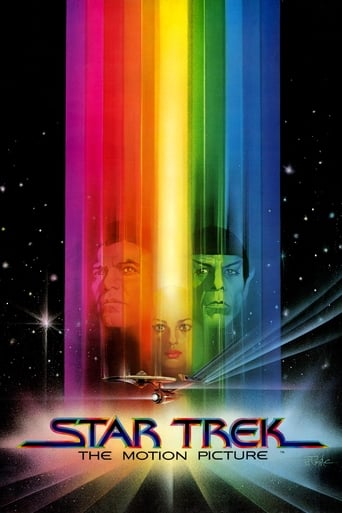
Star Trek: The Motion Picture
1979 · Film · 131 min
Part of Star Trek: The Original Series Collection
Directed by Robert Wise
Science FictionAdventureMystery
When an unidentified alien destroys three powerful Klingon cruisers, Captain James T. Kirk returns to the newly transformed U.S.S. Enterprise to take command.
7 positive1 negative14 neutralfrom 22 commenters
Where to watch
No streaming data for this title.
24 comments on Hacker News
V'ger-- NASA is probing a hot bald alien chick at 15b miles, yes!
//Persis Khambatta was born on 2 October 1948 in Bombay, India. When aged 16, as Femina Miss India, she entered Miss Universe 1965, dressed in off-the-rack clothes she bought at the last minute. Khambatta became a model for companies such as Revlon. Her biggest acting break was getting the role of Lieutenant Ilia, the bald Deltan alien in Star Trek: The Motion Picture (1979). This led to roles in Nighthawks (1981), Megaforce (1982), and Warrior of the Lost World (1983). She was considered for the title role in the James Bond film Octopussy (1983), but was passed over in favor of Maud Adams. Khambatta became the first citizen of India to present an Academy Award in 1980. She was nominated for the Saturn Award for Best Actress for her Star Trek role. Khambatta also made guest appearances in many popular American television series. In the early 1980s, she was seriously injured in a car crash in Germany and had to have heart bypass surgery.
A year before her death, she wrote and published a coffee table book titled "Pride of India", which featured former Miss Indias; it was dedicated to Mother Teresa, and part of the royalties went to the Missionaries of Charity. On 17 August 1998, Persis was taken to the Marine Hospital in South Mumbai, complaining of chest pains. She died of a heart attack the next day at the age of 49; her funeral was held in Mumbai. - IMDb mini biography by: John Atkin//
I assume you are aware of the plot of the first Star Trek movie (https://en.m.wikipedia.org/wiki/Star_Trek:_The_Motion_Picture)? Picard was not involved however...
But it is partly "just the times". There's a dividing line in 1977 called Star Wars. Before Star Wars it was much more common for science fiction films to use long establishing sequences of especially space technology. For a 1960s audience when the actual moon landings were fresh to mind, the long, slow ballet of space was very palpable and appreciable. Star Wars changed a lot of things for scifi, including reducing some of those establishing sequences to their quickest and most basic. It is harder to appreciate something like 2001 on this side of Star Wars. Scifi movies have been trying to mostly be "the next Star Wars" for almost every decade since, with few exceptions, many of which don't always do well in the box office (Tron is a cult favorite, but early theatrical audiences found it slow; Star Trek: The Motion Picture is often considered a bomb by Star Trek standards for being a pre-Star Wars sort of movie released two years after Star Wars; Gravity and Interstellar both got accolades in somewhat recent years for mostly sort of getting away with pre-Star Wars scifi pacing, but partly got away with it from Brand Name stars and directors and a focus on IMAX tech and spectacle).
2001 didn't feel out of place versus scifi movies of its time. It feels slow and ponderous post-Star Wars.
[SPOILER ALERT]
It was the surprise ending for the first Star Trek film...
https://en.m.wikipedia.org/wiki/Star_Trek:_The_Motion_Picture
>Arguably, the original trilogy was simply dungeons and dragons in space. Wizards, rogues, and knights in space.
It was basically Flash Gordon plus WW2 movies plus samurai movies plus fairy tales and Arthurian fantasy in space.
I think one of the reasons why The Force Awakens is not good is that it tries to copy previous Star Wars movies, but Star Wars has always been best when it copies stuff from other genres and mixes them together into a new thing, not when it tries to copy from its own previous films.
>it's pretty much the only widely known sci-fi films from the last 70s early 80s
Close Encounters of the Third Kind, Alien, Blade Runner, and The Terminator are all widely known late 70s / early 80s sci-fi films.
Probably not as well known but still pretty widely known are Star Trek: The Motion Picture, The Thing, and 2010: The Year We Make Contact.
Apropos of absolutely nothing, but IIRC a "Star Trek" movie where a screenshot of one of the displays on some ship or another had the Shields Frequency up which allowed the enemy to match it and disable it, and back in the 80s(?) when this came out I remember thinking "237GHz" (or something like that) was an insanely high frequency and doubted it could ever be reached with any degree of stability. Physics: HMB
I appreciate the Star Trek reference (V'ger incase somebody doesn't know what I'm talking about - Star Trek, The Motion Picture). That movie awed me as a kid.
I don’t agree with that. Having my grown up in that era there is t any shortage of content in popular culture that have smart or sentient AI:
- Asimov novels (as you’ve referenced yourself)
- 2001 (Hal)
- Star Wars (R2D2 & C3PO for example)
- Buck Rogers in the 25th C (Twiki & Theopolis)
- Battlestar Galactica (Cylons)
- Alien (Ash)
- Star Trek TOS (I forget the episode names but there’s a few with smart AI)
- Star Trek: The Motion Picture (V’Ger)
…All from either the same era as 2XL or before.
The problem with “AI” as a term is that it can mean multiple things (like “HD”, “smart”, etc) so it will be used and abused by whoever feels it might sell a few copies of something.
An example of this is computer games. AI has never been used to refer sentience but rather the programmed logic of a computer opponent.
Then you have AI in the research sense; which are the technologies another poster described.
You have AI in stories, TV and movies which are often depicted as human-like intelligence, complex reasoning, or even outright sentient.
It was never a term that had one definitive technical definition.
Now you do see researchers retrofitting different classifications of “AI” in a hope to clear up the confusion around the use of the term “AI”. But that’s a more recent (in comparison) development and certainly isn’t something the general populous are aware of.
Trumbull saved Star Trek: The Motion Picture. The film was scheduled for Christmas 1979 but the effects were not done. Millions were uselessly wasted. Trumbull came in and completed the effects in time, including the amazing drydock scene (<https://www.youtube.com/watch?v=tpEv8pRGkME>). When Kirk thanks Scotty at the end, he is really thanking Trumbull on behalf of the audience.
But I enjoy Dynasty Warriors / Wuxia / Dragonball Z!! (Or 300 if you prefer American)
Heck, I enjoy watching Yu-gi-oh with my nieces. It turns out that full fantasy fights with completely different sets of rules is certainly a genre. Sure, its a cartoon, but the entire point is that the fights progress by a completely different set of rules on purpose.
----------
> There's fake made with human actors, and there's "f--k it, just cut and paste 1000 zombies or robots in the next scene and make the heroes cut through them like butter" fake.
You mean like Star Wars stormtroopers? In something like 3 movies, they only ever land ~2 or 3-shots off on the main characters (R2D2 and Leia in the 3rd film IIRC).
I think about some older movies I've enjoyed: Star Trek, Flash Gordon, etc. etc. Plenty of "1000-to-1 odds" going on and yet I still enjoyed the film. Or Indiana Jones. The 1000-to-1 odds thing is basically an ancient trope: found in old epics / stories, and even movies from decades ago.
The theater this is in might be one of the best places to see a movie. I fondly remember the first night the Star Trek movie was shown. Every time a major character was introduced the crowd went wild. When they told us to turn our phones off some guy yelled "Silence your communicators". It had a really unique energy. Plus they serve beer.
> Jeff Katzenberg, the co-founder, has been 'making content and selling to kids' for 40 years to the tune of literally Billions. Star Trek films, The Little Mermaid, The Lion King, Shrek, How to Train your Dragon etc. etc. - just huge, monster titles.
My argument against this point is simple: few of those were original content conceived by Katzenberg/DreamWorks/Disney. They were existing stories (most already successful as books). The only things I can see in his filmography that are possibly original and hugely successful are Star Trek: The Motion Picture, Kung Fu Panda, and Madagascar, Road to El Dorado, and _maybe_ Chicken Run.
Thank you for this, I did not know about Syd Mead, but just flipping through the images on that page it's clear how influential he was. Wikipedia lists pretty much exactly the associations I made:
> Mead worked with major studios on the feature films: Star Trek: The Motion Picture, Blade Runner, Tron, 2010, Short Circuit, Aliens, The Spirit of '76, Timecop, Johnny Mnemonic, Mission: Impossible III, Elysium, Tomorrowland and Blade Runner 2049. George Lucas created the AT-AT for his Star Wars saga based on art by Mead.
This is in no way to diminish his work, but the impression I got (and that I'm trying to confirm/debunk, given the wikipedia article doesn't really address this) is that his art really transposes the society of its time into the future. That is, he almost exclusively addresses the technological advancement, while keeping the societal structures largely intact. For example, that's why the retrofitted houses give the impression of still being inhabited largely by working class people, while the ski resort and leisure time imagery with the sports cars still seems to be a luxury only few can afford even in the future. I don't see signs of "fully automated luxury space communism" there.
This may be me projecting though, hence the question if this is correct. And again, this is not to take away from his work. They are stunning. :)
I've also seen it commonly attributed to Star Wars. Star Wars, for better or worse, completely and almost single-handedly changed the pacing of sci-fi movies in the 70s. You can almost spot Star Wars as a line in the sand and tell which sci-fi films predate it, which postdate it, and which got stuck being released too close for comfort (the multiple editing cut fiascos of Blade Runner and Star Trek: The Motion Picture seem to be in part due to the pull of pre-Star Wars pacing versus changing film audience expectations).
"Thematically it's unlike anything Asimov wrote."
Again, as everyone seems to miss, it is a pitch-perfect Zeroth Law story, and to my mind fits in squarely into his Robot stories about the perils and limitations of the entire idea of the Three Laws. It is definitely an alternate timeline from the other ones, but that's not hard to believe. I find myself wondering if everybody read the same Asimov as I did. Or have only I read the later Asimov stories? If it was so accurate by accident, then they did a good job being so accidentally accurate.
Yes, Susan Calvin is wrong, but by adaptation standards that's nothing, and Asimov's characterizations were always paper-thin anyhow. I guess I find it less horrifying that Susan Calvin is wrong than some fans because "old, ugly, cerebral, and misanthropic" is pretty much her entire character. It's not like she's some fully-fleshed out character masterpiece with a multi-story arc, reasons for her characteristics, relationships with other characters in the universe, stories of her own, foibles and weaknesses to match her quirks and strengths... she just... likes robots, hates people. Asimov doesn't do characters.
I really feel like for both movies I mentioned, that's it. That's what an Asimov adaptation is going to look like. Those are the best you can possibly hope for. To the extent you still don't like them, a perfectly viable opinion as I do not deny my tastes can be a bit quirky even by HN standards (I like both the Tron movies and Star Trek: The Motion Picture too), then I would therefore not suggest agitating for Hollywood to dip into Asimov's works any more, because it's not going to get any better than that.
I also still think GitS is one of the best hard-core sci-fi things ever put to video, but I've generally considered the (first) film to be the weakest bit. I still like it, in much the same way I actually like Star Trek: The Motion Picture, but I think people generally cut it a lot of slack if it's one of the only Anime things they've ever seen for being "weird" and "Japanese" and "artistic", when in fact I think it's generally just sort of klunky, slow, and weirdly paced.
This particularly comes out when you compare it to the TV series and the subsequent films, which are none of those things. Even when you might argue the film is trying to make a point, the TV series makes it much better. It also has contemplative moments and character pieces and shots that simply show city life and all of the things the movie has, but they are better integrated and paced much better.
YMMV of course. (There was a time when "the anime canon" was Ghost in the Shell (the movie) and Akira; there is still some residual Thou Shalt Not Criticize attitude about for those two, but not much anymore, I think. GitS does fare rather better 20 years on than Akira, which I believe modern consensus is that it is just one big mess, which I thought even when I saw it in 2001 or so. A landmark, yes, but still a mess.)
Highly, highly recommend the TV series. I'd suggest starting there (they are technically different continuities that just happen to have similar characters, so you will miss no story), and circling back around to the movie if you still want more.
The original series is probably worth watching all of, just because there aren't that many episodes, and a few of them are real gems; it also sets the stage for some other things that are worth watching.
Read a summary of Star Trek: The Motion Picture (actually if you can, read a summary of a summary, the pacing of the movie is so ponderous). The even numbered movies are the best, but it's probably worth watching the 3rd one as well for continuity. The majority of the fandom pretends that the fifth movie never happened, and is well worth skipping.
The Next Generation (TNG) and Deep Space Nine (DS9) are the two that seem to have the strongest following with Voyager being a bit divisive among the fandom (depending on who you ask it either sucks or is good).
You will have to suffer through the first season of TNG and just trust that it will get better.
DS9 can stand on its own fairly well, but if you want continuity you can watch any time after season 5 of TNG. DS9 enters a fairly significant tone shift around season 4, and season 1, like TNG, is not necessarily representative of the entire series.
[edit] Here's a super-short summary of the above:
TOS
Movies: 2,3,4,6
TNG: at least first 3 seasons, if you don't like after season 3, drop. If you're impatient, you can watch just the pilot than skip to season 3 and not miss too much.
DS9: Seasons 4 and 5 of TNG develop some of the races that are prominent in DS9, so it's best if you wait until at least season 5 of TNG to watch, if you really didn't like season 3 of TNG, then this will stand on its own though.
Voyager: It was not my cup of tea; some fans liked it though.
The early 80's were a truly special time for action cinema, and sequels in particular. There were several sequels that stand out for both putting a completely different spin on the movies that preceded them while offering relentless and tight pacing.
Aliens is just one example. Consider also, "The Road Warrior" (a.k.a. Mad Max 2). It took the faded and failing civilization of the original and pushed that out to every extreme possible. Total collapse. Anarchy. Barbarism. Post-apocalyptic wasteland. It also featured some of the tightest editing, most impressive stunts, and most relentless action of any film ever made. However, it was far from alone.
"The Empire Strikes Back" took the light, fun, and somewhat corny adventure of "Star Wars" and turned that into a dark, brooding character driven film that was a non-stop roller coaster of tension. Empire is the film that makes people take Star Wars seriously no matter how much zany Ewok slapstick and standup-droid-comedy Lucas put into ROTJ and the prequels (I refuse to even type the full J-J word). The 2001-derivative "Star Trek: The Motion Picture" was followed by the "The Wrath of Khan", which itself focused on character development and featured a climactic battle between both leaders and star ships. This film, despite being made on a shoestring budget when compared to the first Trek film, defined Trek movies for all time. Arguably, the franchise has suffered as Trek film after Trek film tried to recapture the magic of "The Wrath of Khan" instead of blazing their own paths.
When you watch these films and compare them to today's action flicks, one thing that stands out is that the action is anything but non-stop. All of these films feature extended sequences of slow, careful character development that are punctuated by action scenes. Compare the most recent Superman film to Aliens for example. Aliens may have felt relentless and draining in its last hour, but the first hour is relatively slow. That slow, building action sets everything up. It made us care so much about the characters and appreciate how utterly alone and vulnerable they were that it was tough watching them go through the meat grinder of the second half.
"Man of Steel" on the other hand, begins with action, continues with action, and ends with action, taking only brief breaks to string along a flimsy plot and barely flesh out stereotypical characters. Halfway through the city-wrecking final action sequence one finds oneself wishing the film would just get to the point! Both the magnitude of destruction and sheer volume of film expended in "Man of Steel" dwarfs that of Aliens, but there is only a fraction of the tension. You could take your time going to the bathroom at any point in "Man of Steel" and, odds are, all you'd miss is some CG mayhem that has no lasting effect on the plot. Does it really matter how many buildings Superman and his foes level without resolving anything?
Today's film makers are too often afraid of boring their audience and too frequently sacrifice developing what makes the action matter for the sake of giving their audience non-stop action. Non-stop meaningless action is like eating nothing but ice-cream for dinner. Sure, ice cream is great, but it simply isn't satisfying on its own. Today's film makers should look to the early 80's as an example of what can be accomplished when you don't underestimate your audience's attention span.
That would be the "most popular" films of 1979, as rated in recent years.
Here's imdb's biggest films of 1979 by US box office:
http://www.imdb.com/search/title?at=0&sort=boxoffice_gross_us&title_type=feature&year=1979,1979
Alien is thrashed by Star Trek: The Motion Picture and Moonraker. Apocalypse Now is thrashed by The Muppet Movie.
OK, I can't believe I am compelled to "someone is wrong on the internet" over fucking Star Trek...but
Anyway, the first Star Trek film [Star Trek: the Motion Picture] predates The Next Generation by a decade. The next three movies [Wrath of Kahn, Search for Spock, and The Voyage Home] also predate the premier of The Next Generation.
To put it in perspective, the cultural big deal with Star Trek: The Motion Picture was a woman with a bald head. That is how the world was before MTV.
I agree but it does sound like music used by movies intended to evoke creepiness. It's because it sounds unnatural, far outside what we're used to hearing. Compare with, say, the Blaster Beam used by Jerry Goldsmith in the film Star Trek: The Motion Picture. http://en.wikipedia.org/wiki/Blaster_Beam
I got a pretty good chuckle out of this.
Reference to Star Trek: The Motion Picture, for anyone who may not immediately get the reference. The plot of the story revolves a giant space cloud containing a vessel that's ultimately returning Voyager to Earth.
It was a very appropriately timed movie and really explores the idea of Man's impact even beyond our solar system with the devices we shoot off into the stars.
For anyone who didn't get the 'joke' (like me) and who knows nothing about Star Trek (also me), turns out that "V'Ger" is a Star Trek character. From Wikipedia:
"A sentient being that evolved from Voyager 6, a fictitious space probe from the 20th Century that vanished into a black hole and was given life by a race of living machines. The story of V'ger and its return to Earth to seek "the creator" forms the plot for the first feature film in the Star Trek series, Star Trek: The Motion Picture."
Star Wars, the original movie
Superman, the original movie
Star Trek, the first movie with Shatner, Nimoy, etc. Also Wrath of Khan.
The Matrix
300 probably will become one
The Social Network was surprisingly motivational. Fairly realistic portrayal of programming and programmers and startup life, and I loved many of Sean Parker's motivational speeches, and some of the Zuckerberg character's speeches as well.