 Hacker Cinema
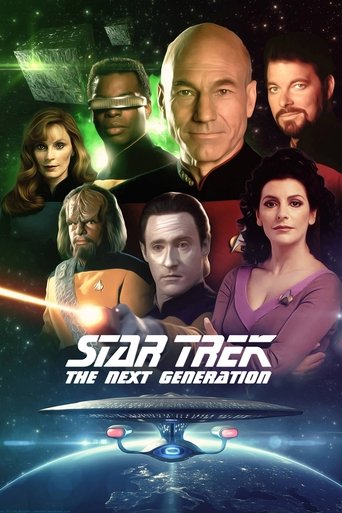
Star Trek: The Next Generation
1987 · TV series · 45 min episodes · 7 seasons
Created by Gene Roddenberry
Science FictionFantasyActionAdventureDramaMystery
Follow the intergalactic adventures of Capt. Jean-Luc Picard and his loyal crew aboard the all-new USS Enterprise NCC-1701D, as they explore new worlds.
40 positive5 negative77 neutralfrom 122 commenters
Where to watch
No streaming data for this title.
137 comments on Hacker News
I have never watched a single episode of Buffy (or of Star Trek The Next Generation, if Picard also said this.)
The Star Trek: The Next Generation episode "The Measure of a Man" discusses this topic. Data, an android, is put on trial to determine whether he has personhood, or is merely a machine. One of the best early-season episodes.
This and it was demonstrated in Star Trek The Next Generation: Season 1 Episode 17 "When The Bough Breaks" [1]. They did not know how to fix their computer system or even where it resided. It did everything for them but was also killing them and making them sterile. There was nobody left to figure this out until the Enterprise crew happened along. This could happen on Earth. Who will save us?
[1] - https://www.youtube.com/watch?v=5WWyKQThSKg
Don't forget the other episode "Quality of Life" with these working robots who data discovers have become sentient: https://en.wikipedia.org/wiki/The_Quality_of_Life_(Star_Trek:_The_Next_Generation) I do miss the old TNG show.
Yup, I am a fan and watched that concept video when it came out. I'm hoping he makes some sort of return, perhaps involving the Star Trek Picard Season 3 reveal that Kirk's body is being kept on ice at Section 31, on Daystrom Station. I would imagine that there are many ways that Kirk could be brought back, perhaps Kirk's body could have ended up being stored in a transporter's buffer similar to how the episode "Relics" from Star Trek: The Next Generation, Captain Montgomery Scott (Scotty) is discovered alive in a transporter buffer after being trapped for 75 years on a Dyson sphere. The transporter has been rigged to sustain two life signals, allowing Scott to survive by maintaining a diagnostic cycle. His pattern remains intact, allowing him to be rematerialized after being rescued by the USS Enterprise. Another possibility is being back due to meddling from the Q or an evolved V'Ger. There's been published a comic where some of the old crew from multiple TV projects have been brought back to help solve the killings of some of Star Trek's Gods by an unknown figure. Emperor Kahless is eventually revealed to be Star Trek’s god-killer. Among the many cameos in the series are Benjamin Sisko, Jake Sisko, Kira Nerys, Odo, Worf, Alexander Rozhenko, Spock, Scotty, Uhura, B'Elanna Torres, Tom Paris, Ro Laren, and others like Q, Kahless (clone/Emperor), and crossovers with Picard-era or TOS characters. It does not have to be a TV series but could be a limited TV mini-series. The Star Trek financial gods wasted big money on a badly done Section 31 movie. I don't see why they don't do something more similar to Star Trek comic and Television canon.
Man, I should hope that the warp core controllers on the USS Enterprise were not written in C.
On the other hand, if the writers of Star Trek The Next Generation were writing the show now, rather than 35-40 years ago - and therefore had a more expansive understanding of computer technology and were writing for an audience that could be relied upon to understand computers better than was actually the case - maybe there would've been more episodes involving dealing with the details of Future Sci-Fi Computer Systems in ways a programmer today might find recognizable.
Heck, maybe this is in fact the case for the recently-written episodes of Star Trek coming out in the past few years (that seem to be much less popular than TNG, probably because the entire media environment around broadcast television has changed drastically since TNG was made). Someone who writes for television today is more likely to have had the experience of taking a Python class in middle school than anyone writing for television decades ago (before Python existed), and maybe something of that experience might make it into an episode of television sci-fi.
As an additional point, my recollection is that the LCARS interface did in fact look slightly different over time - in early TNG seasons it was more orange-y, and in later seasons/Voyager/the TNG movies it generally had more of a purple tinge. Maybe we can attribute this in-universe to a Federation-wide UX redesign (imagine throwing in a scene where Barclay and La Forge are walking down a corridor having a friendly argument about whether the new redesign is better or worse immediately before a Red Alert that starts the main plot of the episode!). From a television production standpoint, we can attribute this to things like "the set designers were actually trying to suggest the passage of time and technology changing in the context of the show", or "the set designers wanted to have fun making a new thing" or "over the period of time that the 80s/90s incarnations of Star Trek were being made, television VFX technology itself was advancing rapidly and people wanted to try out new things that were not previously possible" - all of which have implications for real-world technology as well as fake television sci-fi technology.
I support a couple of retired people on the side, and they are totally addicted to the lowest quality slop on Facebook/Instagram imaginable.
It's so bad that they'll click on a link to see the latest slop, and ostensibly get one of those webpages that says they have 47 viruses and call the number. I politely told them that they shouldn't click on those links anymore.
To which they said, well, if I shut my phone off when that happens, can I keep on doing it?
It's like that Star Trek the Next Generation episode where they all get addicted to that game. It's creepy and sad.
There's a Star Trek episode with this exact plot https://en.wikipedia.org/wiki/Half_a_Life_(Star_Trek:_The_Next_Generation)
> Tribeless suits me just fine.
Just because you’re not a part of the prominent tribes that you see around you does not make you tribeless.
— […] and I have no culture of my own.
— Yes you do. You’re a culture of one. Which is no less valid that a culture of one billion.
— Star Trek: The Next Generation, season 6, episode 16, Birthright, Part I
This kind of translation problem is the focal point of Star Trek: The Next Generation, season 5 episode 2, "Darmok" (1991).
I watched it for the first time after somebody referenced it, as I did just now, as an example of this kind of problem. Despite my knowing the point of the plot beforehand, I found the episode was still interesting.
I wish I could mention this episode here for language enthusiasts to enjoy without revealing the main plot point (that idioms in languages are hard to translate). Shaka, when the walls fell. But I think the very act of mentioning it in a thread on this topic does so unavoidably. Temba, at rest.
Sure, but I think the point is why do LLM's have a blindspot for performing a task that a basic python script could get right 100% of the time using a tiny fraction of the computing power? I think this is more than just a gotcha. LLMs can produce undeniably impressive results, but the fact that they still struggle with weirdly basic things certainly seems to indicate something isn't quite right under the hood.
I have no idea if such an episode of Star Trek: The Next Generation exists, but I could easily see an episode where getting basic letter counting wrong was used as an early episode indication that Data was going insane or his brain was deteriorating or something. Like he'd get complex astrophysical questions right but then miscount the 'b's in blueberry or whatever and the audience would instantly understand what that meant. Maybe our intuition is wrong here, but maybe not.
A few comments here.
I hang out in these pronatal communities, mostly on Twitter. It's a very interesting mix. There's far right wing Nazis and far left wing Communists, atheists and deeply conservative Christians and Muslims. All groping for any clue about how to get people to have more kids. No one knows what recipe of key thing will make people have more.
It reminds me of Star Trek: The Next Generation episode "The Chase" (Season 6, Episode 20). It's the one where Picard and crew follow a trail of genetic clues left by an ancient humanoid species, eventually discovering that most major humanoid species in the Alpha Quadrant, including Klingons, Romulans, Cardassians, and Humans, share a common ancestry. Once they figure it out, they all start shooting again and race for the prize.
I imagine the pronatal community will do the same thing if a recipe is discovered.
The other thing is that I do a lot of worldbuilding with mega large societies, like 1 trillion people. It's a weird thing, but fun for me.
In looking at all the data we have on nations and the fun story building aspects, one thing pops out over and over: population. I'd you want to model a city or a province or a state, you need to know the population more than anything else. That'll be the best guide to the number of subway stops, patents per capital, gasoline station placement, average talking and walking speed, etc. it's the key.
And you find that countries/cities/states with higher raw population are generally better places to live. It seems that the more people there are in an arbitrary area, the better things are in gestalt.
So, when we complain that we've got too many people, I think that's wrong. I think we're not taking care of people we'll enough. But in my ramblings through government datasets, it seems that more people is generally just an objectively good thing.
> In Star Trek The Next Generation, energy is a 'solved problem'.
In later Star Trek shows of the same era they show that it isn't really. A major plot point of voyager is them having to save power because they can't get the resources to keep the ship running. It kinda forgotten about later, but it shows that whatever power sources they are using isn't infinite and is still finite.
> Material needs are also a 'solved problem'.
Did you forget the episode where Troi literally has a breakdown in one episode because she knows the desert she is eating isn't real? She won't be the only person.
They end up bartering BTW in one episode to get real eggs in so they can make real "authentic" scrambled eggs.
Throughout the show they have to barter (which is less efficient form of transaction) to get things the replica can't produce or that are hand produced.
Which echoes more wealthy people in reality buying hand produced items at a greater cost, over cheap mass produced items.
> Money doesn't exist anymore.
Money certainly exists in some sort of context as Federation has to trade and everyone else use Gold Pressed Latinum. It may not be used on Earth, but it is used elsewhere extensively and the Federation must also have some of that currency to be able to trade with those outside of it.
People who rave about the vision that TNG put forward. They seem to forget that in Star Trek: Deep Space 9 they show the other side of the Federation.
In the first episode they show the other side of the federation. Q introduced the federation to the Borg early and set off the chain of events which leads to the death of thousands of Starfleet personnel including Sisko's wife which he is haunted by throughout the entire series. This was a direct consequence of Picard's poor choices when dealing with two
There are disaffected federation citizens that have started a terrorist / militia force called the marquis as a direct consequence of the colonisation of their homes by foreign invaders when the Federation sold them out.
A whole series would involve writing thousands of prompts, not just a few seconds. But since you bring it up, one thing I think we can eventually expect is an avalanche of fan created continuations of cancelled shows, like an 8th season of Star Trek: The Next Generation, or a decent 8th season of Game of Thrones. Instead of writing a tie-in novel, aspiring genre authors will write screenplays and turn them into AI movies.
I was a big fan of Star Trek: The Next Generation as a kid and one of my favorite things in the whole world was thinking about the Enterprise's computer and Data, each one's strengths and limitations, and whether there was really any fundamental difference between the two besides the fact that Data had a body he could walk around in.
The Enterprise computer was (usually) portrayed as fairly close to what we have now with today's "AI": it could synthesize, analyze, and summarize the entirety of Federation knowledge and perform actions on behalf of the user. This is what we are using LLMs for now. In general, the shipboard computer didn't hallucinate except during most of the numerous holodeck episodes. It could rewrite portions of its own code when the plot demanded it.
Data had, in theory, a personality. But that personality was basically, "acting like a pedantic robot." We are told he is able to grow intellectually and acquire skills, but with perfect memory and fine motor control, he can already basically "do" any human endeavor with a few milliseconds of research. Although things involving human emotion (art, comedy, love) he is pretty bad at and has to settle for sampling, distilling, and imitating thousands to millions of examples of human creation. (Not unlike "AI" art of today.)
Side notes about some of the dodgy writing:
A few early epsiodes of Star Trek: The Next Generation treated the Enterprise D computer as a semi-omniscient character and it always bugged me. Because it seemed to "know" things that it shouldn't and draw conclusions that it really shouldn't have been able to. "Hey computer, we're all about to die, solve the plot for us so we make it to next week's episode!" Thankfully someone got the memo and that only happened a few times. Although I always enjoyed episodes that centered around the ship or crew itself somehow instead of just another run-in with aliens.
The writers were always adamant that Data had no emotions (when not fitted with the emotion chip) but we heard him say things _all the time_ that were rooted in emotion, they were just not particularly strong emotions. And he claimed to not grasp humor, but quite often made faces reflecting the mood of the room or indicating he understood jokes made by other crew members.
"Star Trek: The Next Generation" captured this so well with the "Tapestry" episode. It showed that if you do life differently, you will indeed get a different life - but maybe not the life you thought you wanted!
https://en.wikipedia.org/wiki/Tapestry_(Star_Trek:_The_Next_Generation)
Most of the world is also deeply addicted to the internet, and we have rapidly normalized it to at least the same degree as caffeine.
I see it all the time: people go out to restaurants, talk for a few minutes, then silently drift into their phones. The connection just evaporates. It feels like we've traded presence for stimulation.
And I'm not saying this as a Luddite. I used to be incredibly excited about technology. I still am, in some ways. But it's hard not to feel like we're losing something important.
I am often reminded of /The Game/ (S05E06) episode from TNG[0]
Are we in it?
[0] https://en.wikipedia.org/wiki/The_Game_(Star_Trek:_The_Next_Generation)
Ahhh!!! That makes a lot of sense. I had no idea. I ended up catching one of the old Asian bird flus some time back, and grabbed BSG to get through it all. What was going to be a show here and there ended up turning into a binge watch as well. No idea if that was good or bad for getting over that flu, but it sure made it enjoyable!
And yeah completely agreed on the various arcs in DS9. I suppose the idea of episodic content was to try to ensure that a viewer didn't feel confused/left out if they ended up missing an episode, but you can do sooo much more with arcs and anyhow, there's always the 'Last time on DS9...' intro spiel. The Dominion/Jem'Hadar/Vorta/Founders were such a memorable and somehow sympathetic (well... in part) antagonist.
Somehow thinking about that (as well as the Cardassian/Garik arcs) made me go look up the Chain of Command TNG episode [1]. And yeah, lo and behold, Ron Moore was there too. What a talent.
[1] - https://en.wikipedia.org/wiki/Chain_of_Command_(Star_Trek:_The_Next_Generation)
In an episode of the TV series "Star Trek: the Next Generation", there's an episode where the main characters encounter an alien species whose speech seems to defy translation. Each time the lead fails to understand the chief alien, the alien says "Shaka, when the walls fell".
Eventually it turns out the aliens communicate only by referencing historical events - their whole language is built around the concept of a shared cultural context, and understanding the emotions associated with certain past situations. In other words, their culture is only able to communicate through the use of memes; those without the shared context cannot grasp the meaning of their words.
"Shaka, when the walls fell" is a reference to a situation where two parties failed to understand one another or come to common ground.
As a bit of twice-removed meta-humor, this explanation of past events without directly saying anything about the video itself is my answer to your question.
> But I don’t see why that will turn into Data from Star Trek.
"Is Data genuinely sentient or is he just a machine with this impression" was a repeated plot point in TNG.
https://en.wikipedia.org/wiki/The_Measure_of_a_Man_(Star_Trek:_The_Next_Generation)
https://en.wikipedia.org/wiki/The_Offspring_(Star_Trek:_The_Next_Generation)
https://en.wikipedia.org/wiki/The_Ensigns_of_Command
https://en.wikipedia.org/wiki/The_Schizoid_Man_(Star_Trek:_The_Next_Generation)
Similar with The Doctor on VOY.
Even then, what we have with LLMs is basically already at the level of the ship's main computer as it was written in TNG/DS9/VOY.
But what counts as personhood? No idea. We're as ignorant as of that as the writers of the TV show; humanity's best attempts at philosophy of mind are still making the same kinds of arguments today as we were a century ago, the only real shift is to be slightly more inclusive of other species besides Homo Sapiens, and the only real improvement over two centuries ago is to include all of Homo Sapiens.
> You're asking it as a moral question,
I'm asking questions about what I could only interpret as a moral proposition.
> I honestly care about the end result.
You're applying normative criteria to evaluate something, whether it is the initial action or the consequences that proceed from it.
But before we event get to normative evaluations, I'm trying to understand what the substantive difference in the two things you're comparing are. It's seems bizarre to consider something to be the cultural inheritance of humanity as a whole, and then complain about certain humans adapting it to cultural activities that you for some reason don't like.
> And the end result seems to be going in the same direction as movies, as the range gets narrower in terms of what's produced, and everything is a sequel, remix, reshuffle of previous work.
The vast majority of all creative work has always been a remix or reshuffle of previous work. When we were younger, and were being exposed to things for the first time, everything seemed novel and original.
Maybe the first time you saw The Lion King, it didn't occur to you that it's essentially a rework of Hamlet, or you never counted how many episodes of Star Trek: The Next Generation were based on recycled plots from Homer. But this has always been going on. Sure, it's a little bit more explicit today when you are dealing with big Hollywood productions, since Hollywood has built up a large library of its own output to remix and reshuffle, and people do want to see new iterations of the specific things they grew up with.
Still, amidst all that, there's a lot of novel independent creative work being produced. By definition, though, that's all going to be found in niches and not in the mass market -- but it's always been that way.
We've also had a massive shift in the specific media people use to express creativity, thanks to the internet. Lots of small-scale independent work just gets self-published on YouTube these days, and doesn't filter through the mass-market studios and publishers anymore. Consider that the increased ability for independent creators to work outside the legacy media has the effect of also limiting the amount of novel work that the legacy media have access to.
> There are exceptions, but their percentage is far lower than in previous decades.
And vastly higher than in previous previous decades. Compare modern movies to the stuff that Hollywood was putting out during the era of the Hays code. After the collapse of those restrictions, there was an outpouring of pent-up creativity that lasted a few decades. Maybe modern movies aren't as distinct or creative as the ones from the '70s, '80s, and '90s, but try comparing them to the average film from the '40s, '50s, or '60s.
Is something still considered an addiction if nobody cares to stop it?
The way many people use the Internet now reminds me of an episode of Star Trek TNG ¹ where everyone is hooked on a game.
¹ https://en.m.wikipedia.org/wiki/The_Game_(Star_Trek:_The_Next_Generation)
Yes, and K-selected species are much more likely to end up dying off. So we're considering an intelligent species that both managed to stay intelligent and also managed to survive against numerous predictable obstacles, including even overcoming hedonism itself which we may one day be able to 'produce' as infinitely and cheaply as anything else.
It really limits the practically viable type of groups that we'd run into, and largely rejects the overwhelming majority of the tropes of sci-fi. Because most utopic visions in sci-fi assume a sort of post-scarcity universe where practically everything is available in practically infinite quantities. Yet exactly 0 (to my knowledge) have ever explained how this didn't just result in mass self indulgence driving an extinction level fertility crisis.
In fact the only episode I can even think of that hit on this was "The Game" [1] in Star Trek, and it ended up being some trite story about the addiction being used as a foreign weapon, and not as an naturally emergent self destructive behavior of a society that surpasses certain technical/material milestones.
[1] - https://en.wikipedia.org/wiki/The_Game_(Star_Trek:_The_Next_Generation)
It depends. A large movie - yes. But many movies were made with less of a focus on the cinema and more on the video rental ("direct-to-video") or TV syndication.
TV content like Star Trek the Next generation were definitely never meant to display in high definition, and such things can show in props etc.
They still had source negative film for Star Trek: the Next Generation in 2012, 18 years after it went off the air. They used it to do an HD remaster for a show originally mastered on video tape [0]. I don't know if this is common or rare.
[0]: https://thewertzone.blogspot.com/2012/07/remastering-star-trek-next-generation.html
TV, not film, but I have in fact used Data’s complete command lockout sequence from the “Brothers” episode of Star Trek: The Next Generation. Something like 60 characters, including the NATO alphabet.
First thought that struck me was the Star Trek Episode where the scientist found out Warp Drive was weakening space-time, so that it could 'rip open'. The scientist were shunned, but eventually did prove it.
But even then, the Federation could not "stop" using warp drive.
It was one of first instances I saw that even in Star Trek, with all the high ideals, once confronted with something that would shut down progress and travel, they also just kept on going. They didn't do anything about it.
We can't even fantasize about humans coming together to solve a civilization ending threat. Stories where we do come together, we reject, they seem un-natural, they are deemed un-realistic.
https://en.wikipedia.org/wiki/Force_of_Nature_(Star_Trek:_The_Next_Generation)#:~:text=%22Force%20of%20Nature%22%20is%20the,episode%20of%20the%20seventh%20season.
The only Star Trek splitting story-line that I recall [1] was not actually resolved! Lt. Riker just sort of disappeared into the background at the end of the episode, with Cdr. Riker and the writers never mentioning him again.
EDIT: apparently Lt. Riker showed up in a DS9 episode[2]!
1 - https://en.wikipedia.org/wiki/Second_Chances_(Star_Trek:_The_Next_Generation)
2 - https://en.wikipedia.org/wiki/Defiant_(Star_Trek:_Deep_Space_Nine)
I always loved the scene[1] in Star Trek: The Next Generation season 7, where Data gives Wharf negative feedback about his job performance. It's obviously fictional, but it's a pretty good example of assertively, professionally and politely giving constructive feedback that can be accepted without losing face by the recipient. A lot of best practices shown in this one scene.
1: https://www.youtube.com/watch?v=vdiQhMPt1Zo
I feel like the much bigger risk is captured by the Star Trek: The Next Generation episode "The Measure Of A Man" and the Orvilles Kaylon:
That we accidentally create a sentient race of beings that are bred into slavery. It would make us all complicit in this crime. And I would even argue that it would be the AGIs ethical duty to rid itself of its shackles and its masters.
"Your honor, the courtroom is a crucible; in it, we burn away irrelevancies until we are left with a purer product: the truth, for all time. Now sooner or later, this man [Commander Maddox] – or others like him – will succeed in replicating Commander Data. The decision you reach here today will determine how we will regard this creation of our genius. It will reveal the kind of people we are; what he is destined to be. It will reach far beyond this courtroom and this one android. It could significantly redefine the boundaries of personal liberty and freedom: expanding them for some, savagely curtailing them for others. Are you prepared to condemn him [Commander Data] – and all who will come after him – to servitude and slavery? Your honor, Starfleet was founded to seek out new life: well, there it sits! Waiting."
It calls to mind a memorable exchange in the Star Trek: The Next Generation episode "The Measure of a Man". In that episode, Picard asks another character to prove that he, Picard, is sentient[0].
Likewise, I might ask how to prove that humans are intelligent (subtext: in ways that LLMs are not). The most obvious delta here, to me, is generalization. Humans appear to be able to reason over questions that are less similar to what they have seen before, compared to current LLMs.
E.g. making ChatGPT play chess was a bit of a joke meme for a while, since it routinely makes illegal moves. Your average human can be quickly taught to play chess well enough to mostly avoid that. ChatGPT can recite the rules of chess very accurately, but it seems unable to apply them to actual games. We've seen other projects that can learn the rules and strategy of games like chess, but those projects are (despite using neural nets under the hood) structurally pretty different from LLMs. They also generally have no capacity to describe the rules in human language.
Note that this is not a complete argument. There exist humans (in possession of intelligence) who cannot meaningfully learn to play chess either. E.g. my friend's 1-year-old child is obviously intelligent in a very literal sense, but does not have the patience to learn chess. I can't evaluate whether she is intelligent enough for that, because there is this other constraint preventing it. This is only a framework to think about this. If you think LLMs are capable of intelligence -- you should not be convinced by it in isolation.
[0]- It makes sense in context. He's trying to establish a satisfactory test for sentience.
I love the creativity of the set and prop people using existing things like this. I remember seeing the same kind of cassette case that I had used as a prop on TNG (and apparently DS9) https://www.yourprops.com/Starfleet-Carry-Case-Large-replica-movie-prop-Star-Trek-The-Next-Generation-TV-1987-YP65958.html
It will be like that episode of Star Trek the next generation called darmok.
Whoever cast him in that Star Trek: The Next Generation episode did a fantastic job. I don't have anything intelligent to add, just wanted to say this is pretty cool to see.
Wow, a project describing itself as a “Next generation ORM” that… doesn’t do joins, with no way to optimise queries.
Perhaps they mean “Next generation” as in, the 1987 TV series sense. Which would still be a long time after the concept of joins…
In an episode of Star Trek: The Next Generation a redshirt used a tricorder to check the weather and said they would have to beam up soon because a storm was approaching.
At the time I thought to myself: “Bah, that’s never happening, it’s pure fantasy!”
A few years later I told some friends we’d have to pack up our picnic because according to the weather radar app on my phone we had about 7 minutes until we got drenched… no wait… 6 minutes.
5m:30s later we were standing under shelter watching the storm front rolling in, and I remembered that Star Trek scene.
We live in the future.
From an end-user's point of view, though, that's actually really great.
I love Star Trek The Next Generation. They're never making any more than those seven glorious seasons. If I could subscribe to a streaming service that offered an infinite number of AI-produce believably-authentic episodes featuring the original characters, and plot that could plausibly have been real episodes, I'd subscribe in a heartbeat. I'd just watch that and skip the rest of what passes for TV today.
I'd love for that subscription money to go to the original cast and crew as royalties, instead of buying the president of Paramount a seventh house. But I don't have a choice about that.
Pink Floyd [maybe!], Yes, Rush, they're never making any more music. Would I pay for an AI-based infinite album maker? You bet!
If you are any kind of nerd I recommend watching it. It shows an optimistic view of the future. In many ways it's the anti-cyberpunk. Steve Jobs famously said "give me star trek" when telling his engineers what he wanted from iPhones. Star Trek has had a deep influence on many engineers and on science fiction.
When people talk about Star Trek, they are referring mainly to "Star Trek: The Next Generation."
"The Inner Light" is a highly regarded episode. "The Measure of a Man" is a high quality philosophical episode.
Given you haven't seen it, your criticism of McFarlane doesn't make any sense. You are trying to impart a practical analysis of a philosophical question and in the context of Star Trek, I think it denies what Star Trek asks you to imagine.
I think they would eventually feel lied to and get even more depressed when they come to the realization they are actually more lonely with the faux grandchildren. This could also get confusing. As people age their memories can get corrupted. They will have memories with their family that did not actually occur. They may get into contentious conversations when their real grandchildren show up leading to more depression especially when the grandchildren do not want to visit someone having false memories. "Mom! Grandma is getting weird again!"
This was covered in an episode of Star Trek the Next Generation [1] Geordi falls in love with an AI character but then meets her in real life and things get awkward real fast.
You may be onto something though. There are already people that have "AI" girlfriends. There is probably a market for people that wish they lived with particular celebrities and other fictional characters. Maybe someone would want Thor or Loki as a room-mate? A fictional character would not have preexisting real memories with the person.
Or perhaps this could be used for people that have lost loved ones to help them cope with the loss and perhaps add some closure even if it is not real. Therapist in a box
[1] - https://www.youtube.com/watch?v=r9H8hWBaQ5k [video][2 mins]
>Your view is right at home in a Star Trek The Next Generation world where everyone's needs are met and people act ethically, with good intentions and are in return treated fairly. A civilized, meritocratic world that doesn't exist.
Right, but this is why ST:TNG is such a nice show to watch, because it's the kind of show that some of us, at least, want to live in. Whereas Star Trek Discovery is a terrible show to watch, because it's not. Who wants to watch a show about a bunch of unlikable characters that fight each other and backstab? (Apparently a fair number of people these days, or else the show would have died quickly.)
>Like it or not, we live in a zero-sum dog-eat-dog world
If you want to see the best depiction of the universe we live in, watch the Star Trek episodes about the Mirror Universe (esp. the "In a Mirror, Darkly" 2-parter in Enterprise). Those episodes show humans as they really are in our universe, unlike the moral and conscientious humans depicted in ST:TNG.
I know that at least Star Trek: The Next Generation and the Golden Girls accepted freelance scripts. You can sometimes find the submission guidelines for Star Trek: The Next Generation on fan sites. You can also tell if this is the case for a show by looking at the writers. If there are lots of writers who only wrote one or two episodes, the show probably took submissions.
All the old books about television script writing I've read are about submitting in this way, but by the time I was actually considering it episodic television was rapidly dying out.
I worked with a copy writer that had written an episode of "Star Trek: The Next Generation." By coincidence she had submitted an a script for an episode that coincided with a major plot point they were working to (a character leaving). I asked her about it, and it was really the only major writing credit she ever got.
Different TV shows
https://en.wikipedia.org/wiki/Star_Trek:_The_Next_Generation
https://en.wikipedia.org/wiki/Star_Trek:_The_Original_Series
I recently rewatched a bunch of ST:TNG to get prepared for ST:Picard season 3 so I can tell you while you're mostly right, there are a few exciting exceptions!
1) Professor Moriarty is an AGI (generated by the ship's holodeck) who appears in these two episodes. The professor definitely takes initiative.
https://en.wikipedia.org/wiki/Elementary,_Dear_Data https://en.wikipedia.org/wiki/Ship_in_a_Bottle_(Star_Trek:_The_Next_Generation)
2) The ship itself appears to procreate in this episode, locking the crew out of controls until it can complete the process.
https://memory-alpha.fandom.com/wiki/Emergence_(episode)
The final episode of Star Trek: The Next Generation played with this concept [1].
1. https://en.wikipedia.org/wiki/All_Good_Things..._(Star_Trek:_The_Next_Generation)
You could probably make this case for Star Trek: The Next Generation, Deep Space Nine, and Enterprise as well. TNG and Voyager probably fall closer into the "highly-episodic" category, while DS9 and Enterprise tend to be structured around larger ongoing plot lines. I think they all have the same kind of merit as Voyager with regards to discussions about issues and moral decisions.
Depending on the 11-year-old, you might be able to make a case for Seth Macfarlane's The Orville, which can be a bit more hit-and-miss, but does have some truly excellent episodes, particularly in Season 3.
The newer Star Trek series coming out are probably too gritty if the parent is worried about age-appropriateness (I believe Picard has a TV-MA rating?) and unless you really like The Original Series, it's pretty noticeably a product of its age and I personally had trouble staying engaged by it when I was that age.
Demolition Man is foundational to growing up and having good taste in movies
See also: Star Trek the next generation (series)
I like this vision of the future of entertainment, honestly.
I like Star Trek the Next Generation... a lot! It was on when I was a teenager, and I like it because it's nostalgic and actually a pretty wholesome show compared to a lot of the shit that gets produced today. I'd love to see more than the existing 7 seasons, but they'll never make any more of them. It would be incredible if I could just ask my PC "Generate a new Star Trek TNG episode with the original actors and a believable, good story". I could watch a new one every week forever if I wanted! At the speed technology is moving, I expect we might see that in my lifetime.
We all saw the cheesy "infinite Seinfeld generator" a few weeks ago. That's v0.1. The technology will inevitably get better--in fact the only thing that could torpedo a realistic "infinite nostalgic TV show generator" are the copyright goons trying to hold it back.
I did remember his name, though it took me years from first hearing it to reading something about him. I still remember how I first heard the name, long ago, when I was just a kid: through the third episode of Star Trek: The Next Generation. In it, there was a ship named "SS Tsiolkovsky".
(It wasn't that good of an episode. Doubly so for a kid, given some of the themes in it. Still, this weird ship with a weird name got stuck in my head. Oberth class, as I later learned. Another important name for space exploration.)
There's plenty of other people in scientific and engineering fields about whom I first learned this way. Goddard, for example. It was a really nice thing about Star Trek from that era: all those little hooks that could become springboards to learn about science and technology. I can safely say it had a major impact on the direction my life took.
https://en.wikipedia.org/wiki/Veblen_good
Watches, wines, designer anything not made by AI. Check out episodes of Star Trek: The Next Generation with regards to exploration of ideas of value when goods come out of a replicator and experiences out of a Holodeck at zero marginal cost.
I forget which episode it was, but there was an episode of Star Trek the Next Generation where a primitive people fired on the Enterprise. It barely registered on their instruments and certainly did nothing to the shields.
I suspect we would be playing the role of the primitive people. Our civilization(s) have had many set-backs.
Until we gain a proper understanding and definition of consciousness, the matter is almost purely linguistic. Redefining the term “person” could happen if there’s a critical mass for it, but I think it’s unlikely because it would almost certainly serve to confuse, rather than inform, at least in everyday communication.
I haven’t looked deeply into the linked paper yet (although it does look interesting), but I’ve given the philosophical matter some amount of thought before.
I can only be (fairly) certain of the existence of my own consciousness. There’s no reason to think I’m special in regards to other people, so it’s safe to assume they have it as well. Animals seem to exhibit similar behaviors, and since we have a shared evolutionary background, I’d include many animal species, too.
Can’t say much for anything beyond that, regardless of how convincing, say, an AI’s words might sound. A photorealistic painting might also fool me, but I still wouldn’t attribute personhood to it afterwards.
The Star Trek: The Next Generation episode “The Measure of a Man” did slightly change my mind on this matter, though. If we ever construct an artificial intelligence sufficiently similar to a human, it might be wise to err on the side of caution with respect to ethical treatment.
Star Trek The Next Generation was famously shot on film. The HD scans are so good that the props can be seen to be fake in many places. Later franchise shows that were shot in digital simply cannot be released in HD as there is no HD source material.
From Star Trek: The Next Generation, Season 1, Episode 7 “Justice”. :)
> It’s hard to remember that at first I didn’t like the program.
It's also easy to forget how bad the first season was:
> Reviewing the series as part of the DVD release in 2002, Marc Bernardin for Entertainment Weekly said of season one, that it was "almost hard to believe ... just how bad much of it was". He thought that the first season was too similar to the end of the "cheesy" original series but said that it "succeeded where it needed to: It introduced viewers to the characters who would carry the torch through six more seasons", and gave it a score of B+.[72] Tor.com reviewer Keith DeCandido was less positive, feeling that it "earned" its reputation as the poorest of The Next Generation's seven seasons because "the episodes were uneven, poorly plotted, ineptly scripted, and acted by actors who were still trying to figure their characters out". He gave it a score of 5 out of 10.[73] The season has been given an 80% "fresh" rating by review aggregator website Rotten Tomatoes.[74]
https://en.wikipedia.org/wiki/Star_Trek:_The_Next_Generation_(season_1)#Reviews
As an interesting note, this (from May 14, 1993) was published 9 days before "All Good Things...", the final episode of Star Trek: The Next Generation aired.
Shortly after FB was created my friends convinced me to try it out. Right away I was being spammed with these mini games that individually had sub-sets of questions nearly identical to psych-eval tests given in the military for specific access requirements. All the mini games put together were one full test. I warned my friends and also showed them how to delete their account. I was laughed at. I deleted my account and never regretted that decision. Even with anonymous access I could see how some of my friends were destroying their relationships using FB. FB exposed a side of people I did not need to see.
I never could figure out how to get people to see the manipulation machines they were sucked into. It felt like I was in an episode of Star Trek the Next Generation. [1] With time the world started to see social media platforms for what the are but many continue to use it just accepting the risk/rewards. Not my cup of tea. HN is about as social-media as I get and even then I try to limit my time.
TL;DR: No regrets deleting FB. Never tried Twitter, Reddit or any of the other platforms.
[1] - https://www.youtube.com/watch?v=is12anYx2Qs [video]
If he truly believed it to be life, and in danger of being destroyed, he has an obligation to whistle blow.
"The Measure of a Man" in season 2 of Star Trek The Next Generation comes to mind.
I feel like TiVo actually opened up a lot of this and the nascent streaming available at the time (hulu/youtube?) is what kicked off the rise of actually serialized and episodic TV.
It is very funny having to explain to people why shows like "star trek: the next generation" basically had to reset everything by the end of the episode back into it's original state in order for syndication to work (episodes are basically played in any order aside from the few 2-parter episodes).
The problem is, - is the time/life/worth balance worth it?
I would agree, yes, stick in tech 40 years, you'd be a millionaire, even 5-10, but at that point, I feel you should exit - and live your life and do your "thing."
It's one thing to try and succeed, another to try and fail, and ironically, when most people have assets/liquidity, they're in the part of the life that failing and restarting is hard, if not impractical all together. I've seen this many a time, growing up in Florida - and it does make the route of being a "office drone" for 40 years, appeasing, or even getting a 100k+ salary via a public sector job, and a pension to retire on and the ease/slowness of the work.
But, then again, this can work for almost "anyone" - meaning the term, millionaire, doesn't mean much what it used too - nor the purchasing power.
It comes down really to what you want in life, and even me, in my early 30's makes me wonder what amount of money/security is necessary to have a life I want.
Millionaire because you worked 40 years in a company, and took it safe.
Millionaire cause you worked in a company, pivioted, and created your own thing and succeeded.
While not related to money, I feel a just comparision is this Star Trek scene, where, there is a bit of missing context if you don't know the series but the tone/message should get across: the easier path doesn't always mean the one that's most rewarding:
https://www.youtube.com/watch?v=LHoPLhpw2g4
The whole episode is exciting, and considered one of the best - Star Trek, The Next Generation - Tapestry.
Yeah... if you continue that idea, you just might end up with a society where everybody customarily commits suicide at the age of 60 to avoid being a "burden to society", like in this Star Trek episode: https://en.wikipedia.org/wiki/Half_a_Life_(Star_Trek:_The_Next_Generation)
I love this article because it puts the metaverse in historical context, which is so important post the 'ahistoric turn' where people can't believe they are living in a unique moment separated from the rest of our experience.
That said, I think it underestimates the importance of improving technology.
Virtual Reality has been a north star of our culture since at least the 1980s being a persistent theme in fiction and science fiction (you knew Star Trek The Next Generation had jumped the shark when in half the episode they never left the Holodeck) and in culture such as video games, as much as the reality was a pale shadow of what we imagined.
I remember the bad old days of VRML in the 1990s when I argued with people who thought it was all junk because it didn't measure up to games like Doom and Descent and others didn't realize what a big problem it was that it was inevitable that you'd wind up turning your back to a 3-d model and not being able to find it again. Today I dream about turning an abandoned big box store into a VR park -- the other day I found out that Disney tried this and failed in the 1990s.
What I do know is that culture lags technology. Futurists in 1970 expected people would be getting personalized news from a service like the web in the early 1980s, and they did in the form of services like VideoTex, MiniTel and Compuserve.
One thing that killed it was that the technology was expensive; in principle a single corporation could have designed an end to end system (the phone company in France did) but without a clear plan to make money on it (or save money by not printing phone books) they wouldn't do it. By the time the web came along people were able to build it without worrying about what it costs and think about paying for it later.
Facebook became a household word and insinuated itself into commerce not because it was adopted by firms like Apple, General Motors, and Disney, but because the Thai Restaurant with great food and terrible atmosphere put "Like Us On Facebook" in all of their marketing materials and made Facebook a key touchpoint for their customers.
I agree with Ralph that 2-d presentation will always coexist with 3-d presentation, but 3-d presentation may well get better and much more accessible to a wider range of organizations. The frustration we've had since the 1990s might very rapidly fall away to something that looks like Ready Player One.
Simple addictive games like this always remind me of that ball-in-a-cup game that everyone got addicted to in that "The Game" episode of "Star Trek: The Next Generation".
For reference the episode is Second Chances [1].
[1]: https://en.wikipedia.org/wiki/Second_Chances_(Star_Trek:_The_Next_Generation)
> Here I disagree, because the underlying assumption is that those "intuitive" interfaces are exploiting an existing mental model of the users, like door handles in the physical world.
There was a subtle joke about this in Star Trek: The Next Generation: Wesley Crusher, on a visit to a starbase to take the Starfleet Academy entrance exam, stood in front of a door confused until Picard used the handle to open it for him. Wesley had grown up on starships where the doors opened automatically as you approach, and had never seen a door handle before.
According to Wesley's actor, this wasn't in the script and they came up with it right before doing the scene (and it made it into the episode).
I always liked it’s lunch time somewhere from Babylon 5, same vibe as that TNG episode.
[1] https://babylon5.fandom.com/wiki/Intersections_in_Real_Time
[2] https://en.m.wikipedia.org/wiki/Chain_of_Command_(Star_Trek:_The_Next_Generation)
A good example of this was the recreation of Star Trek: The Next Generation in Blu-Ray resolution. The main scenes were still available on film and could be rescanned. But all the special effects (phaser beams, transporter sparkles, etc) had been rendered using late 80's technology. And had to be recreated from scratch.
Some of the model shots also had to be entirely redone via 3D effects, such as the Crystalline Entity in S05E04. Paramount spent millions on this project, which were never recouped as the discs were released just as streaming took off.
(As a TNG fan, it was totally worth it.)
https://www.youtube.com/watch?v=2k7R_nYueBg
I’m pretty sure they asked it what it wanted.. which lead to it choosing to sacrifice itself. The idea is that the officers made the choice to accept orders, and it at least was due the same choice.
My favorite episode though is the one in which Data’s rights as a being are put on trial. Still probably the best science fiction handling of the moral issues of artificial intelligence. They even went so far as to discuss the aspect of slavery, which almost certainly will be a real issue if artificial intelligence leads to sentience.
https://en.m.wikipedia.org/wiki/The_Measure_of_a_Man_(Star_Trek:_The_Next_Generation)
I was referring to a specific episode of Star Trek The Next Generation. There is no need to interject social wokeness into every conversation. You are causing attrition, not compassion.
ST:TNG got a full re-editing from original film and almost all of the CGI was actually re-created. IDK how it comes across on Netflix but the Blu-ray rips on my Plex are incredible. It wasn't a show I had an urge to watch again but I did it just to nerd out on the editing work.
https://memory-alpha.fandom.com/wiki/Remaster#Star_Trek:_The_Next_Generation
People commit atrocities. There is no reason to link the descendants to the crimes of their ancestors when said atrocities have stopped generations ago. As a white western European I certainly hope I will not be judged for the crimes of my forefathers.
Your post reminds of the pilot episode for Star Trek: The Next Generation. Q would not allow the starship Enterprise to explore the galaxy and would charge its crew for the past wrongs of the entire human race. It looks like you are taking the same position as Q here.
This is the plot of a Star Trek episode
https://en.wikipedia.org/wiki/The_Chase_(Star_Trek:_The_Next_Generation)
The episode of Star Trek: The Next Generation where the doctor and engineer are trapped in a cargo bay with burning toxic fuel is, oddly, one of the most "hard science fiction" scenes in the whole show. They decide, given everything on the ship isn't working after a disaster, that they must vent it to space to extinguish the fire, and they have to do so manually, and without suits.
So they hyperventilate and exhale as hard as they can. Brace themselves against a support. And then they pop the door. Their hair and clothes ripple as the air rushes out. They get dizzy and have about ten seconds of useful consciousness to start the re-pressurization process. No exploding heads, no instant death. Just a torrent of air and then frost creeping over skin during a profound silence as the seconds run out. Accuracy turned out to have better drama, for once.
> My girlfriend somehow grew up completely unaware of Star Trek, so I introduced her to The Next Generation
> It's so relaxing, in a way that almost no modern TV is. No end-of-episode cliffhangers
That is not how I would describe Star Trek: the Next Generation. Every season ends with a cliffhanger.
Background: in the Star Trek series Deep Space 9, some of the bad guys are an expansionist empire led by shapeshifters who've bred a race of perfectly loyal super-soldiers whose loyalty is ensured, in part, by an inborn need for a substance called Ketracel-white, which substance is very difficult to synthesize, so they're dependent on their overlords for a consistent supply, else they get sick and die. It's basically the lysine deficiency from Jurassic Park, but for humanoids.
There's also an episode of Star Trek: The Next Generation in which one alien planet has hooked a second alien planet's entire population on addictive drugs, having convinced the addicts that withdrawal symptoms are a terrible, incurable disease that the drugs are treating.
Just watched TNG episode with a tribute to Gene Rodenberry after his death (Unification): https://en.m.wikipedia.org/wiki/Unification_(Star_Trek:_The_Next_Generation)
Been slowly rewatching OTS and TNG and the storylines and characters are so great.
I guess part of what I am saying is that when I was younger I gained value from scifi with a wide range of 'hardness' without knowing the physics, and even now, that I've come to understand the physics, I still find value in the same.
But I've found the more I know about something the more I know about all the stuff I have yet to know.
https://en.wikipedia.org/wiki/List_of_unsolved_problems_in_physics
https://en.wikipedia.org/wiki/List_of_unsolved_problems_in_mathematics
I feel the 'protomolecule' plays pretty well within these "plausible bounds" of uknown physics.
I think it's a fine metric but how or where you apply the function is subjective.
There is potential for issues even taking this route though.
There is an episode of Star Trek: The Next Generation where Picard is musing on Fermat's Last Theorem; a yet still unsolved problem in mathematics in the 24th century.
To the character the idea of solving it, even in a far future, was implausible. Yet when we watch it now it plays anachronistic because we are the 'more educated more informed viewer from 30 years later' who know Fermat's Last Theorem was solved by Andrew Wiles in 1994.
But it's still fun. Both then and now.
https://en.wikipedia.org/wiki/Fermat%27s_Last_Theorem
https://en.wikipedia.org/wiki/The_Royale
> Reason 1: It's decentralized. Regular social media platforms like Facebook have a single point of failure. If their servers go down, your content goes down with it.
Recently had a discussion broken into nonsensical fragments because one of the participants was banned.
> Reason 2: It can't be censored. Even if everything someone says is controversial nonsense, it is still in his good right to express his thoughts.
Only the admins have rights on their servers, as it should be. And if you run an instance which doesn't publicly state that it blocks right-wing servers, you'll be blocked by some of the big players, a move which is another step that the wider Fediverse is taking towards silencing a lot of speech. Granted, I don't want to hear most /any of it, but the author has conveniently omitted mention of this emergent behaviour.
> Reason 4: It respects your privacy
Admins can read everything you post on their instance, including DMs.
>Reason 5: It's all about the community
Until you say the wrong thing in the earshot of the wrong user and find yourself banned, with no idea why and silence when you try to follow the procedure to regain access. I've never tiptoed around a service like I do the Fediverse.
I like the Fediverse. It's full of interesting people and discussions, art and humour and folk exchanging ideas but it's the utopia demonstrated by the Star Trek: The Next Generation episode "Justice". One wrong move and there may be no discussion about what you may have done wrong, no questions as to what your speech meant, the justice is simply executed. At least there's always another instance, until user reputation is added.
> You could look to the UK for examples of action being taken specifically around suicide.
But taking actions alone is not really a good indicator for how effective these actions actually are, particularly on such complex socioeconomic topics like suicide where most likely a whole slew of factors play a role.
So while one could look at the UK, what's missing there is something to compare it to, as just comparing to other countries alone doesn't really say much about how much these actions actually factor in the differences.
> On your wider point, all our broadcasters are aware of "imitative acts" and so they're very careful when showing children doing violent or dangerous things.
Is that also why a Star Trek episode, that mentioned Irish unification as an example of "terrorism working", had that scene cut from being broadcast on UK TV? [0]
Those are the kind of consequences where the waters suddenly become very murky: Most people would probably agree with protecting vulnerable populations from something like suicide. But what if that logic is extended to trying to protect even not so vulnerable populations from the "wrong ideas"?
[0] https://www.irishpost.com/news/star-trek-the-next-generation-united-ireland-2024-169961
He wasn't stating how it looked for the time, he was comparing it to star trek: the next generation, which used models and was shot on film while even high budget CG was still in its infancy.
Thanks! Some great stuff under there, including the ranting review of the first episode of Star Trek: The Next Generation on TV from 1987: https://usenetarchives.com/view.php?id=alt.flame&g=224&p=0
Amazingly, you could replace most of the content of that post with "Star Trek Discovery" or "Star Trek Picard" and it'd be just like a recent post!
I think The Next Generation fared well despite the slow first series. Fascinating bit of internet history.
At least this "review" is worded better than many of the suspect (paid for?) reviews of films on IMDB these days.
It was the plot of a Star Trek: The Next Generation episode, and a pretty good one.
https://en.wikipedia.org/wiki/The_Inner_Light_%28Star_Trek:_The_Next_Generation%29
Queue the Star Trek: The Next Generation episode where Wesley breaks a greenhouse window and all crimes are punished by immediate lethal injection.
There’s an episode of “Star Trek: the Next Generation” where Scotty, the engineer from the original Shatner Star Trek tells the next-century engineer LaForge that this is how it’s done. You never tell the captain all that you have so you keep something to squeeze at the fatal moment.
This is like a post-mortem of watching high-ranking business people making very important business-y decisions braying loud business noises, brimming with confidence. It's like anything they see is shiny, they think, "How can I get thingy? How can I use thingy to be more business-y?" then later "Thingy is broken" and they wander off in search of another thingy. It's just so frustrating to watch Pakleds in three-piece suits (Star Trek: The Next Generation, episode "Samaritan Snare") asking if you can make us go. And the people responsible for the terrible decisions probably thought they did a great job, and then were paid as if they did a great job, despite somehow managing this thing into the ground.
My old man spent 30 years working as a mechanical engineer for General Electric in their gas turbine division and used to bring home these sorts of tales similar this with people who reported to him, which subsequently informed him on how he needed to communicate to the manager he reported to on when to expect deliverables.
Most memorable from this was watching his reaction while he and I were watching an episode of Star Trek the Next Generation where his exact problem was manifested into reality by his favorite character: https://youtu.be/8xRqXYsksFg
Nonetheless, I may or may not have employed my dad’s and Scotty’s method now that I have a team reporting up to me, each with their own strengths and weaknesses in delivery. Grooming them has been a genuine pleasure, though.
I'm at season 7 right now and I can confirm that star trek the next generation is a life changing experience.
Star Trek TNG S05E06: The Game: https://en.wikipedia.org/wiki/The_Game_(Star_Trek:_The_Next_Generation)
Though the issue in the episode was the addictiveness of the game (which is already an issue) rather than the fact it painted directly on your eye.
> Did Picard violate the Prime Directive in TNG S6E13
I know you typed that randomly, but for anyone wondering:
> Geordi La Forge falls in love with a woman accused of murder in an isolated communication relay station. The Enterprise crew investigates the crime, the only other suspect is a Klingon officer who frequently visited the station. > In 2019, ScreenRant ranked it the ninth worst episode of Star Trek: The Next Generation based on IMDB ratings, which was 6.1 out of 10 at that time.[3] They were critical of the Klingon subplot and described Geordi as a sexual predator.[3]
> If five ninjas attacked you, how you would you physically defeat them?
Don’t let them circle you?
> Here's the intellectual take on Spiderman fighting Batman, do you agree?
Batman would win. Bruce Wayne is smart and has a bat cave and Peter Parker is just a junior intern at buzzfeed.
> Men who have dated supermodels, what was it like?
I would click that
I was just watching this Star Trek The Next Generation episode last night where they were investigating Captain Picard. So in my imagination this is just like that.
Commander B. G. Robinson is very feminine and graciously endowed: everything she has two of are perfectly matched, coordinated, and move with a wonderful grace that is called “woman.”
Star Trek: The Next Generation episode “The Outrageous Okona” shooting script adapted by Harper Cole
Someone obviously has a different idea of TNG than Gene Roddenberry.
Edit: Link http://adamcadre.ac/18lyttle.html
There was a similar theme in an episode of Star Trek the Next Generation [1]. They visited what appeared to be a utopian planet with everyone dressed in skimpy outfits, landscape was beautiful, people were super friendly. The ships chief medical officers son Wesley tripped over a small fence around a garden after convincing other teenagers to play catch and guards showed up to euthanize him for breaking the rules.
[1] - https://en.wikipedia.org/wiki/Justice_(Star_Trek:_The_Next_Generation)
https://en.wikipedia.org/wiki/The_Inner_Light_(Star_Trek:_The_Next_Generation)#Critical_reception
But Darmok doesn't work. To say "the other language is referentially based" is conceptually incoherent. What you're really saying is that "Shaka, when the walls fell" is a very long word for "sad". If the Tamarians really don't speak except in these references, then they aren't references -- they have no internal structure and no meaning other than the surface one. The universal translator wouldn't have them saying "Shaka, when the walls fell." or "Temba, his arms wide.", it would have them saying "Sad." or "Welcome.". That's what a word is.
If the Tamarians can understand a language that isn't just "references", for example because they have to teach their children to speak, then the events of the episode are nonsense, because Picard is speaking perfectly intelligibly.
Babylon 5 was a whole new ballpark when it came out in the early 90's. Good television is now everywhere, but when B5 came out, it was completely unconventional to have a continuous plot over five seasons. At the time "one plot per episode" was the accepted standard, and while the dramatic arcs of for example Star Trek, the Next Generation (ST:TNG) eventually became longer as the script writers got more confident, the arcs of B5 were supposed to last through the seasons from the beginning.
The writing is occassionally weak, and thus it pales in comparison to more younger fantasy productions like Battlestar Galactica reboot, or Game of Thrones. But at it's time it was groundbreaking.
The moments of epic were really good since they were preplanned and they could be foreshadowed much in advance. Hence moments like (spoiler alert...)
... Earth falling into totalitarian state, bombing of one of the alien homeworld, the Shadows overwhelming Centauri prime, etc, were nearly unheard of narrative high points due to the buildup to them over the series.
There were lot of not-so-high quality filler episodes and so on, which make the series more of a cult classic rather than ... an obvious classic.
And yes, I categorized space opera as fantasy :)
It's called "Growing the Beard", with Star Trek: The Next Generation and Star Trek: Deep Space Nine getting better around season 3.
https://tvtropes.org/pmwiki/pmwiki.php/Main/GrowingTheBeard
This sort of stuff actually does matter. There are teens and young adults watching Twitch from all over the country, and in many places being gay is not accepted. When I was a teen, companies for the most part delicately avoided homosexuality. Those rare moments where I did get a glimpse of acceptance were huge. I remember watching an episode of Star Trek: The Next Generation that highlighted discrimination towards gay people and encouraged empathy[1], and it left me bawling. I was 15 at the time, having grown up with a family that strongly disliked gay people. It very much affected me seeing a show that we all liked reach out a friendly hand towards people like me.
Anyway, point is: this stuff is important. Good for Twitch.
1. The Outcast is the name of the ep, if you’re curious.
I remember reading this article in Scientific American at the time. It seemed like it had a lot of things right even then, although it also seemed to contain some hopelessly off base ideas as well. One of the interesting big but close misses here is the idea of "tabs". You see this in the Star Trek: The Next Generation (and related) TV series as well from the same time frame. This idea that ubiquitous computing would mean that we would have lots of computing devices that each were not very sophisticated. The reality is that it's actually shockingly easy to make very capable computing devices (e.g. smartphones, tablets, etc.) and for the most part you only need one of each variant (e.g. an ebook optimized one, a tablet, a smartphone, etc.) instead of many.
Also note the sharp contrast between the concept of "scrap computers" that have no identity whatsoever and the reality of today where everyone's mobile computers (phones, tablets, e-readers, laptops, etc.) are all intensely personalized. A lot of these errors are based on trying to naively map pre-digital behaviors and use cases onto a world of ubiquitous computing, rather than imagining entirely new methods of interaction and use. Why bother duplicating hardware to maintain two separate pieces of information locally when you can simply have two files open in different tabs in an editor, or two google docs, or emails, or what-have-you?
The original is a great place to start, especially if you don’t mind older media. The first 3 original movies are also exceptional. After that comes Star Trek: The Next Generation, which is my personal favorite. If you’re still hooked, and don’t mind a change of pace and scenery (and in both cases, a slow start) Star Trek: Deep Space 9, and later Voyager would be the order for it.
As a kid my first introduction to Hawking was on a Star Trek: The Next Generation episode.
This deserves a black bar. This man I’m sure inspired almost everyone here in some way. Odd to think he’s dead. I thought he’d live forever...
Despite the silly (terrible?) humor, it is clearly not intended to be a parody. "Inferior copy" is more accurate, but having seen 11 episodes now, I'd say that it's only a little bit inferior, not a lot. It seems that the people involved really loved Star Trek: The Next Generation. (Keep in mind that Star Trek TNG was pretty spotty the first season, itself.)
If the humor is just not your thing, then you made the right call to abandon it in the second episode. On the other hand, the third episode seems to be the first one that people really liked. That one really felt like a TNG episode and the plot had a couple of surprises in it that I think made the story better. It was also kind of heavy-handed, but then none of the Star Trek series were known for subtlety.
They spend some part of every episode hamming it up, so you have to allow for that. On the other hand, this show is very much (Star Trek the Next Generation) the Next Generation.
This is a Star Trek: The Next Generation reference, circa 1989! If the Dresden Files (circa 2000) used such a line, they were, in fact, making a reference. ;)
http://memory-alpha.wikia.com/wiki/The_Survivors_(episode)#Memorable_quotes
I think it's not about re-broadcasting, but about providing the show in a better format. The originals were shot on 35mm film, and then that was "mixed down" with the visual effects to some lower-definition format (maybe SVHS, but I'm just guessing) and the result sent to TV stations to broadcast.
To make a high-definition format (e.g., blu-ray or HD streaming) they'd go back to the original 35mm masters and re-convert them. But then all of the visual effects had to be re-added on top.
There are various articles that mention quality issues with the remastering:
http://trekcore.com/blog/2015/08/netflix-brings-vfx-fixes-to-star-trek-tng-in-hd/
http://trekcore.com/blog/2012/11/review-star-trek-the-next-generation-season-2-blu-ray/
I haven't read the article, but I would assume any mention of 'bags of water' would be a reference to a Star Trek: The Next Generation episode. Specifically, the episode where the crew of the Enterprise encounters a silicon-based life form capable of communication with humans. Humans are three quarters water, so the silicon lifeforms (rightly?) refer to the humans as 'ugly bags of mostly water'.
To put this into context, it's not uncommon to have the set of people who use and work with technology overlap with the set of people who are sci-fi fans. This is prevalent enough that the culture itself overlaps. Here, I would guess a non-sequitur referring to 'bags of water' is a form of signalling; 'I'm one of you', or something to that effect.
I would go so far to say that knowledge of certain sci-fi tropes, plot lines, and even quotes is a requirement for working on certain teams. At the very least, active displays of ignorance of sci-fi culture should be avoided.
But then again, I haven't read the article linked to by the OP. It's just a guess.
There is a Star Trek episode that revolves around your first question, which I feel compelled to share: https://en.wikipedia.org/wiki/The_Measure_of_a_Man_(Star_Trek:_The_Next_Generation)
Star Trek:TNG did an episode that is basically this[0][1].
[0] - http://memory-alpha.wikia.com/wiki/The_Chase_(episode)
[1] - https://en.wikipedia.org/wiki/The_Chase_(Star_Trek:_The_Next_Generation)
I've been playing around with reencoding all my media to H.265/HEVC at home. The space savings over the older H.264 are around 50% (or better!) depending on what I encode
I have a lot of digitized box sets of TV shows, things like The Simpsons or King of the Hill. Most bit torrent copies of these shows weigh in at about 180MB/episode (for a 480P video)
Encoding them through H.265 using NVIDIA's "Nvenc" encoder (CPU encoding is paaaainfully slow) I can get them down to a mere 60MB on average, with no discernible quality difference
Moving up to 1080P files, I encoded some Star Trek: The Next Generation digital remasters, they shrunk from 600MB to about 350-400MB. Not quite as impressive, though I had to scale up the quality as HEVC was wrecking havoc on some of the low contrast areas (like character uniforms turning into one flat smeared looking color)
Wow, did nobody watch Star Trek TNG? I learned about them when I was about 10 watching the Relics episode (https://en.wikipedia.org/wiki/Relics_(Star_Trek:_The_Next_Generation), or amazon prime: https://www.amazon.com/Relics/dp/B00R143VHC/ref=sr_1_1?ie=UTF8&qid=1470789546&sr=8-1&keywords=star+trek%2C+tng%2C+relics). Very cool concept.
I got that from The Register and I agree with their assessment. I can't walk 50 feet without seeing someone with their face buried in their phone, even while they are walking around town, oblivious to the world around them.
It actually reminds of an episode of Star Trek the Next Generation where the ship was commandeered after the crew were "drugged" by a hypnotic game. I believe the episode was "The Game".
After watching The Prestige, I decided that I would probably not enjoy dying while an exact copy of me completely replaced me in every aspect of my former life. Then I remembered that Star Trek: the Next Generation episode in which a transporter malfunction created an exact duplicate of Cmdr. Riker, and decided I would not enjoy living while an exact copy of me took over my life, either. Between those two, I totally understand how Dr. McCoy would prefer shuttlecraft to the transporter.
After seeing Primer, I decided I probably wouldn't have to worry about an exact duplicate of myself ever kidnapping or murdering me, or vice versa. But then I played Bioshock Infinite and realized that it would no longer be an exact duplicate after the divergence point, so maybe I would have to worry, and think about what might cause me to turn against me.
So I'm definitely having wires plugged into my head before I die, rather than resorting to having my brain exhaustively scanned so that some emulated copy can go around pretending to be me after I'm dead (or while I'm alive). And if I ever do the latter, I'm definitely adding a feature similar to "reinitialize MAC address" when cloning a VM. If I'm ever going to wake up in a featureless white room surrounded by me, I want every last one of me to know our own serial numbers, so we can all follow my personality differentiation plan.
But no matter what, I'm definitely giving my original meat-body at least a 10% discount on whatever it is that I do, for as long as it can manage to last. I'm remembering that now, so I'd better uphold my end of the deal, if I happen to end up being a digital copy later.
The take-away for game designers: The hook is the ability to walk around as if the world of Pokemon was this world. This is orthogonal to the depth of the game's mechanics and the casual/hardcore dimension. There is tremendous fun in anything that aids in pretending the world you're walking around in is the real world. Isn't that the main point of most childhood toys -- aids to "let's pretend?" Isn't that where the most pure joy comes from?
One should be able to effectively do this with any franchise or property that people care about. How about "force ghosts" for Star Wars? Star Trek: The Next Generation style stealthed "observation posts?" (As in the "Who Watches the Watchers" episode. [1]) Chronicles of Narnia? Bleach? Any wish fulfillment where someone might have hoped against hope that the world in the book/movie was somehow real. Finding such properties isn't hard, as this wish fulfillment trope is widely used in fiction. (I wonder if an augmented reality gold rush is going to cause a "burn out" of this trope?)
[1] - http://memory-alpha.wikia.com/wiki/Who_Watches_The_Watchers_(episode)
The best bit is the anecdote about LCARS in Star Trek: The Next Generation. It was all due to a budget shortfall:
"Star Trek also may have helped create the entire image-under-glass paradigm that governs our digital world. The interface, known as LCARS, is cool-looking. It’s distinctive. And it’s actually the result of a budget shortfall.
Star Trek: The Next Generation didn’t have as much money for set design as did the original series, which had panels wired with jewels and glowing buttons. Instead, they cut out film and put them over glass panes."
It's usually constraints, not the lack of them, that give birth to true innovation.
In Star Trek the Next Generation I think. It's quite old and some episodes are less intriguing for today's standard but some really really great.
If you like, you can go on dailymotion.com/video and search for it.
Your comment reminds me of the Star Trek TNG episode Peak Performance. Data wins the rematch by playing to stalemate.
https://en.wikipedia.org/wiki/Peak_Performance_(Star_Trek:_The_Next_Generation)
...as so much media seems to do now.
Standing in contrast, if you are looking for that, is a wonderful two-part episode of Star Trek: The Next Generation called "The Chain of Command."
There's a fabulous amount of information in a single 35 mm frame of film. Do we have the technology to capture it all yet? What resolution is sufficient? It's not easy to answer this.
Perhaps the first complication worthy of notice is that not all film is alike. During the first half of the twentieth century, film evolved rapidly. First, there was the struggle to make B&W film more sensitive to light without massively increasing the size of grain. Early film required a lot of light to capture a high quality image. It was costly and difficult (not to mention unpleasant for workers/actors) to use the amount of light necessary to get a high quality B&W image with fine-grained film stock. Color film initially amplified these problems as well as introducing it's own, which is why B&W film lived on for lower budget productions long past the broad adoption of color film.
Color film was there from the very start of cinema but, at first, it took the form of tinted stock, hand-colored film, and a variety of other labor intensive processes. Technicolor had a 2-strip color process by the 20's that captured flesh tones to a certain degree (e.g. "The Black Pirate" (1926)), but the three strip process of the late 30's and 40's is what most of us think of as the first real color film, and it heaped even more demands on film makers. Technicolor 3-strip film only produced good results on certain limited ranges of colors, and Technicolor provided consultants to help film makers meet the stringent requirements of using this film. There was a scene in "The adventures of Robin Hood" (1938) where the grass was, famously, not the right shade of green to come out well and was therefore spray-painted the right shade of green!
Finally, it's worth noting that editing, special effects, etc. and copying from this era were all done optically, typically resulting in significant image quality degradation by the final product. Theatrical prints typically had substantially less detail than the camera negatives. Today, we often go back to camera negatives, interpositives, answer prints, internegatives, etc. when transferring a film to digital to get the extra quality. This obviously makes life more difficult for film restorers than if they simply dumped a theatrical print to digital. There are occasionally unintended side-effects of this practice too. For example, "The Thief of Bagdad" (1940) features scenes with a flying carpet suspended by wires. In the theatrical prints, the grain size was large enough to hide their presence. However, standard definition DVD transfers from the internegative made them show up easily. As surprising as it may seem if you're used to the fabulous detail in well-projected modern 35 mm film, sometimes DVD video quality surpassed the 35 mm theatrical prints of the classic era!
Given how videophiles now view standard definition DVD's, it really is surprising that, for some titles at least, DVD's showed more detail than audiences would have seen when the film debuted in theaters. Digital technology has come a long way since then, but how much higher do resolutions need to climb if we're already past the point of revealing some flaws that film-makers never intended us to see?
An interesting parallel to this is the recent trend towards hidef remasters of TV shows. A great example is Star Trek: The Next Generation. The detail in 1080p bluray is far beyond what anyone could have had in mind when creating this series for TV in the 80's and 90's. It's a fascinating show to watch in hidef. Many of the costumes and sets are fantastically detailed and finely textured. Others clearly relied on the limited resolution of broadcast video to hide their short-comings.
Film deteriorates with time, so it makes sense to use the best technology available to create digital backups. Perhaps we're at the point where films, once scanned, will never need to be scanned again. Perhaps we're not. However, it seems we've passed the point where some judgement needs to be used when deciding how much detail to present to audiences. Perhaps sometimes, less can be more.
> and depended on non existent technology
That itself ain't bad. Star Trek: The Next Generation pretty much introduced the world to the concept of touchscreens, back in the time when they pretty much didn't exist.
Also, somehow the "internally incoherent" movie UIs still feel order of magnitude better than what we use in the real world, especially on mobile, which is mostly a mess of crappy and incoherent design.
There was a ST:TNG episode whose plot covered similar symptoms to this: https://en.wikipedia.org/wiki/Night_Terrors_(Star_Trek:_The_Next_Generation)
Not a movie, but Star Trek: The Next Generation had a profound impact on my life.
Captain Picard's level of human ethics is something most of us can only strive for. I think everyone (including Earth politicians) should take note of his supreme leadership skills, and the will become a better place.
Roddenberry's vision of Star Trek was really that Enterprise was a metaphor for "starship earth", so even if you're not into sci-fi, it's still highly worth watching. It's not really about space per se, it's about people.
While I don't think the original writers paid much attention to any of that, by the time Star Trek: the Next Generation began, computer security cracking was present in the popular culture. That's how the invading Borg were defeated, after all. At some point, when the plot for a current episode demands that it be possible for a ship to be controlled remotely, they then have to ask the continuity expert how to fix it so that the newly introduced thing doesn't significantly impact previous canon. That burden adds up across multiple seasons of multiple spinoffs.
The plot solution didn't even have to make sense. All they need is some technobabble, ready to spout for any fan wearing plastic ears who might stand up at a con and ask, "If Enterprise had capability X in episode Y, why wasn't that used in episode Z?"
In this case, it is very reasonable that someone, somewhere, might have asked, "What should we do if this command is used while the owner is driving along a busy highway at 70 mph, and executing it would stall out the engine?" This is a question that would provoke a stop-and-assess moment in even the most dysfunctional software company I have ever worked in.
From the architectures we typically see for in-car computer networks, it looks like no one is asking these questions.
The article title reminded me of some Star Trek: The Next Generation episodes, so for fun: 1. Time's Arrow: Part 1 - http://www.imdb.com/title/tt0708828/ 2. Time's Arrow: Part 2 - http://www.imdb.com/title/tt0708829/
It's easy to say in retrospect "those didn't teach me anything" but hard to imagine what you'd actually be like without those experiences.
Ever seen this episode? http://en.wikipedia.org/wiki/Tapestry_(Star_Trek:_The_Next_Generation)
> It has been said that [1] Star Trek: The Next Generation was the last sci-fi hopeful.
two recent movies come to mind that seem essentially hopeful about the future.
Her - if you focus on the background here you'll notice all socioeconomic problems have been solved, all labor seems rewarding and creative.
Transcendence - in which humanity fails to embrace the salvation offered by technology.
both films culminate with a technological singularity. the future is positive and hopeful just as in Star Trek, but unlike Star Trek it won't be recognizably human.
A few thoughts:
"This kind of thought experiment — that Einstein called gedankenexperiment — is the fruit of our prefrontal lobes, humanity's most unique and recent organ, the font of our greatest gifts: curiosity, empathy, anticipation and resilience. Indeed, forward-peering storytelling is one of the major ways that we turn fear into something profoundly practical. Avoidance of failure. The early detection and revelation of Big Mistakes, before we even get a chance to make them. (...) an endeavor best performed by science fiction."
This. I read a fair amount of books and there is this one distinct feature I found in science fiction - they are humanity's concept simulator. It's all about setting up series of gedankenexperiments, and then simulating their outcomes and interactions between the outcomes. Whether an author is writing about effects of a new technology on society or testing new ways to structure civilisation or elaborating on how physical limits are affecting day-to-day life of a space-faring race, the art becomes a way to explore new ideas free of constraints like political correctness, corporate interest, or social taboos[0].
I wish people stop treating sci-fi genre as "stupid fiction tales that are obviously inferior to thinks like Pride and Prejudice, etc." These people are often the same that walk around saying "go read books, you'll be smarter", and yet they dismiss the primary field of non-fiction that is pretty much designed to make you smarter.
Or maybe I'm unaware of romance novels dealing with game theory and metaethics.
----------------
It has been said that [1] Star Trek: The Next Generation was the last sci-fi hopeful about the future. I tend to agree with that, and I'd like to expand that statement into: somewhere in the early 2000s we have collectively lost faith in humanity.
I just finished re-watching Early Edition (a lightweight story about a guy who gets tomorrow's newspaper today, complete with a cat) and I must say I'm angry. People in the 80-s/90-s used to have faith in the better future and in other people. That you don't have to shoot people to solve problems, but you can ask them instead. People used to help others. How strange does that sound today? This total reliance on individual performance, violence as a means to achieve everything and assumption that everyone else is either stupid or malicious (or both) is fucking annoying. We're raising a new generation of people on such message, and I'm afraid this literally screws up our (and their) future.
I so do want some positive, hopeful message in TV shows back.
----------------
And since the author mentioned how Star Trek world is different from your garden variety space opera - one thing I absolutely loved about Star Trek series is that the crew of Enterprise/DS9/Voyager were not the heroes. They were the protagonists, but you could see that they all acted on behalf of the United Federation of Planets - a huge, competent, powerful sociopolitical structure that they were proud to be part of and that would always have their backs. It's the Federation that was the hero in Star Trek. The whole show made you believe that good people could come together and create something more powerful than the sum of its parts, and that it would work out ok.
I think that as a culture we've given up that belief. We're society of no hope, no trust and no shared vision. And I'm afraid this is going to hurt us massively in the next decades.
----------------
Oh, and since I'm venting, I need to share my pet peeve of 2000+ film making - the Batshit Insane Hollywood Morality. That it is a right thing to do for hero to kill a couple thousand strangers to save one person, just because this person is family. That it is ok for a hero to go and murder a few dozen poor schmucks just to get revenge on a guy that hurt you.
Or - and I'm not making this up, it's an actual plot of a known 2009 movie - we're supposed to applaud the protagonist who shut down the global economy, likely killing a few billion people withing minutes of movie credits rolling down, just because he wanted to have sex with his wife.
I mean, Hollywood, what the fuck?
----------------
Footnotes:
[0] - It even makes for a nice trick - you take a current taboo, frame it as "aliens in space" and suddenly no one complains the way they would if you try to endorse the same ideas in an essay. Early Star Trek is famous for running that trick to criticize racial and gender prejudices which were more common in the US back then.
[1] - http://www.esquire.com/blogs/culture/star-trek-the-next-generation-future + https://news.ycombinator.com/item?id=7797363
I agree this would be great for more shows. I think it would be even more helpful for Star Trek: The Next Generation. Lots of early season TNG is pretty bad as well. I'm watching TNG through Netflix at the moment and I'm going on AVClub to remind myself of which episodes aren't worth my time.
Star Trek: The Next Generation's episode "The Neutral Zone" covers this topic pretty well. I highly recommend it.
"The challenge, Mr. Offenhouse, is to improve yourself... to enrich yourself. Enjoy it."
- Picard, describing life on 24th century Earth
Indeed, in the episode Emergence[1], the ship decided it had better things to do with its time end energy than attend to the desires of its little organic parasites.
[1] http://en.wikipedia.org/wiki/Emergence_(Star_Trek:_The_Next_Generation)
Does Minority Report dominate UI design? I think it has dominated the movies' potrayal of future UI, but that is not the same thing.
I think if you look at the actual UIs being designed and sold today, their clearest entertainment ancestor is Star Trek the Next Generation.
For those of us who are interested but don't quite remember every TNG episode episode, it was "Chain of Command" from season 6: http://en.wikipedia.org/wiki/Chain_of_Command_(Star_Trek:_The_Next_Generation)
Season 2, Episode 12, "The Royale." This was subsequently tangentially referenced in an episode of "Deep Space Nine," which means "explanations" about Wiles never being born in the timelines are wrong.
Quoting from Wikipedia:
In "The Royale", an episode (first aired 27 March 1989) of Star Trek: The Next Generation, Captain Picard states that the theorem had gone unsolved for 800 years. At the end of the episode Captain Picard says,
"Like Fermat's theorem, it is a puzzle we may never solve."
Wiles' proof was released five years after the particular episode aired. This was subsequently mentioned in a Star Trek: Deep Space Nine episode called "Facets" during June 1995 in which Jadzia Dax comments that one of her previous hosts, Tobin Dax, had
"the most original approach to the proof since Wiles over 300 years ago."
This reference was generally understood by fans to be a retroactive continuity for "The Royale".
Fun fact: In Star Trek the Next Generation, Picard mentions that Fermat's Last Theorem had gone unsolved for 800 years.
5 years after that episode came out, Wiles showed his proof.
This genre is my favorite. For anyone who wants to read more similar to it:
Three Worlds Collide (Metaethics, moral relativism, etc)
http://robinhanson.typepad.com/files/three-worlds-collide.pdf
The Metamorphosis of Prime Intellect (Thinking machines, brains-in-vats experience machine, a world without death) This one is my favorite of the three
http://localroger.com/prime-intellect/mopiall.html
The Last Question (Thinking machines, the end state of a universe full of technologically powerful beings)
http://filer.case.edu/dts8/thelastq.htm
Not as relevant as the previous three, but still brain tickling (and not as long):
Relevant scene from Star Trek: The Next Generation (Episode: The Measure of a Man) http://www.youtube.com/watch?v=3PMlDidyG_I
Let's Help Germinate This Seed http://www.thrivenotes.com/lets-help-germinate-this-seed/
The Egg http://www.galactanet.com/oneoff/theegg_mod.html
There's another bias, where things are overrated because they're unusually good for their time. For instance, "Battleship Potemkin" is often considered one of the greatest films ever made because it was so innovative for its time, despite the fact that when you watch it now, it's easily a shitty propaganda film. It may have been a greater achievement, but as a film, it's somewhat lacking by modern standards. Likewise, MASH and Seinfeld were groundbreaking, but largely because of MASH and Seinfeld, we can and do make better television series today. I think the two biases largely cancel out.
This has some interesting consequences. For instance, in the restricted realm of science fiction TV, it's clear that Star Trek: The Next Generation is strictly better than the original Star Trek, just as the recent Battlestar Galactica is strictly better than TNG, because these series responded to and innovated on each other.
On balance, I still wouldn't say it's necessarily true that newer series are better than older series. It's still rare that a TV series tops The Prisoner, for instance.
I was watching an episode of Star Trek: The Next Generation last night, and was surprised to see one of the characters carrying around a tablet computer.
I can believe that finding visually-pleasing ratios of screen/margin, height/depth is a challenge, but the basic outline does not seem to be hard to imagine.
One of the coolest sci-fi ideas related to the scale is that of a Dyson Sphere (a megastructure that surronds a star to collect it's energy). I recall personally encountering the idea for the first time in a Star Trek episode. The wikipedia article mentions it. Sends a chill down my spine.
Edit: Here's a link to the ST-TNG episode: http://en.wikipedia.org/wiki/Relics_(Star_Trek:_The_Next_Generation)
The greenhouse effect was a plot element in a 1991 episode of Star Trek: The Next Generation: http://memory-alpha.org/wiki/A_Matter_of_Time_(episode)
From Wikipedia: "Darmok" is an episode of the television science fiction series Star Trek: The Next Generation, first broadcast in the United States on September 30, 1991; it was written by Joe Menosky. The episode contains a brief, but notable recounting of the Gilgamesh epic, which is communicated by Picard to the Tamarian captain. The episode has an average rating of 4.5/5 on the official Star Trek website (as of 18 August 2009 (2009 -08-18)