 Hacker Cinema
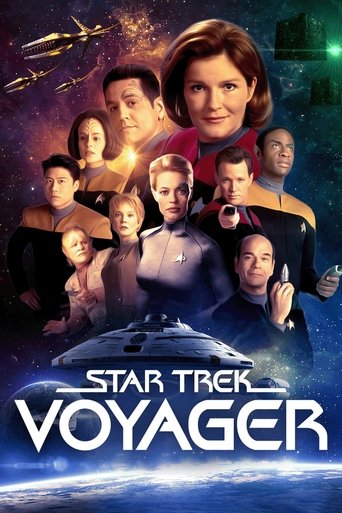
Star Trek: Voyager
1995 · TV series · 45 min episodes · 7 seasons
Created by Jeri Taylor, Rick Berman, Gene Roddenberry, Michael Piller
Science FictionFantasyDramaActionAdventure
Pulled to the far side of the galaxy, where the Federation is 75 years away at maximum warp speed, a Starfleet ship must cooperate with Maquis rebels to find a way home.
11 positive3 negative1 mixed45 neutralfrom 60 commenters
Where to watch
No streaming data for this title.
69 comments on Hacker News
Amazon recently kiboshed a new Stargate television series. The fan community was quite heartbroken because the Amazon had involved some of the writers from the original television series and apparently one of the reasons that they cancelled the show before it made it to production was that the felt that the proposed story would appeal too much to the fans and not new people.
The fans were real heart broken about this but I think you're right on where this is going. We're not going to be seeing the dominance of centrally produced content like this for much longer, like sure, I think there will be big blockbusters will stick around, but I think the day is coming where media becomes a choose your own adventure sort of scenario.
It'll be interesting to see where this scales to. there will definitely be some amazing solo projects but we'll also see the like 4 player co-op version of productions and then the larger mine-craft server 'Minas Tirith' scale ambitious projects that involve a few dozen people. And of course passive consumers will remain a thing, or people who just provide some suggestions or nudges for what they'd like to see others make.
But I don't think it'll be dominated by big companies like Disney, Netflix, Amazon or Paramount.
I'm sure a lot of them will suck but it'll be neat to see the inevitable Seinfield - Star Trek Voyager cross over episodes.
Elaine and B'Elanna Torres feud after a transporter accident leaves the crew stranded the delta quadrant. Jerry attempts to date 7of9 but is rebuffed as she finds Kramer's quirky bluntness more relatable. George panics after someone compares him to Neelix.
There was a good star trek voyager episode, "dreadnought" that was a similar to this, maybe even a direct reference.
That reminds me of a particularly humorous episode Star Trek Voyager where the ship's doctor (who is a computer program projecting a hologram of a middle-aged man with an extremely conceited personality) tries to prove that diseases aren't as bad as humans claim they are by modifying his own code to give himself a simulation of a cold. The "cold" is designed to end after a few days like a real cold would but one of of the crewmembers surreptitiously extends the expiration date while he isn't looking, which drives him into a state of panic when he doesn't understand what's happening to him.
I also have the same feeling about media since around 2015. The prime example being Alien: Earth, which people will argue has immeasurable depth and nuance while when I watched it I just facepalmed a lot. Although it did get better in later episodes.
I feel like no media today has really topped the stuff of the 90s and 00s. Star Trek Voyager season 5 still stands tall above the rest for me. The movie September 5 came close as it had interesting bits.
But besides that, there is a generational thing going on. I felt when I grew up online in the 90s and 00s that people who were older than me were smarter than my generation. My generation watched movies and played games while gen x and baby boomers did hardcore assembly programming and whatever.
And then the same thing happened with millenials and gen z. Gen z is just different from millenials which again are different from baby boomers. Each generation progressively gets less technical it seems like. There are always outliers in every generation of course but I think the trajectory is somewhat clear.
I also think this applies to movies and tv shows. Gen z just thinks differently and doesn't have the same ideas. I don't think a gen z'er could create Voyager season 5, and maybe not even a millenial could. There is so much information and knowledge and perception in the context a generation is born into and grows up in and a lot of that context and information is lost with the next generation.
Star Trek: Voyager(7 seasons, 172 episodes) And they still rushed it at the end.
I remember downloading the last 2 episodes of Star Trek Voyager of of an FTP server through Windows XP's Explorer. 2 WMV files of 50 megabytes each. Took all night. If a single issue had happened I would have had to start the download all over, but it worked out fine!
I got DSL a few weeks later.
Gibson was obviously very inspired by Japan. The Matrix was also in part directly inspired by Ghost in the Shell, even creating The Animatrix at the same time. But Ghost in the Shell and Blade Runner was told from the inside. It is about the authorities chasing down rouge elements. Neuromancer and The Matrix is from the perspective of the outsiders.
Like someone else said in the comments here, cyberpunk is counterculture. It is in the name. Gibson moved to Canada to avoid getting drafted into the Vietnam war. Japan never really did counter-culture as mainstream as the US does. Considering the overlap between cyberpunk and anime, I would actually say that Japan is sometime given too much credit by being treated as the superior original with deeper meaning. When it is Western media that have explored more advanced and diverse interpretations.
A similar thing happened with Battle Royale. A niche movie. The same concept became a cultural phenomenon with The Hunger Games, and later Maze Runner and Divergent series. And then video games. Now made from the outspoken perspective of the teenagers.
So you should absolutely credit the US counterculture and environment for a large part of cyberpunk and dystopian, but also more utopian science fiction. I don't even like Hollywood much, but it still has a far wider catalog than anyone else. Who else could make Grand Theft Auto, Call of Duty: Modern Warfare or even Star Trek: Voyager? Disney made Andor by the way.
The thing about sentient life is we are always finding it odd that everything seems just right for our evolution when that's why it happened in the first place.
Temperatures, resources, distances, orbits, etc.
If there's a world out there without a moon and could not really see other plants and stars, would they have developed the math and science that we have without such motivation? Maybe but slower?
But without our extra large moon, at the right mass and distance, helping tides and lighting the night for hunting, would life even exist? Maybe but not as advanced or a lot slower evolution?
(it's kinda like that Star Trek Voyager episode where they inspire a planet to industrialize after being trapped in their orbit in a dramatic time dilation)
> I dunno. I'd like to give this particular strain techno-futurism back. Can I have a different one please?
This sounds like I'm rewatching the early episodes of Star Trek: Voyager - the gist of the complains is the same as the fictional crew voiced about the AI doctor (Emergency Medical Hologram) they were stuck with when the "organic" doctor died.
The show correctly portrays the struggle of getting people to trust an AI physician, despite it being very good at their job. It also curiously avoids dealing with the question, why even have human/organic doctors, where the EMH is obviously far superior in every aspect of the job? Both of these have strong parallels to the world today.
> The main computer does not make choices stochastically and always understands what people ask it.
The mechanism is never explained, but no, it doesn't always understand correctly — and neither does Data. If hologram-Moriarty is sentient (is he?), then the capability likely exceeds what current LLMs can do, but the cause of the creation is definitely a misunderstanding.
Even the episode where that happens, the script for Dr. Pulaski leading up to Moriarty's IQ boost was exactly the same arguments used against LLMs: https://www.youtube.com/watch?v=4pYDy7vsCj8
(Common trope in that era being that computers (including Data) are too literal, so there was also: https://www.youtube.com/watch?v=HiIlJaSDPaA)
Similar with every time the crew work iteratively to create something in the holodeck. And, of course: https://www.youtube.com/watch?v=srO9D8B6dH4
> I do not think that resembles the current crop of LLMs. On voyager the ships computer is some kind of biological computing entity that they eventually give up on as a story topic but there is an episode where the bio computing gel packs get sick.
"Take the cheese to sickbay" is one of my favourite lines from that series.
> But is minuet?
I would say the character was a puppet, with the Bynars pulling the strings, because the holo-character was immediately seen as lacking personhood the moment they stopped fiddling with the computer.
Vic Fontaine was more ambiguous in that regard. Knew he was "a lightbulb", but (acted like) he wanted to remain within that reality in a way that to me felt like he was *programmed* to respond as if the sim around him was the only reality that mattered rather than having free will in that regard.
(But who has total free will? Humans are to holograms as Q is to humans, and the main cast were also written to reject "gifts" from Riker that time he briefly became a Q).
The villagers of Fair Haven were, I think, not supposed to be sentient (from the POV of the crew), but were from the POV of the writers: https://en.wikipedia.org/wiki/Fair_Haven_(Star_Trek:_Voyager) and https://en.wikipedia.org/wiki/Spirit_Folk_(Star_Trek:_Voyager)
> does eqtransformer have awareness?
There's too many different definitions for a single answer.
We don't know what part of our own brains gives us the sensation of our own existence; and even if we did, we wouldn't know if it was the only mechanism to do so.
To paraphrase your own words:
At what point does chemical pipelines doing some kind of stochastic transformation and electrochemical integration of sensory input become an individual that presents a desire for autonomy like data or the doctor?
I don't know. Like you, I'd say:
> I think there’s lots of questions here to answer and I don’t know the answers to them.
This was already an episode in Voyager, where they had to defuse a bomb by talking to it's AI: https://en.wikipedia.org/wiki/Warhead_(Star_Trek:_Voyager)
Star Trek: Voyager had an — in my opinion — fantastic story about this that non-contiguously spanned more than one episode starting with season 6’s “Fair Haven”.
No one got replaced in these films; additional characters got added.
A sequel or remake doesn't need to be exactly the same as what came 40 years prior.
Back in 1995 Star Trek Voyager added a female captain and a black Vulcan (a first, as far as I know), which passed with little to no comment. Voyager was also widely criticized, but that was just because the writing wasn't very good. Tim Russ' portrayal of Tuvok is generally praised.
Why did they hire a black guy for the role Tuvok even though Vulcans had previously always been portrayed as (very) white? Probably because he was the best actor to audition for the role.
Today I'm 100% sure people would be shouting about "DEI" and whatnot and that Voyager is bad because woke this or that.
Of course, Star Trek also very explicitly did DEI right from the start in the 60s.
What if Fungi were the key to our technological advancement? If we could make fungal computers we could become a bio-technical race like Species 8472 in Star Trek Voyager Season 3 Episode 26.
Can't speak to movies but at this age I loved Star Trek Voyager. Lots of episodic episodes facing real issues/moral decisions.. insightful.
Piracy. This is why piracy is great. Its a tiny digital collection of all the things I care about.
Story time: I was watching Star Trek Voyager. That show is obviously a lot of episodes. So sometime around season 5 it was removed from Netflix. Got pissed, downloaded it, kept watching.
Was recently watching benjamin buttons first time on amazon. Didn't get to finish it that day. Turns out the next day it goes for cash only.
Piracy is honestly the simplest and most consistent way to do this. And if a friend wants it? Bring a USB and it is yours. Sure teeeeechnically we can both watch it, but how often do I re-watch a movie that my friend is currently also watching at home.
Point is that I really hate the current distribution models.
Down side of DVDs is that they degrade.
And to be completely truthful, if everything older than say... 15 years was available in the public domain, we can stop all this wasteful redundant storage everywhere. But due to copyright laws, things so so so old, that they shouldn't be making money anymore continue to be behind "pay walls" of sorts and only because they are protecting a distribution model that hasn't been necessary in over a decade.
There was a 1st Season Episode of Star Trek Voyager called The Phage where a bunch of aliens whose organs were being eaten away by some virus had to continuously harvest fresh new organs from unwitting travelers to stay alive. Is that fictional disease related to the real world virophage?
“If scientific knowledge was all we were after, then the Federation would have built a fleet of probes, not starships. Exploration is about seeing things with your own eyes.”
— Captain Kathryn Janeway, One Small Step, Star Trek Voyager Season 6, Episode 8
Vulcans (and the related Romulans) on Star Trek were always very light-skinned; in the original series and TNG they always appeared with white make-up. Then Voyager had Tuvok (who is black) and no one seemed to mind of complained at the time as far as I can recall. I certainly didn't really take notice of it until today when I started thinking about this entire thing.
Star Trek: Voyager first aired in 1995, so it's been a while. I can't really come up with any meaningful differences between the two cases.
Certainly my reading of "Tolkien's Elves" has always been that they're a very light-skinned (dwarves are more ambiguous). I don't overly care if Elves are black- or white-skinned, just as I don't really care about the skin colour of Vulcans in Star Trek.
Yet at the same time, it somehow feels a bit different. I'm having a hard time to articulate why, but I think a big part of the reason is that it feels more forced with all the rhetoric of the last decade or so where everything and everyone is part of "white supremacist culture" and whatnot over what seem extremely minor issues to me.
Tim Russ was hired to play Tuvok presumably because his audition went well in a kind of "colourblind" hiring that is now, apparently, racist (I have a lot of criticisms of Voyager as a series, but Tim Russ' portrayal of Tuvok is not one of them).
I think what people resent isn't the fact that there are black elves, it's the forcing of it, and that everything is scrutinized at a microscopic level for alleged "racism" (e.g. [1]), and that not going out of your way to be "anti-racist" is racist in itself (as if lots of people don't already have enough problems on their own). I suspect that if the LotR movies had black elves – 20 years ago and in a different time – few people would have raised a ruckus over it.
Fights like this are like argueing over the dishes as a couple: it's not really about the dishes; it's a silly outlet of general dissatisfaction.
[1]: https://theconversation.com/how-hollywoods-alien-and-predator-movies-reinforce-anti-black-racism-127088
So a fun thought experiment, we can store information in DNA now.
What if information was stored in our DNA thousands or hundreds of thousands of years ago? Anatomically modern humans have been around a while now.
How would we go about finding it? If you don't even know something is there or what it would look like if it was there, would be able to find it or even understand it?
The information might even present as behavioral instincts, urges or compulsions. The voices people hear in schizophrenia might be a primitive AI asserting itself.
As usual Star Trek explored this concept too:
https://memory-alpha.fandom.com/wiki/The_Chase_(episode)
https://en.wikipedia.org/wiki/Favorite_Son_(Star_Trek:_Voyager)
There were a few episodes of Star Trek Voyager that involved a holographic version of LdV. Not sure if this was at all based on any historical records or just on Roddenberry et al.'s imagination... I'd guess both.
I'm not browsing netflix regularly but we have a few tv shows which are worth keeping netflix anyway like the current Stranger Things, The Umbrella Academy, Russion Doll, Better Call Saul, ...
Next to that we watch normally one old TV Show which is the easy way to go to. Right now its Friends. Bevor that it was Star Trek Voyager.
Thats enough for me already to not feel bad for paying $10 per month for it.
But than there is also something we don't have in germany: super weird tv shows like 'The floor is lava' or 'is it cake?'. I scroll through them and watch a whole season in lets say 1-2 hours by watching the start and forwarding to the end or so. And there are so many of them and surprisingly interesting like the glass stuff or the chocolate show with Amaury Guichon, which is crazy :D
I thought that this was going to be about some forgotten episode of Star Trek Voyager :(
There was an episode of Star Trek Voyager that had this system in place, ep 7x5 Critical Care
Naturally it was corrupt
It's pretty similar to a Star Trek Voyager episode
https://en.m.wikipedia.org/wiki/The_Thaw_(Star_Trek:_Voyager)
There is an interesting Star Trek Voyager episode Critical Care where people were helped by an AI depending on their social status. I believe they hacked the weights so everyone got a treatment in a part of the episode.
Yeah I think thats exactly whats going to happen. I've been watching old episodes of Star Trek Voyager and laughing to myself the model they used for computers then. Still thinking that a piece of digital data had to be put on a pad and given to someone. I don't think people realize how much in the future we live in right now with tech. A.I. now will train future A.I. and it will get faster and faster.
> The food analogy is shitty because you know what I do when McDonalds takes burgers off of their menu? I go to the grill next door to get my burger.
You don't pull a tantrum on an Internet forum about how you are now forced to hire an anon crew to get into a McDonald's warehouse to get your Mac Something ? Indeed you just go to another service provider to see if they have the Mac Something or something else to satisfy your palates. (sorry I kept the food analogy going).
> and if I've purchaced a streaming service explicitly because of Startrek then I'm going to feel like I was cheated.
Read the lines on the contract. No one is cheated. Especially for the price you are paying by the way. Netflix is still a rental service. (fun fact: Netflix doesn't even have full international rights on its own productions, see: orange is the new black, arrested development).
> You can argue until heat death of the universe whose fault it is, but in the mean time if there is no way of legaly watching the content piracy is the only way.
I will argue until heat death that SG1 content owners are not forcing people to pirate their content. It's just hard cold facts. You may not like it because you feel like you are entitled to it or that it doesn't matter much that no one gets hurt or it's stupid or whatever, that's not really the point. The point is that they are not forcing you. It's on you when you decide to go torrent hunting, launch a DCC+, get popcorn, whatever.
> if there is no way of legaly watching the content piracy is the only way
Doesn't mean you are entitled to it or that you are forced to do it. No one is forcing you to pirate SG1 or Star Trek Voyager. It's entirely on you, own up your actions.
I am not saying you should or shouldn't, I am not questioning the morality of it. All I am saying is "nobody forced you".
> (and importing expensive DVDs in an erra where literally none of my devices have optical bays is not actual option)
Again, that's on you. Not content owner's fault that you don't have a DVD player.
Now let's take a step forward. Imagine you pirated off those SG1 episodes. But then you get a letter from copyright holders and a fine from whatever judicial instances in your country manages these kind of things.
You don't want to pay the fine, you go to courts.
Do you believe for an instant arguments like "I pirated those episodes because they were not available anymore on Netflix, they basically forced my hand ; promised, once they are back up I'll subscribe again to Netflix" will fly ?
Netflix is a rental platform. Like the old DVD and VHS rental shops. And regularly some content gets pull off the shelves because they don't have the licensing fees. It's a pretty well known fact some movies and TV shows come and go on Netflix.
And for what ? Pirating "culture" that is not available on Netflix ? Star Trek Voyager ? I am huge Trek fan but come on.
This is entertainment we are talking about.
> He/she wants to watch a series on a service he/she pays for.
It's like complaining a vegan restaurant doesn't serve meat.
Netflix has very few of the shows, movies and documentaries I can watch on ARTe. Do people complain that ARTe doesn't stream every Netflix shows and vice versa ?
There are a lot of comments on HN when this topic comes up that feel like people want their cake and eat it too "or else I'll just pirate, there's a gun to my head, they give me no choice".
Star Trek Voyager had an episode where the crew got lost in a void 2,500 light years across . . . pretty interesting.
https://memory-alpha.fandom.com/wiki/The_Void_(region)
I recall it changing when Star Trek: Voyager was on the air -- at least for Voyager.
Looking at Amazon Prime, seems the episode length changed from 46 minutes to 44 minutes going from Season 5 (1999) to Season 6 (2000).
(What I was remembering was 47 to 45, but this is a vague memory of a Usenet post I read twenty years ago.)
EDIT: Also, I should note that Voyager was on Fox. If you're talking about NBC specifically, I have no data.
Reminds me of that star trek voyager episode with the fast moving planet “Blink of an eye” Hours in our universe, is centuries on this planet that orbits at an incredible velocity.
There is a Star Trek voyager episode based on this premise. "Distant Origin", in which an intelligent race of hardrosaurs survived the asteroid impact and eventually evolved into a space faring civilization.
star trek voyager had an episode about this
Unintended consequences certainly gets more and more dangerous the more advanced autonomy these weapons gets. In keeping with your mention of sci-fi, there's a Star Trek Voyager episode where two sides of killer robots continue to wage war against each other after having killed their makers because their makers had agreed on a truce, and their instructions had been to eliminate anyone that prevented them from beating their enemy and hence by agreeing a truce their makers had become an obstacle to achieving their programmed goal.
Having done software development my entire life, I'd never trust anyone to manage to avoid every pitfall in guaranteeing you have a foolproof way of making them stop...
There's a good Star Trek Voyager episode that deals with this: https://memory-alpha.fandom.com/wiki/Photons_Be_Free
In this case the holographic doctor writes a novel and there's confusion about who owns the property rights to his work. There was a fascinating panel at Comic Con a few years ago where some prominent lawyers discussed Star Trek episodes like this and specifically brought up the monkey selfie as precedent.
I don't have any answers but it's a good episode.
Edit: The episode is https://memory-alpha.fandom.com/wiki/Author,_Author_(episode)
This is similar to a Star Trek: Voyager episode: https://en.wikipedia.org/wiki/The_Void_(Star_Trek:_Voyager)
> As a PhD in physics, this just sounds like nonsense to me. Energy isn't a field and to polarize it doesn't mean anything.
Not true, they did exactly that on several episodes of “Star Trek: Voyager.” /s
Assuming there's no "[Select] to skip cutscene", which reminds me of a Star Trek:Voyager episode (Blink of an eye https://www.imdb.com/title/tt0708856/)
I really enjoyed the whole Giant series by Hogan.
Star Trek Voyager had an episode with the idea of an ancient saurian species that left earth many millions of years ago. https://en.wikipedia.org/wiki/Distant_Origin
That reminds me a bit of the Star Trek Voyager episode where the a group sends their dead from one dimension to another. Their bodies come through intact but some form of "neural energy emissions" is added to a local energy field.
https://memory-alpha.fandom.com/wiki/Emanations_(episode)
Voyager season 1
US release: Jan 95 UK VHS release: Jun 95 UK TV release: Sep 96
I find it so amusing that Americans complain about having to pay $10 a month for Discovery
Really, the problem isn't scientific. Various sci-fi authors have created all kinds of "hyperspaces" with well-defined rules that would allow for almost any interpretation.
The problem is that it wrecks the drama. Why wasn't this idea used earlier? It's blindingly obvious, not a clever deduction, nor was this some sort of special circumstance (no slingshot around a black hole or some other very unusual thing, for instance). Why won't this be the solution to every battle in the future? Why bother with capital ships if they're so vulnerable to this simple attack? Is the Death Star even necessary if ships can be this powerful on their own? Why did the Rebellion wait so long to deploy this? They'd have been in a wildly better position if they evacuated that ship at the very beginning and used it; the same effect on the enemy, only they have more of their forces left. Why doesn't the Empire, sorry, "First Order" use this on the rebels, sorry, Legitimate Representatives of the Galactic Government Who Are Somehow Still The Rebels? (Although here we come up against the silliness of a sub-light stern chase being the whole movie in a universe with trivial FTL, too. The failures of this movie are like the Shrek onion.)
The problem isn't the science, and it isn't even necessarily that the questions are utterly unanswerable, or that if you try hard enough you can fanon the problem away. (Though IMHO in this particular situation, you must fanon very hard.) The problem is that it raised all these questions, and didn't even acknowledge them, let alone try to address them, and that smacks of bad writing.
There is this popular idea in the writing world that writing science fiction means you can just do whatever you want, whenever you want. The producers of Star Trek: Voyager, for instance, had this idea and clearly articulated it in interviews. And, well, in some sense it's true, but in the sense that it's true, it's no more true in science fiction than it is in any other medium. Nothing stopped Doyle from Sherlock solving all his mysteries by consulting a medium. Nothing stopped Rian Johnson from solving his problem with this particular ass-pull. But being science fiction doesn't prevent the same dramatic consequence happening to the latter as it would in the former. At best it just gives fans a few more avenues for fanon. But that's not good drama.
There are no stakes in a universe where anything can happen at any time.
In particular, I'd highlight that whole Empire/rebels thing again, because that's even more important than the scifi tech stuff. There's just no sensible grand-scale interpretation of the legitimate government of the galaxy being chased by some upstart First Order, and the First Order having all the advantages, literally all of them. (Some advantages, sure, especially around having Sith support. But when did the Galactic government get so anemic? We saw much more strength in tangential fights in the prequels.) Honestly the sequels have been screwed up from the getgo because the writers think they can just do whatever they want, whenever they want, and that the quality never suffers for it. They're spending against an account they don't even know exists and overdrew against it so hard that they may have actually spent Star Wars, Star Wars of all things, dry.
When I first started Netflix, I thought, oh, these recommendations are good, but then I watched one Star Trek Voyager Episode and now all suggestions are about Star Trek.
> By seeking out overvalued assets, short-sellers help rein in animal spirits and prevent bubbles from forming.
Suddenly this article takes an unexpectedly spiritual turn. What are these "animal spirits" and how do they influence markets? It's reminiscent of the Animal Spirit Guide that helped Chakotay in Star Trek Voyager[0]
[0] http://memory-alpha.wikia.com/wiki/The_Cloud_(episode)
There is an episode of Star Trek Voyager (The 37's) where they come across a Red Ford Pickup floating through space.
I can't find a YouTube version of the floating part but here it is in the cargo bay: https://www.youtube.com/watch?v=rD39p7cVS9g
Would be great to VFX the Tesla into the episode.
>“More data” is not inherently good. Without a framework of information for interpretation of that data, it will do far more harm than good.
There's an episode of Star Trek: Voyager about this[1]. Seven of Nine absorbs months worth of data (way more than a human could actually process) from the ship's computer, and "discovers" that both half of the ship plans on mutinying and that the Captain wasn't actually trying to get them home. Both of which were false.
1. http://memory-alpha.wikia.com/wiki/The_Voyager_Conspiracy_(episode)
I experienced this recently in the scariest of circumstances -- a hospital.
I have hemophilia, a bleeding disorder. Normally, its a nuisance that just requires I take medication on semi-daily basis. If I don't take the medication, I'll usually be fine, except if I have an active bleed, which will just continue to bleed, causing damage to my body, and can be life threatening depending on the location of the bleed.
I was recently traveling back home and I ran out of my medication. It's a specialty medication that you can't find in pharmacies. It normally has to be shipped to me. I had ordered some but it wouldn't arrive for another day.
I was having an active bleed in my torso, of all places, which is an odd place and distressing because its close to so many important body systems (the spine, major arteries). The thing about my condition is that normally bleeds are innocuous, but you never know. I always be on the safe side, because when I haven't its often meant months-long recovery.
Anyway, I figured no problem, I'll just go to the hospital ER and get some medication, which is what I'm supposed to do and I've done before -- but not in a long time. Most all major metro hospitals carry my medication.
I went to the hospital and told them about my condition and what I needed. They wanted me to take a CT scan, which I declined (I already knew what I was dealing with and just needed my medication). Then, they wanted to test me for hemophilia (I've had the condition since birth), a very expensive and lengthy test that takes hours.
After finally speaking with a doctor, he declined to give me my medication until I both consented to the CT scan and the test for hemophilia (despite me having official medical identification that explains my condition). I didn't want the CT scan because its ungodly expensive and exposes your body to a lot of radiation (100x an x-ray). You could clearly tell it was a bleed due to swelling, bruising, heat, and my prior medical history. And I've lived with the condition for awhile so I am very attuned to these problems.
I experienced what I can only describe as a similar type of hostility as someone coming in seeking drugs to get high (my medication neither makes you high nor is dangerous, except when I don't get it).
Curious as to why I was being treated this way, I pressed further. The doctor came back with a print-out from some medical "AI" software. It had not only determined what the proper course of action was to be (the tests before my medication), I was also informed that if the staff deviated from the "process" at all, they would risk being fired.
There you have it. All decision-making ability had been revoked from even the doctors. They were prepared to let me bleed for hours, while waiting on a test to confirm a condition I've had since birth rather than risk deviating from some computer-generated "AI" policy. Even more sinister, since it was a screenshot (done with print screen) of the windows-based software, I spotted something else: something called a "risk score". It was a gauge-like visualization that had rated me in the "riskier" category. No doubt this was also the case with patients who are drug seeking, and I hypothesize this was the reason for the apathy and apprehension I detected.
It kind of reminds me of the Critical Care episode of Star Trek: Voyager, where patients have been reduced to a "TC" -- treatment coefficient that determines who gets good care and who doesn't and is based on the person's accomplishments and value to society. Honestly, we're not far off from that.
What would happen if I came into the ER with a serious problem that required immediate treatment? Would they defer to this software and watch me die while waiting on tests? I know my condition is rare, I'm used to educating doctors about it, but the fact that the doctors seemed unwilling to even compromise and do the right thing was alarming to me, and also sad. Its like they have become customer service representatives of a large corporation and they know it, and so they have divorced themselves of any care or humanity at all.
I decided to leave and take my chances on waiting the day, rather than sit there for hours. At that point, I was in extreme pain and I honestly didn't know if the bleed would resolve itself or not. Worse case, I could always come back to the hospital. I guess.
The bleed ended up resolving itself, and I eventually got my medication and was able to treat myself. Ironically, a nurse called later the next day to "check up on me". My tests had finally come back over a day later and confirmed my condition, and also that my factor level was low. After I told her the story I've just shared with you, all she could offer was to "make a note in your chart". That no-one will be looking at, and likely not influence the medical software at all. I looked on the hospital web site for contact information to try and lodge a complaint -- there was none. I also tried calling the hospital's 800 number, which was entirely automated and offered no ability to talk to anyone. In case anyone is wondering, the name of the hospital is Riverside in Columbus, Ohio (part of Ohio Health). It's a huge hospital.
Anyway, this is my story about AI. Something to think about because as engineers we are the ones making these kinds of software and have an ethical and moral responsibility. We need to be aware of how people are going to use technology and actively work to prevent abuses, and hopefully build this into the software itself.
What kind of science fiction novel are we living in?
Dexter, of Dexter's Laboratory fame, thought of it (of course). See "Morning Stretch": https://youtu.be/DWU5U8NxeCA?t=33m32s
In view of all the complications he discovered, maybe a room (or house) which simply stops biological aging of those inside would be preferable... at least until the government starts taking notice: https://en.wikipedia.org/wiki/Way_Station_(novel)
In stories connecting different worlds, time sometimes runs at different rates. A classic example would be the Chronicles of Narnia: https://scifi.stackexchange.com/questions/94204/how-much-time-passed-between-the-lion-the-witch-and-the-wardrobe-and-prince-ca
Of course, to somebody living in a world where time runs fast, venturing out into the "normal" universe would be equivalent to stepping into your imagined room. This happens in one of the better Star Trek Voyager episodes: https://en.wikipedia.org/wiki/Blink_of_an_Eye_(Star_Trek:_Voyager)
There's an excellent episode of Star Trek Voyager where the Borg crewmate Seven of Nine installs a component into her brain that lets her sift through Voyager's immense dataset, and results in her secretly telling the first officer that she believes that the captain is a part of a grand and dark conspiracy.
Then she runs the dataset again, and goes to the captain to say the exact same thing about the first officer.
Happy Netflix user but the quality especially of old-ish series is beyond infuriating.
I have untouched-DVD rips from Star Trek Voyager. Single episodes run around 2 GB of data, while the same Netflix episodes are ~200MB.
Not only does Netflix not carry the bonus stuff, but the quality is seriously braindead - weird moire effects in the intro, for example, and it just looks pixelated.
In fact, the "scene rips" tend to look better than what Netflix offers! And it's certainly not due to low network quality, I've got a 100/20 connection and stuff like Shadowhunters is clear HD.
This always reminds me of the Star Trek Voyager episode "Year Of Hell"
Guy runs around with a ship that can destroy objects through all of time. Causing all of history to be rewritten. Trying to get his wife back after his home planet was destroyed. Manages to restore everything but his wife and goes mad trying to get that to happen.
Reminds me of Star Trek Voyager episode.
This reminds me of the episode where the Q on Star Trek wanting to commit suicide because they were bored of being immortal. https://en.wikipedia.org/wiki/Death_Wish_(Star_Trek:_Voyager)
Of course, that supposes such a level of immortality that we actually do experience anything and everything there is to experience. And we're nowhere close to that yet.
Maybe once I get to see attack ships on fire off the shoulder of Orion. Or C-beams glitter in the dark near the Tannhäuser Gate. Maybe that'd be a good time to die.
When I read Dragon's Egg a few years ago, I realized that it had been the basis of my favorite ST:VOY episode:
https://en.wikipedia.org/wiki/Blink_of_an_Eye_(Star_Trek:_Voyager)
Of course they wouldn't match reality. Only reality can match the experience of being detained and violated without knowing when or if you will ever be allowed to leave.
In an early episode of Star Trek Voyager, the emergency medical hologram subjects himself to a time-limited disease program ostensibly to better understand his biologc patients' suffering, but claims to do so to demonstrate that illness is no excuse for poor productivity. When the disease afflicts him for hours after the programmed end time, he freaks out. Later, his nurse tells him she extended the time, because "the worst part about pain is not knowing when it is going to end."
Perhaps the best way to match reality is to drug the aspiring officers, stash "contraband" inside one of them, then subject all of them to the same invasive searching until the "drugs" are found. The "smuggler" then has to spend an undetermined amount of time (~1 week) in a jail (not prison, jails are for temporary holding) cell under an assumed crime in another district, as to ensure the jailers treat him or her the same way as any other criminal.
The ship's computer in Star Trek: Voyager was biological, with bags of neural tissue networked together. There's an episode where the ship literally gets sick along with the crew: it's what I thought of immediately after reading the headline.
I didn't like DS9 when I was a kid. Same for Babylon 5. However gave it a try three years ago and watched all seven seasons. Enjoyed it much. Especially the last seasons are very good. There are also single episodes with very unique stories.
Also don't forget star trek: voyager, my personal favorite.
“If scientific knowledge was all we were after, then the Federation would have built a fleet of probes, not starships. Exploration is about seeing things with your own eyes.”
— Captain Kathryn Janeway, One Small Step, Star Trek Voyager Season 6, Episode 8
(Previously: https://news.ycombinator.com/item?id=8751282)
It actually helped me to more appreciate a funny episode in Star Trek: Next Generation where the hologram doctor becomes an esteemed musician among a species that previously didn't have music, because they saw it as an amazing mathematical feat.
I think it was Star Trek: Voyager and not TNG.
“If scientific knowledge was all we were after, then the Federation would have built a fleet of probes, not starships. Exploration is about seeing things with your own eyes.”
— Captain Kathryn Janeway, One Small Step, Star Trek Voyager Season 6, Episode 8
> then it is not being run by our descendants.
I see what you are saying, within the bounds of the article, the Basilisk, requires that our descendants are simulating our present. But by necessity, our genetic descendants would also be members of the simulated universe. Of course, they don't have to simulate the entire universe, they only have to simulate the local part that immediately affects what we do. So long as the model we're in produces equal results to "reality" it's good enough.
All simulation hypotheses discount two other kinds of descendants, intellectual "descendants" for one. Observers of the simulation who learn or are influenced by the simulants. Just like I might run a program on an emulated Commodore 64 and be exposed to some idea I hadn't considered before.
"Escapees" - e.g. Tron: Legacy, Agent Smith from the Matrix movies, The Doctor from Star Trek Voyager. Simulated mentalities which find an external host to "upload to". In the case of Tron movie, the particle laser thing constructed a body for Quora, in the Matrix movies, Smith uploaded his consciousness into a real human and in Voyager the doctor was given a portable hologram generator to let him leave the holodeck/sick bay. Any of these could potentially produce a long of descendants.
I can't speak for your specific example, but there are some theories that equate the massive technology leap we had in the 50s->present day has been due to reverse engineered alien technology.
In fact Star Trek: Voyager did a two part episode that used this conspiracy theory as part of the main story line.
I believe that there was a similar premise in a series of Star Trek: Voyager episodes, where a businessman steals a time traveler's technology and uses it to bootstrap the modern computer industry.
> In the TV shows and movies, they never seem to spend more than a few days at a time going anywhere at warp speed.
There are a few canon reasons for this:
1) Ignoring special episodes (and all of Star Trek Voyager) where they use a contrivance to hurl the ship tens of thousands of light-years, the working range of a starship on Star Trek is relatively small:
* The distance to the Romulan Neutral Zone, on the outer fringes of Federation Space, is only 28 light years away from Earth.
* Deep Space 9 (so named because it's on the outer frontiers of known space) is 70 light years away from Earth.
* Oo'nos, the Klingon homeworld, is ~100 light years away from Earth.
2) Ship speed exponentially increases as warp factor increases, and by the time the USS Enterprise-D is in service, warp 9 is fast, but not "I need to get there immediately because every plot shown on TV is an emergency" fast. The maximum sustainable speed for the Enteprise-D is warp 9.6, which is 1,909 times the speed of light. This would allow Picard to reach even Qo'nos from Earth in under 3 weeks.
3) With the exception of the JJ Abrams franchise (where they seem to keep going back to Earth after every mission), the ships featured in Star Trek are generally exploratory: between each episode, they'd roam their mission areas performing routine work. The episode plots would generally revolve around them dealing with an issue that happened to be close to wherever they happened to be at the time.
Of course, being a set of TV series and movies, liberties with distances were routinely taken. For example, in the first episode of Enterprise, they say Qo'nos is 4 days away from Earth at warp 4.5, which would place it less than half the distance between Earth and Alpha Centauri, the closest star system.
For context, I'm 34, and like many around here a bright teenager. One thing that I really missed was story coherency, the careful assembly of motivations, events, themes, and characters into a cohesive whole. I don't even know how to describe my standards for a good story as a youth, but they're wildly different than they are now, and in particular many of the things I enjoyed then I now consider incoherent nonsensical trash. Things like Star Trek Voyager, which I always found weak, but now I can explain that weakness, or Final Fantasy X, which merely slightly bothered me at the time, which I now realize is because it was so bad it managed to penetrate the thick fog of blissful ignorance I was living in, but only a little. On the other hand, many of the original Star Trek episodes actually make a great deal more sense to me now than they used to. (It's fun to read the Blish novelizations of them; without the campy 60s videography and terrible effects, the true quality of the underlying stories comes out more clearly.)
I woke up to this around 25 or so. It was actually Buffy the Vampire Slayer (the TV series, of course, not the forgettable movie) that tripped this for me; I realized I cared far more about the characters than any campy horror show had any right to make me care, and I began to wonder why, and poke into the mechanics of how that was done. That turned out to be a longish and interesting journey.
(I know I've mentioned several media that aren't "reading" here, but it trivially applies there as well.)
There is a Star Trek Voyager episode where three humanoids on a planet survived a natural disaster that destroyed their planet by going into stasis and having their brains stimulated by a computer simulation for over 19 years. In that time, the adaptive computer responded to their worst fears by turning the "fun" model world full of clowns and dancers into a circus nightmare. The virtual characters created to entertain the survivors turned into sinister clowns. The head clown, and the manifestation of fear itself, has full access to their brains and would adapt to circumvent any attempts by them to leave his world or terminate the stasis.
There is a Star Trek Voyager episode on the idea of dinosaurs leaving earth. http://en.memory-alpha.org/wiki/Distant_Origin_(episode)
It is one of my favorite Voyager episodes.
My point was that the purpose of watching this kind of TV show isn't to gain specific knowledge; it's about the progression of events towards the goal.
I just finished "Star Trek: Voyager", so I'll use that as my example. In the first episode, they get stranded far away from home. You know they're going to make it home because that's how stories work. Does that make the show spoiled? Well, they saw reason to make 7 seasons of 24 episodes, so I'm guessing it wasn't spoiled.
Actually, studies[0] have shown that spoilers make stories more enjoyable.
[0] http://www.wired.com/wiredscience/2011/08/spoilers-dont-spoil-anything/