 Hacker Cinema
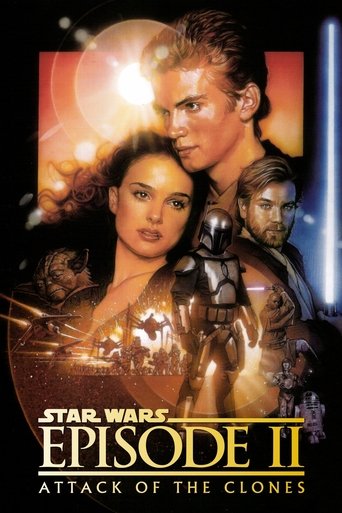
Star Wars: Episode II - Attack of the Clones
2002 · Film · 142 min
Part of Star Wars Collection
Directed by George Lucas
AdventureActionScience Fiction
Following an assassination attempt on Senator Padmé Amidala, Jedi Knights Anakin Skywalker and Obi-Wan Kenobi investigate a mysterious plot into the heart of the Separatist movement and the beginning of the Clone Wars.
5 neutralfrom 5 commenters
Where to watch
No streaming data for this title.
5 comments on Hacker News
Collateral was not the first fully digitally shot feature film. In fact, Collateral was not even fully digital. (The first major, all-digital, HD feature film was Attack of the Clones, but there were other fully-digital feature films before that, just not as major, and/or not always HD. Robert Rodriguez' Once Upon a Time in Mexico (2001) was fully digital.)
But you are right that Collateral did do something very new/unusual at the time, and that was shooting scenes in higher frame-rates than 24, and mixing multiple frame rates in a film. (This might not sound like much, but until this time, pretty much every film was 24fps for the previous eighty years and it had a very specific look that everyone's eyes/brains were conditioned for, unbeknownst to them.)
And the other thing that was very interesting thing about it (though not something very visible to a viewer) was that it was shot on the Thomson Viper FilmStream camera[1], which was the first major attempt at shooting not just digital, but very close to "raw". It was also a huge pain in the ass. The camera itself was massive, but due to the bandwidth, it recorded to an external storage array that had to be pushed alongside it at all times, and that was itself about the size of a shopping cart. (This device was hilariously referred to as the "Director's Friend.")
In 2002, my friend and I, both cinema nerds in high school, drove an hour away to the nearest theater showing a film called Russian Ark[2]. Why were journeying to to see a strange little Russian film where a never-named character walks the viewer through Russian history? Because just like each episode of the recently-released Netflix show Adolescence, this entire film was a single, very long, very complicated, unbroken shot. One shot. No trickery, no cuts that were just hidden to the audience, one shot, through streets, buildings, snow, ballrooms with a couple hundred choreographed actors, it was crazy. This is easy now compared to how it was back then.
As we've now established with Collateral (and this film predates it by 2 years), digital cinematography existed, but the storage was a real problem, the power was a real problem. Since this film was one shot, it needed almost 100 minutes of both, unbroken. And since it was a very complex moving shot, it had to be operated handheld. So essentially they had an incredibly ripped director of photography who operated the camera on a steadicam the whole time while a giant array of daisychained batteries and hard drives were lugged behind him. And they did it something like 100 times until they had a few takes where there were no mistakes.
None of this really means anything to anyone anymore, but at the time, to cinematography nerds at least, this stuff was all absolutely insane!
[1] https://web.archive.org/web/20040103133953/http://www.thomsongrassvalley.com/products/cameras/viper/pdf/viper_ds.pdf
[2]: https://en.wikipedia.org/wiki/Russian_Ark
I agree Glassdoor is in an unusually difficult niche, but rating systems are all over the place.
Steam reviews are interesting because I have started watching someone’s YouTube lets play instead. Even bad ones are mildly interesting and they quickly tell you a lot more about the game than what I get from random reviews.
The best online review system for me is Rotten Tomatoes which shows both what the general public thinks and what the critics do. Looking at say https://www.rottentomatoes.com/m/star_wars_the_rise_of_skywalker I appreciate many of the viewers liked it, but it’s the critics that I find actually agree with. Yep, worse than the prequels, but not quite walk out of the movie theater bad. https://www.rottentomatoes.com/m/star_wars_episode_i_the_phantom_menace, https://www.rottentomatoes.com/m/star_wars_episode_ii_attack_of_the_clones, or https://www.rottentomatoes.com/m/star_wars_episode_iii_revenge_of_the_sith
> I would not be surprised if Death Star construction was initiated during the Old Republic.
It actually was. In the prequel trilogy, we see that the Separatists have plans for it, which are then acquired by the Empire at the end of the film.
> The first Death Star's schematics are visible in the scenes on Geonosis in Star Wars: Episode II – Attack of the Clones showcasing the early development of the Death Star prototype, the Death Star plans were designed by Geonosians led by Archduke Poggle the Lesser, a member of the Confederacy of Independent Systems, and is shown early in construction at the end of Star Wars: Episode III – Revenge of the Sith.
https://en.wikipedia.org/wiki/Death_Star
BRAAAM is first heard in Star Wars Episode II: Attack of the Clones (8 years before Inception): https://youtu.be/3ME5jhsgmB4?t=53 (two in a row spot-on BRAAMs)
Both _Attack of the Clones_ and _Revenge of the Sith_ were projected digitally as well as on film. And yes, if you looked closely at some points you could see the pixels on the projection. (Although _Attack of the Clones_ was also one of the first movies shown in IMAX via process of taking a 35mm film print to IMAX film[0]. So with _Attack_, instead, they upconverted a 2K master that was derived from 1080p source to IMAX film stock (as far as I know). Yes, it had a lot of weird smoothing artifacts when seen projected on an IMAX screen.)
[0] http://en.wikipedia.org/wiki/List_of_IMAX_DMR_films