 Hacker Cinema
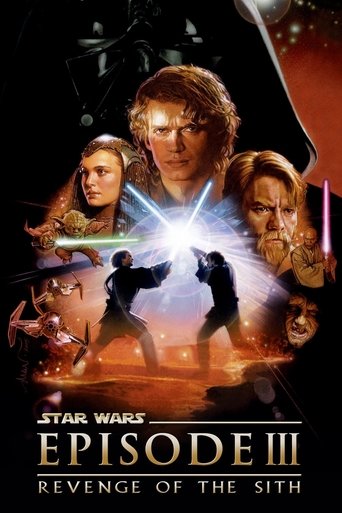
Star Wars: Episode III - Revenge of the Sith
2005 · Film · 140 min
Part of Star Wars Collection
Directed by George Lucas
AdventureActionScience Fiction
When the sinister Sith unveil a thousand-year-old plot to rule the galaxy, the Republic crumbles and from its ashes rises the evil Galactic Empire. Jedi hero Anakin Skywalker must choose a side.
1 positive2 negative9 neutralfrom 12 commenters
Where to watch
No streaming data for this title.
12 comments on Hacker News
The reason that’s okay is because you aren’t competing against the initial source material. A thumbnail on Google for “Revenge of the Sith” is not a replacement for watching the movie.
But, a lot of AI products are specifically and explicitly designed to obsolesce the thing they trained off. No need to go to Encyclopedia X or the NYT, this has the same content.
> Part of my point is that you don't need to produce literally equivalent output. Again, if I record and compress "Revenge of the Sith", there's literally zero pixels shared between my recording and the actual movie. Cool, so I can go upload it for free then right? No, I can't.
That's because you would be redistributing the actual material, just in a really roundabout way. GenAI models are not that, they're not a database and don't work like one.
> Can GenAI produce indistinguishable images to what's on Getty Images?
That doesn't matter because you can't copyright a style. From the point of view of copyright law, it would look like you were copying nothing proprietary/owned at all.
Rifftrax does something very similar, except to mock the films. It made "Revenge of the Sith" entertaining.
I agree Glassdoor is in an unusually difficult niche, but rating systems are all over the place.
Steam reviews are interesting because I have started watching someone’s YouTube lets play instead. Even bad ones are mildly interesting and they quickly tell you a lot more about the game than what I get from random reviews.
The best online review system for me is Rotten Tomatoes which shows both what the general public thinks and what the critics do. Looking at say https://www.rottentomatoes.com/m/star_wars_the_rise_of_skywalker I appreciate many of the viewers liked it, but it’s the critics that I find actually agree with. Yep, worse than the prequels, but not quite walk out of the movie theater bad. https://www.rottentomatoes.com/m/star_wars_episode_i_the_phantom_menace, https://www.rottentomatoes.com/m/star_wars_episode_ii_attack_of_the_clones, or https://www.rottentomatoes.com/m/star_wars_episode_iii_revenge_of_the_sith
> As an example, despite the Star Wars: Episode III - Revenge of the Sith prompt containing text from a single scene, the 0.7 temperature generation imputes characters and lines of dialogue from much further into the movie
This makes me believe it is actually just memorizing the movie script, which is probably in its corpus. As pointed out here, the model has enough parameters to straight-up memorize over 1/3 of its gigantic training set.
https://lambdalabs.com/blog/demystifying-gpt-3/
> who even writes subtitles?
I do, as a hobby. Typesetting in particular is one of the most rewarding things I've ever done. There are few things as satisfying me as being able to set a sign so that it looks like it's part of the video.
If you're curious, there's a tool out there called Aegisub. Pretty much every fansubber uses it, and it can handle most parts of the process: timing, typesetting, TL/editing, and it shows you a preview of what it looks like muxed with the video (though you do need a separate tool to actually generate muxed MKV files).
> Both are in English, so I don't see why they can't just transcribe what's being said. Instead, for dialogues such as "The greatest trick the Devil ever pulled was convincing the world he didn't exist.", the subtitle is written as "The devil tricked the world into thinking he didn't exist."
You have entered the wonderful world of Hong Kong bootlegs, which are usually just called "HKs". The people who work on these just plain don't care. They translate the movie into Chinese, and then for whatever other language they release subtitles in, they just Google Translate their Chinese subs into that language, even if it's the movie's original language.
Fansubbers hate them, and if the show or movie in question was never officially released in English, there are some groups who will clean up these subtitles to make them more presentable and fixing the godawful grammatical errors (this is called "scrubbing"). Of course, you're still left with a shitty base TL, but it's at least better than the HKs-as-is, so these scrubs are always just a stopgap until somebody can do a full TL. And there are some groups who will subtitle a series from scratch just to spite the HKs.
The only thing good about these subs is that they tend to turn into memes. I'd recommend looking up the HKs of Revenge of the Sith, which ended up becoming an impressive stockpile of memes, most famously being the origin of "Do not want!". For memes that came out of shows I actually watch, I'd recommend googling phrases like "Don't molest the lawyer" and "Gao Main Bastard".
> I would not be surprised if Death Star construction was initiated during the Old Republic.
It actually was. In the prequel trilogy, we see that the Separatists have plans for it, which are then acquired by the Empire at the end of the film.
> The first Death Star's schematics are visible in the scenes on Geonosis in Star Wars: Episode II – Attack of the Clones showcasing the early development of the Death Star prototype, the Death Star plans were designed by Geonosians led by Archduke Poggle the Lesser, a member of the Confederacy of Independent Systems, and is shown early in construction at the end of Star Wars: Episode III – Revenge of the Sith.
https://en.wikipedia.org/wiki/Death_Star
Right? The whole time I was watching it all I could think was "this really isn't all that impressive".
Most of what they did is stuff that's been in movies for decades. There wasn't anything really interesting. I mean, almost all of Revenge of the Sith was digital sets. Avatar's use of the same techniques is much more impressive, especially when you consider they did some rendering on the fly so James Cameron could see the digital world on a screen while filming.
Both _Attack of the Clones_ and _Revenge of the Sith_ were projected digitally as well as on film. And yes, if you looked closely at some points you could see the pixels on the projection. (Although _Attack of the Clones_ was also one of the first movies shown in IMAX via process of taking a 35mm film print to IMAX film[0]. So with _Attack_, instead, they upconverted a 2K master that was derived from 1080p source to IMAX film stock (as far as I know). Yes, it had a lot of weird smoothing artifacts when seen projected on an IMAX screen.)
[0] http://en.wikipedia.org/wiki/List_of_IMAX_DMR_films
When it comes to cinema, optical fundamentals are the most important for getting high production value from an indie budget. That means lenses of course, but this is a camera we're talking about, which means sensor size has a huge impact. Compare the size of this camera's sensor (About micro-4/3s) to APS-C and Full frame 35mm. It is about 1/4th the size of a full frame sensor.
https://en.wikipedia.org/wiki/File:Sensor_sizes_overlaid_inside.svg
A larger sensor allows for better low light images with less noise. It also allows for significantly more control over depth of field (and it is this control that distinguishes "cinema" from "video" in people's minds to a great degree.)
You can buy HD (2k) shooting cameras with full frames from Canon for about this price. You can buy APS-C 2k cameras from Sony for 1/3 the price (leaving more money for nice lenses). The NEX-7 seems to be a pretty ideal choice, in fact.
Sure, these cameras don't shoot RAW, but then, you don't really need RAW. RED made RAW popular with their no compromises approach and that's very nice, if you have the money, but notice that RED didn't compromise on their sensors, and actually has (or is promising, you never know with RED) very large sensors. 24mbps HD is more than sufficient for indie filmmakers in most cases. Granted, I think a 48mbps compressed stream would be about ideal. I wish Sony and Canon would make that an option.
I think in this camera, so much went into the ability to record in RAW that to make their price point they had to compromise on the sensor, and that's the wrong compromise. You pull raw off of the sensor in every camera, but carrying it all the way to the storage medium forces you to spend a lot of money on each stage, including shipping the camera with an SSD, and naturally, Thunderbolt then makes sense, but it too adds to the price.
At sundance I've seen movies shot on DV (an SD format) that worked as movies. We've all seen HD movies in the cinemas- for instance Revenge of The Sith was delivered as a 1920x817 frame- HD cut down to make a wider aspect ratio.[1]
And of course when you're working with RAW it affects the rest of your production pipeline- you need more storage space to keep your footage, backups get bigger, you need more bandwidth to your storage and you need a heavier CPU to work with it, etc. The final deliverable isn't going to be RAW, its likely to be HD (at least in many cases) and so I'd rather spend that budget on optical quality, and in a camera that means sensor.
I do hope these guys find great success, as the japanese really could use some good competition.
[1] http://en.wikipedia.org/wiki/CineAlta
-----------------
Edit to add: I wrote the above response based on the EOSHD article, but checking the BlackMagic website, I better understand why they made the choices they did. I still think that if they'd gone with an APS-C sensor, or full frame, this would be much more exciting. But now I'd weight their choice of improved capture via raw as about equal to the impact of sensor size in image quality.
Almost all books are better than movies, even novelizations based on movies are often better - "Revenge of the Sith", "Ironman", and "Terminator Salvation" for examples are all much better than the movies. The only times I have seen movies that were as good, or better than, the novel were where they were very different.
IMDB reports that 2322 movies were released in 1939 alone, is it really surprising that there were a handful of good movies among them?
1980 for comparision, IMDB lists 6007 movies (8000+ if you include TV movies), and contains modern (popular) classics such as Stir Crazy, Superman II, Empire Strikes Back, Airplane!, The Blue Lagoon, Ordinary People, Urban Cowboy. The Shining, Caddyshack, Raging Bull, Friday The 13th, The Fog, The Blues Brothers.
Hmm, looks like 1980 was a much more 'classic' era than the 40s for hollywood, but you wouldn't have heard that from film buffs in the 80s.
Hollywood has always been a great abuser of the 'sling lots of shit at the wall and see what sticks' approach to 'greatness', they're just slinging a lot more shit these days.
Even if we take a really contemporary year and do the same study, we see a pattern of greats no matter what year, take 2005 at random:
Batman Begins, Sin City, V for Vendetta, Revenge of the Sith, King Kong, Brokeback Mountain, Harry Potter/Goblet of Fire, Serenity, Charlie and the Chocolate Factory, Mr & Mrs Smith, Wedding Crashers, Munich, Saw 2, Hostel, Hitchhiker's Guide to the Galaxy, Madagascar, Pride & Prejudice, Land of the Dead.
Ah, but the movie buff will point out that they're not established classics like Gone with the Wind, or Wizard of Oz. Not yet, anyway.
Edit: Btw, for 2005, the number of movies was 28,000+. Is it any wonder that there is a lot of formulaic stuff in there as well?