 Hacker Cinema
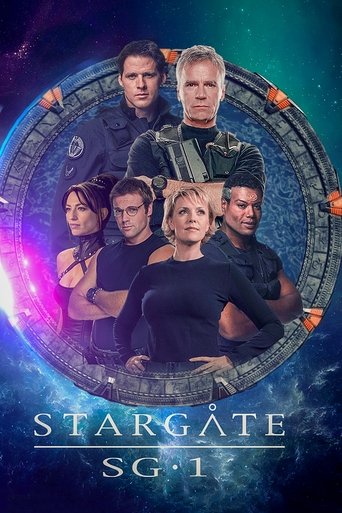
Stargate SG-1
1997 · TV series · 42 min episodes · 10 seasons
Created by Brad Wright, Jonathan Glassner
Science FictionFantasyActionAdventure
The story of Stargate SG-1 begins about a year after the events of the feature film, when the United States government learns that an ancient alien device called the Stargate can access a network of such devices on a multitude of planets. SG-1 is an elite Air Force special operations team, one of more than two dozen teams from Earth who explore the galaxy and defend against alien threats such as the Goa'uld, Replicators, and the Ori.
20 positive4 negative1 mixed27 neutralfrom 52 commenters
Where to watch
No streaming data for this title.
57 comments on Hacker News
I think most people here are talking about the Stargate SG-1 TV series and not the movie.
Just a funny observation, apologies in advance:
I am rewatching Stargate SG-1 with my children right now and cannot read this comment except in the voice of Teal’c.
In the previous episode the team was in 1969 on a hippy bus.
My advice is to chill out a little…
The problem with Plex is that is has a very opinionated system that ignores how things are in real life.
One example I can point to is Stargate SG-1. Episode 1 is a two parter and depending on who you ask it's either Episode 1 and 2 or Episode 1 which causes all subsequent episode numbers to be thrown off by 1 depending on how you count.
This confusion is further complicated by the release order on DVD/Bluray, the order of airing, and the fact that all of these things can be different in different regions of the world.
And that's just one show.
The film is another story, but the show Stargate SG-1 is a boomer series because:
- In most of the episodes, the assumed leader is Colonel Jack O'Neill, who is literally a boomer and fits perfectly into the stereotype. The character's purpose is to show that positive qualities of boomerism win, while sarcastically dismissing the value of everything new.
- It's a patriotic military Sci-Fi that portrays the US military as mostly good. Reverence for the United States military is strongest with Boomers. Similarly, the theme of "American exeptionalism" is strong throughout the series.
- For a show made in the 2000s, Colnel O'Neill's consistent distrust of the Russians, contrasted with the relative openness displayed by other characters, is rooted in Cold War experience that strongly resonates with Boomers.
To be clear, I'm not saying any of this is bad. Personally I think it was a good show. Rewatching it today gives me nostalgia both for the show and the ideals of the era.
You're mixing up a lot of things that don't really belong together here.
To the broader point, Star Trek is a major cultural export of the USA, and has always shown what are now considered to be anti-right-wing ideals, from the Cage daring (by the standard of the era) to have a woman in a senior role in the command hierarchy rather than a traditional gender role, to the main series putting a Japanese officer on the bridge in the shadow of WW2 racial tension, a black woman on the bridge as a main-cast role even though US domestic politics were the Civil Rights era, and a Russian officer also on the bridge despite the US international politics being the Cold War era.
By the films (perhaps sooner, IDK I'm not that nerdy), the canon was the Federation no longer used money.
Later, Top Gun and Stargate SG-1 are both on-the-nose US military propaganda; the latter achieved success even though Sam Carter was not at all a traditional gender role, even introduced with stereotypical gender hostility before Jack O'Neill accepted her as an equal. Stargate Universe failed despite pushing the civilian scientists into military training, IMO because it was trying to be reboot-BSG with different set dressing, putting off all the people who wanted more Stargate without attracting anyone who wanted more BSG, but again, BSG itself managed to be a major cultural export despite the not-traditional-gender-role-conformant characters of Laura Roslin, Starbuck, and (even if they were not really human) Number Six and Number Eight.
In specific details of what's mixed up and why it doesn't work together:
> Yes, the "far right christian ideologies", such as masculinity, traditional gender roles, patriarchal values, self sacrifice and fighting for your kin and country, protestant work ethic and entrepreneurship, protecting your borders against foreign invaders, hierarchical social structures based on merit, the same values and ideologies that built and made the western anglo-european civilizations the envy of the world superpowers, that got us to the moon, and where the rest of the world wants to emigrate to.
Some of that is indeed far-right (masculinity, patriarchal values, and what is currently seen as "traditional" gender roles while actually missing both what those were and why they were fundamentally changed by inventions such as the washing machine and childhood vaccination).
"Self sacrifice", "fighting for your kin and country", and "protecting your borders against foreign invaders" are basically everywhere, those didn't help differentiate "the western anglo-european civilizations" from anyone else, you'll find the former in every culture we have records for, and the latter two (if you accept "territory" rather than "country") even more broadly in species whose most recent common ancestor we share was when dinosaurs still ruled the earth.
"protestant work ethic and entrepreneurship", I mean the Catholics would like a word about the former, let alone historical references like the Islamic golden age having already finished three centuries before the Protestant reformation and China being busy as the Middle Kingdom for most of world history right up until the west surprised them with the Industrial Revolution; and if "entrepreneurship" is limited to "far right" then the USSR getting to space first and China doing pretty well in the last few decades are also counter-examples.
"hierarchical social structures based on merit" covers everyone except anarchists and hereditary rule, I think?
> and where the rest of the world wants to emigrate to
No we don't.
At this point, lots of us are skipping the USA even just for holidays and business trips, let alone migration.
> But at the end of your life, total it all up. You should have produced more than you consumed. That’s what it means to be a good person.
Summing up one's life in terms of "production" and "consumption" is such a broken way of looking at things.
I will be kind to people. I will be patient with them. I will try to help them. I'll try to make the world a better place in all the little ways I can. How much or how little I "produce" has no bearing on whether my life will be weighed as good or bad.
And since we're quoting incredible TV shows...
"The success or failure of your deeds does not add up to the sum of your life. Your spirit cannot be weighed. Judge yourself by the intentions of your actions, and by the strength with which you faced the challenges that have stood in your way. The Universe is vast and we are so small. There is really only one thing we can ever truly control... whether we are good or evil." - Oma Desala, Stargate SG-1
Consider it a translation convention. There's a time and a place for "cycles" or "rels" or whatever, but it gets into "Calling a Rabbit a 'Smeerp'" [1] territory pretty quickly. The payoff isn't really all that great.
Stargate SG-1 is one of my favorite instances of this. The first couple of episodes address the fact that the Earth characters do not speak the same languages as everyone else in the galaxy. Then, having established the point that A: the show runners understand this is an issue and B: it makes for a rather tedious watch, they moved on to "everyone speaks English" and we all breathed a sigh of relief. I just think of it as part of the "camera" now. It turns out that we don't necessarily want a truly literal recording of what such things would look like.
[1]: https://tvtropes.org/pmwiki/pmwiki.php/Main/CallARabbitASmeerp
Actually after reading it more carefully I probably see why it didn't work for me, but the notes in the page are bizarre:
* Avoid special characters such as * in M*A*S*H, use MASH instead.
Since when a common ASCII character is a special one? What about more common unicode characters I use?
* Do not abbreviate the Season folder with S01 or SE01 or alike.
I.e. if I put anything not in the folder named "Season XX" it won't work? Ugh... really?
* Season folders shouldn't contain the series name, otherwise Jellyfin can in certain cases (Stargate SG-1 due to the dash and one, for instance) misdetect your episodes and put them all under the same season.
Well, how about to fix it?
* Episode numbering for specials may vary from metadata provider to metadata provider.
Very helpful, so the "Series XX" required above won't always work.
And even if everything above fails why not to sort by name? It should not be hard for any engineer, right?
For anyone who doesn't know, there later was a popular "Stargate" military sci-fi TV and movie franchise.
Since we're talking about secret military and CIA projects, a fun thing that the "Stargate SG-1" TV series (about a secret military project) did at one point was to have a plot arc around a conspiracy theorist character, who was going to expose the project. So, to placate the conspiracy theorist, and discredit public chatter that was getting too close to the truth, the military in the TV series... commissioned a cheesy military sci-fi TV series, based on the truth of the actual military sci-fi TV series.
"Wormhole X-treme": https://www.youtube.com/watch?v=gT-Vf_x4Dc4
They even did a faux behind-the-scenes piece for it, within the TV series universe (which then broke the fourth wall, to reference the entire real-world franchise): https://www.youtube.com/watch?v=n0hW0A43n3Y
The “secret space program” conspiritainment genre is baked by basically putting all sci-fi from the past 100 years in a blender with a bunch of DARPA press releases and hitting puree. Then they probably binge watch Stargate SG-1 and riff on it in between bong hits.
I am thinking of Stargate SG-1 Season 11. And remaking Game of Thrones after Season 5
It's not simply a choice. I know that I am capable of terrible things, if pushed. I know because I've done plenty of stuff I am not proud of.
Avoiding guilt, or reprisals, doesn't make me "good".
All this reminded me of this fantastic Stargate SG-1 episode: https://stargate.fandom.com/wiki/Absolute_Power
Babylon 5 is the best science fiction series ever IMO (if you can make it all the way through). The first season was especially campy, but the world building, geopolitics (not politics, but how the alien species interact), storytelling, and philosophy are all very thought-provoking. Yeah it had amazing space battles, but where it shines the most is in the dialogue. I still get chills to this day from some of the discussions. The show is even better on a second or tenth watch as all the foreshadowing is so apparent.
I thoroughly enjoyed DS9 as well, but outside of some things like Quark and Garrak, I feel it to sometimes be a pale imitation of B5.
Farscape is just freaking weird, but just so much fun. The characters have no restraints on emotion. There is no chain of command.
Stargate SG-1 and all the spin offs are also extremely good and the only science fiction show my wife could really get into. If you haven't watched it yet...well then you have like 18 seasons and a few movies to get through if you count all the TV shows.
There was a Stargate SG-1 episode in which people were entirely reliant on a network info store to act as an arbiter of truth, and to maintain a handful of other things that superseded the objective of returning a truthful representation of reality to the end user.
A government can be thought of as an abatraction that fulfills a similar purpose. The problem is that sometimes the non-mutability of dead tree publishing is a critical feature, not a bug.
Hell, Stargate SG-1 had a few episodes that touched on the absolute hell of a Federal Government that had access to everything, or a computer system with RW access to people's gray matter and it:s own unknown optimization function (shrinking environmental protection dome resulting in live updates of people's consciousness on a societal scale to keep them in the dark as to it's happening ).
There also was a Stargate SG-1 episode about it (Meridian)
The Stargate SG-1 TV series has a similar, although not exactly identical, recurrent plot point (replicators). The show is well worth watching IMHO.
People who find this interesting might also find the work being done recently by The Companion--a service that specializes in providing fan service (writers panels, behind the scenes stuff, etc.) for popular science fiction content--with some researchers from Google and the showrunner of Stargate on extended episodes for Stargate SG-1 and Stargate Atlantis.
So like, the "obvious problem" with this content for Seinfeld is the "acting" (care of the TTS engine) sucks. Honestly, are the scripts bad? Maybe, sure! But actors actually do a job that can sometimes be ignored by filling in all of the subtle details that make the character the character and even then make awkward interactions suddenly "work".
In the extended work from the Google AI on Stargate, what they did was get some people from the actual cast of the show to be willing to do a table read of the AI-generated scripts (and the AI was then told to limit what it generated to using the actors they had).
And OMG sometimes it was hilarious nonsense and yet it was FUN, because the actors were kind of trying to make it all work, and they were able to lean on their backgrounds doing those characters for a decade and all of the hard-ish stuff of comedic timing but also the easy-ish stuff of how a basic human interaction works.
When we get to the point of being able to have AI actors easily pull off some of those things--having text to speech that infers enough context to know the correct emotions to apply in addition to the appropriate timing and stress as opposed to merely the correct pronunciation (which is always where we seem to be working, practically)--this stuff is going to rock, and it will be scary how well even shitty scripts do (as it isn't like many sitcoms--not saying Seinfeld, but you can easily scrape the bottom of the barrel on formulaic shows people have pumped out--have very good writing to begin with).
Plenty of promising shows got cancelled after Season 1 back in the pre-streaming days too. Firefly is the quintessential example. The opposite can be worse though. Stargate SG-1 did not need 10 seasons. I think Abed had it right: 6 seasons and a movie is the ideal. Of course, once Donald Glover left, that show became a tired repeat too.
I actually really liked the latest season of Stranger Things. Season 3 was the one that I really struggled with. Sure, I get that the kids are teenagers now, but why does that mean that the adults have to have dumb teenage drama too?
Very much agree. Lately, I’ve been watching The X-Files as back in the nineties, I’d only ever seen the odd episode here and there and never saw them in order. It turns out that many of the monster-of-the-week episodes are quite superfluous and not really worth watching – though you don’t know until after you’ve watched it). Likewise, I’d be reluctant to (re)watch old Star Trek, Stargate or other shows that don’t focus on a well-developed story arc.
Some of my favourite shows of recent years have been stories that get wrapped up in one season: True Detective, The Terror, Shining Girls.
"Stargate SG-1" had an episode with this title. https://stargate.fandom.com/wiki/Memento_Mori
Initially, I attributed the difference in the sentiment of the show to them being developed by a different team of writers. However, reflecting further on the matter and taking into account that similar changes occurred in other sci-fi franchises such as Stargate SG-1 vs Universe, it does seem to be somewhat related to the eras' changes in their perception of the future.
Regardless what the reason may be, I would like to see a return to shows like Startrek Next Generation or Stargate SG-1 and a depart from their current versions. A return to the exploration and selflessness that contrasts our real-lives' hardships, socio-political discussions and routine. The utopia of Startrek.
I, for one, could not wait to engineer my next thing after an energizing episode of exploration focused sci-fi. Something that does not happen after watching the dark, emotional facsimiles of today.
*STARGATE SG-1 SPOILERS*
The first episode of Stargate I ever watched sorta touched on this... It's the season 7, episode 5 called "Revisions" with Christopher Heyerdahl. Definitely recommend. It got me hooked on the franchise forever
https://en.wikipedia.org/wiki/Revisions_(Stargate_SG-1)
I loved the TV show Stargate SG-1 as a kid. From what I’ve heard, they had a really positive relationship with the air force and got all kinds of special privileges to film in official locations as a result.
I couldn't agree more.
I'm a die hard fan. I started watching Stargate SG-1 when I was a kid in 1997 (season 1). I've seen ever single episode of every series. Every movie. All multiple times.
I REALLY don't want to see a modern reboot that is like Star Trek Discovery. I'll be so disappointed if they do.
I do think it is possible to revive the franchise and make a compelling show. However, it would be tough to pull off. I love that the show never took itself too serious. Stargate Universe was the opposite and flopped because of this.
Recaps of DVD commentaries, http://stargate-sg1-solutions.com/wiki/DVD_Extras_Index
One (of many) lists of best episodes, https://www.denofgeek.com/tv/25-best-stargate-sg-1-episodes/
>this exact puzzle also came up in an episode of Stargate SG-1 season 2
Impossible, there's no such thing as 2
While introducing the mathematic proof in the show is cool, this exact puzzle also came up in an episode of Stargate SG-1 season 2, which predates this Futurama episode by about 10 years.
https://stargate.fandom.com/wiki/Holiday
See the last few paragraphs of the plot summary.
I wonder where and when this puzzle was first pondered? Is it a sci-fi adaption of a classical math problem?
I think looking at things like Stargate SG-1 seasons 9/10 show why it's better to be left with such questions than answers. And I think that no author would be able to satisfyingly describe concepts like that anyway, just the way that their "mortal" characters perceive such concepts.
It might get a little bit weird when a TV show also has movies that are correlated to the show plot. Stargate SG-1 had a couple like that, if I recall correctly. It might be nice to display those movies with the show so they can be watched together in the appropriate order.
Stargate SG-1 was such an amazing TV series. I literally spent most part of my youth with watching Stargate and playing Starcraft. I don't believe Cheyenne mountain is for anything better then hosting the Stargate command ;-)
Yeah, I'd argue he was overdoing humor in The Orville on purpose - I think he wanted the show to be classified as a parody of Trek-style shows, and not a Trek derivative, in order to avoid intellectual property issues. You can see that as the show established itself, the jokes were toned down a lot - season 2 of The Orville is much more serious than the first one (I'd describe it as TNG, but with the drama/humor proportion of StarGate SG-1), and manages to cover some deep political and ethical topics.
Spoiler of the topic that impressed me (rot13, spoils a topic from S2):
Va gur frevrf-fcnaavat nep nobhg Zbpyna gerngzrag bs jbzra, n dhrfgvba vf orvat envfrq, vs rirelbar guvaxf gurve fbpvrgl vf fb ebggra, jul ner gurl fgvyy zrzoref bs gur Cynargnel Havba? Gheaf bhg, gurl'er gur cevznel jrncbaf fhccyvref bs gur Havba, fb gurl'er orvat gbyrengrq bhg bs cbyvgvpny arprffvgl.
As far as I remember, Star Trek never ventured that far. United Federation of Planets did not make such compromises.
The key is that your long-form stuff needs to take a back seat to a plot that starts and ends in with each episode. In my personal opinion, Stargate SG-1 is a master class in this.
Shows these days are written for streaming, they are clearly meant to be binged a season at a time. You'll have 4 plots an episode and not a one of them starts and ends in the same one, with several episodes having resolution of anything at all. It's maddening.
Like, there are memorable episodes of some shows, like SG-1's Ergo, that you can sit down and re-watch and enjoy yourself, but this made-for-streaming format just doesn't have that quality. What episode did that cool thing happen in? They all blur together.
Stargate: SG-1 series takes its name from SG-1 - the first of many teams USAF sends through the gate on a regular basis. The show focuses on that team, and in this way, it's similar to how Star Trek shows tend to focus on its eponymous ship/station. They somehow end up with most of the cool adventures and do most of the world-saving.
Where it feels more believable/acceptable than Star Trek is:
- SG-1 being special is at least somewhat justified. It's the first team Stargate Command sent through the gate (after the events of the original movie), so they got to be the first to make new friends and enemies.
- The show constantly reminds you about existence of increasing amount of other teams, through namedropping, discussing them, showing them, or showing multi-team missions. While SG-1 may be the tip of the spear, you know that SG-2 through SG-whocankeeptrack are following close behind.
- Unlike in Star Trek, in Stargate, humans start having no idea what they're doing. Quite often, it's them who need to be saved by more powerful forces, whether aliens or institutions.
Stargate: Atlantis starts with a focus on wider cast - so the gate missions are more fluid, you don't care much about who's assigned to which gate team on any given day. The whole ensemble of characters work similarly to a Star Trek series crew. But it makes sense for the same reason most of ST:Voyager made sense: Atlantis expedition is very far away from Earth, alone and with (at least initially) no backup.
Yes. Teal'c is a fictional character [1] from TV Series Stargate SG-1
[1] https://en.wikipedia.org/wiki/Teal%27c
Season 3 was the absolute pinnacle of the show and some of the best scifi ever on tv. It completely blew my mind, and I’ve watched my share of Star Trek, Stargate, Babylon 5, Farscape, BSG, etc over the years. It completely pays off for the buildup of seasons 1 and 2.
Stargate SG-1 is a great documentary on the topic.
- In Stargate SG-1 pretty much every planet in the universe looks like either a Canadian forest or a closeup of a sand dune.
- If you watch classic Dr Who episodes the entire universe is either a rock query or a plywood hallway that nobody dare lean against.
I find I can't watch shows with season+ long arcs at all. It always ends up one way: rage-quiting at 3am on a work night never to watch another episode. All due to the fact that usually the episode boundaries are placed in the most suspenseful places.
However, shows like ST:NG or Stargate SG-1 I enjoyed completely. I'd watch one or two episodes at a time and leave feeling good.
> If you have a new series, all potential viewers are potential viewers. If you have a season 3, the only potential viewers are season 2 watchers.
This is only true for modern TV formats that favor season+ long story arcs so much that any individual episode often contains neither the start nor end of any particular plot and is entirely meaningless outside of its larger contextual role in the series.
In old-fashioned TV, each episode pretty much had to stand on its own as a story and stood a much better chance of hooking new viewers. The downside of that approach of course is that status-quo is God and almost nothing truly interesting ever happens because of it.
The best shows, in my opinion, manage to mix these in a way such that any individual episode can be interesting even to someone who has never seen the show before, while still creating a larger more interesting narrative over time. My personal gold standard for this is Stargate SG-1, which lasted 10 seasons and started with human beings walking through a wormhole to encounter the monster-of-the-week and ended with them zooming across the galaxy in starships and fighting ascended would-be-deities.
I give ENT a pass because it my mind it works as "humanity halfway from now to TNG-era UFP". Taking baby steps both outwards and inwards. It was dark, particularly across the Xindi angle, but not that dark relative to everything else.
I mean, it's like TNG was #EEE, ENT went down to #AAA, but everyone else (including post-ENT Trek) seems to be made at #555 or below. There's a gap, and I'd love if someone was making more idealistic shows these days.
> where you see the Federation portrayed as a true utopia, I don't.
I used to, then I rewatched the whole series as an adult and it changed my mind a bit. But then, I probably used the wrong word. I don't see the Federation as a perfect, flawless utopia. Just a vision of a world as close to utopian as you can get without breaking your suspension of disbelief. A world that works much better than the real one, and not just because of matter replicators and near-infinite energy availability. A word where the baseline for humans is much higher than it is now. And maybe it's unrealistic, it's too out-there, but every time I watch it I feel inspired to do better, be better. It's not something I usually get from other shows; they're all too focused on.
> than to take them as a stepping-off point for a discussion of how utopian ideals are no less susceptible to failure in practice than any other sort of absolutism, and how, while idealism is certainly not lacking in value, it cannot alone serve as the foundation for a mature sense of morality
That's fair, but again - while I love talking about this, I think our media culture spends too much time talking about all the ways ideals fail and high standards don't work, and too little time about what good ideals or values could be and how to make them work.
There's a certain positivity about TNG-era Star Trek that I feel, that I try to refer to, but continuously fail to express in words.
EDIT:
And I forgot one thing: the curiosity of space, the exploration angle. I know that a lot of astronomy in Star Trek is bunk, and a lot of what was accurate at the time of filming didn't age well, but there was a way in which TOS and TNG made people curious about space. I got similar vibes from a few StarGate: SG-1 episodes as well. I don't see any of that in modern shows - just as if familiarity with real and sci-fi astronomy was table stakes these days. It works for me, but I wonder how the young audience, not exposed to TOS/TNG, responds to modern shows.
The spore drive is a correctly-formatted and notarized petition to Juffo-Wup.
The flash does not originate at Discovery and propagate outward as light, but begins before the ship appears, from a diffuse source, constructively interferes at Discovery's normal-spacetime discontinuity, and generates a holographic illusion between the observer and the nebula that just appears to be a flashbulb reflection.
Every Star Trek problem may be resolved by sufficient application of technobabble (a.k.a. [TECH] in the script). It's space opera. Apply the MST3K rule. (It's just a show; I should really just relax.)
The space-mushroom dimension is the same as the gate network from Stargate SG-1, or the wormhole-traversal tech and Leviathan starburst from Farscape. It's the plot conceit that allows the cast to instantly move from one set to another without any of the boring and unremarkable travel time. The exact nature of the instant-transport is dependent on the dramatic series plot arcs that the show-runners came up with in case they ever got past the pilot episode. The cool CGI visual effect used to signal to the viewer that sci-fi is happening now is flawed. Not everyone can pull off the Stargate-opening vortex.
Discovery and Picard are very much darker than pure Roddenberry, in that they portray The Federation as something far short of a perfectly ethical Utopia. In my opinion, this is a decision that allows for a far wider range of character development. An imperfect Starfleet can employ a monstrous starship captain that murders to keep its secrets. Klingons can be more than just a racial stereotype to be used as a script proxy for 1960s Russia (and the language has already been constructed, so might as well use it).
Not a novel, but the first example off my head is that the TV show Stargate SG-1 had a plot line about the discovery of the second Earth gate in Antarctic ice.
Cliff-hangers long predate modern television, and seem to be endemic to any serialized content. The term itself dates back to the late 1800s, and it’s use has been derided in every medium from books to radio to film to television.
It also wasn’t a purely American thing. Go watch some of the old black-and-white Dr. Who episodes, for example; you’ll see some prime examples of cliffhanger- and recap-dominated television.
The exception seems to be late-20th-century television shows, where the syndication system meant that episodes might be dropped or reordered arbitrarily by the local station. This made it difficult to impossible to have any kind of changing circumstances like an overarching plot except at big events like season breaks. Star Trek: TNG is a good example here; the interpersonal relationships between characters don’t really evolve very much, and when they do it’s part of a season-break spanning two-part story. Those reliably had every character in danger at the break to provide the studio leverage during contract negotiations.
As the premium television channels started getting into producing their own shows, they didn’t have the problem of local affiliates reshuffling their schedule— their distribution model let shows have an overall plot, but they still add to be acceptable for viewers that expected to get a whole story each week. This gave us shows like Stargate SG-1 which still had very formulaic episodes, but also a continuity between them.
You also started to have the national networks assert more control over the local stations which led to some successful attempts at shows with both series- and episode-long plot structures, like Babylon 5 & the West Wing. Vestiges of the old system remained for quite a while, though, and is a large part of why Firefly was never commercially successful— it was produced with continuity from episode to episode in mind, but the network aired them in a seemingly random order instead.
https://en.m.wikipedia.org/wiki/Cliffhanger
The Stargate SG-1 writers regretted the "3 shots from a zat-gun disintegrates" thing, and had zat guns only ever hit stuff twice for the rest of the show after they realized the mistake they'd made.
The problem was introduced to solve a plot issue in one episode - they needed a way for the team to get rid of the bodies they were leaving behind on a spaceship in one episode.
Offtopic, but the mention of elegant lightsabers reminds me of a scene from one of my favourite TV series, StarGate SG-1:
https://www.youtube.com/watch?v=NjlCVW_ouL8
Money quote at 02:25:
[O'Neill demonstrating a staff weapon] This is a weapon of terror. It's made to... intimidate the enemy. THIS... [O'Neill shows a P-90] ... is a weapon of _war_. It's made to _kill_ your enemy.
I.e. effective beats elegant :).
Yep. We really enjoy watching the new Marvel movies when they come out, and watching older superhero movies from anything before the 2000s is painful at this point. But things like Star Trek TNG or Stargate SG-1 really hold up to the test of time.
On the TV series Stargate SG-1, they envisioned using conventional EMR (like radio and TV signals) through wormhole connections.
Later plots faced invasion attempts through the stargates (permanent, direct-dial wormhole portals), so matter shielding was employed, and signals were used to authenticate who was on the other side of the connection before lowering the shield.
> Investigating copyright infringement
> Adam McGaughey, the webmaster of a fan site for the television show Stargate SG-1, was charged with copyright infringement and computer fraud. During the investigation, the FBI invoked a provision of the Act to obtain financial records from the site's Internet Service Provider.
I never heard this one before. Using terrorism laws to investigate copyright infringment on a scifi TV show fan site.
A running theme in these cases:
> Millions of phone records were harvested, fed into a database and were searched for patterns of calling to and from numbers of known terrorists. To date, there have been no announced arrests from this program. [..] Furthermore, this information is databased and maintained indefinitely by the FBI.
Haven't read the article in full but as a Stargate SG-1 fanatic, I can tell you there were numerous episodes where the plot played upon the number of bugs and design flaws in the reverse-engineered software that powered the gate on Earth. Almost every season Dr Carter would speak of the improvements she had made to the "dialling computer" and other such things. There was an episode called "Time", my favourite, where they inadvertently dialled a planet next to a black hole and the worm hole could not shut down. It was subsequently learnt that this would never have been possible had it not been for design flaws in the dialling computer program.
To offer another sci-fi example, it's how two pilots of an experimental spacecraft in the TV series Stargate SG-1 were rescued when the spacecraft rapidly traveled away from Earth and locked them out of pretty much everything except ejecting from the craft. Their rescuers were waiting in a nearby spaceship to scoop them out of the vacuum of space.
I suspect this is more a matter of what "sci fi" you like. The 1990s had lots of sci fi TV shows, including, among others:
X-Files
SeaQuest DSV / SeaQuest 2032
More Star Trek than you can shake a stick at (TNG, DS9, and VOY cover the whole decade, with most of it having two at once)
Babylon 5
Sliders
Stargate SG-1
Farscape
I think there's a better case that the 1990s were the high-point of sci fi popularity on TV than a particular drought (though I can see a case that there was something of a drought starting sometime in the mid-1980s through 1993.)
I think it's because it's easy. Dystopia bring automatic conflict which is easy/lazy to dramatize.
Still all isn't bad, it isn't Star Trek, but there are non-dystopic popular fictions:
- Her
- Stargate SG-1 and spinouts
- Fringe
- Warehouse 13
- Eureka
- Sanctuary
- The new crop of super hero shows and movies, Arrow, SHIELD, The Flash
- Heroes
- The short lived new V series
- Dr. Who
- Guardians of the Galaxy
- Inception
- Gravity
and more....
in Literature there's a huge bounty of great non-dystopic stuff too.
- The Golden Oecumene
- The Culture series
- The Night's Dawn Trilogy
- The Gap series
You just have to know where to look.
This hasn't been the case for a long time, although for some reason it remains a common misperception. I think it's mainly a marketing problem because people are always reading comments like this online, or hearing about such-and-such series that "is on Netflix" but disappointingly isn't currently available in the UK, while simultaneously being unaware of all the content that is available in the UK but not in the US.
For example, Netflix UK has the first 2 Hobbit movies, Pixar's Up, the original Danish versions of The Killing and The Bridge, all of Stargate SG-1/Atlantis, 24 and The Shield - none of which are currently available in the US. There's a load more I can't remember off the top of my head. The UK also got Breaking Bad a few hours after it was aired in the US, whereas US customers had to wait several months, presumably due to an exclusivity deal with AMC.
Obviously the UK also gets all the Netflix original content. Occasionally a new season will launch a few months ahead in the US, but that's not really a big deal. I can only assume this is done for same marketing reasons that blockbuster movie launches are typically staggered worldwide.
There are a small number of US shows like 30 Rock and Better Off Ted that I wish were on the UK service, and Star Trek DS9 is conspicuously absent, but that list is much smaller than it was 2 years ago.
Here's what I think is missing from this kickstarter (and was a huge part of the Veronica Mars kickstarter success) -- you can't pay a reasonable amount of money and get the final product.
I realize he probably can't sell advance tickets (beyond special cases like opening night) but how about, say, the DVD/Bluray/iTunes/Amazon version when it becomes available. I'm not a huge Zach Braff fan, but I liked Scrubs a lot, and I enjoyed Garden State. I would totally pay $20 to get the production diary + digital version when it becomes available.
Personally, I think the "pay me to make this movie/tv series and if I get the money I will deliver it to you" model is the future for a lot of entertainment (especially for known quantities like -- say -- the people who produced Stargate SG-1). The inefficiency of paying a network to speculatively create and back TV shows based on guesstimated potential advertising revenue and a tiny chance of a massive payoff if the show is a hit is horrendous.
Stargate Atlantis (plus an episode in Stargate SG-1) touches on #2 and #3.
On the same note, the Asgard race of aliens from Stargate SG-1 were also copies. Later episodes in the series address the same sort of scenario.