 Hacker Cinema
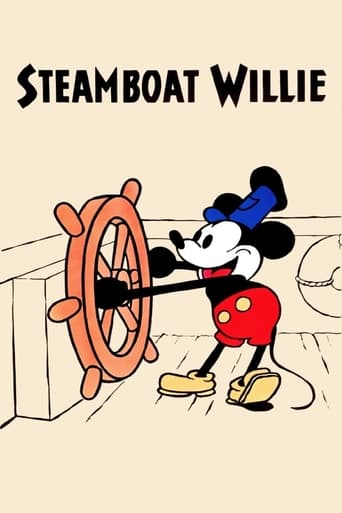
Steamboat Willie
1928 · Film · short · 8 min
Directed by Walt Disney, Ub Iwerks
Mickey Mouse, piloting a steamboat, delights his passenger, Minnie Mouse, by making musical instruments out of the menagerie on deck.
3 negative55 neutralfrom 58 commenters
Where to watch
No streaming data for this title.
62 comments on Hacker News
You're right on the innovation speech, mea culpa.
You surprise me with a proposal for shorter copyright terms. Interesting!
For fun, here's an interesting discussion countering my own earlier statements - Once a work is in the public domain, it seems there's very little to do with an idea except drag it through the mud. Audacity is what drives commerce i suppose. For example as soon as Mickey Mouse entered public domain all the news could talk about was horror films and "adult" films capitalizing on the "what're you gonna do about it" of the moment.
Similarly when Peter Pan entered the public domain there was a short glut of "now he's a nightmare / villain" representations before becoming irrelevant again.
Imagine creating something like Sesame Street or Mr Roger Neighborhood then a mere 30 years later everyone has more fun making "Mr Grouch Goes On A Murder Rampage" bloodbath and "Mr Rogers + Freddie Kruger Teamup" art / film / trite youtube videos.
It'd be pretty soul crushing.
"Tragedy of the commons", as it were.
With this in mind, perhaps... your idea could deal with that via tiered pricing of "official / approved / canon" works are charged the standard fee whilst "unofficial / unapproved" works tithe a larger proportion of the proceeds to the original author...
The biggest annoyance here is the discussion always focuses on protecting individual creators whilst the laws and benefits seem to go to large corporations. e.g. Disney would have no problem using Peter Pan without consequence, while the rest of us wouldn't dare use Steamboat Willie.
The film is in the public domain and the original versions of Mickey and Minnie are public domain. But that does NOT apply to the later versions of Mickey that you'd find Disney pushing today (e.g., at parks, on apparel, etc.). Further, Disney has been trying to continue to assert copyright even over the original version of the character. See here for more info: https://www.cullenllp.com/blog/steamboat-willie-in-the-public-domain-testing-the-boundaries-of-copyright-and-trademark-law/
The push to expand repressive copyright laws because machines can learn from human produced text, code and art is going to hurt us all in the long run.
People usually say contemporary media sucks because of commercial pressures, but those commercial pressures and conditions wouldn't exist without the expansion of copyright.
Yes, giant studios are struggling to introduce new ideas like 1993's Jurassic Park. But that doesn't mean Shane Carruth (of Primer fame) can't. And he could have if Jurassic Park had been released any time between 1790 and 1900.
Our stilted media landscape is directly downstream of prior legislation expanding copyright.
Expanding copyright even more so that text / art that looks stylistically similar to another work is counted as infringing will, in the long run, give Disney's lawyers the power to punish folks for making content that even looks anything like Disney's many, many, many IP assets.
Even though Steamboat Willie has entered the public domain, Disney has been going after folks using the IP, https://mickeyblog.com/2025/07/17/disney-is-suing-a-hong-kong-company-over-their-mickey-mouse-line-of-jewelry/ / https://mickeyblog.com/2025/07/17/disney-is-suing-a-hong-kong-company-over-their-mickey-mouse-line-of-jewelry/
The "infringement" in this case was a diamond encrusted Steamboat Willie style Mickey pendant.
Questionable taste aside, I think it's good for society if people are able to make diamond encrusted miniature sculptures of characters from a 1928 movie in 2025. But Disney clearly disagrees.
Disney (and other giant corps) will use every tool in their belt to go after anyone who comes close to their money makers. There has been a long history of tension between artists and media corps. But that's water under the bridge now. AI art is apparently so bad that artists are willing to hand them the keys to their castle.
No, the Louis Vitton cases would not help M&M here.
To successfully make a parody case in regards to trademark the parody itself must make it obvious that the defendant is not in anyway connected to the owner of the trademarked thing. The Morgan and Morgan ad doesn't do that; without the disclaimer at the beginning it wouldn't be obvious that the ad wasn't a animation created by Disney. (In the original Steamboat Willie, Mickey causes a number of accidents that harm other characters. Causing a car accident would not stand out from the list of things he does.) Importantly, a disclaimer doesn't really mean much for trademark law since this body of law is about how the trademark is used.
Why does MOB get away with parodying the LV bag (in the case you cite)? Well, for starters they didn't just rip off the look of an LV bag; they stylized their renderings of the LV bags to over-emphasize aspects of the LV bags that weren't actually present in the LV bags (but were clearly evocative of the bags). They also were juxtaposing the stylized LV bag against their own product.
The case you cited also specifically refers to other LV cases in which the defendants lost (and LV won). In one case, Hyundai briefly displayed a basketball with a logo very similar to LV's trademarked monogram. Hyundai lost, even though the ad was about the ostentatiousness of luxury goods (i.e., social commentary), because nothing about the parody itself indicated that the trademark owner wasn't involved (and indeed, part of why Hyundai lost was because there was evidence that people believed that LV was making limited-edition basketballs and wanted to buy them).
More on point, the defendant in the Debbie Does Dallas case was sued by the Dallas Cowboy Cheerleaders, and lost, even though DDD is clearly a parody. The problem is that the parody was not sufficiently specific to the trademarked content (in this case, the uniform), and also it wasn't clear from the content of the film itself that the DCC wasn't connected to the film.
This isn't a copyright case, it's a trademark case.
The issue is that some of the specific expressions of the elements may be extremely distinctive, and trademarked by a person (or company) for commercial use. In those situations, you can still use the element, but not the specific expression of that element that is trademarked because that specific expression is being used by another person for ongoing commercial activities. However, unlike copyright, trademarks die if they are not kept in relatively continuous commercial use, generally 3 years after last use.
For example: the Winnie the Pooh horror movie. The specific version of Winnie the Pooh in the animated films is trademarked by Disney. The version that is a serial killer wearing a costume is not. Disney didn't bother to try and stop the film. So, if you wanted to make versions of the Toy Story character that don't look like the animated versions, you'd be in the clear once the copyright expires.
But the Morgan and Morgan ad is different. They're attempting to use trademarked characters for their own commercial purposes. (And there's no clear parody of Steamboat Willie; in the original cartoon he causes a bunch of accidents that harm other characters including the character that would become Minnie, so what is the parody here?) Unless they've made a sizable donation to the judge's bank account, they have no chance of winning their motion as there is over a century of case law against. OTOH, given the current administration and the openness of his appointees to disregarding centuries of existing law, it's very possible that Morgan and Morgan expects to win this case.
As an aside, Morgan and Morgan is generally regarded as the worst of the large personal injury law firms. In cases in which other PI firms sued the same defendants, the M&M plaintiffs got the smallest settlements, because M&M settles as early in the case as possible (usually before discovery) as their business model is based on quick, cheap settlements and they'll put heavy pressure on clients to accept the low-ball offers to avoid having to spend the time or labor costs of going through discovery. There are many complaints of M&M pressuring their own clients, fraudulent billing, withheld settlements, dropped cases, and bait-and-switch fees. They're the most sanctioned law firm in the country...by a lot...
Steamboat Willie has been part of Disney animations trademark for at least a decade. It is literally the trademark animation used at the beginning of every Disney animation film.
Edit: I just learned that parody is part of fair use, so the first part of my comment is redundant.
~~I think that parody would be a far better defense than fair use.~~ But I otherwise agree that those gore movies based on children cartoons would probably be legal even before the original works had become public domain. At most, they might've required a tiny misspelling to be 100% legal and safe to sell.
I mean, South Park already had a gore parody of Mickey Mouse[1] decades before Steamboat Willie went public domain. In fact, South Park's Mickey Mouse has traits from later movies, still copyrighted in 2024, like the eye shapes and the lack of a tail.
That's why I'm unimpressed by these low quality gore parodies. What's actually going to be more exciting are the sincere animated adaptations that could be made from public domain stories, like del Toro's Pinocchio.
[1] https://southpark.fandom.com/wiki/Mickey_Mouse
The copyright has expired for the Steamboat Willie short film and a few other things like certain comic strips featuring Mickey Mouse. To me that seems different than "mickey mouse is out of copyright now".
It’s the older version where there’s no division between the sclera (white of eye) and the rest of the skull:
https://upload.wikimedia.org/wikipedia/en/0/0d/Mickey_-_The_Band_Concert.png
Compare to later versions, where the eyes are well defined:
https://upload.wikimedia.org/wikipedia/en/f/f6/Mickey_-_Fantasia.jpg
In recent years, Disney has been using the old version from Steamboat Willie at the start of movies:
https://en.wikipedia.org/wiki/Steamboat_Willie
And even making new shorts with that style:
https://www.youtube.com/playlist?list=PLC6qIbU1olyXQe1WOKt8UJ4hErx3D7qt8
But the Mickey Mouse that is out of copyright is specifically the one you see in Steamboat Willie from 1928 (and maybe some of their other old movies with Mickey, I don’t remember what other movies Disney made early on around 1928).
Meanwhile the Mickey that is shown posing on top of a building in one of the photos looks like a more recent Mickey. (But I’m no Mickey expert.)
And it is important to keep that in mind.
This is an awesome example of the kind of innovation which overlong copyright prevents.
There’s no particularly good reason that it should be legally impermissible for someone to build and sell a system like this loaded with movies from before, say, 2010 (or 2000, or whatever), but instead what the prospective entrepreneur would be legally able to include would be … Steamboat Willie, and other films of that vintage (as an aside, while Disney’s had a pretty rough couple of years, I’m pretty sure that Steamboat Willie being out of copyright has nothing to do with any of that).
This sort of experience shouldn’t be limited to children of high-tech folks with access to 3D printers: it should be possible for any child — or adult!
It's not like this is a new thing at Disneyland or anywhere. When they opened, they sold your tickets in tiers, and that's when we coined the expression "E-ticket Ride" because they'd deem the most desirable, most exciting attractions as top-tier premium packages, and families on a budget would settle for less.
It was the abolition of these distinctions and the flattening of the price of admission that took a step forward. Since Disneyland's reputation had been established, they were more willing to let the patrons and fans decide which rides were the best and coolest, and inform future iterations of Imagineering.
By the way, to speak to the article itself, I've been reviewing "classic" Disney films and found significant occultism, a lot of "magick" and such ("Sorceror's Apprentice", "Pinocchio"); everyone knows the fairies and supernatural elements; some say that Disney has changed and Disney has lost moral character and is no longer suitable for children, but I suggest that Walt Disney's morality hasn't altered course since its foundation, when "Alice in Wonderland" was a drug-fueled sex romp written by an ephebophile; when Steamboat Willie was an arrogant bigot who violently pounded other animals into submission...
> You say Tomato, I say Potato.
No, "Steamboat Willie" and "Steamboat Silly" are obviously different cartoons.
Specifically, the plot of "Steamboat Silly" involves Mickey pulling out old movies and playing back "Steamboat Willy" to other Disney characters. After a few seconds of clips from "Steamboat Willy," "Steamboat Silly" is a cartoon where a modern-style Mickey chases a 1920s-style Mickey through a completely different setting, with different characters as well.
You clearly haven't looked at the cartoons or trailers, and aren't basing your comments on any factual knowledge whatsoever.
> subjective interpretations.
You are arguing with fact, not making a subjective interpretation. Maybe you looked at the wrong video? Maybe you're just one of those people who likes to argue for the sake of arguing?
Intent is significant, it can determine outcomes in court rulings. So here we have this content ID system which Google claims exists to help some Google partners manage their copyright claims. One would think that would mean it helps them determine which claims are valid and which aren't. But it didn't appear to help Disney with that in this case, rather it enabled Disney to swiftly make an invalid claim after the film entered the public domain.
So Google's tool in this case didn't help their partner manage valid copyright claims. Its just helped Disney suppress some other publisher.
We've known for many years that Steamboat Willie would become public domain in 2024. If you were really trying to help your partners manage copyright claims wouldn't you build some notion of this into the system?
Whereas if you were trying to kowtow to larger publishers in exchange for favors - maybe you would leave details like public domain out of your implementation.
So what was Google's intent here? Of course they will have arguments like "it was a bug" or "that would be too hard," but finding out if those things are true is what you do discovery for.
"Here's my favorite example, here: 1928, my hero, Walt Disney, created this extraordinary work, the birth of Mickey Mouse in the form of Steamboat Willie. But what you probably don't recognize about Steamboat Willie and his emergence into Mickey Mouse is that in 1928, Walt Disney, to use the language of the Disney Corporation today, "stole" Willie from Buster Keaton's "Steamboat Bill."
It was a parody, a take-off; it was built upon Steamboat Bill. Steamboat Bill was produced in 1928, no [waiting] 14 years--just take it, rip, mix, and burn, as he did [laughter] to produce the Disney empire. This was his character. Walt always parroted feature-length mainstream films to produce the Disney empire, and we see the product of this. This is the Disney Corporation: taking works in the public domain, and not even in the public domain, and turning them into vastly greater, new creativity. They took the works of this guy, these guys, the Brothers Grimm, who you think are probably great authors on their own. They produce these horrible stories, these fairy tales, which anybody should keep their children far from because they're utterly bloody and moralistic stories, and are not the sort of thing that children should see, but they were retold for us by the Disney Corporation. Now the Disney Corporation could do this because that culture lived in a commons, an intellectual commons, a cultural commons, where people could freely take and build. It was a lawyer-free zone."
-- Lawrence Lessig, "Free Culture", OSCON 2002 (https://youtu.be/uH4RskpUFiA?si=IHVC72F4oXpLHJVV&t=253)
i'd never seen steamboat willie before; now that it's public domain in the usa, i have
wp says:
> In the 1950s, Disney removed a scene where Mickey tugs on the tails of the baby pigs, picks up the mother and kicks them off her teats, and plays her like an accordion, since television distributors deemed it inappropriate.[34] Since then, the full version of the film was included on the 1998 compilation VHS The Spirit of Mickey and the Walt Disney Treasures DVD set "Mickey Mouse in Black and White", as well as on Disney+.
this version has the tugging on tails, but not the picking up and accordioning of the mother, so it's a falsified version
the version xdennis linked https://www.youtube.com/watch?v=Jap-UBbmPsw in https://news.ycombinator.com/item?id=38830369 does have that full segment and is also clearer
It's the film Steamboat Willie featuring the characters Mickey and Minnie Mouse.
https://en.wikipedia.org/wiki/Steamboat_Willie
It sounds like Disney lawyers are gearing up to issue thousands of trademark infringement suits. They have lost copyright on "Steamboat Willie" but they haven't lost trademark of Mickey Mouse, which lasts forever.
I don't know where the limits of Steamboat Willie end, but I bet an awful lot of people are going to read headlines like "Disney about to lose Mickey Mouse copyright" and find themselves in very hot water very quickly.
I don't even really know why Disney bothered to go to such lengths for a short film that makes them no money. But I suspect it saves the legal department money compared to giving a lot of very expensive lessons on the difference between copyright and trademark.
> That's almost the most infuriating thing about their copyright grabs; it hardly even gets them anything of interest. They're not making any money on the actual Steamboat Willie movie.
It's not about making money from Steamboat Willie, it's about preventing others from enjoying it without a monetary transaction happening. I'm sure if they could, Disney would rather destroy all copies of a work they weren't making money from than release them for free. Look at game companies fighting against people distributing abandonware. It's not about the value of that particular good--it's about the value of the other things they are trying to sell, and not letting customers get something for nothing.
"The works of the roots of the vines, of the trees, must be destroyed to keep up the price, and this is the saddest, bitterest thing of all. Carloads of oranges dumped on the ground. The people came for miles to take the fruit, but this could not be. How would they buy oranges at twenty cents a dozen if they could drive out and pick them up? And men with hoses squirt kerosene on the oranges, and they are angry at the crime, angry at the people who have come to take the fruit. A million people hungry, needing the fruit- and kerosene sprayed over the golden mountains. And the smell of rot fills the country."
To expand on this point a bit, Ars Technica has some articles on the copyright extension saga. In 2019, when works started going into the public domain again in the US, they published https://arstechnica.com/tech-policy/2019/01/a-whole-years-worth-of-works-just-fell-into-the-public-domain/; in 2018, they published https://arstechnica.com/tech-policy/2018/01/hollywood-says-its-not-planning-another-copyright-extension-push/ which had interviews saying that there were no plans for another copyright extension term push.
Of course, both times, comments were pretty incredulous that Disney would prevent Steamboat Willie from going public domain. And now we're 3 weeks from that happening, and 1 week from the US House planning to go on recess, and there's no sign of any bill that would extend copyright further. People who pay attention will note that Disney has seemed to prepare for Steamboat Willie going public domain: part of the short now appears as part of their film logo in movies, presumably to enable them to claim it as trademark and sue anyone who tries to upload it into oblivion. Nevertheless, I fully expect quite a few people to do stuff like upload Steamboat Willie to Youtube in January, and it will be interesting to see what the response of that is.
That's almost the most infuriating thing about their copyright grabs; it hardly even gets them anything of interest. They're not making any money on the actual Steamboat Willie movie. We're still a ways away from anything of even modest commercial interest from Disney entering the public domain, and even when Snow White and the Seven Dwarfs does finally come into public domain, I can't imagine it meaningfully affects their bottom line. The ability to roll into a store and just buy it isn't going to meaningfully affect Disney. Meanwhile, they still have all the trademark control, which itself means you can't really do anything to Steamboat Willie that would "offend" Disney. (I'm going to just leave that vague for now.)
Meanwhile, to keep this at-best modestly interesting historical film locked up for those last few marginal drops of IP, they've kept the entire rest of the culture locked up. Hell of a cost society pays just for that. I'd almost rather we just grant Disney copyright in perpetuity if it would shut them up and leave the rest of the culture alone.
As I understand it, that’s why they’ve been using the little Steamboat Willie clip at the beginning of films for the last several years—to make it a trademark, which never expires while in use.
Interestingly enough, the copyright on the 1928 movie “Steamboat Willie” – the short film that introduced the world to Mickey Mouse – will expire in 2024. That means the Steamboat-Willie-version of Mickey Mouse will enter the public domain.
TM != Copyright, but still interesting.
Disney+ uses a little clip of "Steamboat Willie" in the leaders to streamed Disney movies. Making out-of-copyright Steamboat Willie into a trademark thing muddies the waters at least a little, and I'd guess that's why Disney+ uses it.
I'm not a lawyer either, if copyright is expired, you're free to make a derivative work. Although, you certainly have to be sure you don't derive from a derivative work whose copyright has not expired.
Trademark issues will be tricky, there is a concept of fair use in trademarks, and it seems to me, if you can sell a copy of the film, you must be able to use elements of the film to sell it. If you can create and distribute derivative works, you must be able to use elements of the works to sell them. But maybe we'll just have to have white boxes with 3rd party Mickey (as seen in Steamboat Willie) movies, and boring movie posters too. I expect to see a stream of lawsuits until clear rulings are available.
This is the craziest thing about copyright law. Maybe it's fair that an author and his family should receive compensation for their work even after their deaths.
But Sunrise was released 95 years ago - the odds are that there is nobody alive who worked on this movie, nobody alive that even saw it in theaters. Why is it not publicly available? I doubt anyone is earning significant money off of an extremely old movie that caters to a niche audience - if the media is so old that it is both literally and aesthetically irrelevant in society, it's astounding that it wouldn't have been in the public domain already. It's a massive shame that Disney's corporate plots have been a detriment to other media that isn't generating huge profits. I only wish that "Steamboat Willie" going into the public domain will bring about some sort of copyright reform.
Trademark and copyright are separate. So it's legit to stand outside of Disneyland selling Blu-rays of Steamboat Willie, but there are still limitations on how you can use the character
Some level of remixing/reediting the movie is probably OK, but I'm not sure where the line gets drawn
Isn't that trademark?
IOW, when Steamboat Willie's copyright expires, it doesn't give you the right to make a new Mickey Mouse film. Disney still has a trademark on Mickey.
> (Another item on this scale: trademarks, which are entirely imbued with value by the owner’s exclusive right to use them. They are not time-limited as long as they are used because, to a first approximation, the value of “Levi’s” has nothing to do with the beauty of the word (which one could consider a limited ressource), but depends on the company’s interest in maintaining its status)
After subscribing to Disney Plus I immediately began to notice their use of a segment of Steamboat Willie in place of a static or simply animated trademark. It seems clear to me what Disney's strategy will be going forth: to get as far they can abusing so-called "motion marks" (i.e. animated trademark symbols) to re-capture as much of their expiring copyrighted content they can.
However far they get--it will likely take decades for the dust to settle after years of intensely testing the legal waters and lobbying Congress for various tweaks--I don't doubt that it will prove very effective. Trademarks can in principal provide protection in perpetuity, as you say. Motion marks let you significantly expand the scope of the mark (and art), so you can protect a broader array of merchandise as well as films--not much market for public domain copies if segments have to be removed. Plus with their army of lawyers they can widen that moat even more through sheer intimidation, so they may very well be able to squash alot of otherwise highly marketable derivative works.
I think it is unreasonable to ask for iconic characters like Mickey Mouse, who still see regular content, to fall into public domain because they've become more analogous to a trademark (Mickey Mouse might even be trademarked?). However original media like the 1920s Mickey Mouse cartoon "Steamboat Willie", absolutely should.
I look at like how a song might be in public domain but that doesn't mean the singers voice is. Likewise for actors vs TV shows.
edit: getting downvoted but no explanation why people disagree. I'd love to hear why
edit 2: there seems to be some confusion about my statement above. I don't like nor agree with how Disney 'steal' public domain stories. I don't like nor agree with how Disney extend copyright. However there is a difference between published works (like the 1920s cartoon exampled above) and a mascot that is a trademark and still in common use (like Mickey Mouse). And that is the only point I'm arguing. You can just assume I'd agree to all the other points about how "Disney is evil" etc because I've made those exact same points myself in other conversations in the past (eg https://news.ycombinator.com/item?id=26805071)
I agree with you that they will want an extension before Bambi, but Steamboat Willie does bring in money. When it goes public domain so does the original Micky and Minnie Mouse. In 2025 you could produce a non-Disney Micky Mouse movie.
And they do sell steamboat merch, or have in the recent past:
https://www.lego.com/en-nz/product/steamboat-willie-21317
I don't see it going into the public domain. Steamboat Willie should have entered public domain in 1956 and Disney keeps winning.
"Mickey Mouse" isn't copyrighted, it's trademarked. There is, I believe, pretty wide consensus that trademarks remain valid as long as they're in use.
"Steamboat Willie" is copyrighted, but I don't know if Disney actually makes any money off of it at all (even if there were a good way to account that). What Disney wants is for you to not be using it.
You might have a better case for, say, Cinderella, a film that they actually do make some money off of. Again, I'm not sure how they'd account for it -- it's available on streaming, and how much of that revenue is due to Cinderella?
Even if you were taking a percentage of their DVD sales, I suspect they'd be happy to pay it. As with Steamboat Willie, their intention is for you not to be using it more than their actual use.
I am unclear on how trademark interacts with copyright on this. Unlike copyright, trademarks really were intended to be infinite: they expire only when people stop using them (and paying the relevant fees).
So even if Steamboat Willie were to become public domain, would trademark limit the derivative works that could be made? The movie might be public, but the main character isn't. Can you tell me how that would work?
You're ignoring all the copyrighted movies Disney made based off of public domain works. Good luck just "deriving" off of those too much. With your Steamboat Willie argument, derivative work would have to be based off him, not from works based off him (ie Mickey Mouse).
When Steamboat Willie enters the public domain, those aspects of the Mickey Mouse character that are in that film will also be in the public domain, so people will be able to use the Mickey Mouse character, as long as they don't use aspects of the character that were introduced in later (and so still copyright) works.
Something similar happened a few years ago with Sherlock Holmes [1]. The original Sherlock Holmes stories are public domain, and so the character can be used without the permission of the Conan Doyle estate. However, some of the later stories are still under copyright, so anything about the character which only appears in these later stories cannot be freely used.
[1] https://www.smithsonianmag.com/smart-news/sherlock-holmes-now-officially-copyright-and-open-business-180951794/
> What would this mean for usage of the Mickey Mouse character? Would people be free to use images from the older cartoons in new work? What about more recent updates to the character's design?
Copyright protects the exact expression, but not the general concept. Mickey Mouse is already protected under trademark law, so while Steamboat Willie entering the public domain means you could redistribute that particular film, you wouldn't necessarily be able to do a lot else with the character without infringing on an established mark of Disney.
Since many depictions of Mickey are registered as various trademarks of the Disney conglomerate, things will basically shift from copyright to trademark law and they will be less able to say “you shall not pass” but they can definitely still make your life hell if you cross them.
Edit: I forgot to mention that I suspect that Disney started using their new pre-movie intro motion graphics that are heavily derived from steamboat willie as a bit of a hedge, since they get a reasonably strong defence from the complete inclusion of the opening sequence of steamboat willie against potentially confusing trademark infringement. It’s also a sneaky way to get a new copyright covered variant of their original material.
No. The cartoon steamboat Willie should enter public domain. You should be able to create a character based solely on steamboat Willie but none of the other films. But you couldn't call him Mickey mouse was he is (and sighs be) protected by trademark
>When that expires, Steamboat Willie can be given away, sold, remixed, turned pornographic, or anything else.
Rule 34 indeed. I honestly wonder, in this age of memes and YouTube, if we will see a sudden spasm of creative remixing of the newly open content. Think of the movie Kung Pow but with much more 4Chan-like variety.
shudder
OTOH, Disney is aggressively pushing trademark where it hasn't gone before. For example, they're asserting that "Movies about Snow White" are a thing only Disney can do, because "Snow White" is a trademark.
I could absolutely see Disney saying "That clip of Steamboat Willie is a trademark of Disney Animation Studios. If you use that in animation, you're diluting our trademark."
There is no copyright on the character itself. There's a copyright on each piece of media the character has been in, like Steamboat Willie, but there is no copyright on Mickey Mouse. The character is trademarked, but not copyrighted.
The words "copyright" and "trademark" are different, and mean different things. You might know this and be fuzzing them for the sake of simplification, but if so, you've over-simplified. They are different, and treating them as the same is wrong and leads to confusion.
The copyright on Steamboat Willie will expire, allowing royalty-free use and copying of that movie, including Mickey Mouse. At that point, that version of Mickey Mouse will be free to us--BUT the ongoing trademark on the character will mean people should still stay away.
In case you have not been paying attention, Disney Animation Studio is using the most famous clip from "Steamboat Willie" as part of their trademark.
By the time the movie enters the Public Domain, Disney will be able to defend the clip with a trademark defense.
Is Steamboat Willie really valuable to Disney? Kids aren't exactly fighting to watch old black & white cartoons from the 20s and 30s (one could say the same of the masterpieces of 1930s cinema, a minority of cinephiles still watch them but are they really commercially valuable)?
They discuss is briefly but my understanding is the copyright only protects the work itself. IE the movie steamboat willie could now be freely published by anyone with access to it? But Disney will still own the trademark and be the only entity that can produce new original Mickey Mouse content?
I believe that officially only the movies, etc., would fall into the public domain. But people can make derivative works of public domain items, so they wouldn’t be limited to literal copies of Steamboat Willie. They could show Steamboat Willie using a smartphone.
However, Disney also has trademarks on Mickey Mouse, etc., so using Mickey’s likeness in commercial ways would still be a legal minefield.
Mickey is trademarked. Old Mickey Mouse movies, like Steamboat Willie, will be free to copy and distribute but I don’t think other people will be permitted to produce new works starting Mickey Mouse.
It’s a bit of a legal gray area. I don’t think anyone has settled the question about whether trademarking characters runs afoul of the constitutional prohibition on perpetual copyright.
Based on how much money Disney has put into absorbing every trademarked franchise ever (Marvel, Star Wars, etc.), it seems like they’re willing to bet on those trademarks being enforceable.
It seems you’re conflating trademark and copyright. Personally, I’m fine with trademarks continuing in perpetuity as long as the owner maintains the registration. Disney gets to keep their brand name and trademarked characters. It’s copyright on Disney’s films and music that’s the problem. Maybe I can’t make my own Mickey film, but I could certainly remix Steamboat Willie cartoons if they entered the public domain. Or do similar with their music. But it’s really not even about that. If Disney gobbles up all the copyrightable content, maintains copyright forever, then creating something new (but too similar) can put an individual artist in trouble with copyright law. That’s unacceptable.
You could use this chap[0] in your film, but you couldn't use this more recognizable figure.[1] Disney is at absolutely no risk from unauthorized films starring a black-and-white, whistling mouse.
[0]https://formaementis.files.wordpress.com/2008/11/steamboat-willie.jpg
[1]http://images2.fanpop.com/images/photos/6500000/Mickey-mickey-mouse-6526920-463-600.jpg
No, it was not a rip-off. There are hardly any similarities between the two films.
Steamboat Bill, Jr https://www.youtube.com/watch?v=vjl2Fj-_Hg0
Steamboat Willie https://www.youtube.com/watch?v=BBgghnQF6E4
Steamboat Willie was the first appearance of Mickey Mouse, and it was itself a direct rip-off of Steamboat Bill, a live-acted non-public-domain film.
I promise you the claims was to protect Steamboat Willie (which isn't even commercially exploited by Disney) but the goal was to protect Snow White, Sleeping Beauty, etc. they could still have protect the name under trademark, the argument about the film itself was just nostalgic subterfuge.
In case anybody else is wondering, Steamboat Willie currently will expire in 2023. If the timing of the previous copyright extension acts continues, we should see a new copyright extension act within the next three years or so.
Assuming, of course, it isn't entirely coincidental that the copyright extension acts tend to pop up every time Steamboat Willie gets close to entering the public domain.
I wonder how Steamboat Willie entering the public domain would affect the Mickey Mouse related trademarks (e.g. the mouse ears and such), considering that most of it is simply derived from the character first publicly introduced in that film. I know that trademark law is orthogonal to copyright, but it would certainly allow diluting the brand.
I'd imagine Disney makes plenty on merchandise related to their hoary old characters, particularly Pooh Bear, and not so much the movies/animation/wizened content like Fantasia or Steamboat Willie.
My understanding is that this whole debate is a bit sensationalized, because, whether their copyright expires or not, Disney will still hold a trademark--which exists indefinitely--on the likeness of Mickey Mouse. The issue at stake is their hold over the copyright of the original Steamboat Willie films--that's what the copyright is set to expire on.
Yes, it would be very hard for Disney to exist if they lost IP rights to the likeness of Mickey Mouse, but they won't, because he's trademarked, and trademark exists to ensure that companies retain rights to the branding and art crucial to their operation and the identification of their business. Should Mickey Mouse slip into the public domain? I don't think anybody would argue that. But should the Steamboat Willie cartoons, a cultural landmark now nearing a century old, become common property? A lot more people would argue yes.
My outline here is probably lacking some accuracy and precision, because I'm not an expert. If there are any details I've missed, please do let me know.
The thing is, Mickey Mouse is also a trademark, which doesn't expire.
My understanding is that if Steamboat Willie passes out of copyright, people still won't be able to distribute it, or use Mickey in their own films, because it would violate trademark law.
Agree. I think Disney et al like to play up confusion on trademark v. copyright. Trademark protects corporate identities, brands, and icons, like Mickey Mouse in the context of a representative of an amusement and media company, and copyright protects whole non-trivial creative works, like "Steamboat Willie".
Due to trademark protection, other companies couldn't use Mickey Mouse to create confusion, misrepresent themselves as associated with Disney, etc., but anyone (including Disney) could watch, disseminate, or modify early Disney films under any terms they saw fit.
This is important to note every time someone brings up Mickey Mouse. The super old "steamboat willie" movies would be out of copyright, but Mickey Mouse would still be a trademark.
In addition, Mickey Mouse is perfectly legal to use in works of parody etc
I would argue that Disney alone is more powerful than either political party. It's pretty well known that the copyright extensions have happened in such a way as to keep the movie Steamboat Willie (and therefore Mikey Mouse) under copyright.
http://www.tomwbell.com/images/(C)Term&MMCurve.gif
They can't make copyrights infinite. But the last several decades have shown that they can extend copyright terms indefinitely. And, thanks to Disney's lobbying, will do so every time that it looks like Steamboat Willie is going to become public domain. (That's the first film that Mickey Mouse was in.)
Who cares about Steamboat Willie, or Disney for that matter?
I care about that there will be little to no public domain between now and when I die. And I don't care about X popular work of the hour; I care about the myriads of media that have been orphaned.
Disney and its ilk can afford archiving services, and do as such. Many studios, authors, musicians and such may either have a copy or perhaps even lost it (thinking of Prince of Persia source recently found). Do we just let all but the most popular die in the annals of recorded-but-forgotten history.
DRM is just another chapter, in which the Twilights, Titanics, and Harry Potters are recorded unencrypted, but the minor films and media are forgotten.
*edited for grammar
Copyright is not a basic human right. You may like that you have copyright on what you make, but to claim ownership over ideas is like trying to grab a handful of water.
Also, please don't try to frame this argument as, "If you are against copyright then you must be a pirate!" Please let McCarthy-ism stay dead.
Since you've consistently posted in favour of copyright recently:
* Do you feel the *need* to have copyright 90 years after you are dead? Is that your only incentive to create? * What about retroactive copyright extensions? Are you planning on 'un-creating' things that you created in the past because you weren't retroactively granted a copyright extension so you now have no incentive to create something that you already created?
If copyright terms were 14 years long (IIRC like they were originally), I think people wouldn't have such an issue. The fact that black & white films like Steamboat Willie are sill under copyright long after anyone can make any significant amount of money off of them is a travesty. This is especially true because a lot of things that are under copyright have become part of our culture (the 'Happy Birthday song' anyone?).
>I know that Disney stops people from taking Walt's original concepts. But is that a bad thing? What concepts did Disney steal? None: he made his own. Other people can do that too.
This is completely wrong. Nearly every famous early work of Disney's was "stolen" from others. Among the more famous are Snow White (1937), Fantasia (1940), Pinocchio (1940), Dumbo (1941), Bambi (1942), /Song of the South (1946), Cinderella (1950), Alice in Wonderland (1951), /Robin Hood (1952), Peter Pan (1953), Lady and the Tramp (1955), Mulan (1998), Sleeping Beauty (1959), 101 Dalmatians (1961), The Sword in the Stone (1963), and The Jungle Book (1967).
The first iteration of Mickey Mouse, called "Steamboat Willie", was copied directly from Buster Keaton's "Steamboat Bill."
This is an excerpt from one of Lawrence Lessig's speeches about the topic: "It was a parody, a take-off; it was built upon Steamboat Bill. Steamboat Bill was produced in 1928, no [waiting] 14 years--just take it, rip, mix, and burn, as he did [laughter] to produce the Disney empire. This was his character. Walt always parroted feature-length mainstream films to produce the Disney empire, and we see the product of this. This is the Disney Corporation: taking works in the public domain, and not even in the public domain, and turning them into vastly greater, new creativity. They took the works of this guy, these guys, the Brothers Grimm, who you think are probably great authors on their own. They produce these horrible stories, these fairy tales, which anybody should keep their children far from because they're utterly bloody and moralistic stories, and are not the sort of thing that children should see, but they were retold for us by the Disney Corporation. Now the Disney Corporation could do this because that culture lived in a commons, an intellectual commons, a cultural commons, where people could freely take and build. It was a lawyer-free zone."
To address your second point, "the idea of capitalism" does not necessarily require giving anyone permanent, state-enforced monopolies of anything, no matter how well written it is. Any justification for copyright has to stem from a benefit to society. Strong arguments can be made for giving creators temporary monopolies of a limited scope, but permanent monopolies are bad for both innovation and the public.