 Hacker Cinema
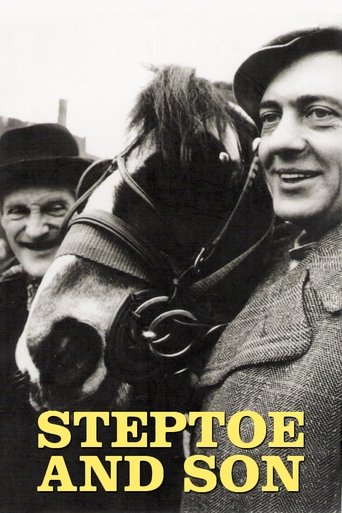
Steptoe and Son
1962 · TV series · 30 min episodes · 8 seasons
Created by Ray Galton, Alan Simpson
A father and son who work as rag-and-bone men live together in Shepherd's Bush, London. While Albert is content with their way of life, Harold aspires to better himself and build a life of his own, but his attempts are repeatedly thwarted by his father, leading to frequent clashes between the two.
1 positive1 neutralfrom 2 commenters
Where to watch
No streaming data for this title.



3 comments on Hacker News
Thanks for the info! Kark it, musty and lakes I haven't come across. As kids we used lairy to mean aggressive or confrontational. Mush, dinlo/din/dinny and squinny are I think truly Pompey, tho it hasn't always been that way. Mush and dinlo are actually Romani words; you sometimes hear them in other areas with regular traveller populations. There's an old episode of Steptoe and Son where the son uses mush, so I think it was common in inner London at one time. Squinny I don't think is Romani. I used to think it was a Pompey oddity but I recently found out that someone from near Birmingham used it growing up.
I'd say a lot of the letter changes (v/f for th, w for l, dropping t's) are fairly standard estuary accent, e.g. the kind of accent Danny Dyer has.
A lot of classic British TV shows from the 70s and 80s hold up really well today. After all, Fawlty Towers was a 1975 and 1979 series, with other greats from the era including Dad's Army (1968-1977) and Steptoe and Son (1968-1972). Blackadder and Only Fools and Horses were good in the next decade as well, and that's only counting some of the comedy ones.
As for whether TV now is better or worse... well, probably the same to be honest. Sturgeon's Law reigns supreme where any fiction is concerned, so every generation will have about 90% utterly forgettable crap and 10% amazing classics. The crap just gets filtered out over time as people choose to preserve the stuff that truly matters.
http://tvtropes.org/pmwiki/pmwiki.php/Main/NostalgiaFilter
Either way, there's really not any one era where 'no TV shows' or 'all TV shows' hold up well.
And this itself is something that seems to vary by country. In the US, the average TV show character seems to be fairly well off, at least 'middle class' and able to pretty much work maybe two hours in their entire life.
In the UK on the other hand, a lot of our characters seem to be from working class backgrounds with a lot of money troubles and lower key living conditions. Like say, basically anyone from a UK soap opera (like Eastenders or Coronation Street). Or the main characters from Only Fools and Houses or Steptoe and Son.