 Hacker Cinema
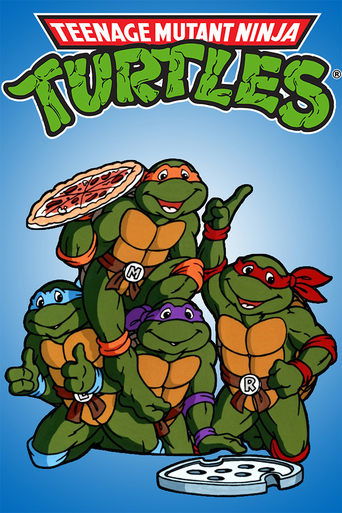
Teenage Mutant Ninja Turtles
1987 · TV series · 22 min episodes · 10 seasons
ActionAdventureAnimationComedyKids
Four turtles fall into the sewers and are befriended by Hamato Yoshi a Japanese man sent to New York who was forced to live in the sewers. One day he sees a strange green glow which transforms the four turtles into human-like creatures. Hamato (now Master Splinter) changes into a giant rat from the green glow and teaches the turtles the skills of the ninja as they team up with news reporter April O'Neil to battle against Yoshi's arch enemy Shredder and Krang, an alien warlord from Dimension X.
1 positive1 negative3 neutralfrom 5 commenters
Where to watch
No streaming data for this title.
6 comments on Hacker News
Just because a show could hypothetically end and the assets would go up, may not be a convincing argument. Hypotheticals could go either way.
One company owns the IP, the rights to the characters, to produce shows, they have the expertise, and it is exactly the show and the brand that drives the demand for merchandise sales. This is well established. They advertise the merchandise.
Now, without the advertisement, there could remain a niche group of people who would pay a lot for collectibles, but nowhere near the amount of people or capital under their management than during the heyday of the show actually airing and constantly making the memes (pokemon, yu gi oh, whatever) relevant and driving demand.
By your argument, LBRY the company could fold and people would continue to use LBRY tokens. Which is exactly what happened. So does that mean it wasn’t securities sales after all?
As for the other issues you mentioned, the court explicitly stated that just because some people buy the cards for consumptive use doesn’t mean they all do. You could buy 100 tickets to a ball game, but intend to only take your family, and scalp the rest. One of the criteria for a securities sale is did you buy more than you could ever conceivably use? And if you keep the cards in mint condition unopened that’s pretty much textbook definition of investing into collectables. Then the only question us how much are you relying on the expertise of the company producing Yu Gi Oh content to… continue to produce Yu Gi Oh and keep it relevant.
Now, if Yu Gi Oh was in the public domain and lots of entities could keep the memes going, sure. It would be super decentralized (although a strict reading by the SEC could nevertheless see a “common enterprise” horizontally across all of them, much as they are considering now for Ethereum!)
But since all these initiatives (Teenage Mutant Ninja Turtles, the music and movie industries etc.) work off massively relying on copyright protections, so they are the ONLY ones authorized to use / license the characters, then yeah you’re kind of relying on the efforts of a third party promoter to make sure a lot of people give a crap about your mint condition charazard collectibles!
Do the following thought experiment … if some group were selling the same exact type of trading cards in the form of NFTs, and creating Telegram channels to promote them, creating all kinds of episodes featuring those characters, are they a “common enterprise”?
> "Teenage Mutant Hero Turtles"
Are you referring to the UK version of the 1987 animated "Teenage Mutant Ninja Turtles" TV series? I never realized it was considered controversial! [0]
0: https://en.wikipedia.org/wiki/Teenage_Mutant_Ninja_Turtles_(1987_TV_series)#International
Right? Let's see...
- GI Joe
- Transformers
- He-Man
- She-Ra
- Might Max
- Power Rangers
- Bionicle
- Ninjago
- Care Bears
- Street Sharks
- Teenage Mutant Ninja Turtles
Those are just off the top of my head. TV shows (and in some instances movies) that existed to sell toys.
I don't think it was. It lasted a while, but that had to do with it being the first syndicated afternoon Disney animated cartoon. (Gummi Bears was a saturday morning one first.) It lasted a bit because of that, but around the same time you had the really popular cartoons and shows, like Tiny Toon Adventures, Batman the Animated series, Teenage Mutant Ninja Turtles, and the Mighty Morphin Power Rangers.
Ducktales was a very well done series, but what appeals to adults doesn't always appeal to kids, and the Ducktales movie bombed so bad it canceled the rest of the movies based on Disney Afternoon shows.
For comparison, the best Disney Afternoon series in the states was Aladdin, which outlasted Ducktales by several years, and spawned several direct to DVD movies.
If you really want blatant commercialization, see Pokemon, Digimon, Yu Gi Oh etc. The latter at least had an interesting plot, and deeper characters. But both are basically cheap adaptations of Japanese anime -- draw a few frames with action lines, sell millions of trading cards.
Compare that to, say, Spiderman for FOX Kids in the 90s. Every scene was carefully animated and the plot was deep.
And to prove it's not just nostalgia, there were cheap shows back then too, like all the Power Rangers knockoffs. Anyone remember "Samurai Pizzacats"? Kind of funny, but mostly repetitive power rangers formula.
Even Japanese anime knockoffs were better before -- like Teenage Mutant Ninja Turtles.
There is still good stuff today but it's few and far between. I'm inclined to think the business objectives have changed more than the kids' tastes. It's like people used to play immersive 3d games, real time strategy games, and now so many play addictive pay-to-accelerate casual nonsense like Farmville or Boom Beach or whatever. Did people simply change their tastes to get ripped off? No, it was directed by business. Actual quality is secondary now.
how did it effect you? How did you recover?
I was warned against D&D, violent video games, and various harmless television shows. It was a bit silly at my house; violent games included Scorched Earth and Starcraft, and inappropriate TV included Teenage Mutant Ninja Turtles and Simpsons. I thought at the time that my parents' fears were misplaced, and I argued as much . . . but I respected their rules because they were my parents. When I moved out, I asked my mother if she would prefer I continue to avoid those things out of respect for her, and she told me that as an adult, that sort of decision was mine to make. I promptly installed TONS of violent video games day 1 at college, and went on to form a rather excellent D&D group. ;)
I resented my parents a little bit for the parts of geek culture I missed out on. And it cost them a bit of respect that I couldn't rationally persuade them they were wrong (we had a relatively robust debate culture at our house). But you know, those have both since mended. It's easy to go back as an adult, and pick up things you missed. And their rules relaxed a lot, shortly after I moved out, to the point that my adult siblings and I can have a Left 4 Dead LAN in their living room, and they think nothing of it.
Looking back, it really was only a handful of things they taught me that were wrong; they taught me a lot of very valuable things that were right, too. I find that the older I get, the more I quote them. And while they laid down certain rules I disagreed with, they very much raised me to think for myself and make up my own mind, and for that I'm grateful. And I'm grateful for the opportunity to think hard about when rebellion against authority is necessary on moral principle, and when it would be selfish even if you're right.
As a kid, I had great respect for their judgement, and I don't think it was misplaced. They were occasionally wrong, but I think I was wrong a lot more often. I understood they had greater experience and wisdom than I did, and greatly valued their opinions. That's still true, and I still do. Part of me resents not playing Magic with my geek friends in junior high, but a larger part of me is glad that I respected their decisions. I think it was the right thing to do, and I'd do it again.