 Hacker Cinema
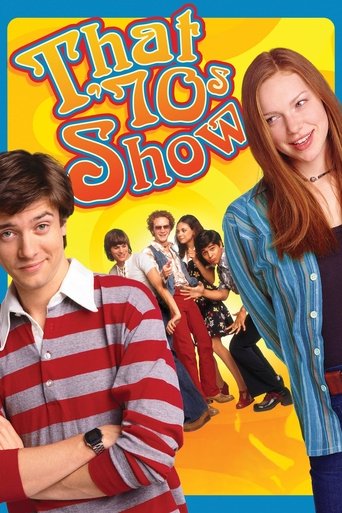
That '70s Show
1998 · TV series · 25 min episodes · 8 seasons
Created by Mark Brazill, Bonnie Turner, Terry Turner
Crank up the 8-track and flash back to a time when platform shoes and puka shells were all the rage in this hilarious retro-sitcom. For Eric, Kelso, Jackie, Hyde, Donna and Fez, a group of high school teens who spend most of their time hanging out in Eric’s basement, life in the ‘70s isn’t always so groovy. But between trying to figure out the meaning of life, avoiding their parents, and dealing with out-of-control hormones, they’ve learned one thing for sure: they’ll always get by with a little help from their friends.
1 positive2 negative12 neutralfrom 15 commenters
Where to watch
No streaming data for this title.




15 comments on Hacker News
> Can you think of one movie or TV show which models a realistically happy working adult marriage which isn't either sentimental and idealised, or doesn't end in drama, tragedy, and betrayal?
The parents in "That '70s show" perhaps? I see the irony in this title tho.
TV shows I've already seen are my go to as well. Parks and Rec is a staple. Office, Scrubs, That 70s Show, Big Bang Theory are all great as well.
Sometimes I get into phases that need a little extra. The Marvel movies phase 1-3 are solid, as is Breaking Bad.
I swap to prog rock music (again stuff I've heard multiple times before) if I have something particularly creative and demanding to work on.
Reminds me of an Episode of That 70s Show, when the mom is asking the dad about how it seems he doesn't have any friends. He says he does and names someone he hasn't seen in years but would give him the shirt off his back.
I have a couple friendships like that. Not all friendships look the same.
Now-a-days, I agree, grain is more of an aesthetic choice and for modern films. And, in fact, I generally don't enable de-noise when it's fairly clear that's what's happening.
However, for a lot of film shot pre-2010, grain is an artifact that's not there by choice or artistically. Other than perhaps the film 300.
It just so happens that most of my personal media fits in that box of being pre-2010 which is why I generally denoise.
Something like 30 rock, or The Office, for example, don't have film grain because of some artistic choice.
Interestingly, though, "That 70s' show" does in a few cases even though it's somewhat noisy be default. That's a more tough call.
But Malcom in the Middle was in syndication (151 episodes), so plenty of people knew his face if not his name, because reruns were airing 2x a day in virtually every US television market, and this was back before streaming so syndication was a huge way to get audience awareness. . The That 70s Show comparison is apt, and while he wasn’t Ashton level of famous from the show, he and the actress that played his wife (Jane Kaczmarek) were both better known than the actors who played the parents on That 70s Show.
Cranston was also the perfect person to cast for Breaking Bad because his character was so different from who audiences expected him to be. It worked brilliantly, the juxtaposition between the kind of zany (if put-upon and long suffering) dad then playing a dramatic role of a high school teacher turned drug-lord.
Having a cast of mostly lesser-knowns and unknowns is one thing. Having zero even recognizable names for a production that costs half a billion dollars is something else.
And Bryan Cranston was a recognizable, if not super famous, name. That’s part of why Breaking Bad worked, it subverted expectations and brought in some character actors that were at least visually familiar to audiences.
Same with the LOTR films. Liv Tyler was actually really huge at the time, having been in a series of high-profile blockbusters and also famous as a pop-culture figure thanks to her dad her music video appearances. Cate Blanchett was already famous, having been nominated for Oscars and BAFTAs. Sir Ian McKellan had been knighted for 20 years and also had nominations and awards out the ass. Sean Astin and Elijah Wood were successful child actors trying to bridge to adult roles. No one was too big of a name to cost too much or detract too much from the story, but you had enough recognizable names to get people excited about the trailer.
The Marvel films followed a similar thing. RDJ, obviously extremely famous already but Iron Man was his ultimate comeback role. ScarJo was also already a huge name (which Marvel used to their advantage for the next decade plus, b/c she was A-list and at the top of her career), and they balanced that with lesser-known names that became big stars.
I don’t think anyone is saying you need a star-studded cast. If anything, that works against you for properties like this, because people have already seen the characters in their mind or in other adaptations. But you usually need one or two recognizable faces, at least with a budget of this size. A smaller-budget show can have a cast of unknowns that hopefully then blow up into superstars, but we’re talking about a budget that eclipses even the largest film properties, where you’re not paying a lot of it towards the above the line expenses.
I think Amazon execs think the power of the LOTR brand can overcome anything else, and maybe they are right. But I don’t know if I would risk $500m of a production with zero recognizable names in front of or behind the camera. Even Stranger Things had Winona Ryder, after all.
35mm stills cameras normally use a 3:2 frame. Television shot on film typically used movie cameras that shot at 1.85:1 and then cropped to 4:3.
But different shows handled the aspect ratios differently in their widescreen re-releases. Seinfeld included slightly more horizontally than the original TV release but still cropped a significant amount from the top and bottom. That 70s Show as one example that was also shot on 35mm film included the whole original 4:3 frame plus extra on the sides.
So true. I don't get why American TV shows always need to be ran to the ground.
Like Two and a Half Men and The Big Bang Theory are shows that should've gone past their 8th season. The Office should've never had those abysmal last two-three seasons. That '70s show should've never had those abysmal last three seasons.
I always like it when creators and producers recognize when a show has run its course. This is why we have good memories of Seinfeld. Jerry Seinfeld stood to make something crazy like 5 million per episode if they had done a 10th season but he knew the show had run its course and ended it on a high note (something, btw, that was a plot point on an earlier episode).
Same with Breaking Bad, they knew that they had a story to tell and that it didn't need to drag on and they delivered some of the finest 5 seasons of television drama that one could ever ask for.
Personal opinion from a brit:
US series are too long.
It is a psychological thing I guess - sitting down and perusing netflix, see something you like but then realise it is 24 hour-long episodes just in the first season. It is a turn off - I can't commit upfront to that amount of time to something entirely unknown to me.
Especially since in a lot of series I've watched, they often lose their way and 99 times out 100 the last 2 or 3 seasons inevitably decay into a "will-they-wont-they" thing about two characters falling in love or whatever, and the rest of the cast and whatever made the series good originally is mostly ignored. Then they're cancelled. So e.g. Lost, US Office, that 70s show and many more all went on way too long while dancing around with romance between two characters etc etc while ignoring what made the first season or two appealing.
Don't get me wrong, I love binge watching something good and I am disappointed when I run out of episodes or whatever, but it is good for people to know when to end a show and leave people with good memories, rather than turning it into a death march where people are relieved to just have finished the show.
Give me 8 to 10 good episodes per season, and please don't string it out for 7, 8, 9 seasons when there is only enough ideas for 2 or maybe rarely 3 seasons's worth of episodes.
Yeah, in the US, if you have a basement, it's most often finished or at least partially finished, with walls and insulation and so on. Teenagers often like to hang out there because it offers semi-private living.
See TV shows like "That 70s Show" for a prime example.
> Wikipedia says only 25% of households had a microwave in 1986 and my whole life I just assumed they’d been a staple kitchen appliance since the 1960s.
In That 70s Show, there is an episode in which the Foremans get a microwave.
Great article. What a life. I enjoyed the Big Star documentary from a few years ago but had no idea how extraordinary his life was.
I always loved this Alex Chilton line from a Rolling Stone interview years ago (as article notes, Chilton wrote the theme song that Cheap Trick covered for That 70’s Show):
> What do you think of Cheap Trick’s take on “In the Street” [used as the theme to the Fox-TV sitcom That 70’s Show]?
I haven’t heard it.
> Really? Is it true that you only get $70 in royalties per airing?
Yeah. It’s actually ironic that the amount is $70. To me it’s “That $70 Show.”
https://www.rollingstone.com/music/music-news/alex-chilton-set-to-go-243920/
That '70s Show had an episode based on that concept, so I assume it had been around for a while.
In one episode of That '70s show Kelso and Red complained that the pong game is too easy because the pad is too wide. They opened the console, used the welding gun and successfully shrank the pad and made it harder:
Red: this is the future
Kelso: yeah, computers...
Red: no dumbass, welding!
I was watching an episode of That 70s Show a few weeks ago, and I swear I saw Comic Sans on a sign. Not even dramatizations of the past are escapable from it.
For me I think it was watching too many episodes of That 70s show. He was too good at being Kelso.