 Hacker Cinema
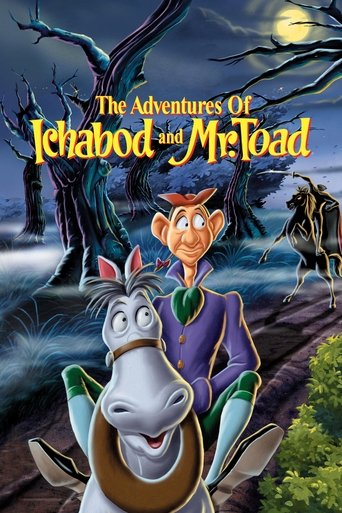
The Adventures of Ichabod and Mr. Toad
1949 · Film · 68 min
Directed by James Algar, Clyde Geronimi, Jack Kinney
A concise adaptation of Kenneth Grahame's "The Wind in the Willows" about Mr. Toad's motor mania, followed by a short retelling of Washington Irving's "The Legend of Sleepy Hollow" concerning schoolmaster Ichabod Crane.
1 positivefrom 1 commenter
Where to watch
No streaming data for this title.


2 comments on Hacker News
If you think about it this came about through laziness and to lower budgets, same deal with great programmers, programmers shouldn't want to do repetitive lazy work but innovate it away. Tedious work becomes a pain on time and budgets, so you innovate to do it faster/better.
Animators didn't want to draw all the backgrounds slightly moving and this allowed re-use and new innovations to make movies faster. This allowed animators to focus on the character cels and making characters look better, the main focus.
The multiplane camera with movable layers for parallaxing directly led to some of the best early Disney movies (Snow White and the Seven Dwarfs, Pinocchio, Fantasia, Bambi, The Adventures of Ichabod and Mr. Toad, Cinderella, Alice in Wonderland, Peter Pan, Sleeping Beauty and The Jungle Book) and helped their budget as well as made them look better. Plus at the time, it was actually an improvement that animators welcomed to speed up their tedious work.
That was the predecessor not the multiplane aspect of it with moving layers, definitely inspired it. Lotte mostly just used it to swap out colored backgrounds on her silhouette cel style to adjust placement and color.
A predecessor to the multiplane camera was used by Lotte Reiniger for her animated feature The Adventures of Prince Achmed (1926). Berthold Bartosch, who worked with Reiniger, used a similar setup in his film L'Idee (1932).
Ub Iwerks invented the multiplane camera with movable layers to create parallax and zooming [1] which created immersive depth. It also saved on budgets, tedious background animation and allowed animators to focus more on the character cels, the star of the show.
The first multiplane camera, using movable layers of flat artwork before a horizontal camera, was invented by former Walt Disney Studios animator/director Ub Iwerks in 1933, using parts from an old Chevrolet automobile. His multiplane camera was used in a number of the Iwerks Studio's Willie Whopper and Comicolor cartoons of the mid-1930s.
Fleischer Studios (Popeye/Betty Boop) also made one or copied in 1934 [1]
The technicians at Fleischer Studios created a distantly related device, called the Stereoptical Camera or Setback, in 1934. Their apparatus used three-dimensional miniature sets built to the scale of the animation artwork. The animation cels were placed within the setup so that various objects could pass in front of and behind them, and the entire scene was shot using a horizontal camera. The Tabletop process was used to create distinctive results in Fleischer's Betty Boop, Popeye the Sailor, and Color Classics cartoons.
William Garrity took Ub Iwerks invention further and that iteration was used in many large successful movies they made [1]
The most famous multiplane camera was invented by William Garity for the Walt Disney Studios to be used in the production of Snow White and the Seven Dwarfs. The camera was completed in early 1937 and tested in a Silly Symphony called The Old Mill, which won the 1937 Academy Award for Animated Short Film. Disney's multiplane camera, which used up to seven layers of artwork (painted in oils on glass) shot under a vertical and moveable camera, allowed for more sophisticated uses than the Iwerks or Fleischer versions, and was used prominently in Disney films such as Pinocchio, Fantasia, Bambi, The Adventures of Ichabod and Mr. Toad, Cinderella, Alice in Wonderland, Peter Pan, Sleeping Beauty and The Jungle Book
[1] https://en.wikipedia.org/wiki/Multiplane_camera