 Hacker Cinema
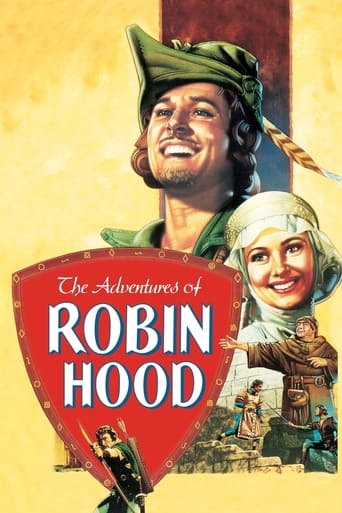
The Adventures of Robin Hood
1938 · Film · 102 min
Directed by Michael Curtiz, William Keighley
Robin Hood fights nobly for justice against the evil Sir Guy of Gisbourne while striving to win the hand of the beautiful Maid Marian.
3 positive4 neutralfrom 7 commenters
Where to watch
No streaming data for this title.
8 comments on Hacker News
(I know you didn't ask me.)
To pick a decade, the 1930's surprised me with a number of good films that I had not seen. It's also the first "modern" decade in a sense — the films are starting to have the kind of narrative you expect from a film (and have sound).
"Love Me Tonight" (1932), "Stella Dallas" (1937) were new to me and enjoyable.
It was the era of the classic big-spectacle Hollywood dance numbers that I knew of but had not seen. These greats from 1933 alone: "42nd Street", "Footlight Parade", "Gold Diggers of 1933".
Fritz Lang's "M" (1931) if you have not seen it. The infamous "Freaks" (1932) that, by its reputation, I thought would disturb me more than it did. "Captain Blood" and the "The Adventures of Robin Hood" are Errol Flynn in his prime…
Bonus link: Ginger Rogers in the classic opening to "Gold Diggers" — and her impromptu Pig Latin verse: https://youtu.be/UJOjTNuuEVw
1939? I suppose you have to pick a year and call that the cutoff.
But you're cutoff leaves to the "Dark Ages" the films Frankenstein (1931), Love Me Tonight (1931), 42nd Street (1933), Gold Diggers of 1933 (1933), King Kong (1933), It Happened One Night (1934), The Thin Man (1934), My Man Godfrey (1936), Stella Dallas (1937), Snow White and the Seven Dwarfs (1937) and The Adventures of Robin Hood (1938) to name a few.
The 1938 Adventures of Robin Hood is still one of my favorite films, and holds up remarkably well against adventure movies of today, in large part thanks to Errol Flynn's ridiculous charisma.
Also see https://en.wikipedia.org/wiki/Prince_of_Persia_(1989_video_game)
Much like Karateka, Mechner's first game, Prince of Persia used rotoscoping for its fluid and realistic animation. For this process, Mechner used as reference for the characters' movements videos of his brother doing acrobatic stunts in white clothes and swashbuckler films such as The Adventures of Robin Hood
I'm not sure I'm able to visualize this correctly. Let's say we have an array of strings containing the top 20 movies from Rotten Tomatoes:
The Wizard of Oz The Third Man Citizen Kane All About Eve Das Cabinet des Dr. Caligari. (The Cabinet of Dr. Caligari) Modern Times A Hard Day's Night The Godfather E.T. The Extra-Terrestrial Metropolis It Happened One Night Singin' in the Rain Laura The Adventures of Robin Hood Inside Out Repulsion Boyhood North by Northwest King Kong Snow White and the Seven Dwarfs
What would this data structure look like?
There's a fabulous amount of information in a single 35 mm frame of film. Do we have the technology to capture it all yet? What resolution is sufficient? It's not easy to answer this.
Perhaps the first complication worthy of notice is that not all film is alike. During the first half of the twentieth century, film evolved rapidly. First, there was the struggle to make B&W film more sensitive to light without massively increasing the size of grain. Early film required a lot of light to capture a high quality image. It was costly and difficult (not to mention unpleasant for workers/actors) to use the amount of light necessary to get a high quality B&W image with fine-grained film stock. Color film initially amplified these problems as well as introducing it's own, which is why B&W film lived on for lower budget productions long past the broad adoption of color film.
Color film was there from the very start of cinema but, at first, it took the form of tinted stock, hand-colored film, and a variety of other labor intensive processes. Technicolor had a 2-strip color process by the 20's that captured flesh tones to a certain degree (e.g. "The Black Pirate" (1926)), but the three strip process of the late 30's and 40's is what most of us think of as the first real color film, and it heaped even more demands on film makers. Technicolor 3-strip film only produced good results on certain limited ranges of colors, and Technicolor provided consultants to help film makers meet the stringent requirements of using this film. There was a scene in "The adventures of Robin Hood" (1938) where the grass was, famously, not the right shade of green to come out well and was therefore spray-painted the right shade of green!
Finally, it's worth noting that editing, special effects, etc. and copying from this era were all done optically, typically resulting in significant image quality degradation by the final product. Theatrical prints typically had substantially less detail than the camera negatives. Today, we often go back to camera negatives, interpositives, answer prints, internegatives, etc. when transferring a film to digital to get the extra quality. This obviously makes life more difficult for film restorers than if they simply dumped a theatrical print to digital. There are occasionally unintended side-effects of this practice too. For example, "The Thief of Bagdad" (1940) features scenes with a flying carpet suspended by wires. In the theatrical prints, the grain size was large enough to hide their presence. However, standard definition DVD transfers from the internegative made them show up easily. As surprising as it may seem if you're used to the fabulous detail in well-projected modern 35 mm film, sometimes DVD video quality surpassed the 35 mm theatrical prints of the classic era!
Given how videophiles now view standard definition DVD's, it really is surprising that, for some titles at least, DVD's showed more detail than audiences would have seen when the film debuted in theaters. Digital technology has come a long way since then, but how much higher do resolutions need to climb if we're already past the point of revealing some flaws that film-makers never intended us to see?
An interesting parallel to this is the recent trend towards hidef remasters of TV shows. A great example is Star Trek: The Next Generation. The detail in 1080p bluray is far beyond what anyone could have had in mind when creating this series for TV in the 80's and 90's. It's a fascinating show to watch in hidef. Many of the costumes and sets are fantastically detailed and finely textured. Others clearly relied on the limited resolution of broadcast video to hide their short-comings.
Film deteriorates with time, so it makes sense to use the best technology available to create digital backups. Perhaps we're at the point where films, once scanned, will never need to be scanned again. Perhaps we're not. However, it seems we've passed the point where some judgement needs to be used when deciding how much detail to present to audiences. Perhaps sometimes, less can be more.
The Adventures of Robin Hood, the Errol Flynn movie from 1938, is an excellent example of three-strip Technicolor, and on blu-ray some scenes look like they were shot last week, not 80 years ago.
Relying on literary adaptations is a symptom of Hollywood's decline from the golden age of The Maltese Falcon (1941 remake of a 1931 adaptation of a 1930 novel), Gone with the Wind (from the bestseller by Margaret Mitchell) and The Adventures of Robin Hood (way more than a hundred years old in 1938)?
The reason most Hollywood material is adapted material, is that a movie is a hell of an expensive place to try out new ideas. A book costs little to write, and takes one person to write it. And there are lots of them, succeeding, or failing, on the strength of their ideas, writing and storytelling. Cinema has never been the place to run a lot of flags up the pole and see which one the public salutes.