 Hacker Cinema
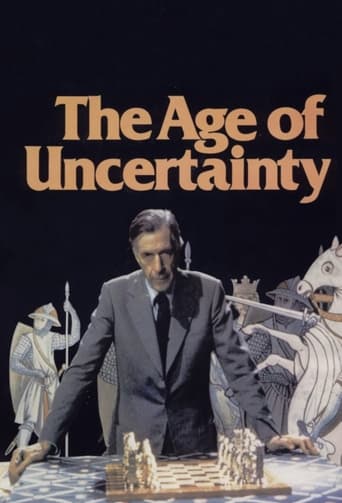
The Age of Uncertainty
1977 · TV series · documentary · 1 season
A 13-part personal view by John Kenneth Galbraith of the rise and crisis of Industrial Society. The ideas of economists and social philosophers shape actions and events even when we are unaware of their sources. They have had a decisive influence on the great rush of change and revolution through which the world has passed in the last two hundred years. Professor Galbraith traces these ideas and their consequences.
2 neutralfrom 2 commenters
Where to watch
No streaming data for this title.



2 comments on Hacker News
John K. Galbraith, the noted Can-Am liberal economist, addressed the necessary components of revolution in the documentary “The Age of Uncertainty.” If I recall correctly, he said you need a weak and/or absent opponent (the state), a strong coalition of single-minded people who act and think together, a lot to be gained and no fear of what will be lost, and an effective leadership to lead the way.
He noted that the prior revolutions, such as China and Russia, had very weak states. I suppose the same could be said of Germany after WW1.
The communists tried to revolt in France in 1848, but they were crushed immediately.
I don’t see Europe in weak position now, and I don’t think that people would be willing to lose everything (and possibly their lives) to achieve better energy prices.
I think you give too much credit to economists as propagandists. Pretty much any other kind of social scientist receives way more space in the media than economists do. And an educated layman seems way more likely to be acquainted with the Milgram experiments or with the Sapir-Whorf hypothesis than he is to be acquainted with comparative advantage. Specially today. Back in the 1970s you could have seen Milton Friedman and John Kenneth Galbraith exchange passive aggressions through their own TV series (respectively "Free to Choose" and "Age of Uncertainty"). I don't know of a contemporary equivalent.
Unless you literally mean that they're making justifications for the ruling class and have them as their captive audience. Which, I'm ... rather tempted to agree. Unfortunately, people have a self-serving bias, and like paying people to say what they want to hear.