 Hacker Cinema
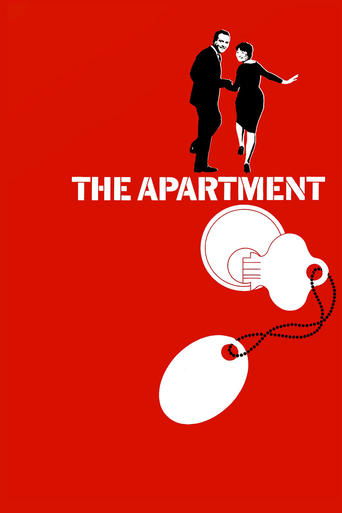
The Apartment
1960 · Film · 126 min
Directed by Billy Wilder
Bud Baxter is a minor clerk in a huge New York insurance company, until he discovers a quick way to climb the corporate ladder. He lends out his apartment to the executives as a place to take their mistresses. Although he often has to deal with the aftermath of their visits, one night he's left with a major problem to solve.
6 positive5 neutralfrom 11 commenters
Where to watch
No streaming data for this title.
14 comments on Hacker News
In the 60s, you'd have offices with thousands of such machines: https://aurorasginjoint.com/2017/08/19/a-look-at-billy-wilders-the-apartment-office-wise/ (in the movie, he mentions 30k employees on all the floors). On this floor, I believe they're mechanical calculators with extra functions (unsure what).
Watch the movie "The Apartment" (1960) for a crash course in mensches.
> I decided there and then that cubicles has material benefits over open offices.
The cubicle was invented in the 60s as a way to liberate people from the tyranny of the open plan office (just look at film from before then — say, “The Apartment” —- and you’ll see the open plan was the norm.
It’s a shame that the cubicle itself became a tool and exemplar of anomie.
This is a still from a movie set in 1959 (Billy Wilder's excellent /The Apartment/): https://onceuponascreen.files.wordpress.com/2017/08/apt.jpg
Those people are all doing white collar jobs nobody does today: adding up columns of numbers with desktop adding machines, retyping manuscript memos, responding to customer and vendor mail, summarizing other hand-generated reports into newer more digestable reports (which are in turn the input for yet more manual clerical steps), maintaining paper indexes into warehouse-sized file stores, etc.
Each of these people (well, it's a movie, but the real people they represent) had a career, performance reviews, Christmas bonuses, all of it. Now the whole work output of this entire high-rise office building floor (and probably more floors on either side of it) can be replaced with one copy of Excel.
I'm confident we'll come up with all kinds of new data-pushing jobs to hand out, assuming we can contrive to continue living in conditions energy abundance (like we already were in 1959).
Well it’s a feminist show or at least change in womens role in society is a large theme (hence the name). I think it might come across preachy if one expects a more nuanced show.
If you look it against films from the era like The Apartment (which is like styleguide to mad men) or All that heaven allows, similar themes and characters were displayed already then as sign of the times.
Someone in the comments once explained that the movie, "The Apartment" (1960), has become their New Year's Eve tradition.
It is now mine.
At precisely 9:58 PM I have scheduled "The Apartment" to begin playing on my TV. If you do the same you'll enjoy the synchronization when midnight drops. (And what a great film from 1960.)
I didn't remember the teleprinter — it's a good excuse to put the movie on again.
Wonderful film, BTW. I'm surprised how many people have not seen some of the old classics like this one. Also, "The Apartment" with Jack Lemmon and Shirley MacLaine, just to rattle off another.
> However those people are a subset of the Haredim.
Yes, I know about them, there was a (quite hopeful) event [1] recently where they rented an entire plane from New York to Satu Mare and then they visited Sighetu Marmatiei, the small town where Elie Wiesel was actually born, plus they re-built a synagogue in there.
I was talking more about the (very) secular Yiddish culture and associated language norms that we used to have around these parts of the world, retrospectively it's quite visible in classic Hollywood productions like The Apartment (I'm sure there must be more than one study about the Yiddish cultural influence on Billy Wilder's movies) and especially in Ernst Lubitsch's movies. That part is all gone. Plus the whole socialist/left-wing movement that was heavily influenced by the local Jewish community (who had been raised in the Yiddish culture), that is of course also long gone, what was not destroyed by the Nazis and by other local rightwing autocrats was transformed (for a lack of better word) into the zionist movement (i.e. not wanting to make a better world for everybody, just for the Jewish people following Herzl's writings, which is fair enough but still a loss imo).
[1] https://www.youtube.com/watch?v=8AeizpoEWsg
> Nobody who isn’t a 60s era fighter plane or space capsule designer, has any idea how to make a chair that is “ergonomic” -nobody really has any idea what “ergonomic” means in terms of office chairs. It’s just a sort of virtue word with vaguely medical connotations. Cargo cult science at its best, designed to ward off bad juju like lawsuits. This is where it started to go bad really quickly.
Sad to say he's right. I once tried to look up academic work on these issues and found essentially none. Almost all you can find is loosely disguised white papers from the manufacturers of "ergonomic" tat.
I never used or wanted an "ergonomic" keyboard but have used all sorts of keyboards over the last four+ decades, from high force mechanical to apple "butterfly" and apart from membrane keyboards they all work the same for me. I credit my late piano teacher for that.
As for chairs: the Aeron is more work than it's worth to me and I used one only because my wife bought it for me. But there's a secret that doesn't apply to everyone: in body size/shape/configuration I'm right in the middle of the bell curve (5'11", BMI of 22, etc). So stuff "out of the box" (car seats, airplane seats, computer desks, etc etc) is designed for me. This was famously a problem for military aircraft in the 40s (cockpits designed for the norm); learning from that inversely affected the choice of early astronauts (nobody too tall or too short or with arms too far out of norm simplified the UX). Also I apparently can stretch and even go get more tea without losing 'flow'.
So yes, chairs work for me but there's a lot of variation. Too bad these expensive chairs don't help.
> Herman Miller who invented the office cubicle: the second most dystopian form of office,...
The irony was that the cubicle was designed as a tool of liberation: until then all work areas, in factories and white collar work were open plan like today (just look at a 1950s movie like "The Apartment"). Finally the cubicle could give workers some modicum of privacy at a cost lower (and flexibility higher) than building lots of private offices. Sad it because a soulless dystopia and was replaced by...open plan offices.
The Apartment (1960) staring Jack Lemmon and Shirley MacLaine: "A man tries to rise in his company by letting its executives use his apartment for trysts, but complications and a romance of his own ensue."
Great comedy, great film. The twist ending is also amazing.
It made me see that though 'the past' may be a foreign country, but we're all people just the same. The problems they had, and that we have, are the same problems. The good ol' days never existed. And we can learn from our forefathers, not as semi-divine laws and sayings, but as one would learn from a friend.
The open plan office was the norm until the cubicle was invented (by Herman Miller I believe) as a tool of liberation in the 1960s. Just look at any film from the 50s (like The Apartment or Desk Set) to see.
Some research institutions, inspired by academia, had offices (IBM, PARC, IAS, Bell Labs..) and mingling areas it that was less common.
I saw open plan offices reappear around 2000 when the price of Palo Alto real estate started shooting up and frankly it shocked me. It’s crazy to me that this is considered savings given how much it costs to recruit and pay a person. I can’t concentrate with noise or visual clutter (people moving in my field of view).
Some jobs do do better with an open plan, like sales teams. It’s a cultural issue.
The superficial examples may change, but that underlying theme is still central to white collar office work. Perhaps it always will be.
Probably so. Billy Wilder's The Apartment executed a very similar lampooning of white-collar office culture 40 years earlier (if you haven't seen it, see it! It's probably Wilder's best film).
In Search of the Last Great Video Store – The Black List Blog || https://blog.blcklst.com/in-search-of-the-last-great-video-store-efcc393f2982
I grew up about 2 blocks away from Scarecrow Video in Seattle. I'm happy it's still around. Place was amazing, and... in the late 80s and early 90s they weren't dicks about renting R movies to kids like Blockbuster was. I remember being like 11, and I negotiated a monthly punch card in lieu of allowance. I could rent any 12 movies I wanted! Such power for a kid. And the clerk always had great suggestions.
It's because of Scarecrow that I got introduced to great films early... The Man Who Shot Liberty Valance, The Apartment, Giant, 12 Angry Men, Dr. Strangelove... anyway for a kid in a single parent home, I lucked out getting to watch old classics when my friends were all busy watching stupid cartoons and Saved By The Bell re-runs.
Website overloaded... here's a cache.
http://webcache.googleusercontent.com/search?q=cache%3Ahttps%3A%2F%2Fweb.law.duke.edu%2Fcspd%2Fpublicdomainday%2F2017%2Fpre-1976
"What books would be entering the public domain if we had the pre-1978 copyright laws?"
Harper Lee, To Kill a Mockingbird John Updike, Rabbit, Run Joy Adamson, Born Free: A Lioness of Two Worlds William L. Shirer, The Rise and Fall of the Third Reich: A History of Nazi Germany Friedrich A. Hayek, The Constitution of Liberty Daniel Bell, The End of Ideology: On the Exhaustion of Political Ideas in the Fifties Arthur M. Schlesinger, Jr., The Politics of Upheaval: The Age of Roosevelt Dr. Seuss, Green Eggs and Ham and One Fish Two Fish Red Fish Blue Fish Scott O’Dell, Island of the Blue Dolphins John Barth, The Sot-Weed Factor Jean-Paul Sartre, Critique de la raison dialectique
"Consider the films and television shows from 1960 that would have become available this year."
The Time Machine Psycho Spartacus Exodus The Apartment Inherit the Wind The Magnificent Seven Ocean’s 11 The Alamo The Andy Griffith Show (first episodes) The Flintstones (first episodes)
Also listed: songs from 1960 (e.g. Elvis's "It's Now or Never"), and copyrighted scientific research from 1960 still behind paywalls (e.g. 1960 papers on the structure of hemoglobin and myoglobin).