 Hacker Cinema
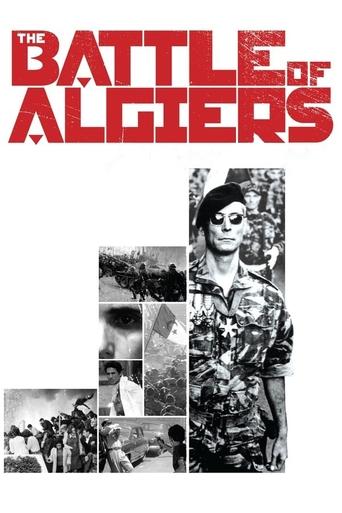
The Battle of Algiers
La battaglia di Algeri
1966 · Film · 122 min
Directed by Gillo Pontecorvo
Former petty criminal Ali la Pointe becomes a commander of the Algerian Front de Liberation Nationale, directing a guerilla insurgency against the colonial French occupation. Paratrooper commander Colonel Phillippe Mathieu, a veteran of World War II and the First Indochina War, is sent to Algeria to reinforce efforts to squelch the uprisings.
7 positive3 neutralfrom 10 commenters
Where to watch
No streaming data for this title.
11 comments on Hacker News
The word "profound" is a bit overused when it comes to movies. I agree that The Battle of Algiers is an excellent film, one of the best ever made even. One Battle After Another is also excellent but it is not really political in the way the TBoA is. It uses a political setting very effectively in a chase thriller. A movie like The Parallax View is a better comparison. That movie used the post-60s paranoia very effectively in a great suspense thriller.
That's mistakenly conflating two concepts: the media propaganda in a more general sense of the word (like the pentagon reviewing movie scripts for war propaganda) and the underlying material and ideological reasons for US foreign policy (see natural resources, petrodollar, etc.). It would be a severe mistake to think the current conflict is somehow detached from the "grand chessboard" type of neoconservative thought dominating foreign policy for decades. In other words you shouldn't disagree with the war on Iran because Trump is an idiot, you should disagree because its an horrific atrocious war even if it were run by competent people instead.
Just as a very basic example: 4 presidents in a row have bombed Yemen: Bush, Obama, Trump and Biden. This is consensus on very fundamental ideas on US foreign policy. But way more importantly than whether or not you agree with bombing Yemen, you should start to recognize that the real reasons for bombing Yemen or any other conflict are completely absent from public discourse and media.
Also once you broaden your horizon on film a bit it becomes very hard to watch modern mainstream western movies at all. Like watch The Battle of Algiers or any Costa-Gavras movie and you realize most western cinema is at best just infantilizing and at worst outright propaganda.
Like if you watched One Battle After Another and thought it was profound, did you not notice the absence of any real ideological exploration beyond "racism is bad"? What did the caricatured resistance really believe in? What can such a movie really say about "radical" politics on immigration if the liberals who made it have to account for liberals approval and funding of ICE? Like it said nothing at all, that's the issue with everything. We are so politically atrophied that we think its the most political movie ever, but its really apolitical if you think about it a bit more.
The film The Battle of Algiers shows this well.
Among cinema's greatest scenes, there is certainly the ending of "The Battle of Algiers", directed by the extraordinary Italian director Gillo Pontecorvo (Kapo, Operacion Ogro, Queimada).
Another amazing scene, not tremendously well know, is the one with the final words of Sacco and Vanzetti during their trial in the movie of the same name directed by Giuliano Montaldo. Gian Maria Volonté interpretation of Vanzetti was monumental.
I should also make it clear that despite having an official policy of "no racial hierarchies" and convincing inhabitants of the colonial world (who were NOT "citizens" of the french Republic, but "Indigènes" and were governed by a different civil/criminal law called "Indegenous Code") to fight against nazism during WWII for freedom and equality for all and against racial hierarchies (that the French colonial empire had themselves setup and supported), and despite many such people being sent a cheap blood on the frontlines instead of white soldiers, the French republic has of course not recognized their sacrifice.
For example, historical celebrations and references to the resistance movement often credit American intervention for the liberation of France, which for sure played a part, but downplays the millions of indigènes involved in the armed insurrection, as well as the Spanish antifascist bridages who have been erased from history despite liberating most of Paris 24h before the Americans even set foot in it.
On the other hand, colonial and racial oppression throughout the french colonized territories has not ceased after WWII. In some cases, it dramatically increased at least compared to the past decades, with the horrors of the "war" (read: genocide) in Algeria and Indochine for example. In fact, that France promised freedom and equality for all in the struggle against nazism while not holding such promise at all is precisely one of the major fire-starters for the anti-colonial independence movements of the 50-60s.
If you'd like a fictional take on what the French occupation in Algeria looked like, the Battle of Algiers is a good introduction. The movie was banned until the 90s in France because it revealed the horrors of colonization, while even today the government and national education insist that colonization was a disinterested act of kindness to help civilize lesser people... which is of course completely false as Africa and Asia had great civilizations long before Rome was born. The writings of Frantz Fanon, a psychiatrist from Martinique who worked in Algeria (and took part in the armed struggle against colonization), open a lot of perspective on practical details of everyday occupation and resistance.
I don't think this is anywhere near as obvious as you make out. Film is an odd example, given that the films that lay claim to being great works of art (e.g, Koyaanisqatsi, Wild Strawberries, The Battle of Algiers) are rarely the most popular and highest-grossing films (e.g., Transformers, Avengers, Toy Story). We usually mean something by 'greatness' quite different from 'popular'.
Even if we just focus on popularity (i.e., first-order preference satisfaction), money is a very rough proxy for it:
1. Lots of profitable activities, once you price-in their externalised social costs, are net negative. Given the scale of the climate and ecological crisis, that is very far from a marginal phenomenon. Ecological economists like Herman Daly argue that once ecological costs are included in the national accounts, we are running a GDP loss.
2. Some commodities are instrumentally necessary but intrinsically negative. Many people acknowledge that social media is a net negative, but use it anyway because it helps build their profile and career. Market dynamics often transform intrinsically positive activities into merely instrumentally necessary activities, e.g., the marketisation of academia means researchers spend their whole career optimising for maximum articles and grants, not great work.
3. Market demand reflects the stratified incomes of people around the world. Markets are therefore heavily skewed in favour of the interests of the rich.
4. Market exchanges which are mutually beneficial for the transacting parties often have unintended effects in the aggregate, sometimes negative, e.g., no one wants Facebook to be a monopoly, and no individual makes it so, but it is the aggregate consequence of people joining Facebook.
> I had never seen a war movie produced outside of Hollywood. Or a director with primarily french influences producing a war movie.
Not sure if the stipulation is a war movie about Vietnam, or just plain a war movie. But certainly here's a list of some non-U.S. 20th century war movies, very vivid, biased towards France:
The Battle of Algiers (French, Gillo Pontecorvo, 1966)
Come and See (Russian, Elem Klimov, 1985)
Ivan's Childhood (Russian, Andrei Tarkovsky, 1962)
Beau Travail (French, Claire Denis, 1999) -- OK, soldiers but not war
Army of Shadows (French, Jean-Pierre Melville, 1969)
A Man Escaped (French, Robert Bresson, 1956) -- POW, not front lines
Little Dieter Needs To Fly (British/French/German?, Werner Herzog, 1997) -- actually relates to the war in Vietnam
He scored "La Bataille d'Alger"[1] ("The Battle of Algiers"), directed by Gillo Pontecorvo, which depicted events that took place in Algiers (specifically the Casbah), Algeria, during the war for independence. Algeria celebrated its independence day yesterday.
So long.
[1]: https://www.youtube.com/watch?v=Tb-OBWU4qY4
If the author reads this, the link in the Google sheet to the Battle of Algiers goes to Algiers, a totally different movie.
Two trucks and a few soldiers lined in a row like ducks. A tank sitting alone.
If the coup you're executing results in civilians being able to seize a tank and police having soldiers in custody, the coup lacked the overwhelming ingredient and swift execution that would paralyze and kill any hope of resisting.
It needed to be clear that the deal was sealed to morally crush anyone willing to resist and make them understand that it's done and they'd better line up with the winning party.
Civilians seizing a tank means they sized the military presence and said "Meh.. we're going for it anyway".
An example of a well executed coup: The Algerian coup in 1965. Algerians woke up in the morning and found tanks in the streets of the capital, but it wasn't the beginning of the coup. It had already taken place. Tanks didn't really surprise because Gillo Pontecorvo was shooting "The Battle of Algiers" during that period and also used tanks (one of the greatest movies. Music by Ennio Morricone).
The President was seized in his bed during the night, they woke him up and he was made prisoner for 15 years (liberated by the subsequent President after Boumédiène's death). The coup's instigator had the control of the Army and Intelligence before.
There are many people who don't know there was a coup in 1965.
Islamic terrorists is not a defined enemy; many people are Islamic, and any of them could be terrorists. The list of who is considered a terrorist is secret and we are not privy to which people or even organisations are considered enemies in this war on terror. The US is also frequently attacked by Christian terrorists.
Terror aims to scare a population, but more importantly to drive a wedge between a government and its people by pushing the government into ever more repressive measures in an attempt to winnow out the terrorists, who can melt back into the population. The aim is precisely to force the government into ever more draconian measures which alienate the population and build support for the terrorists - to force the government to try to fight a war on the terrorists' terms. A great illustration of this from another era is the film The Battle of Algiers - torture, repression, removal of civil rights, and extra-judicial killing by the government in response are exactly what terrorism aims to achieve. Killing innocents in cafés is not the goal of terrorism, it's a means to an end, and that end is to force the government to adopt terror in response.
The correct response to terror attacks is careful police work to track down the killers and bring them to justice, so that they can't continue to plant bombs. This can be done within our existing legal frameworks.
The wrong response is to declare war on the the terrorists' terms, oppress your citizens, and kill yet more innocents in the cross fire as you target people on suspicion. Extra-judicial killing outside of war is as wrong as terror attacks, and as damaging for the parties involved, and eventually it comes to resemble terror itself.