 Hacker Cinema
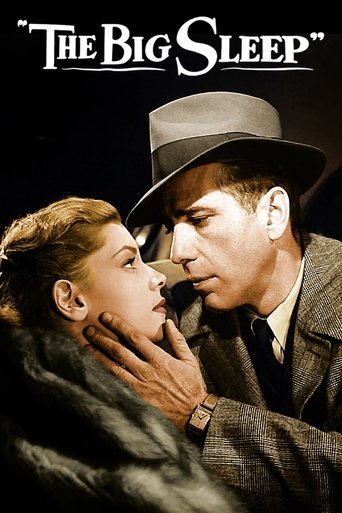
The Big Sleep
1946 · Film · 114 min
Directed by Howard Hawks
Private Investigator Philip Marlowe is hired by wealthy General Sternwood regarding a matter involving his youngest daughter Carmen. Before the complex case is over, Marlowe sees murder, blackmail, deception, and what might be love.
10 positive5 neutralfrom 15 commenters
Where to watch
No streaming data for this title.
16 comments on Hacker News
Much of what you actually see in Empire is written by entirely different people.
> George Lucas initially hired Leigh Brackett, the sci-fi novelist who also wrote screenplays for Howard Hawks—including The Big Sleep (1946)—to write the sequel to Star Wars (1977). Brackett died in March 1978 while the film was still in pre-production, though, and Lucas wasn't satisfied with her script. Lucas wrote the next draft himself, which established structure and twists close to the final film, but suffered from dialogue. When Kasdan delivered his script for Raiders, Lucas asked him to rewrite The Empire Strikes Back. Kasdan suggested he read Raiders first, but Lucas reportedly said: "If I hate Raiders, I'll call you up tomorrow and cancel this offer, but basically I get a feeling about people."[9]
Brackett was a sci-fi author, Kasdan was a screenwriter by trade.
Despite seeming like similar tasks, screenwriting and book-writing actually have pretty distinct skillsets in some ways.
I thought you were going to tell us it has an erratum on page 116.
(A reference to the 1946 film version of "The Big Sleep", starring Bogie and Bacall. If you haven't seen it, it's an excellent movie. It even has a used bookstore.)
I know some tech people who are capable of absorbing difficult material, but who never read for pleasure (and that means especially fiction). I think dyslexia may play a part in it.
If reading is really a chore for you, try looking for movies with more literate scripts. Many good writers have written for film, and in most genres.
If reading itself is not the problem and you are just easily bored, don't try to start with "serious" literature, but look for anything that grabs your attention. Not all of these are to my taste, but they have been broadly popular: The Hitchhiker's Guide to the Galaxy (1979), The Da Vinci Code (2003), The Big Sleep (1939), The Color out of Space (1927) (short), The Hunt for Red October (1984), Hondo (1953), Get Shorty (1990).
I had no idea about the Kieslowski connection, wow. I follow his other great collaborator, composer Zbigniew Preisner, where if you take anyone involved with Kieslowski chances are it's going to be a good film. I have his tri coleurs and decalogue on dvd, and double vie on vhs in a box somewhere. Strange to think when these things were artifacts now that nothing is, and that they could even be somewhat rare. I have the original House of Cards series on dvd in that box, The Big Sleep and other classics as well.
What's disappeared isn't the small independent super-low budget movie... as you said, that market is more active than ever. It's the >$10 million movie that everyone in the country can enjoy, has a name brand actor or two, but isn't just some recycled comic book tripe. Forrest Gump. The Big Sleep. Kramer vs. Kramer. Three Men and a Baby. Four Weddings and a Funeral. Terms of Endearment. etc.
I’ll play:
The Thin Man (1934), It Happened One Night (1934), Dodworth (1936), Fury (1936), The Awful Truth (1937), Grand Illusion (1937), You Only Live Once (1937), Wizard of Oz (1939), Only Angels Have Wings (1939), The Great Dictator (1940), His Girl Friday (1940), Philadelphia Story (1940), Rebecca (1940), The Maltese Falcon (1940), Citizen Kane (1941), A Woman’s Face (1941), The Magnificent Ambersons (1942), The Ox-Bow Incident (1943), Casablanca (1943), Double Indemnity (1944), Mildred Pierce (1945), It’s a Wonderful Life (1946), The Best Years of Our Lives (1946), Great Expectations (1946), The Big Sleep (1946), The Red Shoes (1948), A Letter to Three Wives (1949), Sunset Boulevard (1950), All About Eve (1950), A Place In The Sun (1951), High Noon (1952), Roman Holiday (1953), The Wages of Fear (1953). (I slipped two French films in.)
Almost anything by Hawks during those years. Or Hitchcock. Almost anything with Bogart. Or Grant. Or by Wilder.
Tons of noir films skirted the rules.
Look, I’m not a fan of the Hays code but some of those movies were to me better because of what they had to imply.
This is after the Hays code but as an example I recently watched the original 3:10 to Yuma and the remake. I hated the remake. What appeals to me about Elmore Leonard stories is that despite being about bad guys, they have a degree of charm to them (Out of Sight, Justified, Jackie Brown, Get Shorty,etc). The remake took all of the charm out of the original and replaced it with graphic violence and cruelty.
I was so into art film in college because of the cheap weird art film video store down the street.
Having digested so much and having 30 years to think about, I just don't think the medium lends itself to art well. The medium lends itself to cohesive pedestrian narratives. Going beyond that mostly just ends up with bad art and nonsense.
Big Sleep has nothing on Warhol's Sleep. I mean I actually rented Warhol's Sleep before...
For anyone who had trouble understanding the plot of The Big Sleep, I would really like to hear what the difficult points were for you. It's one of my favorite movies and while the plot was convoluted, I never felt it was confusing. I see this as an opportunity to understand how some other people process narratives.
There was a story I heard that the actors couldn't follow what was going on either, there was a large blackboard with arrows and scenes to help them figure out where they were.
For anyone who's thinking of watching this weekend, the Maltese falcon is another great Bogart movie, and not quite as complex as the big sleep, and my personal favourite.
I'm a big fan of 'The Big Sleep', Kubrick & Lynch. I also enjoy nonfiction literature that dumps you in the middle of the story. I find encountering unfamiliar words, characters, etc. interesting, and the extra work to figure out the context is satisfying. My wife, on the other hand, hates that sort of thing, such that I recognize there are works I cannot recommend to her, or movies we can only watch with my finger on a pause button, ready to explain. She's not dumb, but she certainly has less appreciation or patience to put up with that sort of thing.
It's a matter of setting up expectations and balancing that with good story telling.
Ambiguity, elision, out-of-order story telling, etc. are all part of art but it's a delicate balance. There's a contract that artists set up with the audience that will allow them to use these techniques. Primer is one of those where I'm OK with my confusion because the story was interesting without all the answers, and it was setup pretty early on that this wasn't an A to B story. On the other hand, the fade-to-black ending of The Sopranos was, in my opinion, a total violation of that contract. Nowhere did they setup that kind of ambiguity. Yes, it's a series vs. a movie but my point still stands.
No Country for Old Men, again IMO, rides that line a little close. Sure the Bardem character checks his boots at the end but there were some other major gaps that I don't think were set up. It was well acted and produced but expectations were not managed so it still goes into my meh pile.
When it works the it's a lot of fun figuring things out. I'll have to give The Big Sleep a try.
Edit: At the other end of the spectrum, expository lumps are no fun either.
I really dislike this take.
Listen, it's fine if people enjoy nonlinear storytelling to make it an "experience" or a canvas with a few straight lines painted on it. But it is stupid, to follow your quote.
If you're using devices to make a story more difficult to follow, just for the sake of making it more difficult to follow for the "challenge", then that's stupid. I'm not claiming The Big Sleep is even in this category, because I haven't seen it, but plenty of films and books are.
If a canvas painted a solid color or with a few straight lines sells for millions, then that's stupid.
People enjoy "stupid" things all the time, and that's fine. There's nothing really wrong with that.
But the important part of my point is: only artists seem to think they're above it.
This is a deeply predictable (and pedestrian) take, and I 100% expected to see it here (as I expect to see it in any technical forum).
Highly technical people -- developers, engineers, etc -- are much more likely (at least in my experience) to react negatively to nonlinear storytelling. Further, the reaction is almost never "wow, not for me" but instead "THIS IS STUPID".
It's essentially the equivalent of walking through, say, a Mondrian exhibit and spouting "my kid can do that."
I do not know why this correlation exists. I could make guesses, tying the exacting nature of programming with an attraction to well-defined and explicit storytelling, but it is what it is.
THE BIG SLEEP is awesome. MULHOLLAND DRIVE is a tremendous (and award-winning) film. Ambiguity and vagueness are integral to art (and life!).
Years ago, I saw a play by Maria Irene Fornes called THE DANUBE. It's a bizarre, baffling, and beautiful piece, and you cannot really approach it like you would (say) a Marvel film expecting a traditional narrative. That's not what it's FOR. It's an experience. You have to let go of the desire to tick off plot points and characters like players in a football program and just experience the art on its own terms.
Creating something that includes, or even hinges on, ambiguity is challenging in the extreme. It's like when jazz musicians break the "rules" of music and melody; you can only break the rules and have it work when you have really mastered the underlying craft.
Exploring these kinds of challenging works can be incredibly rewarding. I encourage anyone reading this to do so. I long ago decided that if I only ever saw plays/read books/watched movies that I liked, I wasn't branching out enough. Find things that challenge you, and engage them on their own terms. Figure out why (for example) a host of professional movie critics loved Lynch's film when it left you cold and maybe even angry. What do they see that you don't?
I was amazed and astonished when I first saw 'The Big Sleep', early in my college career. I'd never seen a movie I had a hard time following before, and I was captivated.
There's an old Steve Yegge post where he described presenting for Jeff Bezos. I'm paraphrasing, but Yegge said something like after writing the presentation (no slides), delete every fifth paragraph to keep Bezos intrigued enough to pay attention. I feel like that's what happened to either the script or the filming of 'The Big Sleep.'
EDIT: Every third paragraph, link to Yegge post: https://gist.github.com/kislayverma/6681d4cce736cd7041e6c8214469d2fd
Having mostly seen it on CRT TV screens, with their limited resolution and contrast, I was struck by the amount of detail the film captured, when I first/finally saw a restored print on a high quality, IPS high definition screen.
In the nighttime shots, the delicate and nuanced swirls of cigarette smoke through the air.
If you like "Casablanca" but don't know other films from that era, you really owe it to yourself to check them out.
You can start with Bogart, for example, a couple of other films with him that are personal favorites: "Dark Passage" and "The Big Sleep".
Some things, such a sexuality, were more nuanced (my word for the day, I guess) and implied, in those days; but don't tell me they weren't there. And in some ways things were a little more direct; adults were adults, and some of the humor along with it.
There are also any number of excellent comedies, often as sophisticated as anything we have today.
I've had a few younger friends who tell me, 'I'm not interested in that old stuff.' Until I get them to watch a prime example.
It's an amusing little experiment but there are a number of possible factors the person running it didn't consider that, I think, are more likely than his actual conclusions.
First, there is the possibility that Casablanca is not actually a very good movie. The author of this article claims that Casablanca is "the most famous movie in the history of film." That may have been correct a generation or two ago, but in the decades since Star Wars, I think "the most famous movie" is Star Wars.
I would agree that Casablanca is a very famous movie, and a fun movie, but having seen it in the theater, I didn't think it was actually a great movie. It is a relatively small story, and lightweight, and trivializes its period and events. It's relatively low in drama, and it relies heavily on the (at the time) star power of its leads, and aside from some clever catch-phrases, it is talky and the dialogue does drag.
Just talking movies of the 1940s, I would argue that Citizen Kane (1940), The Great Dictator (1940), The Third Man (1949), The Big Sleep (1946), Rope (1948), and Miracle on 34th Street (1947) are all better movies, more artfully filmed and more memorable, although perhaps some are more kitschy and Corny than Casablanca.
Certainly, one could expect that people reading the screenplay "slush pile" for agencies ought to be familiar enough with the history of film to recognize the story of Casablanca or at least some of the catch-phrases. But I think the "gatekeepers" are actually often the most junior, least knowledgeable folks in the industry.
Wow, I must be really bored today to write all that... eating my lunch and I can't be bothered to do anything but read Hacker News : P