 Hacker Cinema
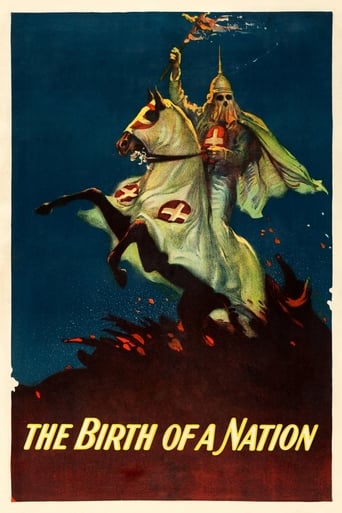
The Birth of a Nation
1915 · Film · 195 min
Directed by D.W. Griffith
Two families, abolitionist Northerners the Stonemans and Southern landowners the Camerons, intertwine. When Confederate colonel Ben Cameron is captured in battle, nurse Elsie Stoneman petitions for his pardon. In Reconstruction-era South Carolina, Cameron founds the Ku Klux Klan, battling Elsie's congressman father and his African-American protégé, Silas Lynch.
27 negative23 neutralfrom 50 commenters
Where to watch
No streaming data for this title.
55 comments on Hacker News
On my news feed today I saw a Newsweek story about how someone found a dvd of Birth of a Nation at Goodwill, not knowing what the plot was.
As far as I can tell the standard for a book being "banned" is just that the librarian or the bookseller is sympathetic to the book's message and thinks it should be more widely read while politicians or parents might think it's inappropriate or they disagree with the message.
If you put the shoe on the other foot and name a book that's out of print because publishers dislike the material or it's problematic in the eyes of librarians, I don't think it fits the standard. Birth of a Nation for example is not a "banned movie" and neither is Song of the South. So the standard is entirely set by teachers, librarians and booksellers.
The entire history of the US is founded on white supremacy. From the genocide of Indigenous people, to slavery, to Hiroshima, Korea, Vietnam, Iraq, Afghanistan, Palestine...
Only Titanic and Avatar earned more money (inflation adjusted) than this film:
https://en.wikipedia.org/wiki/The_Birth_of_a_Nation
A disclaimer on the site that you are not bigoted or genocidal, and that worldviews from the 1913 era were much different than today and don't necessarily reflect your project.
Movie studios have done that for years with old movies. TCM still shows Birth of a Nation and Gone with the Wind.
Edit: I saw further down that you've already done this! What more is there to do?
>The film was controversial even before its release and it has remained so ever since; it has been called "the most controversial film ever made in the United States" and "the most reprehensibly racist film in Hollywood history." The film has been denounced for its racist depiction of African Americans. The film portrays its black characters (many of whom are played by white actors in blackface) as unintelligent and sexually aggressive toward white women. The Ku Klux Klan (KKK), a white supremacist far-right hate group, is portrayed as a heroic force that protects white women and maintains white supremacy.
(from Wikipedia: https://en.wikipedia.org/wiki/The_Birth_of_a_Nation)
I remember watching Intolerance (1916) by D.W. Griffith at the Avignon festival as a teenager in 1986, with a score interpreted by a live symphonic orchestra (https://festival-avignon.com/fr/edition-1986/programmation/intolerance-32452). The movie in itself is definitively a masterpiece for its ambitious structure, innovative editing and grandiose production design (it was a flop at the box office in 1916.)
(Warning: Intolerance was Griffith's response to the widespread criticism of his earlier work, The Birth of a Nation (1915), considered "the most controversial film ever made in the United States" and "the most reprehensibly racist film in Hollywood history" - so we're stepping into controversial territory here).
D.W. Griffith - The Birth of a Nation (1915) The film led to the revival of the KKK
Abel Gance - Napoleon (1927) 562 Minute epos
Buster Keaton - The General (1926) as many have already pointed out
Robert Siodmak - People on Sunday (1930) Captivating images of Berlin pre war
The Brilliant Biograph: Earliest Moving Images of Europe (1897-1902) - Collection of Mutograph (68mm non perforated) films https://player.eyefilm.nl/nl/films/the-brilliant-biograph
Every time I read some Alan Moore interview, I find myself agreeing with him.
Also his masterclass on writing was great to listen to, and I'm not interested in writing. His ideas about writing/creation = magic have stuck with me.
He's always lucid, and clear, and has a stark sense of observation.
One of my favorites: https://alanmooreworld.blogspot.com/2019/11/moore-on-jerusalem-eternalism-anarchy.html
Here's an excerpt:
----
What was the impact of popular heroes comic books in our culture? Why are people fascinated by alternative realities?
I think the impact of superheroes on popular culture is both tremendously embarrassing and not a little worrying. While these characters were originally perfectly suited to stimulating the imaginations of their twelve or thirteen year-old audience, today’s franchised übermenschen, aimed at a supposedly adult audience, seem to be serving some kind of different function, and fulfilling different needs. Primarily, mass-market superhero movies seem to be abetting an audience who do not wish to relinquish their grip on (a) their relatively reassuring childhoods, or (b) the relatively reassuring 20th century. The continuing popularity of these movies to me suggests some kind of deliberate, self-imposed state of emotional arrest, combined with an numbing condition of cultural stasis that can be witnessed in comics, movies, popular music and, indeed, right across the cultural spectrum. The superheroes themselves – largely written and drawn by creators who have never stood up for their own rights against the companies that employ them, much less the rights of a Jack Kirby or Jerry Siegel or Joe Schuster – would seem to be largely employed as cowardice compensators, perhaps a bit like the handgun on the nightstand. I would also remark that save for a smattering of non-white characters (and non-white creators) these books and these iconic characters are still very much white supremacist dreams of the master race. In fact, I think that a good argument can be made for D.W. Griffith’s Birth of a Nation as the first American superhero movie, and the point of origin for all those capes and masks.
----
First off, let’s not forget that you’re criticizing a movie that isn’t even out yet. For all we know it could be a critically acclaimed box office smash hit when it comes out. Not that I hold my breath for these remakes, but the possibility exists. And it’s wildly disingenuous to be a film critic of a film that isn’t out yet.
But anyway, this is funny to me. Snow White is a nearly 100 year old movie. It came out 22 years after Birth of a Nation. If you think a remake can work as a modern movie with zero changes that is kind of naive in itself isn’t it? It’s not like anyone is going to remake From Russia with Love and include the scenes where James Bond slaps women around.
And I mean, yeah, technically, the original Snow White is probably pretty offensive to people with dwarfism. They’re all heavily dehumanized as lesser people with more flaws than Snow White. Snow White has to come in and fix their life essentially, cook and clean for them, etc.
But anyway, I don’t think that’s the driving reason behind using animated dwarves, I think they couldn’t do some of the comedic elements as well with real actors as they can with exaggerated animation.
There also aren’t a lot of people with dwarfism who are lead-quality actors. You need seven of them for that movie. My guess is that test footage wasn’t working.
I'm surprised The Birth of a Nation didn't make it on the list. It's probably one of the most controversial films ever.
re Hollywood:
The Limelight Department was one of the world's first film studios, beginning in 1898, operated by The Salvation Army in Melbourne, Australia.
The Limelight Department produced evangelistic material for use by the Salvation Army, including lantern slides as early as 1891, as well as private and government contracts.
In its 19 years of operation, the Limelight Department produced about 300 films of various lengths, making it one of largest film producers of its time.
Limelight spawned offshoot production efforts from former employees using end of life Limehouse equipment, eg: the 1906 feature length classic The Story of the Kelly Gang
The original cut of this silent film ran for more than an hour with a reel length of about 1,200 metres (4,000 ft), making it the longest narrative film yet seen in the world.
The first proper 'Hollywood' feature length was the 1915 KKK film The Birth of a Nation.
https://en.wikipedia.org/wiki/Limelight_Department
https://en.wikipedia.org/wiki/The_Story_of_the_Kelly_Gang
https://en.wikipedia.org/wiki/The_Birth_of_a_Nation
Sorry but this ignores a lot of history. The plot of the first feature film - Birth of a Nation - is literally the Klu Klux Klan saving the day by driving away the black people run amok during reconstruction. How is that lighthearted and apolitical?
You mean like Apocalypse Now or Birth of a Nation? Movies have been political lecture since the very first feature length film, and have never been very subtle about it either.
I've been picking from a different list (the huge meta-list project from They Shoot Pictures Don't They, which I think does factor in the 1001-films book as one of a whole bunch of things they feed to their Algorithm) but yeah, a lot of the pre-1930 films were a real slog, at least in part. I only bounced off a very few but I was pretty damn bored for long stretches of some others, I think justifiably so.
Big misses for me were anything horror (Nosferatu, The Cabinet of Dr. Caligari—hell, maybe I just don't like German Expressionism?).
Surprise hits were some of the more arthouse films. A Propos de Nice and Man with a Movie Camera were two I loved and are both definitely not conventionally-entertaining. They don't even feature narratives, in any normal sense (but they kinda do?). I also dug some of the Big Damn Movies like Intolerance and Gance's Napoléon—but that wasn't universal, because I found Birth of a Nation unwatchable (I gave it like 90 minutes then bounced—I'd enjoyed none of it, and not just because of the terrible message). Nanook of the North was another surprise hit for me—OK, it's kinda faked or whatever, but they fucking hunted a walrus, for-real, using traditional methods. That they were doing it when they did might have been "fake" because they didn't really do it anymore, but they did it, for-actual-real, which was just nuts to watch, among other things that were "fake" but more-real than a lot of what you might be able to see today.
I started the conversation saying 'you do you'. I don't know where you're getting the idea that I'm expecting anything to be swallowed unquestioningly. I've simply explained why many people do find the movie problematic and even linked academics whose expertise you're free to evaluate on your own.
The follow-up question was simply to gauge what your personal line for content in a film being "problematic" is. From what you've said it sounds like your bar is wherever real world problems can be measured as a result. Fair enough if that's your position, but that's quite a high bar just to say a film is distasteful. Birth of a Nation is the only movie I can think of that might clear it.
I read American Prometheus, and I think the movie is going to be hard on Strauss and Teller. I suppose that the DOE action this month will get mentioned in the closing credits. I don't know, that might seem too little too late to get the AEC/DOE off the hook. It's unfortunate that movie makers are such powerful interpreters of history. (EG, Birth of a Nation, Gone with the Wind) This movie will simplify the history and perhaps not be fair to Strauss and Teller. But if I were going to tell a simple story, I think the upcoming movie would be the story I would tell.
Did something similar when I was in college. I watched the IMDB Top 250 and AFI's Top 100 (lots of overlap at the time). I started aggressively, thinking I could watch one movie a day, and struggled to appreciate any of the movies I watched. I was watching movies to check them off my list. Watching "good" movies back to back made it hard for me to appreciate them; it made my baseline of "what a movie is" too high to enjoy. This made me slow down and add movies between the films on my list. I started watching poorly reviewed movies and found some of my favorite movies along the way.
I like your idea of "... and to understand more about what life was like by watching what they watched ..." That's something I didn't like about strictly sticking to an AFI list. To me, some movies contributed a ton to cinema and are a slog to get through. "Birth of a Nation", "Citizen Kane", and "Gone with the Wind" were more fun to read about than to watch. You can't avoid this with your list having some on there that I dread, but the goal of your list makes more sense to me.
Thanks for the trip down memory lane and getting to think about Netflix DVD subscriptions and my spreadsheets again. I'd like an update when you are done.
I manage to make it through a lot of movies that might, not unfairly, be described as "so boring I'd rather be at the DMV" or "so confusing I don't think even the director knew WTF was happening".
I bailed on Birth of a Nation about halfway through. I can usually suffer through a historically-significant film even if I'm not really loving it (I made it through Battleship Potemkin while hardly enjoying a minute) but Birth was just too much. It wasn't the offensiveness (that can be its own kind of entertaining, in a pinch) but that it was really long, and really dull. Maybe it picked up in the back half, but I doubt I'll ever find out.
I'd say the director's sort-of followup Intolerance also counts as a bit of a challenging watch for modern audiences, but I found that one way more fun.
"The Birth of a Nation" and "The Song of the South" are fair with regard to American history. "The Birth of a Nation" because of the effect it had on the national dialog at the time when it was released. It looks like the only film with Lillian Gish in it on their list as well.
"The Song of the South" might be noteworthy simply for Disney's attempt to bury that film in the recent decades. I don't put it in the same category as "The Birth of a Nation" with regard to how offensive it is (although I am not in the demographic that would be personally offended by either). I'm a huge fan of Joel Chandler Harris' original stories — maybe Disney failed by trying to make Harris' works too "Disney".
Still got a while until Song of the South is freed. We should at least carve out exemptions for works of great cultural importance that are deliberately being kept under lock and key.
I know there are some sensitive race issues, but seriously, the film won an Oscar. It's easier to see the unabashedly hateful Birth of a Nation than it is to see Song of the South!
You originally said that Hollywood movies had become "heavily politicized". I think what you really mean to say is that they've started promoting certain ideas that you don't like. Or are you going to tell me that Birth of a Nation and Gone with the Wind didn't engage with any controversial political ideas?
People say Pet Sounds is good because it invented modern studio recording. That's interesting but Birth of a Nation invented feature films and it's unwatchable.
I really like Pet Sounds. It's The Beach Boys, who sing songs about beaches and girls and surfing, but the whole album is suffused with melancholy. Every song is sad. It's an interesting juxtaposition.
The article references A Love Supreme, which is also great. But in some sense what The Beach Boys are doing is harder than what Coltrane is doing. They're taking a subject matter and art form that are broad, trashy, often associated with kitsch, taking them really seriously, and producing something that avoids all the usual pitfalls when someone writes pop songs about their feelings.
This just doesn't ring true to me, at all.
Is the Youtube algorithm directing people to make vaguely fascist feeling, "bring back the good old days", 'kids today', 'civilization is doomed' content aimed at young males? Or is that just a natural cycle that repeats throughout history?
The biggest film in history was "Birth of a Nation" until it was replaced by "Gone with the Wind", "Star Wars" may have been a rebellion against a vaguely Nazi empire, but it was still about hereditary rulers that are related to each other starting wars.
Overall, the trajectory seems fairly positive. The good old days were pretty crappy and that was reflected in their books, films and songs. Though I suppose if you're young enough that Mulan 1998 is a classic film from the good old days you might simply be ignorant of a lot of the crazy shit that went on.
Look up parents re-watching films from their youth with their children, to realise, horrified, what passed as entertainment in their youth that is now shocking to them and stuff they don't want their kids to emulate or look up to.
I'd argue the KKK is not a good example. The Ku Klux Klan Act was passed in 1871 to target and stop the klan (src: https://en.wikipedia.org/wiki/Ku_Klux_Klan_Act ). This was successful until the Klan was refounded in 1915, thanks to the movie "The Birth of a Nation".
>A woman named Michelle Tandler posted a Tweet lamenting that “every single one of my friends is considering leaving SF.” She added that “My friends are scared for their children and their husbands are scared for their wives.”
>And for some reason, Kate Chatfield, who is a senior director on DA Boudin’s staff, thought this would be a good time for a public official to take a shot at a local resident. Chatfield said the “Husbands are scared for their wives,” was right out of the famously racist film, “Birth of a Nation,” which portrays the Ku Klux Klan as heroes.
This is absolutely insane to me. Someone expresses concern about crime and someone from the DA's office publicly compares them to the KKK? How is that in any way acceptable?
I view that as a positive. Like a lot of other things in the US, the film industry has a long and racist past starting with the infamous "Birth of a Nation," which was highly profitable at the time of its production, but you couldn't make a blatant racist propaganda film like that now, which I'd say is for the better. The article mentions "Borat" which is an interesting example because I'd imagine a lot of people just don't get the joke and would also view it as a racist and anti-semitic film.
Oh? What are the kinds of things in a movie that might make you do that?
Let's suppose you're black and go over to a white friend's house for movie night. He puts on something super racist (say, Birth of a Nation, or a collection of blackface routines). You object, but all of his guests mock you for being "too sensitive" and "too political". You say, "I'm not sitting here for this," and leave. Were they rightfully unhappy with you?
I would say no, that your friends are assholes. That you aren't obliged to silently endorse your own oppression.
And I think it's the same thing at work. Would I want endless off-topic discussion at work? No. But some of what people denigrate as "too political" is entirely material to the workplace. Indeed, the Basecamp mess shows clearly that "no politics" rules are about suppressing discussion of things that are relevant, and are necessary because they are relevant.
Also, a bunch of stuff that seems super-old actually isn't. There were still lions in the Caucusus until the 10th century... CE, not BCE. A thousand years earlier they lived in Thrace, too. There were still some wooly mammoths alive when the Great Pyramids were being built.
Similarly, living history can sometimes reach closer to the modern day than one might appreciate. There were (probably—some of the stories lack documentation) a few people born into legal chattel slavery in the US still alive while Martin Luther King, Jr. was active. The "Old West" and settler/Western Expansion days were still very much in living memory when early western radio serials and films were made, so it's entirely possible (likely, even) that a couple honest-to-god gunslingers (rare though they may have been, and as unlike their film counterparts) or victims/perpetrators of settler/native violence sat down and watched romanticized Westerns on the big screen. Shane is set in 1889 and came out in 1953. Lots of people alive during the fictionalized events of the film were still alive then. At least a few people who fought in or witnessed actual fighting in the Civil War likely watched Keaton's The General in a movie theater, or (more ominously) Griffith's The Birth of a Nation.
But aren't there lots of books/movies/etc that are "pretty far from what most people would see as 'fine' now"?
I watched Birth of a Nation in college for a film class. It's considered the one of the first feature films.
Now I don't particularly like Birth of a Nation, I'm not attached to it (I feel asleep during the screening). I'm also not attached to Dr. Suess. But I know there are definitely things that I am attached to that the "powers that be" will deem too offensive to publish or distribute any longer. And so I find this turn of events disturbing. I want them to keep publishing these books as long as there is demand and, by arguing for that, I am defending the "offensive" things that I do like.
This is all very basic liberalism. I'm an atheist but I will defend people's right to worship and, in doing so, I am defending my own right not to worship. It's disturbing to me to see how the basic tenets of liberal civilization have become cliche in people's minds.
This seems pretty crazy to me - you're saying that if I happen to enjoy anything that also happens to be enjoyed by racists/sexists, you would be concerned? Guess what? Racists and sexists like Harry Potter, and Star Wars, and Marvel movies, and Coca-Cola, and everything else that people who aren't racists and sexists like. I guarantee that you enjoy many, many things that are also enjoyed by people who have detestable beliefs, because people with detestable beliefs sometimes like things that have nothing to do with those detestable beliefs. Racists don't spend all their time reading Mein Kampf and watching Birth of a Nation, they also read the same books you read, watch the same movies and television shows you watch, and, yes, read the same blogs you read.
If the blog has sexist/racist content that attracts sexists and racists, sure, that's a problem, but if the blog had such content, the NYT article wouldn't have resorted to pointing out the commenters, they would have linked the content.
> As to the feminism issue, in the full context, he criticizes feminism with respect to specific points and texts from feminists (which he is 100% entitled to), but then ends with the sentence in question that to me whichever angle you look at it from says, feminism and pure evil are not too distant. As I noted, he could have backed away from the statement easily by saying his statement is wrong (if he thinks so), but claiming it's out of context is dishonest and a diversion.
Specifically, in context, he said "People who go out of their way to be horrifically mean to other people who are pretty unfortunate and unhappy and don't understand why, just for asking why, are pretty much pure evil", it wasn't an attack on all feminists ever, it was an attack on people who he specifically thinks are doing something extremely terrible. That's the context.
Not mentioned on this page, but a more virtuous campaign to ban a film in Boston was Monroe Trotter's attempt to ban the racist film Birth of a Nation:
"Ironically, Trotter had succeeded in tightening a censorship bill but failed to stop the movie. It was a victory for artistic freedom but not necessarily a defeat for civil liberties, since the conflict had nurtured a young NAACP, which gained strength in the ensuing battles for civil rights in the coming century. As for Griffith, in an interview he gave in 1941 when he was virtually forgotten in Hollywood, he remarked that “because of the social progress which Negroes achieved” given the oppression they faced, “it is best that The Birth of a Nation in its present form be withheld from public exhibition.’’"
https://www.thedailybeast.com/the-fight-to-ban-birth-of-a-nation
> "hate speech" is a term that was coined in recent years to silence people.
Americans have been struggling with hate speech and censorship for well over a century. The most obvious example is the censoring of the film The Birth of a Nation back in the late 1910s, but there are examples even further back in US history.
Our interpretation of "freedom of speech" (both philosophically and as protected by the First Amendment) isn't immutable and has changed since the Bill of Rights was adopted. Prior to the 1950s, the supreme court upheld the censorship of books and film for reasons that we now interpret as unconstitutional, and censorship remained the law in many states for decades after.
I would argue that our current expectation for "free speech" and this idea that it is "nearly absolute" is far more liberal than what we've seen through most of American history.
I ignore anyone who puts "left" in scare quotes. It's an ad hominem distraction from the substance of the argument.
As for the claim that Borat is "nearly the most racist movie in history," that shows the author's ignorance of film history and the thousands of very racist films that have been made worldwide. One could argue that Borat is racist, and there would be plenty of points to debate, but there are many many more racist movies in American film history (Birth of a Nation, Song of the South, the entire blaxploitation genre) - not to mention plenty of racist non-American films.
This is just meandering junk, is this the latest instalment in Virtue Signalling? B grade magazines just put Black <random word> Matter and they get advertising $ and upvotes?
The Birth of a Nation is related to the killing of George Floyd because a $2,000,000+ (present day $) movie used a camera and random people on the street used a camera?
If you bothered to look specifically at The Birth of a Nation and movies you would see movies continually move civil rights in the correct direction, outliers like The Birth of a Nation have little effect overall. That for instance might be an interesting discussion.
There’s a lot to unpack there, but essentially, the southern way of life is a myth rooted in nostalgia for the “Old South,” or the plantation south. It started after southern Democrats “redeemed” the south from Reconstruction. They invented a revisionist history known as “The Lost Cause,” which was about the so-called noble Confederacy fighting “The War of Northern Aggression.” This ideology crossed into the mainstream, most notably when they released the film “The Birth of a Nation.” It’s this period of time when the Jim Crow laws were created and white southerners created systems to keep white supremacy in power. Today, this legacy has created the folks who wave their flags.
Religion was just one way they spread that message.
And, aside from that unfortunate part of southern culture, the south is a multi-cultural, complicated place.
> "Deepfakes can be used for many of the things we already know," [co-director of the Nixon film Francesca] Panetta says, "but also to create kind of alternative histories or have the potential to kind of rewrite history as well."
Movies, from Hollywood and elsewhere, have been convincing people of rewritten histories since their inception. How well known is the story of the real Spartacus compared to the Hollywood Spartacus? How many people's vision of the antebellum US South came from Gone With The Wind rather than from historical documents and interviews with former slaves and slave-owners? Birth of a Nation inspired the revival of a terrorist organization that lasted decades; Triumph of the Will painted the Nazis' rise as a matter of noble heroism triumphing over cowardice. Last week I argued with some epistemologically incompetent person who wanted me to watch an anti-vaccine movie about Gardasil, apparently unaware that YouTube videos are not really a publication venue used by medical researchers.
So, what should we do about it? Well, the Soviets had an answer: since movies were so powerful, people would be carefully vetted before they got access to the equipment needed to make them, and if someone made a movie with harmful contents anyway, they would go to GULAG. Is that the solution we want?
Can be unconscious/unintentional connections too.
But I think Moore's real point is simply that the Birth of the Nation does some of the same things as later superhero movies, with the KKK as the superheroes. They also happen to wear uniforms that are strikingly similar as it happens...
But it doesn't mean Siegel and Shuster were consciously -- or even unconsciously -- inspired by Birth of a Nation and the KKK. It might mean that there is a connection/commonalities in the reasons both forms were so popular.
Birth of a Nation was released in 1915. It was enormously popular, it was not some fringe thing, it was a mainstream popular success which generally did not have it's politics questioned in the mainstream, although there were protests by Black people. According to wikipedia, "It presented the Ku Klux Klan (KKK) as a heroic force." Heroic, eh?
Superman's first apperance was in 1938.
> In fact, I think that a good argument can be made for D.W. Griffith’s Birth of a Nation as the first American superhero movie, and the point of origin for all those capes and masks."
And ironically a superhero radio serial helped seriously weaken the KKK in the 40s:
https://www.mentalfloss.com/article/23157/how-superman-defeated-ku-klux-klan
I heard elsewhere that, after the program aired, the children of KKK members were angry when they found their children playing "Superman vs. the Klan" and understanding the Klan to be the enemy.
I'm not defending the superhero genre targeted at adult audiences, and I think the movies tend to be boring and unimaginative.
This is a serious mic-drop line that had my jaw hanging open:
> In fact, I think that a good argument can be made for D.W. Griffith’s Birth of a Nation as the first American superhero movie, and the point of origin for all those capes and masks.
Super heroes capes and masks as inspired by KKK hoods? I don't think it was probably intentional/conscious in the minds of those who originated it, and I don't think Moore necessarily means it was either... but it's definitely an interesting cultural collective unconsciousness sort of lineage.
FYI, the full interview is available here https://alanmooreworld.blogspot.com/2019/11/moore-on-jerusalem-eternalism-anarchy.html
EDIT: The relevant quote (although the whole interview is pretty interesting):
"I think the impact of superheroes on popular culture is both tremendously embarrassing and not a little worrying. While these characters were originally perfectly suited to stimulating the imaginations of their twelve or thirteen year-old audience, today’s franchised übermenschen, aimed at a supposedly adult audience, seem to be serving some kind of different function, and fulfilling different needs. Primarily, mass-market superhero movies seem to be abetting an audience who do not wish to relinquish their grip on (a) their relatively reassuring childhoods, or (b) the relatively reassuring 20th century. The continuing popularity of these movies to me suggests some kind of deliberate, self-imposed state of emotional arrest, combined with an numbing condition of cultural stasis that can be witnessed in comics, movies, popular music and, indeed, right across the cultural spectrum. The superheroes themselves – largely written and drawn by creators who have never stood up for their own rights against the companies that employ them, much less the rights of a Jack Kirby or Jerry Siegel or Joe Schuster – would seem to be largely employed as cowardice compensators, perhaps a bit like the handgun on the nightstand. I would also remark that save for a smattering of non-white characters (and non-white creators) these books and these iconic characters are still very much white supremacist dreams of the master race. In fact, I think that a good argument can be made for D.W. Griffith’s Birth of a Nation as the first American superhero movie, and the point of origin for all those capes and masks."
> In the 20th century, in the US alone, you could point to the suffragettes, organized labor at different times, the KKK (4 million members at peak in 1920s!), the multitude of different workers' groups of all political stripes (from veterans' march to IWW organizers to wacky retirement-lottery scheme whose details I forget) who pushed FDR to eventually offer the New Deal to counter-act the rising tide of protest, the Civil Rights Movement, the anti-Vietnam-war protests, Stonewall and the gay rights movement... on and on and on.
Most of these were borne from trusted institutions:
* Organized labor WAS an institution of its own.
* The resurgence of the KKK in the 20th century was inspired by the Hollywood film Birth of a Nation.
* The Civil Rights Movement was largely organized by institutions like the NAACP and partially borne out of organized religion.
* Popular opposition to the Vietnam War, as explicitly addressed in the article, came largely from the influence of mass media, Walter Cronkite in particular.
* Most of the political movements of the late 1960's and early 1970's were comprised primarily of university students--in other words, they were also incubated (unwittingly, to be fair!) by established institutions.
Many of the rest is stuff that probably seems bigger in retrospect. For example, the Stonewall riots took place in 1969, the same year as the moon landing and Woodstock and one year after the Tet Offensive and the assassinations of both RFK and MLK. It probably didn't make a big impact on the culture at the time. According to a Google ngrams search (https://books.google.com/ngrams/graph?content=stonewall%2C%22stonewall+riots%22&case_insensitive=on&year_start=1800&year_end=2008&corpus=15&smoothing=3&share=&direct_url=t4%3B%2Cstonewall%3B%2Cc0%3B%2Cs0%3B%3BStonewall%3B%2Cc0%3B%3Bstonewall%3B%2Cc0%3B%3BSTONEWALL%3B%2Cc0%3B.t1%3B%2C%22%20Stonewall%20Riots%20%22%3B%2Cc0#t4%3B%2Cstonewall%3B%2Cc0%3B%2Cs0%3B%3BStonewall%3B%2Cc0%3B%3Bstonewall%3B%2Cc0%3B%3BSTONEWALL%3B%2Cc0%3B.t1%3B%2C%22%20Stonewall%20Riots%20%22%3B%2Cc0), the phrase "Stonewall" didn't have a large uptick in terms of being written about in books until the 1980's, over a decade after the riot itself. (Most of the usages prior to then, and probably many of them even after, are likely references to General Thomas "Stonewall" Jackson.)
Well heck, Birth of a Nation was probably considered as a documentary too when it was shot -- along with a lot of war movies.
My larger point was that to produce anything for the public, it must be simplified. That always requires bias. Satire has stopped being entertainment and instead is a way to simplify things. We tell a joke in lieu of explaining something. (As the old documentaries were supposed to do: explain something) Once satire takes on that role, it's always going to be misinformation to some degree or another.
> But many of today's subreddits, facebook pages and 4chan boards don't have a direct equivalent in the 1970s.
I'd like to subscribe to your newsletter ()!
But seriously, The Birth of a Nation came out somewhat before r/RarePepes. Michael Moore films also (barely) predate social media. And people were reading about JFK assassination conspiracies and fake moon landings way before "new" media was around.
() The equivalent to a niche social media group was subscribing to a niche political newsletter.
You are correct. Here (https://en.wikipedia.org/wiki/Woodrow_Wilson#Race_relations) is the Wikipedia section adding more context to the above comment. Note below that photographs became a requirement for application to federal jobs. The level of discrimination and suppression Black folks suffered over centuries is just appalling. "Several historians have spotlighted consistent examples in the public record of Wilson's overtly racist policies and political appointments, such as segregationists he placed in his cabinet.[274][275][276][277][278] According to scholars, Wilson believed that slavery was wrong on economic labor grounds, rather than for moral reasons.[278] They also argue that he idealized the slavery system in the South, viewing masters as patient with "indolent" (i.e. lazy) slaves.[278] In terms of Reconstruction, Wilson held the common southern view that the South was demoralized by Northern carpetbaggers and that overreach on the part of the Radical Republicans justified extreme measures to reassert Democratic national and state governments.[279][280][281] WWI draft card,the lower left corner to be removed by men of African background to help keep military segregated
While president of Princeton University, Wilson had discouraged blacks from applying for admission, preferring to keep the peace among white students and alumni.[282] Wilson's History of the American People (1901) dismissed lynchings committed by the Ku Klux Klan of the late 1860s as a lawless reaction to a lawless period. The President defended them, writing that "[the Klan] began to attempt by intimidation what they were not allowed to attempt by the ballot or by any ordered course of public action".[283]
Wilson's War Department drafted hundreds of thousands of blacks into the army, giving them equal pay with whites, but in accord with military policy from the Civil War through the Second World War, kept them in all-black units with white officers, and kept the great majority out of combat.[284] When a delegation of blacks protested the discriminatory actions, Wilson told them "segregation is not a humiliation but a benefit, and ought to be so regarded by you gentlemen." In 1918, W. E. B. Du Bois—a leader of the NAACP who had campaigned for Wilson believing he was a "liberal southerner"—was offered an Army commission in charge of dealing with race relations; DuBois accepted, but he failed his Army physical and did not serve.[285][286] By 1916, Du Bois opposed Wilson, charging that his first term had seen "the worst attempt at Jim Crow legislation and discrimination in civil service that [blacks] had experienced since the Civil War."[286]
Cabinet heads appointed by President Wilson re-segregated restrooms and cafeterias in their buildings. During Wilson's presidency, the film The Birth of a Nation (1915) became the first motion picture to be in screened in the White House.[287] The film, while revolutionary in its cinematic technique, glorified the Ku Klux Klan and portrayed blacks as uncouth and uncivilized. After seeing the film, Wilson felt betrayed by his old friend Thomas Dixon Jr., who wrote two books the movie was based on, and did not like or endorse the film; he tried to stop its showing during the World War.[288] Biographer Cooper rejects the claim first made in 1937 by a magazine writer who said that Wilson remarked: "It is like writing history with lightning, and my only regret is that it is all so terribly true"; an eye witness reports that Wilson said nothing.[289][290] During Wilson's term, segregation was ordered in the Washington offices of the Navy, the Treasury, and the Postmaster General. Then suddenly, photographs became required for all new federal job applicants. After black leaders pressed him, President Wilson explained he was trying to "reduce friction," and that he "sincerely believe[d] it to be in their interest."[291]
Under Wilson, racial segregation was quickly implemented at the Post Office Department. Many African American employees were downgraded and even fired. Employees who were downgraded were transferred to the dead letter office, where they did not interact with the public. The few African Americans who remained at the main post offices were put to work behind screens, out of customers' sight.[292]"
Birth of a Nation is a restrained work of art compared to the ceaselessly flowing vitriol of Breitbart and Infowars — and those people have the highest levels of endorsement from Trump.
Steve Bannon’s film career was directly inspired by Leni Riefenstahl, according to his former colleagues. Watching Birth of a Nation in the White House is tame compared to making the propaganda director the chief strategist.
> In a strikingly Trumpian fashion, President Wilson himself helped sow suspicion of anything German.
Trump is tame and politically correct compared to Woodrow Wilson. Wilson was an unabashed racist, who screened "Birth of a Nation" in the White House, a pro-KKK film that portrayed the Klan as a heroic force to control hordes of savage black males that wanted to rape white women.
"The Birth of a Nation" (Ku Klux Klan propaganda film) for instance, uses that tactic to dehumanize black men... that film is to blame for a temporary expansion of the KKK.
So I think accusing a demographic of being perverted should be considered hate speech in my opinion.
It's not myth, it's narrative. Antebellum slavery and Jim Crow were narratives[1]. Even worse, they're narratives based on phrenological "science".
[1] see also a novel "The Klansman", the Word of that narrative made flesh and into "Birth of a Nation" , i which the modern movie was born.
Sacrificing individual agency to mythic protections has a name. It's collectivism. And it takes quite the storyteller to kill that sort of story.
The housing crisis? "Housing never goes down." Vietnam? "The domino theory." Manifest Destiny? "Go West, young man."
The problem is that we're adapted to narrative as our principle means of information exchange. So we try to construct counter-narratives. Those work just about as well.
The antidote to narrative is rhetoric.
I'm sure there's lots of examples, but in the documentary world, The Thin Blue Line was about a man wrongfully accused of murder on death row, who was retried and released as a direct result of the movie.
Also, I think Triumph of the Will played a huge part in helping Hitler come to power. And in the US, The Birth of a Nation helped the KKK explode in popularity. These aren't particularly uplifting examples, but I think it's clear that a popular movie can have a huge effect on the political landscape.
This is not true, or is only partly true depending on which KKK you are talking about. The original group formed in the 1960s as an anti-reconstruction organization and used terror tactics to chase politicians and businessmen they didn't like out of certain communities in the South. It didn't last long though and was disbanded in the early 1870's.
The 'second' Klan was originally a merchandizing effort surrounding the movie "Birth of a Nation." It quickly turned into an actual political organization which adopted the white nativist views which were in vogue at the time. It was largely anti-immigrant focusing on Catholics, but also targeting Jews and Eastern Europeans.
It's worth noting that in all of it's incarnations, the Klan was racist and anti-black. It wasn't until the 1960s that this became the center-point of their politics, but it was always there.
You can make a guess for how things held up in the past by looking at some of the Google Books datasets, though that does have some problems. One problem is that it's completely unnormalized (the proportion of the dataset that is made up of different kinds of books changes over time), and another is that you can't really search for movie titles that are also names of anything else, or common English words, without getting other stuff in the results.
But with those caveats it can be fun to play around with: http://books.google.com/ngrams/graph?content=Birth+of+a+Nation%2CCitizen+Kane%2CThe+Big+Parade%2CGet+Carter&year_start=1900&year_end=2008&corpus=15&smoothing=10&share=
"Birth of a Nation", for instance, had a huge impact all across North America -- but nobody is around anymore to cite it
That's an odd choice of counterexample, since it ranks pretty highly in this list, so apparently is actually cited a lot on Wikipedia. It's the "most influential" pick for 1915 in the year-by-year list (http://blog.argteam.com/coding/a-history-of-film-in-wikipedia/), and is #16 of all time in the all-time list (http://blog.argteam.com/golang/the-top-25-movies-of-all-time-chosen-by-an-algorithm/).
You definitely aren't wrong, but it is worth noting that the PageRank is calculated based on all wikipedia articles, and not just those of movies (so influence into other areas will hopefully bubble up). "Birth of a Nation" actually does show up quite prominently for the pre 1930s era.
A suggestion: "Most culturally prominent" works better than "most influential" The only thing Wikipedia is going to tell you is how many other Wikipedia authors cite something. A movie can have terrific influence globally but in an indirect manner, influencing a generation of writers and directors, for instance. Likewise it could have influenced a lot of people, just not people who have anything to do with Wikipedia. Wikipedia is more like a popularity contest. "Birth of a Nation", for instance, had a huge impact all across North America -- but nobody is around anymore to cite it, so it's mostly lost to time.
I see you've changed the title. Cool.
Nice work!
I agree. We've been making movies about war since the dawn of film making. I mean sure, movies like Birth of a Nation and Saving Private Ryan depict it differently, but we've still been doing it in film forever. And in terms of art, for hundreds if not thousands of years. The only difference between, Saving Private Ryan and say Call of Duty 2 is that you are in control of a soldier who is shooting enemy soldiers, and I guess it's this difference that people are harping on, not that I agree with this idea.
People have said similar things regarding books, pictures, movies, etc. and this is nothing new and it's all been for the same reasons: when it's politically advantageous and so as not to blame bad parenting.
The technology associated with film-making has evolved incrementally ever since its inception: from the 1890's Edison Kinetoscope shorts that could be watched by only one person at a time to the 2-reeler comedy shorts circa 1915 to D.W. Griffith's breakthrough with silent feature-length films in Birth of a Nation to the first talkies with 1927's The Jazz Singer to the introduction of color in select 1920's movies such as The Black Pirate (eventually evolving into beautiful technicolor productions) to Disney's feature animations in the 1930's to the first experimentation with 3-D in the 1950's with The Blue Lagoon and other gimmick films featuring knives and other assorted objects being hurled gratuitously at the audience to the widescreen film techniques of the 1950's featuring elongated landscapes that made one dizzy watching them to the modern digital special effects movies featuring CGI in a leading role.
Throughout this history, film-makers have continually experimented with different camera techniques and different types of cameras.
This item relating to Mr. Cameron appears to be another incremental step in this long process. It looks to be interesting and possibly intriguing.
What is being lost in the modern film innovations, however, is what I would call the essence of film-making, which is a play-acted script featuring real people but presented as human drama/comedy/satire/etc. using the recognized camera techniques that distinguish cinema from a live play - rapid cutting, point-of-view camera angles, etc. As things go increasingly digital, and become more and more subject to manipulation of images bearing less and less connection with our real world experiences, we get more and more a sense of watching a cartoon as opposed to real people. It is no coincidence that, in this context, many of the modern plots are drawn from cartoon sources (Batman, Spider Man, many others). As this emphasis on special effects has increased, what has become increasingly lost is the quality scripts (with their corresponding wit, drama, fantasy) that once could be taken for granted in quality film-making. The result is an increasingly artificial experience to which it becomes harder and harder to relate.
Over the centuries, it is the great stories that have moved us, from epic poems to the great novels and, yes, even to the cinema of old warhorses such as Gone with the Wind. Today, technology has become as much a substitute for story-telling as anything else. Yes, it constitutes progress in a real sense (incremental though it may be) but, insofar as it has detracted from inspiring story-telling by serving as a tin-hat means of attracting audiences without the need to develop a great story, it has brought a net loss. Just watch a silent movie like Sunrise (1927) and tell me that CGI and other gimmicks have brought a net improvement to what truly can be inspiring about film.
It is, of course, possible to combine great new technology with great stories but not when the technology itself is being featured as the primary attraction.