 Hacker Cinema
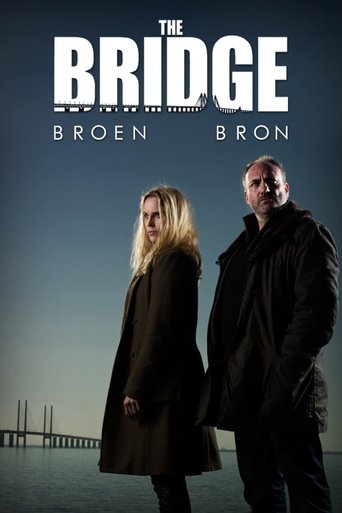
The Bridge
Bron/Broen
2011 · TV series · 60 min episodes · 4 seasons
Created by Hans Rosenfeldt
When a body is found on the bridge between Denmark and Sweden, right on the border, Danish inspector Martin Rohde and Swedish Saga Norén have to share jurisdiction and work together to find the killer.
9 positive1 negative8 neutralfrom 18 commenters
Where to watch
No streaming data for this title.
21 comments on Hacker News
> Since when? What have they been replaced with?
The Helsingborg-Helsingør train ferry was replaced (car ferries remain) by railway on the Öresund Bridge (from the 2011 TV series The Bridge) between the big cities Malmö, Sweden and Copenhagen, Denmark in 2000. https://en.wikipedia.org/wiki/%C3%98resund_Bridge
The Puttgarden-Rødby train ferry was replaced by a new longer but faster railway route via the Great Belt Bridge and Flensburg until the Fehmarn Belt Fixed Link is ready. https://www.seat61.com/trains-and-routes/hamburg-to-copenhagen-by-train.htm#Route_map
One trick I learned a while back to just sort of get my mind right first thing in the morning was to make my bed. I got it from a TV show, The Bridge, I think. It's such a small and seemingly insignificant act, but the routine is comforting and it feels good to have done something that will also bring me comfort when I go to lay down that night. It's nice coming to lay down in a nicely made bed.
I'd love to learn more of these sorts of little actions that bring calm and joy to my brain.
I'd add in The Bridge - original Swedish version with subtitles - is another of my favorite shows. The Nordic Noir genre has mix of intellectualism and misanthropy that I love in shows (including Severance).
https://www.imdb.com/title/tt1733785/
it's the film equivalent of midcentury-Scandinavian design in architecture really. Explosive colors, maximalism and so on have been out of fashion for quite a while, and TV shows and movies opt for a more serious, colder, functional look. Funnily enough I think also inspired by a lot of Scandinavian media. The Bridge which was quite popular internationally is a very muted, grey show as is a lot of British television, Luther comes to mind, which has a lot of success internationally.
I don't really think one needs to go for technical explanations at all because that modernist aesthetic of black and white colors is pretty much everywhere. Inside Apple Stores, in the clothing you see in offices or even at fashion events. If you see something extremely colorful or extravagant today it almost automatically stands out.
And it's also the start of the Swedish-Danish TV series The Bridge. A body is found on the Öresund Bridge between Denmark and Sweden, and a Swedish and Danish cop has to cooperate (with the Swedish one being a woman with Asperger's). Of course in that case, Swedish and Danish are mutually intelligible.
I could go on and on about how great Nordic Noir shows are. They are a refreshing change from the American style of shows. The best are, in order, "Before We Die" (Sweden), "All The Sins" (Sweden), "Broen Bron - The Bridge" (Sweden, Denmark), "Bordertown" (Finland), "Deadwind" (Finland), "Ófærð - Trapped" (Iceland), "Rebecka Martinsson" (Sweden, first season)
I have the Millennium series queued up: "The Girl with the Dragon Tattoo", "The Girl who played with Fire", "The Girl Who Kicked the Hornets"
The only Nordic Noir book I've read is Smilla's Sense of Snow, but I can't recommend.
There are two American Nordic Noir series I recommend: "The Killing", set in Seattle and based on the Danish show "Forbrydelsen." Also "Fargo" the movie and all 4 seasons of the TV series.
It's interesting that that Fargo sensibility that the Cohen Brothers captured so well comes from the Nordic regions. Duluth Minnesota was once called the Helsinki of America.
Globalization for Me and Not for Thee, S36E571
This happens fairly often on German Netflix. When the program's language is neither German nor English, often there are no English subtitles available.
International licensing is obviously complicated, so it's hard to say whose "fault" it is, but my suspicion is that some rights owners will only license the service to use the local language to prevent end users doing digital geo-arbitrage.
For example, the Swedish series "The Bridge" is available on German Netflix, and the trailer has English subtitles, but the actual episodes only offer German subs. AFAICT in the US market this show is only available for streaming as a purchase from Amazon.
Heh, this is the perfect place for me to jump in with some movie trivia.
Have you ever watched either Ip Man or "The Bridge" (Danish/Swedish cop show)?
In Ip Man, there's a gang of Mandarin speakers who show up in Ip Man's Cantonese world. They somehow are able to speak to each other, and I find it unlikely. Perhaps it's because my Cantonese is mediocre. But it just doesn't sound like you could have a casual conversation across the languages.
A similar thing happens in The Bridge. There's two cops solving a crime on the bridge connecting Denmark with Sweden, and they just talk to each other in their own languages. My guess is most people who didn't study the other language would not know all the slang, as importantly the simple expressions. Though I guess it could be learned easily; I can read a Swedish newspaper, just not process it fast enough to have a fast conversation with a colleague.
Similarly with German and Swiss German. Something about the way the sounds are different makes processing the other one a bit slow if you're not used to it.
I lived very near to Denmark for a year and enjoyed quite a bit of Danish television as a result. Unfortunately I did not find too much good Danish comedy in English. Most of the Danish television I found enjoyable has been dramatic acting (including many of the tv series mentioned before in this thread such as The Rain, The Bridge, etc.).
If you are looking for more of a generic Scandinavian style of comedy I can definitely recommend Östlund films, especially The Square and Force Majeure. The former stars a Danish actor and both are quite good examples of Scandinavian comedies.
What enjoys widespread appeal is however the cream of the crop. Being raised in Sweden I often opt out of watching a Swedish movie or tv-show simply because everything that makes Nordic Noir good, morally complex stories with plain language, can make the main characters insufferable and obnoxious. You have to remember that the most exciting stories in a culture are about those who do something daring and in Scandinavia, where we are very conflict averse, you thus get heroes acting like assholes because we wouldn't dare do that ourselves.
It can work quite well as evidenced by the popularity of The Bridge, The Girl with the Dragon Tattoo and others ... but it can also not work out at all if you don't sympathize with the characters' cause. That's why they're almost all crime dramas, because asshole or not, we all sympathize in their attempt to catch the bad guy. Try watching a Scandinavian romantic drama to see what I mean.
Thanks for the recommendations! I haven't watched many Scandi shows since binging through Borgen, Forbrydelsen (The Killing) and Broen (The Bridge) few years ago. All highly recommended.
Ahh yes, thank you! Every time I post in a thread about Malmö & Copenhagen I learn something.
Last time I tried talking about the TV show The Bridge using its original name (Bron/Brøn, I hope I got it right this time!), but I think I used an umlaut instead for the Danish spelling, and apparently that means something different...
Frankly, I don't know which ones produce the best movies in general as this is somewhat subjective. There are gems from all countries and often there is a co-operation between countries.
However, since I especially like Swedish crime drama, I can give you specific recommendations of crime drama movies and TV-series from Sweden and other countries.
* Snabba Cash I, II, III ("Easy Money" I, II, III) * Wallander (yeah, the original Swedish one - there are many) * Beck (there are many) * Jägarna ("The Hunters", there's two) * Midnight Sun ("Midnattssol"; TV series taking place in Lappland)
The latter is a French-Swedish production which is, I think, a good example of what the directive of the article intends to create more.
In addition to watching a crime drama of the kind which you might not have not seen, you get to sight-see places as they are. I especially liked the visual appearance of The Midnattssol since it takes place in Lappland, which I think is beautiful in a rugged way.
Also, you may have seen Hollywood remake of The Girl with the Dragon Tattoo. There's a Swedish original which can be interesting to watch.
A Swedish-Danish series called "The Bridge" (Bro) is very good, but I have not seen it.
An Italian (actually Italian-German) series called "Gomorrah" is very good too, I heard. I have not seen that either, though.
I have yet to fully explore all the crime drama from other European countries; I've seen some Finnish ones (like "Vares") and they were OK too.
Hope this helps.
Edit: forgot Snabba Cash III!
> If we didn't do that, we'd be completely inundated with American shows flogged off on the cheap
Absolutely. I deleted it from my post, but I was going to mention that on non-primary Australian TV stations that don't have the same content restrictions, we get 2 hours of non-stop Big Bang Theory reruns, or endless repeats of Frasier, Sex And The City, Charmed & Becker.
> What kind of tv show do you consider 'culturally significant'?
Glitch is my favorite recent Australian TV show, started on ABC but apparently Season 2 has been sold as a Netflix exclusive. Back in the 90s it would have been shows like Seachange, Frontline, Kath & Kim. Maybe Offspring & Packed To The Rafters are recent equivalents.
(Outside Australia, I'd think of shows like The Bridge, Springfloden, The Killing & Occupied, that have exported Scandinavian culture onto Australian TV.)
One of their better shows last year was Marcella [1], the British show from the guy who wrote the original The Bridge (Broen/Bron).
(If you liked Trapped, make sure you check out Baltasar Kormákur's [2] other non-Hollywood work. 101 Reykjavik and Jar City are particularly good. I also liked The Sea.)
I love that they're pulling in quality indie/foreign films such as Rams [3], but these are few and far apart. There are so many superb "arthouse" films out there that they could offer. I wish someone would sponsor the digitalization of older "out of print" works that now only survives on old, out-of-production DVDs or on VHS. I wanted to find a few of Icelandic director Friðrik Þór Friðriksson's films (Children of Nature is one of my all-time favourites), but they're not available anywhere. I was hopeful for Filmstruck [4], but their selection is very limited.
[1] http://www.imdb.com/title/tt5269594/
[2] https://en.wikipedia.org/wiki/Baltasar_Kormákur
[3] http://www.imdb.com/title/tt3296658/
[4] https://filmstruck.com/
Mutually intelligible is not an exact thing. From my own experience:
A native speaker of Danish, I was able to speak with my Norwegian housemate. It worked OK, but not great, and not for anything technical (like science and finance, where the Germanic words are very different to the English).
With my Swedish friends however, it was harder. Not sure why, since Sweden is visible from Denmark but Norway is a bit further away. Also, I found the TV Series "The Bridge / Broen" quite unlikely. Swedes and Danes don't talk that easily together, and certainly not with slang. The scenario of the cops from opposite sides of the bridge working together could still work, but mostly in writing. Also, the cadence is very different. Swedish is melodic. Danish is grunty.
Of course I have had no instruction in Swedish or Norwegian, but it wouldn't be hard, based on friends who have moved.
German is not mutually intelligible with Danish. But it is. I went to a handful of German classes, and it dawned on me that changing a few things around makes High German pretty much like old Danish, like what you'd hear in old black-and-white movies from around the war. These days Danish has a lot of English in it, and something about the way sentences are put together makes old movies seem very... old. But once you have a simple map in your mind, Danish appears to be German with some substitutions and simplified grammar. I can read the paper in German now, despite having had just those few lessons.
Swiss German, now there's a weird one. The sounds are different. I suppose I'm twice removed from it, but even native Germans I know will produce the WTF face when they hear a Swiss German. Words and grammar are similar, but different enough to be recognisably so by a foreigner like myself. But I suppose it's like Swedish and Danish.
Apropos the article, Singlish I found quite interesting. To me it's just English with sprinkled Chinese, and I think most English speaking people will not have a problem understanding it without instruction. One useful addition: English doesn't make much use of the modal particle, so it makes sense that Cantonese "la" is heard all over the place.
A bit of a digression, but...I strongly dislike dubbing and simply cannot enjoy a dubbed drama or film.
First, you have the distracting mismatch between the actor's mouth movements and the dubbed dialogue.
Second, the way an actor speaks in their native language is an intrinsic part of their performance. A dubbed performance will be different, but can never match the original (unless we're talking about a poorly acted, poor quality production).
To give an example, the Scandinavian series The Bridge has won great praise for the performance of its lead (Sofia Helin). This has been a big international hit (in the UK it was shown subtitled). Can a dubbing actor really ever inhabit a character in the same way as the original performer? (Don't forget the dubbing actor also sits in a room performing the dub, not on location like the original actors).
There is one scenario where I understand dubbing is necessary: children's films. But even here, you can notice a difference. When Disney dubbed the Japanese animated movie Spirited Away, they did a very good job with the American voice actors. However, if you listen to the original Japanese soundtrack, you come away with a different impression of the film because the Japanese language has a very different tone and inflection to English.
This hasn't been the case for a long time, although for some reason it remains a common misperception. I think it's mainly a marketing problem because people are always reading comments like this online, or hearing about such-and-such series that "is on Netflix" but disappointingly isn't currently available in the UK, while simultaneously being unaware of all the content that is available in the UK but not in the US.
For example, Netflix UK has the first 2 Hobbit movies, Pixar's Up, the original Danish versions of The Killing and The Bridge, all of Stargate SG-1/Atlantis, 24 and The Shield - none of which are currently available in the US. There's a load more I can't remember off the top of my head. The UK also got Breaking Bad a few hours after it was aired in the US, whereas US customers had to wait several months, presumably due to an exclusivity deal with AMC.
Obviously the UK also gets all the Netflix original content. Occasionally a new season will launch a few months ahead in the US, but that's not really a big deal. I can only assume this is done for same marketing reasons that blockbuster movie launches are typically staggered worldwide.
There are a small number of US shows like 30 Rock and Better Off Ted that I wish were on the UK service, and Star Trek DS9 is conspicuously absent, but that list is much smaller than it was 2 years ago.
This is a very significant issue that I think should make Netflix re-evaluate their initial release model.
For me, and for a significant number of attentive television fans, a big part of the experience is reading the nightly discussion post by our favorite reviewer and discussing the episode with everyone in the comments section. I'm part of the very active AVClub community and teasing out what happened with the everyone else who just watched the episode greatly enhances the viewing experience.
For FX's The Bridge whose lead character falls within the autism spectrum, a certain commenter who is also on the autism spectrum writes a few hundred words that illuminates what it's like going through life in a very different way from most others. I have learned a great deal in the process, and it's something that is possible only because one episode is available per week. If they were dumped at once, maybe I'd rush through the whole thing at once, or she would and this exchange would never have happened.
So, off the top of my head I can think of these female lead roles who are 'strong' and a whole lot more, including sometimes vulnerable, weak, contradictory and even capricious:
Carrie from Homeland // Sookie from True Blood // Sonya from The Bridge // Sarah from The Killing // Jackie from Nurse Jackie // Tara from United States of Tara
All of those are TV shows, not movies. But I think that is just my own bias, I have a hard time remembering characters in movies because I only get ~90 minutes of exposure, compared to 450-1000 minutes a year with TV.
One point in support of the argument though -- Sucker Punch which was primarily a female cast, had to cut the most pivotal scene in the entire movie where the lead choses sex & death of her mental self rather than fighting because, despite not being explicit, it was the difference between a PG-13 and an R rating.
I think you'll find a bunch of stuff on the pirate bay. Off the top of my head I can think of these Scandinavian shows and movies that are all at least decent if not great:
Trollhunter // The Girl with the Dragon Tattoo (trilogy) // Let the Right One In // Cold Prey [Fritt Vilt] (trilogy) // The Bridge [Bron/Broen] 2 seasons // The Killing [Forbrydelsen] 3 seasons // Kon-Tiki // Dead Snow // Headhunters // Easy Money [Snabba Cash] // Norwegian Ninja