 Hacker Cinema
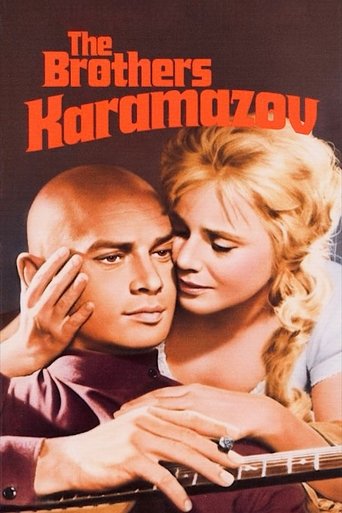
The Brothers Karamazov
1958 · Film · 145 min
Directed by Richard Brooks
Ryevsk, Russia, 1870. Tensions abound in the Karamazov family. Fyodor is a wealthy libertine who holds his purse strings tightly. His four grown sons include Dmitri, the eldest, an elegant officer, always broke and at odds with his father, betrothed to Katya, herself lovely and rich. The other brothers include a sterile aesthete, a factotum who is a bastard, and a monk. Family tensions erupt when Dmitri falls in love with one of his father's mistresses, the coquette Grushenka. Two brothers see Dmitri's jealousy of their father as an opportunity to inherit sooner. Acts of violence lead to the story's conclusion: trials of honor, conscience, forgiveness, and redemption.
1 positive1 negative1 neutralfrom 3 commenters
Where to watch
No streaming data for this title.
3 comments on Hacker News
You’re trying to create a sort of virtual reality, that’s why you need so much world-building. For example, the idea in ”Uncle Tom’s Cabin” is to get the reader to live the life of a slave. The best way to achieve that in writing is details, so the reader can make a picture in their heads. Some people are better than others in making these pictures. Movies are trying to achieve a similar effect, but it’s much easier there.
It is definitely about making an emotional connection. To persuade someone from that angle, think of it like this: a lot of people who were not abolitionists changed their minds after reading Uncle Tom’s Cabin. If it wasn’t for that book, we would not be living in our modern world.
You need to make someone feel the horrors of slavery in order to get them to want to do something about it. That the brain is able to actually be able to go into this alternate reality just with words on papers is actually pretty crazy but definitely valuable.
Plus, a book doesn’t have to just have a single point. Look at “Brothers Karamazov”. There also wouldn’t be a modern world if it wasn’t for that book.
That’s not something you can do with anything other than art. To change someone’s mind. To influence someone...You can’t do that sort of societal change with a list article or a summary or even an essay.
I don’t think it’s a frivolous thing. It’s actually the most valuable and important work you can do if you want to change the world for the better.
Crime and Punishment is a wonderful deep dive into the mind of a really messed up person. If you like the film Taxi Driver, it is sort of similar, but with a lot more direct philosophical underpinnings. Raskolnikov has a whole philosophical framework on why he's allowed to murder the pawn shop owner* and he spends time explaining and discussing it.
The motif of the nihilistic, disaffected young man is something Fyodor gets a lot of mileage out of, but he's the master of that genre. Notes From Underground is similar, but a lot shorter. It's one of the few Dostoevsky novels I haven't read, so I can't say much more than that. Its opening is his most famous line: "I am a sick man. I am a spiteful man. I am an unpleasant man. I think my liver is diseased."
To go against the grain of most recommendations, I'll say that "Notes from a Dead House" (the name differs depending on translation) is a good place to start too. It's essentially his prison memoirs, slightly fictionalized to avoid censors. There are a lot of little details that stood out and affected me deeply. e.g: He recalls a small dog that was often abused by the other prisoners, and was so timid that it would "sink to the ground on all fours and start trembling all over" when he petted it. The book has so many small, human details that really show the personal history that influenced his later books. He has an eye for those details that most people would gloss over.
The thing to keep in mind is that, across Dostoyevsky's novels, there are a lot of scenes where people stand around discussing philosophy. It's great and engaging if you're into it, but it will kill your enjoyment if it's not your thing. The Brothers Karamazov and Demons are books to avoid for your first attempt; they include a lot of that. Fyodor is really preachy in general, but this increases over time in his career, so his earlier books are more plot-focused. And he's all about symbolism, like the hypothetical author in the famous "curtains are blue" meme.
Finally, don't worry too much about translation. Pevear and Volokhonsky are always the most recommended, but that is more due to current trends in translation than their objective superiority. That's not to say they're bad, but any modern translation is going to be fine. Constance Garnett is the only one who's not so great, but I had a fine experience with her translation of C&P as my first Dostoyesvky novel, so it's hardly unreadable.
*not a spoiler, this happens in the opening
Fun trivia about Shatner (who at 79, has unquestionably still got it) that I just discovered on his wiki:
In 1958, he appeared in the film The Brothers Karamazov with Yul Brynner.