 Hacker Cinema
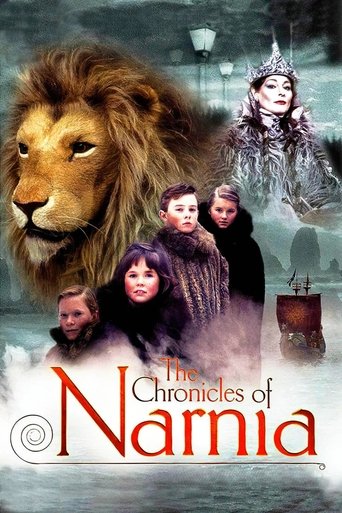
The Chronicles of Narnia
1988 · TV series · 30 min episodes · 3 seasons
Created by Alan Seymour, C. S. Lewis
DramaScience FictionFantasyActionAdventure
The Chronicles of Narnia is a British television miniseries adapting four of C.S. Lewis's books, blending live-action with animation for fantasy elements like Aslan and the creatures. The first series—The Lion, the Witch and the Wardrobe—aired from 13 November to 18 December 1988; the second—Prince Caspian and The Voyage of the Dawn Treader—aired from 19 November to 24 December 1989; and the third—The Silver Chair—from 18 November to 23 December 1990. Each series consists of six episodes each.
1 negative4 neutralfrom 5 commenters
Where to watch
No streaming data for this title.
5 comments on Hacker News
Family therapy > Summary of theories and techniques: https://en.wikipedia.org/wiki/Family_therapy#Summary_of_theories_and_techniques
Expressive therapies: https://en.wikipedia.org/wiki/Expressive_therapies
Systemic therapy: https://en.wikipedia.org/wiki/Systemic_therapy :
> Based largely on the work of anthropologists Gregory Bateson and Margaret Mead, this resulted in a shift towards what is known as "second-order cybernetics" which acknowledges the influence of the subjective observer in any study, essentially applying the principles of cybernetics to cybernetics – examining the examination.
"What are the treatment goals?"
Clean Language: https://en.wikipedia.org/wiki/Clean_language
...
In "Jack Ryan" (TV Series) Season 1 Episode 1, the children suffer from war trauma in their upbringing and that pervades their lives: https://en.wikipedia.org/wiki/Jack_Ryan_(TV_series)#Season_1_(2018)
In "Life is Beautiful" (1997) Italian children are trapped in war: https://en.wikipedia.org/wiki/Life_Is_Beautiful
Magneto from X-Men (with the helmet) > Fictional character biography > Early life: https://en.wikipedia.org/wiki/Magneto_(Marvel_Comics)#Early_life
"Chronicles of Narnia" (1939-1949) > Background and conception: https://en.wikipedia.org/wiki/The_Chronicles_of_Narnia#Background_and_conception
What was woke about the Chronicles of Narnia movies?
The books are famously super-Christian, and the movie adaptation was produced by Walden Media, owned by the ultraconservative Philip Anschutz.
"Woke" movies end up being greenlit like sequels are, on the basis of something about them not on their individual strengths. That's why spiritually correct movies (Lionsgate makes them too, it's not just Disney) and sequels are often worse than one-off productions that slip through the extremely challenging filtering process. If you combine ideology and sequels, you get some of these remakes. The only thing saving us from a live action remake of Chronicles of Narnia is that it was live action to begin with.
I've been lucky, starting young, early industry, eager to please, and willing to work on interesting over a better salary:
* I was a beta tester and original 3rd party developer for the Mac, in '83, a year before the Mac's release; (Everything was written in assembly at that point.)
* I worked for DeVanney & Mandelbrot on their original Fractal Mathematics publication, the work later became the book Beauty of Fractals.
* Back when the Mac was new and there were many DOS GUIs floating around, before Windows 3.1 became the standard, I wrote the "official" in-house DOS GUI for AT&T internal use. I wrote that in '88, and it was their in-house GUI for about 5 years.
* I co-wrote the video subsystems for both the 3D0 and the original PlayStation. That was a two very different adventures.
* I was on the first Tiger Woods PSX Golf game dev team, the one with the South Park animation (for reals accidentally) left on the published CD. I wrote the front-end using an opinionated framework I made, which went on to be used by several E.A. titles.
* I was director of research for the first Internet Live Video Infrastructure provider. Wrote code that got patented, stewarded the patent process, produced live shows. This was '99.
* Worked in VFX on some milestone films, such as Chronicles of Narnia, both as a digital artist and as a financial analyst. Two Oscars were won during my time at R&H. I was doing an MBA at the same time my later period there. I wrote a production resources forecasting system that would be called a deep learning trained algorithm today, but I wrote it in 2001. Used on 9 major release features.
* I created, patented, and went bankrupt trying to commercialize what are now called deep fakes. I was too early, with a working patented system in '08. Financial crisis plus no one believed the tech was possible at that time, and those that did wanted to do porn, which I & my team refused to produce. That was hard, 'cause it worked, but humans are like cats...
* After that I was principal engineer on a globally leading enterprise FR system. Did that for 7 years to dig out of bankruptcy. That was stressful and I quit 1.5 years ago.
Yeah, I'm both lucky and overly ambitious. I'm currently taking a boatload of DL/ML & Docker/K8 classes, preparing to make something that combines my history and skills.
The gulf between homage and derivative work is quite wide. Consider a few examples of famous derivative works: Baz Luhrmann's Romeo + Juliet, Alice in Wonderland, Apocalypse Now, Muppet Christmas Carol. Right now there are no less than 3 different ongoing adaptations of Sherlock Holmes (the movie series, the BBC series, and CBS's Elementary series).
These are works that would be patently illegal if the source material were not in the public domain. This isn't just about "remix culture", it's about being able to adapt and interpret what's out there, fully and without restriction. Clearly there is value to allowing such artistic freedom once a work has grown sufficiently old. However, today that age has grown quite impractically long. A movie such as War of the Worlds (a 110+ year old book) can be made without seeking a licensing agreement, but movies such as The Hobbit (a 75 year old book), King Kong (79 years), The Chronicles of Narnia (62 years), Casino Royale (59 years), or The Dark Knight Rises (73 years) still require licensing.
And the sad part is that even in the next 20 years when, say, the Superman IP will be pushing 100 years old and Mickey Mouse even older it seems likely that such things will still require licensing.
The fact that the current IP laws have not utterly destroyed creativity or the productivity of creative industries is not a ringing endorsement. The fact is that they are stifling and they have been responsible for creating an industry which is too heavily controlled by a small group.