 Hacker Cinema
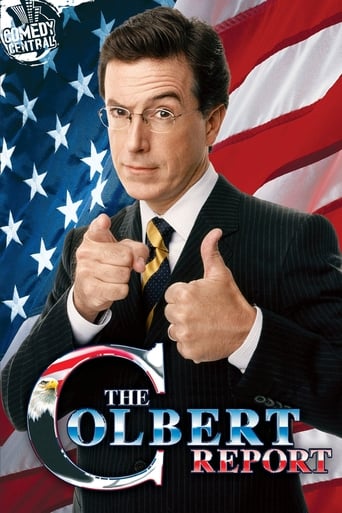
The Colbert Report
2005 · TV series · 24 min episodes · 11 seasons
Created by Stephen Colbert, Jon Stewart, Ben Karlin
The Colbert Report is an American satirical late night television program. It stars political humorist Stephen Colbert, a former correspondent for The Daily Show with Jon Stewart. The Colbert Report is a spin-off from and counterpart to The Daily Show that comments on politics and the media in a similar way. The show focuses on a fictional anchorman character named Stephen Colbert, played by his real-life namesake. The character, described by Colbert as a "well-intentioned, poorly informed, high-status idiot", is a caricature of televised political pundits.
8 positive1 negative1 mixed13 neutralfrom 23 commenters
Where to watch
No streaming data for this title.
26 comments on Hacker News
> Stephen Colbert made the joke "Reality has a well known liberal bias"
Video (queued up): https://youtu.be/IJ-a2KeyCAY?t=270
It's always pretty depressing to go back and watch this or old Colbert Report episodes and realize how parts are incredibly "evergreen", sometimes you don't even need to change out the names.
> Colbert highlighted [truthiness] on the very first episode of his Colbert Report, a spinoff of The Daily Show which featured him as a blown-up parody of TV pundits like original Fox News Channel star Bill O'Reilly — championing the idea of believing something because it feels true, regardless of the facts. "I don't trust books," he says in a segment from that first show. "They're all facts and no heart."
> ...
> "Stephen Colbert has shown, more so than anyone else of this modern era of late night, the power of sticking to the truth," says Roy Wood Jr., a former correspondent on The Daily Show and host of CNN's satire program, Have I Got News for You.
The problem is there isn't just one "truth" (at least in politics and many other things). Liberals like to believe that "truthiness" is just the other guys' problem, which is a pretty "truthy" belief itself.
One of the most dangerous and foolish beliefs is the one where you you believe your side has access to the truth and the other side is all lies.
> And while some critics have theorized that part of the slide in ratings among network TV late night shows might be attributed to the hosts' increasingly intense political stands, Carter disagrees. He says modern media consumers often operate in an information silo where online algorithms push content at them, which reinforces what they already believe – making it tough for anyone to craft comedy which speaks across a wide swath of consumers.
Colbert played a significant role in creating and maintaining those silos. He definitely wasn't an antidote in any sense. I watched him for several years, but eventually got tried of his show because I realized it wasn't really that funny, it was more a setup to get viewers to think "I too do not like that man, we are right and superior to those who disagree."
It’s not even about “offensive” or “cancelled.” It’s about the pure economics of in-theater movies.
The whole business model of comedy movies released to theaters was that they had mediocre theater box office numbers but the theater release would drive a crazy home rental business for years after the movie came out.
That entire business model doesn’t work anymore. After a comedy movie leaves the theater it’s basically worthless and does nothing to drive streaming subscriptions.
Examples like Rogan, South Park, Chappelle, do not apply here.
Rogan’s podcast is not a comedy. And he’s a terrible standup comic.
Chappelle’s comedy specials only require a stage and a microphone to produce. There is no budget besides paying Chappelle.
Eminem is a musician. And, he’s not actually offensive to the general public, especially not anymore.
South Park is a TV show. Trey Parker and Matt Stone haven’t made any movies since the DVD rental era that I talked about. It’s also very inexpensive to produce compared to a comedy movie.
Finally, the elephant in the room. You should really get out of your conservative reality distortion field. This whole idea that Disney’s their wokeness is ruining everything is utter bullshit. My man, they own 20th Century Studios, 20th Century TV, and ABC Studios. They are the majority owner of Hulu. Disney isn’t just “woke politically correct family movies” or whatever conservative weirdos think they are. They are a giant media conglomerate. They finance shows like The Great, full of swearing, violence, and nudity. [1]
Let’s also not forget that Disney is still a box office machine and knows exactly what they are doing.
The top grossing movies in the United States in 2024, 2021, and 2015-2019 were all Disney.
In 2022 Avatar 2 beats out Top Gun Maverick in the worldwide box office.
This idea that Disney has lost its way and doesn’t understand the movie business is baloney. Disney’s stock didn’t tank because of “cancel culture” or “wokeness,” it tanked because half of the company’s revenue is theme parks and Covid-19 wrecked their business. Its movie business is also heavily skewed to in-theater big blockbusters. Seriously, look up the stock, all the downturn happened in 2020-2022. Disney stock is up 5% this year.
Disney struggles with streaming for the same reason the other networks struggle with it: streaming replaced cable but nothing replaced DVD sales and rentals.
[1] I have also noticed that conservative weirdos always bring up South Park, Rogan, Chappelle, and Eminem specifically as great examples of anti-cancel crusaders. The funniest part about that to me is that conservatives are so behind the times that they don’t realize that Eminem isn’t “slim shady” anymore and isn’t offensive to the general public. Somehow Rogan is supposed to be proof that a show that elevates conservative voices can break through an anti-conservative system, when really all he proves is that conservative talk radio is as good a business as it ever was. He is effectively now no different than Rush Limbaugh, except with a format where he has guests on the show. And then there’s South Park which is basically coasting on a fan base just like The Simpsons.
Finally, Chappelle. Let’s be real be real here: a good portion of Chappelle’s white male audience enjoyed the original show because they took his show to be jokes about Black people, at the expense of Black people. Just like the people who didn’t realize that Colbert on The Colbert Report was satire, they didn’t really see any of the satire or social commentary. So it’s not surprising to me that those same mostly conservative white men enjoy watching an hour of trans hate jokes.
My original youtube channel was basically just funneling split up episodes of Daily show & Colbert Report directly onto it. Would get about 100,000 views a day until they started cutting down.
third paragraph of the linked article
> Unfortunately for those in search of older episodes of The Daily Show and The Colbert Report, neither can be found on Paramount+.
third paragraph of the article
> Unfortunately for those in search of older episodes of The Daily Show and The Colbert Report, neither can be found on Paramount+.
Partially
>Unfortunately for those in search of older episodes of The Daily Show and The Colbert Report, neither can be found on Paramount+.
And you're missing
>Unfortunately for those in search of older episodes of The Daily Show and The Colbert Report, neither can be found on Paramount+.
I imagine that finding copies of much of that will be difficult. I know someone who took to the high seas for episodes of the Colbert Report, but how many people are still seeding full seasons of that, let alone shows like Lights Out which were nowhere near as popular.
Not according to the article: "Unfortunately for those in search of older episodes of The Daily Show and The Colbert Report, neither can be found on Paramount+."
It's a real shame too because I might actually be tempted to at least burn a free trial of that service if they had The Colbert Report
> At one point Amtrak had a photo contest to take photos of their trains and submit them, and a guy was arrested by Amtrack police for doing just that.
And Stephen Colbert did a great comedy episode about this exact problem. https://www.cc.com/video/9kc6le/the-colbert-report-nailed-em-amtrak-photographer , https://www.nytimes.com/2010/07/28/nyregion/28about.html
It was from a skit on the Colbert Report (can't remember the episode). He talks about how NASA added a leap second and then pulled out this comical "second-by-second" year planner and said his plans are ruined because he doesn't know what to do with the extra second. Wish I could remember it.
It's Malcom Gladwell so take it with a grain of salt, but his episode on The Satire Paradox was great:
https://www.pushkin.fm/podcasts/revisionist-history/the-satire-paradox
The premise is that despite Satire being an attempt at speaking truth to power, the people who are targets of satire will often think to themselves "I get that it's satire, but don't they make good points".
I don't know that I've actually seen this in real life, but he mentioned lots of conservatives liked the Colbert Report because despite knowing it was making fun of them, they agreed with the messages. I've seen this with myself in Portlandia. I live in Portland, and while I'm not a stereotype of a hipster, I moved to Portland for the "reasons people move to Portland" and I often find Portlandia sketches manage to capture the essence of the very things they're trying to make fun of.
Ultimately I don't think people taking the bee seriously is a bug, it's a feature.
Reasons (TV/Movie) piracy is better than any paid service:
* All in one place/App/UI. Be it Plex/Jellyfin/Emby/Kodi/etc, you only have 1 app UI/UX to deal with. No more wondering "What network was that on?", "Wait, it's on 2 services but which one has my watched status?", "What does clicking forward/back do in this App?", "How do I turn on subtitles?", etc
* Local playback. You never have to wait on your internet or deal with lower quality if something goes amiss.
* More features. Ability to download a show/movie to your iPad for travel (Yes, this has improved on the streaming platforms but is not always easy or ubiquitous)
* Access forever. If you hoard at least. You cannot find certain shows online anymore. The Daily Show or The Colbert Report are good examples. I know some people might find watching old episodes of daily news shows to be odd but I find them interesting and still humorous. All you can find is scattered clips online. Also shows that were never super popular can be impossible to find on streaming and often impossible to buy.
* No Ads. Zero. Zilch. Nada.
* Tech/Job improvement Aspect. This is less about piracy directly and the skills you are forced to learn to maintain an *arr+plex+UnRaid/FreeNAS/Debian/etc box.
You are correct that the cost is not cheap, I've probably sunk $5K+ into my servers but I find the process to be both informative and enjoyable.
Lastly, I would happily pay $100-150+ a month for a service that gave me all of the above (aside from server management experience). 1 App, offline/local caching, no ads, all content. But it will never happen. Netflix gave us some golden years where they had almost everything someone would want but then the content providers started to pull back their content to their own "platforms" and now it's a mess. Even things like Amazon Channels, Apple TV (no, not the device, no, not the service, the app :rolleyes:), or now even Plex (with their newest release) that attempt to serve as directory that can either play the content directly or bounce you directly into the app to play are a far cry from what you get from an only-Plex (or insert other media server) setup.
You're comparing satire to light entertainment. The "Colbert Report" was satire (on cable!), and Colbert's current show is a light entertainment talk show (on a network!). They have different forms, different audiences, and incommensurate goals.
As in South Park, satire even today seems to grant a license to the performer that isn't there in light entertainment.
Here's an example: there's a trope that Colbert, Bill Maher, SNL Weekend Update, and many others use that goes like this:
1. Unstated premise: Anti-$foo politician exists.
2. Premise of joke mentions something that is related to deplorable anti-$foo sentiment
3. Punchline is the comedian attributing an anachronistic anti-$foo street joke to said politician
The only person I ever heard complain about this trope was Norm MacDonald wrt anti-gay conservative pundits who had been outed as gay. (Though it's Norm, so I'm not sure if he was just trying to a get a rise out of a guest or really thought there was some bona fide double-standard going on here.) To be fair the comedian is in a way "laundering" the humor from the old street joke, but most people seem to understand the upshot as showing the object of ire as being out of touch/ignorant/etc.
The humor on the "Colbert Report" was similar, but more intense-- Colbert was publicly playing a homophobic/racist/narcissistic ignoramus built in the mold of a Bill O'Reilly. For years.
In the clip you linked, I'm guessing his character was a) reflexively lumping in the word "hispanic" with the topic of illegal immigration, and b) using that connection as a fear-mongering tactic to persuade his audience to be suspicious of hispanics even in the conceptual domain of a fucking calendar.
Colbert of the Colbert Report usually got away with that-- if a viewer from his audience switched to his show in the middle of it and saw him wearing that hacky getup, they'd likely assume it was satire, suspend disbelief, and look for the upshot of the joke.
But even given that, it didn't always work. Colbert did indeed get flak on "Colbert Report" for taking this approach with a recurring bit about Asians. The bit was built on a long-standing satire trope where a comedian/writer pretends to fix a racist logo, slogan, book, or even a slur itself by shifting it from that target group to an Asian ethnicity. The undertone would be that it's somehow less dangerous or problematic, with an implication that the Asian ethnicity in question is less likely to complain or fight back. You can see Sarah Silverman telling such a joke on an old episode of Conan (for which she was called out), so the trope has been around since at least the 90s. Turns out that people tend to look down on satire which tries to call out prejudice by unwittingly relying on other prejudice.
Regardless of whether you agree with the calling out of those particular bits, the following are true:
1. Sarah Silverman was called out for her satire on a light entertainment show in the 90s
2. Colbert was called out for his satire, even on a satire in the 2000s
3. Colbert of today runs a light entertainment show where the satire of #2 is much less prevalent, which likely explains why he doesn't do bits anything like what he did in the "Colbert Report"
In conclusion, on this particular topic: times have not changed.
Thank you for your time.
You both raise some good points, but in your case you may at least understand what Hitler was trying to communicate when you decide not to adopt his view.
To answer your question, a bad situation in my mind would be something like this example: a few years ago a relatively bright friend who had worked for a famous national politician got into a disagreement with me when I referred to The Colbert Report as satire. He did not think there was satire or that Colbert was putting on another character for the show at all. I was a big fan of the show, but it was alarming to me how many people might not understand subtlety like satire in novels and movies.
Maybe there was never a golden area when everybody got it. In Voltaire's day, did the majority of the populace comprehend his meaning? Were the majority even aware of his messages?
I have always loved reading novels from an early age, and find them superior in understanding other people's ways of thinking. As advanced and educated as many people enjoy being in the 21st century, I fear too many might still not bother to dig deeper into the intentions of a writer to truly understand what they were hinting at. It's an excellent skill applicable to other areas in life, and with controversial topics it can really help to bridge the gap in a polarized debate. Hitler is an extreme, and I personally don't believe all writing is fundamentally good and edifying to your soul, but I do think effort should be made to understand an author, especially when the writing clashes with contemporary norms. You can still discard it after carefully weighing it, but if you discard it without giving credit to what the author was trying to say because you don't even understand it, that's a loss.
These zealous critics could apply their same logic to cancel my beloved Huckleberry Finn, a book that shed light on injustice more effectively than most even though the author did not come from the same ethnic background as Jim.
I'll agree with the working out regularly being good for your health, both mental and physical. Exercising has gotten me through some tough spots in my life and it has always been a major coping mechanism.
Another thing that has always worked for me has been laughter. Whether it's watching a classic movie like Dumb & Dumber, reading reddit/r/funny, or catching The Colbert Report, laughing eases all the little things that otherwise might eat you up.
"Piracy has put the impetus on media companies to more quickly strike deals to make television and movies available on the Web legitimately. In 2007, Erik Flannigan, now the executive vice president of digital media at Viacom Entertainment Group, pulled up the Google search page on a giant screen at Viacom’s Times Square headquarters. He typed in “South Park” and took senior executives on a tour of Web sites offering pirated episodes.
Today, Comedy Central makes every episode of “South Park,” “The Daily Show” and “The Colbert Report” available free online. The efforts, Mr. Flannigan said, put a big dent in piracy. As for the television industry as a whole, Mr. Flannigan said: “You might not like the windows, or that shows go up and come down, but it’s a far cry from where we were.”
Still, Comedy Central shows do not make billions in syndication or in DVD sales like some TV series. The industry has been reluctant to make available shows like CBS’s “The Big Bang Theory,” which sold for $2 million an episode to Time Warner’s TBS and Fox. That makes piracy a tempting option.
“If they don’t make content available where consumers are, they’re just shooting themselves in the foot,” said Ron Conway, a Silicon Valley investor and the head of the SV Angel investment fund."
CBS' concerns stem from the fact that if the web delegitimizes a television channel's status as the go-to source for viewers, then the whole process of the concentrated industry's livelihood, one which they have established as essential to stay afloat, let alone profit, is irreparably diminished.
If advertisers do not think the money they paid in the past is what they need to pay TBS now, given other advert opportunities, they will to want pay less for commercials, which support TBS' model, and would bungle up their plans. (TV Industry would go off of Nielsen ratings, which were strong estimated guesses of # of ppl/demos tuning into particular programming; this information provided Advertisers an idea of where they should their energies and money, for maximum appeal.)
TBS will want to pay less because they won't rake in as much from commercials, pissing CBS off since they rely upon $2 mil/episode syndication deals of their most popular properties to subsist and survive.
And CBS won't want to spend as much on their properties (production budgets, salaries, etc) because they will be uncertain if it will even pay off. We are past the days of Must-See TV Thursday and 30 Million Viewers for 30 mins of Friends. Sorry Burbank, they are not coming back. ---- At least Comedy Central recognizes their new competition in distribution and knew to bite the proverbial bullet and stream for free what is going to be out there for free, no matter what. Because of that, they build up brand loyalty (less and less of an influence on TV, more and more of one online) and can make money advertising -- centralizing properties, distributing, and payoff -- within the company. Establish an optional low-cost subscription fee for complete access to their library, and enough people will pay for it to justify its creation, too!
I am 21 years old, and hardly anyone my age watches TV. They WILL subscribe to Hulu, and they WILL subscribe to Netflix -- but look at the volume of content, and the amount of control the viewer has with those services! The television is a box of content that asks for passivity from the viewer, especially in choice availability. That does NOT work in The Game anymore.
Those that look to "Remember When" and long for systems of the past are individuals who are losing to progress, because they did not -- or COULD not, in much of Hollywood's case -- look past their at-present business models for more innovative means necessary for industry survival.
Now is the opportunity for independents all over to seize the unprecedented access to the consumer they now have and make a living doing it.
People do not care if Paramount Pictures made a movie or Uncle Regis' buddy two towns over did -- they just need it offered to them, they want it when they want it, and above all, they want it to be worth their time. Anybody can do that, and anybody can make money off of that.
--stepping off the soapbox--
The Daily Show and the Colbert Report somehow manage to get all my friends to watch every single night, commercials and all.
That's because they type www.thedailyshow.com and then they can instantly watch the entire week of episodes for free, with Comedy-Central's advertising revenue still intact. The way forward seems pretty clear to me.
The Colbert Report (via colbertnation.com) had/has something like this. It prompted me to try it when I was watching an episode, basically you wait for a room to fill up with people, then it plays to all of you while you chat. Obviously you can't pause, which bothered me as I am usually doing two things at once while watching something online
It was The Daily Show and The Colbert Report On Ice; a traveling live version of the television show.
I guess I'd rate making interesting videogames at considerably more worthwhile than many of the startup ideas we see around here. I mean, ultimately most web 2.0 sites are kind of a waste of time, except for the potential to get rich off them. If anything, social media is a bigger unproductive time-sink than videogames or TV are these days.
I do agree that building just another clone of an existing game (say, a new FPS with no real innovation) is a bit of a waste of time though, just like building a Twitter clone or reddit clone or something would be. But that's true in all media: most Hollywood films are derivative crap good for nothing but mindless entertainment, but that doesn't mean the entire idea of making a film is pointless.
Of course, others have talked about this at greater length: http://www.colbertnation.com/the-colbert-report-videos/91012/august-07-2007/ian-bogost
Colbert Report June 15th episode (includes interview with Rushkoff):
http://www.hulu.com/watch/83170/the-colbert-report-wed-jul-15-2009
People like to claim that TV is only full of crap. This is grade A, Microsoft-FUD-level, Bullshit.
Like anything, sure, most of it is crap. Just like if you went to a bookstore and picked up 10 random fantasy novels. You might conclude that they're all just cookie cutter pablum - most are - but then you miss out on George R. R. Martin's Song of Fire and Ice, Guy Gavriel Kay's Tigana, LeGuin's Earthsea, and other truly excellent works of fiction.
But like anything, it takes some investment to tell the good from the bad. If you just watch Jon & Kate Plus 8, Entertainment Tonight, and According to Jim, yeah, you're better off without the TV altogether. But I claim that there's more good TV being made now than at any time in history, particularly for niche markets.
Here's some of my recommendations: Mythbusters, Penn & Teller's Bullshit, Supernatural, Dollhouse, The Office, 30 Rock, Lost, The Simpsons (not as great as it was, but still fun), The Daily Show/Colbert Report, Mad Men... and more, there's just a ton of really high quality work being done.
If your argument is that instead, you watch things online/through netflix, that makes sense. If I didn't enjoy live sports sometimes, I'd consider doing the same.
Not everyone has to have a hobby of watching television, or movies, or reading for that matter, but the opinion that it's all crap is extremely ill-informed and snobbish, and I strongly encourage it to be dropped as something that makes you sound actively stupid when you say it. It's an anti-pattern.
The Colbert Report is a satirical tv show poking fun at conservative US TV pundits. http://en.wikipedia.org/wiki/The_Colbert_Report
I'm that guy too. I hate TV.
Except heroes and house. Ohhh. The daily show. Colbert Report. Gotta catch south park and sarah silverman. Six feet under was pretty good, too...
Other then that TV sucks. I watch TV shows, but have no TV. The trick is to download your tv from the internet so you can dodge the ads concentrated power scientifically calibrate to manipulate you, and still get a dose of culture and electronic sedation.